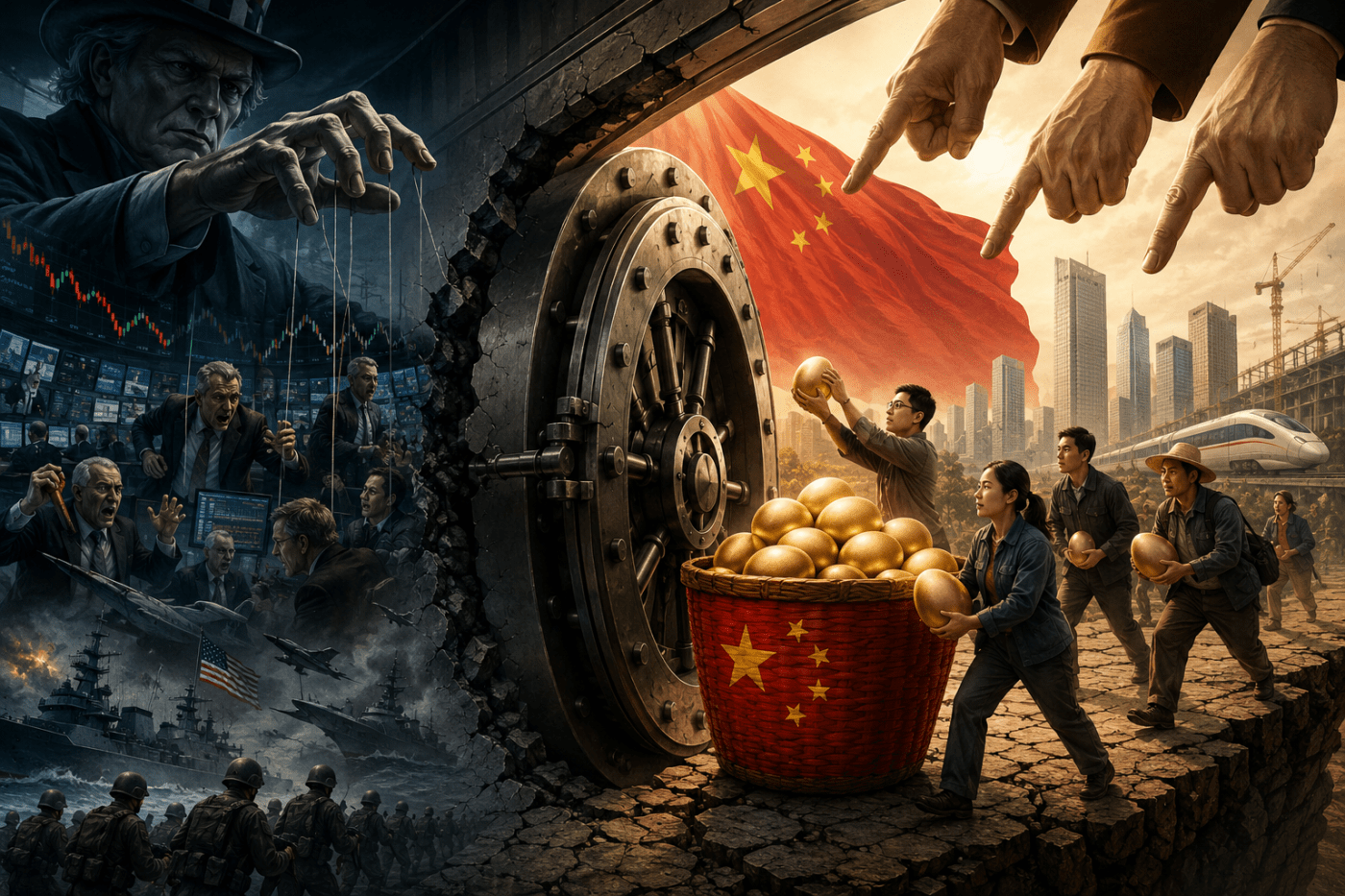
The New York Times turns Chinese financial regulation into a morality tale about trapped money and wounded investors. The facts show a state trying to discipline capital flight while managing household savings, property stress, industrial renewal, and U.S. technological containment. The real story is a struggle over whether China’s accumulated social wealth will serve national development or flow into the circuits of imperial finance. The task now is to reject anti-China propaganda, oppose the New Cold War, and defend the right of nations to control their own development.
Prince Kapone | Weaponized Information | June 19, 2026
Wall Street Discovers That China Has a Door
The New York Times article under excavation, “Beijing’s New Message to Its Citizens: Your Money Belongs at Home”, by Li Yuan, published June 16, 2026, presents China’s tightening of overseas investment channels as another gloomy chapter in the familiar liberal novel of Chinese authoritarian suffocation. The article reports that Beijing has moved against informal pathways used by Chinese citizens to invest in overseas securities, especially U.S. stocks, by pressuring Hong Kong and Singapore-based brokerages, tightening account requirements, expanding outbound investment rules, and treating certain overseas gains as illegal. On the surface, it is a business story about capital controls, retail investors, brokerages, bank deposits, low returns, and the frustrations of China’s urban middle class. But underneath that surface, the article performs a much older ideological labor. It teaches the reader to identify freedom with the unrestricted motion of private money.
The New York Times does not arrive here as a neutral village notice board, humbly informing humanity that one more regulation has appeared in Beijing. It arrives as one of the central organs of U.S. liberal imperial common sense, a corporate media institution whose authority rests on subscription wealth, advertising prestige, elite access, and its long-standing position inside the opinion-making machinery of the American ruling class. Its China coverage often speaks in the polished dialect of Wall Street anxiety and State Department morality. It does not need to shout. The bourgeois paper of record rarely does. It simply arranges the furniture of the story so that the U.S. financial order appears as the natural habitat of modern freedom, while any socialist or sovereign attempt to regulate capital appears as a prison wall built around the human soul.
Li Yuan’s professional location matters here, not because biography determines truth in some crude and mechanical way, but because social position helps explain the line of sight. Yuan writes from the perch of a China business columnist concerned with entrepreneurs, investors, consumers, technology workers, markets, and the anxieties of the urban middle class. That is a real social layer. Its frustrations are not invented. But the article lets that layer stand in for “Chinese citizens” as such, as though the great question of China’s future is whether a technology worker can move household savings into an American brokerage account without Beijing asking too many irritating questions. The Chinese worker building the robot component, the peasant whose village is tied to infrastructure investment, the state planner tasked with preventing speculative collapse, and the millions whose lives depend on disciplined national development do not occupy the moral center of this story. The investor does. The portfolio has become the protagonist.
The first device at work is narrative framing. China is introduced through “walls”: the Great Firewall, passport controls, exit bans, and now financial barriers. Before the reader reaches the economic question, the emotional architecture has already been built. China is a sealed room, and the investor is looking for a window. This is clever propaganda because it does not begin by arguing that capital mobility is freedom. It assumes it. From there, the story practically writes itself. If money wants to leave China, then money must be expressing the authentic desire of the people. If the state restricts that motion, then the state must be violating the people. What disappears is the elementary Marxist fact that money is not a little bird of liberty fluttering above society. Money is social power condensed into private form, and when it moves, whole classes move with it.
The second device is appeal to emotion. The article gives us the trembling question of an investor: “Is my money still mine?” It is a useful line, almost too perfect, a little porcelain figurine of bourgeois suffering placed carefully on the mantelpiece. The reader is invited to feel the injury of the property-holder confronting the state. But the question itself is loaded. Under capitalism, the wealthy always ask whether their money is still theirs when society dares to make a claim upon it. The landlord asks this when rent controls appear. The banker asks this when debt relief is proposed. The shareholder asks this when wages rise. Here the same drama is relocated to China and dressed in the language of human rights. The money wants to go to the United States. The state says no. The Times sighs as though Prometheus has been chained to a brokerage app.
The third device is omission. The article speaks at length about Chinese citizens seeking better returns in U.S. markets, but it gives little space to the world system in which those markets sit. The United States appears as an investment destination, not as the imperial center of sanctions, export controls, military encirclement, technological sabotage, currency privilege, and financial coercion. The dollar system is treated as a neutral opportunity rather than a weaponized architecture. Wall Street becomes a nice meadow where Chinese households might graze their savings if only Beijing would stop being so jealous. This is omission not as accident, but as method. Remove imperialism from the scene, and sovereign capital regulation looks like paranoia. Put imperialism back into the scene, and the same regulation begins to look like a defensive act by a country that has read the enemy’s manual.
The fourth device is source hierarchy. The article’s moral authority is built through private investors, technology workers, brokerages, Western consulting estimates, and market-facing commentators. These are not useless sources, but they are class-specific sources. They tell the story from the angle of those who want access to global capital markets, not from those responsible for preventing capital flight, defending industrial policy, managing debt, stabilizing development, or protecting national sovereignty under hostile pressure. The state appears mostly as a blocking force. The market appears as the sphere of desire. The people appear most vividly when they are investors. In this arrangement, the working class is not refuted. It is simply not invited into the room.
The fifth device is card stacking. The article piles up low Chinese deposit rates, the collapse of the housing market, distrust of domestic A-shares, the rise of U.S. stocks, and the sophistication of investors seeking overseas hedges. Each fact may be individually reportable. The propaganda lies in the arrangement. The reader is led toward a single conclusion: of course rational people want out, and of course Beijing is trapping them in. What is not stacked beside these facts is the counter-question: what happens to a country’s development strategy when private wealth, accumulated under national conditions and social infrastructure, is permitted to flee into the financial circuits of its main geopolitical adversary? The article does not ask this because the answer would disturb the liberal piety that capital’s exit is always innocent.
The sixth device is loaded language, subtle enough to wear a necktie. Beijing “cracks down.” Investors “slip under the wire.” The government “pulls levers.” Financial rules become “walls.” Citizens are “redirected back home.” These phrases are not neutral. They place the Chinese state in the role of jailer and the investor in the role of fugitive. The comedy, of course, is that the fugitive is not fleeing hunger, bombs, eviction, or a sweatshop floor. The fugitive is fleeing a one percent deposit rate in search of U.S. equity returns. There is the small tragedy of the bourgeois age: when capital cannot freely migrate toward higher yields, the newspaper calls it captivity.
The Times article does not simply report a Chinese financial restriction. It converts the class interest of mobile private wealth into the language of citizenship, turns the U.S. financial system into the horizon of freedom, and presents Chinese sovereignty as suspicion, control, and enclosure. It is a familiar trick. The empire calls its own walls markets, its own controls rules-based order, its own coercion stability, and its own appetite liberty. But when a socialist-led state puts a lock on the door to keep national wealth from draining into Wall Street, suddenly the guardians of capital discover the poetry of freedom.
The Money Question Was Never Just About Money
The article’s basic factual terrain is clear enough once the fog machine is turned down. Beijing has not abolished overseas investment. The State Council’s new outbound investment regulation says China will still support investors carrying out overseas investment according to market principles, while also requiring that such activity obey Chinese law, social responsibility obligations, national image concerns, and regulatory procedures. In other words, the state is not saying that every yuan must sit obediently in a bank account like a schoolchild with folded hands. It is saying that capital leaving the country must leave through a gate, not through a hole in the fence. Even the official formulation preserves the investor’s legal right to independent decision-making, but it places that right inside a regulated national framework rather than above society like a little golden god.
The immediate target is the gray zone around mainland individual access to offshore securities. Chinese citizens already operate under a foreign-exchange system in which household currency conversion is regulated, and the State Administration of Foreign Exchange has repeatedly emphasized the need to coordinate foreign-exchange management with financial stability, reform, and risk prevention. The New York Times story focuses on the frustrations of mainland investors who used Hong Kong, Singapore, brokerages, and social-media tutorials to reach U.S. equities. That frustration is real. But it sits inside a structure that China has never pretended was a fully liberalized capital account. The question is not whether rules suddenly appeared from the sky. The question is why informal channels tolerated in one period are being tightened in another.
The answer begins with the official direction of Chinese financial policy. At the Central Financial Work Conference, China’s leadership defined finance as the “blood” of the national economy and stressed that the financial sector must serve the real economy, strengthen financial supervision, prevent and defuse risks, and support high-quality development. That is not decorative language. It is the governing line behind the present conflict. Finance is not being treated as a casino for every sufficiently clever individual with a brokerage app and a VPN-adjacent workaround. It is being treated as a strategic system tied to industry, employment, technology, public finance, debt management, and national security.
The domestic pressure is also concrete. China’s Ministry of Finance reported that in 2025 the state issued 1.3 trillion yuan in ultra-long special treasury bonds, 500 billion yuan in special treasury bonds for capital injection into central financial institutions, and 4.4 trillion yuan in local government special-purpose bonds. Those figures are not abstractions. They describe a state trying to finance major national strategies, stabilize banks, support local governments, sustain investment, and move the economy through a difficult restructuring. The same budget report states that 800 billion yuan of ultra-long special treasury bonds supported major national strategies and security capacity-building in key areas, while 500 billion yuan supported equipment upgrades and consumer goods trade-in programs. A country trying to mobilize capital for industrial renewal will not look kindly on private wealth quietly leaking into Wall Street because the S&P looks more appetizing than a domestic deposit account.
The household side matters too. China’s National Bureau of Statistics reported that by the end of 2025, domestic household deposits in RMB reached 165.8935 trillion yuan, up 9.7 percent from the previous year. This is the mountain of savings behind the whole dispute. The New York Times treats that money mainly as frustrated private wealth looking for higher returns. Chinese planners see something else as well: a vast pool of domestic savings that can either stabilize development at home or be drawn outward into foreign markets, foreign currencies, foreign assets, and foreign political leverage. The article notices the saver. It does not sufficiently notice the social consequences of the savings pool itself.
The property crisis is the bridge between those two realities. For years, Chinese households relied on real estate as the core family asset. Since 2021, China’s housing prices have been falling after a long rise in major-city property values, and the weakening of that old household wealth machine has pushed many families toward caution, bank deposits, and alternative investment routes. This is not merely a mood. It is a reallocation problem created by the exhaustion of a property-centered growth model. When housing no longer performs the old miracle, money goes looking for another altar. The Times finds the altar in U.S. stocks. Beijing finds a policy problem.
At the same time, China is not closing itself off from global finance in any simple sense. At the 2026 Lujiazui Forum, Chinese regulators announced measures to promote offshore yuan business in Shanghai, create a yuan liquidity tool for foreign monetary authorities, and issue fresh quotas under the QDII outbound investment scheme. That matters because it shows the actual line: not no outward finance, but regulated outward finance; not no internationalization, but yuan-centered internationalization; not every back door into U.S. equities, but state-supervised channels that fit the larger architecture of financial stability. The same report notes that Chinese regulators are trying to guide resources toward emerging industries while managing risks from real estate, local government debt, and small financial institutions. This is a managed transition, not a tantrum.
The omitted international terrain is just as important. The United States does not encounter China as a friendly neutral market. Washington has built an outbound-investment security program that restricts U.S. persons from making certain investments in Chinese entities tied to semiconductors, microelectronics, quantum information technologies, and artificial intelligence. The U.S. Commerce Department has also strengthened export controls to restrict China’s capacity to produce advanced semiconductors and related technologies. This is the background the article leaves mostly offstage. China is managing capital under conditions where its principal rival is trying to block its technological ascent, police investment flows, and use the commanding heights of the dollar-centered system as a weapon.
That is why the story cannot be reduced to the hurt feelings of investors locked out of U.S. stocks. China is dealing with a domestic property correction, huge household deposits, local debt restructuring, fiscal stimulus, industrial upgrading, financial-risk prevention, yuan internationalization, and U.S.-led technology containment all at once. The article reports the tightening of offshore channels, but it narrows the frame until the reader sees mainly a middle-class investor peering longingly across the Pacific. The fuller terrain shows a state trying to prevent household savings from becoming fuel for external dependency at the exact moment it is attempting to reorganize finance around domestic development, technological capacity, and systemic stability.
Capital Wanted a Passport, China Asked for Its Papers
Now the fog clears. This is not a story about Beijing suddenly deciding that Chinese citizens should suffer because one more bureaucrat woke up allergic to freedom. It is a story about a socialist-led state confronting the old problem of money under conditions of siege, transition, and imperial temptation. Capital always wants a passport. It wants to stroll across borders with no history, no obligation, no class character, and no memory of the roads, schools, ports, factories, workers, banks, subsidies, public institutions, and social order that made its accumulation possible in the first place. It wants to be born in China, fed by China, protected by China, enriched by China, and then retire comfortably in the warm lap of Wall Street like a landlord discovering patriotism only when the rent is due.
The New York Times looks at this contradiction and sees only an investor denied convenience. China looks at the same contradiction and sees a national development problem. That difference is the whole battlefield. In the liberal imagination, money belongs to the individual in the purest possible sense. It is private property, therefore private destiny. It should move where it pleases, yield where it can, and obey no discipline higher than return. But in a country attempting socialist modernization through the controlled use of markets, money cannot be treated as a wandering aristocrat with diplomatic immunity. It is social labor in monetary form. It carries within it the sweat of workers, the scaffolding of public investment, the patience of families, the infrastructure of the state, and the accumulated sacrifices of a society that chose development over dependency.
This is why the article’s moral drama is so narrow. It asks whether the investor’s money is still his. It does not ask whether a country has the right to defend the collective wealth produced inside its borders. It does not ask whether the savings of households, gathered under Chinese conditions and stabilized by Chinese institutions, should be allowed to drain into the financial circuits of the very imperial system trying to contain China’s rise. It does not ask whether capital flight is a private lifestyle choice or a political-economic weapon. The bourgeois press has a magnificent talent for turning class power into personal anxiety. The investor feels trapped. The broker feels frustrated. The U.S. market feels distant. So the newspaper declares a tragedy.
But the real tragedy would be something else. The real tragedy would be a nation carrying the burdens of housing correction, local debt, industrial restructuring, technological blockade, and geopolitical pressure while permitting its accumulated savings to escape through every informal channel dug by private wealth. That would not be freedom. That would be disarmament. A country under pressure cannot treat its capital account like an unlocked liquor cabinet in a house full of thieves. It must ask where the money is going, what purpose it serves, whose power it strengthens, and what social obligations it abandons on the way out.
This is the contradiction of socialist construction in the age of imperial finance. China has used markets without surrendering the commanding heights of development to market anarchy. That produces tensions, and we should not pretend otherwise. Market mechanisms create strata with market desires. They produce investors, speculators, property holders, entrepreneurs, and professional classes who begin to imagine themselves as citizens of yield before they are citizens of the republic. They accept the state when it builds the infrastructure, disciplines chaos, stabilizes growth, and creates the conditions for accumulation. But when the same state tells capital that it cannot simply desert the national project for higher returns abroad, the bourgeois soul begins to sing the blues.
Here, class struggle does not appear as a factory strike or a barricade in the street. It appears as a dispute over capital mobility. It appears in the gray zone between legal quotas and informal brokerage channels. It appears in the difference between household savings as private escape fund and household savings as national development resource. It appears in the question of whether finance will be subordinated to production or whether production will be sacrificed to finance. The Times cannot see this because it treats finance as freedom’s bloodstream. China’s planners treat finance as an artery that must not be cut open for Wall Street to drink.
The New Cold War sharpens every part of this struggle. If the United States were merely another peaceful market among many, then offshore investing would be one regulatory issue among others. But the United States is not merely a market. It is the headquarters of the imperial financial system, the guardian of dollar privilege, the engineer of sanctions architecture, the organizer of technological exclusion, and the chief political force trying to prevent China from reaching full technological sovereignty. To move Chinese household wealth into that system under these conditions is not just diversification. It is a transfer of social power into the camp seeking to discipline China’s rise.
This does not mean every individual investor is a conscious agent of empire. Most are doing what people are trained to do under market conditions: seek security for their families, protect savings, find better returns, escape uncertainty. That is precisely why the matter must be understood structurally. Imperialism does not need every participant to wave a flag and salute the Pentagon. It only needs the normal incentives of the market to pull wealth, talent, data, savings, and strategic capacity toward the imperial center. The genius of imperial finance is that it makes dependency feel like prudence. It teaches people to call capital flight “diversification,” to call dollar dependence “safety,” and to call national discipline “authoritarian control.”
China’s answer, however imperfect and contradictory, is to insist that finance must remain tied to the real economy, to industrial upgrading, to social stability, to national strategy, and to the long project of sovereignty. That is what the article cannot forgive. The problem is not merely that China restricts capital. The problem is that China refuses the metaphysics of capital. It refuses to accept that money becomes innocent the moment it seeks a higher yield. It refuses to accept that Wall Street is the natural destination of all savings and that every state must politely step aside while its private wealth marches into the American furnace.
There is a delicious little irony here. The same imperial order that freezes reserves, seizes assets, sanctions banks, blocks technologies, polices investment, and weaponizes payment systems now lectures China on the sacred freedom of money. The empire builds cages and calls them compliance. It strangles economies and calls it rules. It blocks development and calls it security. But when China regulates outbound capital in defense of its own development path, suddenly the violins come out for the persecuted brokerage account. Marx would have laughed until the ink spilled.
The real story, then, is not the death of Chinese freedom. It is the struggle over who commands China’s accumulated social wealth. Will it be organized through a national development strategy aimed at technological sovereignty, industrial renewal, risk control, and socialist modernization? Or will it be dispersed through private channels into the U.S.-centered circuits of imperial accumulation? That is the question the Times buries under the sad little fable of the frustrated investor. Beneath the complaint about blocked U.S. stocks lies a larger truth: China is trying to keep the bloodstream of development from being drained by the very system that wants to contain it. Capital asked for a passport. China asked for its papers.
Do Not Let Wall Street Teach You Freedom
The practical conclusion is not complicated. We do not answer this propaganda by becoming amateur brokers for the Chinese middle class, cheering for every yuan that finds its way into a U.S. trading account. We answer it by organizing against the imperial machine that teaches workers in the United States to see China as a threat, while that same machine drains their wages, loots their cities, militarizes their future, and sells them war as a patriotic retirement plan. The issue is not whether ordinary people anywhere want security for their families. Of course they do. The issue is whether the U.S. financial order has the right to present itself as humanity’s safe deposit box while Washington surrounds China with bases, sanctions, export controls, propaganda, and technological warfare.
That is why readers should plug into CODEPINK’s “China Is Not Our Enemy” campaign, which organizes directly against the anti-China war drive and gives people tools to challenge Cold War propaganda in their communities. CODEPINK’s own materials identify it as a 501(c)(3) nonprofit organization, making it a usable organizing vehicle for petitions, call-in days, delegations, educational events, and public pressure campaigns against U.S. escalation. Use those materials to hold teach-ins at union halls, churches, schools, libraries, community centers, and online spaces. Put the question plainly to people: who benefits when workers here are trained to hate China while landlords, banks, weapons firms, and tech monopolies pick their pockets at home?
Readers should also build with the Black Alliance for Peace and its China delegation report-back work, because BAP places the New Cold War where it belongs: inside the long history of U.S. militarism, racism, colonial domination, and anti-communist violence. BAP’s donation infrastructure identifies its fiscal sponsor as Community Movement Builders, a 501(c)(3) organization, and its political line offers a necessary correction to liberal peace talk. This is not about begging the empire to be nicer. It is about building an anti-imperialist peace movement rooted in Black radical internationalism, Global South solidarity, and the understanding that every dollar spent preparing war against China is a dollar stolen from housing, schools, hospitals, wages, and life itself.
For political education, readers should study and circulate Qiao Collective, a diaspora Chinese media collective that challenges U.S. aggression against China and explains the ideological machinery behind Sinophobia, sanctions, and war propaganda. Qiao describes itself as volunteer-run, and its public political education has been useful precisely because it does not treat China as a laboratory specimen for Western liberals to dissect from a distance. It helps people ask better questions: who is manufacturing fear of China, what class interests does that fear serve, and why does every serious attempt by a non-Western country to control its own development get translated into the language of tyranny?
Readers should also follow and amplify the No Cold War campaign, which connects the attack on China to the wider U.S.-led effort to preserve a declining unipolar order by military, financial, technological, and ideological means. No Cold War’s interventions are especially useful because they place China not as an isolated “problem,” but as part of a world struggle over sovereignty, development, peace, and the right of nations to choose their own path outside Washington’s permission slip. Use this campaign’s statements, graphics, webinars, and educational materials to build study circles, social media campaigns, and public forums against the lie that U.S. hostility toward China is defensive.
There are concrete tasks in front of us. Challenge anti-China stories when they appear in your workplace, classroom, union local, church group, family chat, or social media feed. When Congress pushes sanctions, export controls, military budgets, Taiwan escalation, or anti-China propaganda funding, organize calls, letters, public comments, and local resolutions against them. When the media says “China threat,” answer with the real questions: who has hundreds of overseas bases, who weaponizes the dollar, who surrounds whom, who sanctions whom, who profits from war, and who needs the working class frightened enough to accept another generation of militarized poverty?
Above all, do not let Wall Street teach you freedom. The freedom of capital is not the freedom of the people. The freedom of money to flee social obligation is not the freedom of workers to live with dignity. The freedom of U.S. finance to absorb the savings of the world is not democracy. It is empire with better stationery. Our task is to oppose the New Cold War, defend the right of China and all oppressed nations to control their own development, and build an anti-imperialist movement in the belly of the beast that refuses to confuse the investor’s escape route with the people’s road to liberation.
 Weaponized Information
Leave a comment