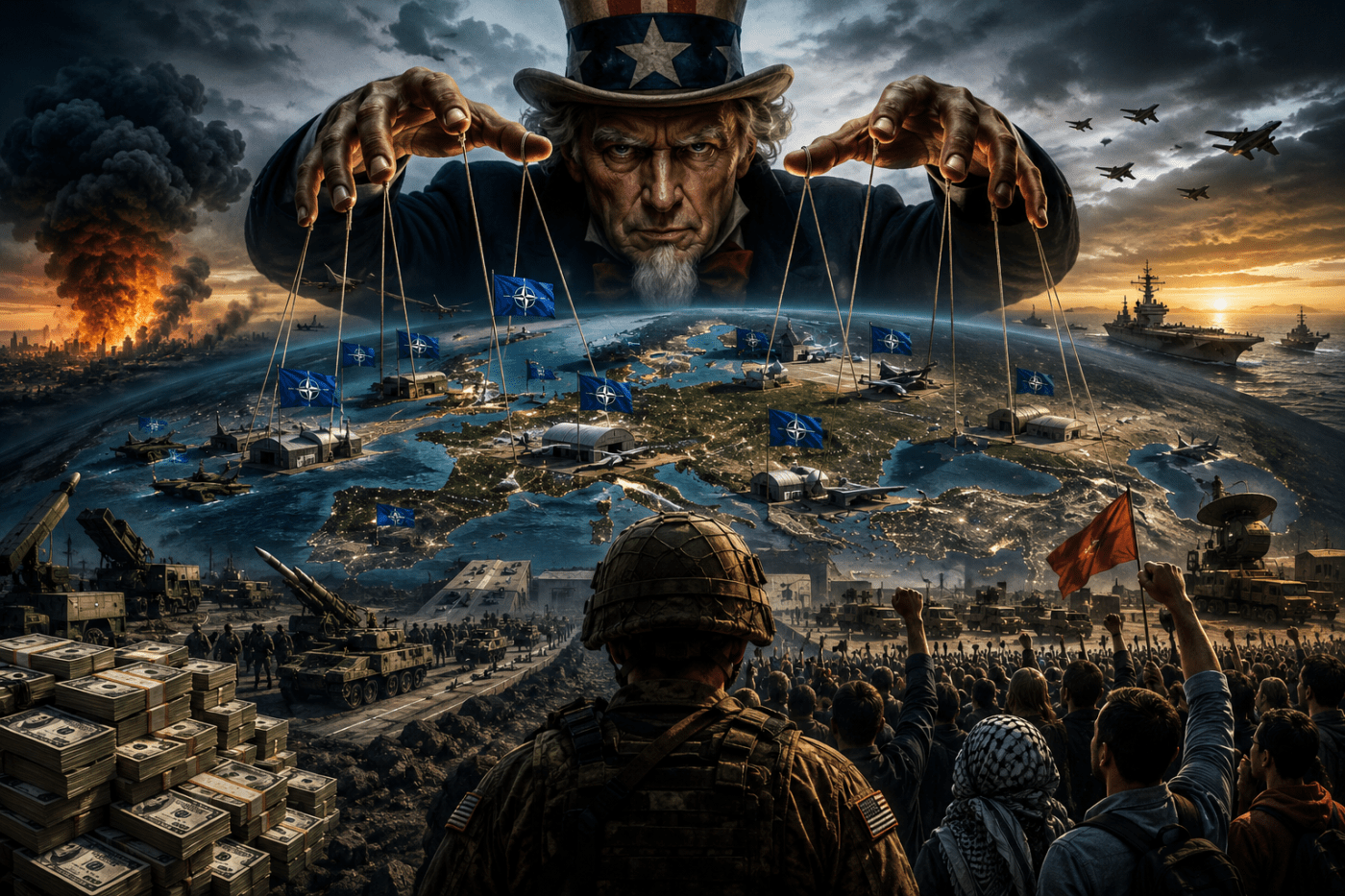
NBC turns Hegseth’s tantrum in Brussels into anxiety over alliance cohesion, teaching readers to worry about NATO reliability rather than the imperial demand for bases, ports, and skies. The facts beneath the article show that NATO is not simply a treaty but an operational geography of runways, fuel depots, air corridors, military budgets, and logistics corridors. “Burden-sharing,” “European leadership,” and “NATO 3.0” are not neutral policy phrases but coded demands for Europe to pay more while Washington keeps command. The task for the people is to make the war machine visible, organize against its infrastructure, and refuse every base, port, runway, and public dollar used for imperial domination.
Prince Kapone | Weaponized Information | June 18, 2026
The Empire Complains When Its Launchpads Hesitate
NBC’s “Hegseth lashes out at NATO allies and announces a review of U.S. forces in Europe”, written by Mosheh Gains and the Associated Press and published on June 18, 2026, reports on Defense Secretary Pete Hegseth’s remarks in Brussels before NATO defense ministers. The article presents Hegseth as chastising European allies for failing to provide U.S. forces with access to bases and overflight routes during attacks on Iran, while announcing a six-month Pentagon review of U.S. troop deployments in Europe. It frames the moment as a crisis of alliance responsibility: Europe must “step up,” NATO must become “NATO 3.0,” and the United States must reconsider how much of Europe’s defense it is willing to carry on its imperial back. The story is dressed in the language of security policy, but its emotional center is much simpler: Washington is angry because some allies hesitated to make their territory available for another U.S.-led war.
This article comes from NBC News, a corporate media institution housed inside NBCUniversal and Comcast’s vast communications empire. That location matters. NBC does not speak from a picket line, a bomb shelter, a refugee camp, a trade union hall, or the streets of Tehran, Madrid, Naples, or Brussels. It speaks from the polished corridors of professional U.S. journalism, where Pentagon access, NATO briefings, official doctrine, and elite anxiety form the grammar of “serious” reporting. The article does not need to openly cheerlead for empire. It performs a subtler function. It allows imperial administrators to define the problem, name the crisis, identify the irresponsible parties, and establish the emotional boundaries inside which the reader is expected to think.
Mosheh Gains’s professional location sharpens this frame. As a Pentagon and national-security journalist, his reporting world is organized around military institutions, defense officials, alliance meetings, and the state managers of war. That does not mean every sentence is false. Propaganda rarely works that crudely. Its real power lies in arrangement. It selects which facts become urgent, which voices become authoritative, which questions become invisible, and which emotions the reader is invited to feel. Here, the reader is not invited to ask whether European territory should be used to launch attacks on Iran. The reader is invited to worry that NATO is fraying because some Europeans did not salute quickly enough when Washington demanded access.
The article’s first major device is appeal to authority. Hegseth, NATO officials, U.S. commanders, and alliance doctrine sit at the center of the narrative. Their language becomes the article’s political architecture. “Burden-sharing,” “deterrence,” “Article 5,” “force posture,” and “NATO 3.0” appear as technical terms rather than ideological weapons. This is how imperial journalism launders politics into procedure. A demand for European submission becomes a debate over readiness. A dispute over whether bases should be used to bomb Iran becomes a question of alliance reliability. The empire speaks in acronyms and policy phrases, and the article respectfully holds the microphone.
The second device is omission. The article reports Hegseth’s outrage over denied access, basing, and overflight, but it does not center the sovereignty question buried inside that complaint. Whose land? Whose skies? Whose ports? Whose people are being made into rear-area infrastructure for war? These questions do not guide the article because they would disturb the imperial common sense beneath it. The refusal of bases is treated as a breach of alliance expectation, not as a possible act of political restraint. European reluctance appears as irresponsibility. U.S. entitlement to foreign territory appears as normal.
The third device is emotional architecture. The article organizes anxiety over NATO cohesion, fear over Article 5 reliability, irritation toward European hesitation, and acceptance of further militarization as the adult response to crisis. The reader is nudged to feel that something sacred is being endangered: the alliance, the guarantee, the command structure, the smooth functioning of the Western war machine. But notice who is absent from this emotional universe. Iranian civilians do not haunt the article. European workers asked to pay for more weapons do not appear. Anti-war movements do not speak. The emotional burden is placed on U.S. troops and NATO planners, not on the people who live under the bombs or pay for the bombers.
The fourth device is narrative framing. Hegseth’s fury is framed as a hard but necessary intervention into NATO weakness. Europe is cast as dependent, hesitant, insufficiently serious, and morally suspect for failing to provide automatic cooperation. The United States, meanwhile, appears as the overburdened guarantor finally demanding that its allies grow up. This is the old imperial comedy: the arsonist complains that the neighbors are not carrying enough water. Washington wages wars across continents, stretches its military architecture across the planet, demands access to foreign territory, and then lectures others about responsibility when they show the smallest sign of reluctance.
The fifth device is doublespeak. “Europe leading its own defense” sounds like independence, but inside the article it means something closer to militarized obedience. “NATO 3.0” sounds modern, efficient, even visionary. But the phrase functions as a branding exercise for deeper military integration, higher defense spending, and more predictable access to the infrastructure of war. “Alliance cohesion” sounds like friendship among nations. In practice, the article reveals that cohesion means knowing in advance which bases, ports, skies, and corridors will be available when Washington decides the next target must be struck.
What NBC gives us, then, is not merely a report on a NATO meeting. It is a small instructional manual in imperial feeling. The reader is taught to sympathize with command frustration, to fear alliance disorder, to normalize military expansion, and to treat territorial access for U.S. war-making as a reasonable expectation. The article does not shout for empire. It sighs for empire. It worries for empire. It scolds on behalf of empire. And in that polished tone, it reveals the deeper truth it cannot name: the machinery of Western power depends not only on missiles and money, but on the disciplined availability of other people’s land.
The Alliance Is a Map of Bases, Ports, Skies, and Budgets
The factual surface of this story is plain enough. At the NATO defense ministers’ meeting in Brussels, Pete Hegseth announced a six-month review of U.S. troop deployments in Europe, tying that review to whether European NATO members would assume greater responsibility for their own military posture and meet their spending commitments. He did not present this review as a withdrawal from the alliance. He presented it as a method of discipline. The United States would examine where its troops are stationed, what obligations it still carries, and which allies have behaved as reliable partners in the machinery of war.
The immediate trigger was not simply European defense spending. Hegseth criticized allies that denied U.S. forces basing and overflight rights during the Iran conflict. Pentagon remarks made the same point in more bureaucratic language: the review would examine whether U.S. forces could rely on assured “access, basing, and overflight”. That phrase is the key. It tells us that NATO is not only a treaty, not only a meeting table, not only a flag outside a headquarters in Brussels. NATO is territory made available for military movement. It is permission. It is concrete. It is runway, pier, depot, air corridor, fuel hose, legal arrangement, customs procedure, and chain of command.
At the same time, NATO officials were already dealing with the practical effects of U.S. force adjustments. Mark Rutte said allies were filling gaps left by U.S. reductions in NATO crisis-response forces. Those reductions reportedly included fighter jets, drones, refueling aircraft, maritime patrol aircraft, destroyers, and other high-end capabilities. So the story is not merely that Washington wants Europe to spend more. It is that Washington is recalculating what it supplies, what Europe must supply, and how reliably Europe must open its geography when the United States goes to war outside Europe.
The article’s most important omission is Spain. The Spanish government denied U.S. use of the jointly operated Rota and Morón bases for attacks on Iran, arguing that such use exceeded the governing agreements and violated the limits of the UN Charter. Spain later closed its airspace to U.S. aircraft involved in the war on Iran. That means the dispute was not symbolic. It concerned the physical routes through which war moves: bases on the ground, air corridors overhead, and the legal-political authority to say yes or no.
Rota matters because it is not an ordinary naval outpost. The U.S. Navy describes Naval Station Rota as a facility that provides cargo, fuel, and logistics support to U.S. and NATO units transiting the region. It supports ships through three active piers, aircraft through a large airfield, and stores major weapons and fuel facilities inside a single secured perimeter. Morón matters for the same reason. U.S. military sources describe Morón Air Base as a vital link in operations moving east from the United States because of its location near the Mediterranean and Middle East, with a large flight line, long runway, and refueling systems. These are not abstractions. These are imperial arteries.
The larger European infrastructure is being reorganized along the same lines. The European Union’s military mobility program seeks to remove regulatory, infrastructure, and capability barriers to moving military personnel and equipment across Europe. A related European Commission transport initiative describes a move toward harmonized rules, streamlined customs procedures, and priority access to infrastructure for military movements. In plain language, the continent is being refitted so troops, weapons, fuel, and equipment can move faster across borders. The old dream of a borderless Europe is being given a new uniform and a military timetable.
This is why Hegseth’s complaint about “access, basing, and overflight” should not be read as a passing insult aimed at soft Europeans. It should be read as a demand that the alliance’s operational geography remain predictable. The United States wants to know which ports will load its ships, which bases will receive its aircraft, which skies will open, which roads and rails will carry military cargo, and which governments will not interrupt the schedule when the target is outside the North Atlantic area. The fact that NATO territory has historically supported operations beyond Europe — from the Balkans to Afghanistan, Iraq, and Libya — shows that this system has long functioned as more than a defensive arrangement. It is a launch and transit system for wars conducted in the name of Western security.
Nor is Europe refusing militarization. The numbers show the opposite. EU defense spending was expected to reach €381 billion in 2025, an 11 percent increase over 2024 and a 62.87 percent increase over 2020. SIPRI reported that world military expenditure reached $2.887 trillion in 2025, with spending rising sharply in Europe and Asia/Oceania. NATO members together accounted for $1.581 trillion, or 55 percent of global military spending. This is not a continent laying down its sword and taking up the plow. This is a continent buying more swords while arguing with Washington over who gets to point them, where, and when.
The Article 5 anxiety in the NBC article also requires factual grounding. NATO itself explains that Article 5 assistance “may or may not involve the use of armed force”. That means the treaty is more flexible than the panic suggests. The real issue is not whether every ally is legally required to send soldiers into every crisis. The real issue is whether the United States can count on allied territory, airspace, and infrastructure when its wars stretch from Europe to the Middle East and beyond.
Placed in this wider context, the dispute becomes clearer. Washington is reducing certain U.S. commitments inside NATO while demanding that Europe spend more, move faster, and keep its infrastructure available. Europe is militarizing, but some governments are not always willing to convert their territory into automatic staging ground for U.S. wars. That is the contradiction NBC leaves under the floorboards. The alliance is not simply debating “defense.” It is fighting over the material machinery of war: who pays for it, who commands it, who hosts it, and who has the right to interrupt it.
NATO 3.0 Means Empire Wants the Keys to the Continent
The real story is not that Europe has become weak, spoiled, ungrateful, or insufficiently serious about defense. That is the nursery rhyme told by the generals to the journalists, and then by the journalists to the public. The real story is that U.S. imperial power is being reorganized under the pressure of overextension. Washington still wants the world. It simply wants other people to pay more for the privilege of being governed by its military priorities. So the United States looks across the Atlantic and tells Europe to stand up, grow up, spend up, and open up — stand up militarily, grow up politically, spend up financially, and open up territorially when the next war requires runways, ports, skies, fuel, and silence.
This is what hides inside the phrase “NATO 3.0.” It sounds like software. It sounds clean, modern, frictionless, as if a military alliance drenched in blood can be updated like an app on a phone. But translated into material language, “NATO 3.0” means a restructuring of alliance financing, force posture, territorial access, and logistics obligations. It means Europe must carry more of the military cost while the United States preserves the strategic command. It means more weapons, more readiness, more infrastructure, more movement, more capacity, and more discipline. The branding is new. The structure is old. The empire calls it modernization because “please help us manage the decline of unipolar domination” does not fit so well on a podium in Brussels.
“Burden-sharing” must also be translated. The burden is not shared with the nurse, the dockworker, the teacher, the migrant cleaner, the warehouse worker, or the unemployed youth told that social spending is irresponsible while military budgets rise like smoke from a burning village. The burden is shifted downward. European taxpayers are asked to finance more of the alliance while U.S. strategic primacy remains intact. This is cost redistribution without command redistribution. The bill is passed around the table, but the seating arrangement does not change. Washington still sits at the head. Europe is invited to contribute more generously to the meal and then applaud the chef who poisoned the kitchen.
“European leadership” receives the same treatment. In ordinary language, leadership suggests authority. In NATO language, it means heavier militarization inside a U.S.-led command architecture. Europe may purchase more weapons, expand its forces, harden its infrastructure, and assume greater regional obligations, but this does not automatically produce strategic sovereignty. A worker who buys his own uniform is not therefore the owner of the factory. A continent that pays more for war does not become free if the war plan still comes from Washington. What is being advertised as European maturity is, in practice, militarized dependency under renovated management.
“Alliance cohesion” is perhaps the most revealing phrase of all. In the sentimental language of the Atlantic world, cohesion means unity, trust, shared values, common purpose, the whole choir singing from the same hymn sheet. But in the hard geography of war, cohesion means something much more concrete. It means predictable access to territory, bases, ports, airspace, refueling systems, weapons facilities, and transport corridors. It means that when Washington names a target, allied land must behave like imperial property. It means no delays, no legal complications, no parliaments wandering into the machinery, no inconvenient publics asking why their soil and skies are being used to widen another war.
That is why the dispute over bases and overflight cuts deeper than the article allows. It exposes NATO not as an abstract community of democracies, but as an operational geography. NATO is a map through which war travels. Its treaties are written in legal language, but its real sentences are runways, piers, depots, pipelines, flight paths, command centers, customs clearances, and rail corridors. The polite word is “interoperability.” The honest word is machinery. The purpose of the machinery is to ensure that military force can move quickly across borders when political decisions have already been made elsewhere.
Hegseth’s anger is therefore not the anger of a man defending Europe. It is the anger of an imperial manager whose logistics chain was interrupted. Europe did not refuse militarism. Europe is already militarizing. What some European governments refused, in this instance, was the automatic conversion of their territory into staging ground for attacks on Iran. That small interruption enraged Washington because empire depends on predictability. It cannot fight global wars if every base becomes a debate, every air corridor becomes a political question, every port becomes a site of public scrutiny, and every government reserves the right to say no. Sovereignty, even in partial and contradictory form, becomes a wrench in the machine.
Here we can see the dynamic contradiction moving. The more Washington shifts resources toward confrontation with China, the more it needs Europe to militarize itself. The more Europe militarizes, the more questions arise over who controls the alliance, who pays the bill, who commands the forces, and who decides when European territory will be used for wars outside Europe. The more those questions arise, the more Washington must turn the language of alliance unity into coercive discipline. The contradiction does not stand still. It sharpens. U.S. power wants Europe to become stronger and more subordinate at the same time. It wants allies who can carry heavier weapons but not heavier political authority. It wants a militarized Europe without a sovereign Europe.
This is imperialist recalibration, not retreat. The United States is not abandoning NATO. It is trying to renovate NATO for a world in which the old unipolar arrogance no longer moves as easily as it once did. The empire still wants its European shield, its Mediterranean hinge, its Atlantic rear base, and its forward corridors toward the Middle East, Africa, and Eurasia. But now it wants Europe to finance more of this architecture while Washington reserves its own high-end power for larger strategic confrontations. The old arrangement was expensive. The new arrangement is supposed to be more efficient. The same knife, a different hand paying for the handle.
From the standpoint of the global working class and oppressed nations, the question is not whether NATO can be made fairer, more balanced, or more modern. A more balanced war machine is still a war machine. A more Europeanized imperial infrastructure is still imperial infrastructure. A military alliance that redistributes expenses among ruling classes while draining social wealth from workers remains an instrument of class power. The workers of Europe are not being asked to defend peace. They are being asked to finance readiness. They are being asked to pay for roads that move tanks faster, budgets that enrich arms manufacturers, and bases that make wars easier to launch. The people are told the house is unsafe, and then billed for the arsonist’s new gasoline.
The buried truth is that NATO is strained not because Europe refuses defense, but because U.S. empire needs European sovereignty to behave like imperial property. It needs countries to possess flags, parliaments, and legal systems, but not enough independent will to obstruct the movement of war. It needs allies that can say “democracy” in public and “cleared for takeoff” in private. It needs governments that can comfort their populations with the language of national dignity while signing away the material substance of territorial control. This is the contradiction Hegseth stumbled into and NBC politely covered with a tablecloth.
So when Washington says “NATO 3.0,” we should hear the gears turning. When it says “burden-sharing,” we should see the public budget being raided. When it says “European leadership,” we should ask who writes the strategic script. When it says “alliance cohesion,” we should look for the bases, ports, skies, fuel, and corridors. The empire is not merely asking Europe to defend itself. It is demanding a continent built for war movement, disciplined for U.S. strategy, financed by European workers, and available when Washington calls. That is the story the propaganda article cannot tell, because to tell it would be to admit that behind the smiling family portrait of the Atlantic alliance stands a logistics machine with its mouth open, waiting for land.
Make the War Machine Visible, Then Make It Costly
The practical lesson is not complicated. If empire moves through bases, ports, airspace, refueling systems, rail corridors, weapons depots, and military budgets, then anti-imperialist struggle must learn to see those routes and organize against them. We cannot fight NATO only as an idea floating above the clouds. NATO is not merely a logo, a summit, or a statement from some well-fed official in Brussels. NATO is infrastructure. It is public money turned into military mobility. It is land turned into staging ground. It is the sky above ordinary people’s heads turned into a highway for bombers. It is the port, the runway, the contractor, the fuel line, the logistics corridor, the parliamentary vote, and the local official who pretends all of this has nothing to do with the rising rent and the closing hospital.
This is where movements already in motion matter. Black Alliance for Peace has been among the clearest organizations in the United States connecting NATO, AFRICOM, foreign bases, sanctions, domestic repression, and U.S. imperial violence into one system of domination; its donations are fiscally sponsored through Community Movement Builders. World BEYOND War’s No Bases campaign gives organizers a concrete anti-base framework for exposing and opposing the global U.S. military footprint; its public accountability materials include annual reporting. ANSWER Coalition organizes emergency mobilizations against U.S. wars, including war on Iran, and states that its work is funded through supporters rather than corporate or government donors. In Britain, Campaign for Nuclear Disarmament remains a central force against nuclear militarism, NATO escalation, and U.S. basing, with public annual reporting and accounts available for scrutiny.
These organizations are not substitutes for local initiative. They are starting points, networks, tools, and political homes for people ready to move from outrage into organized pressure. The first task is to map the war machine where you live. Find the nearby base, the port that handles military cargo, the weapons manufacturer, the university weapons lab, the congressional office taking defense money, the airport used for military transit, the rail line moving equipment, the police department training with federal counterinsurgency money. Make the hidden geography visible. Empire wants its logistics to appear boring, technical, and inevitable. Our job is to make it political.
The second task is to make “access, basing, and overflight” a public slogan of exposure. No bases for attacks on Iran. No ports for imperial escalation. No airspace for illegal war. No rail corridors for NATO expansion. No public money for the military mobility of empire. No five-percent NATO budgets while workers are told there is no money for housing, schools, hospitals, food, transit, or climate survival. The ruling class always says there is no money when the people ask to live, and then suddenly discovers oceans of money when the generals ask to prepare death. This fraud must be named in every union hall, church basement, campus meeting, city council chamber, and workplace break room.
The third task is to connect local struggle to global solidarity. The people of Iran have the right not to be bombed. The people of Europe have the right not to have their land and skies converted into imperial launchpads. The people of the United States have the right not to be robbed by the Pentagon while their own communities are left to rot. The peoples of Africa, Asia, Latin America, and the Caribbean have the right to live outside the shadow of NATO, sanctions, bases, coups, drones, debt, and gunboat diplomacy dressed up as “rules-based order.” These are not separate struggles. They are different fronts in the same fight against Western domination of the world.
So the call is simple: join the organizations already doing this work, build local committees where none exist, pressure elected officials, pass union and community resolutions, organize teach-ins, expose contractors, protest bases, confront war budgets, and refuse the normalization of NATO’s global expansion. Make every node of imperial logistics visible. Make every vote for NATO spending shameful. Make every base a public controversy. Make every air corridor a political question. The empire depends on silence, paperwork, and smooth movement. We answer with organization, exposure, disruption, and solidarity. No NATO expansion. No U.S. foreign bases. No overflight for imperial war. No workers’ money for Western domination. No land, no sky, no sea, no port, no runway for empire.
 Weaponized Information
Leave a comment