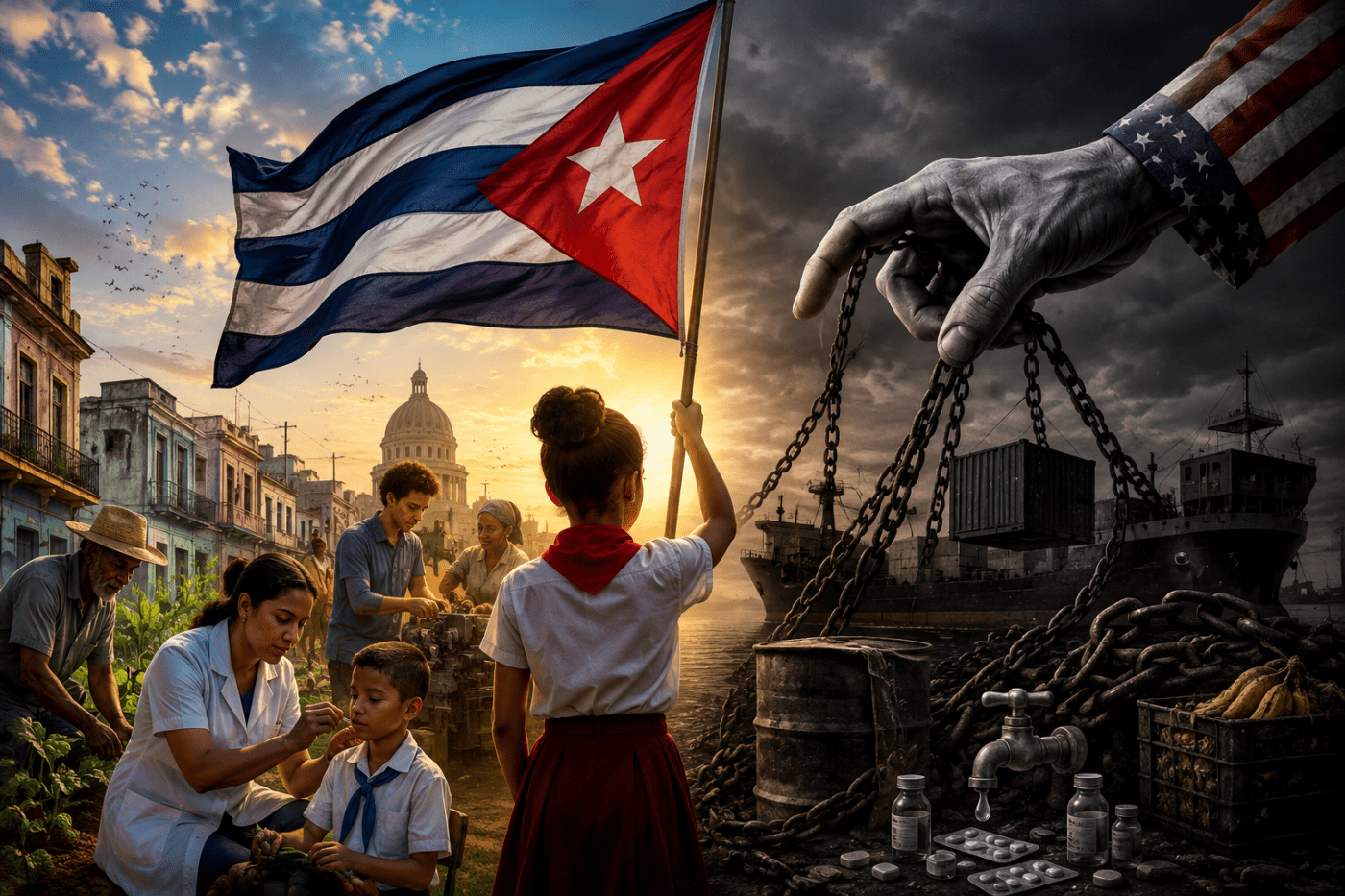
CBS/AFP turns Cuba’s reform process into a morality play where the market arrives as medicine and the blockade disappears into the weather. Cuba’s own record shows a state attempting to correct distortions, revive production, discipline bureaucracy, regulate non-state activity, and preserve socialist planning under siege. The real contradiction is not socialism versus markets, but sovereignty versus imperial command. The task now is to break the blockade, defeat sanctions as economic warfare, and defend Cuba’s right to breathe, build, reform, and survive on its own terms.
Prince Kapone | Weaponized Information | June 19, 2026
When the Blockade Becomes Weather and the Market Becomes Medicine
On June 18, 2026, CBS News published a CBS/AFP article titled “Cuba approves unprecedented free-market reforms in effort to stave off economic collapse”. The article reports that Cuban lawmakers adopted 176 economic measures presented by Prime Minister Manuel Marrero, including changes involving foreign investment, private enterprise, banking, tourism, agriculture, and participation in state companies. It frames these reforms as historic “free-market” concessions forced by economic collapse, deep shortages, and U.S. pressure. The reader is invited to see Cuba not as a socialist country attempting to survive under siege, but as a failed experiment finally dragged, hungry and exhausted, before the altar of the market.
This is not a neutral frame. CBS News operates within the corporate machinery of Paramount, a vast media conglomerate whose news division is part of a larger entertainment, advertising, streaming, and information empire. AFP adds the Western wire-service layer, giving the report the familiar odor of international objectivity while still speaking from the professional institutions of the imperial press. The byline itself — CBS/AFP — tells us something important. This is not reporting from Cuban workers, Cuban farmers, Cuban planners, Cuban unions, Cuban neighborhood assemblies, or Cuban socialist institutions. It is institutional journalism from the commanding heights of the Western information order, looking down upon Cuba and explaining Cuba to the world in the language empire prefers.
The first weapon here is narrative framing. Before Cuba’s own language of correction, planning, production, bureaucracy, and socialist preservation can breathe, the article nails the label “free-market reforms” to the wall. Once that phrase is installed, every subsequent fact is made to march behind it. Foreign investment becomes market salvation. State adjustment becomes ideological retreat. Productive reform becomes confession. Scarcity becomes proof. The old imperial sermon returns in a new suit: socialism creates hunger, markets bring bread, and Washington, naturally, is only standing nearby with clean hands and humanitarian concern.
But the article cannot avoid the blockade entirely, so it performs a more delicate trick. U.S. coercion is acknowledged, but not reconstructed. It is mentioned as pressure, not machinery. It appears as atmosphere, not architecture. The blockade becomes bad weather over Havana: unfortunate, heavy, perhaps even cruel, but somehow detached from the storm-makers in Washington. There is no full accounting of how sanctions operate through banks, ships, fuel, insurance, remittances, trade, credit, investment, and fear. There is no patient explanation of how an island economy is strangled not only by what is formally banned, but by what banks, firms, insurers, and governments refuse to touch because the United States has turned normal exchange into a legal minefield. The gun is shown only after the bullet has entered the body.
The second weapon is source hierarchy. Cuban officials appear in the article, but they do not govern its interpretation. The meaning of Cuba’s reforms is handed to AFP, Western economists, U.S. officials, a University of Miami expert, selected private-sector voices, and unnamed sources. The Cuban state may speak, but the imperial press reserves the right to translate. President Miguel Díaz-Canel says the reforms are not being made because of pressure from “the Yankees,” but to preserve socialism. The article includes the line, then surrounds it with voices telling the reader what it really means. Here we see the polite arrogance of imperial journalism: the Cuban revolutionary may testify, but the empire will interpret his testimony.
The third weapon is compression. Cuba’s crisis is made to look like the natural outcome of socialist management, with U.S. aggression treated as one aggravating factor among many. The structure is simple and effective: describe shortages, blackouts, hunger, frustration, bureaucracy, and collapse; mention the blockade; then return quickly to the question of whether markets will rescue the island. This is not direct lying. It is something more durable. It is card stacking. It places facts in such an order that the reader arrives at the desired conclusion without being openly commanded to do so. The suffering is real. The shortages are real. The frustration is real. But their arrangement in the article turns a history of siege into a morality play about socialist failure.
The fourth weapon is bait and switch. The article invokes humanitarian suffering — food rotting during power cuts, medicine shortages, children dying, people tired and worn down — but the political energy of that suffering is not directed against the system strangling Cuba. Instead, it is redirected toward the question of whether Cuba’s reforms will satisfy Donald Trump. Imagine the obscenity. A country is being squeezed, its fuel supply choked, its medicine constrained, its people forced into darkness, and the article ends up asking whether the bully will be pleased with the victim’s concessions. This is the humanitarianism of the imperial press: it weeps over the wound while asking whether the knife has been respected.
The fifth weapon is the old imperial habit of presenting coercion as common sense. Vice President JD Vance is quoted saying Washington wants Cubans to be “happy and successful,” as though the United States has spent more than six decades lovingly preparing Cuba for joy through blockade, isolation, sabotage, and economic punishment. This is the comedy Marx would have enjoyed if the consequences were not so obscene. The arsonist arrives with a pamphlet on fire safety. The jailer gives a lecture on freedom. The empire that blocks the medicine now announces its concern for the patient.
What CBS/AFP gives us, then, is not simply an article about Cuban economic policy. It is a small workshop in imperial narration. Cuba is made into an object. Washington is made into the judge. The market is made into medicine. The blockade is made into weather. The Cuban people are made into evidence against their own revolution. And socialism, before it is even allowed to explain the battle it is fighting, is dragged into court by the very system that has spent generations trying to starve it into surrender.
The Reform Cuba Actually Announced, and the Siege CBS Would Not Reconstruct
The first correction to make is simple: Cuba did not describe these measures as a kneeling confession before the market. Cuban officials placed them inside a state-directed process of economic correction, productive revitalization, and socialist preservation. The Cuban presidency’s own program is named the Program of Government to Correct Distortions and Reinvigorate the Economy, which is not the language of a state announcing its own liquidation, but of a government trying to restore control over an economy deformed by scarcity, sanctions, currency disorder, low productivity, and administrative delay. The 2026 version of the program defines planning and implementation for crisis management — what to do, how to do it, and when to do it. That matters because CBS/AFP begins from “free-market reforms,” while Cuba begins from correction, planning, and survival.
The measures reported by CBS/AFP were real. Cuban lawmakers did approve a package after Prime Minister Manuel Marrero presented reforms to the National Assembly, and Cuban reporting described the moment as requiring “urgent and necessary changes” across agriculture, energy, health, education, banking, foreign trade, logistics, tourism, tax collection, digital transformation, and state functions. This was not a narrow reform of shopkeepers and restaurants. It was a large state agenda aimed at restructuring how production, investment, imports, exports, municipal administration, finance, and social priorities function under crisis conditions. Cuban reporting also identifies the 2026 program as an updated planning instrument with ten general objectives, 111 specific objectives, 505 actions, and 309 indicators and targets. That is not how a serious analyst describes a sudden ideological panic. That is how a state describes an administrative and economic work plan.
Nor did the Cuban government present the reforms as a decree dropped from the sky. Granma reported that the economic program was revised after public consultation, expert recommendations, Party discussion, National Assembly input, and annual updating. Another Cuban report described a phase of popular discussion involving tens of thousands of meetings and more than 140,000 proposals. One does not have to romanticize every meeting or pretend bureaucracy disappears because a meeting was held. But the empirical record does show that Cuba’s reforms emerged from a domestic process of state consultation and policy revision, not merely from Washington cracking its whip and Havana obediently changing costumes.
The content of the reform process is also more complicated than the phrase “free market” allows. Cuban reporting says the program includes measures affecting state and non-state economic actors, productive linkages, foreign-currency allocation, price regulation, fuel-purchasing mechanisms, and incentives for foreign investment in the Mariel Special Development Zone. Díaz-Canel has also explained priorities involving state socialist enterprises, non-state actors, real foreign-currency accounts, streamlined business creation, business models among different actors, food sovereignty, and self-sufficiency. In other words, Cuba is not simply “rolling back the state.” It is trying to reorganize relations between state enterprise, local government, foreign currency, non-state activity, imports, production, and investment. The question is not whether markets exist. The question is how they are subordinated, regulated, taxed, directed, and contained by a socialist state attempting to keep command over national development.
Food is one of the clearest examples. CBS/AFP gestures toward shortages, but does not reconstruct Cuba’s attempt to address the productive base of those shortages. Cuba has tied agricultural recovery to a broader legal and planning framework for food sovereignty and sustainable local food systems. This matters because “food shortage” can be reported as misery, but the underlying policy question is whether the country can reduce import dependence, strengthen local production, improve distribution, and keep food access from being surrendered to pure purchasing power. The same is true for energy. Cuba’s crisis includes fuel shortages, aging infrastructure, grid failures, and repeated blackouts; Reuters reported in March 2026 that millions remained without power after another nationwide grid collapse. Cuban leadership has linked these difficulties to external pressure while also calling for domestic transformation to overcome structural problems. That combination — external siege and internal correction — is precisely what the CBS/AFP frame cannot hold together.
Then there is the blockade, which the article mentions but does not map. The blockade is not a slogan. It is a legal, financial, commercial, shipping, diplomatic, and psychological machinery designed to make normal economic life abnormal. The U.S. Treasury’s own sanctions rules describe the 180-day rule, which can bar a vessel that trades in Cuba from entering a U.S. port to load or unload freight for 180 days after leaving Cuba unless authorized by OFAC. This does not merely punish Cuba. It disciplines shipowners, insurers, traders, and intermediaries around the world. The same machinery runs through the Cuban Democracy Act, also known as the Torricelli Act, which the State Department identifies as part of the statutory framework governing U.S. policy toward Cuba and which tightened the embargo in the early 1990s. The Helms-Burton Act then hardened the blockade further by seeking international sanctions against the Cuban government and by codifying U.S. policy around a transition away from Cuba’s existing political order. This is not “pressure.” It is imperial lawfare turned into economic geography.
The State Sponsor of Terrorism designation adds another layer to the cage. WOLA has explained that Cuba’s inclusion on the list produces a human cost through banking overcompliance, blocked transactions, travel constraints, aid difficulties, and fear among financial institutions and humanitarian actors. UN experts likewise expressed alarm at Cuba’s reinstatement and warned that unilateral coercive measures worsen humanitarian and economic conditions. That is the operational geography CBS/AFP leaves behind the curtain. A bank does not have to be formally forbidden from touching Cuba in order to refuse Cuba. A shipping company does not need a personal visit from the State Department to calculate the risk. A supplier does not need to hate socialism to decide that the U.S. market is larger, the penalties are sharper, and the safest Cuban transaction is no transaction at all.
The economic damage is measurable. Cuba’s 2025 blockade report estimated more than $7.5 billion in losses from March 2024 to February 2025, with accumulated damages exceeding $170 billion. At the United Nations, Cuba presented those figures while the General Assembly once again debated the U.S. embargo, and UN records show member states confronting the blockade as a long-standing violation of Cuba’s economic rights and sovereignty. The EU has also acknowledged that the embargo damages Cuba’s economy and living standards while restricting trade and investment. This is the world saying, year after year, that Washington’s policy is not a neutral disagreement with Havana, but an economic weapon against a whole people.
The current fuel crisis shows how that weapon tightens in real time. Reuters reported in June 2026 that the United States sanctioned Cuba’s state oil company CUPET, adding obstacles to fuel imports, and that Washington’s measures came amid blackouts and an already severe energy shortage. Reuters also reported earlier that the United States reinstated the Cuba Restricted List and placed sanctions on a remittance provider, a move Cuban officials warned would heighten shortages and complicate money transfers between Cuban families abroad and relatives on the island. So when CBS/AFP writes of blackouts, food rotting, shortages, and desperation, it is not describing a mystery. It is describing the daily life of a country forced to plan development while fuel, finance, shipping, remittances, credit, imports, and medical access are all made more difficult by design.
The longer history also matters. The United States itself acknowledges that after Spain’s defeat in 1898, U.S. forces occupied Cuba until 1902 and forced the Platt Amendment as a condition of independence, claiming a continuing right to intervene on the island. That history did not vanish in 1959. It changed form. Direct occupation became economic strangulation. Formal tutelage became sanctions architecture. The right to intervene became the right to decide what kind of economy Cuba may have, what kind of government Washington will tolerate, what kind of trade Cuba may conduct, and what kind of suffering the Cuban people must endure until they vote correctly with their stomachs. This is the colonial wound behind the contemporary policy fight.
That is why the factual terrain is far larger than the CBS/AFP storyline. Cuba is not merely approving “free-market reforms.” Cuba is attempting to correct economic distortions, revive production, strengthen local governance, reorganize state and non-state activity, address food and energy shortages, attract investment under Cuban authority, and preserve national direction while the United States tightens the blockade through statutes, banking risk, fuel sanctions, shipping penalties, remittance restrictions, and terror-list stigma. The article reports the reforms. It does not reconstruct the battlefield on which those reforms became necessary.
A Socialist State Does Not Kneel When It Learns to Breathe Under Siege
The real story is not that Cuba has accepted the market’s verdict. The real story is that a socialist state under siege is attempting to reorganize production, discipline bureaucracy, regulate non-state activity, attract investment, and preserve public power under conditions deliberately engineered to make socialist development fail. That is the fact pattern CBS/AFP cannot narrate because its entire ideological machinery depends upon a simpler fable: socialism produces scarcity, scarcity forces surrender, and the market arrives like a missionary with bread in one hand and a contract in the other.
But Cuba’s crisis does not unfold in a laboratory. It unfolds inside the sanctions architecture of U.S. imperialism, where finance, fuel, shipping, investment, trade, remittances, aid, insurance, and ordinary commerce are turned into weapons against a small island that dared to break from imperial command. The blockade is not a policy disagreement. It is class war at the international scale. It is imperial punishment against a society that removed the old comprador order from power, nationalized the commanding heights, and insisted that development could be organized around people rather than plantations, casinos, landlords, and foreign capital. For that crime, the empire has never forgiven Cuba. It has merely changed the paperwork of revenge.
This is why the phrase “free-market reforms” is so dishonest. It presents the market as the subject of history and Cuba as the exhausted object finally submitting to reason. But the actual contradiction is not state versus market in the childish catechism of neoliberal economics. The contradiction is sovereignty versus imperial command. It is whether a socialist state, surrounded and strangled, can use limited market mechanisms without surrendering the political direction of society to capital. Can foreign investment be admitted without allowing foreign capital to become sovereign? Can non-state activity be expanded without allowing a new domestic bourgeoisie to dictate national life? Can state enterprises be made more flexible without turning the working class into disposable inventory? Can bureaucracy be disciplined without dismantling public power? These are not textbook questions. They are questions of survival.
Cuba is therefore moving through dangerous terrain. No revolutionary should pretend otherwise. Markets do not enter a socialist society as innocent little shopkeepers carrying baskets of tomatoes. They bring class pressures. They bring inequalities. They bring new habits, new appetites, new privileges, new temptations, and new political demands. They create spaces where money begins to speak louder than social need. They give imperialism something to court, penetrate, flatter, finance, and eventually organize. Anyone who treats market expansion as harmless does not understand capitalism. But anyone who treats all market mechanisms as automatic capitalist restoration does not understand siege, scarcity, planning, or the uneven roads by which oppressed nations are forced to defend sovereignty in a hostile world economy.
The revolutionary question is not whether Cuba touches the market. The revolutionary question is who commands the process. Under whose authority does investment enter? Under whose law does private activity operate? Toward whose priorities are resources directed? Who captures the surplus? Who eats first? Who decides whether foreign currency serves national development or private enrichment? Who stands above the economy: the people organized through the socialist state, or capital organized through profit, scarcity, and imperial connection? That is the decisive line. Everything else is smoke blown from the cigar of some well-fed liberal economist explaining hunger to the hungry.
Here we must hold two truths together without flinching. Cuba’s internal contradictions are real. Bureaucracy is real. Low productivity is real. Delayed decisions are real. Currency disorder, agricultural weakness, energy dependency, and administrative sclerosis are real. A socialist state does not become stronger by denying these problems. It becomes stronger by naming them, correcting them, and mobilizing the people to overcome them. But these contradictions do not float above history like clouds. They are intensified, distorted, and weaponized by a blockade designed precisely to make every internal weakness heavier, every shortage sharper, every policy error more expensive, and every reform more dangerous.
That is the imperial genius of sanctions. They do not merely remove goods from shelves. They reorganize reality. They make planning harder, credit scarcer, fuel riskier, medicine costlier, shipping more complicated, investment more cautious, and family support more difficult. Then, after producing the conditions of exhaustion, the imperial media arrives with a notebook and asks why socialism looks tired. This is not journalism. It is the stenography of strangulation.
Washington’s goal has never been Cuban prosperity. If Cuba expands public provision, the empire calls it authoritarian control. If Cuba opens space for private activity, the empire calls it proof of socialist failure. If Cuba resists reform, the empire calls it ideological rigidity. If Cuba reforms under pressure, the empire calls it capitulation. If Cuba suffers, the empire calls it evidence. If Cuba survives, the empire calls it repression. The game is rigged before the first fact enters the room. The conclusion has already been written: Cuba must be wrong because Cuba is not obedient.
This is why the CBS/AFP article must be read as part of the imperial media apparatus. Its function is not only to inform readers that Cuba has approved reforms. Its function is to discipline the meaning of those reforms before the Cuban people can define them for themselves. It turns a socialist correction process into a capitalist morality tale. It turns sanctions into scenery. It turns imperial coercion into background weather. It turns internal self-criticism into confession. It turns survival into surrender.
A serious anti-imperialist reading begins elsewhere. Cuba is not a paradise immune from contradiction. It is not a museum exhibit of 1959. It is not a slogan preserved under glass. It is a living revolutionary process forced to make decisions inside a hostile world system. Its reforms must be judged by whether they defend the people, strengthen production, preserve sovereignty, prevent comprador capture, and keep the commanding direction of society in public hands. That is the standard. Not whether Washington approves. Not whether CBS discovers “free markets” in Havana like Columbus discovering people already living on land he claimed to find.
The danger is real, but so is the strategy. Cuba is attempting to breathe under siege without handing the oxygen tank to the empire. It is trying to use controlled openings without allowing those openings to become trapdoors. It is trying to revive production without restoring the old class order. It is trying to discipline bureaucracy without dismantling socialism. It is trying to attract investment without selling sovereignty. That is not a simple story, which is precisely why corporate media cannot tell it. The imperial press prefers cartoons: state bad, market good, empire concerned, socialism defeated. But history is not a cartoon. It is struggle.
The task of Weaponized Information is therefore to recover the contradiction buried beneath the headline. Cuba’s reforms are not the market’s victory speech. They are a contested maneuver inside the long war between socialist sovereignty and imperial domination. The Cuban people are not props in a Western article about collapse. They are the living subjects of a revolution still fighting to feed, power, heal, educate, and defend itself while the most violent empire in modern history stands offshore, pretending to be a humanitarian observer of the hunger it helped produce.
Break the Blockade, Break the Habit of Imperial Punishment
The task now is not to pity Cuba. Pity is cheap. Solidarity is organized. The Cuban people do not need the imperial core to send tears after Washington sends sanctions. They need the machinery of punishment named, exposed, confronted, and made politically illegitimate. The blockade is not simply a Cuba policy. It is a method of imperial governance. It is the same logic that turns food, fuel, medicine, credit, trade, shipping, remittances, and banking into weapons against any people who refuse to kneel. To defend Cuba, then, is to fight the whole doctrine of sanctions as economic warfare.
There are already organizations moving on this terrain. CODEPINK maintains active Cuba solidarity work against the blockade and the State Sponsor of Terrorism designation, and its nonprofit status is publicly documented through ProPublica’s records for CODEPINK Women for Peace. This gives organizers a ready lane for call-in campaigns, webinars, teach-ins, delegations, petitions, and pressure on Congress. The immediate demand is clear: remove Cuba from the terror list, end the blockade, stop the fuel strangulation, and end the financial warfare that turns ordinary economic life into a legal trap.
Material solidarity also matters. IFCO/Pastors for Peace is organizing humanitarian aid for Cuba, including a 2026 campaign to send tens of thousands of pounds of supplies, and its long record of confrontation with U.S. restrictions on Cuba aid is part of the living history of blockade-breaking. Supporting such efforts does not replace political struggle, but it roots political struggle in the actual needs of the people: medicine, equipment, supplies, and the refusal to let Washington decide who may receive help and who must suffer for disobedience.
The Black radical anti-imperialist lane is equally essential. Black Alliance for Peace organized a 2026 Week of Action to Defend Cuba, demanding an end to the blockade, Cuba’s removal from the terror list, and respect for Cuban sovereignty. BAP also states that it is fiscally sponsored by Community Movement Builders, whose nonprofit record is publicly documented through ProPublica. This matters because Cuba solidarity in the United States cannot be separated from the struggle against colonialism, racism, militarism, and the domestic police state. The same empire that cages Black communities at home tries to starve revolutionary sovereignty abroad.
For broader coalition work, the National Network on Cuba coordinates anti-blockade solidarity across organizations and can help connect local activists to campaigns, events, statements, and educational materials. For street mobilization, ANSWER has organized actions against the blockade and states that its work is funded by supporters rather than corporations or government grants. These lanes should be used carefully and concretely: not as logos to decorate a paragraph, but as vehicles for action.
The tactical direction is straightforward. Organize teach-ins that explain the blockade as a machine, not a mood. Pressure unions, churches, student groups, city councils, and community organizations to pass resolutions demanding an end to the blockade and Cuba’s removal from the State Sponsor of Terrorism list. Join call-in campaigns. Support medical-aid drives. Share Cuban and anti-blockade sources when corporate media turns suffering into anti-socialist propaganda. Connect Cuba to the broader fight against sanctions on Venezuela, Iran, Nicaragua, Syria, and every other country Washington tries to discipline through hunger.
The slogan must become a political line: sanctions are economic warfare. The blockade is not an unfortunate relic. It is active imperial punishment. It is meant to make socialist development look impossible by making daily life impossible. Our answer must be equally active. Defend Cuba’s sovereignty. Break the blockade. End the terror designation. Build organized solidarity from the shop floor to the classroom, from the church basement to the city council, from the union hall to the street. The empire has spent more than sixty years trying to make Cuba surrender. The least we can do is stop pretending that neutrality is anything but collaboration with the siege.
 Weaponized Information
Leave a comment