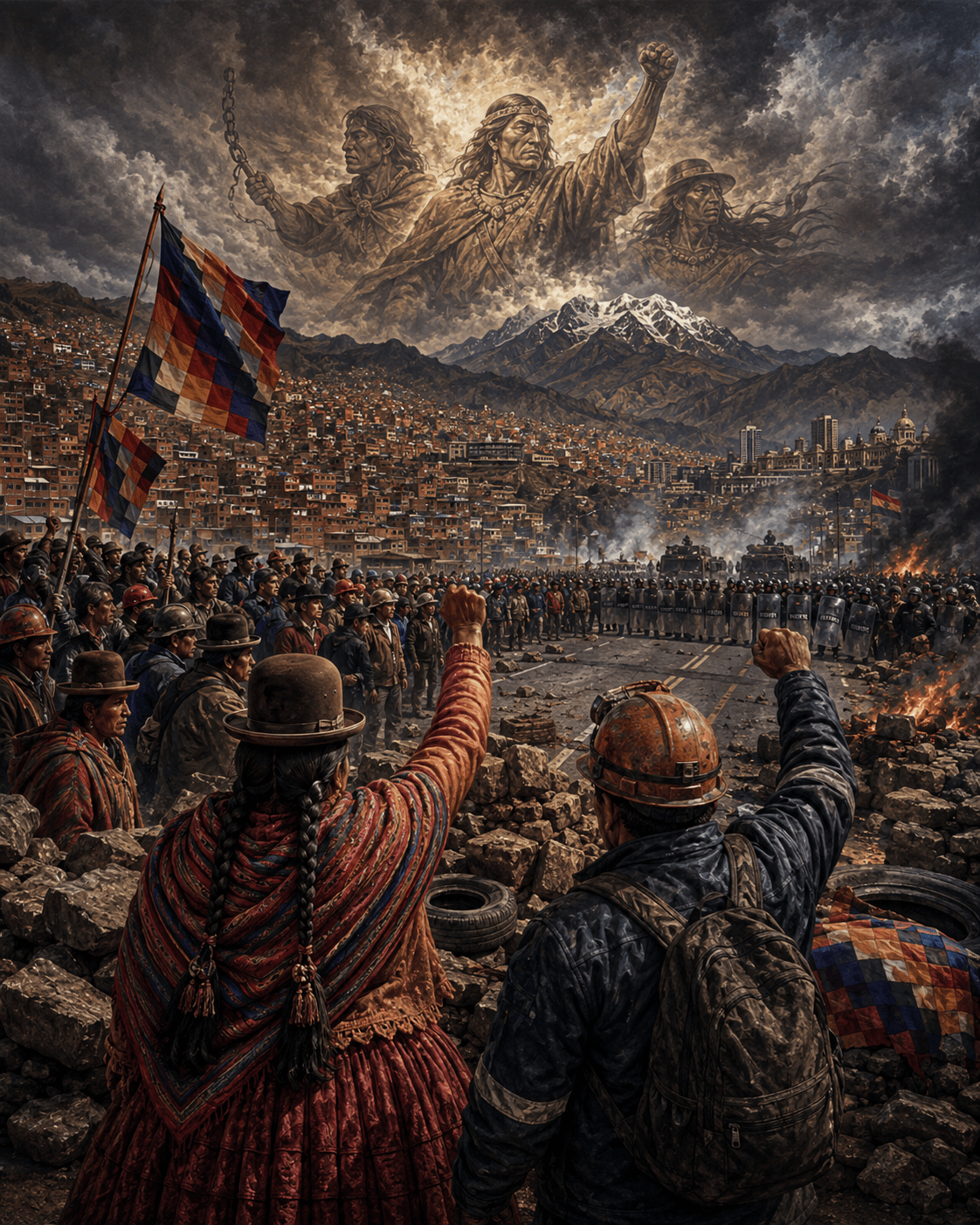
Jacobin praises Bolivia’s indigenous and working-class rebellion only to recast its power as chaos, fragmentation, and political absence. Behind the blocked roads stands a concrete struggle against land commodification, economic surrender, police repression, and renewed alignment with Washington. What the magazine calls a “vacuum” is actually a contest between the formal authority of the colonial republic and the territorial power of workers, campesinos, and indigenous communities. International solidarity must stand with the barricades, defend the persecuted organizers, amplify movement-controlled voices, and confront the imperial machinery supporting Rodrigo Paz.
Prince Kapone | Weaponized Information | June 17, 2026
The “Vacuum” Jacobin Fears Is the People Entering History
In “Who Will Rule Bolivia?”, published by Jacobin on June 16, 2026, Olivia Arigho-Stiles reports on more than forty days of road blockades confronting the right-wing government of President Rodrigo Paz. The article describes mass arrests, attacks on union leaders, violent efforts to clear the roads, fuel shortages, rising food prices, and the growing inability of the government to restore order. It even concedes that the blockades represent a “colossal display of worker and indigenous power.” Yet the article’s real concern is announced in its title. It does not ask what the Bolivian masses are fighting against, what they are struggling to defend, or what forms of power they are already exercising. It asks who will rule once the old authorities can no longer rule as before.
Jacobin presents itself as a leading publication of the American socialist left, supported through subscriptions, donations, and the nonprofit Jacobin Foundation. Its political location is therefore peculiar but familiar: it speaks in the language of socialism while operating inside the professionalized media and philanthropic infrastructure of the imperial center. Its readers are encouraged to admire workers from a safe distance, provided those workers remain recognizable as voters, petitioners, union members, or supporting actors in a parliamentary drama. The trouble begins when the masses stop requesting representation and start exercising power directly. At that moment, the barricade becomes a menace, popular initiative becomes instability, and history itself is diagnosed as a political vacuum.
The author, Olivia Arigho-Stiles, is a postdoctoral researcher at the University of Manchester whose work concerns Bolivian indigenous movements and environmental politics. She is based in La Paz and clearly possesses proximity to the events, access to movement voices, and substantial knowledge of the organizations involved. This makes the limitations of the article more revealing, not less. The problem is not a lack of information. The problem is the frame through which the information is arranged. Indigenous leaders and union militants are allowed to describe their grievances, announce their distrust, and explain their immediate demands. Academics and economists are then called upon to explain what the struggle supposedly means. The people make history; the professional observer interprets it for them.
The article’s dominant propaganda device is narrative framing. Its repeated warning of a “dangerous political vacuum” quietly establishes the continued functioning of the existing state as the standard by which the movement must be judged. Political power exercised through community assemblies, unions, territorial organization, and collective control of the roads is treated as incomplete because it has not yet produced an obvious presidential replacement. The state can arrest, repress, privatize, and betray without being described as a vacuum. But when workers and indigenous communities withdraw their consent and interrupt the circulation of goods, suddenly Bolivia is imagined as a country without politics.
This framing is reinforced by an appeal to fear. Bolivia is said to be at a “breaking point.” Cities are “strangled.” A “dangerously unstable” climate approaches. The conclusion is “grim and uncertain.” The article piles up images of scarcity: hospitals without oxygen, travelers dragging suitcases, empty meat counters, and a six-dollar head of broccoli. These hardships are real within the article’s own account, but their narrative placement is calculated. The reader is trained to encounter the mobilized poor primarily through the inconvenience and suffering produced by their resistance, rather than through the conditions that made resistance unavoidable. The blockade becomes the visible crisis, while the government and social order being blockaded recede politely into the background.
Card stacking performs the next operation. The article gives abundant space to factionalism, disagreements, electoral weakness, rival leaderships, middle-class anger, and the absence of a universally accepted successor. It offers far less attention to the political intelligence contained within the assemblies, the collective procedures through which decisions are made, or the forms of popular authority already operating outside parliament. Genuine contradictions are selected and arranged until they become the essence of the movement. Jacobin thus constructs a rebellion powerful enough to paralyze a government but supposedly too divided to govern anything itself.
Divide-and-conquer framing follows naturally. Evistas are separated from the COB, the COB from peasant federations, blockaders from dissenters within their communities, and rural insurgents from urban residents. No mass movement is without contradiction, least of all one emerging from years of political fracture. But Jacobin treats those contradictions less as a battlefield upon which unity and leadership must be forged than as evidence that unity is impossible. The article admires the people’s strength only to dissolve them into competing sociological fragments before they can appear as a historical subject.
The final trick is poisoning the well through political code words. “Parallelism,” “illicit capital,” “vacuum,” “post-MAS era,” and “no obvious figure” surround the mobilization with an atmosphere of criminality, fragmentation, and absence. This is not the crude propaganda of the police bulletin. It is more refined. The article concedes the repression, recognizes the grievances, and praises the courage of the masses. Then, having granted them everything except the capacity to rule, it gently escorts the reader back to the safety of bourgeois governability. Jacobin can see the people blocking the roads. What it cannot bear to see is that the people may be opening another road altogether.
What Was Already in Motion Before Bolivia Stopped Moving
The roads did not close all at once, nor did they close because one politician issued an order from a balcony. According to the Bolivian Defensoría del Pueblo’s reconstruction of the conflict, blockades began appearing gradually in early May and expanded nationally after a May 4 call by the Central Obrera Boliviana and campesino sectors. By June 2, the state road authority was reporting 103 blockade points across seven departments, with the heaviest concentration in Cochabamba and La Paz. Five days later, eighty-five routes remained interrupted after thirty-eight days of conflict. This was not a theatrical march assembled for an afternoon photograph. It was a sustained mobilization stretching across the highlands, valleys, cities, transport corridors, and agricultural regions of the country.
The principal demand hardened as the conflict widened: the resignation of President Rodrigo Paz and Vice President Edmand Lara. Workers and campesinos marched from El Alto into the center of La Paz under the banners of the COB and the Túpac Katari federation, while the CSUTCB continued to ratify the blockades in mid-June. Yet the movement did not operate through a single uncontested command. Different organizations disagreed over negotiations, leadership, Evo Morales, and the duration of the struggle. Even the COB’s executive leadership repeatedly returned major decisions to its affiliates: after weeks of confrontation, Mario Argollo declared that the rank and file would determine whether the blockades continued. An earlier national assembly had rejected immediate negotiations while authorizing humanitarian corridors and maintaining the demand for Paz’s departure.
The government answered the spreading mobilization with arrests, police operations, legal accusations, and preparations for exceptional rule. On May 16, the Defensoría reported fifty-seven people apprehended, detained, or arrested during clearance operations in La Paz and El Alto, along with an injured person and attacks against the press. The Túpac Katari federation later denounced the treatment of its members and demanded information about the detention of campesino leader Vicente Salazar during a march in La Paz. Courts had previously annulled arrest orders against Salazar and COB leader Mario Argollo, but the campaign against movement leadership continued as the government increasingly described the protests through the language of criminality and destabilization.
The legislature then cleared a path toward emergency powers. It first abolished the previous law governing states of exception, with supporters openly describing that law as an obstacle to executive action, and subsequently approved Law 1740 to regulate a new exceptional regime. The Defensor del Pueblo identified three serious problems in the replacement: weakened legislative control, a presumption that police and military conduct is lawful, and insufficient guarantees for investigating abuses. These were not abstract concerns. The legislation was debated while police and military forces were already clearing roads and the government was considering whether to place selected areas under exceptional authority.
The collision in San Julián showed what “unblocking” could mean on the ground. On June 6, police, military personnel, and members of the Unión Juvenil Cruceñista entered the area together. The UJC’s president publicly stated that his members would remain alongside the police, while neighborhood leaders who were not themselves participating in the resignation blockades denounced the arrival of what they called an irregular civilian group. The confrontation included gunfire and injuries. The Defensoría later warned of the presumed presence of shock groups and para-state formations, as well as the use of firearms and explosives, and called for an impartial investigation into individual responsibility.
These events followed an economic confrontation that began before the current blockade cycle. Paz’s December 2025 Decree 5503 was not a narrow fuel-supply measure. The decree contained more than 120 articles and established an emergency economic regime covering foreign and domestic investment protections, regulatory stability, monetary policy, fuel imports, public administration, energy, and private investment. Its investment provisions promised legal predictability and nondiscriminatory treatment to national and foreign capital, while the decree declared its emergency measures immediately applicable and preferential over conflicting regulations. The COB opposed provisions it said would place natural resources in the hands of transnational interests, and sustained protest forced the government to agree to replace the measure. Argollo described the agreement to abolish Decree 5503 as a victory won by popular pressure.
The next major confrontation concerned Law 1720. Promulgated in April, the law permitted titled small agricultural properties to be converted into medium-sized holdings at an owner’s request. That distinction carried material consequences. Under Bolivia’s agrarian framework, small property is protected as a family’s home, workplace, principal source of food, and patrimony. Fundación TIERRA warned that conversion could make land available as mortgage collateral, allowing poverty and lack of credit to push campesino families into surrendering protections presented as obstacles to finance. After an extended indigenous-campesino campaign, the Chamber of Deputies approved the complete repeal of Law 1720. The repeal removed the law, but it did not remove the distrust produced by its passage.
The fuel emergency developed within an older material decline. Bolivia had depended heavily on natural-gas exports to earn the foreign currency required for imports, including diesel and gasoline. The national statistical institute’s figures show that hydrocarbon exports fell by 38 percent during the first two months of 2025 compared with the same period in 2024, while the INE’s production series records the longer decline in petroleum and natural-gas output. Fewer export dollars reduced the state’s capacity to purchase imported fuel. The resulting queues, interrupted transport, poor-quality diesel, higher logistics costs, and rising food prices were already punishing workers and small producers before the national road network was brought to a halt.
The parliamentary map offers little reflection of the forces now assembled outside it. Paz and Lara won the 2025 runoff, but the election also registered the collapse of the political instrument that had governed Bolivia for most of the previous two decades. The official electoral allocation left MAS-IPSP with only two seats in the Chamber of Deputies. The unions, campesino federations, neighborhood organizations, transport sectors, miners, coca growers, and community assemblies now acting beyond parliament therefore possess a territorial and organizational reach that is not expressed through a comparable legislative presence. The state’s institutional balance and the country’s organized social balance no longer resemble one another.
Bolivia’s foreign alignment was also changing. Under the previous government, the country became a BRICS partner and pursued expanded trade, alternative development financing, and access to the New Development Bank. Bolivian officials later proposed currency arrangements with China and a bridging role between BRICS, ALBA, and Mercosur. Paz instead joined Washington’s Shield of the Americas summit alongside a bloc of right-wing governments. As his government confronted the blockades, US Secretary of State Marco Rubio informed him that Washington was increasing emergency assistance and logistical support while affirming its commitment to the government’s security and stability. Members of the US-led initiative separately described the blockades as an effort to subvert Bolivia’s constitutional order.
None of this entered an empty historical field. The contemporary Túpac Katari and Bartolina Sisa organizations carry the names of leaders from the great Andean rebellions of 1781–1782, when Gregoria Apaza, Bartolina Sisa, Túpac Katari, Andrés Túpac Amaru, and their forces coordinated resistance across the colonial geography of present-day Bolivia and Peru. In October 2003, another national confrontation over natural gas and political authority ended after the government used lethal force against civilians attempting to prevent the export of gas through Chile. In November 2019, joint police-military operations left ten people dead at Sacaba and another ten at Senkata, with 184 injured and 224 detained. Previous Weaponized Information analysis had already traced the present conflict through the land law, the return of business elites to executive power, the criminalization of popular resistance, strategic resources, and renewed alignment with Washington. The current blockades are the latest stage of that accumulating confrontation, not its unexplained beginning.
The So-Called Vacuum Is the People Contesting Power
The question hanging over Bolivia is not merely who will sit in the presidential palace if Rodrigo Paz falls. That is the question Jacobin asks because Jacobin still recognizes power most comfortably when it arrives wearing a sash, carrying a cabinet list, and promising to keep the ministries open on Monday morning. The real question is much larger and far more dangerous to the existing order: which social forces will command Bolivia’s land, labor, roads, resources, institutions, and international direction? The government possesses the offices, the decrees, the courts, the armed bodies, and the diplomatic recognition. The insurgent masses possess the territory, the organizations, the memory, and the power to make the machinery of formal authority seize up. That is not a vacuum. That is a struggle over who rules.
Jacobin sees closed roads and concludes that politics has broken down. But the blockade is not the absence of politics. It is politics stripped of the perfume that bourgeois society sprays over coercion. Under normal conditions, capital decides what moves, where it moves, and who profits from its movement. Fuel moves when merchants can pay for it. Food moves when transport remains profitable. Minerals move when foreign buyers are ready. Money moves freely while workers are told to be patient. The blockade interrupts this sacred freedom of commodities. People who do not control the banks, ministries, pipelines, or ports seize control over circulation itself. They cannot yet command the whole economy, but they can stop it. Suddenly the ruling class discovers that the “backward peasant” it ignored was holding up the country all along.
This is why the road becomes weaponized infrastructure from below. A highway built to carry goods to markets becomes a line of collective defense. The intersection ceases to be merely asphalt and becomes a political assembly. The community that had been treated as an object of policy becomes a subject capable of imposing consequences. The state calls this disorder because the state reserves the right to blockade entire populations through shortages, debt, legal decrees, police violence, and economic abandonment. When the poor blockade a highway, however, civilization itself is said to be in danger. Apparently a society may be starved from above with great administrative dignity, but when the hungry close the road, Jacobin reaches for the smelling salts.
The conflict has produced a condition of dual and contending power. Paz governs formally, but he cannot govern effectively across whole sections of the country without confronting the organized refusal of workers, campesinos, transport sectors, neighborhood organizations, and indigenous communities. The mobilized forces can paralyze the government, force the repeal of laws, interrupt the circulation of commodities, and compel the state to negotiate or repress. Yet they have not consolidated these capacities into a unified political authority capable of replacing the existing state. This contradiction is real. It is also the central fact that Jacobin buries beneath the word “vacuum.” The old authority is losing the ability to rule, while the new authority has not yet concentrated itself enough to govern. That is not empty space. It is a battlefield.
The Bolivians at the barricades are the sons and daughters of Túpac Amaru, Túpac Katari, Bartolina Sisa, and Gregoria Apaza. Not because history repeats itself as costume, and not because every present militant carries an eighteenth-century program in their pocket, but because the colonial contradiction that produced those rebellions was never fully resolved. The names of the offices changed. The flags changed. The legal language became more refined. Yet the struggle over land, sovereignty, extraction, racial hierarchy, and who has the right to command the Andean world remained embedded in the social structure. The descendants of those once treated as laboring subjects of empire now close the roads of the republic and force the ruling class to remember that Bolivia was built on indigenous land and sustained by indigenous and working-class labor.
The immediate conflict over fuel, investment, and land reveals the class content of the government’s program. The fuel crisis is real, but the solution offered from above was not to place the burden upon those who accumulated wealth during the years of plenty. The solution was to stabilize the conditions of investment, deepen openings to private capital, rearrange control over strategic sectors, and loosen the protections surrounding small campesino property. In other words, the government proposed to cure dependency by offering the dependent country for sale in more attractive packaging. The patient was bleeding, so the doctors invited the vultures to improve circulation.
Law 1720 exposed the same logic in the countryside. Small property was not merely a commodity waiting to be liberated from regulation. It was home, labor, food, memory, and family survival. To transform protected land into mortgageable and transferable property was to place campesino life more directly inside the circuits of debt and dispossession. The law’s defenders could call this modernization because bourgeois society has always possessed a remarkable talent for renaming theft. Enclosure becomes efficiency. Dispossession becomes access to credit. The destruction of social protection becomes economic inclusion. The peasant is finally declared free at the exact moment the bank acquires the freedom to take the land.
The collapse of MAS as a parliamentary force did not erase the classes and communities that once carried it into government. Jacobin confuses the decay of an electoral instrument with the disappearance of the people who used that instrument. A party can lose its legitimacy, fracture its leadership, and be reduced to near irrelevance inside the legislature while the unions, federations, neighborhoods, and communal structures beneath it remain capable of shaking the state. The popular camp has not vanished. It has lost the vessel that once translated its power into government. That is why the present moment is both magnificent and perilous. The masses possess immense disruptive capacity, but that capacity remains divided among organizations that do not yet constitute a single revolutionary center.
This is the weakness Jacobin observes but does not understand. It treats fragmentation as proof that the people are incapable of ruling, when fragmentation is actually the terrain upon which leadership is being fought out. Every revolutionary process begins amid uneven consciousness, competing organizations, contradictory class interests, inherited loyalties, and political wounds. Unity is not a miracle handed down to the masses by a clever columnist. It is constructed through struggle. The absence of a finished instrument of popular power does not invalidate the forces struggling to create one. It merely means that the outcome is not yet decided.
The United States understands the stakes more clearly than Jacobin does. Washington’s support for Paz is not a sentimental attachment to Bolivian constitutional procedure. Imperial power has never cared much for constitutional order when constitutions interfere with property, military alignment, or strategic control. It cares whether Bolivia’s government can stabilize the country for investment, protect access to strategic resources, contain indigenous-worker insurgency, and draw the state back toward the American pole. Emergency assistance and logistical support are therefore not neutral gestures floating above the class struggle. They enter the conflict on the side of a government attempting to survive the withdrawal of popular consent.
Bolivia’s movement between BRICS-oriented cooperation and Washington’s hemispheric architecture demonstrates that multipolarity is itself a field of class struggle. A country may join new international formations, diversify its partnerships, and seek alternatives to the old imperial institutions. But those openings do not automatically settle who rules inside the country. A domestic ruling bloc tied to agribusiness, foreign investment, finance, and US strategic interests can redirect the state even after previous governments established alternative relationships. National sovereignty without popular class power can be emptied out and sold back as diplomacy. Anti-imperialist sovereignty becomes material only when the people who defend the nation also possess the power to determine its economic and political direction.
Jacobin’s “dangerous political vacuum” is therefore not a neutral description. It is the anxiety of a left that can praise rebellion only so long as rebellion remains subordinate to the institutions it is rebelling against. Jacobin admires the courage of the blockaders, lists their grievances, condemns repression, and then quietly joins the ruling class in asking who will restore governability. But governability for whom? Stability for what? The uninterrupted circulation of which goods, the security of which investments, the authority of which class? Every ruling order calls itself stability. Every revolt against it is introduced as chaos.
The old order in Bolivia cannot govern without escalating coercion. The popular forces can obstruct that order, force retreats, and expose its weakness, but they have not yet forged a unified instrument capable of taking and reorganizing state power. This is the contradiction at the heart of the moment. The answer is not to mourn the absence of a respectable successor acceptable to parliament, capital, and Washington. The answer is to recognize that the people are already creating the material basis of another authority through assemblies, unions, territorial control, and collective action. The blockades are not the end of politics. They are politics returning to its most honest form: organized classes struggling over the power to command society.
So when Jacobin asks, “Who will rule Bolivia?” it does not understand that the roads have already begun to answer. The workers who move the country, the campesinos who feed it, and the indigenous nations whose land lies beneath it have withdrawn their consent from those who claimed the right to govern them. They have not yet won. They are not yet unified. They have not solved every contradiction. But they have shattered the lie that power belongs naturally to presidents, investors, generals, and foreign patrons. The vacuum Jacobin fears is not empty. It is crowded with the people.
Our Place Is Beside the Barricade
The struggle in Bolivia does not ask the rest of us for pity. It asks whether we understand which side of the barricade we are standing on. On one side are the workers, campesinos, indigenous nations, transport workers, neighborhood assemblies, coca growers, and organized women who have withdrawn their consent from a government that answered economic crisis with privatization, dispossession, police violence, and closer alignment with Washington. On the other side are the ministries, investors, generals, right-wing shock groups, and foreign patrons insisting that the circulation of commodities must be restored even if the people must be broken to restore it. Neutrality between these forces is only a polite name for siding with power.
International solidarity must therefore begin with the organizations through which the Bolivian masses are already acting. The Central Obrera Boliviana has repeatedly referred decisive questions back to its affiliated unions and rank-and-file bases, while its organizational structure is sustained through the contributions of affiliated workers and unions. The Confederación Sindical Única de Trabajadores Campesinos de Bolivia remains active in the national mobilization, rooted in a structure whose material foundation rests upon its affiliates and organized campesino base. These are not humanitarian objects waiting for a foreign benefactor. They are organs of working-class and peasant power that deserve direct political relations with unions, agricultural organizations, Indigenous movements, and land-defense struggles across the world.
That solidarity must be made visible. Union locals can pass resolutions demanding the release of detained organizers and an end to military and police attacks on the blockades. Peasant and Indigenous organizations can exchange declarations with Bolivian campesino federations defending the land against commodification and mortgage seizure. Students and educators can organize forums that place the current revolt inside the longer history of Túpac Amaru, Túpac Katari, Bartolina Sisa, the Gas War, and the massacres at Sacaba and Senkata. The purpose is not to transform living rebellion into another academic subject. It is to break the isolation that allows imperial media to describe organized indigenous-worker power as a regrettable interruption of normal life.
Normal life for whom? The campesino family watching its land transformed into collateral? The driver sleeping in a fuel line? The worker whose leaders are dragged from the street? The community facing police, soldiers, and right-wing civilians sent to reopen the road? The normality Jacobin mourns is the normal operation of a social order in which the poor must continue moving goods, feeding cities, and supplying labor while possessing little authority over the wealth they create. The blockade makes that hidden arrangement visible. It forces everyone inconvenienced by the uprising to confront the people whose daily exploitation made their convenience possible.
The battle over information is therefore part of the battle over the roads. Statements from the Túpac Katari federations, Bartolina Sisa women, El Alto neighborhoods, coca-growing communities, San Julián campesinos, the COB, and the CSUTCB must be translated and circulated before foreign journalists reduce them to a crowd, a shortage, or a security problem. Movement-controlled reporting from Bolivia should travel farther than the commentaries of observers who see every uprising through the window of a hotel or university office. The people who are risking arrest, injury, and death must be allowed to explain why they fight in their own words.
The International League of Peoples’ Struggle has already declared its support for the Bolivian mobilization, while its international work is sustained through membership contributions and the activity of its constituent organizations. Networks such as this can help connect Bolivian unions and campesino formations to workers and oppressed peoples beyond the country’s borders. But international coordination must amplify the leadership on the ground, not replace it with a foreign committee issuing instructions from safety.
Those of us inside the United States carry a more immediate responsibility. Marco Rubio has already promised increased emergency assistance and logistical support to the Paz government. These phrases must not be allowed to disappear into the bureaucratic fog where empire hides its weapons. What assistance? What logistics? What advisers, equipment, intelligence, training, or security cooperation? Every union, antiwar organization, student formation, and Bolivian diaspora group in the United States should demand disclosure and oppose any material support that can be turned against the blockades. Washington cannot be permitted to arm repression abroad while its citizens pretend that Bolivia’s conflict is a distant domestic quarrel.
The Bolivian masses do not need us to rescue them. They need us to confront the institutions that threaten them from where we stand. They need workers to speak to workers, campesinos to campesinos, and oppressed nations to one another without the permission of governments, foundations, or imperial media. They need their political prisoners defended, their declarations translated, their history taught, and Washington’s intervention exposed. They need solidarity that can survive after the headlines disappear.
The roads of Bolivia are closed because the people who built, fed, and carried the country have decided that business as usual is no longer acceptable. They have not asked Jacobin whether the moment is sufficiently orderly. They have not waited for a respectable candidate to certify their grievances. They have entered history with the instruments available to them: the union, the assembly, the community, the march, and the barricade. Our place is not among those complaining that the road is blocked. Our place is beside the people who finally decided where that road would lead.
 Weaponized Information
Leave a comment