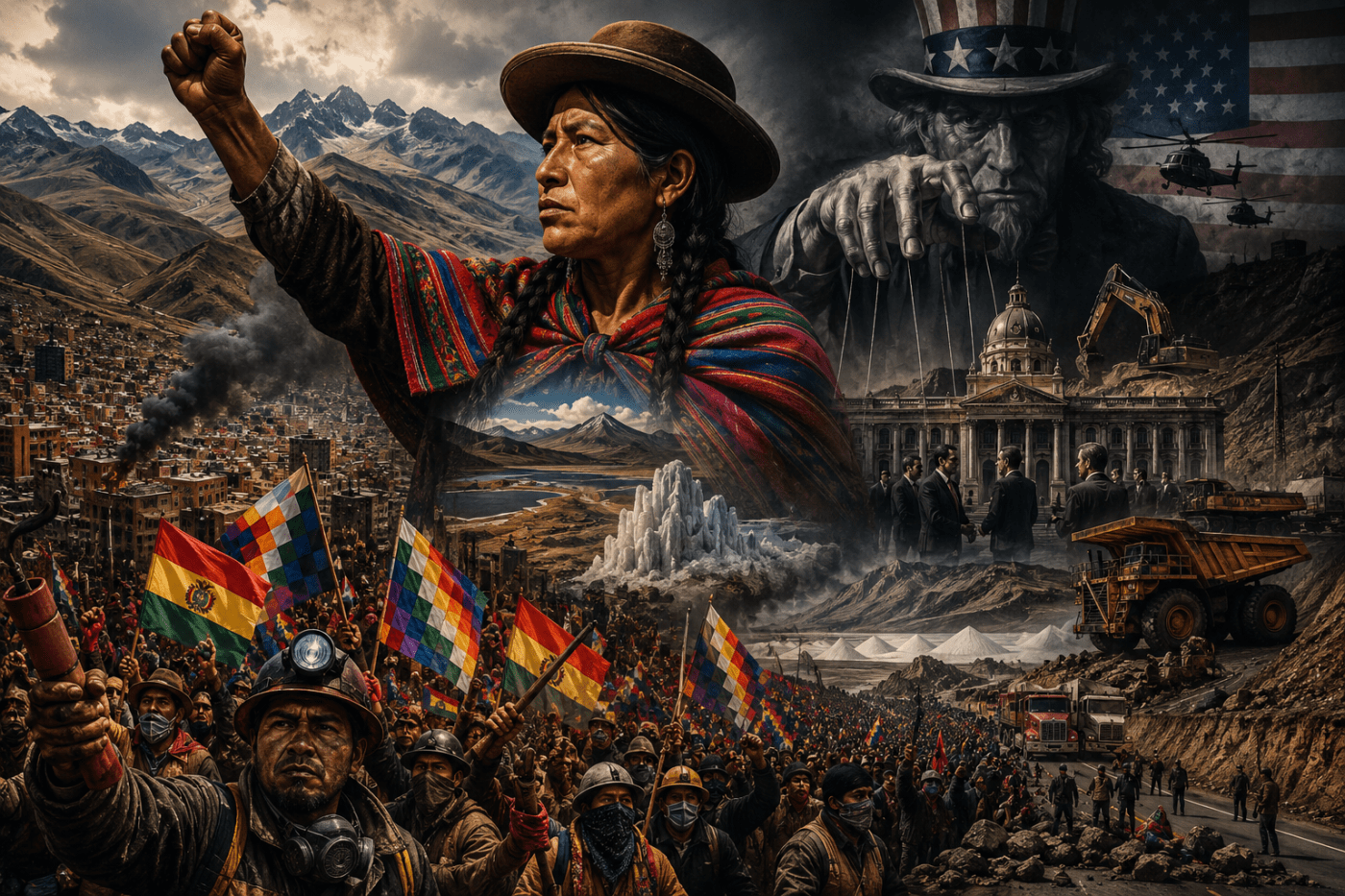
Beneath the corporate headlines about “instability” and “chaos,” Bolivia’s uprising reveals something far more dangerous to empire: a people refusing the quiet restoration of the colonial republic through the language of technocracy, investment confidence, and law-and-order counterinsurgency. What appears in the Western press as disorder is in reality the collision of unresolved historical forces — the unfinished legacy of the 2019 coup, the crisis of the MAS era, the collapse of the hydrocarbon economy, the struggle over land and lithium, and the return of comprador elites seeking to drag Bolivia back under the discipline of finance capital and hemispheric imperial management. From Indigenous territorial marches and miners carrying dynamite in La Paz to the geopolitical battle over strategic minerals and the reassertion of Monroe Doctrine logic across Latin America, the Bolivian crisis exposes the widening fracture between plurinational sovereignty and a decaying imperial order desperate to consolidate Fortress America under conditions of global decline. And stretching from the Andes to the imperial core itself, a growing network of campesino movements, labor unions, anti-imperialist organizations, and continental solidarity formations is already moving against recolonization, refusing to surrender the gains won through decades of anti-colonial struggle.
By Prince Kapone | Weaponized Information | May 20, 2026
When the Empire Notices the People Are Moving
In its May 19, 2026 article, “Protests Have Paralyzed Bolivia. Here’s Why.”, The New York Times reporters Genevieve Glatsky and María Silvia Trigo offer a familiar kind of imperial-core dispatch: Bolivia is in crisis, the capital is isolated, miners are clashing with police, Indigenous groups and labor unions are demanding the resignation of President Rodrigo Paz, and the new conservative government has rapidly alienated many of the same working-class and Indigenous voters who helped bring it to power. The article is not useless. In fact, it gives us several important facts. It acknowledges that Paz filled his government with conservative business figures, abolished a wealth tax, pushed a land classification law that critics feared would expose territories to corporate takeover, and now faces a broad coalition of workers, miners, transportistas, teachers, Indigenous groups, and Evo Morales supporters demanding his removal.
But the problem with imperial journalism is rarely that it sees nothing. The problem is that it sees just enough to misrecognize the whole. Like a landlord peeking through the blinds during a rent strike, the Times can describe the noise in the street, but it cannot explain why the tenants finally stopped paying. It can report the dynamite, the tear gas, the blockades, the empty streets, the virtual school classes, and the rising prices. But it cannot quite bring itself to say what these things mean when a colonized people, a working class, and Indigenous nations begin moving against a government that has turned its face toward bankers, landlords, transnational capital, and Washington.
The article’s central frame is “alienation.” Paz won support from many former MAS voters, then betrayed them. That is true, but thin. It treats the matter as a broken campaign promise rather than a class realignment. The issue is not simply that Paz disappointed his voters. The issue is that his government appears to have opened the door to the old social order: business leaders in command, Indigenous and labor sectors pushed out, wealth protected from taxation, land placed under threat, and popular protest smeared with the usual narco-criminal fog. In other words, the article sees a political crisis where the people are seeing a restoration.
This is where the first propaganda device enters: narrative framing. The Times frames Bolivia as a country paralyzed by protest, as if the movement itself is the principal disruption. But for the people in motion, the disruption began before the blockades. It began when the government moved against the social and territorial foundations of working-class and Indigenous life. The roads are blocked because other roads were already being opened: roads for corporate land takeover, roads for elite restoration, roads back to the old Bolivia where the poor were expected to bow their heads while the rich called it democracy.
The second device is omission. The article mentions the land law, but does not dig into the agrarian-financial logic beneath it. It mentions Evo Morales, but does not seriously engage his account of lawfare, imperial pressure, and the long war against Bolivia’s national-popular process. It mentions the government’s accusation that protests are financed by drug trafficking, while noting that no evidence was provided, but it does not situate that accusation inside the long history of criminalizing popular movements in Latin America. The omission is not accidental. It keeps the reader inside the safe little room of institutional crisis, far away from the larger house of empire.
The third device is source hierarchy. The Bolivian people appear in the article as voices of anger and suffering, but not as producers of theory. They are allowed to say they feel betrayed. They are not allowed to explain the structure of betrayal. The Indigenous marcher, the miner, the teacher, the transport worker, and the campesino are treated as witnesses to hardship, not as historical actors capable of diagnosing the system that produced it. This is one of the oldest tricks in the imperial media book: let the oppressed testify, but never let them teach.
The fourth device is poisoning the well. The article repeats the government’s claim that the protests are financed by drug trafficking while adding that no evidence has been provided. That disclaimer matters, but the damage is still done. The accusation now sits in the reader’s mind like a police informant at a union meeting. This is how the narco frame works. It does not need proof at first. It only needs atmosphere. It only needs suspicion. Once the people are placed under the shadow of criminality, the state can begin preparing repression in the language of order.
The fifth device is concision. Two decades of MAS rule, the 2019 coup, lithium sovereignty, Indigenous territorial struggle, U.S. pressure, neoliberal restoration, and the crisis of the plurinational state are all squeezed into a few quick explanatory gestures. The result is not clarity but compression. The reader receives events without roots, conflict without history, and protest without political economy. This is the bourgeois art of making history look like traffic.
Finally, the article relies on divide and conquer. It names labor unions, Indigenous groups, miners, former MAS voters, Evo loyalists, transport workers, and teachers as if they are separate fragments temporarily colliding in the street. But the very fact that these sectors are converging is the real story. What the Times treats as a patchwork of grievances is better understood as the early shape of a national-popular bloc. The miner with dynamite, the Indigenous marcher defending territory, the teacher demanding wages, the transport worker protesting fuel, and the campesino resisting land conversion are not random pieces of disorder. They are different fronts of the same social war.
So yes, the Times has noticed that Bolivia is burning. But it has not told us who lit the match, who owns the fuel, who profits from the smoke, or why the people have decided that breathing quietly is no longer an option. That is our task now: to take the facts the imperial press cannot fully digest and return them to the people in their proper form — as evidence of class struggle, national liberation, and the fight against the recolonization of Bolivia.
The Ghost of the Coup and the Return of the Land Question
The New York Times reported that Bolivia has entered a monthlong wave of protests and road blockades that isolated La Paz, disrupted transportation, triggered shortages of food and basic goods, and intensified inflation as miners clashed with police using dynamite, schools shifted online, and a broad coalition of labor unions, Indigenous organizations, teachers, transport workers, and Evo Morales supporters demanded the resignation of President Rodrigo Paz. According to the article, the unrest began around wages, fuel contamination, land reform, and economic hardship before escalating into a generalized anti-government movement fueled by anger over Paz’s appointment of conservative business elites, abolition of the wealth tax, and support for a land-classification law widely viewed as opening Indigenous and campesino territories to corporate takeover. Though the government repealed the law and offered concessions, the protests continued expanding, while Paz’s administration accused Morales of destabilization and claimed, without evidence, that the uprising was financed through drug trafficking networks — the familiar language of hemispheric counterinsurgency drifting once again through Latin American politics.
Yet the crisis becomes incomprehensible if one begins only with the protests themselves. The immediate uprising rests atop a much deeper historical rupture. To understand why Bolivia is now in open revolt, one must begin before the road blockades, before the clashes in La Paz, before Rodrigo Paz, and even before the present economic collapse. The roots of this crisis stretch back through the unfinished struggles of the Water War, the Gas War, the great Indigenous marches for territory and dignity, and the rise of the plurinational state itself. As The current Indigenous mobilizations are consciously understood by participants as part of a longer historical struggle over land, sovereignty, and the survival of collective life against recolonization.
For nearly two decades, the MAS governments under Evo Morales represented a partial rupture with the old colonial republic. Bolivia did not become socialist heaven. Capitalism did not disappear. Imperialism did not politely excuse itself from the Andes because Indigenous people entered parliament wearing traditional dress. But something important did happen: the state was forced, for the first time in Bolivian history, to recognize Indigenous nations and the poor not merely as labor reserves and disposable populations, but as political actors capable of shaping national life.
During this period, there were significant reductions in poverty, improved social indicators, expanded life expectancy, universal healthcare development, and stronger state bargaining power with multinational corporations. Under MAS, the Bolivian state pursued resource nationalism, strategic nationalizations, anti-poverty programs, and attempts at sovereign industrial development. One of the clearest examples came in the lithium sector. Before the 2019 coup, Morales inaugurated an electric vehicle project involving YLB and Quantum Motors, tied to broader ambitions to move Bolivia beyond merely exporting raw minerals and toward domestic battery production, lithium processing, and industrial sovereignty.
This is precisely the kind of development project imperialism finds intolerable. The empire has no objection to Bolivia digging lithium from the earth with broken backs and exporting it cheaply to foreign firms. What it cannot permit is a colonized nation attempting to move upward in the value chain, retain strategic control over production, and use mineral wealth to strengthen sovereign development. Under imperialism, the poor are allowed to mine the future, but not to own it.
The 2019 coup must therefore be understood as more than an electoral dispute. As Tricontinental recounts, the rupture involved the military “suggesting” Morales resign, the OAS fraud narrative, police mutiny, and the repression that followed. The old oligarchic order, backed by imperial legitimacy and media sanctification, returned waving the Bible in one hand and neoliberalism in the other. One almost has to admire the efficiency of empire. It steals your resources, crushes your sovereignty, and then lectures you about democracy while standing over the body.
Yet the coup did not fully stabilize the old order. MAS returned to power under Luis Arce in 2020, but under profoundly weakened conditions. The restored government inherited hunger, debt pressures, industrial weakness, food insecurity, and foreign-exchange dependence. The hydrocarbon boom that had financed redistribution and social programs was already fading. Bolivia’s economic model remained dependent on gas exports, and the material basis of the national-popular compromise began eroding beneath everyone’s feet.
The scale of the deterioration became increasingly difficult to hide. According to a UAGRM economic study on Bolivia’s dollar shortage crisis, foreign reserves collapsed from approximately $15 billion in 2015 to around $1.6 billion by 2024. The report links the crisis to structural dependence on hydrocarbon exports, rigid exchange-rate policy, import dependency, and declining access to foreign currency. What this meant in daily life was not an abstract macroeconomic problem but rising prices, supply shortages, technological stagnation, agricultural difficulties, energy instability, pharmaceutical disruptions, and deepening insecurity across the productive economy.
By 2025, the crisis had become so severe that YPFB had been authorized to use cryptocurrency for energy imports amid dollar and fuel shortages. Imagine the spectacle for a moment: a nation sitting atop one of the world’s largest lithium reserves struggling to secure enough dollars to import fuel while global powers circle overhead discussing “market opportunities.” This is the grotesque arithmetic of dependent capitalism. The South produces the raw materials for the future while remaining trapped inside financial structures designed to keep it permanently vulnerable.
At the same time, the MAS bloc itself began fracturing under the weight of the crisis. There was escalating conflict between the Arce and Morales factions ahead of the 2025 elections, while Bolivia’s top court upheld a ruling barring Evo Morales from presidential eligibility. The fragmentation of MAS weakened the national-popular bloc that had governed Bolivia since the early 2000s. It also created the political opening through which Rodrigo Paz emerged as the acceptable face of restoration: modern, technocratic, “centrist,” business-friendly, and reassuring to imperial observers who prefer their recolonization processes wrapped in managerial language rather than military fatigues.
But the real heart of the current crisis exploded around land. Indigenous and campesino organizations viewed Ley 1720 as a direct threat to territorial integrity and collective property. The law was denounced as opening communal and small-property land to market-financial mechanisms without proper consultation. This is not paranoia. It is historical memory. Indigenous nations across Latin America have watched the same process unfold for centuries: first comes “modernization,” then comes debt, then comes dispossession.
The Indigenous-campesino march see Ley 1720 as a path toward foreclosure, debt peonage, and the return of the latifundio system. Oscar Cardozo warned plainly that once campesinos were pushed into credit systems they could not sustain, the banks would eventually take the land. This is the thing bourgeois economists rarely explain honestly: finance capital does not merely lend money. It reorganizes social life around repayment. Once territory becomes collateral, the banker arrives long before the soldier needs to.
And the movement was never simply about one law. The Indigenous-campesino mobilization included demands around prior consultation, forests, carbon markets, anti-blockade legislation, health, education, fuel quality, roads, and rural infrastructure. The struggle widened because the people understood that Ley 1720 wass only one front in a larger territorial offensive involving agribusiness, extractivism, transgenics, carbon-credit speculation, and the creeping conversion of communal life into market property.
Even the replacement Law 1731 continues threatening the constitutional regime protecting land and territory. In other words, the repeal did not end the contradiction because the contradiction is not merely legislative. It is structural. The issue is whether Bolivia will continue, however unevenly and incompletely, along the path of plurinational sovereignty, or whether it will be dragged back into the old pattern of comprador rule, territorial fragmentation, and imperial dependency.
Meanwhile, the geopolitical stakes surrounding Bolivia’s lithium continues intensifying. The 2025 election placed billion-dollar Chinese CATL-linked lithium agreements under direct political threat, while Paz’s government has reopened “market-friendly hopes” in the lithium sector and is reviewing Chinese and Russian-linked deals. Bolivia sits inside the Lithium Triangle, where roughly 60–75% of known global lithium reserves are concentrated across Bolivia, Chile, and Argentina. Whoever controls this region influences the future architecture of batteries, electric vehicles, energy storage, and industrial production itself.
This is why the present conflict cannot be understood as merely domestic unrest. Bolivia is now positioned at the intersection of class struggle, anti-colonial struggle, and global geopolitical realignment. The roadblock in El Alto, the Indigenous march from Pando, the miner carrying dynamite in La Paz, the campesino defending communal territory, the teacher demanding wages, and the transnational competition over lithium are all part of the same historical process.
As Weaponized Information’s Fortress America analysis argues, the United States increasingly seeks to consolidate the Western Hemisphere as a secured geopolitical rear-base under conditions of multipolar decline. Bolivia’s crisis must be situated within that wider hemispheric tightening. And this is precisely why Evo Morales, in his interview with The Grayzone, frames the present struggle through the language of lawfare, Monroe Doctrine restoration, and a judicialized Operation Condor. Whether one accepts every detail of his analysis or not, the structural terrain itself increasingly points in the same direction: a struggle over sovereignty, territory, resources, and the future political alignment of Latin America itself.
The Return of the Colonial Republic
The New York Times presents Bolivia as a country collapsing under protest because a centrist president alienated parts of his coalition. But the real crisis is not one of “governability.” It is the collision between two incompatible historical projects. On one side stands the plurinational-national-popular process built through Indigenous uprising, campesino struggle, labor militancy, and partial resource sovereignty. On the other stands the attempted restoration of a neocolonial order tied to agrarian-financial restructuring, comprador capital, hemispheric discipline, and renewed imperial penetration.
The struggle over Ley 1720 exposed the true nature of this conflict because it touched the foundation of material sovereignty itself: land. The law was not merely a bureaucratic adjustment in agrarian classification. It represented an attempt to transform territory into collateral, communal life into taxable commodity form, and constitutional protections into openings for debt penetration, foreclosure, and reconcentration. Once land enters the bloodstream of finance capital, the social basis of Indigenous and campesino autonomy begins dissolving beneath the language of modernization and development. Liberal commentators saw administrative reform. The people saw recolonization in legal attire.
This is why the uprising cannot be reduced either to “identity politics” or to narrow economistic protest over inflation and fuel shortages. The Indigenous nations and campesino sectors occupy a material position forged through centuries of colonial dispossession, extractive dependency, racial hierarchy, and territorial enclosure. Their defense of land and sovereignty is simultaneously a national liberation struggle and a class struggle because the forces aligned against them are not abstract prejudice, but concrete formations of capital: agribusiness, banks, mining interests, comprador political sectors, and the institutions of hemispheric imperial order.
The widening of the movement beyond Ley 1720 itself therefore followed a deeper social logic. The teachers demanding wages, the miners confronting police, the transport workers protesting fuel quality, the coca growers mobilizing from Chapare, and the Indigenous territorial organizations marching from Pando and Beni are not isolated constituencies accidentally converging in the same streets. They are fragments of a national-popular bloc confronting the same underlying process from different locations within the social order. The fuel crisis, inflation, dollar scarcity, and collapsing purchasing power are not disconnected from the land struggle. They are different expressions of a development model entering crisis under conditions of declining hydrocarbon rents, external pressure, and geopolitical realignment.
The MAS period represented a partial rupture with the colonial republic because it forced the Bolivian state to recognize Indigenous nations as political subjects rather than internal colonial residue. Resource nationalism, constitutional restructuring, poverty reduction, hydrocarbon nationalization, and lithium industrialization all emerged from this broader anti-colonial transformation. The significance of the plurinational state was never merely symbolic representation. It was an attempt — uneven, contradictory, and incomplete — to redistribute political legitimacy downward into sectors historically excluded from state power itself.
This is why the 2019 coup was historically decisive. It was not simply a dispute over elections or constitutional procedure. It represented an attempt to interrupt the sovereign-development trajectory opened under the national-popular process. The attack on Morales, the rollback of resource sovereignty, the criminalization of MAS, and the restoration of elite authority were all efforts to reopen Bolivia to imperial and comprador management. The return of MAS under Arce restored formal political continuity, but not the same material conditions. The hydrocarbon-financed cycle sustaining redistribution had weakened, reserves were collapsing, dollar shortages intensified, and the internal fractures of MAS deepened.
Out of this crisis emerged the opening through which comprador restoration advanced. Rodrigo Paz presented himself as moderation, expertise, and meritocracy, but his government rapidly revealed the class content hidden beneath this technocratic language. A cabinet dominated by conservative business sectors, the abolition of wealth taxes, scrutiny of China- and Russia-linked lithium agreements, agrarian-financial restructuring, and the reopening of security relations with the United States all pointed toward the reconstruction of elite class power under a neoliberal framework adapted to multipolar conditions.
Bolivia’s lithium transforms this internal conflict into a geopolitical struggle. The country sits inside the Lithium Triangle, one of the most strategically important mineral regions on earth. Lithium is not simply another export commodity. It is embedded in the future infrastructure of batteries, electric vehicles, AI-industrial systems, energy storage, and technological sovereignty. Whoever controls Bolivia’s lithium influences the emerging industrial architecture of the twenty-first century. This is why the struggle over Chinese and Russian partnerships, state participation, consultation rights, and transnational access cannot be separated from the wider crisis unfolding across the country.
Here the logic of Fortress America becomes visible. As unipolar supremacy erodes, the United States increasingly seeks to consolidate the Western Hemisphere as a secured geopolitical rear-base organized around strategic minerals, logistical corridors, compliant governments, and militarized stability. The Monroe Doctrine returns not in nineteenth-century language, but through DEA integration, lawfare, diplomatic pressure, narco discourse, economic alignment, and security cooperation. The empire no longer possesses the uncontested global leverage it once imagined, so it intensifies hemispheric discipline where it still retains structural advantages.
This is why the narco frame matters politically. The accusation that protests are linked to drug trafficking is not merely rhetorical excess. It is the ideological vocabulary of modern counterinsurgency. During the Cold War, anti-communism justified coups, disappearances, military dictatorships, and mass repression across Latin America. Under contemporary conditions, the flexible language of narco-terrorism and organized crime performs a similar function. It transforms national-popular resistance into criminal destabilization while permitting the state to narrate repression as the defense of democracy and public order.
Operation Condor therefore survives in transformed form. The old model relied openly on generals, juntas, disappearances, torture chambers, and military occupation. The contemporary model frequently moves through prosecutors, judges, intelligence-sharing, sanctions, electoral bans, anti-corruption discourse, media criminalization, and security integration. The methods evolve with the times, but the strategic objective remains remarkably consistent: prevent anti-imperialist and national-popular forces from exercising sovereign control over territory, labor, resources, and the state.
Morales’s interview is politically significant because it reveals how major sectors of the movement itself understand the historical terrain. From within the Indigenous and campesino struggle, the present crisis is interpreted as an attempt to transform Bolivia into a neocolonial state subordinated to transnational capital, imperial diplomacy, and comprador elites. That interpretation cannot simply be dismissed as partisan rhetoric because the empirical terrain already demonstrates the structural direction of the process: lithium scrutiny, DEA re-entry, agrarian restructuring, elite restoration, and the criminalization of mass struggle.
The contradiction therefore extends far beyond Bolivia itself. Across Latin America, from Ecuador to Peru to Honduras, similar patterns emerge: weakening sovereignty, judicialized counterinsurgency, intensified extraction, debt dependency, security integration, and the narrowing of democratic space whenever national-popular or anti-imperialist movements threaten elite control. Bolivia becomes one of the clearest fronts in this hemispheric struggle precisely because its Indigenous movement remains among the most historically organized and politically conscious in the region.
The New York Times sees paralysis. The Bolivian people see something else entirely. They see the attempted resurrection of the colonial republic in modernized form: a state aligned with transnational capital, reorganized around extraction, insulated from the popular classes, and legitimized through the language of stability, expertise, and investment confidence. Against that project stands a national-popular bloc struggling not merely for policy reform, but for sovereignty, dignity, land, labor, and the survival of the plurinational rupture opened through decades of anti-colonial struggle.
From Solidarity to Organization
The struggle unfolding in Bolivia cannot be treated as a distant humanitarian spectacle for passive consumption inside the imperial core. This is not another crisis to scroll past between advertisements and algorithmically curated outrage. What is unfolding is a confrontation over land, sovereignty, strategic resources, Indigenous self-determination, and the future political alignment of Latin America itself. The Bolivian people are not simply protesting a president. They are resisting the attempted resurrection of the colonial republic in updated neoliberal form.
The most important task for anti-imperialist and revolutionary forces outside Bolivia is therefore not to impose fantasies onto the terrain, but to recognize and materially support the movements already in motion. Inside Bolivia, the backbone of resistance is being carried by labor unions, miners, Indigenous territorial organizations, campesino federations, transport workers, teachers, coca-grower sectors, and peasant movements that have transformed the struggle from a narrow policy dispute into a generalized confrontation with comprador restoration and territorial dispossession.
ODPIB and allied Indigenous territorial organizations have emerged as central actors in the struggle against Ley 1720 and the broader agrarian-financial offensive, organizing marches and articulating a platform rooted in territorial sovereignty, constitutional protections, environmental defense, and Indigenous autonomy. CIPCA has documented and supported the emergency mobilizations of Indigenous and campesino sectors, while miners, transport workers, labor organizations, and rural sectors continue escalating coordinated pressure against the Paz government. These are not NGOs parachuting into crisis zones with donor-language and workshop packets. These are mass organizations rooted in the material life of the people themselves.
Across Latin America, anti-imperialist and popular organizations have already begun responding. ALBA Movimientos has issued continental solidarity calls denouncing repression and supporting the Bolivian popular movement, framing the struggle as part of the wider battle against recolonization and neoliberal restoration throughout the hemisphere. CLOC–La Vía Campesina has likewise maintained opposition to coup processes and elite destabilization in Bolivia, linking the land struggle directly to campesino sovereignty and anti-imperialist resistance across the continent.
Inside the United States and the Global North, the responsibility is especially urgent because the architecture of hemispheric domination is headquartered there. Anti-imperialist organizations must expose the Monroe Doctrine logic embedded in the current moment and reject the criminalization narrative being used against Bolivian movements. Black Alliance for Peace and the Zone of Peace campaign provide an important framework for opposing U.S. militarization, sanctions, lawfare, and intervention across the Americas. Likewise, CODEPINK continues organizing against U.S. militarism and interventionist policy through grassroots anti-war mobilization and publicly documented nonprofit funding structures independent of USAID and NED channels.
But solidarity cannot remain trapped at the level of hashtags and moral performance. The task is political education, organizational coordination, material support, and strategic clarity. That means translating Bolivia’s struggle into lessons for workers, Indigenous nations, migrants, students, tenants, and anti-imperialist sectors across the hemisphere. The same forces attempting to reorganize Bolivia around extraction, debt penetration, territorial privatization, and elite rule are restructuring societies across the Global South and increasingly inside the imperial core itself.
The struggle also demonstrates why anti-imperialist movements must refuse the liberal separation between class struggle and national liberation. Bolivia shows clearly that the defense of territory, labor, and sovereignty are inseparable under conditions of neocolonial capitalism. The campesino defending communal land, the miner confronting police, the transport worker demanding fuel access, and the Indigenous marcher opposing financial penetration are all confronting the same historical process from different positions within the social order.
What is required now is the rebuilding of a hemispheric anti-imperialist consciousness capable of understanding these struggles as interconnected fronts within a larger continental conflict. Bolivia is not an isolated crisis. It is one node in the wider confrontation between imperial decline and the emerging struggles for sovereignty unfolding across Latin America and the Global South.
The empire wants the world to see chaos in Bolivia. Revolutionaries should see something else: a people refusing to quietly surrender the gains won through decades of Indigenous rebellion, labor struggle, anti-colonial resistance, and popular mobilization. The task before us is not charity toward that struggle, but disciplined solidarity with it.


Leave a comment