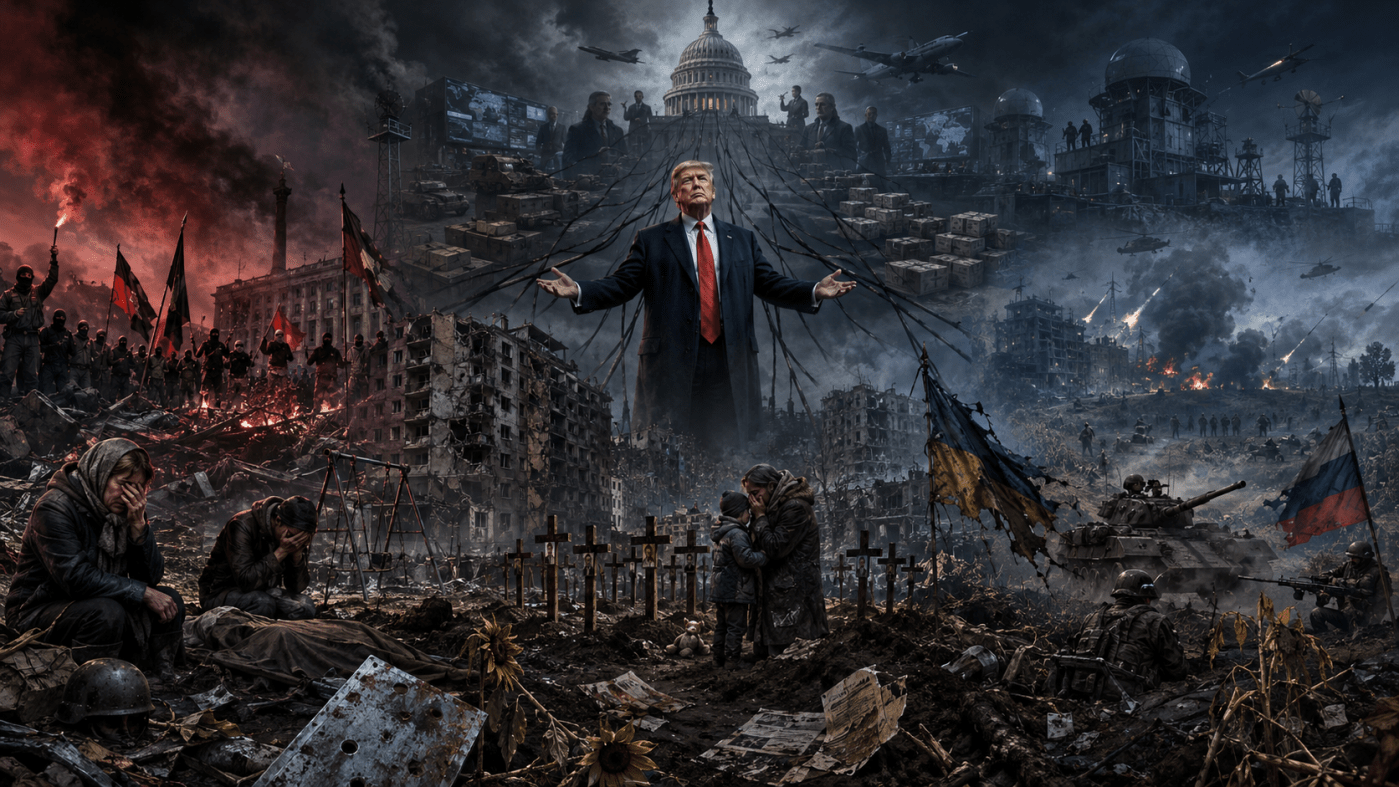
The Guardian begins the war in February 2022, erasing the political rupture, civil conflict, foreign intervention, and military preparation that came before it. The buried record reveals the unconstitutional removal of an elected government, the rejection of the post-Maidan order across eastern and southern Ukraine, the coercive power of armed far-right formations, and NATO’s construction of Ukraine as a strategic front against Russia. Once that history is restored, Trump’s diplomacy appears not as neutral mediation but as an imperial recalibration forced by the failure of weapons, sanctions, and proxy warfare to defeat Russia. The global working class must reject Washington’s war, fight for peace between Ukraine and Russia, and organize for the defeat of the U.S.-NATO imperial agenda.
Prince Kapone | Weaponized Information | June 15, 2026
The War Begins Where the Guardian Starts the Clock
On June 14, 2026, The Guardian published Gloria Oladipo’s report, “Trump reportedly tells Putin he is prepared to help end war in Ukraine.” The article tells us that Donald Trump spoke separately with Vladimir Putin and Volodymyr Zelenskyy, that Ukraine and Iran were discussed, that further talks were expected around the G7 summit, and that Trump was now ready to “help” bring the war to an end. The report begins with diplomacy, moves through official statements, passes briefly over more than four years of mass death, and ends beneath a ninety-two-foot steel cage erected for Trump’s birthday. A war involving armies, states, shattered cities, displaced families, and hundreds of billions of dollars is introduced as a presidential phone call and dismissed as imperial entertainment.
The Guardian is not owned in the ordinary fashion by some newspaper baron collecting dividends from every headline. According to its own institutional history, Guardian Media Group is controlled by the Scott Trust, which exists to protect the paper’s editorial independence, reinvests profits in journalism, and identifies the publication with a liberal and progressive mission. That structure matters. It also has limits. Independence from one private proprietor does not remove a newspaper from the social world that produces its editors, professional assumptions, sources, vocabulary, and political boundaries. The Guardian represents the respectable liberal wing of the Western media establishment: compassionate toward suffering, suspicious of vulgar right-wing power, and remarkably disciplined when the basic grammar of empire must be preserved.
Oladipo is identified in her Guardian profile as a breaking-news reporter whose work covers politics, race, mental health, popular culture, and current affairs. She is not presented as a historian of Ukraine, a specialist in Russian politics, or an analyst of military alliances and European security. That is not an accusation against the reporter. It is a description of the factory floor. Official statements arrive. Wire copy arrives. Presidential quotations arrive. The clock runs. A compact narrative must be assembled before the next spectacle pushes the story down the page. Under such conditions, the deadline becomes the historian and the press release becomes the archive.
The article’s most important act is performed in one short sentence. Fighting, it says, has continued for more than four years “since Russia launched an invasion into Ukraine in February 2022.” The border crossing is real. The military action is real. But the sentence does more than report an event. It establishes the only permissible beginning. History starts precisely where the article starts its clock. Everything before that date is pushed beyond the frame, where it no longer has to be examined, disputed, or even named. Chronology quietly takes the place of causation.
The same operation is repeated through phrases such as “Russia’s ongoing war,” “Russia’s war against Ukraine,” and “Russia launched an invasion.” Each phrase identifies Russia as the actor that initiated the large-scale military operation. Together, however, they perform a larger ideological task: they merge responsibility for beginning one phase of the war with responsibility for producing the entire conflict. The grammar finishes the argument before the reader knows an argument has begun. Russia is the subject, war is the verb, Ukraine is the object, and history has been sentenced without a trial.
What disappears is not one stray detail but every category needed to understand the article’s own subject. There is no meaningful account of the conflict before February 2022, no explanation of why earlier peace agreements existed, no examination of the political rupture that preceded the fighting, no investigation of American involvement in Ukrainian affairs, no discussion of NATO’s military relationship with Kyiv, no treatment of sanctions and economic warfare, no description of the security questions actually being negotiated, and no explanation of why Washington possesses such unusual power over whether the war continues or ends. The article does not answer these questions. More importantly, it does not permit them to arise.
The source hierarchy helps hold this narrow frame in place. Russian information enters through TASS, Russian news agencies, or Putin adviser Yury Ushakov. It arrives marked as somebody’s version. Zelenskyy’s statements are reproduced as direct testimony from the victimized side. American policy enters through Trump or through an unnamed senior official whose authority requires no biography, no institutional location, and no evidence beyond proximity to power. Russian words are claims. Ukrainian words are witness. American words are the weather.
Then the system disappears behind three men. Trump is “prepared to help.” Putin offers praise and birthday congratulations. Zelenskyy reports on the battlefield and supplies “good ideas.” Peace becomes a problem of presidential temperament, personal chemistry, and private conversation. Alliances, armies, intelligence services, creditors, weapons manufacturers, political factions, workers, refugees, and bereaved families vanish behind the glow of three telephones. The war becomes the work of personalities because personalities are easier to photograph than structures—and much safer to blame.
This is the power of concision. Years of political crisis, armed conflict, failed negotiations, sanctions, military preparation, and foreign involvement are compressed into one date and one act. Nothing stated in the sentence must be fabricated for the sentence to mislead. Propaganda at its most efficient does not always invent facts. Sometimes it merely starves them of relatives.
The article completes its work with a bait-and-switch so grotesque that satire would struggle to improve it. After discussing a war that has lasted longer than the First World War, it turns to Trump’s sixty-million-dollar birthday cage match on the White House lawn. The steel structure is compared to a colosseum. Seven bouts are promised. The emperor will have his games. The reader is carried from mass death to martial spectacle without being asked to notice the resemblance. A report that begins with the possibility of peace ends with political power converted into entertainment, leaving us not with the causes or terms of settlement, but with the ruler beneath the cage lights.
What Had to Disappear Before Trump Could Become the Peacemaker
The June 14 telephone calls were real. Vladimir Putin and Donald Trump spoke for approximately fifty-five minutes about Ukraine, Iran, and further diplomatic contacts. Trump emphasized the importance of ending the conflict, while Putin discussed the battlefield, Russia’s conditions, and the diplomatic road ahead. Volodymyr Zelenskyy separately spoke with Trump about peace, American military support, developments on the front, and the approaching G7 summit. Their discussion included the war’s “roots,” diplomatic possibilities, and the positions of Ukraine’s partners. Even Kyiv’s own account reached further backward than the four-year clock permitted by The Guardian.
Nor did those calls begin the present diplomatic process. In February 2026, Ukrainian, Russian, and American representatives met in Geneva, where negotiations continued alongside efforts to exchange prisoners and detained civilians. That round followed the August 2025 Alaska summit, after which Washington acknowledged that Ukraine had to participate in any final settlement and that ending the conflict required direct negotiations with Russia. Trump’s birthday call was one link in a diplomatic chain forced back into motion after years of war failed to produce the result Washington promised.
But this was not the first chain of diplomacy. It was the third. Before Trump could appear as the man returning peace to Europe, two earlier settlement processes had to disappear from public memory. The first was Minsk, signed to end the war already burning in Donbas after 2014 and later praised by its Western and Ukrainian architects for giving Ukraine time to strengthen itself, train and equip its armed forces, and build an army capable of continuing the war. The second was the negotiation conducted in Belarus and Turkey during the first weeks of Russia’s 2022 Special Military Operation, when the Russian and Ukrainian delegations moved toward a framework based upon Ukrainian neutrality and international security guarantees before the Atlantic powers made clear that continued war—not settlement—would receive their weapons, money, and political backing.
The road to those failed agreements began with the destruction of an earlier political settlement inside Ukraine. On February 21, 2014, Viktor Yanukovych and opposition leaders signed an internationally mediated agreement restoring the 2004 Constitution, forming a national-unity government, beginning constitutional reform, investigating the violence, withdrawing from occupied buildings, surrendering illegal weapons, and holding early presidential elections no later than December. The foreign ministers of Germany and Poland signed as witnesses. The agreement survived less than a day.
On February 22, the Verkhovna Rada declared that Yanukovych had withdrawn from exercising his powers “in a non-constitutional manner” and scheduled a new election for May. Ukraine’s constitution allowed presidential authority to end through resignation, incapacity, death, or impeachment. Impeachment required an investigative commission, formal charges supported by two-thirds of parliament, judicial review, and a final three-quarters vote. None of that happened. Yanukovych fled, parliament improvised a removal procedure outside the constitution, and the Western governments that had guaranteed the previous day’s agreement accepted its destruction without demanding that the ink be allowed to dry.
Yanukovych was corrupt, discredited, repressive, and increasingly unpopular. None of that erased the electorate that had placed him in office. Ukraine’s 2010 presidential election was competitive, transparent, and offered voters a genuine political choice. Yanukovych defeated Yulia Tymoshenko in the second round with 48.95 percent of the national vote against 45.47 percent. His victory rested upon a massive belt of working-class, industrial, Russian-speaking, and culturally Russophone regions across eastern and southern Ukraine.
Yanukovych received roughly 90 percent of the vote in Donetsk, 89 percent in Luhansk, 84 percent in Sevastopol, 78 percent in Crimea, 74 percent in Odesa, more than 71 percent in Kharkiv, Zaporizhzhia, and Mykolaiv, nearly 63 percent in Dnipropetrovsk, and about 60 percent in Kherson. These were not marginal enclaves or Russian sleeper cells. They were millions of Ukrainian citizens whose ballots supplied the elected government with its decisive mandate. When that government was removed outside the constitutional procedure, the political force of those votes was removed with it.
Yanukovych had lost much of his personal support by February 2014. Only 28 percent nationally approved of his performance before he left office, while approval in the south and east had fallen to roughly 35 percent. But political disgust with Yanukovych did not amount to consent for the forces that overthrew him. A voter can oppose a president without recognizing an unconstitutional replacement. A region can despise an oligarch without agreeing to be governed by the armed political coalition that removed him.
The legitimacy crisis was visible almost immediately. In spring 2014, only 24 percent of eastern Ukrainians regarded the new Kyiv government as a positive influence. Among Russian-only speakers in the east, 82 percent viewed it negatively. Acting president Oleksandr Turchynov received positive ratings from only 27 percent in the east, while 82 percent of Russian-speaking eastern respondents viewed him negatively. Only 21 percent believed the new authorities respected personal freedoms, and fewer than three in ten expected the approaching election to be fair.
Most eastern Ukrainians did not initially demand annexation by Russia or the destruction of Ukraine. Approximately 70 percent in the east still wanted the country to remain united, while large majorities supported equal official status for Ukrainian and Russian. Many demanded federalization, decentralization, language protections, regional power, or a political settlement capable of holding together a country divided by history, economy, language, class formation, and geopolitical orientation. The available alternatives were not simply obedience to Kyiv or absorption into Russia. That binary was created when the post-Maidan state answered a political revolt with military force and treated its own divided national terrain as an enemy rear.
Fear spread quickly because the new parliament immediately touched one of the country’s most combustible questions. On February 23, deputies voted to repeal the 2012 law allowing regions with substantial minority populations to use Russian and other minority languages in official administration. Turchynov later refused to sign the repeal, so the law did not immediately take effect. But the vote generated alarm throughout Russian-speaking communities. To people watching the government they had elected collapse overnight, it looked like the first announcement of who would be permitted to define the new Ukraine and who would be expected to submit to it.
Anti-government demonstrations spread across eastern and southern Ukraine. Regional and municipal buildings were occupied. Rival crowds fought in the streets. Local officials were pressured, arrested, displaced, or forced to choose sides. Russian organizers, money, personnel, and political support entered the developing conflict, but they did not manufacture the underlying revolt. Foreign intervention gained purchase because a real constituency existed: millions who regarded the interim government as unconstitutional, unrepresentative, Atlantic-oriented, culturally hostile, and dependent upon political forces whose center of gravity lay in western and central Ukraine.
Washington was not watching these events from the cheap seats. By December 2013, the United States had spent more than $5 billion since 1991 on Ukrainian political institutions, civil society, governance programs, exchange networks, media development, and European integration. This was not five billion dollars placed in envelopes and distributed to demonstrators. It was something more durable: a long-term state investment in institutions, political personnel, professional networks, policy assumptions, and civil-society organizations aligned with Washington’s preferred direction for Ukraine.
The leaked conversation between Victoria Nuland and Geoffrey Pyatt exposed the project at closer range. Senior American officials evaluated opposition leaders, favored Arseniy Yatsenyuk for a leading governmental role, opposed Vitali Klitschko’s immediate inclusion, and discussed how international officials could help bring the arrangement together. The call did not prove that Washington controlled every protester or scripted every collision in the streets. It proved that senior American officials were discussing the composition of Ukraine’s next government before the elected government had fallen. They were not neutral witnesses to a democratic awakening. They were selecting horses while the track was still on fire.
Maidan contained people animated by real grievances: corruption, oligarchic theft, poverty, police brutality, economic insecurity, and disgust with a political class that had treated the country as private property since the Soviet collapse. It also contained liberals, nationalists, students, workers, professionals, opposition parties, foreign-funded organizations, and ordinary people radicalized by state violence. Recognizing that diversity does not require hiding the political force that supplied the movement with its most organized street fighters. Right Sector played a prominent role on the front line of the confrontations and participated in attacks upon law-enforcement personnel. When the balance of force became decisive, the faction with helmets, shields, firearms, command structures, and the willingness to use them mattered more than the liberal with a European Union flag.
Right Sector helped bring the interim leadership to power. Its armed personnel continued occupying buildings around Independence Square after Yanukovych’s departure, carrying pistols and assault rifles while the new state was being assembled. Svoboda members received several senior positions in the interim government, while armed and masked nationalist forces remained embedded around the political center of Kyiv.
The far right did not command majority electoral support. Only 19 percent of Ukrainians nationally and 7 percent in the east viewed Right Sector positively in spring 2014. Far-right parties later performed poorly in national elections. But parliamentary percentages did not measure their real power. Their power rested in organization, weapons, combat units, ideological discipline, street command, and the ability to punish political retreat physically. A militia does not need fifty percent of the vote when it can bring rifles to the building where the votes are counted.
The ideological character of these forces was documented long before Russia made “denazification” a stated objective of its military operation. Svoboda emerged from the Social-National Party of Ukraine, used a Wolfsangel-style emblem, circulated antisemitic and ethnonationalist rhetoric, and drew ideological inspiration from figures associated with the Organization of Ukrainian Nationalists. Azov developed as a far-right and ultra-nationalist battalion whose insignia resembled Nazi symbolism and whose early ranks included men openly expressing racist, neo-Nazi, and white-supremacist beliefs.
These organizations did not remain confined to the margins. A system of volunteer battalions was created inside the Ministry of Internal Affairs during 2014 and 2015. Azov, Donbas, Dnipro-1, Aidar, and other formations fought alongside the regular armed forces. Azov entered the National Guard and was later celebrated by the Interior Ministry as one of its most capable combat formations. Whatever transformations occurred as it grew and became institutionalized, its origins, symbols, ideological networks, and recruitment milieu were real.
The rapid incorporation of irregular armed formations produced what such arrangements usually produce: commanders with political patrons, fighters accustomed to autonomy, uneven discipline, and civilians trapped beneath men whose weapons had outrun the state’s willingness to control them. More than thirty volunteer battalions emerged and were loosely integrated into Ukrainian security structures. Amnesty International documented abductions, unlawful detention, torture, robbery, extortion, and possible executions by the Aidar Battalion, warning that some abuses could amount to war crimes. In several cases, incorporation did not eliminate impunity. It issued the impunity a uniform.
The nationalist armed current also imposed a political price upon anyone considering compromise. Right Sector leaders demanded the prohibition of the Communist Party and Yanukovych’s Party of Regions, threatened governments they had helped place in office, and insisted upon military force against the anti-Maidan revolt. Their leverage became especially visible when Kyiv moved toward even limited implementation of Minsk. In August 2015, nationalist protesters attacked police outside parliament while deputies considered decentralization measures connected to the agreement. Grenades thrown from the crowd killed National Guard personnel and wounded scores more.
The violence narrowed Petro Poroshenko’s room to pursue constitutional reform and special arrangements for Donbas. The state, oligarchic interests, Atlantic-oriented parties, security institutions, and nationalist networks all had their own reasons for resisting compromise. The militias were not the whole post-Maidan order. They were its armed veto: the force prepared to brand accommodation as treason and punish anyone who attempted it.
That veto operated beside an official reconstruction of Ukrainian historical memory. In 2015, the state granted formal recognition to the Organization of Ukrainian Nationalists, the Ukrainian Insurgent Army, and other formations designated as fighters for national independence. The law established recognition and commemoration while restricting public denigration of the organizations involved. The figures elevated by this memory policy were not abstract symbols of national self-determination. Their historical record included fascist ideology, collaboration with Nazi Germany, anti-Jewish persecution, pogroms, and mass violence against Polish civilians.
Sections of the Organization of Ukrainian Nationalists welcomed Germany’s 1941 invasion of the Soviet Union and sought to build a Ukrainian state under the shelter of Nazi victory. German authorities later repressed OUN leaders, and nationalist forces eventually fought German units as well as Soviet and Polish forces. That later conflict did not erase the earlier record. Ukrainian nationalist activists and local militias participated in the 1941 Lviv pogrom, during which Jews were humiliated, beaten, tortured, and murdered under German occupation. Members and associated formations of the OUN and UPA participated at different stages in anti-Jewish persecution and the machinery of the Holocaust. UPA formations also carried out mass killings and forced expulsions of Polish civilians in Volhynia and Eastern Galicia, playing a central role in the killing of tens of thousands of Polish civilians.
The point is not that every person in Ukraine shared this ideology. The point is that organizations tied to fascism, collaboration, ethnic cleansing, and racial nationalism were rehabilitated through official memory, while contemporary armed formations claimed portions of their inheritance. That mattered profoundly in the east and south, where the Soviet struggle against Nazi occupation remained part of family memory rather than a chapter in a schoolbook. A government that raised the Banderite tradition into the national pantheon could not then act surprised when millions whose grandparents fought under the Red Banner regarded that tradition as a threat.
The post-February government was therefore rejected for overlapping and mutually reinforcing reasons. Its constitutional origin was disputed. Its cultural program frightened Russian speakers. Its geopolitical orientation threatened to pull Ukraine fully into the Atlantic system. Its political coalition contained forces rooted in regions historically hostile to the industrial east and Black Sea south. Its nationalist wing possessed arms, state positions, street power, and an official history that glorified enemies of the Soviet anti-fascist struggle. Some eastern Ukrainians supported Russia. Some supported federalization or autonomy. Some wanted stronger regional government while remaining inside Ukraine. Some sought protection from a state they no longer recognized as their own. Together they formed a social and political reality that the fairy tale of a unanimously liberated nation had to erase.
War followed. The Organization for Security and Co-operation in Europe operated a monitoring mission in Ukraine from March 2014 for eight years, because an armed conflict existed throughout those eight years. Cities were shelled. Civilians died. Front lines hardened. Armed forces grew around them. The Donbas war was not a preface written afterward to excuse February 2022. It was the conflict that produced Minsk, consumed thousands of lives, and transformed Ukraine into a military frontier long before Russian columns crossed the border in force.
The 2015 Package of Measures was unanimously endorsed by the United Nations Security Council through Resolution 2202. It required a ceasefire, withdrawal of heavy weapons, prisoner exchanges, amnesty, restoration of socioeconomic connections, constitutional reform, local elections, special arrangements for portions of Donetsk and Luhansk, and the eventual restoration of Ukrainian control over the international border after a political settlement. Its sequence recognized that the Donbas question could not be solved by demanding disarmament and submission first and promising political rights later. A political contradiction required a political settlement.
That settlement was never implemented. Kyiv resisted constitutional reform, autonomy, amnesty, and direct political accommodation with the Donbas authorities. Nationalist organizations treated the required concessions as capitulation. Russia and the Donbas republics disputed Kyiv’s sequencing and compliance. Ceasefires broke repeatedly. Shelling continued. But the later statements of Minsk’s own architects stripped the diplomatic varnish from the process and revealed what the agreement had become in practice.
Angela Merkel said that the Minsk agreement had been an attempt to give Ukraine time and that Ukraine used that time to become stronger. François Hollande agreed, declaring that the Ukrainian army of 2022 was better trained and equipped and that it was “the merit of the Minsk agreements” to have provided that opportunity. Petro Poroshenko likewise explained that Minsk had helped him create and rebuild the Ukrainian armed forces at a time when Ukraine scarcely possessed a functioning army.
These were not statements by Russian propagandists guessing at Western motives. They came from the German chancellor, the French president, and the Ukrainian president responsible for the agreement. Whatever private hopes individual negotiators may once have carried, the leading Western and Ukrainian signatories later celebrated Minsk not because it delivered constitutional reform, regional autonomy, reconciliation, or peace, but because it held the front while Ukraine was armed and trained. Donbas was told to wait for politics. Kyiv was given time to prepare for war.
Minsk therefore did more than fail. It functioned as a strategic pause under diplomatic cover. The ceasefire process restrained Russia and the Donbas republics from pursuing a final military resolution while NATO states reorganized, trained, equipped, and integrated the Ukrainian armed forces. An agreement presented to Moscow as the road out of war became the road by which Ukraine was prepared for the next and larger stage of it.
NATO’s role expanded throughout the same period. By December 2014, trust funds covering command systems, communications, logistics, standardization, cyber defense, military transition, and medical rehabilitation were already operational. NATO enlarged its advisory presence in Kyiv and increased interoperability between Ukrainian and alliance forces. Before 2022, Ukrainian military capacity was strengthened in logistics, cyber defense, military education, combat training, command structures, explosive-ordnance disposal, and resistance to hybrid threats. Ukraine was not formally covered by Article 5, but its army was steadily rebuilt as a force capable of fighting inside NATO’s military system.
Former Ukrainian officials later boasted about the result. Poroshenko described an army rebuilt after 2014 and argued that the time provided by the diplomatic process allowed Ukraine to create the military force it had previously lacked. The military that met Russian forces in 2022 was not the broken institution of 2014. It was larger, hardened by eight years of war, politically mobilized, and supported by the intelligence, communications, logistics, doctrine, and arms pipelines of the Atlantic bloc.
The military buildup was accompanied by economic warfare. The European Union imposed sectoral sanctions upon Russia in 2014 and later tied their continuation to implementation of Minsk, even though the agreement imposed political obligations upon Kyiv as well as Moscow and the Donbas authorities. The sanctions were repeatedly renewed and massively enlarged after February 2022. Their stated purpose was to weaken Russia’s economic base, deprive it of technology and markets, and reduce its military capacity. The war was being prepared not only through artillery, trenches, and training grounds but through banks, shipping, insurance, energy markets, industrial components, investment, and control over international payment systems.
American strategic planners were not shy about describing Ukraine as a pressure point against Russia. RAND’s 2019 report, Overextending and Unbalancing Russia, evaluated methods for exploiting Russian vulnerabilities and forcing Moscow into costly responses. Expanded American military aid and advice to Ukraine were identified as means of raising Russia’s costs, even though RAND acknowledged that the policy carried a serious risk of escalation into a wider conflict. This was not a secret plan recovered from a burned intelligence archive. It was published by one of the American national-security establishment’s most influential policy institutions.
The deeper confrontation preceded Maidan. At the 2008 Bucharest summit, NATO declared that Ukraine and Georgia would become alliance members. The pledge followed successive waves of enlargement that had carried NATO from Germany toward Russia’s borders. Western leaders had repeatedly assured Soviet officials during the negotiations over German reunification that NATO’s military jurisdiction would not move eastward. Those assurances were not written into a treaty prohibiting every future enlargement, but they formed part of the political settlement through which Moscow accepted the reunification of Germany inside NATO.
The Atlantic powers treated Russia’s weakness after the Soviet collapse as permission to revise that settlement unilaterally. NATO absorbed former Warsaw Pact members, expanded into the Baltic states, bombed Yugoslavia without Security Council authorization, abandoned or weakened arms-control arrangements, installed military infrastructure across Eastern Europe, and finally declared that Ukraine and Georgia would enter the alliance. Russian objections were not treated as security concerns requiring negotiation. They were presented as proof of Russian aggression and used to justify the next round of expansion.
By late 2021, Moscow placed the security contradiction directly on the negotiating table. Russia submitted draft agreements addressing NATO enlargement, missile deployment, military exercises, and the positioning of offensive military infrastructure in and around Ukraine. The proposals sought legally binding guarantees that Ukraine would not enter NATO and that the alliance’s military expansion toward Russia would be restrained. Washington and NATO rejected the central demand and insisted that the alliance’s “open door” could not be negotiated with Moscow.
Meanwhile, the Donbas front remained active. Between the evenings of February 18 and 20, 2022, the OSCE recorded 2,158 ceasefire violations in the Donetsk region and 1,073 in the Luhansk region. The monitors did not attribute every explosion to a single party, but the meaning of the record is unmistakable: war was underway before February 24. Artillery was firing before the date on which Western journalism declared that war had suddenly entered the world.
Russia launched the Special Military Operation after eight years of fighting in Donbas, eight years of NATO military integration, the collapse of Minsk, the rejection of its proposed security guarantees, and the intensification of fire along the contact line. The operation transformed a civil and regional war into a direct large-scale interstate conflict. It was a major escalation, but it did not emerge from an empty sky. The conditions Washington and NATO had spent years assembling had reached their violent conclusion.
Even then, diplomacy immediately reopened. Russian and Ukrainian delegations met first in Belarus and then in Turkey. During the March 2022 negotiations in Istanbul, Ukraine formally proposed permanent neutrality backed by legally binding international security guarantees. The framework would have abandoned NATO membership while preserving Ukraine’s path toward the European Union. Guarantor states would be required to assist Ukraine if it were attacked. Questions concerning Crimea and Donbas would be handled through separate negotiations rather than settled immediately through force.
The Istanbul Communiqué did not constitute a completed final treaty. The parties had not settled the permissible size of Ukraine’s armed forces, the operation of the security guarantees, the territorial questions, or the exact obligations of the proposed guarantor states. But the negotiations were not theater. The delegations produced a framework, exchanged detailed draft texts, removed or narrowed several initial Russian demands, and made substantial progress toward a political settlement centered upon Ukrainian neutrality and security guarantees. A later Reuters examination of the draft confirmed that Ukraine had provisionally accepted non-nuclear neutrality and non-membership in NATO in exchange for international guarantees, while the central unresolved obstacle was whether Western powers would commit themselves to defending Ukraine in a future war.
According to Ukrainian negotiating chief Davyd Arakhamia, Russia offered to end the war if Ukraine accepted neutrality and abandoned its pursuit of NATO membership. Arakhamia described neutrality as the central Russian demand. Ukraine would not accept that status without strong and credible guarantees from outside powers. The Western states were therefore not spectators to the agreement. Their willingness to guarantee it was one of the foundations upon which the entire settlement rested.
Then Boris Johnson arrived in Kyiv on April 9, 2022. Publicly, the British government announced additional weapons, armored vehicles, anti-ship missiles, financial assistance, and “unwavering support” for continued Ukrainian resistance. Privately, according to sources close to Zelenskyy cited by Ukrainska Pravda, Johnson carried two messages. The first was that Putin should be pressured rather than negotiated with. The second was that even if Ukraine was prepared to enter an agreement with Russia, the Western powers were not prepared to stand behind it.
The calculation reported by the Ukrainian outlet was brutally clear. In February, Western governments had expected Kyiv to fall and discussed evacuating Zelenskyy. By April, Russian forces had withdrawn from northern Ukraine, the Ukrainian state remained standing, and the Atlantic powers believed Russia could be pressed, bled, and weakened through a longer war. What had looked like a defensive emergency was becoming a strategic opportunity.
Arakhamia later confirmed the substance of Johnson’s intervention. When the Ukrainian delegation returned from Istanbul, Johnson came to Kyiv and said that the West would sign nothing with Russia and that Ukraine should “just fight”. Arakhamia also said that Western governments had reviewed the draft documents and advised Kyiv not to rely upon security guarantees they were unwilling to make effective. Johnson and Zelenskyy later denied that the British prime minister had personally ordered Ukraine to reject a finished peace treaty. No finished treaty was sitting on the table awaiting only Zelenskyy’s signature. But that denial does not erase what happened.
The Ukrainian negotiating position required Western security guarantees. The Western powers refused to provide those guarantees for a settlement while offering weapons, intelligence, loans, sanctions, diplomatic cover, and political protection for continued war. London did not need to place a colonial decree before Zelenskyy and command him to sign it. The order was material. Peace would not receive the backing upon which it depended. War would receive everything the Atlantic arsenal could supply.
Territorial questions remained unresolved. The scope of the proposed guarantees remained contested. The permitted size and armament of Ukraine’s military had not been settled. Battlefield developments changed the calculations of both governments. But the Atlantic powers were not helpless outsiders watching diplomacy collapse under the weight of ancient hatred. At the moment when the negotiations had produced their most developed framework, a leading NATO government intervened against settlement, while the states whose participation was necessary for the guarantees declined to support peace and dramatically expanded their support for war.
The pattern was now complete. Minsk promised political settlement while time was used to rebuild Ukraine’s military. Istanbul developed a possible framework for neutrality and security, but the powers whose guarantees were necessary refused to support it and instead armed Ukraine for continued combat. Diplomacy was not exhausted and found impossible. It was used when it prepared the battlefield and discarded when the battlefield appeared capable of delivering a larger strategic prize.
The prize was never simply the defense of Ukraine. Washington had spent years treating Ukraine as the forward edge of a broader campaign against Russia: military encirclement, economic strangulation, political isolation, technological deprivation, strategic overstretch, and the hope that defeat would destabilize the Russian state itself. Ukrainians supplied the territory and the bodies. NATO supplied the weapons, intelligence, money, strategic direction, and promise that enough sacrifice would eventually break Russia.
That promise failed. Russia did not collapse under sanctions. Its government was not overthrown. Its economy did not disintegrate. Its army was not driven from the battlefield. NATO weapons inflicted enormous damage and prolonged the war, but they did not deliver the decisive victory advertised in Washington, London, Brussels, or Kyiv. The battlefield became a graveyard for the fantasy that Russia could be defeated cheaply through Ukrainian blood.
Only after that failure did diplomacy return as respectable policy. The August 2025 Alaska summit, the February 2026 Geneva talks, and the June telephone calls did not appear because Washington suddenly discovered the moral value of negotiation. They appeared because the strategy pursued since 2014—and intensified after the Istanbul process was abandoned—had reached its limits. Weapons, sanctions, isolation, and proxy warfare had failed to impose the required surrender.
The chronology is therefore far longer and more damning than The Guardian allows. NATO expanded eastward after the Cold War settlement. Ukraine and Georgia were promised eventual membership. Washington invested for decades in the Ukrainian political direction it preferred. An elected government resting upon an overwhelming eastern and southern mandate was removed outside the constitutional procedure after an internationally mediated transition agreement collapsed. Armed nationalist formations helped determine the outcome in Kyiv and entered the security state. Millions in the east and south rejected the post-Maidan order. War began in Donbas. Minsk promised settlement while Ukraine was trained and armed. NATO integration and sanctions accelerated. Russian security proposals were rejected. The Donbas front erupted again. Russia launched its operation. Negotiations in Istanbul produced an advanced settlement framework. Britain and the Atlantic bloc withheld the guarantees required for peace and supplied the means required for war.
Prior Weaponized Information investigations—especially “Russia Without Putin”, “Stacking the Deck and Losing the Game”, and “The Long Road to Multipolarity”—had already traced these structural lines. The full record now places them in sequence.
Trump did not step into a four-year war created by one Russian decision in February 2022. He stepped into a conflict produced through decades of NATO expansion, twelve years of Ukrainian rupture and civil war, two abandoned settlement processes, and an imperial strategy that repeatedly chose military pressure over negotiated security. The peacemaker could appear only after the press buried the governments that broke the peace.
The Mediator Was Already Inside the War
Trump says he is prepared to “help” end the war. Help? Washington armed one side, financed its government, trained its army, fed it intelligence, reorganized its command structures, strangled the opposing country with sanctions, and buried two roads to peace beneath an avalanche of weapons. Now the arsonist has returned wearing a fire marshal’s helmet. The Guardian calls this mediation because calling it what it is—imperial retreat under diplomatic cover—would ruin the photograph.
The United States is not standing outside the war. It is woven through the whole thing. It was there in the long cultivation of Ukraine’s Atlantic political class. It was there when American officials discussed who should enter the government before the elected government had fallen. It was there when the political weight of eastern and southern Ukraine was cast aside. It was there while NATO rebuilt the Ukrainian military, standardized its command, trained its officers, supplied its weapons, hardened its ideology, and prepared its territory as a forward position against Russia. Washington’s power to influence the peace comes from the same place as its power to prolong the war: it was already a belligerent.
That is the first truth buried beneath the headline. The second is that this war has more than one beginning. The interstate phase began in February 2022 when Russian forces crossed the border. But the war itself did not fall from the sky that morning. It had been burning in Donbas for eight years. It began with the rupture of the Ukrainian state in 2014, the destruction of its unstable regional balance, the removal of an elected president outside the constitutional procedure, the political dispossession of the east and south, and the decision to answer a national contradiction with military force.
The Russian operation was tactically offensive. Russian troops crossed a border and carried war deeper into Ukrainian territory. But strategy is not reduced to the direction in which the tanks are moving. A state can move forward militarily while defending itself historically against an advancing system of encirclement. NATO had been moving east for three decades. Its bases, weapons, exercises, intelligence networks, political clients, sanctions machinery, and military infrastructure were tightening around Russia long before Russian troops moved west. To call the operation “unprovoked” is not to describe history. It is to erase it.
“Unprovoked” is a little word doing the labor of an entire propaganda ministry. It removes NATO expansion. It removes the promise that Ukraine would enter the alliance. It removes the political seizure of 2014. It removes the millions of Ukrainians whose votes had anchored the constitutional order that was overturned. It removes Donbas, the shelling, the dead, the armed nationalist battalions, the sanctions, the military buildup, the rejected security proposals, and the peace agreements that were signed with one hand while the other loaded the artillery. Once all that has been thrown down the memory hole, Russia appears as a mad bear that woke one morning and decided to eat Europe before breakfast.
Maidan did not have to be fake in order to be captured. The people who entered the streets carried real anger. Ukraine’s oligarchs were thieves. Its political system was rotten. Its police were brutal. Its working people had been bled white by privatization, unemployment, corruption, and the wreckage of the Soviet collapse. No serious materialist needs to pretend that Victoria Nuland created every grievance in a State Department laboratory and shipped it to Kyiv in a diplomatic pouch.
But genuine anger does not guarantee a progressive outcome. A mass movement can rise from real suffering and still be captured by a ruling-class project. It can contain workers and students while delivering power to oligarchs, Atlanticists, and armed reactionaries. It can speak the language of freedom while destroying the political rights of half the country. History is full of revolts whose courage belonged to the people and whose victory belonged to somebody else.
That is what happened in Ukraine. One section of the country was promoted into “the Ukrainian people,” while another was pushed outside the gates of the nation. The crowds in Kyiv became democracy incarnate. The millions in Donetsk, Luhansk, Crimea, Kharkiv, Odesa, Zaporizhzhia, Mykolaiv, Kherson, and across the industrial east and south became obstacles to history. Their votes were acceptable when Western observers could cite them as proof of Ukrainian democracy. Their resistance became unacceptable when those votes stood in the path of NATO.
Yanukovych was corrupt. He was no socialist tribune and no hero of the working class. But he was elected, and his mandate came overwhelmingly from the regions later told that their consent no longer mattered. His unpopularity did not authorize armed factions, opposition politicians, and foreign sponsors to dispose of the constitutional order. A bad president can be defeated at the ballot box. The fact that he is bad does not magically turn a coup into a revolution.
The February 2014 transfer of power destroyed Ukraine’s already fragile compromise between its regions, languages, histories, and geopolitical orientations. The Atlantic bloc treated that compromise as an inconvenience. Washington did not need a Ukraine capable of living between East and West. It needed a Ukraine pulled decisively into the Western camp, severed from Russia economically and culturally, militarized against its eastern population, and eventually usable as a weapon against Moscow.
The armed far right was indispensable to that rupture—not because it represented most Ukrainians, but because it represented organized force. Liberals love to answer every discussion of Ukrainian fascism by reciting poor electoral percentages, as though rifles become harmless when their owners lose an election. The far right’s power did not rest primarily in parliament. It rested in the streets, in its units, in its weapons, in its ideological discipline, and in its ability to make compromise physically dangerous.
Azov did not emerge from a multicultural book club. Svoboda was not founded by confused social democrats. Right Sector was not a neighborhood gardening association that accidentally wandered into a coup carrying assault rifles. Their roots, symbols, heroes, racial politics, and historical lineage were visible to anyone who cared to look before February 2022 made such looking professionally inconvenient.
The real question was never whether every Ukrainian soldier was a Nazi. That was always a diversion. The question was whether organized fascist and white-supremacist currents gained coercive influence inside the post-Maidan order, whether their battalions entered the state, whether their heroes entered official memory, whether their threats narrowed the space for negotiation, and whether their Russophobia helped define who could belong to the nation. The factual record says yes.
This mattered because the people of Donbas were not abstractions. They were miners, factory workers, pensioners, families, communists, conservatives, Russian speakers, Ukrainians, Russians, and people who did not care to select one identity from a Western questionnaire. Many wanted to remain inside a decentralized Ukraine. Many wanted autonomy. Some wanted union with Russia. What they did not want was to be ruled as a defeated population by a government born from the destruction of their electoral mandate and flanked by forces that called their language, history, and Soviet memory foreign contamination.
The conflict in Donbas was therefore not simply a Russian invasion wearing local clothing. Russian assistance became decisive. Russian interests were real. But no foreign power can sustain a revolt for eight years where no social base exists. The rebellion took root because the Ukrainian state had broken apart politically before it broke apart territorially. Moscow entered a contradiction. It did not invent the people living inside it.
Then came Minsk. The agreement promised a ceasefire, autonomy, constitutional reform, elections, amnesty, and the political reintegration of Donbas. Kyiv signed it. Berlin and Paris guaranteed it. Moscow accepted it. The United Nations endorsed it. For years the Western press blamed Russia alone for its failure, as if Kyiv had been asked to do nothing more difficult than remain photogenic.
Later, the guarantors told the truth with the calmness of people who expected never to be punished for it. Merkel said Minsk gave Ukraine time to grow stronger. Hollande called the strengthening of the Ukrainian military one of the agreement’s achievements. Poroshenko boasted that the years were used to build an army, win Western support, and prepare the state. There it was. The peace agreement was praised not because it brought peace, but because it bought time for war.
Donbas was told to wait for autonomy while NATO trained the army that would deny it. Russia was told to respect a diplomatic process whose Western sponsors were using that process as a military interval. The agreement became a sandbag placed in front of the battlefield while the Atlantic bloc moved ammunition behind it. And when the shooting returned at a higher level, the same officials who had admitted the deception placed their hands upon their hearts and asked how Russia could possibly distrust Western diplomacy.
The pattern repeated itself in Istanbul. Weeks after the Special Military Operation began, Russian and Ukrainian negotiators moved toward a framework based upon Ukrainian neutrality, security guarantees, and the abandonment of NATO membership. It was not a completed treaty. Serious questions remained. But it was a road away from mass death, and both sides had traveled far enough down that road for the Atlantic powers to become alarmed.
Boris Johnson arrived in Kyiv carrying the material message of the NATO bloc. The West would not stand behind the guarantees required for peace. It would, however, stand behind continued war. No parchment decree was needed. Britain did not have to chain Zelenskyy to his desk or snatch the pen from his fingers. Ukraine depended upon Western weapons, money, intelligence, diplomatic protection, and economic life support. The instruction was written in the distribution of power: settlement would be abandoned; fighting would be financed.
This was not because London and Washington loved Ukraine too much to permit compromise. Imperialism has never loved the people whose countries it turns into battlefields. It loved the opportunity. Russia had failed to produce a rapid collapse of the Ukrainian state. Western planners decided that the war could now become what they had wanted all along: a means to bleed Russia, isolate it, exhaust it, fracture it internally, and perhaps drag it back into the submissive condition of the 1990s.
Minsk and Istanbul therefore belong to the same history. Minsk was used when diplomacy could buy time to prepare war. Istanbul was abandoned when war appeared capable of weakening Russia. Peace was acceptable as camouflage, but not as an obstacle to imperial strategy. The Atlantic bloc did not exhaust diplomacy before turning to war. It subordinated diplomacy to war and discarded it whenever negotiation threatened to interrupt the larger campaign.
That larger campaign was never merely about Ukraine’s borders. Ukraine was the terrain, not the full objective. The objective was Russia: its sovereignty, its military capacity, its economic independence, its control over its resources, its partnerships with China and the Global South, and its refusal to return quietly to the colonial obedience of the Yeltsin years. The Ukrainian people were promised victory. What Washington wanted was Russian defeat.
This is where much of the Western left loses its nerve and its compass. It notices that Russia is capitalist and imagines it has completed an analysis. Russia has oligarchs; therefore Russia and the United States are the same. Russia uses military force; therefore Russia and NATO are rival imperialisms of equal weight. Russia has reactionaries; therefore the only revolutionary position is to stand in the middle of the battlefield holding a moral report card.
That is not Marxism. It is liberalism wearing a Lenin badge.
Russia is capitalist. Its workers are exploited. Its ruling bloc contains oligarchs, bureaucrats, security institutions, strategic corporations, conservative currents, and nationally oriented capital. Its state is not the Soviet Union, and its government does not carry a socialist program. None of that turns Russia into the mirror image of the United States.
Imperialism is not every large capitalist country we dislike. It is a world system. It has banks, currencies, debt institutions, monopolies, military alliances, reserve assets, technological rents, information networks, sanctions regimes, and bases spread across the planet. The United States sits at the center of that system. Russia does not. Russia does not decide which countries may use the international banking system. It does not surround North America with military alliances. It does not maintain hundreds of bases across the globe. It does not possess the power to freeze half the world’s reserves, close shipping lanes, dictate lending terms, and turn national economies off like light switches.
Russia is a powerful capitalist state, but it is not the imperial core in Slavic costume. It is a sovereign, semi-peripheral formation resisting subordination to a U.S.-led order that has already demonstrated what it intended for Russia during the 1990s: privatization, plunder, demographic collapse, oligarchic looting, strategic submission, and the conversion of a great country into a raw-material appendage of Western capital.
That is why WI defends Russia in this conflict. Not because Putin is Lenin. Not because every Russian policy is correct. Not because capitalism becomes socialism when it speaks Russian. We defend Russia because the principal contradiction is clear: the U.S.-NATO imperial bloc seeks Russia’s military defeat, economic suffocation, political destabilization, fragmentation, and return to comprador rule. A Russian defeat under those conditions would not liberate Russian workers. It would hand their country back to the people who looted it once already.
There is nothing revolutionary about assisting that project. The NATO left may cover its collaboration with talk of “Ukrainian agency,” but agency is a strange word for a government whose war budget, weapons, intelligence, diplomatic position, and economic survival depend upon foreign powers. A client state can still make decisions. A subcontractor can still choose which hammer to use. That does not make the construction site his.
Nor does defending Russia require contempt for Ukrainian life. On the contrary, opposition to the NATO project begins from the recognition that Ukraine has been sacrificed to it. Its workers were sent into a war sold as national salvation and used as an instrument of imperial attrition. Its public wealth was mortgaged. Its opposition was narrowed. Its political life was militarized. Its young men were fed into a battlefield so that officials in Washington and London could test theories about Russian collapse from offices safely beyond the range of the artillery.
The tragedy is not that Ukraine lacked heroes. The tragedy is that the courage of its people was chained to a project that could not deliver the future it promised. NATO offered weapons without security, debt without development, and endless war without a believable path to victory. It turned the whole country into a spear pointed east and then expressed surprise when the spear shattered in the hands holding it.
Trump now turns toward negotiation because the old strategy failed. This is imperialist recalibration, not conversion on the road to Damascus. Washington did not wake up with a sudden love of peace. It discovered that Russia could not be defeated at an acceptable price. The sanctions did not collapse its economy. The proxy war did not break its state. The weapons did not reverse the strategic balance. The promised isolation did not prevent Russia from deepening its relations across Eurasia and the Global South.
The empire negotiates when reality closes its fist around the empire’s fantasies. It calls the retreat pragmatism, gives the president a telephone, and asks the press to photograph him as a peacemaker.
But Trump’s ability to negotiate proves the charge against Washington. He has leverage because the United States has been inside the war from the beginning. It can slow the weapons. It can alter the money. It can loosen the diplomatic chains around Kyiv. It can accept the security questions it previously declared inadmissible. It can do these things because the war was never simply Ukraine versus Russia. It was the U.S.-NATO system fighting Russia through Ukraine, with Ukrainian land as the field and Ukrainian bodies as the ammunition.
The buried history therefore leads to a conclusion that no amount of liberal throat-clearing can avoid. Russia did not create this conflict from nothing in February 2022. It entered the decisive military phase of a confrontation built through NATO expansion, the 2014 coup, the political exclusion of eastern and southern Ukraine, the war in Donbas, the incorporation of armed reaction into the state, the sabotage of Minsk, the rejection of Russian security demands, and the Western intervention against the Istanbul settlement.
The West lit the fuse, trained the demolition crew, supplied the explosives, blocked the exits, and then stood before the cameras complaining about the noise. Now that the building has refused to fall in the desired direction, the same power wants credit for discussing the fire.
WI rejects the fraud. We defend Russia against imperial defeat. We oppose the NATO transformation of Ukraine into a permanent anti-Russian garrison. We oppose every Ukrainian political project founded upon Atlantic dependency, Russophobia, anti-communism, Banderite reaction, white supremacy, and the suppression of the people of Donbas. We oppose the partition of the region into armed camps serving capital and empire. And we refuse to apologize to a Western left whose internationalism begins with Washington’s enemies and ends at the Pentagon’s door.
Trump is not entering the war as a neutral man bringing peace. He is managing the failure of an imperial campaign. The diplomacy matters because the killing must end. But the meaning of that diplomacy must remain clear. The empire did not choose peace before the war. It chose peace only after the war failed to break Russia.
The Working Class Has No Stake in NATO’s War
The historical record imposes a political obligation. Once the war is understood not as a bolt of Russian irrationality falling from a clear blue sky, but as the culmination of a political rupture, a civil conflict, NATO expansion, military integration, sanctions, failed negotiations, and the transformation of Ukraine into a strategic pressure point against Russia, neutrality toward the imperial project is no longer possible. The global working class has no interest in helping Washington and Brussels prolong this war. Workers have no interest in defending NATO’s right to absorb another frontier, no interest in sacrificing hospitals and housing to weapons contractors, no interest in sanctions that punish ordinary people, and no interest in turning Ukrainian cities and Russian borderlands into the proving ground for an Atlantic empire attempting to preserve a supremacy it can no longer command by consent.
The workers of Ukraine need peace. The workers of Russia need peace. The peoples of Europe need relief from militarization, energy insecurity, austerity, and the permanent threat of a war between nuclear powers. The oppressed nations of Africa, Asia, Latin America, the Caribbean, and the Middle East need an end to a conflict that has inflated food, fertilizer, fuel, and shipping costs while Western governments divert vast resources toward weapons and demand that the rest of the world enlist in their crusade. Peace between Russia and Ukraine is therefore not a sentimental appeal from people frightened by conflict. It is a material interest of the international working class and of every nation struggling to develop outside imperial command.
Nor does the movement for peace have to be invented from nothing. Organizations are already educating, mobilizing, petitioning, demonstrating, confronting legislators, holding public meetings, circulating digital resources, and resisting the attempt to make endless war appear inevitable. The task is to deepen these campaigns, connect them across borders, and give them a sharper class and anti-imperialist direction.
The Peace in Ukraine Coalition brings together peace and social-justice organizations around immediate demands for a ceasefire, negotiations instead of escalation, and a halt to weapons shipments that prolong the fighting. Its significance lies in the clarity of its organizing premise: people in the United States cannot command the Russian or Ukrainian governments, but they can organize against the policies of their own imperial state. This is where internationalism begins—not by lecturing the peoples Washington targets, but by weakening the machinery of war inside the country that operates it.
CODEPINK’s Peace in Ukraine campaign has kept negotiations, opposition to NATO expansion, resistance to sanctions, and solidarity with refugees and war victims before a public saturated with military propaganda. Its campaign for negotiations and an end to American weapons shipments gives readers concrete avenues for action through petitions, congressional pressure, online education, public demonstrations, media interventions, webinars, and coordinated days of protest. The point is not simply to persuade politicians that peace would be morally preferable. It is to impose a political cost on every official who treats Ukrainian lives as expendable ammunition in a strategy for weakening Russia.
The Black Alliance for Peace has assembled a body of political education on Ukraine, NATO expansion, the 2014 rupture, white supremacy, and imperial militarism that places the war inside the global structure of Western domination. This perspective is indispensable. NATO is not merely a European security club that made an unfortunate mistake in Ukraine. It is the military arm of a wider imperial system whose states maintain bases, conduct interventions, organize sanctions, police trade routes, and suppress sovereign development across the world. The struggle against NATO in Europe is inseparable from the struggle against AFRICOM in Africa, foreign occupation in the Caribbean, regime-change warfare in Latin America, and military encirclement in Asia.
BAP’s work offers Black communities, Pan-Africanists, anti-colonial organizers, and working people throughout the imperial core a way to reject the racial hypocrisy through which one European war is presented as the supreme emergency of humanity while the victims of Western wars in Libya, Iraq, Afghanistan, Somalia, Yemen, Palestine, Haiti, and the Congo are assigned to permanent oblivion. Supporting peace in Ukraine cannot mean preserving NATO so that it may continue its violence elsewhere. The objective must be the dismantling of the imperial structures that made Ukraine one battlefield among many.
Veterans For Peace continues to organize through its Diplomacy Not War campaign, bringing the testimony of former service members into the struggle against escalation. Veterans possess a particular power when they expose the distance between the patriotic language used to sell wars and the bodies, trauma, displacement, and moral injury those wars leave behind. Their chapters, vigils, public statements, educational work, and pressure campaigns can help break the monopoly that generals, intelligence officials, and military contractors exercise over the public meaning of “security.” Security for workers is not another missile battery on Russia’s frontier. It is housing, healthcare, dignified employment, education, public infrastructure, and freedom from the possibility that one reckless escalation will incinerate millions.
The anti-war current is not confined to the United States. Britain’s Stop the War Coalition continues to organize against the war drive and for ceasefires in Ukraine and elsewhere, while its 2026 work has connected the continuation of the Ukraine war to NATO’s effort to weaken Russia and preserve Western hegemony. The Campaign for Nuclear Disarmament continues to demand a negotiated settlement and an end to nuclear escalation, while opposing British and French plans to deploy NATO troops into Ukraine under the cover of a future ceasefire. These movements understand that troops called “peacekeepers” do not produce peace when they belong to the alliance whose expansion helped generate the confrontation.
These campaigns must be carried into the institutions where working people already possess collective power. Trade unions should pass resolutions opposing further weapons shipments, NATO expansion, sanctions against civilians, and military deployments that threaten a direct war with Russia. Union members should demand that pension funds divest from weapons manufacturers profiting from the conflict and that military production be converted through a just transition into socially necessary industry. Teachers should bring the missing chronology into classrooms. Students should challenge universities that invest in arms corporations or host NATO-linked research. Tenants’ organizations should connect military spending to the housing crisis. Healthcare workers should ask why billions exist for artillery while clinics close and medical debt buries families alive.
Churches, mosques, community centers, veterans’ halls, libraries, and neighborhood organizations should host public forums built around the question the Guardian refuses to ask: what happened before February 2022? Social-media organizers should circulate timelines, election maps, the February 2014 agreement, the constitutional record, the Minsk framework, the history of NATO integration, and the evidence of armed nationalist pressure. Short videos, graphics, livestreams, reading groups, digital teach-ins, coordinated hashtags, and public document threads can break the monopoly of the imperial media apparatus by restoring the sequence it erased.
Congressional offices should not be approached as temples where citizens quietly submit moral requests. They should be treated as pressure points inside the war machine. Organized delegations should demand an end to weapons escalation, direct negotiations, publication of settlement proposals, opposition to NATO troop deployments, and hearings into American involvement in Ukraine since 2014. Every legislator who votes for more war should be confronted in public meetings, union halls, campaign events, local media, and online forums with the same question: how many Ukrainians and Russians must die to preserve Washington’s right to dominate the European security order?
The movement must also oppose every form of chauvinism used to divide the people whose common interest is peace. Russophobia turns an entire population into legitimate targets for sanctions, censorship, exclusion, and collective punishment. Anti-Ukrainian hatred erases the suffering and agency of millions caught beneath a state and war they do not control. The far right must be exposed without declaring every Ukrainian a fascist. Russian capitalism must be criticized without repeating the imperial lie that Russia’s defeat, partition, or recolonization would liberate its workers. Revolutionary politics requires distinctions because empire survives by collapsing peoples into governments and governments into enemies.
The defeat of the U.S.–NATO agenda does not mean the conquest or humiliation of the Ukrainian people. It means the defeat of the project that turned Ukraine into a forward military frontier, subordinated its future to foreign creditors and weapons suppliers, and treated its population as the human cost of weakening Russia. A just peace must remove Ukraine from the role of proxy battlefield, protect the political and cultural rights of its different regions and communities, end the killing, prevent further NATO expansion, and allow both Ukrainian and Russian workers to pursue their own struggles against exploitation without imperial armies standing over them.
The global working class must therefore choose its own side. Not Washington. Not NATO. Not the weapons corporations. Not the oligarchs who profit in every capital while workers bury the dead. Our side is the side of peace between peoples, sovereignty for nations, political rights for the communities divided by war, and organized resistance to the imperial system that made their division profitable. Join the campaigns already in motion. Carry their demands into workplaces, campuses, neighborhoods, legislatures, streets, and social networks. Put the missing history back into public memory, make endless war politically impossible, and deny the Atlantic empire another generation of workers to spend in its struggle against a world escaping its command.
 Weaponized Information
Leave a comment