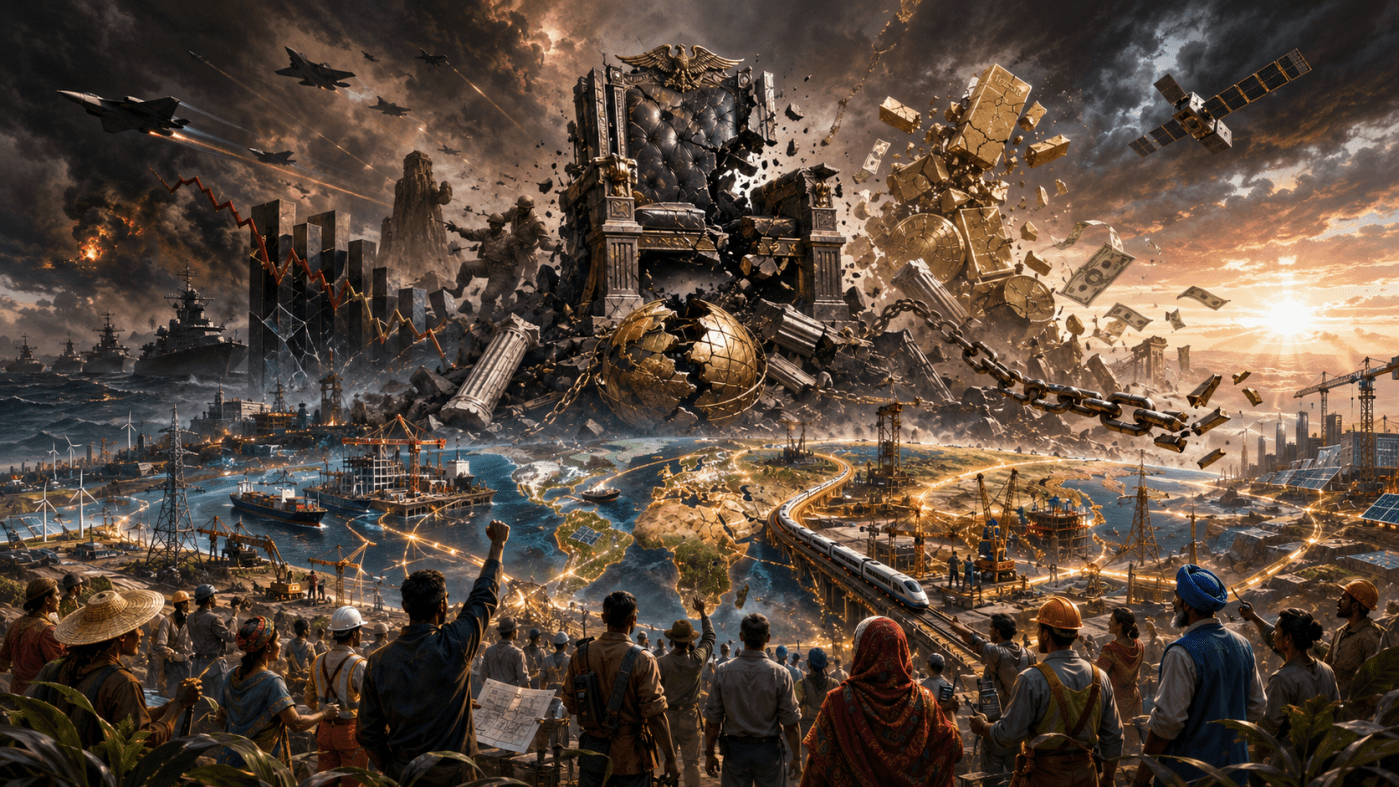
Radhika Desai’s Geopolitical Economy demolishes the mythology of a stable American-led world by showing that capitalism has never been governed from a single commanding center, but driven through conflict among states, classes, currencies, empires, and revolutionary projects. From Britain’s protected industrial ascent and America’s failed imperial imitation to the dollar’s recurring crises, financialization, globalization, and the mortgage collapse, every supposed restoration of US power merely transferred its contradictions onto workers, debtor nations, and the next bubble. Desai reveals multipolarity not as the peaceful succession of one hegemon by another, but as the material breakdown of the old monopoly and the widening space for sovereign development, socialist planning, and international cooperation beyond imperial command. Yet that opening will become liberation only if working people seize the productive, financial, technological, and ecological capacities now being contested and turn material sovereignty into popular power.
Prince Kapone | Weaponized Information | Weaponized Intellects Book Review | June 14, 2026
The Theory Arrived After the World Had Already Refuted It
Radhika Desai opens Geopolitical Economy amid the wreckage of 2008, when the priests of the free market suddenly discovered the healing powers of the public treasury. For three decades they had lectured workers, indebted countries, and governments across the Global South about discipline. Markets were wise. States were clumsy. Public ownership was obsolete. Capital had become global, agile, almost celestial, while ordinary people remained inconveniently attached to jobs, homes, hospitals, schools, and meals. Then the financial system broke its own neck, and the men who had declared the state dead arrived at its door carrying empty buckets.
The rescue settled one matter immediately. As Desai writes, “the state had never gone away.” It had not been defeated by the market. It had been reorganized around the needs of property. The same governments that could not find money for housing, health care, public employment, or industrial reconstruction created guarantees, emergency facilities, asset purchases, and central-bank support on a scale previously dismissed as impossible. Capitalism did not survive because the market corrected itself. It survived because public power was mobilized to protect private command.
Desai’s argument begins here but does not stop at the hypocrisy of the bailout. Hypocrisy is cheap. Every ruling order carries a warehouse full of it. The more important question is why the crisis shocked a political and academic establishment that had spent years manufacturing theories of stability. If the world economy had truly been integrated by rational markets, and if the United States had truly supplied coherent leadership to that economy, why did the system’s commanding financial institutions produce a disaster that required emergency state intervention across the capitalist world?
The answer is not that a sound American-led order suffered a temporary malfunction. Desai’s accusation is more serious: the coherence had been invented. The theories did not describe an accomplished world order so much as promote one. American ambition was converted into historical fact, and policy desire was dressed up as social science.
Her first target is globalization. In its most popular form, globalization described capital as having escaped the nation-state. Production crossed borders. Finance crossed borders. Technology dissolved distance. Governments could either make themselves attractive to capital or be punished by its departure. National development, industrial planning, capital controls, and public ownership belonged to an age that history had supposedly buried without ceremony.
This picture removed politics from the very processes political power had constructed. Governments liberalized capital accounts, negotiated trade rules, privatized public assets, changed tax codes, weakened unions, protected intellectual property, and rescued banks. International institutions imposed policies upon debtor countries. Powerful states enforced the legal conditions through which capital moved. Yet the resulting movement was presented as an impersonal force, something like gravity with a business degree.
Desai’s breakthrough appears in the question she asks after globalization repeatedly fails its own empirical test: “If globalization was not what it was supposed to be, what was it?” The question moves beyond fact-checking. A false idea can survive overwhelming evidence when it performs useful political work. Globalization survived because it told people what they were no longer permitted to imagine.
It told workers that capital’s mobility made national economic struggle futile. It told governments that industrial policy would frighten investors. It told the nations of the Global South that the colonial division of labor had been replaced by the neutral wisdom of comparative efficiency. It told socialist and anti-imperialist movements that the state had become too weak to transform and too provincial to defend. The doctrine did not merely explain power. It disarmed those who might challenge it.
Desai observes that globalization became “at once the explanandum and the explanans.” It was the phenomenon requiring explanation and the explanation offered for everything else. Factories closed because of globalization. Wages fell because of globalization. Finance was deregulated because of globalization. Globalization existed because factories closed, wages fell, and finance was deregulated. The snake swallowed its tail, published the result in a journal, and received tenure.
Desai returns agency to this circular story. Globalization had a political history. It named the strategy through which the Clinton administration deepened financial liberalization, defended a strong dollar, and attracted capital into American markets. It was not the spontaneous unification of humanity by computers and container ships. It was a particular organization of international finance presented as the destiny of the species.
This discovery led Desai toward hegemonic stability theory, which seemed to offer a larger explanation. According to HST, the world economy requires a dominant state capable of supplying liquidity, open markets, security, and institutional coordination. Britain had supposedly performed this role in the nineteenth century. The United States inherited it after the Second World War. Stability depended upon American willingness and capacity to lead. The trouble was that the history refused to behave like the theory.
The postwar monetary system suffered repeated crises. Europe and Japan recovered and became industrial competitors. The socialist world stood outside American command. Decolonization expanded the number of states seeking control over their own development. The United States moved from overwhelming creditor strength toward persistent deficits and increasing dependence upon capital inflows. Gold convertibility collapsed. Each monetary reconstruction advertised as proof of durable leadership generated the conditions for another emergency.
Hegemonic stability theory did not arise at the height of a stable American system and then explain it. Desai shows that it reconstructed the postwar era as hegemonic “entirely retrospectively,” gaining authority during the 1970s, when the arrangement it celebrated was already breaking down. This chronology exposes the theory’s ideological function. Crisis did not falsify American leadership. Crisis proved that the world needed more of it.
Kindleberger’s interpretation of the Great Depression supplied the foundational morality play. Britain had become unable to lead, while the United States remained unwilling to accept responsibility. The catastrophe followed from a shortage of leadership. American power appeared not as the pursuit of national advantage but as a public service tragically withheld from an ungrateful world.
Desai overturns this fable. The American ruling class did not lack the desire for international power. It lacked the historical conditions required to reproduce Britain’s earlier position. Britain had industrialized before comparable rivals existed and had converted that lead into imperial, commercial, naval, and financial dominance. By the time the United States sought a similar position, industrial capacity had spread. Contender states had learned to compress development. Revolutionary movements and socialist states had entered history. Colonial peoples were no longer waiting quietly for instruction.
American power was enormous, but enormous power is not the same thing as a stable capacity to organize the world. HST blurred the difference. When American power weakened, the theorists became declinists and demanded renewal. When finance expanded or the military won a quick battle, they became renewalists and announced that hegemony had returned. The category could survive every outcome because every outcome was interpreted as evidence for the category.
Desai’s criticism reaches beyond liberal scholarship. Radical theories can condemn the United States while accepting the same inflated image of its coherence. A theory may call the system imperial, transnational, or hegemonic and still portray it as so complete that no national project can escape, no contender state can develop, and no socialist experiment can alter the field. Liberalism turns American power into benevolent leadership. A certain kind of radicalism turns it into omnipotence. One kneels before the empire because it is good; the other kneels because resistance is useless.
Desai rejects both forms of surrender. Her alternative begins from what she calls the “materiality of nations.” This is not a sentimental appeal to flags or bloodlines. Nations are material because accumulation is organized through currencies, tax systems, labor regimes, laws, banks, infrastructures, public institutions, and political struggles. Capital moves internationally, but it does not float above the earth. It depends upon states to establish property, enforce contracts, organize money, discipline labor, absorb losses, and defend access to markets and resources.
The capitalist world is therefore not a single economic machine with national governments bolted onto its exterior. It is produced through the “conflicting, competing or cooperative” relations among distinct political economies. These economies are neither sealed containers nor powerless administrative districts. Their states organize class relations internally while confronting other states internationally.
This formulation allows Desai to recover the political terrain that globalization discourse tried to erase. The state remains a “strategic battlefield.” It is not neutral, and it is not automatically progressive. Capitalist classes struggle to command it because its capacities are indispensable. Workers and oppressed peoples cannot afford to abandon the terrain simply because the ruling class currently occupies the high ground.
National struggle alone is insufficient, but national struggle cannot be skipped. Workers confront capital through actual laws, employers, currencies, institutions, and governments. Countries attempting sovereign development must gain control over credit, trade, land, resources, infrastructure, and technology. Internationalism built by pretending these material structures no longer exist becomes a moral posture without an engine.
Desai replaces the fantasy of a smoothly integrated world with uneven and combined development. Dominant states seek to preserve the existing concentration of productive, financial, technological, and military power. Contender states seek to escape the subordinate place assigned to them by compressing development, directing investment, acquiring technology, and constructing new institutions. Geopolitical economy therefore “places contestation at its core.”
This is the book’s decisive break with hegemonic stability theory. World order is not created by a benevolent manager standing above the conflict. It is produced through the conflict. Attempts to preserve monopoly generate efforts to break monopoly. Restrictions imposed upon development encourage states and revolutions to build capacities outside the institutions controlled by the dominant power. The world does not wait passively for leadership. It pushes back.
Robert Brenner’s account of postwar capitalism helps Desai give this conflict a productive foundation. Western Europe and Japan did not merely recover beneath an American security umbrella; their development intensified competition and generated overcapacity. The very reconstruction credited to American leadership eroded the productive advantage upon which that leadership supposedly rested. Desai uses Brenner to return production and national competition to a discussion dominated by monetary abstractions, while insisting that competitive overcapacity must also be connected to constrained mass demand and the political management of crisis.
None of this makes American imperial power imaginary. Desai’s refusal of accomplished hegemony must not be confused with a denial of hierarchy. The United States possessed extraordinary military reach, monetary privilege, corporate power, institutional influence, and the capacity to impose devastating costs upon other peoples. It overthrew governments, enforced adjustment, armed allies, punished enemies, and constructed networks of dependence.
The distinction is between imperial predominance and successful world organization. Washington could destroy a government without building a stable society in its place. It could force a country into crisis without preventing that country from later seeking alternative partners and institutions. It could defend the dollar through one emergency arrangement after another without resolving the contradiction that made those arrangements necessary.
The United States was powerful enough to devastate the world and too limited to master it. This distinction protects analysis from two symmetrical errors. The first treats every American setback as proof that imperialism has disappeared. The second treats every American act of coercion as proof that the entire historical process remains under Washington’s command. One confuses limitation with harmlessness. The other confuses violence with control.
Desai’s method demands a harder measure of power. A ruling state must be judged not only by its ability to punish, invade, sanction, and disrupt, but by its capacity to reproduce a durable political-economic order. American coercive power remained formidable. The order built around it remained unstable.
This is the opening achievement of Geopolitical Economy. Desai does not simply nominate another state to sit upon the throne of world leadership. She questions why the throne should organize our understanding of history at all. The capitalist world develops through class struggle, national development, monetary conflict, imperial pressure, revolution, crisis, and resistance. No single state commands those forces as a conductor commands an orchestra.
The theory of American hegemony arrived after the world had already begun disproving it. Globalization declared the state obsolete while states were reorganizing the world for finance. Hegemonic stability theory declared American leadership indispensable while the institutions associated with that leadership generated repeated instability. Empire declared dominance complete while coercion was increasingly required to defend it.
Desai’s answer is not that imperialism has grown weak enough to ignore. It is that imperialism remains a struggle because the world refuses to stay uneven in precisely the manner the dominant powers require. That refusal—sometimes capitalist, sometimes socialist, sometimes revolutionary, always contradictory—is where geopolitical economy begins.
Free Trade Was the Flag Raised After the Fort Had Been Taken
Britain did not become the workshop of the world by obeying the rules it later prescribed to everybody else. It did not rise through humble submission to market signals, a reverent faith in comparative advantage, or a gentlemanly refusal to interfere with commerce. Its industrial supremacy was built by political power. Protection sheltered production. Empire seized markets and raw materials. Naval force guarded trade. Public institutions created the conditions under which British capital could accumulate beyond the reach of its competitors. Only after the advantage had been secured did free trade descend from the clouds as universal wisdom.
This is the fraud Radhika Desai dismantles in the second chapter of Geopolitical Economy. The nineteenth century was not a liberal marketplace unfortunately surrounded by a little colonial violence. Industrial power and imperial power grew together. The factory cannot be placed in one textbook and the plantation, gunboat, occupied port, and conquered market in another. Cotton, credit, labor, land, shipping, and machinery did not arrive at the factory gate innocent of history.
Desai insists that Britain’s development depended upon “state measures, including protection and imperialism.” The phrase is short, but it overturns an entire mythology. Bourgeois history treats protection as an embarrassing childhood illness that capitalism outgrew and empire as an external adventure unrelated to industrialization. Britain is allowed to keep the factory while somebody quietly removes the colonies from the balance sheet.
Put the colonies back, and free trade changes its meaning. Britain defended and enlarged its productive advantage through state power, then demanded that other countries expose their weaker industries to British competition. A tariff imposed by a late developer was not merely a tax paid by consumers. It was a wall behind which producers might acquire machinery, train labor, build scale, absorb technology, and eventually challenge the industrial power already sitting at the top of the system.
Free trade therefore did not place unequal nations onto a level field. It froze the field after the strongest player had already taken possession of it. Britain’s industrial superiority appeared as proof that Britain was naturally suited to manufacturing. The colony’s forced dependence upon agriculture or mineral exports appeared as proof of its proper place. Conquest disappeared, and specialization took the witness stand.
The trick survives because it is useful. Whenever a dependent country is advised to concentrate on the raw material it can export most cheaply, the old doctrine has merely changed its tie. Today it may speak of competitiveness, investor confidence, global value chains, or integration. The order remains recognizable: produce what the dominant economies require, import what their firms have mastered, and call the resulting dependence efficiency.
Desai returns to classical political economy because the liberal canon was never as clean as its modern custodians pretend. Adam Smith is routinely reduced to a wind-up toy that says “free market” whenever a corporation needs something deregulated. His attention to domestic production, employment, national defense, and the historical development of labor is stripped away. The dead author is then marched into every debate to bless policies whose consequences he never examined.
Desai does not turn Smith into a socialist. She shows that classical political economy had not yet fully separated economics from history and power. Production still mattered. National development still mattered. The state had not yet been banished from theory only to return in practice whenever property required protection.
The ideological tightening comes through Ricardo. Desai identifies Say’s law and comparative advantage as “two Ricardian fictions.” They work together. One denies capitalism’s tendency toward general overproduction. The other naturalizes the international division of labor through which dominant states seek markets and preserve industrial hierarchy.
Say’s law declares that production creates the income necessary to purchase what has been produced. Particular industries may miscalculate, but the system as a whole cannot suffer from an enduring deficiency of demand. Crisis becomes a temporary imbalance, a policy error, or an interference with the market. Capitalism is acquitted before the trial begins.
Desai places class exploitation back inside the equation. The system rests upon what she calls the “poverty and restricted consumption of the masses.” Workers produce more value than they receive in wages. Every capitalist tries to reduce labor costs, but the class of capitalists must later sell commodities to a population whose consumption has been restricted by that same success. Labor appears first as a cost to be cut and then as a customer expected to buy.
This contradiction is not a moral stain on an otherwise functional system. It is part of the machinery. Capital accumulates by restricting the share of social wealth returned to the producers, then confronts difficulty finding sufficiently profitable outlets for the resulting surplus. Say’s law resolves the problem with the courage available only to a theory protected from reality: it declares the problem impossible.
Once general overproduction has been abolished on paper, the search for foreign markets no longer appears as a pressure arising from accumulation. Colonial expansion can be described as civilizing duty, strategic necessity, or political excess. Economics washes its hands while the navy opens the port.
Comparative advantage finishes the job. Each country is told to specialize according to its relative efficiency. The industrial center manufactures. The dependent country supplies food, fibers, fuels, and minerals. The theory treats both positions as though they had been chosen under equal conditions.
It asks the subordinate nation to compare itself only with its own existing backwardness. It does not ask whether continued specialization prevents technological development, traps labor in low-productivity sectors, exposes public revenue to commodity-price shocks, or leaves the country dependent upon imported machinery. British industrial superiority enters the model without the protection and empire that produced it. Colonial underdevelopment enters without the violence that imposed it.
The doctrine can therefore defend empire without mentioning empire. The colony remains agricultural not because its production was destroyed or redirected, but because arithmetic has discovered its destiny. Coercion is translated into comparative efficiency, and dependency becomes a voluntary career choice.
Hamilton and List supplied the answer from the standpoint of contender development. An undeveloped producer cannot become competitive by being destroyed in the name of competition. Industrial capacity has to be constructed. Credit must be directed. Skills must be developed. Infrastructure must be built. Technologies must be acquired and absorbed. Strategic industries may need protection before they can withstand firms already strengthened by scale, capital, and state support.
Protection, in this account, is not a shrine erected to permanent inefficiency. It is one instrument for changing what a country is capable of producing. A nation denied the right to direct credit, manage trade, and coordinate investment is left with a magnificent freedom: the freedom to remain exactly where the existing hierarchy placed it.
This is the material basis of combined development. The late developer cannot leisurely retrace the route of the first industrial power. It confronts a world already transformed by machinery, empire, finance, and military competition. Development must therefore be compressed into what Desai calls “shorter and more intense bursts.”
The compression is political. Education, transport, energy, banking, land, industry, and technology must be coordinated. Resources may have to be directed toward sectors that do not promise the quickest private return. Foreign capital and foreign technology may be used without being allowed to command the whole process. No collection of firms, each pursuing its own balance sheet, can reorganize an entire national productive system against stronger competitors.
Combined development does not reject international exchange. It changes the purpose of exchange. Trade becomes a means of acquiring capacities rather than a tribunal before which development must ask permission.
The present struggle over strategic technology confirms Desai’s argument without requiring us to turn this section into a catalogue of contemporary industries. The states that preached open markets now use subsidies, licensing restrictions, export controls, and alliance pressure when trade threatens to redistribute productive power. The moment a contender moves from buying advanced goods to producing them, the free market discovers national security.
The hypocrisy is real, but the structure matters more than the hypocrisy. Dominant states defend openness where openness reinforces their advantage and restriction where restriction protects it. The doctrine changes because the position of the dominant power has changed. The principle was never universal; the interest merely wore universal clothing.
Desai recovers Marx and Engels from readings that turn them into prophets of a borderless capitalism steadily dissolving national states. Capital creates a world market, but it does not erase the “relations of producing nations.” Nations occupy different positions in a hierarchy of productive power. They do not enter exchange with equal capacities to manufacture machinery, issue credit, control shipping, survive interruption, or defend their development.
Circulation creates the appearance of equality. Commodities confront one another as values. States confront one another as formally sovereign units. Beneath this legal symmetry stand unequal histories of industrialization, conquest, finance, technology, and political power.
Marx’s critique of the labor contract exposed the domination hidden beneath formally equal exchange between worker and capitalist. Desai carries the same movement into international relations. A formally voluntary trade between an industrial power and a dependent country may conceal the history that determined what each side is able to produce and how much pressure each can endure.
The classical theories of imperialism developed this insight for an age of concentrated capital, colonial rivalry, and the export of capital. Their contribution was not an eternal checklist by which every foreign investment could be stamped imperialist. They understood that capitalist contradiction had become geopolitical. The struggle for markets, resources, investments, territory, and strategic position arose from accumulation itself.
Imperialism preserves unevenness. It does not merely extract wealth after the world economy has formed. It shapes the world economy so that extraction and dependence can continue. Colonial administration, unequal treaties, debt, military power, and trade rules defend concentrations of production and finance in the dominant centers.
Combined development is the counter-movement. Subordinate peoples and contender states are not blank surfaces upon which imperial power writes. They resist, imitate, plan, revolt, and build. Efforts to preserve monopoly generate the necessity of breaking it.
The Bolshevik Revolution is decisive for Desai because it joined resistance to class exploitation with resistance to international unevenness. Russia could not wait politely for capitalism to complete every historical stage under bourgeois leadership. The most advanced forms of imperial finance, modern industry, peasant life, national oppression, and proletarian organization already existed together. History had combined the stages before revolution compressed them politically.
A workers’ state then confronted industrialization, land transformation, defense, education, and national survival under encirclement. The process was full of contradiction, sacrifice, and error. Its historical significance does not depend upon pretending otherwise. It demonstrated that development could be directed through political power no longer formally subordinated to private ownership.
Desai therefore calls communism the strongest form of combined development. Public command over strategic resources can direct investment toward electrification, industry, transport, science, health, and mass education on a scale and timetable private profitability may refuse.
The formulation requires care. Socialism is not revolutionary merely because it can industrialize faster. Capitalist states also plan, protect industries, direct credit, and build infrastructure. Capital plans every day; it simply prefers to call its own planning management and everybody else’s tyranny.
The difference lies in command. Who owns the strategic sectors? Who directs finance? Who appropriates the surplus? What social needs govern investment? Combined development becomes socialist when development is subordinated to working-class political power, public ownership, and collective purpose rather than the creation of a stronger national bourgeoisie.
This is one of the productive tensions inside Desai’s argument. Her category of combined development explains how countries compress development against imperial pressure. It does not by itself settle the class character of the state carrying out that development. A capitalist contender may break an external monopoly while disciplining its own workers. A socialist state may use markets while retaining political command over the commanding heights. The presence of state direction proves less than the class power directing the state.
The same need for precision appears in Desai’s theory of crisis. She grounds accumulation in restricted mass consumption and later draws upon Robert Brenner’s account of overcapacity created by intensified competition among industrial economies. These explanations need not cancel one another. They describe different movements of the same contradiction.
Workers’ consumption is restricted by the distribution of income. Combined development adds new productive capacity. Firms and states then compete more intensely for markets that cannot expand sufficiently under the existing class relation. Overcapacity is not simply the unfortunate result of too many factories. It is capacity judged excessive in relation to profitable demand, even while human need remains immense.
That is why capitalism can produce idle factories beside overcrowded housing, surplus food beside hunger, and unemployed workers beside decaying infrastructure. The system has not produced too much for society. It has produced too much to sell profitably to people denied the income or social right to obtain what they need.
The “thirty years’ crisis” from 1914 to 1945 placed these contradictions into the furnace of war, revolution, depression, and mass politics. War compelled states to plan production, direct investment, allocate labor, manage prices, and organize transport. Ruling classes that considered economic coordination impossible in peacetime discovered miraculous administrative talents when the object was slaughter.
Mass political organization made unemployment and social collapse harder to treat as private misfortune. Workers demanded employment, welfare, and security. Socialist revolution demonstrated that property itself could be challenged. Colonial peoples turned national self-determination against the empires that had used the phrase selectively.
Keynes and Polanyi enter Desai’s reconstruction because they preserved questions that orthodox economics had buried. Keynes understood that international adjustment was political: a monetary order that placed every burden upon debtor countries imposed deflation and unemployment while leaving persistent creditors untouched. Polanyi demonstrated that the self-regulating market had to be built and defended by states, and that treating labor, land, and money as ordinary commodities tore apart the social conditions upon which production depended.
Neither supplied a completed revolutionary theory. Their importance lies in restoring what liberal economics removed: money is political, markets are instituted, adjustment distributes suffering, and society resists when human life is subordinated without limit to profitability.
The ecological crisis now sharpens the problem without overturning Desai’s framework. The oppressed nations still require productive capacity, technology, energy, housing, transport, and food sovereignty. They cannot be liberated by remaining suppliers of raw materials to richer states. But combined development can no longer mean mechanically repeating the wasteful path taken by the old industrial powers.
The issue is not production or no production. It is what is produced, under whose ownership, with what energy system, and for whose need. A green international division of labor in which the South extracts minerals while the North owns patents and high-value manufacturing would preserve the old hierarchy beneath new paint.
Desai’s historical lesson remains firm. Productive hierarchies were not created by nature. They were built through protection, empire, state power, class rule, and resistance. They will not be overcome by greater obedience to rules written after the dominant powers had already secured their advantage.
Free trade was the flag raised after the fort had been taken. Comparative advantage was the map drawn after the territory had been divided. Say’s law was the alibi written after restricted consumption had created the pressure for expansion. Desai restores the history concealed by all three.
The central question is therefore not whether the state should interfere with development. States already organize the conditions under which development occurs. The question is which classes command that power, which nations are permitted to change their place in the world, and what human purpose productive capacity is made to serve.
The American Century Was an Imperial Copy Without the Original Conditions
The United States did not become imperial when it sailed beyond its continental borders. By then it had already spent generations conquering territory, breaking Indigenous sovereignty, annexing land, expanding slavery, and turning dispossession into property. The empire did not begin overseas. It trained at home.
Radhika Desai calls the United States an “imperial republic,” a phrase that tears through the country’s favorite costume. The republic proclaimed liberty while expanding through conquest. It celebrated self-government while denying it to the peoples standing between capital and land. The contradiction was not an unfortunate betrayal of an otherwise innocent national project. Territorial expansion furnished the land, labor, resources, markets, and political power from which that project grew.
The continental economy that later challenged the old European powers had been built through state violence. Indigenous nations were removed or confined. Mexican territory was incorporated through war. African labor was imported in chains and converted into commodities, credit, and accumulated wealth. Railroads, farms, mines, towns, and financial claims spread across territory cleared by force. The state did not merely defend private property after the economy had formed. It created the property order upon which accumulation proceeded.
This is where Desai’s account must be pushed through a contradiction she does not fully center. The materiality of the American nation was never the economic organization of one unified people. One national project consolidated itself through the subordination of others. The later empire carried abroad techniques of rule already rehearsed through settler conquest, racialized labor, and internal colonization.
The distinction between domestic development and foreign expansion therefore conceals more than it reveals. The army that crossed oceans had first crossed the continent. The legal reasoning later used to reduce foreign sovereignty had been practiced against Indigenous nations. The racial doctrines that accompanied colonial administration abroad had roots in slavery, removal, and annexation. The American republic did not abandon innocence when it entered the imperial age. Its innocence was one of the empire’s founding myths.
Desai’s term “imperial mimesis” identifies the next movement. American ruling classes sought to reproduce the position Britain had occupied: industrial superiority, command over trade, financial centrality, strategic control of routes and markets, and a national currency elevated into international money. The United States did not invent a new universal order. It tried to copy an earlier imperial achievement while denying that it was copying an empire.
The imitation was doomed to contradiction because history had changed. Britain industrialized before comparable rivals existed. It faced a largely pre-industrial world and used that head start to construct commercial, naval, colonial, and financial supremacy. By the time the United States pursued the same prize, industrial capacity had spread. Germany and Japan had developed. Russia had entered the field and would later undergo socialist revolution. Anti-colonial movements were growing. The world was no longer a silent warehouse waiting for one industrial power to inventory it.
This is why Desai calls Britain’s dominance “unrepeatable.” She does not mean that later powers could not conquer, intimidate, or accumulate extraordinary advantages. She means that no later state could recover the first industrializer’s historical solitude. Once several states possessed factories, banking systems, modern armies, research institutions, and developmental ambitions, the conditions for singular industrial command had vanished.
American ambition was therefore larger than American capacity from the beginning. The United States wanted open access to foreign markets while other powers defended colonial blocs and national industries. It demanded entry into territories it had not conquered and opposed exclusions established before its own rise. Its Open Door doctrine was not an escape from imperialism. It was the demand of a late-arriving imperial power that the older empires stop locking the rooms.
Informal empire suited this position. A territory did not always need to be annexed if its tariff policy, banking system, military organization, resources, and foreign relations could be directed from outside. The flag could remain while sovereignty was emptied out from underneath it.
This form remains visible today because empire rarely introduces itself by name. It appears through military agreements, debt conditions, sanctions, investment rules, technology restrictions, and security partnerships. The local government may still issue speeches, conduct elections, and display national colors. The harder question is whether it can control credit, resources, trade, and strategic infrastructure without external permission.
American ideology converted this expansion into anti-colonialism. Washington denounced the closed empires of Europe because their privileges obstructed American capital. It supported formal independence where independence widened access and opposed national liberation where liberation threatened property. Universal access sounded nobler than imperial rivalry, but its universalism had a national sponsor and a commercial address.
Desai therefore rejects the story that the United States had to be dragged from isolation into world responsibility. American elites were willing to expand. The difficulty was turning desire into durable dominance. The familiar claim that Britain had become unable to lead before the United States became willing gets the problem backward. Washington’s willingness was plentiful. What history withheld were the conditions that had once made British dominance possible.
The First World War seemed to create an opening. European powers destroyed productive capacity, accumulated debt, and weakened themselves through slaughter. American industry and finance emerged stronger. New York advanced against London. The United States moved toward creditor status. For its ruling circles, the catastrophe looked like history clearing the stage.
Yet the war produced more than weakened rivals. It produced socialist revolution, mass working-class politics, colonial revolt, and a crisis of the old imperial order. The Russian Revolution removed a vast territory from capitalist command. National liberation movements seized the language of self-determination and turned it against the empires that used it selectively. Europe remained capable of reconstruction. The same crisis that opened space for American ambition also released forces hostile to any new single-power settlement.
The first opportunity was therefore thwarted. The United States possessed growing power but could not impose a stable international arrangement. The Great Depression then exposed the incapacity of the capitalist powers to govern the crisis collectively. Trade contracted, currencies fractured, blocs hardened, and the world moved toward another war.
The Second World War gave Washington what Desai calls a “second chance.” This time the destruction was immense. Europe and Japan lay devastated. The Soviet Union had suffered staggering losses. American factories had expanded, American creditors held enormous claims, and American gold reserves towered over those of every rival. No moment had placed the United States closer to the imperial position it wanted.
But the source of this supremacy already contained its expiration date. American predominance was “wrought by war.” It did not prove the permanent superiority of American capitalism. It reflected the destruction of competing industrial centers while production inside the United States expanded behind the protection of two oceans.
If superiority arises from the ruin of rivals, their reconstruction will reduce it. The United States stood so high after 1945 partly because much of the industrial world had been bombed into a crater. Recovery would close the distance.
The Cold War made that recovery unavoidable. Washington could not preserve capitalist rule in Western Europe and Japan by leaving their economies broken. Communist parties, militant labor movements, the prestige of the Soviet victory, and colonial revolt made social stabilization urgent. Allied states had to rebuild production, provide employment, expand welfare, and demonstrate that capitalism could still deliver material improvement.
The United States was therefore compelled to sponsor the recovery of the competitors that would erode its own exceptional advantage. It needed strong allies against socialism but did not want allies strong enough to become autonomous. It wanted reconstruction without rivalry, development without independent power, and industrial growth without the competition industrial growth necessarily brings.
This contradiction remains embedded in American alliance strategy. Washington demands that allies strengthen military and industrial capacity while resisting any move toward independent financial, technological, or diplomatic power. Dependence must be reduced everywhere except where dependence runs toward the United States.
The postwar settlement reached its institutional expression at Bretton Woods. Desai calls the outcome “dominance over internationalism.” The phrase rejects the sentimental image of farsighted statesmen designing neutral institutions for the common good. Bretton Woods was a struggle over international liquidity, adjustment, and monetary authority.
Keynes proposed an International Clearing Union and a supranational unit of account. Such a system would have reduced dependence upon one national currency and placed obligations upon persistent creditor as well as debtor countries. A surplus was not treated as private virtue floating free from another country’s deficit. Both sides of the imbalance would face pressure to adjust.
The American plan preserved a different arrangement. The dollar would stand at the center, convertible into gold and supported by the extraordinary concentration of American power created by war. Other governments would hold dollars as reserves and use them for international payments. The United States would enjoy freedoms denied to countries forced to obtain a currency they could not issue.
This was “dominance over internationalism” because cooperation was accepted within a structure organized around American national privilege. The institutions were international in membership but unequal in command. The dollar was asked to function as world money while remaining the currency of one state whose domestic priorities would affect every country dependent upon it.
The contradiction was present at the foundation. The United States had to supply dollars to the world, but the creation of those dollar claims would eventually weaken confidence in their conversion into gold. It had to rebuild allied economies, but their success would increase competition. It had to institutionalize an international order, but the institutions gave other states arenas in which to resist American preferences.
Desai’s rejection of US hegemony turns upon this history. The United States achieved real predominance after 1945. It possessed unmatched productive, financial, military, and institutional advantages. It did not achieve the stable reproduction of Britain’s earlier position. Socialism, decolonization, allied reconstruction, national development, and the contradiction inside the dollar system prevented it.
The distinction is not semantic. A state may exercise immense coercive power without supplying the conditions for a stable world order. Washington could overthrow governments, enforce financial adjustment, arm client states, and command military alliances. It could not abolish the development of rivals, the resistance of peoples, or the economic pressures generated by its own arrangements.
Desai’s argument should not be misunderstood as saying that the United States failed because it was insufficiently imperial. It failed to reproduce Britain’s position because the world had already become too industrially and politically plural for such a position to last. The project was historically anachronistic even at the height of its power.
That anachronism made the project no less violent. A ruling class attempting to preserve an impossible hierarchy may become more dangerous as the means of preserving it narrow. Destruction can delay the development of a contender. Sanctions can raise the cost of refusal. Technology restrictions can slow industrial upgrading. None can permanently return the world to the moment before productive capacity spread.
Indeed, coercion may produce the opposite result. A state confronted with the political danger of dependence has stronger reasons to construct alternative finance, domestic production, new trade routes, and technological capacity. The weapon intended to prove indispensability teaches its target why dependence must be escaped.
This is the movement Desai calls imperial mimesis. The United States copied Britain’s ambition but could not copy the world in which Britain achieved it. Its power after 1945 rested upon exceptional wartime conditions that reconstruction itself would erode. Its international institutions preserved American advantage while creating contradictions that required continuous management.
The American century was therefore not the peaceful maturation of a universal leadership. It was the attempt to turn a temporary concentration of power into a permanent world hierarchy. The project proclaimed sovereign equality while establishing monetary privilege, denounced old colonialism while constructing informal empire, and called American national strategy an international public good.
The dollar would become the pressure point where these contradictions converged. It had been elevated into international money under conditions created by war. As those conditions receded, Washington would have to defend its role through political pressure, financial improvisation, and repeated reconstruction. Desai’s next move is to follow that currency from the apparent confidence of Bretton Woods into the crisis already lodged inside it.
A National Currency Tried to Rule the World
The dollar entered the postwar order with two jobs that could not be reconciled indefinitely. It was the national currency of the United States, managed according to the needs and conflicts of the American economy. It was also expected to supply reserves, liquidity, and settlement money to the capitalist world. One state’s domestic money had been promoted to an international office, but it never stopped answering to its national employer.
Radhika Desai’s fourth chapter dismantles the comforting story that Bretton Woods was a stable system later ruined by bad policy. Instability was built into the arrangement. Other countries required dollars to finance trade, rebuild production, and hold reserves. The United States could supply those dollars only by spending, lending, investing, or importing abroad. The deficits that furnished international liquidity also accumulated foreign claims against American gold.
The contradiction was cruelly simple. Too few dollars threatened reconstruction and trade. Too many dollars threatened confidence in the promise that they could be converted into gold. The United States had to provide the world with enough of its currency to keep the system moving, but not so much that holders began asking whether the cashier could cover the checks.
This was the material core of the Triffin dilemma. The national deficit of the reserve-currency state supplied the international system with liquidity. That same deficit weakened the reserve currency’s monetary foundation. The better the United States performed one side of the assignment, the more it damaged the other.
The problem intensified as Western Europe and Japan recovered. Their reconstruction increased production, exports, and reserve holdings. They became more capable of earning dollars and more capable of demanding gold for them. The system had been designed under the exceptional concentration of American power created by war. It had to operate after that concentration began to recede.
The usual account treats allied recovery as proof of successful American leadership. Desai forces us to notice the contradiction. Recovery stabilized capitalism against socialism, but it also rebuilt the competitors whose destruction had elevated the United States. The capitalist bloc became stronger collectively while American productive supremacy became less exclusive.
Gold convertibility was supposed to guarantee discipline. Foreign official holders could exchange dollars at a fixed rate. The promise gave the currency an anchor beyond Washington’s assurances. But as external dollar claims multiplied beyond the gold available to redeem them, the anchor became a noose.
Desai names the political management of this problem “the confidence game.” Confidence did not descend spontaneously from the market. Governments negotiated, central banks coordinated, and allies were pressured to limit conversion. Gold-pool arrangements and diplomatic appeals defended the official price. The system looked automatic only because so much state labor went into preventing it from behaving automatically.
This was not a secret fraud in which officials knew the dollar to be worthless. It was a system whose stability increasingly depended upon creditors declining to exercise the rights the system formally granted them. Washington needed foreign governments to continue behaving as if every dollar remained as good as gold while the relation between dollar liabilities and gold reserves steadily worsened.
Reserve-currency privilege was therefore both real and political. The United States could settle international obligations in money it issued. Other states had to acquire that money through exports, borrowing, or capital inflows. Yet the privilege endured only because governments, banks, and firms continued holding American liabilities and organizing trade around them.
The dollar did not abolish conflict among capitalist states. It moved part of that conflict into exchange rates, reserves, gold claims, trade balances, and the distribution of adjustment. No tanks need cross a border for monetary pressure to close factories, raise unemployment, restrict public expenditure, or force a government to abandon development plans.
The Kennedy years expose the domestic side of the trap. The administration faced gold outflows, external deficits, overseas commitments, and increasing industrial competition. Policies that expanded employment and demand at home could worsen the balance of payments. Policies intended to defend the dollar could restrain domestic growth.
Monetary privilege did not mean freedom from constraint. It meant greater power to decide where the constraint would land.
The United States could defend convertibility through slower growth, tighter demand, taxes, or restrictions on external spending. It could also pressure allies, discourage gold conversion, and demand cooperation from surplus countries. Every proposed solution distributed the burden differently among American workers, American capital, allied governments, creditors, and debtor populations.
This is what orthodox monetary history removes when it describes adjustment as a technical necessity. Adjustment always has an address. Somebody loses employment. Somebody gives up public spending. Somebody’s currency falls. Somebody’s claims remain protected. The arithmetic may balance after the politics have selected the victim.
As the United States moved from creditor strength toward indebtedness, its theorists responded by redescribing the deterioration as a service. The international financial intermediation hypothesis presented American deficits as evidence that the United States was acting as banker to the world: borrowing through liquid short-term claims and investing in longer-term or riskier assets abroad.
Desai’s treatment of the IFIH is devastating because she recognizes the ideological reversal. A weakening external position becomes proof of indispensability. American indebtedness no longer indicates that the productive and monetary foundations of postwar predominance are eroding. It demonstrates that the United States is generously supplying financial sophistication to lesser economies.
The theory did not invent the intermediation. The United States did borrow and invest through different maturities and asset forms. The fraud lay in treating this arrangement as a stable substitute for the productive, creditor, and gold position that had initially supported the dollar.
Finance can extend power after productive predominance weakens. It can attract capital, distribute credit, discipline states, and command claims upon future output. It cannot make the material basis of those claims irrelevant. A financial center may postpone a reckoning, shift it elsewhere, and profit from the delay. Postponement is not resolution.
This is one of the places where Desai’s argument must be stated carefully. The dollar’s later survival does not prove that finance replaced production once and for all. Nor does productive erosion imply immediate monetary collapse. Currency systems possess institutional weight. Contracts, reserves, banking practices, legal jurisdictions, and political alliances can keep a monetary structure alive long after the balance of production that created it has changed.
Before the gold system finally broke, special drawing rights appeared as a possible alternative source of international liquidity. Desai calls them a “foiled Plan B.” The phrase matters because it shows that the contradiction was neither invisible nor technically insoluble. A more genuinely international reserve instrument could have reduced dependence upon the deficits and liabilities of one national state.
SDRs could have widened the creation of liquidity beyond the dollar. A stronger version might have distributed monetary authority more broadly and reduced the privilege attached to American issuance. Such an arrangement would also have required political power to move away from Washington.
That is why the alternative remained limited. Institutions do not surrender hierarchy simply because economists have designed a cleaner mechanism. Those benefiting from an unstable order may prefer instability to a reform that diminishes their command.
The American state could complain about the burden of supplying international liquidity while resisting a system that would share the authority attached to supplying it. The burden and the privilege came together. Washington wished to lighten one without surrendering the other. History, being poorly trained in diplomacy, refused the arrangement.
By the late 1960s, the “confidence game” was becoming harder to sustain. European and Japanese reserve holdings had grown. American external commitments had expanded. Gold cover had weakened. Allied cooperation could delay the confrontation but not erase the changing relation beneath it.
The Vietnam War sharpened the problem. Overseas military expenditure supplied more dollars to the world while increasing pressure upon convertibility. Washington sought to finance war, sustain domestic growth, reassure allies, and defend the gold link at the same time. The currency expected to organize the capitalist world was weakened by the cost of enforcing the political order in which that world operated.
The dollar and the military supported one another but did not fit together without friction. Military reach defended strategic access and alliance structures. It also required spending, deficits, logistics, and overseas commitments. Imperial power helped sustain monetary privilege while generating pressures against its foundation.
In 1971, Nixon closed the gold window. Later histories would portray the decision as the confident birth of a flexible dollar order. Desai strips away the swagger. The move came “in the last ditch.” It was the abandonment of a promise the United States could no longer honor, not the serene execution of a master plan conceived in advance.
Nixon did not solve the contradiction. He removed the mechanism through which it had become immediately unbearable. The world still required reserves, credit, and means of payment. The dollar remained embedded in trade, banking, contracts, and political alliances. Its first foundation had failed, but the structure built upon it did not vanish overnight. This is the hinge of Desai’s history. The end of convertibility did not end the dollar. It began the search for another basis of dollar demand.
The post-1971 order would have to be constructed through oil pricing, international banking, high interest rates, debt relations, foreign capital inflows, and eventually financial bubbles. Each new support would be advertised as evidence that the dollar’s centrality required no explanation. Desai’s achievement is to show how much explanation—and how much state power—was required to keep that appearance alive.
The dollar’s continued predominance in the present does not simply refute this argument. It does expose one limitation in how the transition might be read. The crisis of a monetary foundation does not necessarily produce the rapid displacement of the currency attached to it. A system can lose coherence faster than it loses centrality.
The dollar remains deeply rooted in reserves, debt markets, trade invoicing, banking, and settlement. Its legal and financial infrastructure still offers liquidity and scale that no single alternative currently reproduces. States may object to the hierarchy and continue using the currency because the cost of immediate exit is high.
This endurance should not be confused with restored stability. It is better understood as prolonged centrality under accumulating pressure. States diversify reserves, settle portions of trade in national currencies, construct regional payment mechanisms, and seek development finance outside the old centers. No single measure dethrones the dollar. Together they narrow the field in which dollar dependence is unavoidable.
The political character of the system becomes most visible when monetary infrastructure is weaponized. Reserves can be frozen. Banks can be excluded from payment channels. Firms outside the United States can be threatened through their reliance upon dollar clearing or American jurisdiction. The currency used as a universal medium retains a national command point.
This is not a new subject that replaces Desai’s analysis. It confirms its central premise. International money remains embedded in state power. The institutions that make the dollar useful also make dependence upon it vulnerable to coercion.
Weaponization then produces a counterpressure. Every sanctioned or threatened state receives a practical lesson in the political cost of concentrated dependence. Alternative payment systems, reserve diversification, bilateral settlement, and domestic financial capacity become matters of survival rather than monetary fashion.
These alternatives will develop unevenly because money cannot be liberated from production by decree. A country that depends upon imported energy, foreign technology, external credit, and dollar-denominated debt cannot achieve sovereignty by changing the currency printed on an invoice. Monetary autonomy rests upon productive, institutional, and political capacity.
Desai’s chapter therefore leaves us with a problem larger than the fate of one currency. Can international liquidity be organized without making the national money of one state the strategic infrastructure of all the others? Can adjustment be shared between creditors and debtors rather than imposed through austerity upon the weaker side? Can international money become genuinely international?
The Bretton Woods answer was no. American dominance prevailed over a more balanced internationalism. The gold-backed form of that dominance broke under its own contradiction. What followed was not a free-floating market order but a series of political reconstructions designed to preserve the same monetary center on new foundations.
A national currency tried to rule the world. Gold could no longer carry the arrangement. The next chapters follow the devices assembled in its place—and the countries, classes, and workers compelled to pay for each renewal.
Every Restoration Built Another Bubble
When Nixon closed the gold window, the dollar did not become magically self-sustaining. Its old foundation had broken, and another had to be built. The question guiding Radhika Desai’s sixth chapter is therefore not whether American power disappeared after 1971. It is how that power was repeatedly reconstructed after the monetary basis created at Bretton Woods had failed.
Desai places a question mark after “Renewal?” because every restoration arrived with a victory speech and an unpaid bill. Nixon supposedly liberated the dollar from obsolete gold. Carter supposedly marked an unfortunate pause before discipline returned. Reagan supposedly restored confidence, growth, and national strength. Beneath the ceremony stood a chain of emergency arrangements that shifted contradiction elsewhere without resolving it.
Nixon’s government did not calmly release the dollar into the loving care of private markets. Washington intervened, negotiated, and pressured allies because there was no guarantee that the world would continue demanding dollars on the scale American policy required. “Benign neglect” was less a settled strategy than a dignified phrase for officials improvising while pretending not to sweat.
Without convertibility, the dollar needed a new source of international demand. Oil and international banking supplied it. Petroleum-exporting states accumulated enormous dollar revenues, which flowed into Western banks and were then lent onward. Desai identifies petrodollars as the first major post-gold phase of financialization.
The arrangement joined energy, finance, and state power. Oil was priced and settled in dollars. Exporting states accumulated dollar surpluses. Banks at the center of the dollar system transformed those surpluses into loans. Developing countries and socialist states seeking investment or relief from external constraints became borrowers.
The process appeared to solve several problems at once. Oil exporters gained financial assets. Banks gained deposits and lending opportunities. Borrowing states gained access to funds. The dollar acquired renewed demand after gold.
What looked like circulation was also a hierarchy. The loans were denominated in a currency debtor states did not issue. Their repayment capacity depended upon export earnings, commodity prices, exchange rates, and interest decisions made elsewhere. Credit traveled outward; command over the terms remained close to the center.
Petrodollar recycling therefore planted the seeds of the debt crisis inside the apparent solution to the dollar crisis. The same flow that supported international liquidity exposed borrowers to obligations that could become unbearable as soon as the monetary conditions changed.
Those conditions changed under Carter. The dollar weakened, inflation deepened, and the second oil shock failed to recreate the earlier stabilizing flow. Desai strips away the familiar story of national “malaise.” The difficulty was not a population suffering from low self-esteem. The United States faced productive weakness, external imbalance, inflation, energy dependence, and a reserve currency that still required defense.
The ruling class confronted a choice. It could attempt productive reconstruction, reduce imperial burdens, and direct investment toward industrial renewal. That path would have required a confrontation with the financial interests strengthened by the previous decade. The path chosen was monetary discipline.
Paul Volcker raised interest rates to shore up the dollar. The language of monetary seriousness conceals the social violence of the act. Credit contracted. Investment slowed. Unemployment rose. Industrial workers faced plant closures and wage pressure. Capital was drawn toward high-yield dollar assets.
Outside the United States, the shock was more severe. Debtor countries that had borrowed during the petrodollar boom suddenly faced dramatically higher servicing costs. A decision made to defend the American currency detonated a crisis across the Global South. The dollar was strengthened by weakening workers and debtor nations.
This is what makes Volcker’s intervention more than an episode in domestic inflation management. The interest-rate shock reorganized class power inside the United States and financial power internationally. Labor was disciplined through recession. Borrowing states were disciplined through debt.
The Third World debt crisis did not fall from the sky, and it did not prove that whole populations had irresponsibly lived beyond their means. Western banks had pushed recycled liquidity outward because it needed profitable placement. The United States then altered the monetary conditions under which those loans had to be repaid. When the borrowers broke, the lenders arrived as moral instructors.
Desai shows how IMF management redirected payments toward Western banks. The debtor state was not merely ordered to repay. It was ordered to reorganize society around repayment. Public expenditure was cut. State enterprises were privatized. Currencies were devalued. Wages were restrained. Trade and capital controls were weakened. Development plans were placed beneath the claims of creditors. The banks that had failed to restrain their lending discovered a passionate commitment to restraint—provided somebody else practiced it.
Debt adjustment transferred more than money. It transferred political authority. Governments that needed continued access to dollars surrendered control over public investment, industrial policy, subsidies, and ownership. Formal independence survived while the range of economic decisions narrowed.
This was one of the post-gold dollar system’s most effective methods. The crisis of the reserve currency could be answered by drawing resources toward the United States and placing weaker states under creditor supervision. National contradiction was converted into international discipline.
Reagan entered this terrain promising restoration. The free market would be released from government, American confidence would return, and military strength would erase the humiliations of the previous decade. Desai’s “Reagan’s restoration?” asks us to inspect the machinery beneath the theater.
The recovery did not result from the state stepping aside. It depended upon tax cuts, military expenditure, high interest rates, and publicly supported research. Social programs were denounced as waste while weapons contracts were treated as productive virtue. Government had not become smaller. It had become more openly devoted to property and war.
Military Keynesianism allowed the ruling class to stimulate demand without admitting that public spending could be used to expand social provision. A missile could justify planning, procurement, and industrial support. Housing, health care, and public transit were told to wait for the invisible hand to finish polishing the warhead.
The distinction was political, not economic. Both military and social expenditure mobilize public resources. One strengthens contractors, strategic industries, and imperial reach. The other may strengthen working-class security and expectations of social right. The state knew perfectly well how to spend. It objected to who might benefit.
Reagan’s restoration also depended upon the high interest rates inherited from Volcker. Capital flowed into dollar assets. Foreign purchases helped finance growing American deficits. Japan, whose productive development had already made it a major competitor, became one of the principal financiers of the United States.
The arrangement could be presented as proof of American strength. The country imported goods, ran deficits, and issued assets the rest of the world purchased. But the same process exposed a growing dependence upon foreign savings and productive surpluses.
An ordinary debtor country facing comparable imbalances would have been instructed to contract demand and submit to supervision. The United States borrowed in the currency it issued and occupied the center of the financial system. Its debt became everybody else’s reserve asset.
This privilege was substantial, but it carried a contradiction. The high dollar that attracted capital also made American exports more expensive, cheapened imports, and intensified pressure upon manufacturing. Financial strength could therefore deepen productive weakness.
The costs were distributed by class and region. Asset owners, banks, importers, and internationally oriented corporations benefited. Industrial workers and their communities absorbed layoffs, plant closures, falling union power, and municipal decline. The restoration of American power was announced from the places where capital was recovering and imposed upon the places it had abandoned.
The anger produced by this deindustrialization still stalks American politics. Workers are encouraged to blame immigrants, foreign labor, environmental rules, or cultural enemies for losses rooted in a ruling-class strategy that favored finance, corporate mobility, and the defense of the dollar. National grievance is separated from class explanation and handed to the right.
A revolutionary response must refuse the fraud at both ends. Neoliberalism lied when it called deindustrialization inevitable. Corporate nationalism lies when it promises that tariffs and subsidies alone will restore working-class power. A factory owned by the same monopoly, subsidized by the public, disciplined by weak unions, and organized around private profit does not become popular industry merely because the machinery has crossed back over the border.
By the middle of the 1980s, the strong dollar had become destructive enough to require correction. The Plaza Accord organized a coordinated depreciation. Once again, states intervened directly in the currency markets supposedly governed by private judgment. The invisible hand required a meeting agenda.
The resulting changes in exchange rates and liquidity fed expanding asset markets. When the stock market crashed in 1987, the Federal Reserve responded by supplying liquidity and reassuring financial institutions. Desai identifies the emerging arrangement as the “Greenspan put.”
The phrase describes more than one rescue. It names an expectation: severe financial losses would bring public intervention. Investors remained free to pursue private gains while counting on collective protection when the scale of failure threatened the system.
Risk was not eliminated. It was rearranged around the state’s commitment to prevent financial collapse. The more reliable the rescue appeared, the more confidently institutions could expand leverage and speculation. Every successful bailout trained capital for the next emergency.
The free market reached a peculiar maturity. Rising asset prices demonstrated private wisdom. Falling asset prices demanded public assistance. Capital enjoyed discipline for workers and social protection for itself.
No comparable “put” existed beneath an industrial town. A factory could close, a union could be broken, and a community could lose its economic base because the market had spoken. Only when financial markets faced systemic loss did the state discover that private decisions had become matters of national survival.
This asymmetry accelerated financialization. Protected asset markets attracted capital. Firms found growing incentives to raise share prices, restructure debt, and pursue acquisitions rather than commit to long-term productive investment. The state did not withdraw from accumulation. It built a safety net beneath the institutions organizing ruling-class wealth.
Desai’s sequence is therefore more important than any single policy. Petrodollars supported the dollar after gold. Dollar lending expanded the vulnerability of borrowing states. Volcker’s rate shock detonated the debt crisis. IMF adjustment redirected resources toward creditors and weakened developmental institutions. High rates drew capital into the United States. Foreign financing sustained deficits while the strong dollar battered manufacturing. Coordinated depreciation fed financial expansion. The “Greenspan put” protected asset markets and encouraged the growth of larger bubbles.
Each arrangement answered the weakness created or exposed by the previous one. None repaired the contradiction between the dollar’s international role, the erosion of American productive supremacy, and the restricted demand generated by class inequality.
This is why the chapter’s question mark must remain. Renewal did not mean resolution. It meant finding a new population, country, or asset market capable of carrying the burden for another period.
The ability to shift costs was itself a form of imperial power. The United States could respond to its monetary difficulties by imposing recession upon workers, debt discipline upon the Global South, and financial dependence upon allies. A weaker state would have been subjected to adjustment. The reserve-currency state reorganized adjustment around itself.
Yet the transferred costs did not disappear. They returned as deindustrialization, public debt, fragile financial institutions, widening inequality, and larger rescue obligations. The system expanded its reach while weakening the productive and social basis beneath it.
Desai does not ask us to treat finance as imaginary. Financial institutions command real resources, reorganize production, discipline governments, and decide which activities receive investment. The problem is that they can multiply claims without resolving the contradictions that make those claims unstable.
Finance can postpone devaluation, transfer losses, and extract payment. It cannot permanently replace wages with credit, production with asset inflation, or development with debt servicing. It turns the future into collateral and calls the result prosperity.
The present still bears the shape of this history. Central banks defend financial stability through emergency liquidity. Governments insist that social expenditure is unaffordable while mobilizing enormous resources for banks, military contractors, and strategic corporations. Developing states remain exposed to interest-rate decisions made in the United States and debt contracts denominated in currencies they do not control.
The continuity should not be stretched into the claim that nothing has changed. Financial instruments, creditors, and institutions have evolved. The underlying struggle over who receives protection and who receives discipline remains intact.
Desai’s account of post-gold “renewal” strips away the romance of market restoration. Nixon relied upon oil and banking. Carter imposed monetary violence. Reagan combined military Keynesianism with foreign financing. Greenspan taught asset holders to expect rescue. At every stage, the state stood in the middle of the supposedly private order, directing pressure downward and protection upward.
By the end of the chapter, the United States had not rebuilt the industrial position it once possessed. It had built a more financialized method of sustaining the dollar and projecting power. The Soviet Union’s collapse would soon permit the ruling class to confuse geopolitical victory with economic renewal.
That confusion prepared the next ideology. The Clinton administration would take the capital flows, deregulation, strong-dollar policy, and protected financial markets produced by the previous era and present them as an irresistible world process called globalization.
Globalization Had a Government, a Currency, and a Class
Globalization did not arrive like weather. It was not blown across the planet by container ships, computers, and fiber-optic cables acting on their own. Technology changed the speed and scale of economic life, but machines did not decide which countries would open their capital accounts, which currencies would settle trade, whose industries would be sacrificed, or which banks would be rescued when the great experiment went bad. Radhika Desai pulls globalization down from the clouds and places it where it belongs: inside a government, a currency system, and a class project.
The Clinton administration entered office with a real choice before it. The United States had emerged from the Reagan years with stronger finance, weaker unions, widening trade deficits, and industrial regions already paying the price of the high dollar. The Cold War had ended, but geopolitical victory had not repaired the productive economy. Washington could direct public power toward infrastructure, industrial upgrading, technology, education, and employment, or it could deepen the financial strategy inherited from the previous decade.
Desai organizes this conflict through the difference between Reichian and Stiglitzian globalization. These were not merely rival theories discussed by clever men around polished tables. They represented competing directions inside the state.
Robert Reich began from production. International competition was real, but it did not make national policy obsolete. It made industrial strategy more urgent. Public investment, training, infrastructure, technological development, and higher-value production were necessary if the United States was to respond to productive decline without forcing workers to compete through lower wages and greater insecurity.
Reich’s project remained capitalist and therefore limited. Industrial policy can easily become a public subsidy for private monopoly. Training can mean teaching workers to adapt more obediently to decisions made over their heads. Productive renewal does not become working-class power simply because more machines are installed. But the proposal at least recognized that an economy cannot indefinitely replace production with imported goods, asset inflation, and speeches about innovation.
That position lost. The Clinton administration embraced deficit reduction, financial liberalization, a strong dollar, and the authority of bond markets. Desai identifies this victory as the displacement of Reichian globalization by Stiglitzian globalization. The change was not forced upon the government by an abstract world economy. It reflected the consolidation of Wall Street power inside the Democratic Party and the state.
Finance did not need to overthrow the government. It taught the government to speak in its voice. Fiscal credibility meant reassuring bondholders. Monetary responsibility meant attracting capital. Openness meant removing restrictions on financial movement. Public policy would construct these conditions and then announce that globalization had made them unavoidable.
The word performed a useful trick. A class victory was renamed modernization. Policy became destiny. The strong dollar, deregulated finance, and mobile capital no longer appeared as interests advanced by particular institutions. They became the demands of history itself.
This was globalization’s greatest ideological service. A worker could organize against an employer, a law, or a government. It was harder to organize against a planetary force described as inevitable. Factory closures, falling wages, privatization, and austerity could all be blamed on globalization, which was then defined by the very consequences used to prove its existence.
Desai breaks the circle by following the money. The Clinton project did not dissolve the American state into a borderless economy. It used state policy to strengthen dollar-centered finance. Deficit reduction reassured holders of financial assets. Higher interest rates and the strong dollar attracted funds toward the United States. Capital-account liberalization opened new territories for speculative investment.
The process contained two movements that Desai calls “centrifugal finance” and “centripetal finance.” The distinction gives globalization a geography and exposes the hierarchy hidden inside the language of free movement.
Centrifugal finance moved outward from the major financial centers into emerging markets. Banks, investment funds, and speculators searched for higher returns in countries pressured to remove restrictions on foreign capital. The inflows could be dramatic. Credit expanded, stock and property prices rose, and governments were praised for earning market confidence.
Much of this money did not arrive to build factories, power systems, or durable infrastructure. It entered liquid assets and short-term instruments because the investor wished to preserve the right to leave. The recipient state was expected to guarantee capital’s freedom of movement while accepting that the same freedom could tear the economy apart.
The asymmetry was called openness. Financial assets could cross a border in seconds. Workers, towns, public institutions, and unfinished development plans could not pack their bags so quickly. Capital enjoyed mobility; society received the consequences.
The possibility of exit disciplined policy before any exit occurred. Governments adjusted interest rates, budgets, labor protections, and exchange policy to maintain confidence. Public need had to pass through the judgment of investors who could punish the country for choosing it. The freedom of finance became the discipline of everyone else.
This structure exploded in the East Asian financial crisis. The affected economies had not simply failed to develop. Several had built formidable industrial capacities through state-directed credit, protection, public planning, and controlled integration into international trade. Their productive achievements did not protect them from the volatility unleashed by financial opening.
The doctrine responsible for increasing their vulnerability then returned as the cure. Governments were pressured to liberalize further, restructure industries, open assets to foreign acquisition, and weaken institutions that had supported development. The patient was prescribed a stronger dose of the poison and lectured for lacking discipline while swallowing it.
Crisis became a method of ownership transfer. Currency collapse and capital flight lowered asset prices. Firms and banks weakened. Foreign investors holding liquidity could acquire positions under conditions created by the withdrawal of foreign capital itself. The market did not merely punish bad policy. It reorganized property.
This is why financial crises must be understood geopolitically. They do not only erase numbers from balance sheets. They can strip governments of developmental instruments, expose domestic industries to takeover, and transfer political authority toward creditors and international institutions.
The movement outward then reversed. Capital fleeing crisis sought safety, and within the dollar-centered system much of it returned toward American assets. This was Desai’s “centripetal finance.” The instability of the periphery became an inflow into the center.
The relation exposes the perversity of the system. Liberalized finance moved into developing economies in search of high returns, contributed to instability, and then retreated toward the United States when the instability became dangerous. The crisis generated by outward expansion reinforced demand for the financial assets of the country sitting at the center of the arrangement. This is not stable leadership. It is a system capable of feeding upon the disorder it helps produce.
The returning capital strengthened the dollar and flowed into the American stock market. The technology boom supplied the story required to make financial inflation look like productive transcendence. Digital communications, computing, and telecommunications were transforming economic life, but the existence of important technologies did not validate every price attached to their imagined future profits.
The “new economy” converted the stock market into proof of American superiority. Rising valuations demonstrated innovation. Innovation justified further investment. Further investment raised valuations. The circle appeared virtuous until the prices had to meet the earnings.
Technology became the alibi of finance. The decline of manufacturing no longer mattered because value had supposedly become immaterial. Trade deficits no longer indicated productive weakness because the United States specialized in ideas. Capital inflows did not reveal dependence because investors were merely recognizing American genius.
Desai refuses this escape from production. A technological transformation can be real while the financial bubble built around it remains fictitious. Computers, telecommunications, and software changed production. That did not make every speculative claim upon their future value sound.
The distinction matters because the financial system regularly hides behind genuine innovation. Public research, infrastructure, skilled labor, and government procurement create much of the technical foundation. Private firms then enclose the results, financial markets inflate expectations, and market valuation is presented as evidence that private capital produced the whole achievement by itself.
The Clinton boom depended upon this conversion of asset prices into national proof. Capital inflows raised stock values. Rising stock values made the United States appear exceptionally productive. That appearance attracted more capital. The financial circuit authenticated itself until the technology bubble burst.
The strong dollar that supported the circuit imposed a different reality upon industrial workers. It increased the purchasing power of American finance abroad and made imports cheaper, but it also made American exports more expensive and intensified pressure upon domestic production. One policy produced different nations inside the same nation.
For Wall Street, the strong dollar was a mark of confidence. For communities losing factories, it arrived as layoffs, declining union power, and municipal decay. The policy could be called good for America only by treating the interests of finance as the interests of everybody.
Globalization concealed this class division. Workers were told that the destruction of productive communities resulted from an impersonal planetary transformation. The decisions favoring capital inflows over industrial renewal disappeared. The ruling class converted its strategy into an alibi and handed the casualties a lecture on adaptation.
Desai’s argument is stronger than the claim that globalization was unfair. The process was not an autonomous economic force whose gains happened to be badly distributed. Governments constructed the legal and monetary conditions under which it operated. Capital controls were removed. Finance was deregulated. Trade agreements protected property and investment rights. Central banks selected whose stability mattered. Public institutions absorbed the risks.
Politics did not retreat. Politics changed uniforms. This is why the debate cannot be reduced to whether international trade and technological exchange are good or bad. The useful question is who governs them. Does a flow of capital build productive capacity or inflate an asset? Can the receiving state control its movement? Does trade transfer technology or lock a country into low-value specialization? Are profits privately captured while public institutions absorb the damage?
Globalization treated every cross-border movement as evidence of progress. A speculative inflow and a long-term industrial investment became identical examples of openness. A supply chain built through cooperation and one organized through super-exploitation both counted as integration. Quantity replaced political content.
Desai’s categories restore the missing content. Direction matters. Duration matters. Currency matters. Ownership matters. The power to withdraw matters. A flow crossing a border tells us very little until we know who controls it and what it leaves behind.
The present return of tariffs, industrial subsidies, investment screening, export controls, and strategic supply-chain policy confirms the point. The same states that declared national economic strategy impossible now practice it openly when their own productive position is threatened.
This is not the sudden death of a once-neutral globalization. It reveals that the market was governed politically all along. Openness was celebrated while it widened the reach of dominant financial and corporate power. Restriction returned when contender development began redistributing strategic capacity.
Workers should draw no comfort from a simple nationalist reversal. The alternative to neoliberal globalization is not a tariff wall behind which the same monopolies collect subsidies, suppress unions, and continue commanding investment. Reindustrialization without working-class power can restore production while leaving workers subordinate inside it.
The real opposition is not between the global and the national as abstract principles. Capital operates through both. Finance used international liberalization to discipline labor and attract resources toward American markets. Nationalist capital can use protection and industrial policy to strengthen domestic monopolies without changing who controls the economy.
Desai’s chapter clears the ground for a different conclusion. Because globalization was politically constructed, it can be politically dismantled. Capital mobility is not a law of nature. Financial openness is not irreversible. Industrial policy is not obsolete. The state never lost the power to act; it was instructed to use that power selectively.
The technology crash exposed the limit of the Clinton arrangement. Stock prices could not rise forever upon expectations of future profit. When the bubble burst, the financial strategy did not give way to productive reconstruction. It searched for another asset capable of carrying credit expansion and household demand. The house would become that asset.
Globalization had promised a world beyond national policy. What it delivered was a national strategy for sustaining dollar-centered finance. It had a government that built the rules, a currency that drew the flows inward, and a class that collected the gains.
The Bombs Rose With the Mortgages
The Bush administration did not replace finance with force. It joined them. Aircraft carriers, invasion columns, tax cuts, mortgage brokers, military contractors, and securitization desks belonged to the same political economy. War projected American strength outward while household debt sustained consumption at home. The bombs and the mortgages were two attempts to make American power exceed the productive and social foundation beneath it.
Radhika Desai enters this period through the contradiction between “power projection and economic debility.” The United States possessed unrivaled destructive capacity. Its military could cross continents, dismantle governments, occupy territory, and pulverize infrastructure. The spectacle of force was then offered as proof that a stable imperial order had arrived.
But the ability to destroy a state is not the ability to construct a society. An invading army can break ministries, power grids, transportation systems, hospitals, and public authority in a matter of weeks. It cannot manufacture legitimacy, erase national resistance, or create the political forces required to govern afterward. The victory parade begins where the harder history starts.
Desai calls the Bush project a “bubble of militarist hubris.” The phrase links military fantasy to the financial logic of the era. A real asset—in this case overwhelming firepower—became the basis for claims far beyond what it could deliver. The ability to win an opening battle was inflated into the capacity to command a region and reorganize the world.
The costs were concealed. The dead were mostly counted elsewhere. The destruction of homes, schools, water systems, hospitals, archives, and public institutions entered American debate as collateral damage or future reconstruction work. The occupied society appeared mainly as a problem created by its own resistance, as though history began when the invaders arrived.
The financial costs could also be postponed. War expanded while taxes on wealth were cut. Military expenditure flowed through deficits, contracts, and future obligations. Those who benefited most from the imperial order were not asked to finance it immediately. Credit allowed conquest to be sold as strength without presenting the full bill.
The same state that pleaded poverty when confronted with housing, health care, transit, or industrial renewal demonstrated magnificent planning capacity when missiles and occupations were involved. Procurement was coordinated. Research was funded. Supply chains were organized. Contractors were guaranteed markets. Apparently, the invisible hand performs best when the Pentagon holds its wrist.
This was not evidence that war stood outside neoliberalism. Military power, public spending, and private accumulation were tightly fused. Contractors drew upon state budgets. Technology firms benefited from military research and purchasing. Oil and strategic access shaped foreign policy. Finance processed the borrowing. The state organized the circuit while the ideology praised private enterprise.
The invasions also exposed the limit of using force to compensate for economic weakness. Military power could seize territory and enrich favored sectors. It could not reverse deindustrialization, eliminate external deficits, or build a durable international order. Occupation produced resistance, political isolation, and continuing expense. The effort to repair declining command through force generated new burdens upon the economy expected to sustain it.
Desai’s argument does not require us to pretend the wars lacked material objectives or beneficiaries. Contractors profited. Strategic positions were pursued. Public money moved into private hands. Yet a project can enrich particular capitals while weakening the larger political order in whose name it acts.
At home, the technology bubble had already burst. The economy had not been rebuilt around higher wages, stronger unions, or public investment. Consumption still had to continue, but working-class income had not been restored sufficiently to carry it. Another financial mechanism was needed. The house became that mechanism.
Desai describes the real-estate boom as history repeating “second time as farce.” The farce was deadly because housing reaches deeper into life than a speculative stock. A home is shelter, family security, neighborhood, memory, and, under American capitalism, often the principal store of household wealth. Financialization turned all of that into collateral.
Low interest rates and expanding mortgage credit drove property values upward. Rising prices created the appearance that households were becoming richer. Owners could refinance, withdraw equity, and borrow against the value of the house. Consumption no longer had to rely entirely upon wages because the home could be converted into a private line of credit.
Desai identifies credit-fueled consumption as “the only source of growth” available under the prevailing structure. The phrase exposes the weakness beneath the apparent prosperity. The economy needed households to keep spending, but capital had spent decades suppressing wages, weakening labor, and dismantling social provision. Debt filled the gap between what workers earned and what the system required them to consume.
The arrangement allowed several classes to avoid confronting the wage relation. Employers did not have to concede higher pay. Governments did not have to construct a stronger social wage. Financial institutions gained interest and fees. Households could temporarily preserve consumption by pledging future income against a rising asset. This was not the democratization of wealth. It was the financialization of insecurity.
The house increasingly functioned as a substitute for public provision. Equity was expected to finance retirement, education, medical emergencies, and intergenerational support. Social needs abandoned by the state were loaded onto property prices. Security depended upon the assumption that the home would keep appreciating. The ideology celebrated ownership. The balance sheet recorded debt.
The boom rested upon what Desai calls “another bubble, a credit bubble.” House prices could rise only so long as credit expanded. Rising prices made lending appear safer because a troubled borrower could refinance or sell. That appearance justified looser credit, which pushed prices higher and appeared to validate the lending. The bubble manufactured the evidence used to prove that it was not a bubble.
Securitization widened the machinery. Mortgage lenders no longer had to hold every loan until repayment. Mortgages could be pooled, divided, rated, insured, and sold. A monthly payment made by one household entered a chain connecting brokers, banks, rating agencies, insurers, pension funds, investment vehicles, and foreign investors.
The mortgage therefore performed more than a domestic function. It produced dollar-denominated financial assets capable of attracting capital into the United States. Household debt supported consumption, mortgage securities absorbed international money, and capital inflows helped finance the country’s wider deficits.
The American home was asked to carry part of the imperial order. Families were told they were building personal wealth. Their debts were being transformed into instruments circulating through the global financial system. The intimacy of the home concealed the scale of the machinery attached to it.
The term “financial innovation” concealed another relation: the separation of lending from responsibility. Brokers originated loans and passed them onward. Banks collected fees without retaining the whole risk. Rating agencies were paid within the system whose products they judged. Securities were sold through chains long enough to hide the household whose payment stood at the beginning.
Risk did not disappear. Each institution found a way to send it to somebody else, and the system congratulated itself for diversification. Subprime lending was not an accidental infection introduced into a healthy market by a few irresponsible actors. Continued expansion required new borrowers, larger debts, weaker standards, and more aggressive terms. Once safer borrowers had been absorbed, the bubble had to move further into populations with fewer resources and fewer alternatives. Predation became one of the conditions of growth.
This is where Desai’s analysis must be extended through the racial and colonial history of American property. Black and Latino communities had been shaped by redlining, segregation, discriminatory lending, unequal income, and restricted access to accumulated wealth. Financial institutions now entered those same communities presenting costly and abusive credit as inclusion.
The contradiction was vicious. A legitimate demand for housing and fair credit, produced by generations of exclusion, was answered through products designed to extract more from those with less. Finance converted inherited inequality into a new market.
Borrowers could be charged more precisely because they possessed fewer options. Neighborhoods could be targeted because earlier discrimination had created unmet demand. The predatory mortgage wore the costume of opportunity, and the borrower was expected to feel grateful while signing the trap.
Racial inequality was not merely added onto the housing bubble from outside. It helped structure where the most exploitative lending could expand. Financial institutions did not create every inequality they monetized, but they knew how to turn the accumulated history of dispossession into fees, interest, and securities.
This extension matters because property in the United States has never been only a class relation in the abstract. Land and housing carry the history of Indigenous dispossession, slavery, segregation, suburban exclusion, and public subsidy distributed along racial lines. The crash therefore did not strike one unified working class evenly. It traveled along channels the state and market had already dug.
The expansion could continue only while property values rose. Once rates increased, adjustable payments reset, and prices weakened, borrowers could no longer refinance out of trouble. Defaults rose. Foreclosures multiplied. Securities backed by mortgages lost credibility. Institutions that had praised diversification discovered that the same underlying debt connected them all.
Desai’s “descent into crisis” was not irrational panic invading a sound system. The crisis was the system’s actual structure becoming visible. Prices could not rise forever. Many borrowers could not sustain the payments once the terms changed. The chain depended upon assumptions that collapsed together.
Every effort to spread risk had also spread exposure. Mortgage weakness moved through banks, funds, insurers, and international markets. Institutions stopped trusting one another because the financial products designed to distribute risk had made it difficult to locate. Complexity had been advertised as sophistication. In the crisis it became organized ignorance.
The local mortgage and the global financial system now collapsed into one another. A missed payment in one neighborhood weakened a security held elsewhere. Foreclosures pushed property values lower, producing more negative equity and further defaults. Falling prices reinforced the decline just as rising prices had reinforced the boom.
The United States transmitted the crisis outward through the same financial networks used to attract capital inward. This centrality is often treated as proof of strength. Desai’s argument is harsher. A country can remain central to global finance while becoming central to the production and export of instability. The fire spread widely because it began in a house wired into the whole neighborhood.
The collapse also exposed the fraud of the private market. Financial institutions had claimed freedom to lend, leverage, package, rate, and speculate. When their decisions threatened general breakdown, those decisions were suddenly too important to remain private.
The state intervened because finance had become indispensable to payments, credit, pensions, and economic circulation. But that indispensability had been politically constructed through deregulation, concentration, and previous rescue. Institutions became too large and connected to fail because public policy had permitted them to organize society around their continued survival.
The rescue revealed the hierarchy of obligation. Households faced foreclosure. Workers lost jobs. Cities lost revenue. Communities absorbed abandonment. Banks received liquidity, guarantees, emergency lending, and public capital. The ruling class had found its socialism. Losses were collectivized. Command remained private.
Desai’s discussion of “Obama’s change” prevents the electoral transition from serving as a false ending. Bush left office discredited by war and financial collapse. Obama arrived through mass hope and the promise of a break with the old order. Yet the institutions at the center of the disaster were rescued rather than subordinated to public control.
The issue is not that nothing changed or no reforms followed. The strategic decision remained clear. Public authority repaired private finance without converting rescue into democratic ownership. The state saved the machinery but returned its steering wheel to those who had crashed it.
A different response was possible. Failed institutions could have been taken into public ownership. Mortgage debt could have been reduced or restructured directly. Households could have been protected before bank balance sheets. Credit could have been redirected toward housing, employment, infrastructure, and social need. Instead, recovery was organized around restoring the existing financial system. Change stopped where property began.
This choice expressed more than personal weakness or administrative cowardice. Financialization had made society dependent upon the institutions through which capital ruled it. Banks and markets organized credit, pensions, investment, and daily transactions. Rescue could therefore be presented as a rescue of society itself.
The deeper question was who would command the rescued system afterward. Public guarantees stood behind finance. Public institutions absorbed risk. Public money restored stability. Private actors retained the authority to allocate credit and collect the gains.
The crisis proved that the state could mobilize extraordinary resources quickly. The obstacle to protecting homes, jobs, and public services was never a lack of administrative capacity. It was a question of which property relations the state was prepared to disturb.
The present remains marked by that decision. Housing is still treated primarily as an asset before it is treated as shelter. Financial stability still receives faster and stronger protection than household stability. Emergency intervention is normal when markets seize up and radical when people demand homes.
The Bush-era housing bubble therefore cannot be dismissed as a brief madness corrected by better regulation. It arose from a social order in which wages were too weak to sustain consumption, public provision had retreated, and households were expected to secure the future through debt and property appreciation.
The military side of the era followed the same method of deferral. War costs were borrowed. Human costs were externalized. Political consequences were postponed. The empire accumulated obligations while announcing victory. The household accumulated obligations while announcing prosperity.
Both depended upon inflated claims about the future. The occupation would somehow produce order after destroying the institutions needed to govern. The mortgage would somehow produce permanent wealth through prices that had to rise forever. In each case, present power created the conditions that made the promised future less attainable.
This is the force of Desai’s “power projection and economic debility.” The United States projected military command while relying upon debt, capital inflows, and inflated property values. It occupied countries abroad while working families at home borrowed against shelter to preserve consumption. The spectacle of imperial confidence rested upon a deeply insecure social foundation.
The bombs were real. The mortgages were real. So were the occupations, foreclosures, profits, and losses. The lie was not that American power existed. The lie was that destructive power and financial expansion had resolved the weakness beneath them.
When the payments stopped, the imperial fantasy descended into its material parts: unpaid mortgages, abandoned houses, frozen credit, broken securities, public guarantees, and wars that had produced neither peace nor durable command. The household had carried the contradiction until it could carry no more.
The crisis did not end American power. It exposed the machinery through which that power was being sustained. The United States survived at the center of the financial system it had destabilized, but the claim that its supremacy supplied order to the world had become harder to maintain.
That rupture opens Desai’s final question. If every attempt to restore single-power dominance has generated another contradiction, what possibilities arise from the increasingly multipolar world built through those failures—and which social forces will determine what that opening becomes?
Multipolarity Is the Opening, Not the Outcome
Radhika Desai ends Geopolitical Economy in the unsettled space between an old order that can no longer reproduce itself as before and a new order whose political character has not yet been decided. The institutions of single-power dominance remain. The dollar still organizes much of international finance. American military commands still circle the planet. Rules written under Western supremacy continue to govern states whose productive weight has grown far beyond the place assigned to them. Yet the material world beneath those institutions has changed.
Production has spread. States once treated as permanent suppliers of raw materials have built industry, technology, finance, infrastructure, and political capacity. Socialist and developmental projects have created alternatives to the paths prescribed by the old imperial centers. The result is what Desai calls “the multipolar moment.”
The word moment matters. Multipolarity is not a destination already reached. It is a historical opening produced by the failure of every attempt to restore stable single-power dominance. The old centers retain enormous power. New centers rise unevenly. Cooperation and competition coexist. No constitutional assembly has gathered to declare the birth of a new world order. The transition proceeds through sanctions, trade agreements, wars, development banks, payment systems, industrial plans, infrastructure corridors, and struggles inside states over who will command the new capacities being built.
Desai describes the persistence of the old order as the “strange afterlife of single-power dominance.” The phrase captures a basic feature of historical power. An arrangement does not disappear when the material conditions that created it begin to fade. It remains embedded in institutions, military bases, debt contracts, currencies, corporate networks, legal systems, and ruling-class habits. The corpse may continue signing checks.
This institutional afterlife can make decline difficult to recognize. A power may lose its earlier productive position while retaining monetary privilege, financial depth, military reach, and the capacity to punish weaker states. The continued operation of the old machinery is then presented as evidence that nothing fundamental has changed.
Desai’s argument is more demanding. The weakening of single-power dominance is not measured by the disappearance of American coercion. It is measured by the declining ability of one state to organize the world’s development around its own requirements. Washington may still obstruct, sanction, invade, exclude, and destabilize. It can no longer assume that every major productive center will remain inside a hierarchy it alone directs.
This is why the contemporary debate cannot be reduced to whether China will replace the United States. The question assumes that history must pass the same crown from one empire to another. Britain led, then America; therefore China must be waiting backstage to perform the same part with different flags and better trains.
Desai’s framework breaks with this succession story. Britain’s position was already historically unrepeatable. The spread of productive capacity has made the world too economically plural for another state to reproduce it in the same form. The issue is not which country inherits the throne. It is whether the throne remains the proper architecture of international order.
A succession preserves the hierarchy and changes its manager. Multipolarity creates the possibility of changing the hierarchy itself. It multiplies the number of states capable of financing development, producing strategic goods, organizing trade, building infrastructure, and refusing commands issued from the old centers.
That possibility rests upon material capacity. Sovereignty is not a speech delivered beneath a flag. A state that cannot feed its population, supply energy, finance investment, maintain infrastructure, acquire technology, or settle trade remains vulnerable no matter how fiercely its leaders pronounce independence.
Desai restores sovereignty to production. Political autonomy depends upon the capacity to survive refusal. A country unable to withstand the withdrawal of foreign credit, the interruption of imports, or the exclusion from a payment network possesses formal rights without the means to exercise them.
This does not mean every nation must produce everything within its borders. Modern economies depend upon exchange, specialization, and cooperation. The question is whether interdependence expands national capacity or concentrates vulnerability in a form that another power can weaponize.
Multipolarity widens the field of choice. Additional sources of trade, finance, technology, and diplomatic support reduce the leverage of any single creditor or imperial center. A country offered one road can be commanded by whoever owns the road. Several roads create room for bargaining, recalibration, and refusal.
Room is not freedom already achieved. A government may exchange one dependency for another. A national bourgeoisie may use new partnerships to improve its own bargaining position while workers and peasants remain excluded from the gains. External diversification can strengthen a state without democratizing it.
That is why multipolarity is the opening, not the outcome.
The multiplication of capitalist centers does not abolish capitalist exploitation. Rival states may weaken one imperial monopoly while competing for markets, minerals, labor, and strategic position. A world of several oligarchies is more plural than a world ruled through one center, but plurality alone does not make it just.
The class question therefore begins where the geopolitical map ends. Who commands the productive capacity created through development? Who owns the banks, energy systems, transport networks, land, mines, factories, and digital infrastructure? Who receives the surplus? Whose needs determine investment?
A railway can carry commodities out of a country or connect its internal economy. A development bank can strengthen public planning or deepen external debt. A power grid can serve universal provision or private extraction. Infrastructure has no automatic political virtue. Its social character depends upon ownership, control, and purpose.
This is where Desai’s recovery of the state must not be allowed to harden into mere statism. She argues that states must be reoriented toward “popular interests and even socialism.” The phrase points toward the unfinished political problem inside geopolitical economy. The state never disappeared, but the existence of state capacity tells us little about which class commands it.
Neoliberal states planned constantly. They planned privatization, financial rescue, labor discipline, military expansion, and the protection of monopoly. Their supposed weakness appeared only when workers demanded housing, health care, full employment, or public ownership.
Reorienting the state therefore requires more than appointing wiser officials. It requires organized power capable of changing who controls investment and whose needs count as national priorities. Public ownership without popular control can become bureaucratic command. Industrial policy without labor power can become corporate welfare. National development without redistribution can strengthen the country while leaving the people weak inside it.
Desai calls for development that is “egalitarian, productive, green and culturally dynamic.” These terms belong together. Productive development without equality can build national power on the backs of workers. Equality without productive transformation can distribute scarcity while dependence continues. Green development without public control can create a new mineral frontier for monopoly capital. Cultural vitality without material sovereignty can be reduced to colorful decoration around an economy governed elsewhere.
The standard of development must therefore move beyond growth. Gross domestic product can rise while land is seized, wages stagnate, rivers are poisoned, and public wealth is privatized. Export earnings can increase while food dependence deepens. Concrete can be poured while the population acquires less control over the decisions shaping its future.
Desai’s method gives us the questions by which every institution of the multipolar transition must be judged. Who borrows? Who lends? In what currency? Who bears the exchange risk? Does the agreement transfer technology or preserve dependence? Does it build local productive capacity? Who owns the infrastructure after the ribbon is cut?
A development bank is not emancipatory merely because it is not headquartered in Washington. A trade agreement is not progressive merely because Western governments dislike it. The weakening of one monopoly opens space. It does not absolve the alternatives from class analysis.
BRICS illustrates this contradiction. Its importance is material. Major states outside the old Western core possess enough economic and political weight to coordinate policies, create financial institutions, demand changes in global governance, and experiment with trade and settlement beyond exclusive dollar dependence. The formation itself demonstrates that the world can no longer be managed through a small club of former colonial powers and their extensions.
BRICS is not a socialist bloc. Its members contain different political systems, ruling coalitions, class structures, and development strategies. Some possess strong public sectors and planning capacities. Others are deeply shaped by private conglomerates, extractive capital, or financial oligarchy.
This does not make BRICS meaningless. It defines its historical limits. A formation can weaken imperial monopoly without abolishing capitalism. It can expand sovereign space that domestic popular forces must then struggle to control.
The same distinction applies to local-currency trade and alternative payment arrangements. Reducing dollar dependence can protect transactions from sanctions and lessen exposure to decisions made in Washington. It does not determine how the resulting trade is organized or who captures the surplus. Monetary diversification is a capacity. It is not socialism printed on new paper.
Desai’s analysis helps us understand why de-dollarization appears as a process rather than a dramatic event. Currencies do not become international because governments announce them at a summit. They require trade networks, credit institutions, liquid assets, payment systems, productive depth, and political confidence.
The old architecture remains useful even to states seeking to escape it. Governments may settle more trade in national currencies while continuing to hold dollar reserves and borrow in dollar markets. This contradiction is not evidence that alternatives are fraudulent. It reflects the difficulty of building new institutions while the old ones still organize much of world economic life.
Sanctions have made the political necessity clearer. When reserves can be frozen, banks excluded, technologies withheld, and companies punished through secondary jurisdiction, dependence loses its neutral appearance. The cheapest or most efficient route becomes a chokepoint when its owner can close it.
This weaponization encourages states to build redundancy: alternative settlement systems, domestic industries, strategic reserves, diversified energy supplies, and regional logistics. The accountant may call such duplication inefficient. A people who have experienced siege may call it survival.
The alternative is not autarky. Isolation can produce stagnation and scarcity. Sovereign development means cooperation organized so that no single external actor can strangle the whole society.
South–South cooperation matters because it can widen this space. Countries with complementary needs and capacities can finance infrastructure, exchange technology, expand markets, and coordinate development without passing every project through institutions designed under colonial and imperial command.
Its political value depends upon what it leaves behind. Does cooperation build local industry, train workers, transfer knowledge, strengthen public institutions, and expand policy autonomy? Or does it merely open another route through which resources leave and profits concentrate?
The enemy of the old empire is not automatically the friend of the working class. But the weakening of Western monopoly remains historically significant because monopoly narrowed the field in which any alternative could develop. Multipolarity changes the battlefield. It does not fight the battle for us.
China stands at the center of this argument because its rise cannot be adequately explained as the emergence of one more ordinary capitalist contender. Desai identifies communism as the strongest form of combined development, but the subsequent weight of China forces that category toward the center of the analysis.
China’s importance does not arise from economic size alone. Large dependent economies exist. Its strategic power rests upon the combination of industrial depth, public ownership in decisive sectors, state-directed finance, long-term planning, technological development, infrastructure, and Communist Party authority.
Markets operate inside this system. Private firms accumulate capital and generate contradictions. Wealth inequality, property speculation, regional disparities, labor conflict, and bureaucratic deformation are not imaginary. The decisive question is whether capital possesses the sovereign authority to determine the development path.
Desai’s framework directs us toward command rather than appearances. The existence of commodities and profit does not by itself tell us which class holds strategic power. Nor does state intervention automatically prove socialism. Imperial states intervene constantly on behalf of private property.
The distinction lies in whether public authority retains the capacity to discipline capital, direct finance, control strategic sectors, and subordinate market mechanisms to national plans and social objectives. Socialist development is not demonstrated by the absence of contradiction. It is tested by the political means available to act upon contradiction without surrendering the commanding heights to private capital.
China’s confrontation with export controls and technology restrictions makes Desai’s dialectic concrete. Dominant powers reach for administrative prohibition when market exchange no longer preserves their productive advantage. The language of fair competition collapses the moment a contender begins to master strategic technology.
The response—domestic production, public research, industrial upgrading, alternative supply chains—becomes another round of combined development. The attempt to preserve unevenness stimulates the effort to overcome it.
This does not mean every Chinese overseas project is beyond criticism or every policy automatically advances socialism. It means China’s productive and institutional power widens the material possibility of an international order not centered upon Western financial and military command. The social direction of that opening remains a political struggle, including within China itself.
The ecological crisis makes the final test even harder. The spread of productive capacity has weakened imperial monopoly, but the planet cannot sustain a simple multiplication of the wasteful accumulation path followed by the old industrial powers.
The countries denied development cannot be ordered to remain poor because the former colonial powers exhausted atmospheric and ecological space while becoming rich. At the same time, liberation cannot mean reproducing fossil dependence, planned obsolescence, private luxury, and endless commodity expansion everywhere.
Combined development must now compress two processes at once: industrial development and ecological transition. States must expand energy, housing, transit, agriculture, health, and manufacturing while avoiding the waste built into the old model.
This burden is unequal. Many countries face climate damage they did little to create, punishing borrowing costs, foreign debt, and restrictions on the technologies needed for transition. Without debt relief, public finance, technology sharing, and reparative transfers, green development can become another imperial division of labor.
The South extracts lithium, cobalt, nickel, copper, and rare earths. The North owns patents, brands, financial platforms, and high-value manufacturing. The commodity changes color. The hierarchy remains.
Green productive sovereignty means more than supplying minerals to somebody else’s transition. It requires the capacity to process materials, manufacture technologies, own energy systems, and decide what production serves.
The market cannot make that decision for society. An electric luxury vehicle may produce more profit than mass transit. A data center may consume enormous energy for advertising or financial speculation while nearby communities lack reliable power. Purchasing power records who can pay, not what humanity needs.
Planning therefore returns as an ecological necessity. Society must decide what to expand, what to transform, and what to reduce. The question is not planning or no planning. Capital already plans inside corporations and governments. The question is whether planning remains private command or becomes democratic social direction.
This is also the point where Desai’s geopolitical economy reaches its political limit. Her theory explains why the world has become multipolar more fully than it explains who can turn that condition into emancipation. Workers, peasants, colonized nations, women, and popular movements appear as forces pressing upon states, but they do not consistently command the narrative. Geopolitical economy must therefore become revolutionary political economy.
The state cannot remain the final unit of agency because every state is divided by class struggle. Production cannot remain the final measure of success because production can serve war, waste, luxury, or human need. Multipolarity cannot remain the final horizon because multiple capitalist poles can reproduce exploitation and ecological destruction.
The revolutionary horizon is a world of sovereign peoples coordinating development without imperial command or capitalist compulsion. Such a world requires transformation inside states and new relations among them. Diplomatic pluralism is not enough.
Desai’s indispensable contribution is to destroy the theories that made the old order appear natural and permanent. She shows that dominant states never organized the world without resistance. Their efforts to preserve unevenness generated contender development, socialist revolution, national liberation, and new institutions.
The failure of American hegemony does not make the United States harmless. A power losing the ability to command may rely more heavily upon coercion. Sanctions, military encirclement, technological blockade, political destabilization, and ideological warfare can intensify as the old privileges become harder to preserve.
Multipolarity therefore arrives not as peace but as struggle over the terms of transition. The revolutionary task is not to applaud every diplomatic setback for Washington from the spectator seats. It is to defend nations targeted by imperial coercion, support institutions that reduce monopoly, and struggle over the class direction of the space being opened. International recalibration must be connected to land, labor, housing, health, technology, public ownership, and ecological repair.
A government gaining room through multipolarity may use it to build public services, strengthen labor, redistribute land, and expand productive sovereignty. It may also use the same room to enrich domestic capital. The international balance does not determine the domestic outcome. The opening becomes an outcome only when material sovereignty becomes popular sovereignty.
That is the final strength and final limit of Geopolitical Economy. Desai takes us beyond the mythology of globalization, benevolent hegemony, and accomplished empire. She reveals a world too politically active and too productively dispersed to be commanded indefinitely by one state.
She also leaves us with the burden of political decision. The old order has lost the power to remain what it was. The new order has not yet decided what it will become. Between those two facts lies the terrain of struggle.
 Weaponized Information
Leave a comment