Democracy With a Visa Stamp: Washington’s Election War on Brazil

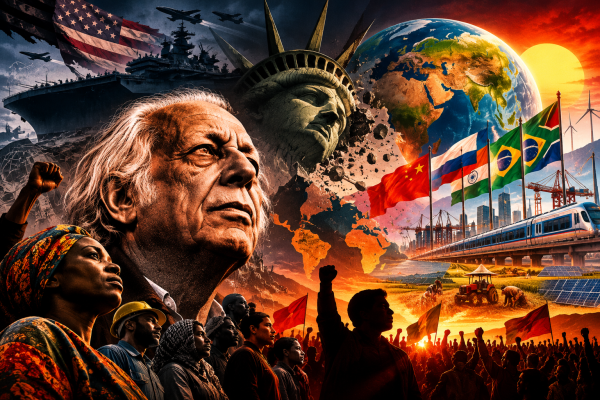
Reuters exposed an alleged Trump administration attempt to enter Brazil and cast doubt on its 2026 election, but treated the affair as partisan misconduct rather than part of a wider imperial campaign. Tariffs structured around U.S. economic needs, sanctions against Brazilian judicial officials, terrorism designations and long-standing security ties reveal a coordinated effort to discipline Brazilian sovereignty. The confrontation also belongs to Washington’s imperialist recalibration: consolidating the American Pole as Brazil deepens economic and technological relations with China. The real struggle is over who governs Brazil—its people, or an empire determined to supervise its courts, elections and developmental future.

Beyond Hegemony, Beyond Illusion: Samir Amin, Multipolarity, and the Unfinished Road to Socialism

What happens when one of the twentieth century's greatest Marxist theorists is tested against the world that emerged after unipolarity began to fracture? This Weaponized Intellects review excavates Samir Amin's Beyond US Hegemony? as both a product of its historical moment and a living revolutionary framework, measuring its arguments against China's socialist transition, Russia's anti-hegemonic resurgence, the rise of BRICS, and Amin's own later theoretical development. The result is neither celebration nor dismissal, but a critical reconstruction that distinguishes multipolarity from socialism and argues that only organized popular power can transform the decline of empire into genuine human emancipation.

Communists and Patriots: The Flag, the Class, and the Lie of Imperial Nationalism

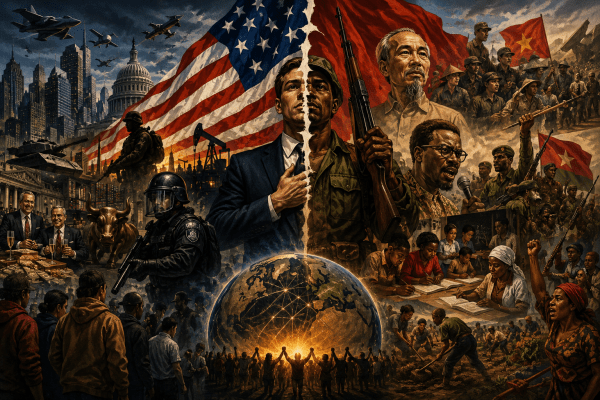
Trump says you can be a communist or a patriot—but not both. This essay exposes the historical fraud buried inside that slogan. By reconstructing the nation through historical materialism, it shows that nationalism has never possessed a fixed political content. In oppressed nations, communists repeatedly became the truest patriots because the struggle for national liberation demanded the overthrow of colonialism, imperialism, and comprador rule. In imperialist nations, however, nationalism serves the opposite function: binding workers to the ruling class and its global system of domination. The real contradiction is not between communism and patriotism, but between imperial patriotism and the liberation of the people.

The Throne Was Always Cracked: Radhika Desai and the Myth of American Hegemony

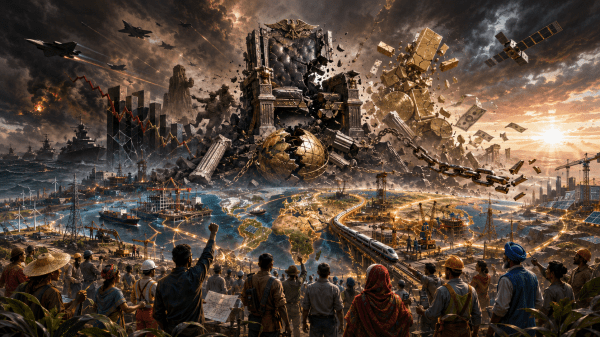
Radhika Desai’s Geopolitical Economy obliterates the illusion of a stable, American-led world, revealing that capitalism thrives on conflict, not unity. The book exposes capitalism’s instability, punctuated by crises that merely reshift the burdens onto workers and debtor nations. Desai argues for a multipolar world not as a peaceful transition to a new hegemon, but as a rupture from monopolistic control, fostering opportunities for sovereign development and socialist planning. However, liberation demands that working people reclaim the means of production and governance. The narrative warns against complacency; the emerging multipolarity is ripe for struggle, shaping the future based on who wields power over resources and development.

Strategic Stability or Strategic Pause: The Trump–Xi Summit and the Fracturing of the American Century

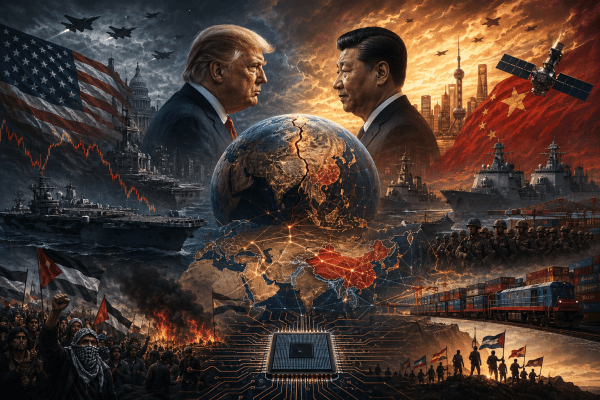
The Beijing summit epitomizes the unraveling of American supremacy, as Donald Trump arrived not merely as a president, but as a messenger of an empire in disarray. The spectacle of diplomatic niceties belied a crumbling global landscape, where the U.S. seeks containment while its capital cravenly craves access to China's vast markets. The summit revealed profound contradictions: America, armed yet impotent, involved in a tech war while reliant on the very infrastructure it seeks to undermine. As the Atlantic order falters, a multipolar era teeters on the edge, with ideological fractures foreshadowing a future fraught with uncertainty—yet, fertile for revolutionary possibilities.

Website Powered by WordPress.com.

Up ↑