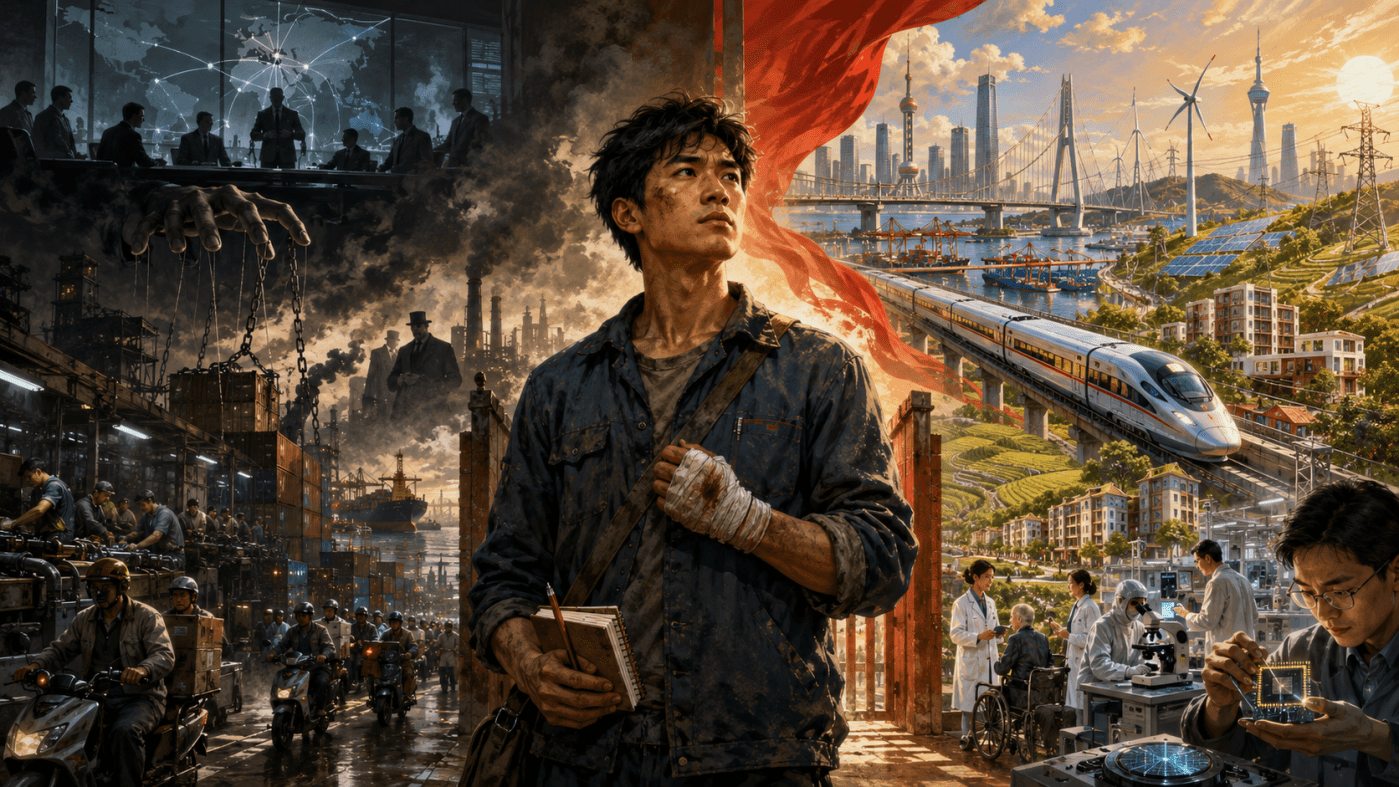
Jacobin takes Xiao Hai’s authentic testimony of exploitation and stretches one factory wound into a verdict against the entire Chinese Revolution. Restoring the history outside the factory gate reveals a sovereign socialist state that used a costly engagement with global capital to expand public power, overcome extreme poverty, and build capacities the imperial system never intended China to possess. The real struggle is not between China and its workers, but over how fully capital remains subordinate to the people’s state and how completely development is converted into worker dignity, security, leisure, and collective command. Chinese workers must be defended against exploitation without allowing their suffering to become a weapon for Washington’s technological blockade, military encirclement, and New Cold War.
By Prince Kapone | Weaponized Information | June 14, 2026
When Marx Is Made to Prosecute a Revolution
In “The Other Side of China’s Economic Miracle,” published by Jacobin on June 13, 2026, Daniel Cheng reviews Adrift in the South, Xiao Hai’s memoir of adolescence and early adulthood spent drifting through the factories, workshops, warehouses, and delivery routes of industrial China. Cheng recounts long working days, poverty wages, poisoned air, damaged bodies, managerial punishment, mechanical discipline, and the daily degradation of workers treated as removable parts in somebody else’s production process. Xiao Hai’s testimony deserves to be heard without dilution. The wound is real. The propaganda operation begins when Cheng makes the wound pronounce a verdict upon the entire Chinese Revolution.
Cheng’s contributor biography identifies him as a former sociology doctoral student and an independent researcher on Chinese political economy and technology. Jacobin describes itself as a leading voice of the American left, while its fundraising apparatus solicits subscriptions, donations, grants, bequests, stocks, and bonds to sustain a professional media institution located inside the imperial center. The point is not that Cheng received instructions from some hidden committee. No conspiracy is necessary when a political milieu already supplies the limits of respectable thought. Jacobin occupies that familiar province of the professional Western left where the language of class struggle remains in circulation, but socialist state power—especially when exercised by China—is treated as an embarrassment to be explained away.
The article’s principal device is narrative framing. Xiao Hai’s factory expands until it fills the entire country. The manager grows until he becomes the Chinese state. A particular labor regime, encountered in particular workplaces during particular stages of China’s development, is transformed into the essential truth of the whole social system. The factory becomes China. The manager becomes the state. The wound becomes the Revolution.
This framing is reinforced through composition. Cheng establishes several propositions that can be defended: China developed rapidly; millions of workers entered industrial production; migrant labor was frequently cheap, vulnerable, and harshly disciplined; employers extracted surplus from long hours and weak bargaining power. He then assembles those propositions into a conclusion larger than they can carry: that China’s development was made possible, in its essential character, by brutal exploitation. Exploitation unquestionably contributed to accumulation. But a mechanism within development is not automatically the explanation of development as a whole. Xiao Hai’s suffering cannot by itself explain the class character of the state, the ownership of strategic industry, the planning system, the use of investment, the historical foundations of sovereignty, or the destination of the accumulated resources.
Cheng also practices card stacking through disappearance. The foreign buyer vanishes. The multinational brand vanishes. The retailer, patent holder, purchasing contract, export market, logistics chain, and consumer in the imperial core all vanish. The commodity crosses the ocean, but the social relations organizing its journey are mysteriously detained at customs. China alone is left standing beside the exhausted worker, as though the factory produced for itself and the largest profits dissolved somewhere above the loading dock. The commodity becomes American when innovation, branding, patents, and executive brilliance are counted. It becomes Chinese when the injuries are counted.
The article’s grand historical maneuver is the false analogy between industrial China and nineteenth-century Britain. Cheng invokes the poisoned bodies, child labor, murderous working days, and machine discipline documented in Marx’s Capital, then places Shenzhen beside Manchester as though resemblance at the point of production established identity at the level of the social order. The analogy works emotionally because exploitation has recognizable forms across centuries. Machines accelerate. Managers command. Workers become exhausted. But two workers may bear similar wounds without the states surrounding them possessing the same history, property structure, class power, or position in the world.
Here Marx himself is recruited through appeal to authority, transfer, and quote mining. Cheng borrows Marx’s descriptions of the labor process and uses their moral and intellectual force to certify his classification of China. But he leaves behind the method that made Marx a revolutionary rather than a Victorian factory inspector. Marx did not classify an entire social formation by staring only at the wound. He investigated ownership, accumulation, class rule, state power, the organization of production, and the movement of the total system. Cheng preserves Marx’s image of the worker as an appendage of the machine while discarding the totality required to explain who commands the machine, where the surplus travels, and what historical order is being reproduced through it.
The article even contains a concession that quietly undermines its own thesis. Cheng acknowledges that workers across the Global South endure brutal exploitation without receiving anything resembling China’s scale of development. This should provoke the decisive question: if exploitation is widespread but China’s transformation is exceptional, then what explains the exception? Why did cheap labor produce dependency, debt, and permanent subordination across so much of the colonial world, while China converted industrial production into expanding national capacity? The article approaches this contradiction, looks directly at it, and then moves along before it has to answer.
Xiao Hai’s authority is also transferred beyond its legitimate reach. He possesses unquestionable authority over what the factory did to him: the hours it took, the injuries it inflicted, the humiliation it imposed, and the dignity it denied. Cheng attaches that authority to a political classification Xiao Hai is not quoted making. The worker verifies the wound. The reviewer makes the wound appear to verify the diagnosis of the entire system.
The memoir’s final demand—to live as a human being with dignity—is then presented as the cry for a world beyond capitalism. But the article never establishes whether Xiao Hai’s immediate antagonist is the private employer, the labor contractor, the local official, the foreign buyer, the platform algorithm, failed enforcement, market competition, or some combination of these forces. The worker asks for dignity. Cheng supplies the regime verdict.
The revolutionary answer cannot be another confiscation. Xiao Hai must not be transformed into an anticommunist witness, but neither should he be forced to recite a socialist doctrine he did not explicitly declare. His testimony should stand in its full power as an accusation against every employer, institution, and economic pressure that treated his life as disposable. Within China’s socialist constitutional and historical framework, his demand can also be understood as a claim upon obligations the state has undertaken but not fully realized. That is an interpretation grounded in the contradiction, not a slogan placed into the worker’s mouth.
Cheng’s review takes a real wound and installs it inside a narrative already prepared to receive it. The factory is separated from the country beyond its gates. The worker is separated from the revolution, institutions, supply chains, and international forces that shaped the factory. The foreign corporation disappears. Public power disappears. The historical transformation of China disappears. Marx is summoned only to inspect the body and forbidden from investigating the society. The wound must be seen. But it must not be permitted to stand trial in place of a revolution.
The Country That Existed Before the Factory Opened
Cheng’s review begins from facts that require neither denial nor dilution. Xiao Hai left the countryside for industrial employment and encountered long hours, low wages, managerial domination, physical exhaustion, workplace injury, economic insecurity, and the daily indignity of being treated as an expendable instrument of production. His story belongs to the enormous movement of rural labor into China’s coastal manufacturing centers, where disciplined and inexpensive workforces contributed materially to export production and industrial accumulation. This much is contained in the account Cheng places before his readers. The factual problem begins when that account is treated as though no country, revolution, state, or world economy existed beyond the factory walls.
The China into which foreign capital entered was not an empty territory waiting for the market to create history. The Chinese Revolution unified a country fractured by foreign invasion, occupation, civil war, warlordism, and semicolonial subordination. Land reform destroyed the political power of the landlord class, and by 1956 China had substantially completed the socialist transformation of private ownership in the major means of production. Reform and opening therefore did not create China’s sovereignty, national state, public institutions, or capacity to direct development. Those foundations had already been constructed through revolution.
The revolutionary period also transformed the people who later entered the factories. China’s official historical record shows that average life expectancy rose from approximately thirty-five years in 1949 to more than seventy-six years by 2015, alongside mass campaigns in public health, literacy, education, sanitation, disease control, and basic infrastructure. Rural workers did not descend upon the coastal cities from some society untouched by collective development. They came from communities already changed by land redistribution, public investment, primary health systems, expanded schooling, agricultural organization, and the construction of a sovereign national economy.
China later made a deliberate decision to use foreign capital, trade, technology, and commodity exchange to accelerate productive development. According to the State Council’s account of China’s foreign trade, processing trade expanded rapidly after the 1980s and for a period accounted for roughly half of the country’s total foreign trade. Foreign-invested enterprises became major participants in the export economy, while production was relocated into mainland China from Hong Kong, Taiwan, Japan, South Korea, Singapore, the United States, Europe, and other centers of industrial and financial capital.
The factory described by a Chinese worker was therefore rarely an isolated national institution producing goods solely for an internal Chinese market. It commonly operated inside a transnational chain. A corporation outside mainland China might control the brand, patent, product design, purchasing price, retail network, delivery schedule, and final consumer market. A Taiwanese, Hong Kong, Japanese, Korean, European, American, foreign-invested, or mainland contractor might operate the plant. Chinese workers performed the assembly, while ownership and economic command were dispersed across several legal jurisdictions and layers of subcontracting.
China’s trade documentation records that many technological exports assembled in China contained high-value components manufactured abroad. The customs label recorded the final site of assembly. It did not reveal who controlled the intellectual property, purchasing contract, distribution system, consumer market, or largest share of the commodity’s value. The worker was visible at the production line. The corporation directing the chain often remained several contracts away.
Foreign capital did not impose this arrangement upon a helpless Chinese state. Special economic zones, industrial parks, export-processing systems, infrastructure, and access to a large labor force were deliberately used to attract production. China sought foreign exchange, machinery, technical knowledge, management experience, employment, supplier networks, export markets, and entry into an international division of labor whose most profitable sectors were already controlled by developed capitalist states. Between 1978 and 2018, China attracted more than two trillion dollars in nonfinancial foreign direct investment and registered nearly one million foreign-invested enterprises.
The benefits of that strategy arrived with severe contradictions. Rural migrants frequently entered cities without equal access to the schools, health systems, housing programs, pensions, and social services attached to local household registration. The Chinese government has acknowledged that hukou restrictions prevented many migrant workers from fully accessing urban public services. Their unequal position increased vulnerability to unstable employment, employer-controlled housing, weak contracts, social-insurance evasion, wage arrears, and replacement by newly arriving labor.
Yet rural migration in China did not simply reproduce the complete dispossession through which British enclosure created a proletariat severed from the land. China’s Rural Revitalization Promotion Law requires the protection and development of rural collective property and directs the state to ensure that farmers benefit from collective assets. The government also carried out a national process to determine, register, and certify contracted rural land-use rights. Migrant workers faced real urban inequality, but many also retained connections to collective rural economies and legally recognized contractual land rights. The resulting labor regime was unequal and divided, but it was not identical to the historic liquidation of rural property that accompanied British industrial capitalism.
The hukou structure itself has continued to change. A national urbanization program announced in 2024 sought to reduce restrictions on urban residence and widen migrants’ access to schooling, health care, housing support, and other public services where they actually live. These reforms do not erase the unequal conditions through which previous generations of migrant workers passed. They establish that the migrant-labor system has been treated as an institutional problem subject to continued revision rather than as a permanent principle of Chinese development.
The same distinction applies to workplace conditions. China’s Labor Contract Law requires written contracts and establishes employer liability for unpaid wages, uncompensated overtime, sub-minimum pay, unlawful dismissal, and other violations. Chinese labor regulations establish the eight-hour day, forty-hour week, overtime limits, and additional compensation for extended work. In 2021, judicial and labor authorities identified the notorious “996” schedule—nine in the morning to nine at night, six days per week—as unlawful, and authorities subsequently launched measures against excessive overtime.
The legal standard and the lived reality have not always coincided. Official statistics reported that enterprise employees still worked an average of 48.6 hours per week during the third quarter of 2025. Local governments seeking investment and revenue have not enforced central protections with equal determination. Employers have used dispatch labor, subcontracting, informal arrangements, and complicated corporate structures to evade responsibility. Production deadlines and supplier competition have rewarded violations that the law formally prohibits.
But enforcement has not remained on paper. During the first eleven months of 2024, Chinese courts handled approximately 590,000 first-instance labor disputes and concluded about 80,000 civil cases involving new forms of employment. By mid-December, court enforcement had resolved roughly 69,000 cases involving migrant workers and recovered ¥1.72 billion in unpaid compensation. Prosecutors also charged 1,866 people in 2024 with criminal offenses related to withholding labor remuneration. The scale of these cases confirms that wage theft and labor violations remain substantial. Their prosecution confirms that the offending employers and the institutions enforcing labor claims cannot simply be treated as one undifferentiated capitalist authority.
The platform economy described through Xiao Hai’s delivery work has likewise become a direct object of regulation. National guidelines issued in 2024 required platform firms to prevent overwork, provide minimum-pay protections, compensate holiday labor, and consult workers before changing algorithms that affect their rights and income. Courts and labor authorities have also developed dedicated mechanisms and precedent-setting cases for delivery drivers, ride-hailing workers, and other workers whose legal employment relationships were obscured by digital platforms and subcontractors.
Chinese workers have not existed only as victims waiting for administrators to notice their suffering. The Constitution requires state-owned enterprises to practice democratic management through employee congresses and other legally established mechanisms. China’s Foreign Investment Law provides that employees in foreign-funded enterprises may establish trade unions and carry out union activity to protect their legitimate interests. By 2016, China reported 2.75 million grassroots trade unions with 280 million members, including 109 million rural migrant workers. The strength and effectiveness of these institutions vary across workplaces, but their existence places workers inside the formal political and legal structure rather than outside it as an entirely atomized laboring mass.
The economic position of migrant workers has also changed substantially since Xiao Hai first entered factory employment. In 2025, China counted more than 300 million rural migrant workers, while their average monthly income reached ¥5,075, an increase of 2.3 percent over the previous year. The same statistical record shows that rural disposable income grew faster than urban income and that the urban-rural income ratio narrowed to 2.31. These figures do not abolish regional inequality, cost-of-living pressures, excessive working time, or the unequal treatment of migrants. They establish that the workforce cannot accurately be represented as though it remained permanently suspended at Xiao Hai’s first wage of roughly ¥400 per month.
The destination of the resources accumulated during China’s development must also be included in the record. A joint study by the World Bank, China’s Ministry of Finance, and the Development Research Center of the State Council found that nearly 800 million people rose above the international extreme-poverty line during four decades of reform and development, accounting for close to three-quarters of the global reduction. This achievement does not compensate an injured worker for an untreated wound. It does establish that accumulated resources were not exhausted by private consumption or expatriated profit, but were also converted into infrastructure, housing, education, health, productive capacity, rural development, and the elimination of extreme poverty.
The ownership structure through which this transformation occurred cannot be determined solely by reading constitutional vocabulary, but neither can the constitutional framework be dismissed as ceremonial. The Constitution defines public ownership as the mainstay of China’s economy while permitting diverse forms of ownership during the primary stage of socialism. By the end of 2025, central state-owned enterprises held more than ¥95 trillion in assets and had invested ¥2.5 trillion during that year in strategic emerging industries. Central SOEs accounted for approximately 80 percent of domestic crude-oil production, 70 percent of natural-gas output, and 60 percent of the country’s power supply.
Private and foreign capital therefore operate inside China, employ workers, accumulate wealth, and generate pressures upon the legal and political system. But they do so within an economy where the state retains planning authority and commands major concentrations of energy, infrastructure, finance, communications, transportation, and strategic investment. The factory owner exists. So do public institutions with material power extending far beyond the factory owner’s balance sheet.
Processing trade and foreign-invested production helped China acquire machinery, foreign exchange, industrial knowledge, supplier networks, and access to global markets. Domestic firms and public institutions then expanded their own productive capacities. Imported components were progressively replaced with locally manufactured inputs. Assembly was joined by engineering, research, telecommunications, renewable energy, high-speed transportation, advanced manufacturing, and domestically organized supply chains. China did not remain confined to the low-value position initially assigned to it.
The international response to that movement is now part of the factual terrain. The United States has imposed extensive licensing requirements and export controls on advanced computing systems, semiconductor-manufacturing equipment, high-performance chips, software, and Chinese technology firms. In May 2026, the US Bureau of Industry and Security reaffirmed that advanced-computing items remain subject to licensing restrictions when supplied to entities headquartered in China or Macau, even when those entities operate through facilities in third countries. Earlier measures had also restricted China’s access to advanced computing and semiconductor-manufacturing technologies.
The sequence is concrete. Western and transnational capital entered China to gain access to labor, infrastructure, production, and a growing market. China used that relationship to acquire foreign exchange, technical knowledge, industrial depth, and increasingly advanced productive capacity. As Chinese enterprises and public institutions moved beyond assembly toward control of higher-value technological systems, the United States expanded measures intended to restrict that movement.
The complete record therefore permits neither denial nor indictment. Exploited labor contributed to accumulation. Foreign corporations and transnational production networks helped organize the export economy. Chinese policy deliberately created the conditions through which those firms operated, and Chinese institutions bear responsibility for protections they failed to enforce consistently. At the same time, the sovereign state constructed by the Revolution retained public control over strategic sectors, expanded worker protections and institutions, raised migrant incomes, reduced rural poverty, reformed unequal systems, and converted foreign investment and processing trade into productive capacities that foreign capital did not intend China to command.
The factory wound belongs inside the history of China’s development. It does not contain that whole history. The question left unanswered by Cheng is not whether workers suffered. They did. The question is why exploitation generated renewed dependency across so much of the Global South, while China converted an unequal encounter with world capital into the industrial, social, and technological foundations of sovereign development.
The Worker Is the Measure of the Revolution
The worker’s suffering is real. The conclusion drawn from it depends upon the history into which that suffering is placed. If every wage relation, private employer, foreign investment, inequality, and violation of labor law automatically proves capitalist state power, then socialism becomes impossible everywhere except in a fantasy world where the revolution awakens one morning to discover that contradiction has packed its bags and left the country. That is not historical materialism. It is a purity test wearing Marx’s coat.
China is not a capitalist state disguising itself with red flags and revolutionary vocabulary. It is a sovereign socialist state led by the Communist Party of China, using markets, private enterprise, foreign investment, commodity exchange, and competition within a nationally directed developmental system whose strategic foundations remain under public command. Capital operates inside China. It accumulates wealth, employs labor, strains against regulation, and attempts to enlarge its room for maneuver. But capital does not possess sovereignty. It does not command the state, own the strategic heights of the economy, or determine the long-term direction of national development.
This distinction is the foundation Cheng’s argument cannot permit itself to examine. The class character of a state cannot be read from the existence of a factory owner alone. It must be located in who commands land, energy, finance, infrastructure, communications, transportation, industrial policy, and strategic investment; who possesses the power to regulate, prosecute, redirect, or suppress private interests; and whether accumulation is ultimately subordinated to public development or public authority subordinated to accumulation.
Private capital in China is active, wealthy, ambitious, and capable of inflicting tremendous damage upon workers. But it is not an alternative sovereign power standing on equal terms against the people’s state. It exists within political boundaries established by a revolutionary order that retains the institutional capacity to discipline it. The contradiction is serious precisely because capital never stops testing those boundaries. It seeks longer working days, lower labor costs, weaker enforcement, greater managerial command, and the conversion of economic wealth into social influence. Yet pressure upon the socialist system is not the same thing as command of the socialist system.
The market is therefore neither an innocent tool nor an invading army that has already conquered the country. It is an instrument whose use generates its own dangers. China admitted and regulated market relations because they could mobilize investment, stimulate production, transfer technology, expand trade, and accelerate the development of productive forces. But capital does not enter a socialist country as a grateful technical consultant. It enters hungry. Every opening becomes, from its standpoint, an opportunity to enlarge private power. Every regulation becomes a cost to evade. Every worker becomes labor time to be purchased as cheaply and consumed as completely as conditions allow.
Xiao Hai’s wounds arose within this contradiction. Cheap migrant labor, long hours, social inequality, weak bargaining power, subcontracting, and harsh discipline materially contributed to export production and accumulation. Chinese institutions failed too often to enforce the standards they had formally established. Local authorities sometimes privileged investment, output, and revenue over the rights of workers. Employers exploited the distance between law and enforcement. Foreign corporations and purchasing firms benefited from production systems that allowed them to control prices and deadlines while remaining legally removed from the factory floor.
None of this can be denied without denying the worker himself. But exploitation did not create the revolutionary state, reunify China, abolish landlord rule, establish public ownership, preserve rural collective property, construct national planning, expand literacy and public health, or build the sovereign institutions through which foreign capital would later be admitted. Exploitation contributed to accumulation during a particular stage of development. It does not explain how that accumulation was directed, why it did not simply leave the country, or how it was converted into national industrial, technological, and social capacity.
This is the contradiction concealed by Cheng’s own reluctant admission that workers throughout the Global South have endured comparable or worse exploitation without receiving anything resembling China’s developmental transformation. If exploitation alone produced sovereign industrial power, the formerly colonized world would be overflowing with technological giants, national infrastructure, strategic public industries, and eradicated extreme poverty. It is not.
Across much of the Global South, workers have been exploited while machinery remained foreign, finance remained external, profit departed, and dependency survived. Mines were dug, plantations expanded, factories opened, and bodies exhausted, but the commanding capacities of development remained elsewhere. Exploitation enriched foreign capital and local comprador classes while the country itself remained trapped at the subordinate end of the international division of labor.
China moved differently because the Revolution had already built the state through which the encounter with foreign capital would be managed. The door was opened, but the house did not belong to the visitor. Foreign corporations entered seeking cheap labor, market access, and enlarged profit. The Chinese state entered the same relationship seeking machinery, foreign exchange, technical knowledge, industrial experience, supplier networks, employment, and access to international markets.
The relationship was unequal, contradictory, and costly. Workers paid too much of that cost. But it did not end where transnational capital expected it to end. China did not remain a permanent assembly platform. The workshop learned. The supplier became a producer. The producer became an engineer. The engineer became a competitor. A country assigned the task of assembling commodities designed, financed, branded, and sold elsewhere began mastering the systems necessary to design, finance, manufacture, transport, and develop them for itself.
That is the point at which the imperial core’s moral concern underwent its miraculous awakening. When Chinese workers assembled foreign products under exhausting conditions, the arrangement was praised as globalization, efficiency, openness, and comparative advantage. When China began moving from assembly toward advanced production and technological sovereignty, the same powers discovered unfair competition, national-security threats, and the urgent necessity of export controls.
The Chinese worker was acceptable to imperial capital while he remained cheap, subordinate, and confined to a low-value position inside a production chain controlled elsewhere. He became a humanitarian concern only after the productive system built through his labor began weakening the technological monopolies of the imperial center.
The commodity became American when patents, branding, innovation, retail margins, and executive intelligence were counted. It became Chinese when overtime, toxic exposure, injury, and exhaustion were counted. Western capital claimed the mind of the commodity and assigned its wounds to socialism.
This is the colonial contradiction operating through the language of labor concern. The imperial powers do not oppose exploitation as a universal principle. Their own corporations entered China because the available labor regime improved profitability. What they oppose is the ability of a sovereign socialist state to take an unequal relationship with global capital and use it to construct capacities that weaken imperial command over technology, finance, industry, and trade.
The comparison between Manchester and Shenzhen collapses at precisely this point. Workers in both places may endure long days, industrial injury, managerial discipline, and the reduction of human life to measurable units of production. Similar wounds reveal the brutality of capital at the point of exploitation. They do not establish identical histories or social systems.
British industrial capitalism developed through the destruction of rural livelihoods, the concentration of private property, colonial domination, and an expanding imperial system that subordinated other peoples to British accumulation. Chinese industrialization emerged from semicolonial dismemberment, revolutionary reunification, public ownership, protected rural collective property, and a state attempting to overcome the dependency imposed upon it by the imperial order.
Even the migrant worker’s relation to the countryside was not identical. Hukou inequality deprived many workers of equal urban services and made them more vulnerable to employers. Yet many remained connected to rural collective economies and retained legally recognized land-use rights. They were not simply produced through the wholesale liquidation of rural property that accompanied the rise of British capitalism. China’s migrant labor regime contained serious inequality, but it did not emerge from the same history of complete proletarian dispossession.
The analogy fails because Cheng takes a similarity in the labor process and asks it to erase the Revolution, the state, the property system, the countryside, the global production chain, and China’s position inside the world economy. He preserves the factory wound and removes everything required to explain it.
The enforcement gap inside China must also be understood as a field of class struggle rather than proof that the state and employer are one. Labor laws establish standards employers continually attempt to evade. Courts recover stolen wages. Prosecutors charge those who withhold compensation. Platform regulations seek to restrain excessive working time and algorithmic control. Trade unions, employee congresses, and formal mechanisms of workplace participation place workers within the institutional structure of the socialist state.
These institutions are not equally effective in every workplace. Their existence does not abolish exploitation by declaration. But they demonstrate that Chinese workers are not merely passive victims standing outside the state and pleading for rescue. They possess legal claims, political institutions, collective organizations, and formal channels through which the pressure of labor can be brought against capital. The worker appears not only as an injured body but as a political subject inside the socialist order.
This is why the rising income of migrant workers, narrowing urban-rural inequality, expansion of public services, prosecution of wage theft, regulation of platform labor, and eradication of extreme poverty matter to the classification of China’s development. They do not cancel Xiao Hai’s suffering. They reveal the direction in which resources and state power have also moved.
Under capitalism, the social surplus is commanded principally through private accumulation, even when portions of it are taxed and redistributed. In socialist development, the decisive question is whether public power can direct that surplus toward collective capacity, social provision, national sovereignty, and the progressive improvement of working life. China’s record shows both unresolved exploitation and enormous social transformation. The two realities must be held together because the struggle between them is part of the socialist process itself.
Chinese sovereignty and Chinese worker power are therefore not opposing principles. Sovereignty establishes the political ground upon which finance, technology, strategic industry, and accumulated resources can be kept from foreign command. Worker power gives that sovereignty its socialist content. Without sovereignty, Chinese labor would remain subject to the discipline of imperial finance, foreign monopolies, sanctions, and technological dependency. Without expanding worker participation, social protection, leisure, security, and command over the fruits of production, sovereignty would become thinner than the Revolution that created it.
Xiao Hai’s demand for dignity belongs inside this struggle. It is not evidence that the Revolution was a fraud. It is a claim upon the Revolution’s unfinished obligations. The worker who built Shenzhen has the right to demand that public authority reach through every contractual layer, discipline the employer, enforce the working day, insure the injured, restrain the algorithm, open urban services to migrant families, and ensure that the enormous productive capacity created by labor returns to the people as security, time, participation, and common prosperity.
The socialist character of China does not depend upon pretending that capitalist contradictions have vanished. It depends upon whether the people’s state retains the capacity and political direction necessary to restrain those contradictions, subordinate capital, defend public ownership, and progressively transform the conditions under which workers live and labor.
The struggle, then, is not between China and its workers. It is over how fully the productive power built by Chinese workers will be placed under their collective command. It is over whether capital remains a useful but subordinate instrument or acquires powers that threaten the socialist direction of the country. It is over whether development produces only national strength or converts that strength ever more deeply into human dignity. The worker is not the evidence against the Revolution. The worker is the measure of how far the Revolution has come—and how far it has yet to go.
The Worker Is Not Washington’s Weapon
Chinese workers will not be liberated by tariffs, semiconductor blockades, military encirclement, blacklists, or another fleet steaming toward the western Pacific. None of these measures shortens the working day, recovers stolen wages, insures an injured courier, or places one factory under worker control. They constrict development, threaten employment, deepen insecurity, and strengthen the imperial state whose corporations profited from the labor regime they now parade as proof of Chinese barbarism. A worker does not become freer because the Pentagon has discovered concern for his fingers.
Our first task inside the United States is therefore to break the propaganda chain that converts Chinese workers’ testimony into ammunition for war. CODEPINK’s China Is Not Our Enemy campaign organizes public education, congressional pressure, teach-ins, and actions against sanctions, militarization, and confrontation with China. Union locals, classrooms, community organizations, churches, independent media projects, and political study groups should use these materials to expose the New Cold War before its slogans harden into public consent for another catastrophe.
Every discussion of Chinese factory exploitation must restore the whole production chain. The foreign brand, purchasing corporation, patent holder, retailer, investor, and logistics company must be brought back into the picture. Workers and organizers should demand disclosure of supplier prices, production deadlines, subcontracting arrangements, safety records, wage violations, and the division of value between the corporation controlling the commodity and the workers assembling it. The capitalist firm must not be allowed to claim the innovation, collect the profit, and then assign the injury to China.
This political education should also make use of Friends of Socialist China, a platform dedicated to defending the People’s Republic and promoting understanding of Chinese socialism, whose institutional registration and filing history are publicly recorded by the United Kingdom’s Companies House. Its articles, conferences, discussions, and educational work provide resources for studying Chinese labor contradictions without submitting them to either corporate anticommunism or the imperial left’s ritual prosecution of every existing socialist state.
Workers in the imperial core must reject the lie that Chinese workers stole their jobs. Capital relocated production to discipline labor at both ends of the chain. In China, it exploited migrant vulnerability, supplier competition, and long hours. In the United States and Europe, it used plant closures, offshoring, and the threat of relocation to crush unions, lower wages, and abandon entire communities. The worker assembling the commodity abroad was never the enemy of the worker whose factory was closed at home. The enemy was the capital that arranged them against one another and collected the winnings from both.
The practical line follows directly. Pass union and community resolutions opposing military confrontation and technological strangulation. Organize workplace and neighborhood teach-ins on the international production chain. Pressure elected officials against export controls, military appropriations, and base expansion. Expose corporations that impose impossible deadlines and poverty-level supplier prices while hiding behind contractors. Pair Xiao Hai’s testimony with evidence of China’s labor enforcement, social development, public ownership, and continued struggle against the abuses generated by market relations.
Solidarity must neither erase contradiction nor deliver it to an imperial tribunal. Defend the right of Chinese workers to wages, safety, leisure, social protection, and greater command over the wealth they produce. Defend the sovereignty of socialist China against every attempt to reverse its development through coercion and war. Refuse the demand that Chinese workers denounce their own state before their suffering is considered legitimate, and refuse the equally false demand that they remain silent because their country is under attack.
The political line must be carried without apology: uphold the Chinese Revolution, defend the People’s Republic, expose the corporations that profited from contractual distance, and build solidarity between workers separated by borders but disciplined by the same transnational capital.
Tell the worker’s truth. Expose the corporation. Break the war drive. Defend socialist China. Place capital under the command of the people.


Leave a Reply