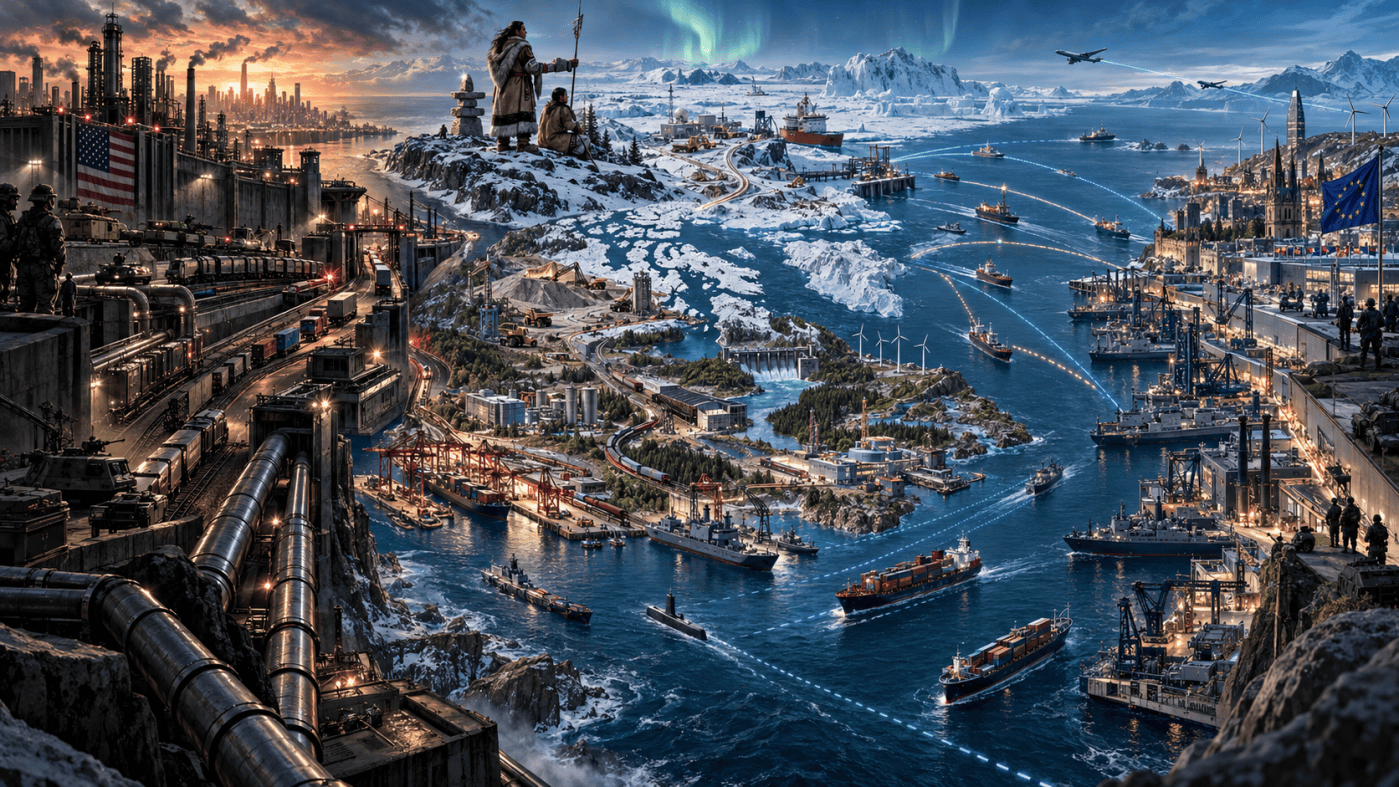
The New York Times sees a dramatic European invitation, but Canada and the EU had already been joining defence production, finance, minerals, technology and infrastructure long before anyone invented the phrase “associate member.” Washington’s imperialist recalibration is tightening the American Pole around Canada while demanding a stronger, more heavily armed European rear to carry a greater share of the imperial burden. That contradiction is producing its own escape routes: Canada is reaching toward the very European industrial capacities that U.S. strategy helped enlarge, weakening exclusive American leverage even as the wider Atlantic system grows stronger. But more exits from Washington don’t settle who owns the factories, commands the mines, governs the Arctic or controls the public money building this new architecture.
Prince Kapone | Weaponized Information | September 16, 2026
The Membership Came After the Machinery
On September 16, The New York Times published Jeanna Smialek and Matina Stevis-Gridneff’s report from Strasbourg announcing that Canada could become the European Union’s first “associate member.” Ursula von der Leyen supplied the spectacle from the European Parliament: Mark Carney seated beside her, lawmakers rising in applause, the two leaders shaking hands as she invited Canada toward a relationship nobody had quite defined yet. The ceremony was new. The relationship underneath it plainly wasn’t.
The Times starts its clock where the television cameras do. Von der Leyen makes the proposal, Carney’s Davos speech supplies the doctrine, and the deterioration of Canada’s relationship with Washington supplies the crisis. China appears as “competitive.” The United States appears as “at-times-hostile.” Canada and Europe are presented as caught between them, two middle powers reaching toward each other as the giants crowd the room. But the article’s own facts wreck that tidy symmetry. China is a competitor. The United States is the destination for roughly three-quarters of Canadian exports, Canada’s overwhelmingly dominant economic relationship, and the government now locked in an actual trade war with Ottawa. Those aren’t two versions of the same pressure.
The Times also keeps tripping over evidence that its historical clock starts late. Canada and the EU already have a trade agreement. Roughly 90 percent of their trade is already tariff-free. They’re already working together on critical minerals, technology regulation, security and defence. Von der Leyen is already proposing a European Security Council that could include Canada. The supposed beginning arrives carrying enough institutional baggage to make one wonder how long the train has actually been moving.
The framing works by giving political leaders nearly all the agency. Carney strategizes. Von der Leyen opens doors. Trump pushes. European diplomats deliberate. Russia threatens. China competes. What mostly disappears are the people and institutions that make any of these relationships material: corporations, procurement agencies, defence manufacturers, miners, investors, workers, unions, Indigenous governments, ports, factories and supply chains. “Closer cooperation” sounds pleasantly diplomatic when nobody asks what is being integrated, who owns it, who finances it or who gets paid.
The security framing performs similar sorcery. Drone incursions and alleged Russian provocations appear immediately before von der Leyen’s proposals for new European security mechanisms. The sequence makes expansion look almost automatic: danger appears, responsible governments respond, institutions grow. History apparently filled out the application form by itself.
The Times isn’t fabricating the rupture with Washington, and it isn’t wrong that Canada and Europe are drawing closer. The trick is subtler. Immediate geopolitical pressure becomes the explanation for a relationship whose own details show that much of the machinery already existed. The real unanswered question isn’t simply how old the Canada-EU relationship is. It’s what changed that made those existing connections suddenly worth elevating into a strategy of economic and security survival. The Times gives us the new sign on the door. It never asks who built the damn hallway—or why everyone suddenly needs another way out.
The Machinery Was Already Running
The handshake in Strasbourg didn’t switch the machinery on. By the time Ursula von der Leyen floated “associate membership,” governments on both sides of the Atlantic had already spent years rewriting procurement rules, opening credit lines, joining defence supply chains, locking down minerals and building new industrial relationships. What looked new from the parliamentary balcony was already old news on the factory floor.
What had changed was the pressure around that machinery. Washington was no longer pretending that continental integration was politically neutral. In February 2025, the White House imposed new tariffs on Canadian goods and openly declared that tariffs were leverage and access to the U.S. market a privilege. It later adjusted auto tariffs around the realities of continental production rather than abandoning the weapon. By January 2026, Washington had also pulled processed critical minerals into its national-security trade machinery. The point wasn’t subtle: factories, market access and strategic inputs were becoming instruments of state pressure.
Ottawa answered by trying to harden some of the weak points at home. Canada’s Defence Industrial Strategy directs procurement toward Canadian firms where possible, promotes domestic industrial champions, seeks Canadian control over critical intellectual property and uses a “Build–Partner–Buy” model when Canada can’t produce alone. The state is trying to rebuild capacities that years of dependence left exposed while still using allied production where it needs scale, technology or speed.
Europe matters because it has been rebuilding capacity of its own. In March 2026, the European Parliament called for Canada to be integrated, as far as possible, into Europe’s defence technological and industrial base. The resolution pushed military supply-chain integration, Canadian access to procurement, expanded PESCO participation, joint research, technology transfer, Arctic cooperation and work across AI, quantum systems, space and cyber. Canada wasn’t being invited into a static European market. It was being connected to a European industrial structure that Brussels itself was trying to enlarge.
The EU’s SAFE programme makes that material. The €150 billion financing instrument is designed to expand common defence procurement and productive capacity across Europe, and Canada became its first non-European participant. By June, Montréal-based Marconi Technologies had secured a Polish tactical-radio contract through the new arrangement. The relationship had already moved from communiqués into orders, components and production before anybody found the phrase “associate member.”
European capacity is also pushing outward through finance. In March, the European Investment Bank and Canada signed a letter of intent that could eventually allow the EU-owned bank to finance Canadian exploration, extraction, processing, recycling and innovation where projects serve European strategic needs. Europe’s search for greater industrial security therefore doesn’t stop at its borders. It reaches toward the mines and processing plants that supply the machinery Europe wants to build.
Nor does everything depend on Brussels moving as one body. Canada and Germany are negotiating a strategic partnership covering defence, artificial intelligence, space, energy, investment and critical minerals. Canada’s decision to join German-Norwegian submarine cooperation is meant to bind their military and industrial relationship for decades while strengthening what all three governments still call transatlantic collective defence. European industrial strengthening and Atlantic military integration are already traveling in the same vehicle.
Europe isn’t Canada’s only exit. Ottawa has also pushed tighter links between the European Union and the CPTPP, and the two groupings have opened a formal trade and investment dialogue. That matters because Canada isn’t replacing one giant market with another. It is trying to widen the number of markets, suppliers and institutions available when Washington makes the old continental bargain more expensive.
Eventually all this lands on actual ground. In the Arctic, the proposed Grays Bay Road and Port would connect mineral deposits to a deepwater port while supporting transportation, development and possible security uses. The Kitikmeot Inuit Association supports the project, but Inuit Tapiriit Kanatami has insisted that Canadian Arctic strategy must rest on Inuit governance, not treat Inuit as scenery on land suddenly declared strategic. First Nations leaders have made the same point around critical minerals: the resources Ottawa and its partners want frequently sit on First Nations territories where jurisdiction and consent matter.
Workers are contesting the industrial terms too. Unifor has pushed stronger Canadian-content and procurement rules so diversification translates into domestic production rather than another round of branch-plant dependence. On the European side, industriAll Europe has demanded worker protections, collective bargaining and social conditions on the flood of public money entering defence production.
Put those pieces together and the September announcement changes shape. Washington was tightening the political use of continental dependence. Canada was rebuilding selected domestic capacities and looking for additional routes around that pressure. Europe, meanwhile, was expanding the industrial, financial and military capacity that made it capable of serving as one of those routes. By the time von der Leyen gave the relationship a dramatic new name, factories, banks, ministries, unions, Indigenous governments and procurement offices were already remaking the ground beneath it.
One Chokepoint, Many Exits
The old continental bargain worked precisely because it was unequal. Canada sold into the enormous U.S. market, organized industries across the border and plugged its factories, resources and military systems into a continental machine dominated from Washington. Capital loved the efficiency. Governments praised integration. Then the political weather changed and the machinery showed its teeth. The same market access, supply chains and strategic inputs that had lowered costs could be turned into leverage. Yesterday’s cheapest route became tomorrow’s chokepoint.
Weaponized Information has called the larger U.S. response to relative decline imperialist recalibration. Washington isn’t simply abandoning an order it can no longer command as cheaply as before. It is trying to reorganize that order: pull strategic production closer, secure resources, force allies to carry more of the military and industrial burden, and use the advantages it still possesses more aggressively. In the Western Hemisphere, that takes the form of the American Pole, or Fortress America: a harder continental core in which markets, minerals, manufacturing and security are increasingly treated as instruments of command. Canada sits inside that project whether Ottawa likes the architecture or not.
The new Canadian strategy grows from that pressure. If Washington can make one continental relationship hurt badly enough to discipline Canadian policy, Ottawa needs more places to sell, buy, finance, build and source what it cannot produce alone. That is the practical content of what we’ve called distributed interdependence. Canada is trying to rebuild selected capacities at home while multiplying usable connections abroad. More suppliers. More markets. More industrial partners. More routes around a gate that one power has proved willing to close.
But here is where Europe enters as something larger than another customer. Washington’s recalibration has also demanded a stronger European rear. The United States wants Europe spending more, producing more weapons, carrying more of the security burden and rebuilding industries that decades of dependency allowed to thin out. Europe’s ruling classes and states have their own reasons to accept much of that program. Defence production expands. Public finance moves toward strategic industries. Procurement systems grow. Supply chains thicken. The rear gets stronger because the empire needs it stronger.
And that creates a contradiction Washington can’t simply command away. Productive capacity has consequences of its own. A Europe capable of financing more industry, manufacturing more military equipment, securing more raw materials and organizing more of its own procurement is better equipped to serve the Atlantic system. It is also better equipped to bargain inside it. More muscle for the bloc doesn’t necessarily mean the same hand controls every finger.
Canada and Europe therefore meet inside the same imperial recalibration from opposite directions. Washington squeezes Canada through the very continental dependencies built under the old arrangement. Washington presses Europe to become a more capable industrial and military rear. Canada starts looking for exits. Europe, having been pushed to build more capacity, increasingly possesses something worth exiting toward. The Canadian-European relationship is partly the child of a U.S. strategy intended to preserve command.
That doesn’t mean Washington has somehow engineered its own disappearance. The Atlantic military structure remains. European rearmament still strengthens it. Canada still sits beside the United States and remains tied into continental systems that can’t be unwound with a summit communiqué. The contradiction is sharper than some clean break between empire and independence. The very capacities that loosen Washington’s exclusive grip can also make the wider Western system more powerful.
This is why sovereignty has to be dragged down from the podium and put on the shop floor. Freedom of maneuver means little unless it rests on control over something material: factories that can make what was once imported, procurement systems with alternative sellers, ports serving different routes, technology that cannot be switched off elsewhere, minerals processed instead of merely dug up and shipped away, financing that comes from more than one direction. A government can say no only to the degree that somebody somewhere has built the means to survive the answer.
Capacity, though, has its own class address. Ottawa wants Canadian industrial champions, controlled intellectual property, larger export markets and strategic industries less vulnerable to foreign pressure. Workers may gain employment, bargaining terrain and productive capacity from that shift. Capital gains something else: subsidized markets, public contracts, protected investment and new outlets for accumulation. One side still owns. The other still works. A Canadian-controlled supply chain can reduce foreign leverage while leaving command inside the workplace exactly where it was.
The mineral and Arctic front makes that even harder to disguise. The state speaks of Canadian sovereignty over territories and resources that are also governed through Indigenous rights, treaties and institutions. Roads, ports and mines don’t rise on an empty northern map. Inuit communities can support infrastructure while demanding control over its terms. First Nations can demand consent and jurisdiction while governments and investors see strategic minerals needed for a larger industrial project. The struggle isn’t over an abstract choice between development and isolation. It is over who governs development, who owns the assets, who receives the wealth and whose sovereignty counts when several claims occupy the same ground.
So the new map contains more than one struggle for autonomy. Canada seeks room against concentrated U.S. command. Europe accumulates capacity inside an Atlantic order that still disciplines it. Workers fight over whether public industrial spending strengthens labour or merely fattens contractors. Indigenous nations confront a state that invokes their lands as the foundation of national sovereignty while still trying to retain final command over development. Each movement touches the others, but they are not identical.
That is why the Times’ framing feels plausible while missing the historical motion underneath it. From the newsroom, the visible event is the handshake: Trump pressures Canada, Canada turns toward Europe, von der Leyen opens the door. From the ground, the sequence is harsher. U.S. power tightens the hemisphere. Europe is armed and industrially strengthened to carry more of the imperial load. Canada searches for routes around the pressure. Then the capacities created inside one part of the Atlantic system become useful to another state trying to escape concentrated command inside the same system.
The irony is almost too clean. Washington hardens Fortress America to preserve leverage and strengthens Europe to preserve the wider order. Canada responds by reaching toward the very European capacities that recalibration helped enlarge. The system produces exits while trying to close ranks. Those exits may never abolish dependence, and they certainly don’t abolish capitalist command. But they change who can bargain, who can refuse and where pressure can be redirected. The chokepoint remains. What has changed is that more roads are being built around it—and the struggle now turns on who will own the damn tollbooths.
Who Gets the New Levers?
The new factories, procurement systems, mineral corridors and Arctic infrastructure aren’t being built outside the imperial recalibration described above. They are part of it. Governments are pouring public money into the productive machinery of security while trying to reduce particular dependencies inside that machinery. That makes the terms of construction a battlefield in their own right. If workers, Indigenous nations and communities don’t contest those terms, strategic autonomy can amount to little more than giving capital new suppliers, new subsidies and a fresh set of flags to hang over the loading dock.
Public procurement is one of the clearest levers. Unifor has backed diversification in defence production while demanding that public contracts create Canadian manufacturing, high-value work and durable industrial capacity. Across the Atlantic, industriAll Europe is fighting over the other end of the same pipeline, pressing for collective bargaining, worker protections, local production and social conditions on the billions flowing into rearmament. The leverage comes from the money itself. States need workers and factories to build the new capacity; unions can fight to make public contracts carry obligations stronger than guaranteed profits.
Critical minerals put another lever in the ground. The Assembly of First Nations has insisted that the minerals governments suddenly call strategic often sit on First Nations territories where jurisdiction and consent don’t vanish because Ottawa found a European buyer. That gives First Nations governments material leverage over how extraction proceeds, who holds equity, how revenues move and whether another generation of resource wealth leaves Indigenous land while ownership and decision-making travel elsewhere.
The Arctic makes the same struggle impossible to hide behind a national flag. Inuit Tapiriit Kanatami argues that Canadian Arctic power rests on Inuit land, presence and governance, and that Inuit must help shape the security and infrastructure policies transforming Inuit Nunangat. At the same time, the Kitikmeot Inuit Association supports Grays Bay because roads, ports, mineral development and security infrastructure can produce real regional benefits. The contradiction therefore doesn’t run between development and refusal. It runs through the terms: who governs, who owns, who works, who gets paid and whose consent has force.
That is where solidarity has to become material. Procurement rules, collective agreements, ownership structures, treaty institutions, Indigenous equity and the conditions attached to public finance can all change who commands what is being built. The Times sees Europe opening a door for Canada. Behind that door sits a factory floor, a mine, an Arctic road, a credit line and a bargaining table. The strategic map may be changing, but the decisive question remains stubbornly old: when the new levers are installed, whose hands will actually be on them?
 Weaponized Information
Leave a comment