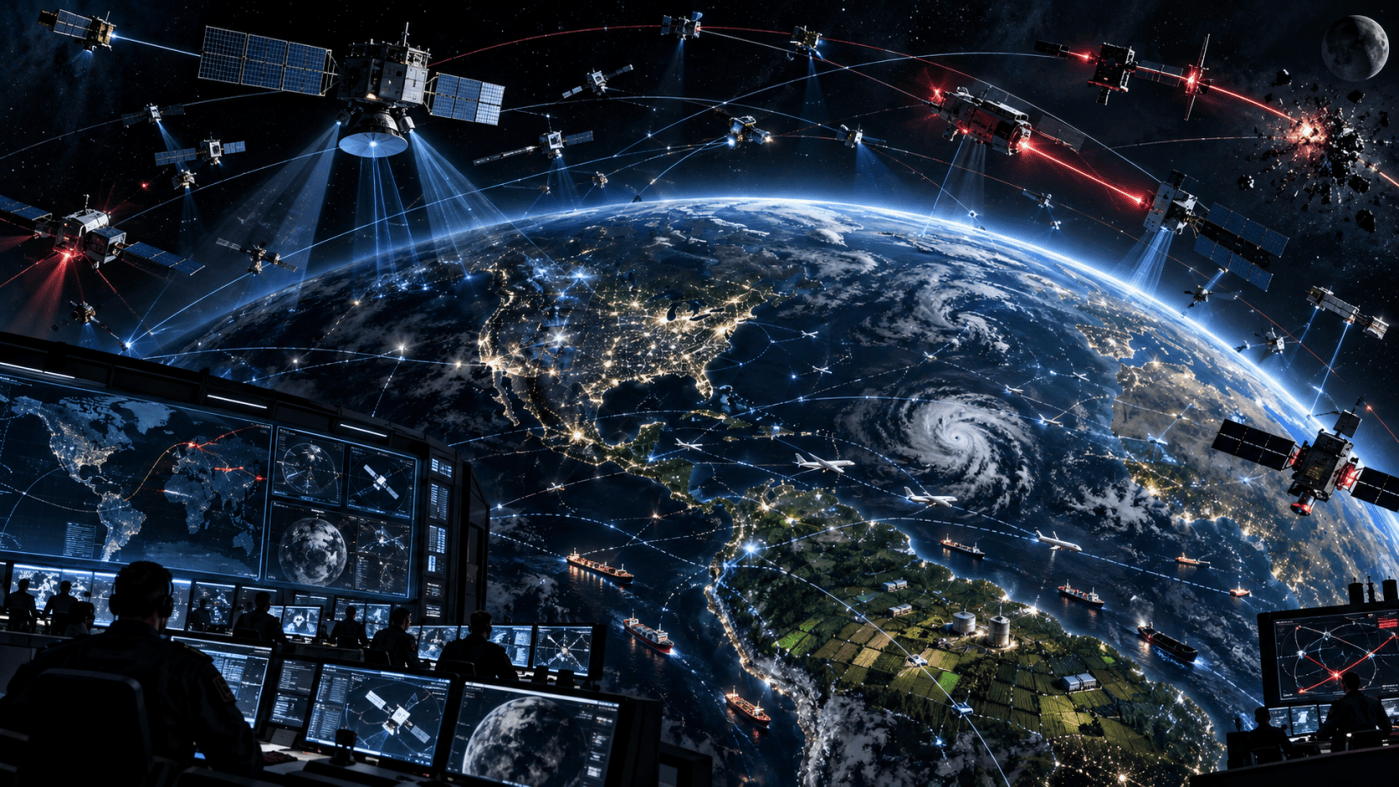
Washington’s admission that U.S. troops now operate weapons in orbit didn’t begin the militarization of space; it exposed how far the transformation had already gone. For half a century, military dependence, anti-satellite weapons, failed arms-control efforts and technological development have grown inside the same orbital infrastructure humanity increasingly relies on for communication, navigation, science and commerce. Now the U.S. state is pulling privately owned space technology ever deeper into a warfighting system built to preserve American freedom of action while rival powers develop counterforces of their own. Beneath Reuters’ tidy story of Russian protest sits the harder struggle: whether an infrastructure used by humanity will be governed around common need or reorganized around the military command of those powerful enough to fight over it.
Prince Kapone | Weaponized Information | September 16, 2026
I. The Weapon Becomes Background
Reuters published a remarkable story on September 16, 2026, and then built its headline around the reaction to it. The dispatch from Moscow reports that Russian Deputy Foreign Minister Sergei Ryabkov called for a legally binding agreement to prevent an arms race in space after Washington publicly acknowledged that the Pentagon is already operating weapons in Earth’s orbit. Reuters itself calls the admission “a landmark moment in the militarisation of space.” Yet the headline doesn’t say the United States has admitted putting operational weapons overhead. It says Russia wants to stop an arms race after Washington acknowledged doing exactly that. The weapon becomes background; the objection becomes the event.
That’s the first trick of scale. Reuters doesn’t fabricate the American admission. It puts it right there in the copy. But agency is arranged differently. Russia speaks, complains, accuses and warns. The United States simply “acknowledged” a capability, as if somebody opened a warehouse door and discovered orbital weapons sitting there between the spare parts. The institutions that conceived them, funded them, built them, deployed them and folded them into military doctrine barely enter the frame. Technology arrives finished. History arrives without fingerprints.
The chronology performs similar work. Reuters begins its active story this week: Washington acknowledges the weapons, Moscow responds, Ryabkov renews Russia’s demand for a treaty. We’re told Russia has pushed such an agreement for years, but the article leaves that history folded into a sentence. No reader confined to this report could reconstruct how long states have argued over weapons in space, why no binding prohibition was reached, or what political choices produced the legal hole through which today’s systems entered orbit. The past survives only as Ryabkov’s claim about the past.
Reuters also selects the Pentagon’s most reassuring description. Space Force chief Gen. Douglas Schiess says Guardians operate on-orbit weapons that can defend the Joint Force against space-enabled attacks. That statement is real. But Schiess’s full speech surrounds it with considerably harder language: space is a “battlefield,” the service must “grow our combat power,” and space superiority is presented as necessary for American military advantage. Reuters gives us the shield while leaving the rest of the armory outside the room.
The result is subtler than an outright falsehood and ideologically more effective. A historical transformation becomes a diplomatic quarrel. An operational American weapon system becomes scenery behind Russian rhetoric. The framing steers the reader toward judging Moscow’s accusation before giving them enough history to ask the more basic question: how did weapons in orbit become normal enough that their existence can be announced almost in passing?
II. Orbit Was Armed Before Washington Admitted It
The admission in September 2026 didn’t inaugurate the militarization of space. It made one part of that process public. The legal architecture governing orbit was built when the technology was far younger. The 1967 Outer Space Treaty declared that exploration and use should benefit all countries regardless of their level of economic or scientific development and barred states from placing nuclear weapons or other weapons of mass destruction in orbit. It never imposed the same categorical ban on conventional weapons. The door wasn’t thrown open, but it wasn’t shut either.
Military use expanded inside a legal order framed around peaceful cooperation without banning military activity in Earth orbit as such. A declassified 1978 U.S. space directive already listed command and control, communications, navigation, warning, tactical intelligence, targeting, battlefield surveillance and space defense among the functions satellites were expected to perform. Even civilian communications systems used for critical military purposes were supposed to receive wartime protection. Long before anybody founded a Space Force, orbit was becoming part of the wiring of modern war.
The same document demolishes the comforting story that weapons came first and arms control arrived later to clean up the mess. President Jimmy Carter instructed Washington to pursue a verifiable ban on anti-satellite weapons while ordering the Pentagon to “vigorously pursue” an American ASAT capability until a treaty actually covered it. Some research was to continue even afterward as insurance against Soviet breakout. Washington negotiated restraint with one hand while keeping the engineering shop open with the other. That wasn’t an accidental contradiction. It was policy.
The negotiations also ran into problems that still haunt the argument today. The United States and Soviet Union fought over what counted as an anti-satellite system, how compliance could be verified and how to handle technologies built for more than one purpose. The difficulty wasn’t imaginary. A spacecraft that can approach another satellite for inspection, repair or debris removal may possess many of the same maneuvering abilities required to interfere with it. Better electronics haven’t abolished that problem.
Russia and China tried to address another piece of the gap when they introduced the PPWT draft, first in 2008 and in revised form in 2014. The proposal would prohibit parties from placing defined weapons in outer space and from threatening or using force against another party’s space objects. It also recognizes self-defense. But it doesn’t prohibit every stage of weapons development on Earth, and its detailed verification system was left for later negotiation. Russia’s demand for a treaty is real without making the proposed treaty magically complete.
Washington’s objections are similarly more concrete than Ryabkov’s description of Western excuses suggests. A U.S. PPWT assessment argues that dual-use spacecraft make “weapon” difficult to define, that the treaty lacks an integral verification regime, that it doesn’t prohibit production or terrestrial stockpiling of space weapons, and that ground-based anti-satellite systems remain outside its placement ban. Those are substantive problems. What the record establishes is that the legal dispute has remained unresolved while military capabilities continued advancing.
Those capabilities aren’t confined to one country. Russia has demonstrated a destructive direct-ascent ASAT capability, China has developed counterspace-relevant systems and rendezvous technologies, and India demonstrated an ASAT capability in 2019. Independent assessments now track counterspace programs across a wider group of states, even though recent wartime use has leaned more heavily toward jamming, cyber interference and other non-destructive means than spectacular satellite destruction. The arms race is broader than Washington, Moscow and Beijing, even if those powers remain central to it.
The military architecture has also moved far beyond the 1970s. The Space Force’s 2025 warfighting framework calls space operations the backbone of the Joint Force, enabling long-range kill chains and global power projection. Its doctrine doesn’t stop at protecting American satellites. It lays out offensive and defensive counterspace operations involving orbital warfare, electromagnetic warfare and cyber operations. The September admission of operational weapons therefore landed inside a military doctrine that had already defined orbit as terrain to be fought over.
At the same time, the same orbital infrastructure has become woven into civilian life: communications, navigation, weather forecasting, scientific observation, disaster response, agriculture and commerce increasingly depend on systems overhead. That social dependence matters because military and civilian uses often run through the same technical environment. The more indispensable orbit becomes below, the more consequential any conflict above becomes.
The productive machinery underneath the military side of that system has changed too. In July 2026, the Space Force announced more than $500 million in prototype agreements intended to pull commercial technology into its Space Combat Power portfolio. The service openly described the purpose as accelerating capabilities for joint warfighting while strengthening the domestic space industrial base. Launch companies, satellite manufacturers, software firms, sensor companies and newer venture-backed aerospace outfits aren’t standing outside the military system selling occasional widgets. The Pentagon is deliberately shortening the distance between a commercial breakthrough and a deployable military capability.
Nor is the fight over that transformation simply Moscow versus Washington. Brazil warned in the current UN process against normalizing space as a warfighting domain and argued that offensive capabilities and the systems built to counter them have to be considered together. India has supported movement toward a universally acceptable, verifiable and legally binding instrument, while South Africa has connected peaceful use to development, scientific access and the interests of countries without the military machinery of the major space powers. The United Nations’ PAROS process remains alive precisely because the consequences don’t belong only to the states powerful enough to put weapons overhead.
That is the history Reuters compresses into a Russian complaint and an American announcement. Military dependence, counterspace development, failed arms-control efforts, commercial integration and legal ambiguity have been feeding one another for decades. What changed in September was public acknowledgment: Washington could now say openly that its troops operate weapons in orbit.
III. The Commons Becomes a Command Post
By the time Washington admits that weapons are operating in orbit, the decisive transformation has already happened. Humanity has spent generations building an orbital infrastructure that increasingly behaves like a nervous system stretched above the planet. Communications, navigation, weather forecasting, scientific observation, agriculture, disaster response and commerce now run through systems overhead. Militaries run through them too. The contradiction begins there, inside the same machinery: the more socially necessary orbit becomes, the more strategically valuable command over that machinery becomes.
That’s why the real division isn’t between peaceful satellites floating politely on one side of the sky and sinister military satellites hovering somewhere else. Military command developed inside the same productive architecture that made space useful to civilian society. Communications became command links. Navigation became targeting infrastructure. Observation became battlefield surveillance. Once modern warfare became dependent on those connections, protecting them and attacking an enemy’s connections became two sides of the same military problem.
This is where the language of defense begins to slide around in its own boots. A military can sincerely describe a capability as defensive because it protects satellites, communications or troops. But those protected systems may also sustain forces capable of projecting violence far beyond their own territory. Defense of the relay becomes defense of the larger military machine the relay makes possible. When military command reaches through orbit, whoever can interrupt orbit gains leverage over command on Earth.
That vulnerability generates real counterpressure. Russia, China, India and other states have developed counterspace capabilities because dependence creates targets as surely as it creates advantages. That reciprocal motion is real. It is also the point where lazy geopolitics usually throws up its hands and declares a timeless contest among states. But reciprocity doesn’t produce historical equivalence. A counterspace weapon built to threaten the orbital infrastructure of a global military system enters a different material relation than the infrastructure that makes worldwide force projection possible in the first place.
This is where the New Cold War sharpens an older contradiction rather than inventing a new one. Today’s action, response and counter-response sit on top of a counterspace struggle already visible decades ago. What has changed is the productive and strategic terrain: more states can challenge orbital systems, commercial technology has expanded what can be built, and Washington’s relative freedom of command faces more friction than it did during the unipolar moment. WI has called that wider movement Imperialist Recalibration. Relative diffusion of productive and technological power doesn’t automatically produce imperial retreat. It can make the remaining architectures of command more valuable. Space is one of them.
The American case therefore can’t be reduced to Washington simply wanting more “influence,” as if influence were a sack of grain states collect because states naturally like sacks of grain. Space superiority protects communications, targeting, warning and navigation systems through which military power moves across the earth. It also increasingly rests on productive capacity outside government arsenals. The state supplies strategic demand, public money, procurement and military missions; private firms supply launch systems, spacecraft, sensors, software and engineering. Companies receive the contracts, private owners capture returns, and the finished capacity comes back to the state as military power.
That relation belongs squarely inside WI’s analysis of technofascist consolidation in the imperial core. The point isn’t that every satellite company is fascist or that every commercial contract carries some mystical political essence. The material relation is harder and more concrete: privately owned technological capacity is being integrated directly into coercive state command. The state isn’t standing at the edge of the marketplace holding a shopping list. It is helping build the marketplace, reducing risk for selected technologies, funding development and pulling commercial productive capacity toward future warfighting needs.
The same productive development that strengthens military power also makes regulation harder. A spacecraft capable of approaching another vehicle for inspection, repair or debris removal may possess abilities that can be turned toward interference. Hardware doesn’t arrive with its class character or military intention stamped on the side like a shipping label. What the machine becomes depends partly on who commands it, for what purpose and inside what institutional system. That’s why the verification problem has survived so long. Technology hasn’t simply outrun law. Technology has produced capabilities whose meaning changes with the social relation in which they’re used.
Arms control therefore has never stood outside the arms race like a priest trying to calm two drunks. It developed inside the struggle. Governments negotiate restrictions while protecting capabilities they regard as necessary. They demand limits on systems that threaten them while preserving room for systems that serve their own strategy. Russia and China can advocate restraints on weapons in orbit while maintaining counterspace capacities. Washington can identify genuine weaknesses in proposed treaties while continuing to expand the military architecture those treaties are meant to restrain. The negotiating table is another place where states fight over whose freedom of action survives.
That doesn’t make multipolar counterpressure meaningless. Rival sovereign capability can constrain unilateral U.S. command, complicate military planning and widen the space available for states that refuse simple subordination. But multipolarity isn’t socialism, and strategic autonomy isn’t emancipation. A world with several armed poles can restrain one center of command while reproducing military competition in another form. The distinction matters because opposition to U.S. superiority doesn’t automatically turn every counterforce into a popular one.
Most of humanity doesn’t possess fleets of counterspace systems anyway. Yet more and more of it depends on the orbital infrastructure those systems threaten. Developing states need communications, navigation, science and access to space without having the military capacity to dictate how orbit is governed. Their interest isn’t simply deciding whether Washington, Moscow or Beijing should hold the better hand. It is preventing a socially necessary domain from being organized so completely around great-power military competition that everyone else inherits the instability, debris and rules produced by someone else’s contest.
That is the deeper relation hidden beneath Reuters’ tidy sequence of American announcement and Russian response. Society builds an increasingly common infrastructure. Military institutions discover that command over it multiplies power on Earth. Capital is organized to expand the relevant productive capacity. Rivals develop counters. Law becomes another battlefield over which forms of command will be permitted and which will be constrained.
The battlefield didn’t descend from the heavens. It was assembled piece by piece inside infrastructure built for far more than war. Every civilian dependency made orbit more socially valuable; every military dependency made it more strategically vulnerable. Now those tendencies meet in the same sky. The struggle is over whether that orbital nervous system will remain organized around the human needs that made it indispensable, or be pulled ever deeper into the machinery of military command.
IV. Who Gets to Write the Rules of Orbit?
The arms race isn’t unfolding beyond politics. Weapons programs pass through budgets, procurement offices, diplomatic negotiations, technical standards and decisions about what governments disclose or hide. Those are also the pressure points where orbital militarization is being contested. The existing opposition isn’t a mass force capable of shutting down military-space programs. What exists is a narrower but real field of treaty negotiations, technical scrutiny, public campaigning and pressure from states that don’t possess the arsenals of the major space powers.
The most immediate institutional arena is the United Nations process on preventing an arms race in outer space. The current PAROS working group continues through 2028 and allows qualifying civil-society organizations to observe proceedings, submit documents and speak during sessions. That gives the legal gap an actual point of contest: governments and participating organizations can fight over binding prohibitions, verification, proximity operations, destructive testing and protections for civilian systems. The material question is simple enough even when the treaty language isn’t: which military freedoms get written into the rules, and which ones get constrained?
Secrecy creates another pressure point. The Secure World Foundation, which participated in the July 2026 negotiations, has advanced measures including fuller registration of military space objects, advance notification where possible, greater transparency around doctrine, restraints on dangerous proximity operations and protections for critical civilian services. These measures don’t amount to disarmament. Their narrower function is to make behavior more visible, reduce room for miscalculation and create standards that can be tested, monitored and potentially hardened into stronger rules.
Public legitimacy is contested outside the negotiating room as well. The Global Network Against Weapons & Nuclear Power in Space links organizations and individuals across countries and organizes the annual Keep Space for Peace Week. Its meetings and actions have often been held in communities connected to military-space bases and production facilities, bringing decisions normally buried inside military planning into public view. That kind of organizing doesn’t command satellites or write treaties. It does challenge the convenient fiction that orbital warfare is a technical matter best left to generals, contractors and ministries.
There is also pressure from states whose primary stake in orbit is neither military supremacy nor counterspace advantage. Brazil, India, South Africa and other developing countries have brought peaceful use, scientific access, development and equitable governance into negotiations dominated by the security doctrines of major powers. Their positions aren’t identical, but they widen the argument beyond the choice between one armed bloc and another.
The existing terrain is therefore concrete: treaty language can be contested, military behavior can be made more transparent, civilian infrastructure can be placed closer to the center of negotiations, and weapons programs can be dragged into public scrutiny. None of those fronts alone settles the struggle over orbit. Together they show where the supposedly automatic march toward space warfare is still made through human decisions—and therefore where those decisions remain open to organized contest.
 Weaponized Information
Leave a comment