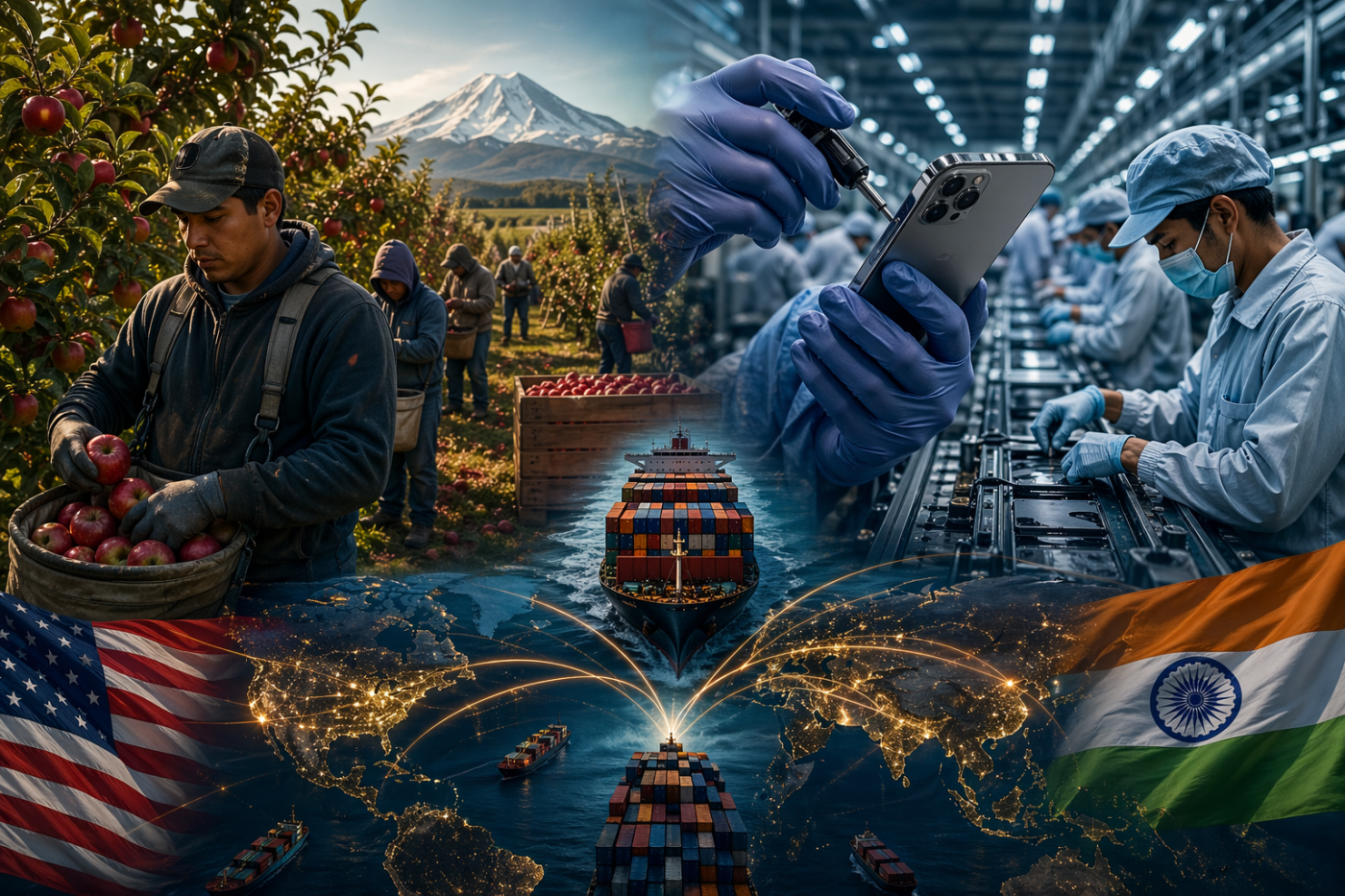
What appears to be a comparison between two unrelated commodities—apples picked in U.S. orchards and Apple devices assembled across the Global South—is in fact a comparison between two forms of the same capitalist-imperialist labor regime. In U.S. agriculture, superexploitation is organized through settler-colonial land relations, racialized migrant labor, H-2A dependency, deportability, and the broader coercive architecture that disciplines migrant labor inside the imperial core. In Apple’s global supply chains, it is organized through labor arbitrage, contract manufacturing, dormitory control, state-managed labor discipline, and the imperial concentration of profit at the top of the chain.
By Prince Kapone | Weaponized Information | April 23, 2026
When the Commodity Changes but the Empire Stays the Same
At first glance, the comparison seems almost mischievous, the kind of thing a tired worker might say half as a joke and half as an accusation. One apple hangs in a Washington orchard beneath the pastoral halo of American innocence, wrapped in the language of family farming, harvest tradition, and the wholesome dignity of the land. The other arrives in the palm of the hand sealed in glass and aluminum, glowing with software, marketed as intelligence, elegance, and the future itself. One is sold as nature. The other is sold as innovation. One carries the perfume of orchard mythology. The other arrives wrapped in the polished vanity of twenty-first-century monopoly capital. Yet once the costumes are stripped away, the kinship becomes impossible to ignore. These are not opposite worlds. They are two commodities bearing different masks for the same empire.
This essay begins from a proposition bourgeois common sense works very hard to keep out of sight: the apple picked in the orchard and the Apple device assembled through the global supply chain are not two unrelated labor stories that happen to share a name. They are two territorial expressions of the same capitalist-imperialist system. Each emerges from a different site of production, moves through a different institutional pathway, and is clothed in a different ideological language, but both depend on labor regimes built out of segmentation, vulnerability, and unequal command over value. In one case, the workforce is racialized, migrant, legally precarious, and tethered to production through seasonal demand, immigration law, and the constant threat environment hanging over migrant life in the imperial core. In the other, labor is dispersed through subcontracted industrial corridors, dormitory systems, supplier competition, wage arbitrage, and corporate command exercised at a distance. Different machinery, same logic. The commodity changes. The empire stays the same.
This is not a comparison of two industries. It is a comparison of one system operating across two terrains.
The system survives in part by making these two worlds appear incomparable. Agriculture is framed as something old, rooted, local, almost pre-political—an innocent relation between soil and toil, where exploitation appears only as an unfortunate imperfection in an otherwise noble national tradition. High-tech production, by contrast, is staged as almost immaterial, as though the iPhone were born not from mines, component plants, conveyor belts, dormitories, and exhausted bodies, but from pure reason floating above history in a Californian office park. In one fantasy, labor disappears into the landscape. In the other, it disappears into design. The worker is erased twice—once by the romance of nature and once by the glamour of innovation. Capital has always loved this trick. It makes the orchard speak the language of heritage and the device speak the language of progress while both are really saying the same thing: somebody labored, somebody was disciplined, and somebody else walked away with the wealth.
That is why the comparison has to be made. Not because it is clever, but because the old separations no longer hold. The worker climbing ladders in a Washington orchard, the migrant living under the shadow of deportability, the worker on the assembly line in Zhengzhou or Tamil Nadu, the laborer deeper in the chain extracting or processing the material substance of the device—all are inserted into a single geography of value. They are separated by nation, law, language, and state form, but joined by a deeper law: capital’s need for labor that can be used intensely without being fully empowered. In the orchard, this appears through guestworker dependency, deportable labor, racial hierarchy, and the continual production of insecurity inside the settler core. In Apple’s supply chains, it appears through outsourced command, labor arbitrage, industrial dispersion, state-tailored manufacturing zones, and the concentration of profit in the imperial center while assembly remains externalized. What the world presents as separate sectors are, in reality, different institutional forms through which the same system is trying to stabilize accumulation under new conditions.
To say this plainly is already to break with the polite habits of mainstream political economy. Liberal analysis prefers neat compartments because compartments make domination look manageable. Farm labor becomes an immigration issue, perhaps a labor-rights issue if the editorial board is feeling sentimental. Apple’s production becomes a supply-chain issue, a trade issue, or at most a human-rights issue whenever abuse spills too visibly into the press. This fragmentation is not an analytical weakness. It is one of the system’s ideological strengths. Once everything is boxed off into separate policy domains, the orchard worker and the electronics assembler can no longer recognize one another across the chain of empire. One becomes a domestic labor problem. The other becomes a globalization problem. The state becomes a neutral manager. The corporation becomes a neutral innovator. And the larger structure that produces both forms of labor discipline slips away untouched, smiling like a landlord explaining market necessity while changing the locks.
But the structure is precisely what concerns us here. What we are dealing with is not exploitation in the abstract, nor merely inequality, nor some regrettable side effect of otherwise productive markets. We are dealing with the colonial contradiction as a living relation inside the capitalist-imperialist world system. Capital does not merely require labor in general. It requires labor organized in such a way that those who produce wealth cannot effectively claim command over it. It requires workers whose movement can be managed, whose legal standing can be narrowed, whose social reproduction can be externalized, and whose suffering can be hidden behind distance, branding, nationalism, or the soft language of efficiency. In the internal terrain of the settler empire, that means migrant labor regimes, deportability, racialized precarity, and domestic counterinsurgency against sectors of labor deemed usable but disposable. In the external terrain, it means subcontracted manufacturing, unequal exchange, supplier discipline, state-managed industrial adaptation, and the long chain of neocolonial dependence that allows monopoly capital to rule production without sitting next to it. The system does not stumble into this contradiction. It is built on it.
What has changed in the present conjuncture is not the existence of that contradiction but the way it is being recomposed. The old model of smooth imperial management—where capital could plunder abroad, pacify broad layers at home through cheap commodities, debt, and selective incorporation, and still call the arrangement liberal order—is under strain. Geopolitical fracture, unstable trade regimes, tariff shocks, exemptions, legal reversals, supply-chain hedging, and the rising difficulty of commanding the world through the old channels have made imperial management harsher and more improvisational. Production is not simply being “brought home,” nor cleanly shifted from one country to another by sovereign design. Command is being recomposed through a contradictory mix of coercion, subsidy, logistical pressure, corporate hedging, migration management, and labor discipline. Domestic labor is being recalibrated through precarity, surveillance, controlled migration, deportation terror, and selective mechanization. Externalized production is being rerouted through a more unstable Asia-centered geography shaped by state inducement and geopolitical uncertainty. The orchard and the iPhone plant sit inside this larger process. One shows how the empire manages labor vulnerability within the core. The other shows how monopoly capital reorganizes outsourced labor under conditions where the old global order no longer runs as smoothly as before.
That is why the comparison must be apples to apples. Once the surface distinctions are stripped away, what remains is not two separate commodities but one crisis-ridden labor geography. The apple in the grocery store and the iPhone in the pocket arrive as finished objects, silent and self-contained, as though value were something they naturally possessed. But value does not grow on trees, and it does not descend from Cupertino like revelation either. It is wrung from laboring bodies under historically specific conditions of domination, segmentation, and control. The orchard worker and the assembly worker do not stand at opposite ends of modernity. They stand inside the same imperial machine, one nearer the internal colony, the other nearer the outsourced industrial frontier, both feeding a structure that depends on keeping labor visible enough to use and invisible enough to deny. That is the world this essay enters. It will move from the orchard to the supply chain, from the labor regime to the value structure, from the commodity to the crisis of empire, and ask the question bourgeois economics fears most: who made this wealth, under what conditions, and why does the system work so hard to ensure that those who make it remain the last to command it?
Where the Orchard Becomes a Labor Regime
The apple orchard is one of the most carefully sanitized scenes in the American imagination. In the official picture, it is all ladders, autumn light, family heritage, and the old pastoral sermon that the land rewards those who work it. The apple appears in this mythology as a wholesome national fruit, something clean enough for a schoolchild’s lunch and sacred enough for the marketing department to wrap in nostalgia. But the orchard does not run on nostalgia. It runs on labor, and not just labor in the abstract, but a very specific kind of labor: racialized, migrant, legally differentiated labor whose vulnerability is not incidental to production but built into it. Washington remains the commanding center of this system. USApple’s 2025–26 crop outlook projects 278.5 million bushels nationally and more than 180 million bushels in Washington alone, roughly two-thirds of U.S. production. This is not some quaint regional holdover. It is a major site of food production inside the imperial core, and its smooth functioning depends on a workforce that is kept necessary, seasonal, and governable.
The labor force itself tells the story before any theorist has to. A Washington State farmworker study found that 83 percent of surveyed workers were born in Mexico, with only 14 percent born in the United States, while the remainder came largely from Central America. The same study found that about 26 percent of respondents were H-2A workers. Nationally, produce labor still relies heavily on undocumented workers, with reporting indicating that about 40 percent of produce farmworkers are undocumented. So when we speak of orchard labor, we are not speaking of a generic rural workforce. We are speaking of a labor regime assembled through migration, legal stratification, and fear.
That regime is now being scaled more openly through the guestworker system. The U.S. Department of Labor recorded 398,258 H-2A positions certified nationally in FY2025, including 34,560 in Washington, making Washington one of the top H-2A states in the country. That expansion is not some neutral administrative response to “labor shortages.” It is part of a deeper restructuring of how capital secures labor: not by stabilizing workers as full social beings with durable rights, but by importing them in a temporary, employer-bound, highly disciplined form. The H-2A worker is useful precisely because the right to remain employed is conditional. The worker can be used intensely, but not easily rooted. He can be counted, moved, and rotated, but not easily incorporated as a political subject. The system does not merely recruit labor. It recruits labor in a form designed to minimize resistance.
That is why the orchard cannot be understood as a “farm labor problem” in the narrow sense. The labor regime is stabilized not only by growers, contracts, and harvest schedules, but by a wider coercive architecture. Growers and agribusiness spokesmen present H-2A as a practical labor pipeline that keeps fruit from rotting on the branch. But what it really offers capital is a more governable worker: one tied to a single employer, admitted temporarily, uprooted from durable community life, and always aware that the right to work is conditional. The Department of Labor lists Washington’s H-2A Adverse Effect Wage Rate at $19.82 an hour. Liberal common sense treats that number as proof that conditions cannot be all that bad. But a labor regime can pay more in nominal terms and still remain deeply superexploitative if the worker is subordinated through speed, seasonality, employer dependence, unstable housing, and a vanishing share of the final value chain.
And the growers are candid enough, in their own way, to admit the class substance of the matter. USApple warns of “skyrocketing labor costs” and presses the case for more disciplined, more efficient harvest decisions. That language is revealing because it shows the world from the standpoint of capital. Labor appears not as the source of value, but as a cost pressure to be contained, rationalized, or replaced. The worker’s body enters the ledger as an expense. The worker’s life, community, and future lie somewhere outside the spreadsheet, which is to say outside the concern of capital. What matters is that enough labor power arrives on time, moves fast enough, and remains politically weak enough to keep the commodity flowing.
The labor process itself is organized around speed, exhaustion, and seasonality. Harvest windows are not negotiated with the worker’s body. They are dictated by the commodity and enforced by the boss. Survey data from Washington show workers averaging roughly 36 to 42 hours a week during peak periods, with a notable share crossing the forty-hour threshold while only a minority actually received overtime pay. Courts have had to intervene in disputes over piece-rate overtime compensation, which tells you more about the structure than a thousand patriotic speeches about feeding the nation ever could. This is timed labor under seasonal pressure, where the body is made to move at the speed of ripening fruit and market demand. The orchard may look slower than a factory to the untrained eye, but that is only because the machinery here is disguised as landscape and the conveyor belt has been replaced by ladders, bins, and repetitive strain in the service of somebody else’s profit.
And like any serious site of exploitation, the orchard writes its truth on the body. A CDC investigation into pesticide poisoning in Washington apple orchards found that 88 percent of exposed workers in one incident experienced systemic symptoms. Here again the orchard strips away the mythology. We are not looking at a postcard. We are looking at a site where capital pushes danger downward and takes sweetness upward. Orchard labor brings chemical exposure, falls, ladder injuries, heat stress, repetitive strain, and the chronic wear of doing hard physical work under pressure with inadequate protections. The workforce most exposed to these conditions is overwhelmingly Latino, not because pesticides discriminate on their own, but because the labor hierarchy decides whose lungs, skin, and nervous systems can be treated as acceptable collateral damage.
The same is true when we widen the frame from the labor process to the reproduction of labor power. The H-2A regime requires employers to provide housing, yet a Washington survey found that only 2 out of 52 H-2A respondents reported receiving employer-provided housing. That is not some clerical lapse. It is a window into how the system externalizes the cost of keeping workers alive, sheltered, and stable. Even where labor is tightly managed at the point of production, the social costs of reproducing that labor are pushed back onto the worker, the family, the camp, the overcrowded dwelling, or the broader migrant community. Capital wants the body fresh enough to pick, but not secure enough to negotiate.
Under these conditions, mechanization enters not as emancipation, but as recomposition. Industry planning now openly links orchard restructuring, tighter labor markets, and efficiency pressures. But mechanization here should not be narrated as a clean escape from labor. It is one moment in the reorganization of control. Capital tries to reduce its dependence on living labor while deepening control over the labor that remains indispensable. More rationalized orchard design, more controlled harvest systems, more measurable productivity, more employer-managed labor flows—these are signs that the labor regime is being modernized in the usual capitalist fashion: by making labor more legible to management and more conditional for the worker.
Historically, none of this is new. The apple economy sits on land made available through Indigenous dispossession, and its labor regime echoes a long lineage that runs through the Bracero Program, racialized labor importation, and the broader organization of agricultural capitalism in the settler order. Today’s orchard worker stands inside a historical continuum in which the U.S. state and agrarian capital have repeatedly solved labor shortages by drawing in vulnerable populations under unequal terms, then denying them full social and political incorporation. Some of the workers in Central Washington, as reporting has noted, arrived decades ago through earlier migration waves, only to remain suspended in a social order that wants their labor on a permanent basis but their rights only on a temporary, revocable basis. That is the genius of the settler-colonial labor machine: it imports labor, extracts value, and withholds belonging.
What gives the orchard its full significance in the present conjuncture, however, is that it can no longer be understood through agriculture alone. The worker in the field is governed not only by the grower and the harvest schedule, but by a broader coercive environment in which migration status, border enforcement, data-sharing, and deportability operate as labor-market technologies. The state does not merely patrol the border and step away. It helps organize the terms under which labor can be made vulnerable enough to remain profitable. Deportation is not a byproduct of immigration policy. It is a mechanism of labor control. It regulates the price of labor, fragments the workforce, and enforces discipline without requiring constant direct repression. It is not external to production. It is one of its conditions.
In this sense, deportation is not just fear in the atmosphere. It is a weapon of economic warfare. It terrorizes migrant workers, suppresses bargaining power, fragments solidarity, and helps prepare a harsher labor regime inside the core as a whole. Once that is understood, the orchard appears in a new light. It is not a quaint remnant of an older America. It is a modern site of internal colonial labor discipline and part of a broader domestic counterinsurgency regime, where agrarian capital and the settler state jointly produce a labor force that is indispensable to production yet denied stable command over the conditions of its own survival. What appears here in agricultural form is part of a broader restructuring of labor inside the imperial core: a shift toward managed, conditional, and surveilled workforces under direct coordination between state policy and capital. The apple reaches the supermarket polished and innocent. The labor regime that made it possible remains buried beneath the shine.
Where Design Rules by Distance and the Factory Never Gets the Credit
If the orchard reveals how labor is organized inside the imperial core through migration, legality, and managed vulnerability, then the global production system of Apple, Inc. shows the same logic stretched across continents. Here the system no longer appears as a field bounded by fences and harvest cycles, but as a planetary architecture in which command is centralized while labor is dispersed. The familiar story tells us Apple is a company of ideas—design, software, innovation—floating above the grime of production. But Apple’s own filings tell a different story. Its 2025 10-K states plainly that a “significant majority” of its manufacturing is carried out by external partners, primarily across China, India, Japan, South Korea, Taiwan, and Vietnam. This is not a company that transcends industry. It is a company that has perfected the art of controlling industry from a distance.
That distance is not incidental—it is the mechanism of power. Apple keeps the brand, the patents, the software ecosystem, and the overwhelming share of profit, while pushing the direct management of labor downward into a network of suppliers. The phrase “Designed in California” is not a description; it is an ideological maneuver. It separates conception from execution, prestige from production, and command from responsibility. The worker assembling devices in Zhengzhou, Shenzhen, or Chennai disappears not because she is unimportant, but because her visibility would disrupt the mythology. Empire prefers its intelligence to look disembodied. It wants the mind in Silicon Valley and the body somewhere cheaper, more governable, and far enough away that suffering can be treated as a subcontracting detail.
This is the real structure of the global assembly line. Historically anchored in China through firms like Foxconn, Pegatron, and Wistron, Apple’s production network has not dissolved—it has recomposed. By 2026, reporting indicates that roughly 55 million iPhones were assembled in India in 2025, about a quarter of global output, even as China remains central to the broader system. The point is not that Apple has “left China,” but that it has layered a new geography onto an existing one. Production is being redistributed across an Asia-centered network, not repatriated to the imperial core. The system diversifies its sites of labor, but preserves its structure of control.
The forces driving that redistribution are anything but clean or stable. The Trump administration escalated tariff threats in 2025, then carved out exemptions for electronics, only for the Supreme Court in early 2026 to invalidate large portions of those tariffs, triggering refunds and legal uncertainty. Yet Apple continued expanding production in India anyway. The restructuring of Apple’s geography is not the result of a coherent industrial strategy. It is the outcome of instability—tariff escalation followed by exemptions, legal reversals, and shifting state pressure. Capital is not responding to a plan. It is responding to a field of uncertainty. And in that uncertainty, it reorganizes production to remain flexible, mobile, and insulated from risk.
This is the key shift. Supply-chain restructuring is no longer driven by a single clean story of tariffs pushing corporations out of China. It is being shaped by erratic coercion: threat, exemption, subsidy, and legal volatility operating together under conditions of imperial strain. Tariffs mattered. Exemptions mattered. Legal reversals mattered. But what mattered most was the instability itself. Apple is not navigating a stable project of national industrial restoration. It is navigating a harsher and more improvisational phase of imperial management.
India’s role in this recomposition makes that even clearer. The shift is not simply toward “cheaper labor.” It is enabled by state policy designed to attract and discipline manufacturing capital. India has rolled out new incentive programs tied to electronics production, building on earlier schemes and targeting hundreds of billions in output growth. Regulatory changes have allowed foreign firms to supply equipment to contract manufacturers without immediate tax penalties, smoothing the expansion of outsourced production. This is not passive development. It is active state participation in constructing a new labor geography—one in which monopoly capital, national policy, and disciplined labor converge. India does not replace China as a site of production. It supplements it as a new terrain where state policy and labor discipline can be coordinated to stabilize accumulation under new geopolitical conditions.
Inside that geography, the labor regime remains structured by asymmetry. Apple’s supply chain spans thousands of facilities across more than sixty countries, yet its own public disclosures emphasize audits, compliance, and training rather than control over wages, hours, or working conditions. Apple reports conducting 895 supplier assessments in 2025 and training 2.4 million workers on workplace rights. These numbers are not meaningless, but they must be read dialectically. Compliance does not negate exploitation. It manages it. Audits do not dismantle the system. They stabilize it by reducing reputational risk while leaving the underlying structure intact: outsourced labor, fragmented responsibility, and concentrated profit at the top.
What defines this system is not simply low wages, but the organization of labor through distance and dependency. Workers in assembly plants are subject to long hours, production surges tied to product cycles, and managerial systems that regulate not only work but life itself. The dormitory system described in studies of major suppliers is not just about housing. It is about integrating the worker’s daily existence into the production process—compressing the boundary between labor time and life time until the two become indistinguishable. The annual product launch, celebrated in the core as innovation, appears in the factory as intensified labor, tighter quotas, and accelerated exhaustion. Where the orchard worker is disciplined by the season, the assembly worker is disciplined by the product cycle. Different rhythms, same command.
What emerges from all this is a clearer understanding of Apple’s position. It is not simply a corporation participating in globalization. It is a command node within a reconfiguring imperial logistics field. Its power lies in orchestrating production across multiple territories while retaining control over design, branding, and profit. Its supply chain is not a neutral network. It is a political architecture that converts inequality into advantage—turning differences in wages, laws, and state policies into mechanisms of accumulation.
This is why the shift in Apple’s production geography must be understood not as liberation from exploitation, but as its recomposition. The move from China to India does not dissolve the labor regime. It relocates and rearticulates it under new conditions. The system adapts to geopolitical pressure, legal volatility, and state incentives, but its core logic remains intact: labor is indispensable, labor is controlled, and labor is denied the wealth it creates. If the orchard showed how capital disciplines labor inside the imperial core through migration and legal vulnerability, the global assembly line shows how the same system governs labor across borders through subcontracting, dispersion, and strategic distance. The surface has changed—from soil to circuitry, from ladder to conveyor—but the governing principle remains. The commodity appears as design and innovation. The labor that makes it possible is pushed downward, outward, and out of sight. And the hand that captures the value remains firmly at the top.
Where the Value Climbs Upward and the Worker Stays at the Bottom
By the time the apple reaches the shelf and the iPhone reaches the hand, the hardest ideological work has already been done. The commodity appears as a finished thing, self-contained, complete, as if its value were a natural property that ripened inside it. But value does not sit quietly inside the object like a seed in the fruit. It is produced socially, captured politically, and distributed according to power. That is the real question before us now. Having looked at the orchard and the assembly chain as labor regimes, we have to ask how the wealth they generate is actually organized. Who produces it? Who realizes it? Who commands it? And why do the workers who make the commodity possible remain so far from the point where the wealth finally pools?
The orchard gives us the first answer. Even where legal wage floors rise and growers complain loudly about labor costs, the worker still enters the chain as a subordinate cost item rather than as the living source of value. USApple’s own 2025–26 outlook dwells on “skyrocketing labor costs” and the pressure they place on growers, but that language already tells us how the relation is structured. Labor appears in the grower’s ledger as an expense to be minimized, not as the force that animates the commodity. The picker does not command the price at which apples are sold, the margins taken by packers and shippers, the power of retailers, or the broader terms of realization once the fruit leaves the orchard. The orchard worker performs indispensable labor, but the chain of value climbs upward through other hands. The worker touches the fruit first and controls it least.
This is why the wage question, taken by itself, always misleads. Bourgeois common sense stares at the hourly rate and imagines that the matter is settled there, as though exploitation were simply the gap between a “low” wage and a “decent” one. But superexploitation is not exhausted by the immediate wage form. It concerns the entire structure through which labor is made necessary yet denied command over the conditions and outcomes of production. A worker may receive a legal wage floor and still remain trapped inside a relation where labor time is subordinated to harvest urgency, social reproduction is externalized, legal status weakens bargaining power, and the realized value of the commodity is captured elsewhere. The issue is not that labor is underpaid. It is that the entire structure ensures labor cannot command the conditions of its own reproduction.
The Apple side makes the same architecture more visible because the scale is enormous and the corporate image so carefully polished. Apple’s 2025 10-K shows a corporation of immense size, global reach, and concentrated profitability, even as the overwhelming share of manufacturing remains outsourced across Asia. That alone should settle one point: Apple’s wealth does not come from “making” in the old industrial sense. It comes from commanding a chain. Design, branding, software ecosystems, intellectual property, logistics coordination, market access, and supplier power all sit above the point of assembly, where labor is most intense and least rewarded. The company does not need to own every factory in order to dominate the value relation. It needs only to monopolize the highest nodes of command while pushing the low-margin, labor-intensive work outward into subcontracted terrain.
That is why the older arguments about the iPhone’s value breakdown remain useful, even if they should be handled with care rather than fetishized as sacred percentages. The exact ratio can vary by model, year, and method of calculation, but the structure does not. The Tricontinental estimate of the iPhone X remains politically illuminating because it captures the asymmetry clearly: labor enters the final price as a tiny fraction, while surplus is concentrated at the top through brand, design, market control, and command over the chain. The point is not that one spreadsheet can reveal the whole truth of exploitation. The point is that the structure consistently places living labor at the bottom of value capture and monopoly command at the top. The worker assembles the device, but the corporation owns the narrative, the margins, and the market. The hand that makes the phone is not the hand that captures the wealth.
This is the deeper unity between the orchard and the iPhone plant. The two sectors look different because the mechanisms of realization are distributed differently, but the architecture is the same. On both sides, labor is indispensable. On both sides, labor is denied command over the pace, terms, and rewards of production. On both sides, the wealth generated by work rises upward through layers of ownership, logistics, brand power, distribution, and market control. The orchard worker is subordinated to growers, packers, distributors, and retailers. The assembly worker is subordinated to suppliers, contractors, logistics systems, and above all the monopoly corporation that sits at the summit of the chain. The social form changes. The structure of appropriation remains.
This is precisely where the concept of superexploitation must be handled with discipline. It does not mean merely that some workers are paid less than others. It means that the labor relation is organized in such a way that workers who generate enormous social value are kept far from the sites where that value is realized and accumulated. They are made cheap not only through wages, but through legal vulnerability, territorial distance, subcontracting, social disempowerment, and the systematic externalization of the costs of reproducing labor power. The orchard and the iPhone supply chain are both examples of this wider structure. The worker does not simply lose out at payday. The worker is positioned structurally so that the entire architecture of the commodity chain works against the possibility of labor commanding the wealth it produces.
This is where the argument widens into the broader political economy of imperial decline. The United States is not ceasing to rely on externalized labor capture. It is trying to preserve that capture while reconstructing harsher labor discipline inside the core. The core still feeds on outsourced production, subcontracted labor, and unequal exchange abroad. But as the old model of smooth neoliberal management becomes less stable, the system is sharpening internal labor discipline at home—through deportability, guestworker expansion, labor-market fear, and the legal production of precarious workforces. In that sense, the orchard and the iPhone do not merely show us two ugly examples of exploitation. They show us one empire trying to preserve its command over value by tightening the screws on labor both internally and externally at the same time.
So the question of value is not an abstract accounting exercise. It is the point where the whole system reveals itself most clearly. The apple and the iPhone both appear before the consumer as mute objects, their histories dissolved into price tags and packaging. But underneath the polished skin and the polished screen lies the same structure: labor creates the commodity, command captures the wealth, and the chain is organized to keep those two facts as far apart as possible. And as the system becomes less able to secure this arrangement through market integration alone, it increasingly relies on direct mechanisms of control to maintain it.
Where the Internal Colony Meets the External Chain
By the time we arrive here, the old habit of treating these labor regimes as separate stories should already be breaking down. The orchard and the global assembly line do not simply resemble one another by coincidence, nor are they linked only by some vague moral analogy about exploitation in different places. They belong to the same imperial system because they solve the same problem for capital in two different terrains. That problem is not how to find labor in the abstract. It is how to secure labor that can be used intensely without becoming politically dangerous, labor that can be made indispensable without becoming fully empowerable, labor that can be folded into production while kept structurally distant from command. This is where the internal and external colony have to be understood together—not as identical institutions, but as parallel forms through which capital organizes segmented, vulnerable, and undercompensated workers for the purposes of accumulation.
What unites them first is the question of population. Neither regime rests on a stable, socially secure labor force integrated into the political life of the society on equal terms. Both depend on uprooted or semi-uprooted workers whose mobility is controlled and whose presence is conditional. In the orchard, that means migrant workers, guestworkers tied to employers, undocumented laborers living under the permanent weather system of deportability, and long-settled communities that remain politically precarious despite their central role in production. In Apple’s external chain, it means workers drawn into outsourced manufacturing zones, dormitory regimes, dispatch systems, and regional industrial corridors whose very function is to convert social dislocation into productive discipline. In both cases, workers arrive already marked by inequality. They do not enter the labor process as free and equal sellers of labor power in the fairy-tale sense. They enter through channels structured by law, territory, status, and managed vulnerability.
This is why the distinction between the internal colony and the external colony must be made carefully. The internal colony is not simply “inside the nation,” nor is the external colony simply “abroad.” These are not geographic labels alone. They are forms of rule. Inside the settler core, the orchard and adjacent sectors are governed through a system that combines H-2A dependence, undocumented vulnerability, seasonal command, selective mechanization, labor raids, and the ever-present terror of the deportation apparatus. The worker is disciplined not only by the grower but by the state form itself, which sorts labor through legality, mobility, and removability. Outside the core, Apple’s chain is governed through a different configuration: outsourced final assembly, supplier competition, dormitory labor, contingent and dispatch labor, state-managed export platforms, shifting tariff geographies, and industrial policies tailored to attract and stabilize monopoly capital. The forms differ. The function does not. In both cases, labor is governed through a structure that maximizes usability and minimizes collective power.
That is why deportation must be understood as more than immigration policy. It is a weapon of economic warfare and labor-market engineering. Deportation in the internal colony performs the same structural function as subcontracting in the external chain: both fragment labor, suppress bargaining power, and prevent the formation of unified class force. The point is not simply that fear exists in both systems. It is that fear is organized differently in each case to achieve the same end: the prevention of solidarity strong enough to alter the terms of accumulation. In the internal colony, deportation, raids, status insecurity, and the broader atmosphere of criminalization help ensure that labor remains fragmented and politically hesitant. In the external chain, supplier competition, dormitory confinement, dispatch precarity, labor-law flexibility, and regional manufacturing rivalry perform the same political work under another name.
The comparison becomes even clearer when we look at mobility. Capitalist mythology likes to imagine globalization as a story of free flows, but the truth is more selective. Capital moves. Commodities move. Logistics systems move. Labor, however, is allowed to move only under forms useful to capital. The orchard worker may cross borders only through tightly controlled guestworker channels or by entering the labor market in undocumented form, always under threat. The assembly worker may be drawn from rural hinterlands into urban-industrial zones, but only to be fixed inside systems of dormitory discipline, dispatch arrangements, or localized labor dependency. What appears as mobility from above is immobilization from below. Labor moves only to be fixed. Capital moves freely; workers are repositioned into controlled systems of dependency.
The colonial contradiction becomes sharper here. Capital needs workers who can produce value, but it also needs those workers to remain divided by nation, status, race, language, contract form, and geography. This is not some residue left behind by history. It is a functional requirement of accumulation, and under the current crisis it is being actively recomposed. Inside the core, we see more guestworker scaling, more deportation terror, more workforce sorting, and more pressure to reconstruct sectors of domestic production on harsher terms. Outside the core, we see supply chains diversifying not toward freedom, but toward new combinations of subsidy, tariff pressure, logistics hedging, and disciplined labor pools. The old neoliberal order promised that the world would be integrated through trade. What we are watching now is integration being replaced by managed fragmentation. The system still wants a single field of accumulation, but increasingly governs that field through differentiated coercion rather than smooth inclusion.
This is why the phrase “internal colony” matters, and why it should not be used loosely. The orchard is not just a place where migrants work. It is a place where the social conditions of colonized labor are reproduced inside the imperial core: restricted rights, conditional belonging, intensified bodily risk, weak bargaining power, and a constant reminder that the worker is welcome only so long as he remains useful. And the external colony is not just “foreign manufacturing.” It is the part of the system where capital externalizes the most labor-intensive and politically disposable forms of production while retaining command over design, branding, finance, and realization. One terrain relies more openly on the state’s power to police legality and movement. The other relies more openly on the corporation’s power to distribute production across competing jurisdictions. But each depends on the other. The internal colony helps stabilize accumulation at home. The external colony helps stabilize profit globally. Together they form a single imperial labor geography.
The system is not abandoning externalized labor capture in order to rebuild some sovereign domestic industrial paradise. Nor is it simply continuing the old globalization model unchanged. It is trying to do both at once: preserve externalized capture abroad while reconstructing harsher labor discipline internally. That is why the orchard and the Apple chain must be held together analytically. The first shows how labor is recalibrated inside the core through legality, deportability, and controlled migration. The second shows how labor is recalibrated across the external chain through subcontracting, state incentives, logistics pressure, and uneven geopolitical realignment. The empire does not choose between the two. It feeds on both. The colonial relation is no longer something that appears only “over there.” It is being thickened, layered, and generalized across the whole field of accumulation.
How the System Teaches You Not to See It
By now the structure is visible—at least to anyone willing to look directly at labor instead of the commodity. But the system does not rely on ignorance alone. It actively produces a way of seeing that makes these relations appear natural, even admirable. That is the work of ideology at the level of the commodity. Not simply to hide exploitation in some crude sense, but to reorganize perception so that what is historically produced appears inevitable, what is politically enforced appears technical, and what is rooted in domination appears as common sense. If the orchard and the global supply chain can coexist without provoking outrage, it is because they have already been translated into stories that make their underlying relations difficult to recognize, let alone challenge.
Take the orchard first. The apple is wrapped in a mythology so old it feels like the ground itself. It is “Washington grown,” “family farmed,” tied to seasons, soil, and the quiet dignity of rural life. The marketing language does not lie outright; it selects. It selects the image of the farmer and erases the laborer. It selects the land and erases the relation that organizes work upon it. It selects heritage and erases the modern regime of migration, legality, and discipline that makes the harvest possible. By the time the apple reaches the supermarket, the worker has already been removed from the narrative twice—first by the pastoral image, and then by the consumer’s own habits, which treat the commodity as something complete in itself.
The Apple device performs the same ideological trick at a higher pitch and with more technological confidence. It arrives not as an agricultural product but as an artifact of intelligence, design, and innovation. “Designed in California” functions here the way “Washington apples” does on the other side. It anchors the commodity in a place associated with creativity, prestige, and authority, while everything beneath that layer—assembly, component production, extraction, logistics—is rendered secondary or invisible. Even when labor appears in the narrative, it appears as a problem being responsibly managed rather than as a relation that structures the entire commodity. Apple’s own supply-chain disclosures emphasize assessments, workplace training, and compliance systems, projecting an image of oversight and ethical stewardship. But this language does not negate the underlying structure. It reframes it. Domination becomes governance. Exploitation becomes risk management. Distance becomes responsibility.
This is the modern form of commodity fetishism sharpened for an age of global logistics and digital branding. The commodity does not simply hide the labor that produced it. It reorganizes the meaning of that labor. In the orchard, exploitation dissolves into nature. In the supply chain, it dissolves into management. In both cases, the worker disappears not because no one knows they exist, but because the system has already decided how their existence will be interpreted. The migrant picker becomes part of a timeless rural economy. The assembly worker becomes part of a monitored and improving supply chain. In neither case does the worker appear as a political subject capable of making claims on the wealth they produce.
What is new in the present moment is that ideology is no longer limited to hiding exploitation. It is increasingly tasked with normalizing recomposition. As the imperial system reorganizes itself under strain, the language surrounding these processes shifts accordingly. Corporate rerouting becomes “resilience.” Supply-chain disruption becomes “adaptation.” Tariff shocks and policy volatility become “strategic realignment.” Public subsidy becomes “industrial renewal.” On the labor side, deportation becomes “border security,” guestworker expansion becomes “meeting workforce needs,” and surveillance becomes “compliance” or “efficiency.” Each term performs a small act of translation, moving the phenomenon out of the realm of political struggle and into the realm of technical necessity. Ideology does not simply hide exploitation. It organizes perception so that exploitation appears necessary, technical, and inevitable.
This is where the ideological field connects directly back to the material transformations we have traced. When policy lurches between tariff escalation, exemptions, and legal reversals, it is presented not as a symptom of imperial strain but as part of a deliberate strategy. When corporations diversify production across China, India, and Vietnam, it is narrated as resilience rather than as a search for new configurations of cheap and controllable labor. When the state expands guestworker programs or intensifies deportation enforcement, it is framed as administrative necessity rather than as labor-market engineering. Each shift appears rational in isolation. The totality disappears.
And this disappearance is not accidental. It is necessary for the reproduction of the system itself. Because if the unity of these processes were widely understood—if it became clear that the orchard and the iPhone plant are governed by the same underlying logic of segmented labor, controlled mobility, and upward value capture—then the divisions that keep workers apart would begin to look less natural and more manufactured. The entire edifice depends on preventing that recognition. It depends on making the internal colony appear local and the external chain appear global, the first tied to tradition and the second to progress, so that neither can be easily connected to the other as part of a single imperial labor regime.
When Empire Reorganizes the Ground Beneath Our Feet
What we are looking at now is not the smooth functioning of a system that knows exactly where it is going. It is a system under pressure, trying to reassemble itself while still in motion. The orchard, the supply chain, the upward capture of value, and the ideological cover that makes it all appear natural—these are not separate phenomena drifting along unchanged. They are being actively reorganized in response to a deeper crisis. And that crisis is not simply economic in the narrow sense. It is a crisis of imperial management: the old model of globalization can no longer secure accumulation as easily as it once did, and the new model has not yet stabilized. What emerges in this gap is recomposition—uneven, contradictory, and often improvised.
Start again with the orchard, because it tells the truth in a grounded way. Production does not collapse under pressure. It intensifies and reorganizes. Washington remains dominant, producing roughly two-thirds of U.S. apples, even as labor pressure deepens. The response is not to democratize the labor relation, but to restructure it: expand H-2A usage, tighten migration channels, increase reliance on controlled labor pools, and accelerate mechanization where possible. What appears in public discourse as a “labor shortage” is, in reality, a problem of labor control. Capital is not struggling to find workers in the abstract. It is struggling to find workers under conditions that preserve profitability without conceding power. So it turns to the state, to law, to technology, and to migration policy to reshape the workforce itself. The orchard becomes a site where domestic labor recalibration is not debated—it is enacted.
Now turn outward. The Apple supply chain does not dissolve under geopolitical strain. It mutates. Production shifts toward India at a rapid pace, but not as a clean exit from China. China remains central, while India rises as a major node, and Vietnam and others remain embedded in the wider system. Apple’s push to expand Indian production while still relying heavily on China captures the dynamic precisely: this is diversification under pressure, not national repatriation. The system is spreading risk, layering supply chains, and adjusting geography while preserving the underlying logic of outsourced labor and centralized command. The factory does not come “home.” It is rearranged abroad in ways that better fit the new balance of power.
And over both processes hangs the increasingly unstable role of the state. Aggressive tariff threats were followed by selective exemptions and then partially undone through legal challenges in 2026. This is not coherent industrial planning. It is pressure without full control—coercion colliding with legal limits, corporate interests, and the realities of interdependence. Yet the effect still matters. Capital responds not only to stable policy, but to the field of uncertainty itself. It hedges, reroutes, and reorganizes. The state does not need to dictate every move. It needs only to create a terrain where certain moves become more likely than others. What we are seeing, then, is not orderly strategy, but erratic coercion: a mix of threats, incentives, exemptions, and reversals that pushes the system toward recomposition without ever fully stabilizing it.
When we step back, the pattern becomes unmistakable. Capital is not ending exploitation. It is redistributing it, hardening it, and buffering it across a more volatile imperial landscape. Guestworker expansion deepens internal labor control. Deportation terror disciplines the workforce and fragments solidarity. Mechanization reduces certain dependencies while intensifying others. Supply chains diversify across Asia, not to liberate labor, but to maintain flexibility and cost advantage. Corporate audit systems expand to manage risk and reputation without altering the fundamental relation. States compete to offer incentives, infrastructure, and legal environments that attract capital while keeping labor contained. The system adapts not by becoming more stable, but by becoming more agile in how it organizes domination.
This is where the idea of a “Fortress America” or an “American Pole” must be grasped dialectically. It is not a finished structure, neatly enclosing production within secure borders. It is a project in motion—an attempt to build a more controlled imperial formation while the ground shifts beneath it. External consolidation and domestic labor recalibration are not separate tracks. They are two sides of the same enclosure, constructed from both ends. But the construction is uneven. Some sectors are pulled inward, others remain externalized, and many exist in hybrid forms that blur the line between domestic and global. The empire is trying to build a fortress, but it is doing so under conditions where full control is no longer guaranteed. That is what gives the process its instability—and its intensity.
This is also where the concept of technofascism sharpens into something concrete. The system is no longer able to integrate populations through rising living standards. It is reorganizing itself through segmentation, containment, and control. This is the material basis of technofascism: the fusion of monopoly capital and state power to manage populations through controlled labor regimes, legal instability, deportation machinery, and technological oversight in a period when the old liberal-globalist integration model is breaking down. Deportation becomes labor policy. Surveillance becomes workplace management. Algorithmic control organizes the labor process. Legal instability becomes a tool rather than a flaw. The boundary between economic governance and political repression begins to dissolve, not because the system has abandoned markets, but because it can no longer rely on markets alone to secure compliance.
What begins with the most vulnerable does not remain there. The same mechanisms used to discipline migrant labor—status insecurity, mobility control, targeted enforcement—become templates for broader forms of workforce management. The same logic that fragments labor externally through supplier competition fragments it internally through legality and fear. This is not an accident. It is the system learning how to operate under new constraints. When it can no longer integrate widely, it begins to segment more aggressively. When it can no longer promise broadly shared gains, it turns toward selective inclusion and generalized precarity.
Seen in this light, the orchard and the iPhone chain are not just examples of exploitation. They are indicators of direction. They show us how the system is reorganizing itself—where it is tightening control, where it is redistributing production, and where it is experimenting with new forms of labor discipline. They reveal an imperial order that is no longer able to reproduce itself through the same balance of integration and extraction that defined the previous era. Instead, it is moving toward a more openly managed, more segmented, and more coercive configuration.
One System, One Struggle
By now the separation has collapsed. The orchard and the iPhone plant can no longer be treated as different worlds, different problems, or different moral questions. They are expressions of the same system viewed from two angles—one inside the imperial core, one stretched across its external chain. The worker on the ladder and the worker on the line are not divided by history so much as positioned within it. Each stands in a different segment of a single labor geography organized to produce value while preventing those who produce it from claiming power over it. That is the unity this essay has been working toward—not a metaphor, but a material relation.
What we are confronting, then, is not simply inequality or exploitation in the abstract. It is a system in motion under conditions of crisis. An imperial order that once managed to stabilize itself through a combination of external extraction and partial internal integration is now reorganizing that balance. It is tightening control over labor inside the core while redistributing production across a more volatile global field. It is layering new mechanisms of discipline—legal, technological, logistical—onto old structures of domination. And it is doing all of this while insisting, through ideology, that what we are witnessing is nothing more than adaptation, innovation, or necessity.
The orchard shows how this reorganization unfolds at home. Labor is made available through controlled migration, divided through legality, and disciplined through the constant possibility of removal. The supply chain shows how it unfolds abroad. Labor is outsourced, fragmented, and managed through competition, policy incentives, and corporate command. Between them runs the same current: the preservation of accumulation through the segmentation and containment of the working class. Not the elimination of exploitation, but its redistribution and intensification across new terrain.
This is why the present moment must be understood clearly. It is not the return of a strong national economy replacing globalization. Nor is it the simple continuation of the old neoliberal model. It is something more unstable and more revealing: a recomposition of imperial power in which internal recolonization and external reorganization proceed together. The orchard does not become less central as supply chains shift. It becomes more important as a site where labor can be recalibrated under direct state and employer control. The global chain does not disappear under geopolitical strain. It becomes more layered, more diversified, and more tightly managed. Together they form a system that is trying to preserve command over value while losing the stable conditions that once made that command appear natural.
And yet, within this recomposition lies a contradiction that cannot be wished away. The same processes that fragment labor also reveal its unity. The same system that divides workers across borders, statuses, and sectors increasingly binds their conditions together. The migrant worker disciplined through deportability, the guestworker tied to an employer, the assembly worker managed through subcontracting, the logistics worker tracked through digital systems—these are not isolated figures. They are different expressions of the same structural position. Each is necessary to the system. Each is denied power within it. And as the system tightens its grip, that shared condition becomes harder to conceal.
This is where the question shifts from analysis to horizon. Because if the structure is one, then the struggle it generates cannot remain permanently divided. The empire depends on segmentation—on keeping labor separated by nation, legality, race, and function. But the more it recomposes itself through these mechanisms, the more it reveals the underlying unity of the relation it is trying to manage. The orchard cannot function without the broader chain. The chain cannot function without the disciplined labor regimes that sustain it at every level. And the workers within these systems, though separated by distance and condition, are increasingly shaped by the same forces.
To recognize that is not to collapse differences or pretend that all positions are identical. It is to understand that those differences are organized within a single system of power. And once that is understood, the strategic meaning becomes clearer. The problem is not simply that exploitation exists in many places. It is that exploitation is coordinated across those places in ways that reinforce the power of capital and weaken the power of labor. The response, if it is to be effective, must move in the opposite direction: toward forms of organization, solidarity, and struggle that can recognize and act upon that unity.
The system will not present this unity to us. It will continue to speak in the language of difference—domestic versus foreign, legal versus illegal, high-tech versus low-skill, tradition versus innovation. It will continue to fragment the picture, isolate each struggle, and render each site of exploitation as a separate issue to be managed rather than a connected relation to be transformed. That is part of how it survives. But the material conditions it produces are moving in another direction. They are drawing connections whether ideology acknowledges them or not.
So the final point must be stated plainly. You cannot understand the orchard without the supply chain, and you cannot understand the supply chain without the orchard. Both belong to the same crisis-ridden labor geography in which empire is trying to preserve command over value while losing control over the conditions that once made that command appear stable. That is the world we are living in. And within it, the question is no longer whether this unity exists. The question is whether it will be recognized, organized, and acted upon.


Leave a Reply