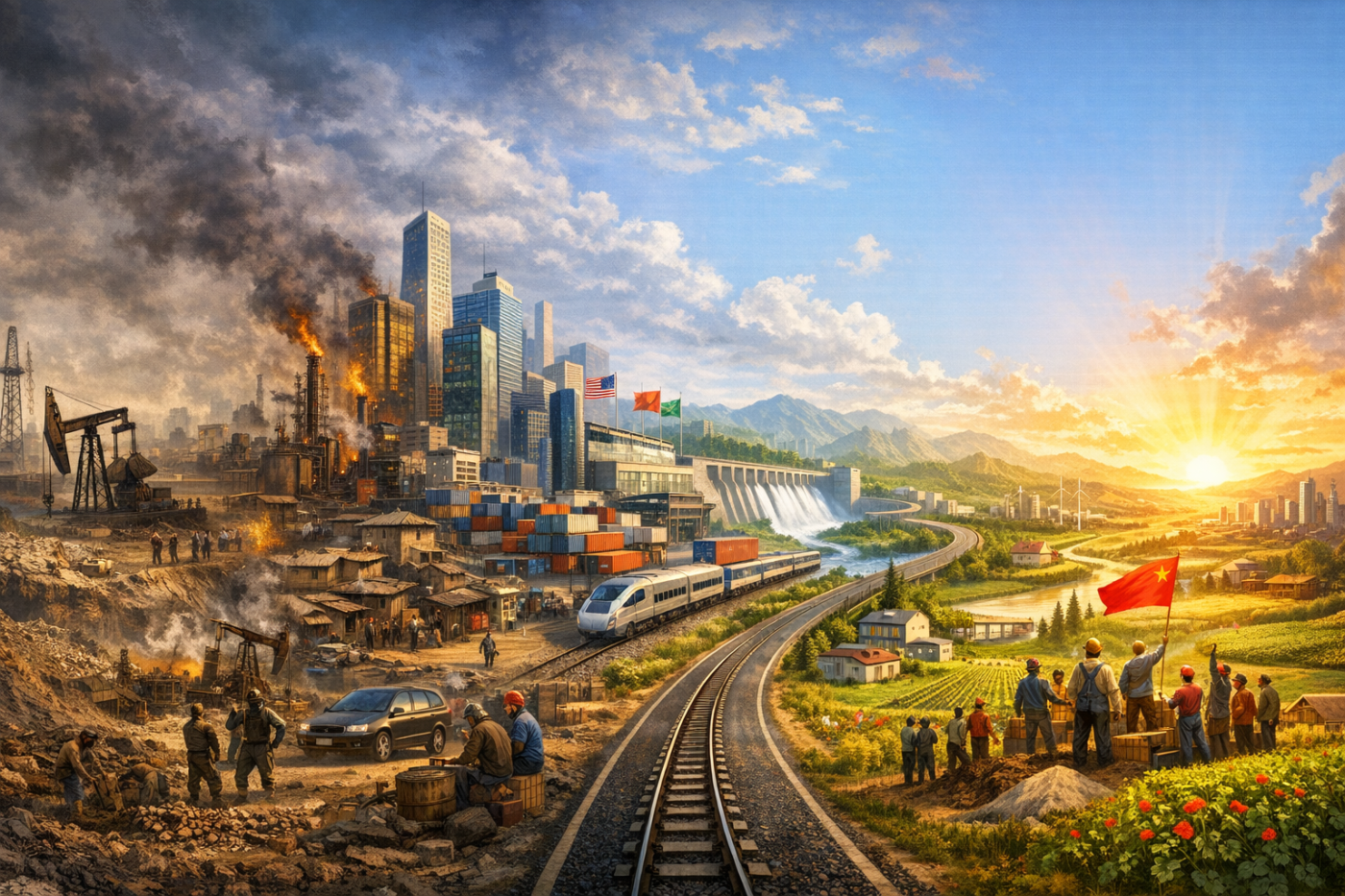
Development is not a neutral path but a historical process forged through conquest, extraction, and domination. Underdevelopment is not a failure to advance, but the condition produced by integration into a world system structured by imperial power. As the crisis of global capitalism deepens and the space for sovereign maneuver widens yet destabilizes, nations are increasingly pushed toward autonomy not by choice but necessity. The decisive question is no longer who will “develop,” but which classes will seize power, command surplus, and determine the future of human development itself.
By Prince Kapone | Weaponized Information
April 14, 2026
The Mansion Was Built on the Ruins of Someone Else’s House
The old fairy tale of development has always asked humanity to admire the mansion while forgetting the plantation, to applaud the chandelier while stepping over the blood in the basement. In that tale, the rich nations are presented as the diligent children of history, the ones who rose early, honored contracts, trusted science, saved their pennies, and climbed patiently toward prosperity by the sweat of their own brow. The poor nations, by contrast, are cast as the latecomers, the stragglers, the boys caught smoking behind the schoolhouse of modernity, forever advised to wash up, liberalize, behave, and repeat the lesson. This story is told in the language of expertise, but it reeks of incense. It is less a science than a sermon, less an explanation than an absolution. Its real function is not to clarify the world but to launder it. It blesses the wealth of the imperial centers as earned virtue and recasts the misery of the periphery as unfortunate delay. The thief not only keeps the stolen watch; he lectures the robbed man on punctuality.
History, however, is less pious and more impolite than the economists. Once dragged out of the drawing room and forced to speak plainly, it tells a harsher truth. The wealth of the North did not arise in splendid isolation, as though Europe and North America had matured inside a greenhouse sealed off from the rest of humanity. Their ascent was forged through conquest, colonial plunder, enslavement, land seizure, coerced monoculture, the destruction of local industry, engineered famines, debt peonage, and tribute disguised as commerce. Capitalism did not produce development in one zone and underdevelopment in another as separate accidents of geography or culture. It produced them together, as linked outcomes of one world-historical process. One region’s granaries, mills, ports, stock exchanges, laboratories, and banks were fertilized by another region’s dispossession. The same ship that carried machinery one way carried sugar, cotton, copper, rubber, tea, palm oil, and human beings the other. The same order that built railways and universities in one pole broke soils, shattered food systems, and imposed hunger in another. To speak of “rich countries” and “poor countries” as though they emerged from separate moral climates is to describe a hanging by discussing rope quality.
And that order did not retire; it reorganized. Today, it persists in a more polite vocabulary but with no less discipline, anchored in the commanding position of the United States, Western Europe, and Japan—the imperial triad that presides over global finance, technology, and the rules of exchange. Their power does not merely appear after wealth has been created; it structures in advance how wealth is produced, who captures it, and how it moves. International financial institutions, sanctions regimes, currency hierarchies, intellectual property systems, and military alliances form a single apparatus of control. They ensure that what was once enforced by gunboats and chartered companies is now reproduced through debt contracts, trade rules, and technological monopolies—less visible perhaps, but no less effective.
Once that veil is torn, the old question begins to rot. The issue is not why some countries are rich and others poor, as though we were comparing exam scores in a classroom where everyone took the same test under the same light. The real question is who has been allowed to command accumulation, and who has been forced to surrender it. Who controls the surplus produced by labor? Who decides whether wealth is used to build domestic productive capacity, feed a population, educate a generation, electrify a countryside, and industrialize a nation? And who is compelled instead to ship value outward, service debt, obey distant creditors, open markets, cheapen labor, and restructure life itself around external priorities? Strip away the liberal incense and that is the matter in front of us. Development is not first a problem of national character or administrative competence. It is a problem of power. It is a problem of command over the material basis of social reproduction.
This is why the conventional vocabulary fails. The word development, in its mainstream usage, arrives already compromised. It smells of Truman’s podium, World Bank memoranda, and the polished grammar of imperial paternalism. It invites us to think in terms of quantities without relations: more growth, more trade, more investment, more GDP, more integration. But growth can coexist with hunger. Exports can rise while sovereignty collapses. Factories can multiply while technology remains foreign, finance remains foreign, logistics remain foreign, and policy remains hostage to institutions sitting an ocean away. We have seen this contradiction repeatedly: countries can post growth while their fiscal life is mortgaged outward and their export structures remain narrowly tied to a single commodity or external market. A nation may grow in the statistical sense and still be chained in the historical sense. To speak seriously, then, we must move from the childish imagery of ascent to the harder terrain of structure. We must stop asking who is moving up and begin asking how the world economy is organized, how value is transferred, how labor is ranked, how states are disciplined, and how entire societies are positioned inside a hierarchy they did not design.
That shift requires a more ruthless lens. The global economy is not a friendly marketplace populated by sovereign equals exchanging the fruits of their comparative virtues. It is a hierarchical field structured by unequal power, unequal profitability, unequal technological control, and unequal capacity to define the rules of exchange. Its governors do not merely dominate after wealth has been created; they shape in advance the terms under which wealth is produced, valued, transferred, and defended. Trade, debt, investment, sanctions, military pressure, technological monopoly, currency hierarchy, and institutional blackmail all belong to the same architecture. They are not separate misfortunes. They are the organized means by which a world system reproduces the domination of some over the developmental possibilities of others. What appears as “market outcomes” is in fact the steady transfer of value outward and upward, a process long ago identified by anti-colonial thinkers and still visible today in the persistence of debt dependency, technological enclosure, and unequal exchange.
From that standpoint, the old division between developed and underdeveloped nations gives way to something far more precise and far more dangerous. The world is not divided into those who have arrived and those still on the road. It is divided into historically produced forms of social reproduction inside a capitalist world order structured by imperial power, unequal exchange, debt discipline, military coercion, technological monopoly, sanctions, and class domination. Some are granted distorted growth that deepens inequality and dependence while parading as progress. Some industrialize, but only through a subordinate integration that channels value upward and outward. Some claw out strategic room to maneuver, seeking to subordinate external relations to internal priorities without breaking from capitalism itself. And some attempt the far more difficult task of transforming social relations, property, planning, and political power so that production may be governed by social need rather than profit. These are not stages in a universal sequence. They are structured relations within a single world order, shaped by distinct degrees of subordination, resistance, and rupture.
This essay begins from that wager. Underdevelopment, maldevelopment, dependency, sovereignty, and socialism must be understood not as moral labels or textbook stages in a neutral sequence, but as different historical relations to imperial domination and different possibilities of escape from it. The decisive question running beneath them is the question of delinking: not isolation, not fantasy autarky, but the struggle to subordinate external economic relations to internal social priorities—to decide, in concrete terms, what is produced, for whom, and under whose control.
The modern world crisis gives this question fresh life. As United States hegemony frays, as the older centers of accumulation face stagnation, and as new poles of economic and political power emerge, a different global terrain is taking shape. Multipolarity is not salvation delivered by mapmakers. It is a battlefield condition. It widens the space within which states and movements can maneuver, negotiate, resist, and sometimes break. Some use that space to secure a better position within the existing order. Others attempt to defend sovereignty against external command. Still others try to push beyond both toward a reorganization of production itself. That is why multipolarity matters—not because it guarantees liberation, but because it alters the conditions under which liberation can be fought for.
The argument that follows is therefore simple in statement and severe in implication. The central divide in the world today is not between developed and undeveloped nations, but between different positions inside a global system of imperial accumulation. Development, in any serious sense, turns on whether a society remains subordinated to external command or succeeds in bending external relations toward internal reproduction. Multipolarity names the geopolitical form taken by these uneven struggles over delinking. And socialism, whatever its contradictions and incompleteness in practice, remains the most advanced effort to transform the social basis of development itself under conditions not of its own choosing. The question before humanity is not who will finally join the rich by climbing a staircase built on myth. The question is who will command the future of human development, by what social power, through what institutions, and for whose ends.
Delinking: Not Escape, But Refusal
If the old language of development collapses under the weight of its own illusions, then a new language must begin from a refusal. Not a refusal of the world, but a refusal of the terms on which the world has been organized. It is here that the concept of delinking enters—not as a slogan, not as a romantic gesture of isolation, but as a hard and practical question of power. Delinking does not mean retreating from the global economy, sealing borders, or indulging fantasies of self-sufficient purity. No serious society can “go to the moon,” as Samir Amin put it, and detach itself entirely from a world that is materially interconnected. The question is not whether to engage, but on what terms, and in whose interest.
In its simplest form, delinking names the effort to subordinate external economic relations to internal social priorities. It asks whether a society’s engagement with trade, finance, technology, and investment is governed by the needs of its people or dictated by the imperatives of external capital. Under imperialism, the answer is structured in advance. The dominant centers—the United States, Western Europe, and Japan—do not merely participate in the global economy; they organize it. They monopolize finance through currency hierarchy and institutions like the IMF and World Bank. They monopolize technology through patents, standards, and control over advanced production systems. They monopolize communication through platforms and information infrastructure. They monopolize natural resources through corporate networks and military reach. And when these mechanisms fail, they monopolize violence through sanctions, covert intervention, and open war. These are not separate levers. They are a coordinated system designed to prevent autonomy at its root.
Delinking, then, begins not with isolation but with disobedience. It is the refusal to allow those mechanisms to dictate the direction of national development. It is the attempt—partial, uneven, and always contested—to bend external relations toward internal needs. This may take the form of controlling strategic sectors, managing capital flows, diversifying trade partners, building domestic technological capacity, or insulating key areas of social reproduction from external shocks. But none of these measures are technical in the narrow sense. They are political decisions, and they are fought over accordingly. Every attempt to widen autonomy is met with pressure: capital flight, sanctions, diplomatic isolation, military threat. The system does not tolerate even modest deviations from its logic without response.
This is why the distinction identified by Walter Rodney remains decisive. The issue is not simply whether a country trades or receives investment, but who makes the decisions. Do external forces determine what is produced, how it is produced, and for whom? Or does a society retain the capacity to decide these questions for itself? That line, thin as it may appear, marks the difference between subordination and the beginning of autonomy. It is the difference between an economy organized to meet internal needs and one reorganized to satisfy external demands. And it is precisely this line that imperial power works relentlessly to erase.
It is also why delinking cannot be understood as a purely economic adjustment. It is inseparable from the question of class power. To subordinate external relations to internal priorities requires a state capable of resisting external pressure and a social bloc willing to bear the costs of that resistance. Where ruling classes are tied to external capital—through finance, trade, or personal interest—delinking remains shallow or collapses altogether. Where political power is held by forces committed to national-popular development or socialist transformation, the possibility of sustained delinking becomes real, though never guaranteed. The struggle over delinking is therefore not only a struggle between nations and an imperial system; it is a struggle within nations over who commands the state and to what end.
In practice, delinking appears in degrees, not absolutes. At one pole lies full subordination, where external relations dictate internal life and policy follows the instructions of creditors and markets. At another lies partial and contested delinking, where states attempt to secure room for maneuver without breaking from capitalism itself. And beyond that lies the more difficult terrain where societies attempt to transform the underlying relations of production and subordinate accumulation itself to social need. No country occupies these positions in pure form. Each exists within a shifting balance of pressures, concessions, and contradictions. Even those that have advanced furthest toward autonomy remain entangled in a world system that they did not create and cannot simply exit.
To speak of delinking, then, is not to describe a completed condition but an ongoing struggle. It is a process marked by advance and retreat, by gains that are partial and reversals that can be severe. It is shaped by internal contradictions—between classes, regions, and sectors—as much as by external pressure. And it is conditioned by the broader structure of the world system itself, which sets limits even as it creates openings. The emergence of a more multipolar world does not resolve this tension, but it does alter its terrain. As the grip of a single hegemonic center weakens, the space for maneuver expands. Alternative trade routes, financial arrangements, and political alliances become possible. The cost of disobedience, while still high, is no longer uniformly prohibitive.
But multipolarity does not abolish domination; it redistributes and complicates it. New poles do not automatically produce a just order, and not every form of resistance leads beyond the existing system. Delinking, in this context, becomes both more feasible and more contested. It can be pursued in ways that merely renegotiate a country’s position within global capitalism, or in ways that begin to challenge the logic of that system itself. The difference between these paths is not technical but political. It turns on the same question that runs beneath the entire problem of development: who holds power, and what they intend to do with it.
For that reason, delinking must be understood as the hinge on which the entire discussion turns. It is the point at which critique becomes strategy, where analysis meets decision. It forces us to move beyond describing inequality toward confronting the mechanisms that produce it, and beyond diagnosing dependence toward organizing against it. It does not promise an easy escape, because none exists. But it names, with clarity and without illusion, the terrain on which any serious struggle for development must be fought.
Five Positions in a World That Was Never Neutral
Once the question of development is stripped of its fairy tales and restored to its material foundations, what appears is not a ladder but a structure. The world does not consist of nations patiently climbing toward the same destination at different speeds. It consists of societies inserted into a single, unequal system in fundamentally different ways. These differences are not accidental. They are produced, reproduced, and enforced through the historical expansion of capitalism and the ongoing operations of imperial power. To speak of development seriously, then, is not to rank countries along a scale of progress, but to identify the distinct positions they occupy within this hierarchy of accumulation and control. These positions are not moral categories. They are political-economic relations. They tell us who commands, who mediates, who labors, who pays, and who is permitted to decide the terms of social reproduction.
At one extreme lie those societies we can describe as underdeveloped—not in the sense of lacking potential, but in the precise sense that their productive capacities have been systematically weakened, fragmented, or externally dominated to the point where coherent social reproduction becomes difficult to sustain. Here, the economy does not so much function as endure. Hunger, displacement, and institutional fragility are not episodic crises but structural conditions. In Haiti, more than 5.7 million people now face acute hunger, while around 1.4 million have been displaced by violence, which is to say that social reproduction itself has been ripped apart and handed over to a machinery of emergency management and imperial charity. Somalia presents the same logic in another register: 6.5 million people face high levels of hunger, 1.84 million children are projected to suffer acute malnutrition, and even after debt-relief rituals and endless international conferences the state remains “extremely fragile,” leaning on external security architectures to perform functions that a sovereign social order ought to command itself. This is not backwardness in the nursery-rhyme sense. It is a condition produced through intervention, disarticulation, extraction, and the long destruction of internal coherence.
Move one step across the field and we encounter maldevelopment, which is often mistaken for progress because it comes dressed in the garments of growth. Here, the economy expands—sometimes rapidly—but in ways that deepen its structural distortions. Wealth is generated, but it is concentrated, expatriated, or locked into enclaves that barely connect to the broader society. Debt piles up, ecological damage accumulates, inequality sharpens, and the state governs increasingly in conversation with creditors, donors, and investors rather than with the popular classes. Kenya illustrates this contradiction with almost theatrical cruelty. Debt service in fiscal year 2024/25 consumed roughly 71.2 percent of government revenue, meaning that the state increasingly governs not for its own population but for the bondholder and the lender. At the same time, the country’s “ambitious” educational reforms stumble over infrastructure gaps, teacher shortages, and access barriers so severe that some 800,000 learners fail to transition onward. Nigeria offers another version of the same disease. Crude oil still accounts for roughly 80.80 percent of total exports, which means that the appearance of growth remains chained to a narrow and externally vulnerable base, while mass poverty stagnates and the broader productive structure remains weak. This is not development interrupted. It is development warped into a shape useful to others.
Further along we find dependency, or dependent development, a more sophisticated arrangement that often impresses economists and confuses the casual observer. Here, industrialization does occur. Factories are built, exports diversify, highways spread, and the indicators begin to resemble those of more “advanced” economies. But beneath the surface lies persistent subordination. The strategic segments of production—technology, design, finance, logistics, branding—remain externally controlled. Mexico stands as a paradigmatic case. Its export manufacturing regime is deeply tied to the U.S. market, and recent estimates indicate that USMCA-region value added in Mexico’s manufacturing exports to the United States reached about 73.7 percent by 2024, revealing the density of its regional integration and, at the same time, the extent of its dependence on an externally governed productive circuit. Even the automotive sector, so often paraded as proof of industrial modernity, accounted for 23.6 percent of manufacturing GDP in a structure still anchored in low-wage assembly and foreign command. Brazil shows a different but related contradiction. It has greater industrial depth and geopolitical weight, yet it has also undergone what ECLAC calls premature deindustrialization, drifting toward commodities, resource-based manufactures, and low-productivity services. Its primary deficit reached 2.4 percent of GDP in 2023, and the pressure of debt continues to narrow developmental options. In both cases, growth is real, but so is the external command that shapes it. The economy moves, but the steering wheel is still shared, and the destination is still not self-determined.
Then there are those formations that begin, unevenly and often precariously, to push back—what we may call sovereign development. Here, the state seeks to reclaim some measure of control over accumulation. It imposes capital controls, defends strategic sectors, reroutes trade, seeks alternatives to dollar dependence, and attempts to widen national room for maneuver within a world that punishes disobedience. Countries such as Iran, Russia, and Eritrea embody different versions of this effort. Iran has spent decades developing under sanctions designed to asphyxiate it, and yet it has sustained strategic sectors, military-technological capacities, and regional influence in defiance of that siege. Russia, forced by NATO expansion, sanctions, and financial warfare into deeper confrontation with the U.S.-led order, has rerouted trade, expanded non-Western financial linkages, and accelerated forms of partial delinking that it did not fully choose but now has to live through. Eritrea, with fewer resources and harsher constraints, has pursued a defensive sovereignty organized around survival, national control, and refusal of easy incorporation into donor-scripted dependency. None of these projects breaks from capitalism itself. None resolves the class contradictions lodged within national accumulation. But all of them matter, because they show that subordination is not the only available posture and that room for maneuver, once created, becomes a material force in world politics.
Beyond this lies the most ambitious and most embattled terrain: socialist development. Here, the question is no longer limited to securing autonomy within an imperial system, but extends to transforming the social basis on which development itself is organized. This does not mean total delinking. No socialist project has floated free of the capitalist-imperialist world system, and it would be foolish to pretend otherwise. It means, rather, the strategic effort to maximize autonomous command over accumulation, planning, and surplus while selectively engaging the world economy on terms not wholly dictated by it. China is the clearest contemporary example of large-scale structural transformation under such conditions: close to 800 million people have been lifted above the international extreme poverty line over roughly four decades, and the state has retained decisive control over finance, land, and strategic sectors even while using global integration as an instrument of national development. Vietnam offers a different but related trajectory, moving from cheap-labor export dependence toward a more knowledge-based economy under a socialist-oriented market framework reaffirmed by the 2026 Party Congress. Cuba remains the most dramatic proof that socialist development under siege is not a fantasy but a lived and costly reality: blockaded, sanctioned, and financially strangled, it has still preserved universal social goods and developed forms of collective resilience that far exceed what its material conditions ought to permit. The DPRK, under perhaps the most intense regime of sanctions and military pressure in the world, represents an even harsher form of socialist sovereignty shaped by siege, security, and a long struggle not to be broken. These are not pure models, and they are not free of contradiction. But they do represent attempts to subordinate accumulation to political projects beyond profit alone.
These five positions—underdevelopment, maldevelopment, dependency, sovereignty, and socialism—do not form a staircase. They form a field: a structured set of relations within a world system that distributes power unevenly and defends that distribution with finance, technology, coercion, and myth. A country may move within this field, but it does not do so freely. Underdevelopment can persist as a trap. Maldevelopment can masquerade as success while rotting the social body. Dependency can deepen even as industry expands. Sovereignty can widen room for maneuver without resolving class contradiction. Socialism can reorganize development toward social need while still confronting siege, market pressures, and internal bureaucratic danger. There is movement, yes, but it is structured movement, not destiny.
To understand the world in these terms is to abandon the comfort of linear narratives. It forces us to see that what is celebrated as success may conceal subordination, and what is denounced as failure may be the result of structural imposition or the costs of resistance. It also forces a more difficult recognition: these positions did not arise spontaneously. They were made through concrete historical processes—conquest, colonization, debt, disarticulation, restructuring, and the continuous management of the global economy by imperial power. The field exists because it was built. And if it was built, then the next task is clear enough: we must turn from the map to the history that drew it.
The Spread of Capitalism Was a Campaign, Not a Process
The present structure of the world economy did not arise from the patient flowering of commerce among equals, nor from some cheerful evolutionary process in which societies gradually discovered the virtues of efficiency, thrift, and comparative advantage. It was built through a campaign—organized, violent, cumulative, and unapologetically parasitic—by successive imperial powers that expanded outward not in search of mutual prosperity but in search of land, labor, tribute, bullion, markets, and command. Capitalism did not simply spread; it was carried by cannon, charter, decree, plantation whip, and the accountant’s ledger. It did not encounter the rest of the world as a polite trading partner. It seized, reorganized, and subordinated. What later generations would praise as development in one pole was purchased by the active dismemberment of development elsewhere. The world economy was not woven together like a quilt. It was stitched together like a wound.
The first great thrust of this process came under the flags of Portugal and Spain, whose maritime empires opened the early circuits of conquest linking Europe, Africa, Asia, and the Americas. This was not exchange in any meaningful reciprocal sense. It was organized plunder backed by naval violence and sanctified by crown and cross. The silver of Potosí did not rise from the mountain as a gift from geology to European civilization. It was torn from the earth through coerced indigenous labor under the mit’a system, and then funneled into the arteries of empire, financing state power, commerce, and the expanding monetary circuits of early capitalism. Europe did not discover wealth in the New World as an innocent bystander stumbles across a purse in the street. It pried open entire continents, emptied their veins, and called the operation progress.
At the same time, Africa was drawn into this expanding order not as a partner but as a reservoir of stolen labor. Human beings were transformed into movable property and shipped across the Atlantic to furnish the plantation economies of the Caribbean and the Americas. There, sugar, tobacco, cotton, and other commodities were produced not for local nourishment or balanced development, but for the appetites of distant markets and the accumulation needs of emerging capitalist centers. This was primitive accumulation only in the sense that a knife wound is primitive surgery. It laid foundations, yes, but foundations mortared with enslavement, dispossession, and death. The wealth so created did not remain where it was produced. It flowed outward, upward, and across oceans, helping to finance the rise of European states and commercial classes while leaving behind landscapes organized for extraction and societies broken to fit imperial use.
As the center of gravity shifted northward, Dutch and British power refined these arrangements into a more systematic architecture of imperial command. The Dutch East India Company and its counterparts did not merely transport goods. They monopolized routes, enforced terms, wielded private armies, and fused commercial interest with state violence so tightly that the distinction became almost theatrical. Britain, for its part, carried this logic to a higher level of integration. Caribbean plantations generated vast surpluses through enslaved labor; colonial trade linked port to metropole; and the factories of Lancashire spun cotton into industrial wealth using raw material grown under colonial and slave conditions abroad. The cotton mills of Britain did not hum in glorious isolation, as though steam itself had a patriot’s soul. Their rhythm was set by plantation labor, colonial extraction, and world-market coercion. Manchester’s prosperity had fingerprints on it, and most of them belonged to the colonized.
India offers one of the clearest demonstrations that capitalism’s world expansion did not merely “include” existing societies but forcibly reorganized them to serve external accumulation. British rule did not encounter Indian industry, especially textile production, and then gently outcompete it in a fair contest adjudicated by the invisible hand. It dismantled, taxed, redirected, and subordinated. India was transformed from a major manufacturing center into a supplier of raw materials and a captive market for British manufactures. This was not a developmental delay. It was deindustrialization as imperial policy. The very powers that later lectured the world on free trade first used force, monopoly, and colonial control to destroy competitors and secure their own ascent. The sermon came after the theft, which is the usual order of bourgeois morality.
France followed along the same broad road, building plantation wealth in the Caribbean, extending domination across Africa, and incorporating Indochina into circuits designed to serve metropolitan priorities. Germany, arriving later to the imperial feast, behaved with the desperation of a late guest and the brutality of one determined to eat twice as much. Its colonial ventures in Africa were marked by extreme coercion and exterminatory violence, revealing that the scramble for empire was not some adventurous footnote to capitalist development but one of its constitutive theaters. Different empires wore different uniforms, spoke different languages, and cultivated different hypocrisies, but the underlying logic remained remarkably stable. External territories were reorganized to serve internal accumulation. Labor was cheapened, coerced, or stolen. Land was enclosed. Production was redirected outward. And force, where necessary, settled what theory could not.
These were not isolated episodes scattered across time like unfortunate storms in an otherwise sunny history of progress. They were interlocking moments of one world-historical process. Capitalism developed through the active production of asymmetry—between colony and metropole, plantation and factory, mine and bank, coerced labor and protected industry, raw-material zone and manufacturing center. One region’s industrialization was not simply accompanied by another’s impoverishment; it was fed by it. The outward movement of European power and the inward concentration of wealth in Europe were part of the same motion. As Walter Rodney insisted, what appeared as the development of some societies was inseparable from the underdevelopment of others. The world was not divided after the fact into successful and unsuccessful nations. It was divided in the making.
By the time formal colonial rule began to recede in the twentieth century, the underlying structure had already been deeply inscribed. Newly independent states did not enter a neutral international order with a clean slate and a fair chance. They entered a world economy already organized against them: export structures geared outward, currencies vulnerable, technology concentrated elsewhere, credit controlled abroad, and domestic class formations deeply shaped by colonial mediation. Political flags changed. The direction of value largely did not. The old empires lowered their banners, but their firms remained, their banks remained, their trade routes remained, and the social hierarchies they had cultivated often remained seated quite comfortably in the old chairs. Empire changed uniform. It did not retire.
In the postwar period, the United States emerged not as a benevolent custodian of a new universal order, but as successor-hegemon to this long imperial tradition, armed with greater productive power, greater financial reach, and a more elaborate institutional machinery for organizing subordination at a global scale. Bretton Woods, the dollar system, the International Monetary Fund, the World Bank, the expanding architecture of trade rules and strategic alliances—these did not abolish imperial hierarchy. They modernized its administration. What had once been imposed through colonial office and gunboat increasingly appeared through loan conditionality, currency discipline, development doctrine, and the polite extortion of policy advice. If Britain had ruled with the customs house and the gunship, Washington learned to rule with the central bank, the military base, and the memorandum.
The neoliberal turn did not reverse this history. It sharpened it. The debt crises of the late twentieth century became the occasion for a new wave of restructuring across the Global South. Structural adjustment did not merely request efficiency from bloated states, as the story was told in the stale idiom of the donor class. It meant cutting food subsidies so the poor could learn the virtues of hunger. It meant privatizing public assets so that transnational capital could inherit what collective struggle had once built. It meant suppressing wages, shrinking public employment, liberalizing imports, weakening industrial policy, and reducing development strategy to the management of scarcity under external supervision. In social terms, adjustment meant clinics without medicine, schools without teachers, farms without support, cities without work, and governments told that sovereignty was an expensive habit they could no longer afford. Neoliberalism did not represent a retreat of power. It represented the re-disciplining of the periphery through market language and financial coercion.
Today, the same imperial logic persists through more diffuse but no less decisive mechanisms. Financial markets discipline national policy through credit ratings, capital flows, and debt service. Technological monopolies fence off the higher-value segments of production. Global value chains disperse labor while centralizing command. Commodity dependence continues to expose much of the Global South to violent price swings and structurally unequal terms of exchange. Sanctions, investment treaties, military pacts, and logistical chokepoints stand ready to punish states that seek too much room to maneuver. The forms have evolved, yes. They are less likely now to arrive wearing admiral’s gold braid. They arrive instead wearing the sober suit of necessity. But the continuity is unmistakable. The mechanisms changed. The direction of value did not.
Seen from this angle, the global economy is not an accidental patchwork of winners and losers, nor a neutral field in which some nations simply developed more discipline than others. It is the historical product of conquest, extraction, and continuous reorganization in the interest of capital accumulation centered first in Europe and later under United States hegemony. The world was not born unequal. It was made unequal—through slavery, colonialism, deindustrialization, debt, unequal exchange, and the repeated restructuring of entire societies to serve external command. And because that making did not end with formal empire, the problem before us is not merely to remember the crime scene, but to understand that the body is still warm.
The System That Does Not Let You Leave
Empire no longer always arrives in a navy uniform, though one should never make the mistake of thinking it has renounced the use of force. More often now it appears in the patient, polished language of economics, in the soft clerical violence of debt contracts, payment systems, sanctions lists, shipping insurance, patent law, compliance departments, ratings agencies, and the ever-present threat of capital flight. It does not need to shout because its rules are already lodged in the structure of the world economy. It does not need to conquer every territory afresh because so much of the globe has already been fitted into its circuitry. What confronts the majority of humanity today is not simply a gap between rich and poor, nor merely an unfair distribution of opportunities, but a total architecture of constraint designed to ensure that movement does not become escape, that growth does not become autonomy, and that participation does not become command. This arrangement is not a technical defect in an otherwise functional global order. It is the order.
At the center of that order lies the continuous transfer of value from the periphery to the core. This is not one mechanism among others, nor a leftover from some antique colonial age embalmed in the textbooks and politely retired from contemporary life. It is the living grammar of the system. Value is siphoned through a layered ensemble of processes: unequal exchange in trade, the super-exploitation of labor, the historical and ongoing drain of land, minerals, energy, and social wealth, and the disciplining force of debt. These are not rival theories lined up in academic competition like racehorses at the gate. They are interlocking moments of the same structure. What the accountant records as profit repatriation is, from the standpoint of historical truth, the outward transfer of wealth generated by the labor and resources of the Third World. The wealth is produced in the mine shaft, on the plantation, at the machine bench, at the port, in the warehouse, in the market stall, and in the exhausted body of the worker who comes home with less than the value he created. It is only counted, legalized, and celebrated elsewhere.
Debt is one of the most refined instruments through which this transfer is enforced. It does not merely extract; it reorganizes. It reaches into the budget before a government can do so. It informs ministries what is realistic, teaches finance officials the theology of restraint, and narrows the political horizon until entire populations are told that hunger, privatization, wage suppression, and social decay are regrettable but necessary facts of adult economic life. In Kenya, debt service consumed 71.2 percent of government revenue in the 2024/25 fiscal year. One need not be a Marxist to recognize the obscenity. When nearly three-quarters of state revenue is committed to servicing financial claims, then the state is no longer planning development in any meaningful sense; it is administering tribute. South Africa, often presented in the language of bourgeois common sense as one of the “stronger” or “more stable” cases, still devoted 27.5 percent of government revenue to debt service in 2023. Pakistan offers an even harsher lesson in the political uses of indebtedness. Under repeated IMF discipline, the country has been pushed through cycles of austerity, currency devaluation, restructuring, inflation, and stagnation, while the poor are told that the medicine is bitter because the patient is sick rather than because the doctor is a creditor. Debt, in this structure, is not a bridge to development. It is a command device. It binds the future to the claims of the past and subordinates domestic life to external obligation.
If debt narrows the range of political action, technology narrows the range of historical possibility. Here too empire prefers the language of efficiency to the language of domination, but the effect is much the same. Control over research, innovation, technical standards, data, patents, and advanced production systems has become one of the decisive frontiers of contemporary imperial power. The disparity is not merely quantitative; it is structural. Across Africa, average gross domestic expenditure on research and development hovers around 0.45 percent of GDP. More than 45 African countries rely on external sources for over 80 percent of their research and development funding. This is not simply a story of inadequate budgets or delayed modernization. It is a story about who gets to determine the direction of inquiry, the ownership of knowledge, the pricing of innovation, and the terms on which whole societies may access the technical means of transforming nature and social life. Technology, in such a world, is not simply imported. It is governed from elsewhere. What results is a condition in which entire regions are integrated as consumers, assemblers, and low-cost users of systems they do not command. The question therefore is not only who produces, but who decides what can be produced, how it is to be produced, and on what terms others may touch the future.
Global value chains extend this hierarchy into the very organization of production. They are advertised as ladders into modernity, but function more often as segmented corridors in which labor is dispersed while command is concentrated. Mexico’s place within North American manufacturing is illustrative. It is deeply integrated into export networks, especially in automotive production, which accounted for approximately 23.6 percent of its manufacturing GDP, yet the commanding segments of value capture—design, finance, branding, logistics coordination, high-end inputs, and final strategic decision-making—remain anchored elsewhere. Output grows, factories hum, exports rise, and economists clap politely from the balcony, but the steering wheel stays abroad. Vietnam presents a more ambitious and contradictory case. Its long-term development strategy toward 2045 expresses a real effort to move upward in the chain, to develop semiconductor capacity, concentrate skills, and retain greater strategic control within a socialist-led framework. Yet the contradiction remains: integration into global circuits can widen room for maneuver while simultaneously exposing national development to external price structures, technological bottlenecks, market dependence, and the disciplinary logic of internationally organized production. Participation does not abolish hierarchy. It often perfects it.
Above these layers sits the monetary and financial architecture dominated by the United States, whose power resides not only in military capacity or diplomatic reach, but in the centrality of the dollar to global trade, payments, reserves, and credit. The dollar is not merely a currency in this system. It is an instrument of command. Access to liquidity, settlement, correspondent banking, investment flows, and financial legitimacy passes through channels shaped by U.S. state power and institutions aligned with it. The result is a world in which monetary hierarchy becomes geopolitical hierarchy by other means. Cuba offers a clear and brutal illustration. In less than four years during the Obama period and its immediate aftermath, foreign firms dealing with Cuba were subjected to 2.26 billion dollars in fines under U.S. sanctions enforcement. Those were not symbolic reprimands. They were disciplinary strikes intended to isolate a country from the ordinary arteries of world commerce. The pressure extends even into the engineering of development itself. The Scarabeo 9 offshore drilling rig, a 750 million dollar project, had to be constructed without U.S. components in order to comply with sanctions restrictions. This is what extraterritorial power looks like when stripped of euphemism: not simply the policing of transactions, but the shaping of technological design and the sabotage of developmental possibility.
Sanctions, financial exclusion, and control over payment systems are therefore not emergency tools brought out only during exceptional crises. They have become normalized methods of governance within the imperial order. Iran, Russia, and the DPRK operate under different degrees and forms of restriction, but the message delivered to each is fundamentally the same: integration is conditional, access is revocable, and deviation from the preferred geopolitical line carries material cost. These measures do not merely punish states after the fact. They structure the field in advance. They force rerouting, improvisation, defensive adaptation, technological substitution, and alternative financial architecture, all under immense pressure. Even resistance must pay a toll to enter the road.
Taken together, these mechanisms compose a system that does not need closed borders to prevent exit. On the contrary, it often prefers open borders, but open on unequal terms. It allows participation while weighting the structure so heavily in favor of the center that incorporation reproduces subordination. Unequal exchange moves value outward. Debt bends policy toward creditors. Technological enclosure narrows the scope of independent development. Global value chains fragment production while preserving command at the top. Dollar dominance and sanctions enforce compliance across jurisdictions. These are not separate misfortunes. They are the interconnected means by which a world system ensures that ascent remains conditional, autonomy remains difficult, and delinking remains costly.
This is why delinking cannot be reduced to a slogan, a mood, or a ceremonial declaration of national pride. It is a material struggle against a structure that has had centuries to learn flexibility. It requires the construction of alternative payment systems, the development of domestic technological capacity, the diversification of trade partners, the protection of strategic sectors, and the political ability to defend all of this against retaliation from stronger powers and their domestic allies. The difficulty is immense precisely because the system does not remain still when challenged. It adjusts, absorbs, reroutes, punishes, and adapts. Like any seasoned parasite, it does not surrender the host without a fight.
To speak seriously of development under such conditions is therefore to speak not only of possibility, but of constraint; not only of growth, but of power; not only of production, but of command over the terms under which production occurs. The global economy is not a neutral field in which nations rise by effort and fall by error. It is a structured order in which movement is shaped in advance by forces operating beyond national borders but deeply within national life. The task before any serious developmental project is not merely to grow inside this order, but to alter the terms of participation themselves. That transformation remains uneven, contested, and incomplete. But it has already begun—in the defensive innovations of sanctioned states, in the search for monetary alternatives, in efforts to climb beyond assembly and commodity dependence, and in the wider fractures opened by the crisis of imperial hegemony. The system does not let you leave easily. But it is no longer as unchallenged, nor as secure, as it once was.
Who Rules, Who Mediates, Who Pays
All the machinery we have described—the debt, the trade, the sanctions, the quiet theft dressed up as policy—only works because someone is there to operate it. Systems do not rule by themselves. People do. Classes do. States do. So the real question, the one that cuts through all the polite language of “development strategy” and “institutional reform,” is a simple one: who is in charge? Who decides what gets built, what gets sold, what gets eaten, what gets cut, and what gets sacrificed?
Walter Rodney put it plainly, without ceremony. The issue is not just economics. It is power. Who makes the decisions, and in whose interest? Once you ask that question, the whole conversation changes. Development stops looking like a technical problem and starts revealing itself as what it is: a struggle over control—control of surplus, control of labor, control of the direction of society itself. The state is not some neutral referee blowing a whistle when things get out of hand. It is the field of battle, and often the weapon. One class uses it to organize life in its own interest, while another is told to be patient and wait its turn.
In places marked by underdevelopment, even that battlefield is broken. The state exists, but it does not command. Authority is scattered—some in the hands of local elites, some with foreign governments, some with NGOs, some with armed groups, and plenty with institutions sitting thousands of miles away. Haiti is not just “poor.” Over 1.4 million people are displaced, not because of bad luck, but because there is no centralized authority capable of organizing basic social life. Somalia tells the same story on a larger scale—6.5 million people facing hunger, 1.84 million children acutely malnourished. These are not acts of God. They are the consequences of a system in which no one inside the country truly controls accumulation, food systems, or development priorities. In such conditions, “development” is not delayed—it is blocked at the root.
Maldevelopment looks more orderly, but the order is deceptive. The state functions, roads are built, budgets are passed, officials speak the language of growth—but the direction is already set from elsewhere. The key actors here are what we might call the middlemen of empire: the comprador bourgeoisie. They do not necessarily wear foreign uniforms, but their interests are tied to foreign capital all the same. They manage the country, but on behalf of a system they do not control. Angola offers a clean example. When 71.2 percent of government revenue is swallowed by debt service, the budget is no longer a national document—it is a payment schedule. Nigeria shows the same logic in another form: 80.80 percent of export revenue tied to crude oil. That is not development. That is enclosure. The country works, produces, exports—but within a narrow lane carved out for it by the global market. You can build highways to the port, but if everything still leads outward, nothing really changes.
Then comes what passes, at first glance, for success: dependent development. Factories rise, exports boom, GDP figures begin to smile for the statisticians. But look closer, and you see the same old story wearing new clothes. The local bourgeoisie is not overthrown—it is incorporated. It runs things at home while taking orders from abroad. Marini called this the dominated-dominant bourgeoisie: strong enough to discipline workers, not strong enough to set the rules. Mexico’s maquiladora system makes the point with brutal clarity. Components come in, labor is applied, finished goods go out—over 80 percent to the United States. In some sectors, the country keeps as little as 10–15 percent of the value it produces. The rest flows outward, like water through a cracked pipe. Brazil, often held up as a more independent case, runs into the same ceiling—debt pressure, deficits, vulnerability to global swings. Industry grows, but sovereignty does not keep pace. The country works harder, but still does not decide.
And yet, this is not the end of the story. At a certain point, contradictions pile up. Pressures build. Sections of the state begin to push back—not always cleanly, not always consistently, but enough to open a crack. Policies shift. Control over certain sectors tightens. External relations are renegotiated. These are not revolutions by themselves. They are attempts—partial, uneven, and often fragile—to reclaim some measure of decision-making power. They do not abolish the system, but they disturb it. And in that disturbance, something new becomes possible: the idea that development might be directed from within, rather than dictated from without.
Through all of this, one question refuses to go away: who pays? Not in theory, but in flesh and blood. It is workers whose wages are squeezed in the name of competitiveness. It is families who lose access to food when land is turned over to export crops. It is communities who watch schools and hospitals shrink so that creditors can be paid on time. In Haiti and Somalia, the cost appears as displacement and hunger. In Angola and Nigeria, it shows up as budgets drained and futures narrowed. In Mexico and Brazil, it appears as long hours, low wages, and an economy that grows without lifting those who sustain it. The system runs—but it runs on people.
Rodney’s clarity remains undefeated. The question is not whether development is happening somewhere in the statistics. The question is whether a people have the power to decide what development means for them. That power is not given. It is fought over. It lives in class relations, in control over institutions, in the ability to say no—and to make that no stick. Where that power is captured by those tied to external accumulation, dependence renews itself in new forms. Where it begins to shift, even slightly, the horizon changes. Not automatically, not safely, but materially. And that is the dividing line that matters. Not who is growing faster, but who is deciding—and who is made to pay for decisions they never had the power to make.
Multipolarity — A Cracked World, Not a New One
Something is breaking in the world order, and everyone can feel it—even if they cannot yet name it. The old arrangement, where one center of power set the terms and the rest adjusted accordingly, no longer holds with the same confidence. The commands still come, the sanctions still fall, the markets still tremble at signals from Washington—but the obedience is less automatic, the compliance less complete, the outcomes less certain. This is what is commonly called multipolarity. But like most words that circulate too easily, it risks saying everything and nothing at once. If we are to use it seriously, we must strip it of illusion.
Multipolarity is not the arrival of a just world. It is not the end of imperialism, nor the triumph of balance, nor the polite coexistence of equal nations finally sitting down at the same table. It is something rougher, more unstable, and more dangerous. It is a cracked world—a condition produced by the weakening of US hegemony and the uneven attempts by states to loosen that hegemony. It is not a new order. It is a battlefield condition.
For decades, the United States stood at the center of a system that combined financial dominance, military reach, technological control, and institutional authority. Western Europe and Japan formed its closest partners, together constituting a bloc that could define the rules of trade, finance, and political legitimacy. That system has not disappeared. The dollar still dominates. NATO still expands. Sanctions still bite. But the ability to enforce a single line across the globe has eroded. Cracks have appeared—not because the system chose to relax, but because pressures have built against it.
Those pressures have taken concrete form. China has risen as a major economic and technological power, building infrastructure networks and trade corridors that do not pass through traditional Western channels. Russia, under sustained pressure and sanction, has reoriented significant parts of its economic activity away from Europe and toward Asia and other partners. Iran has developed strategies to operate under long-term financial and trade restrictions, forging links that bypass conventional systems. Around them, broader groupings have emerged—BRICS and its expanding circle, regional alignments across Africa, Latin America, and Asia—each experimenting, cautiously or boldly, with alternatives to the established order.
These shifts are not abstract. They take material form in new institutions and practices. Development banks that operate outside the traditional Bretton Woods framework. Infrastructure projects that tie regions together without routing everything through the old centers. Payment systems that seek to reduce reliance on the dollar. Trade agreements that settle transactions in local currencies. Supply chains that are rerouted to avoid chokepoints controlled by hostile powers. None of these mechanisms, taken alone, overturn the system. But together, they signal something important: the monopoly over the terms of global integration is no longer absolute.
And yet, it would be a mistake—an easy and comforting mistake—to read this as a simple story of progress. Multipolarity does not abolish hierarchy. It redistributes it unevenly. Within this emerging landscape are very different kinds of actors: socialist states attempting to reshape development on new foundations; sovereign states seeking greater autonomy without breaking from capitalism; and others maneuvering opportunistically within the gaps, bargaining for advantage without altering underlying structures. Their interests do not always align. Their strategies often collide. The result is not harmony, but tension—a field of overlapping projects, some advancing, some retreating, all constrained by the same global system they are trying, in different ways, to navigate.
What multipolarity does change is the geometry of possibility. Under unipolar dominance, deviation was costly and often swiftly punished. Alternatives existed, but they were narrow, isolated, and difficult to sustain. In a multipolar condition, the space for maneuver widens. States can diversify partners, access different sources of finance, reroute trade, and build partial buffers against external pressure. Sanctions can be mitigated, if not fully escaped. Dependencies can be rearranged, if not eliminated. This does not mean freedom. It means room—room to negotiate, to experiment, to resist in ways that were previously foreclosed.
This is why multipolarity matters for the question of development. It does not resolve the problem of dependence, but it alters the conditions under which that problem is confronted. It makes delinking—partial, uneven, and contested—more materially possible. It allows states to test strategies that subordinate external relations to internal priorities, even if only in limited domains. It creates openings where none existed before, and pressures where none were previously felt. But it does not decide the outcome. The same structures of class power, the same mechanisms of value transfer, the same hierarchies of technology and finance remain in place, even as they are strained.
To understand multipolarity, then, is to understand it as a moment of transition without a guaranteed destination. It is the geopolitical expression of uneven delinking: some moving faster, some slower, some not at all, and some moving in circles. It expands the field of struggle without determining its direction. Whether that expanded field leads to deeper autonomy, renewed forms of dependence, or something more transformative depends not on the existence of multiple poles, but on the forces that operate within and between them.
The world, in other words, is no longer organized around a single unquestioned center. But neither has it arrived at a new equilibrium. It is fractured, shifting, and contested. And it is within this fractured terrain that the next chapters of development—sovereign and socialist alike—must be fought out.
Sovereign Development in Practice — Partial Delinking Under Fire
If multipolarity opens a door, sovereign development is what happens when a nation tries to step through it while someone else still has a boot in the frame. It is not escape. The exits are guarded, and most of the locks remain in foreign hands. What exists instead is a struggle over inches—a fight to reclaim decision, to pull accumulation back from distant command centers, to make national life answer, however partially, to internal needs rather than external instruction. It is a project born not in calm but in compression. It does not unfold on a blank slate but inside a structure that resists it at every turn. One part of the state leans toward autonomy; another remains wired into circuits laid down under domination. Sovereign development, in this sense, is not freedom achieved. It is freedom attempted under supervision, a house being repaired while the landlord still claims ownership of the ground beneath it.
Iran offers a clear view of this condition, not as theory but as consequence. It did not wake up one morning and choose sovereign development as a preferred model. It was pushed into it, slowly and then all at once, by decades of sanctions designed to narrow its possibilities until compliance appeared as the only rational option. Inflation reached 42.5 percent in late 2025. The currency lost nearly half its value in a year. Oil exports—roughly 2 million barrels per day—have been treated as targets rather than transactions. This is not the invisible hand of the market doing its mysterious work. It is pressure applied with a steady grip, an attempt to reduce an economy until it fits inside the limits prescribed for it.
And yet the economy does not simply fold. It mutates. Oil continues to move, not along the clean lines of official trade, but through channels that exist precisely because the official ones have been blocked. Tankers change flags. Intermediaries multiply. Routes bend and double back. Trade that once flowed openly is rerouted through partners willing or compelled to operate in the gray. At one point, nearly 90 percent of exports were directed toward China—not as an expression of strategic elegance, but as a necessity carved out under constraint. Finance follows the same logic. Dollars become liabilities. Transactions slip into non-dollar settlements, informal clearing systems, digital exchanges—mechanisms that do not abolish the global system but learn to move through its blind spots. By 2024, U.S. officials were tracking approximately $9 billion moving through networks tied to institutions in China, the United Arab Emirates, Oman, and Hong Kong. What we are looking at is not integration but improvisation, not participation but navigation through obstruction.
More revealing than these maneuvers is what persists beneath them. The infrastructure remains in motion. The state continues to reproduce key capacities under conditions designed to prevent exactly that. Iran’s military-industrial sector, constrained and cut off from conventional supply chains, has produced low-cost drone systems that have unsettled the arithmetic of modern warfare, forcing actors with vastly greater resources to rethink the price of domination. This is not the smooth story of development found in textbooks. It is something rougher and more instructive: survival with teeth, adaptation under siege. And yet the contradiction sits where it always sits. The costs of this endurance are not shared evenly. Inflation does not visit all households in the same way. Scarcity does not fall equally across classes. Sovereign development resists external command while reproducing internal unevenness, a tension that does not resolve itself through resilience alone.
Russia presents the same drama written on a larger canvas. Sanctions were meant to isolate, to sever, to discipline. Instead, they forced a rapid redrawing of economic geography. Where trade once leaned heavily toward Europe, it now arcs toward Asia and beyond. By early 2026, China absorbed approximately 51 percent of Russia’s crude exports, India 38 percent, while the European Union—once central—was reduced to a marginal 1.8 percent. Petroleum products followed similar paths, finding new destinations in Türkiye, China, and Brazil. This is not a minor correction. It is a rerouting of flows on a continental scale, a map being rewritten under pressure rather than negotiation.
The same shift unfolds in finance. The dollar and euro, long treated as unavoidable mediators of global exchange, recede as Russia expands the use of the ruble and the currencies of aligned states. Their combined share in trade settlements falls below 15 percent, while alternative arrangements account for the majority of transactions. Parallel circuits take shape—payment systems, financial channels, reserve strategies—designed not to overthrow the existing order, but to reduce vulnerability to its enforcement. With international reserves reaching approximately $767.5 billion in April 2026, the state builds a buffer against external pressure while signaling that dependence, though not eliminated, is no longer total.
But to mistake this for transformation would be to confuse movement with destination. Beneath the rerouted flows, the underlying structure of accumulation remains largely intact. Production continues to operate through capital. Strategic sectors may be directed, but they are not reorganized at the level of social relations. External ties persist within a hierarchy that has not been dismantled. Sovereignty expands, but it expands within a field still shaped by unequal power. The system turns, adjusts, repositions—but it does not fundamentally change its nature. The engine runs on the same logic, even as its routes are altered.
Eritrea offers a starker, more austere version of this same struggle—one built less on rerouting than on refusal. Where others seek new pathways, Eritrea narrows the field itself. Imports are compressed. External engagement is restricted. The state holds firm control over key sectors, drawing tight boundaries around what enters and exits the economy. Mining dominates, accounting for over 95 percent of foreign earnings. Growth proceeds modestly, between 3.5 and 3.6 percent, while a current account surplus of roughly 14 percent of GDP reflects not expansive development, but controlled exposure—an economy disciplined into endurance rather than opened to risk.
This discipline carries consequences that cannot be ignored. Integration with regional economies remains limited. Economic life is tightly regulated. State-owned enterprises dominate the strategic terrain. Labor is organized through an extensive system of national service that absorbs large portions of the population under conditions that blur the line between employment and obligation. Social reproduction depends in part on remittances and diaspora taxation. Here, sovereignty is maintained not through expansion, but through contraction—autonomy purchased at the price of internal strain.
Across these cases, no clean model emerges. There is no universal formula waiting to be exported. What appears instead is a pattern of struggle shaped by circumstance. Iran reroutes under siege. Russia reorients at scale. Eritrea restricts and insulates. The material foundations differ—oil, industry, minerals. The strategies diverge. But the pressures converge: sanctions, exclusion, technological constraint, the persistent attempt to reassert external command. And in each case, the limits assert themselves just as clearly. Gains in one domain are offset by constraints in another. Autonomy expands, but unevenly. The costs settle, as they so often do, along familiar lines of inequality.
What unites these experiences is not their outcomes, but their direction. Each represents a refusal—partial, contested, incomplete—to submit entirely to the terms imposed from outside. These states do not step beyond the system. They move within it, pressing against its boundaries, bending its rules where possible, constructing alternative pathways where necessary. They reroute flows, build buffers, improvise mechanisms that allow them to function under conditions designed to suffocate them. The result is not resolution. It is tension maintained over time, a balance that must be constantly fought for rather than secured once and for all.
And so the central question returns, sharper than before. Sovereign development does not resolve the problem of domination. It exposes it. It creates space, but it does not determine what fills that space. It loosens constraint without abolishing it. At the center remains the same stubborn issue that has haunted the entire history of development: who commands accumulation, and in whose interest it is organized. Until that question is answered at its root, sovereign development remains what it is—a struggle for room inside a structure that was never designed to accommodate it.
Socialist Development in Practice — Strategic Delinking Under Siege
If sovereign development widens the space to breathe within the system, socialist development begins from a more dangerous proposition: that the purpose of development itself must be transformed. It is not simply a question of defending autonomy, rerouting trade, or insulating key sectors. It is a question of command—of whether accumulation is directed toward profit or subordinated, however unevenly, to the reproduction and advancement of society as a whole. This is the line that separates sovereign maneuver from socialist transformation. One defends room. The other seeks to change what that room is used for.
No socialist project begins on neutral ground. Each emerges under conditions shaped by war, underdevelopment, and external hostility, and each remains entangled in a capitalist-imperialist world system it did not create and cannot simply exit. For that reason, socialist development is not defined by isolation or purity, but by strategy. It is a form of delinking that does not sever external relations, but attempts to subordinate them—selectively, unevenly, and under pressure—to internally defined priorities. It is not the absence of contradiction. It is the organization of development through contradiction under a different social command.
China represents the most expansive example of this process carried out at scale. Emerging from revolution into isolation and scarcity, it constructed internal capacity before re-entering the world economy on terms increasingly shaped by state direction. The result is not theoretical. Over 800 million people have been lifted above the international extreme poverty line across four decades, a transformation without precedent in scope. This was not achieved through passive integration, but through the retention of decisive control over finance, land, and strategic sectors, allowing accumulation to be directed toward long-term national development rather than short-term profitability alone.
That same logic is visible in China’s role in the global energy transition, where it now accounts for a substantial share of new renewable capacity and roughly a third of global clean-energy investment. This is not a market accident. It reflects a system capable of mobilizing resources at scale under strategic planning. Yet the contradiction remains active. Market mechanisms generate inequality and exert pressure on planning priorities. Integration into global circuits exposes the system to external demand and internal stratification. The project advances, but through tension—balancing social objectives against the persistent pull of commodity logic.
Vietnam’s trajectory illustrates a different configuration of the same problem. Rather than retreat from the world market, it entered it deliberately, using export-led growth as an instrument of development while maintaining a socialist-oriented institutional framework. By 2024, exports accounted for roughly 73 percent of GDP, signaling deep integration into global trade. But this integration is not passive. It is managed. The state has pursued upgrading—moving beyond low-cost assembly toward higher-value production, including a national semiconductor strategy aimed at developing a skilled workforce of at least 50,000 workers by 2030.
Vietnam’s participation in a wide network of trade agreements is often read as evidence of liberalization. In practice, it reflects a calculated use of external relations to expand internal capacity. These agreements widen access to markets and technology, while the state attempts to retain direction over development priorities. The contradiction is sharp. Growth brings pressure—on labor, on domestic firms, on the ability to retain value internally. The struggle is not whether to engage the world economy, but whether that engagement can be governed rather than surrendered.
Cuba presents socialist development in its most compressed and embattled form. For decades, it has operated under a comprehensive blockade designed to restrict access to finance, trade, and technology. The material consequences are severe. Energy shortages, constrained imports, and financial isolation impose constant limits on economic expansion. The country requires roughly 100,000 barrels of oil per day, while domestic production covers only a fraction of that need. Imports fluctuate under political pressure, leaving the system in a permanent state of strain.
And yet, within these constraints, Cuba has maintained a development model oriented toward social reproduction rather than profit. Healthcare, education, and biotechnology remain central pillars. Its medical internationalism—exporting doctors and public health expertise across the Global South—has generated foreign exchange while advancing a fundamentally different conception of value: human capacity rather than commodity output. This does not eliminate contradiction. Scarcity is real, and the pressure of external isolation is constant. But the system continues to reproduce life at levels that exceed what its material conditions would otherwise permit.
The Democratic People’s Republic of Korea represents the most extreme case of socialist development under siege. Here, the question of development is inseparable from survival itself. Sanctions regimes approach totality, restricting access to technology, finance, and trade to a degree unmatched elsewhere. Agricultural production is constrained by geography, inputs, and climate, producing chronic pressure on food systems. Under such conditions, development cannot follow conventional paths.
What emerges instead is a compressed strategy in which security, survival, and development are fused. The state pursues internal industrialization through regionally distributed initiatives, attempting to build productive capacity across multiple counties despite severe constraints. Market activity has re-emerged in limited forms, not as a shift in social purpose, but as an adaptation to scarcity. The contradiction is stark. A system committed to self-reliance must improvise within conditions of enforced isolation. Development is not expansive. It is defensive, uneven, and constantly under threat.
Across these cases, the distinction from sovereign development becomes clear. Socialist development is not defined by the absence of markets, nor by complete autonomy from the world system. It is defined by the attempt to command accumulation—by the effort to direct surplus, however imperfectly, toward social priorities rather than private profit. External relations are not rejected outright, but subordinated where possible. Integration is not embraced unconditionally, but used instrumentally. The state does not merely defend space. It attempts to organize what that space produces.
This does not resolve the contradictions of development. It reorganizes them. China confronts inequality within growth. Vietnam balances integration with direction. Cuba sustains social goods under scarcity. The DPRK compresses development into survival under siege. None of these projects exist outside the pressures of the global system. All of them are shaped by it. But in each case, the question of who decides—who commands the direction of development—is not surrendered entirely to external forces.
That is the difference that matters. Sovereign development reclaims room within the system. Socialist development attempts to transform the purpose of development itself. It seeks to move from accumulation governed by profit to accumulation directed toward social need. Whether it succeeds fully remains an open question. But it is precisely in attempting this transformation, under conditions not of its own choosing, that socialist development reveals both its necessity and its limits—and prepares the ground for the more decisive question that follows: not how to manage development, but who has the power to determine its course.
The Threshold Is Power — Where Reform Exhausts Itself and Revolution Begins
By the time we arrive here, the argument can no longer hide behind technical language or policy nuance. The question that has been circling beneath every example, every strategy, every partial success and stubborn limitation now steps forward plainly: who rules? Not in the ceremonial sense of constitutions and offices, but in the material sense of who commands production, who directs surplus, who decides whether a society feeds its people or feeds the market. Everything we have traced—sovereign development, strategic delinking, socialist experiments under siege—turns on this axis. Without resolving it, development remains a negotiation with forces that cannot be persuaded, only displaced.
Sovereignty widens the room, but it does not change the landlord. A nation may reclaim its ports, renegotiate its contracts, build its industries, and still find itself governed by the same logic that made it dependent in the first place. Capital does not need foreign flags to rule. It requires only the continuation of a system in which accumulation for profit remains the organizing principle of social life. Under those conditions, every gain carries its own erosion. Every reform contains its own reversal. The system adapts, absorbs, and waits. It does not concede power because it has been reasoned with. It concedes only what it must, and takes back what it can.
This is the hinge that revolutionaries like Walter Rodney insisted upon with an urgency that polite development theory has always tried to bury: the decisive issue is political power. Not growth rates. Not export figures. Not the elegance of policy design. Power. Which class holds it, and in whose interest it is exercised. Because the direction of development is not determined by good intentions or technical competence, but by the social forces that command the state and the economy. Where classes rooted in profit retain control, development bends—sooner or later—back toward accumulation for accumulation’s sake. Where those classes are displaced, a different horizon becomes possible, though never guaranteed.
The distinction between reform and rupture lives precisely here. Reform attempts to negotiate within the existing structure, to extract concessions, to regulate excess, to humanize what is fundamentally inhuman. At times, it wins real gains. It builds infrastructure, expands services, alleviates suffering. But it operates within boundaries it does not control. It cannot abolish the conditions that produce inequality, dependency, and crisis because those conditions are not accidental—they are structural. To remain within the system is to remain subject to its logic, no matter how skillfully one maneuvers.
Rupture begins when that logic is no longer accepted as the horizon of possibility. It is not a moral gesture or a romantic leap. It is the material reorganization of power. The working class, the peasantry, and all those strata whose lives are subordinated to accumulation must not simply demand change—they must take hold of the institutions that decide it. The state must cease to be an instrument of managing exploitation and become, instead, a mechanism for dismantling it. This is what is meant, stripped of all mystification, by the dictatorship of the working class: not tyranny, but the end of a system in which a minority dictates the conditions of life for the majority.
This threshold is not crossed in theory. It is crossed in struggle. It emerges from crises that expose the limits of reform, from contradictions that can no longer be contained, from movements that refuse to retreat back into negotiation once they have glimpsed the possibility of transformation. It is uneven, contested, and often brutally resisted. Imperialism does not observe such transitions with academic curiosity. It intervenes—economically, politically, militarily—to crush them. The history of the twentieth and twenty-first centuries is littered with the wreckage of attempts to cross this threshold and the violence deployed to prevent it.
And yet, the necessity does not disappear. On the contrary, it sharpens. As the global system enters deeper crisis—ecological breakdown, financial instability, endless war—the space for stable reform narrows. Sovereign development becomes harder to sustain. Even socialist-oriented projects find their limits more quickly under intensifying pressure. The contradictions accelerate, and with them the question that cannot be postponed: will development continue to be governed by the imperatives of profit, or will it be reorganized around the needs of human life?
There is no technocratic solution to this dilemma. No policy package that can reconcile irreconcilable interests. No gradual path that dissolves structural domination without confronting it. At a certain point—different in every context, but inevitable in its arrival—the problem ceases to be how to manage the system and becomes whether to break from it. That is the threshold. Not a line drawn in rhetoric, but a material boundary between two orders of social life.
To recognize this is not to dismiss the importance of reforms or the struggles that win them. It is to understand their place within a larger process. They can open space, build capacity, and prepare the ground. But they cannot substitute for the transformation of power itself. Without that transformation, development remains trapped in a cycle of advance and retreat, forever negotiating with a system designed to subordinate it.
Beyond that threshold lies no guarantee of success, only the possibility of a different path. A path in which production is organized for need rather than profit, in which social wealth is directed toward collective well-being rather than private accumulation, in which the question of development is no longer how to catch up to the existing order, but how to transcend it. The door to that path does not open through policy alone. It opens through struggle, through organization, and through the conquest of power by those who have been denied it for centuries.
The Future Will Not Be Negotiated — It Will Be Decided
The old story is breaking down in real time. The one that promised development as a patient climb, a polite convergence, a gradual inclusion into a system that would eventually reward discipline and obedience. That story required stability. It required the illusion that the rules were fixed, that the ladder was intact, that the house of global capitalism could expand indefinitely without collapsing under its own weight. None of that holds anymore. The system is no longer offering a path forward. It is tightening, fragmenting, turning inward, and lashing outward all at once.
Across the Global South, the pressure is unmistakable. Debt mounts faster than growth. Trade is weaponized. Sanctions proliferate. Supply chains are reorganized not for efficiency, but for control. Even access to food, fuel, and finance is increasingly subject to geopolitical command. What was once presented as a neutral global market now reveals itself as a battlefield structured by power. Under these conditions, the question is no longer whether to develop within the system, but whether development within the system remains possible at all.
This is where the present moment diverges from the past. Multipolarity is not simply the rise of new powers. It is the erosion of a singular authority that once disciplined the world economy. It creates openings—real ones—for countries to maneuver, to negotiate, to delink in partial and strategic ways. But these openings do not resolve the underlying contradiction. They intensify it. Because the more space that is won, the more sharply its limits are encountered. The more sovereignty is asserted, the more violently it is contested. The system does not loosen gracefully. It fractures under pressure.
And in that fracture, a pattern begins to emerge. Nations attempt to reclaim control over their development. They diversify partners, assert policy space, rebuild productive capacity. Some move further, attempting to subordinate accumulation to social need, to reorganize development itself. But again and again, they encounter the same barrier. The closer development moves toward independence, the more it collides with the structures that enforce dependence. The closer it moves toward social purpose, the more it confronts forces organized around profit.
This is not failure. It is revelation. It reveals that the limits of development are not technical, but political. That the obstacles are not simply external constraints, but the social relations that reproduce those constraints. That the system is not malfunctioning—it is functioning exactly as designed. And that to move beyond its limits requires more than adaptation. It requires transformation.
What follows from this is not a single path, but a convergence of pressures. As imperial decline deepens and crises compound—economic, ecological, geopolitical—the space for stable compromise narrows. The strategies that once extended survival become harder to sustain. The contradictions sharpen more quickly, resolve less cleanly, and return with greater force. Under these conditions, more and more societies will be pushed toward the same horizon: the necessity of breaking from a system that can no longer accommodate their development without subordinating it.
This does not mean that rupture will arrive uniformly or predictably. It will emerge unevenly, shaped by local histories, class configurations, and international pressures. Some will resist longer. Some will move sooner. Some will attempt to hold the line within the system until the ground gives way beneath them. But the direction is set not by will alone, but by material conditions that are becoming harder to evade. The future is not an open field of infinite options. It is a narrowing corridor defined by crisis and contradiction.
Within that corridor, the decisive question remains what it has always been: who will command the direction of development? Not in abstraction, but in practice. Will accumulation continue to be organized for profit, with all the inequality, instability, and domination that entails? Or will it be reorganized around the needs of human life, requiring the displacement of those whose power depends on its opposite? This is not a question that can be settled through dialogue between equals. It is a question of power, and power is not conceded—it is taken.
The coming period will not be defined by the smooth extension of the present, but by its rupture. Not necessarily everywhere at once, not without setbacks, not without immense struggle—but with a growing frequency that reflects the exhaustion of the old order. Sovereign development will continue to open space. Socialist projects will continue to test the limits of transformation within that space. But again and again, the same conclusion will press itself forward: that without the conquest of power, development remains bound to a system that cannot be reformed into something fundamentally different.
What stands before us, then, is not a choice between models, but a choice between futures. One in which the crisis of the system deepens, dragging humanity with it, preserving accumulation while eroding the conditions of life. And another, uncertain but necessary, in which the organization of society is taken into the hands of those who produce it. The first is already underway. The second must be made.
The future will not be negotiated into existence. It will be decided—through struggle, through organization, and through the reconstitution of power on entirely different foundations. Everything we have traced points to this, not as an abstract possibility, but as a material necessity emerging from the contradictions of the present. The question is no longer whether the world will change. It is who will shape that change, and in whose interest it will be made.


Leave a Reply