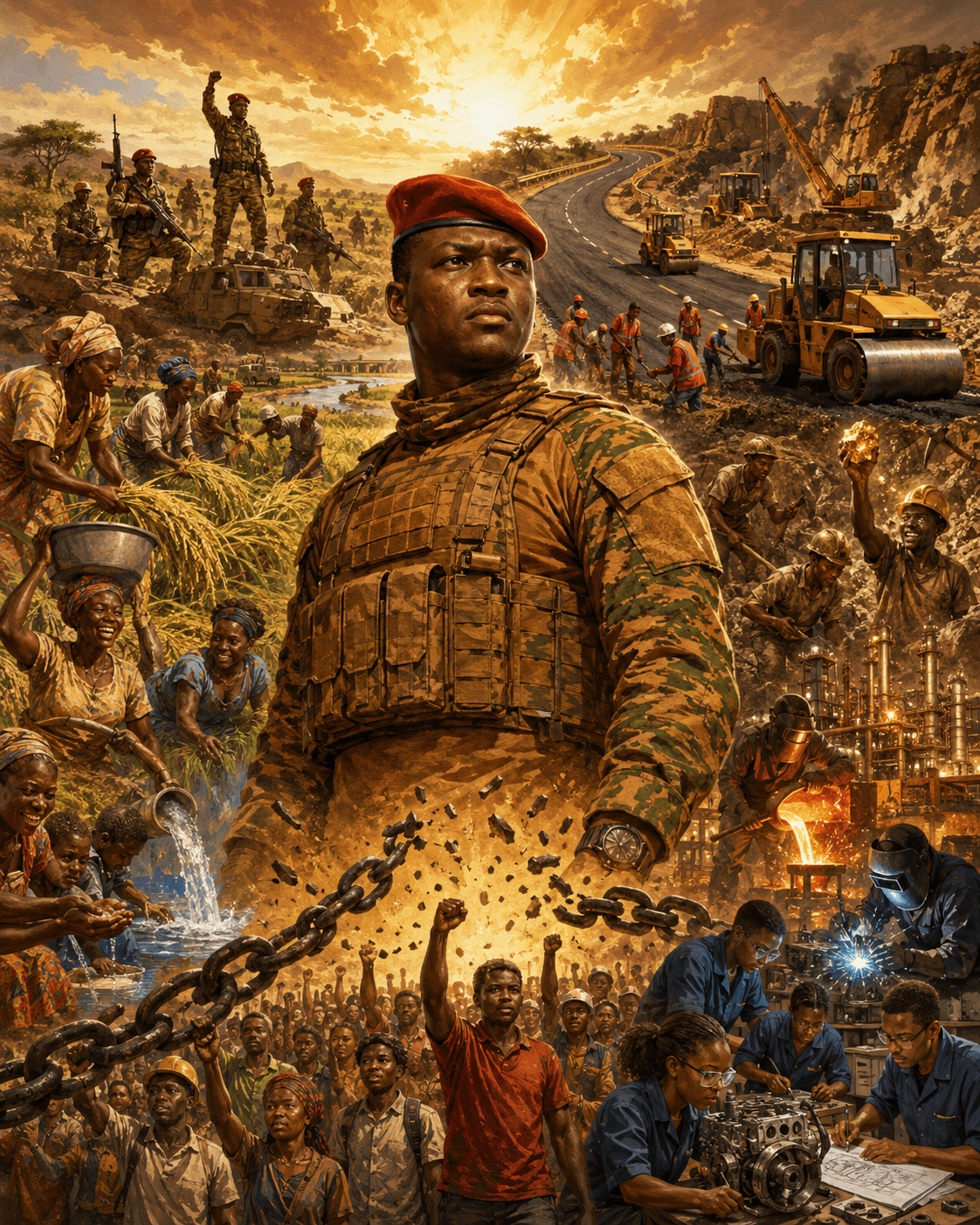
Ibrahim Traoré’s question—“Are we cursed?”—opens a confrontation with the colonial order that separated African labor, intelligence and resources from the machinery required to transform them into collective power. His speech joins territorial defense to road construction, food sovereignty, mining control, industrialization, technical education and revolutionary discipline, revealing each as a front in the same struggle to make political independence materially real. Yet the Revolution Progressive Populaire will not overcome dependence through patriotic exhortation, state ownership or the sacrifice of one leader alone: nationalization must become popular control, mobilization must become governing power, and regional defiance must become a productive Pan-African bloc. Burkina Faso can become the mirror in which Africa recognizes its buried capacities—but only if the people cease to be passengers and take collective possession of the machinery, the map and the road ahead.
By Prince Kapone | Weaponized Information | July 21, 2026
Introduction: Sovereignty as Statecraft
Ibrahim Traoré’s July 16, 2026 address to the living forces of Burkina Faso’s Yaadga region begins with soldiers fighting to reconquer national territory and then moves through roads, water, universities, gold, rice, religion, imported commodities and technological dependence. What first appears to be a sprawling public meeting is held together by one underlying question: what must a people control in order to become sovereign in more than name?
Traoré refuses to reduce independence to a flag raised above an economy still commanded elsewhere. He asks why gold leaves the soil without building collective capacity, why farmers struggle for access to their own national market, why universities produce credentials without producing machinery, and why governments repeatedly promise infrastructure without developing the means to construct it. The rifle, road, mine, classroom and rice field emerge as connected fronts within a struggle over who will organize national life and for whose benefit.
This Weaponized Intervention does not treat the speech as scripture, nor does it submit an African revolutionary leader to the liberal tribunal that demands every act of sovereignty justify itself before the empire it resists. The method is excavation. Each governing passage is opened from within: its language examined, its historical memory recovered, the social forces inside it identified, and its proposed solution tested against the political and material conditions required to make it real.
Where Traoré identifies a decisive contradiction, the essay develops its class and historical content. Where the speech moves from material explanation toward moral condemnation, racial generalization or allegations unsupported by public evidence, the revolutionary demand is separated from the weakness of its formulation. The purpose is neither celebration nor dismissal, but critical solidarity: to place Traoré’s words within the histories of colonial extraction, commodity dependence, comprador power, technological subordination and Pan-African struggle while asking what institutions could carry the possibilities contained within them.
The recurring question—whether Africans are somehow cursed—therefore enters this intervention not as an answer, but as the problem to be excavated. It compels us to ask what forces produced the condition Traoré describes, who benefits from its continuation, and what kind of organized power would be capable of breaking it.
A Curse Has No Date
“Are we cursed or not? If we are not cursed, then we must be capable of doing these things. That is what I want us to do. We are going to do it.” Ibrahim Traoré returns to this question throughout his address like a man pressing his finger against an old wound. It rises from the contradiction between what Africa possesses and what Africans have been permitted to command: gold beneath the soil, iron in the earth, sun above the land, millions of working hands—and factories, machines, medicines and industrial systems arriving from somewhere else. The continent appears rich whenever foreign corporations calculate what can be extracted from it and poor whenever its people ask what those resources have built for them. Hence the temptation to imagine a curse.
But Traoré does not leave the question in the heavens. “Our ancestors, in the countryside, were capable of taking the earth and extracting iron from it. Why can we no longer do it today?” The question immediately moves from metaphysics toward history. A cursed people would never have possessed the capacity in the first place. A naturally incapable civilization could not have cultivated crops, forged tools, organized cities, governed trade routes and transformed the material world long before the European conqueror arrived carrying a Bible in one hand, a rifle in the other and an invoice for both. “Africa was not always like this,” Traoré insists. “We lost something along the way. What did we lose? How did we lose it?”
That is the door through which history enters. Africa did not simply misplace its productive powers like a careless man losing his keys. Human beings were captured and exported. Communities were shattered. Land was seized. Colonial taxation forced peasants into cash-crop and wage-labor systems organized around European demand. Mines were built to remove minerals rather than develop national economies. Railways ran from the interior to the port because their purpose was not to connect African peoples to one another, but to carry African wealth toward foreign ships. Independence changed the flag over the state, but much of the economic plumbing continued carrying wealth in the same direction.
The arrangement survives because it remains profitable. Ninety-five of 143 developing countries remained dependent upon commodity exports between 2021 and 2023, while three quarters of Western African countries derived more than 80 percent of their export earnings from primary commodities. They export the cotton and import the clothing, export the ore and import the machine, export the petroleum and import the chemicals, plastics and engines produced from it. The world market then congratulates them for participating in international trade, much as the plantation master once congratulated the enslaved for participating in agriculture.
Burkina Faso carries this history inside its present labor structure. More than 93 percent of its jobs remain informal and 83 percent of its workers occupy vulnerable employment. This does not mean Burkinabè people do not work. They work relentlessly. It means their labor is scattered across survival economies, denied the organization required to accumulate national productive power. The problem is not a shortage of effort. The poor have never suffered from an excess of leisure. Their labor reproduces life from one difficult day to the next while the commanding heights of production remain weak, fragmented or externally controlled.
Traoré describes the country’s condition through the language of sickness: “We know the disease. Everything we are doing today is meant to cure it.” The metaphor is powerful because sickness is neither identity nor destiny. It has causes. It acts upon a body. It can be diagnosed, confronted and overcome.
Yet Traoré’s refrain derives its revolutionary force precisely from the way he turns the colonial insult against the condition colonialism produced. “Are we cursed?” is not a declaration that Black people are naturally incapable. It is a provocation directed at a people whom empire has taught to interpret dispossession as destiny. When he demands that Africans think, study, create and use the intelligence God gave them, he is pleading with them to reject the role assigned to them by the colonial order, assume responsibility for their collective future and seize command over the resources, knowledge and productive forces from which they have been separated. The supposed curse is the lie that Africa must remain dependent because Africans cannot govern, manufacture or transform the world for themselves. Traoré’s exhortation seeks to break that spell: not by denying what was done to Africa, but by refusing to allow historical injury to become an alibi for permanent surrender.
Burkina Faso is not cursed. Africa is not cursed. A curse has no date, no institution, no balance sheet and no beneficiary. Historical dispossession has all four. The continent’s productive capacity was not erased by fate but conquered, redirected and subordinated through definite systems of power. Traoré’s question becomes revolutionary at the precise moment it ceases to be a lament and becomes an investigation: not what is wrong with Black people, but what was done, who continues to benefit, and what organized power will be required to undo it.
The Road Did Not Move
“There is an enormous amount of work to be done. I cannot solve everything with the snap of my fingers. That is impossible.” With this admission, Ibrahim Traoré rejects one of the oldest frauds of postcolonial politics: the pretense that political power is a magician’s wand and development a gift pulled from the sleeve of a candidate. Roads require machines. Machines require trained operators. Universities require lecture halls, residences, teachers and laboratories. Water systems require dams, pumps, pipes, engineers and maintenance. A government may command that these things be built, but command cannot substitute for the organized capacity to build them.
That distinction separates two conceptions of politics. The first is electoral transaction. “We will build this for you. We will give you that. We will do this. We will do that.” The politician presents the people with a shopping list of future favors and collects their votes as advance payment. The population appears only as a queue of clients waiting outside the state, while the material questions—Who owns the equipment? Where are the trained workers? What funds have been allocated?—remain hidden behind campaign music and professionally printed lies.
Traoré condenses the history of that deception into one road. The population had been told since approximately 1975 that financing had been secured and the road would finally be paved. “Every five years, you voted. You voted. You voted. And the road is still there in the same condition.” The repetition is devastating because everything moves except the road. Candidates arrive and disappear. Ballot papers are printed, counted and discarded. Cabinets are reshuffled. Ministers acquire new titles. Democracy performs its ceremony with admirable punctuality, but the people continue swallowing dust.
The unbuilt road becomes a monument to a political order that confused institutional repetition with social progress. Its defenders can count elections but cannot count kilometers. They can produce speeches, communiqués and financing announcements while failing to produce asphalt. The ballot box becomes the place where the people periodically authorize another round of waiting.
Traoré answers with organized capacity. Faso Mêbo was established in October 2024 around road brigades intended to construct infrastructure at reduced cost, alongside housing, sanitation and public-space development. The speech makes the logic concrete: equipment must be acquired and distributed; operators must learn to control it; regional brigades must be established; communities must identify priorities; the state must provide support. The burned clutch plate becomes almost as instructive as the unbuilt road. Revolutionary enthusiasm cannot operate heavy machinery. Training is not an excuse for delay but part of the productive force being constructed.
This does not mean nothing can be accomplished until a perfect national machine descends from the future. Existing territorial-development programs have built or rehabilitated 995 kilometers of roads, 248 educational and health facilities, and 207 boreholes and drinking-water systems. But isolated projects do not yet constitute sovereign capacity. The greater objective is to create permanent institutions able to repeat such work without waiting for every road, classroom and water pump to arrive through a separate foreign-financed project.
Traoré’s refusal to distribute fantasy therefore carries real political value. Yet “perhaps I will simply surprise you” cannot become the governing principle of revolutionary accountability. A new way of doing things must publish its priorities, costs, equipment inventories, training schedules, completion targets and reasons for delay. Communities cannot merely be invited to applaud the arrival of machines; they must possess authority in deciding where those machines go and power to evaluate what officials do with them.
The alternative to the lying politician is not unquestioning faith in the sincere captain. It is collective control over the process by which intention becomes capacity. The road must move, but the people must also be able to see who is moving it, what it costs and why another road was chosen first.
A Nation Must Be Reachable
“The enemy cannot defeat us if we remain a nation.” Traoré does not define the nation as a flag planted over a map. He defines it as a disciplined social body capable of holding territory and reaching its people. It follows his account of roads severed, an airfield rendered inaccessible and localities cut away from the state. The enemy does not need to erase Burkina Faso’s borders if it can break the roads inside them. A country may remain intact in the atlas while dissolving into isolated towns, interrupted markets and populations forced to flee.
There is no change of subject. The fighting forces and the road brigades confront different moments of the same territorial problem. Soldiers may reopen a locality. Engineers, drivers, builders, teachers, health workers and producers must make that locality livable again. Military reconquest establishes the possibility of return; material reconstruction determines whether return can endure. A flag over a settlement without water, transport, schooling, medicine or markets announces sovereignty without completing it.
The scale of the rupture is written across the humanitarian map. In 2026, 4.5 million people in Burkina Faso require humanitarian assistance. A closed school interrupts the reproduction of knowledge. A dead clinic turns preventable illness into exile or death. A blocked road severs the peasant from the market, the patient from the hospital and the state from the population it claims to govern.
Traoré’s formulation therefore contains a material theory of territorial power. A sovereign state must move food, medicine, soldiers, machinery and information across its own space. It must reconnect cultivators to land, towns to supply lines and producers to consumers. When armed groups cut highways, they attack the circulation through which a nation reproduces itself. Isolation opens space for scarcity, fear and parallel authority.
Faso Mêbo enters here not as a second explanation of road administration but as an instrument of territorial consolidation. When the state delivered more than 900 machines to the initiative in March 2025, it linked the road network to military operations, agricultural production, commerce and transport. The political logic is clear: territorial defense requires permanent construction capacity. The bulldozer follows the armored vehicle because reconquest without reconstruction leaves the victory exposed.
Yet not every paved road carries sovereignty. Colonial Africa also had roads. They were designed to move labor and raw materials from the interior toward the port. A road joining villages to schools, clinics, farms and domestic markets can thicken national life. A road running from a mine to an export corridor may accelerate the removal of national wealth while leaving surrounding communities exactly where they were. Asphalt has no revolutionary character of its own. Its politics are determined by what it connects, what it carries and who commands the route.
This is why Traoré’s promise that communities will identify priority roads with governors and district authorities deserves more than applause. It contains the embryo of decentralized planning, but consultation is not power. Do residents possess binding authority over project selection, or are they invited to recommend while officials decide? Can they inspect budgets, verify construction quality and demand maintenance after the ceremony has ended?
Traoré’s declaration is therefore not merely a call for unity behind the armed forces. It is a demand to make the nation materially present everywhere. The rifle can prevent territory from being seized. Only organized social power can ensure that the people living upon it are connected, supplied and able to govern what is built beneath their feet.
Gold Income, Imported Motion
“Take one thousand people purchasing vehicles costing twenty million francs each. That is twenty billion francs handed away somewhere else. Yet we do not even have roads on which to drive those vehicles.” Traoré’s arithmetic is deliberately crude because the contradiction requires no economist to translate it. Gold is removed from Burkinabè soil, converted into private money and immediately exchanged for a machine designed, manufactured and largely maintained abroad. The buyer acquires mobility and status. The country acquires another obligation to import fuel, spare parts and technical knowledge.
The automobile appears as an individual possession, but it carries an entire foreign productive system beneath its polished surface. Behind the steering wheel stand steel mills, electronics factories, machine-tool producers, research laboratories and logistics networks. Burkina Faso purchases the finished concentration of all that accumulated labor while contributing little to its manufacture. The commodity arrives complete; the productive power that created it remains somewhere else.
The national trade ledger gives Traoré’s hypothetical calculation a material scale. In 2024, Burkina Faso spent more than 215 billion CFA francs importing automobiles, tractors, cycles, other land vehicles, parts and accessories. It spent another 1.6 trillion CFA francs on imported mineral fuels and petroleum products. The vehicle is therefore not purchased once. It continues collecting tribute through every tank of fuel and every replacement part.
Meanwhile, manufacturing produced only about 7 percent of Burkina Faso’s gross domestic product in 2025. This is the deeper meaning of Traoré’s question: “Are we building roads, or are we simply buying cars?” He is not merely comparing two expenditures. He is comparing two forms of wealth. Private purchasing power allows one person to obtain a finished commodity. Collective productive power allows a society to build the roads, machinery and technical institutions upon which modern mobility depends.
The answer cannot be a sermon against comfort. Workers and peasants are not guilty for wanting vehicles, phones, refrigerators, decent homes or leisure. The poor have already endured enough compulsory simplicity while the rich preached patience from air-conditioned rooms. The problem is not desire. It is an economic structure in which importing finished goods produces faster and safer profits than manufacturing them, while national surplus flows toward commerce, speculation and foreign industry.
Gold should not be transformed into a morality tale about the buyer’s vanity. It must be transformed into public transport, machine shops, repair industries, component production, roads serving farms and communities, and the technical capacity to manufacture increasingly complex goods. Everything built elsewhere can be built in Burkina Faso—but only when wealth ceases to appear primarily as what an individual can purchase and begins to appear as what the people can collectively produce.
The Champagne Drinker Needs the Thirsty
“When we rise against those who drink champagne so that everyone can have clean water, the champagne drinker pays the person without water to sing his praises and fight against you. And sometimes the person without water accepts.” In one bitter image, Traoré strips national unity of its ceremonial clothing and reveals the class struggle underneath. There is the man with champagne, whose abundance rests upon an order that leaves others thirsty. There is the woman at the pump, waking before dawn to secure one yellow container for her family. There is the state attempting to move resources from luxury toward life. And between them stands the paid defender of the cellar: a dispossessed person recruited to protect the arrangement that dispossesses him.
This is more than bribery. It is a compact theory of how a ruling class rules. Wealth does not defend itself by money alone. It purchases voices, loyalties, reputations and confusion. It pays the hungry to denounce those demanding bread, the thirsty to defend the monopolist of water, and the exploited to repeat that redistribution is tyranny. The champagne drinker understands what liberal theory prefers to forget: a small privileged class cannot govern a large injured population without organizing part of that population into its political armor.
The material stakes are not metaphorical. Burkina Faso’s last national household survey placed the poverty rate at 43.2 percent in 2021–22, while public programs have since extended drinking-water access to more than 829,000 people and improved sanitation to more than 406,000. Every new connection is an advance, but the woman beside the pump remains the measure of the distance still to travel. Water is not charity delivered downward. It is social wealth returned to those whose labor produced the country.
Traoré says, “We are a rich country. We lack dignity because the wealth has not been shared.” The sentence punctures the fiction that everyone inside the nation shares one economic interest. The importer enriched by dependency, speculative gold dealer, politically connected contractor and foreign-financed intermediary do not occupy the same position as the peasant, worker, student, displaced family, technician or public servant. Patriotism cannot dissolve this antagonism. The person guarding the champagne and the mother searching for water may carry the same passport, but they do not inhabit the same Burkina Faso.
The speech therefore identifies two blocs. On one side stands the network converting public scarcity into private advantage and hiring intermediaries to defend it. On the other stands a potential national-popular force composed of those who cultivate, build, teach, repair, defend and reproduce social life. Traoré declares that “the popular masses are what matter.” The decisive question is whether they will matter as a governing force or merely as an audience applauding a government acting in their name.
A revolution cannot defeat the champagne drinker only by exposing his selfishness. It must dismantle the machinery through which wealth purchases influence and poverty becomes recruitable. That requires workers, peasants and communities organized strongly enough to prevent old elites from returning through the side door wearing patriotic colors. The poor do not need better instructions about whom to follow. They need power strong enough that nobody can hire them to fight against their own thirst.
The Importer Prays for the Harvest to Fail
“He would rather take Burkina Faso’s money, purchase rice from a farmer in Asia and import it here than allow our own Burkinabè farmers to benefit.” With this sentence, Traoré gives food sovereignty a class enemy. The problem is not simply that rice crosses a border. It is that a commercial layer has built its fortunes upon the permanent separation of Burkinabè consumers from Burkinabè producers. Money leaves the country, foreign agriculture receives the demand, and the local cultivator is told to compete against an import system already equipped with shipping networks, credit, storage and accumulated advantage.
The sequence inside the speech matters. Traoré does not begin with a customs barrier and declare victory. “We purchased tractors and agricultural inputs. We produced improved seeds. Agriculture advanced, and we achieved strong harvests.” The state first attempts to enlarge the productive base, then protects the market required to sustain it. In May 2025, the government delivered 608 tractors, 1,102 motor cultivators, 15,000 tonnes of plant seed and 70,000 tonnes of mineral fertilizer through an agricultural program valued above 104 billion CFA francs. The point is not the ceremony of handing over machines. It is to reduce the cultivator’s exposure to imported food produced under conditions he has never been allowed to match.
That protection became concrete on April 29, 2026, when Burkina Faso suspended rice imports nationwide to clear domestic stocks and reserve market space for national production. The measure confronts a real dependency: approximately half the rice consumed in Burkina Faso was still imported in 2025. The national market had been cultivated for the importer more effectively than the national rice field had been cultivated for the people.
Traoré says the import merchants became angry and began praying for the agricultural program to collapse. The sarcasm is deserved, but moral betrayal does not fully explain their opposition. The importer is not behaving irrationally. His warehouses, credit lines, supplier contracts, transport arrangements and profit margins depend upon domestic insufficiency. Every additional tonne harvested by a Burkinabè farmer threatens capital accumulated through external dependence. Food sovereignty is therefore not a patriotic misunderstanding waiting to be corrected by a lecture. It is a conflict between two material interests.
The state has begun entering that conflict as a buyer as well as a regulator. For the 2025–26 campaign, SONAGESS was authorized to collect 530,000 tonnes of cereals and legumes directly from producers, including 300,000 tonnes of paddy rice, at prices intended to remunerate farmers while building sovereign food stocks. A harvest without storage and a guaranteed buyer can rot while imported rice continues moving through established commercial channels.
Yet protection can reproduce inequality inside the countryside if the Revolution does not ask who receives the tractors, who controls irrigated land, who owns the mills and warehouses, and who fixes producer prices. A rice ban can enrich large landholders, politically connected processors or a new rural bourgeoisie just as easily as it can strengthen small cultivators and cooperatives. The banner of sovereignty does not automatically determine the class receiving the grain.
The importer must be subordinated to national planning, but the farmer must not be subordinated to a new chain of domestic middlemen. The rice field becomes revolutionary only when those who plant, harvest and process the crop acquire durable control over land, machinery, credit, storage, prices and the institutions governing the market. Food sovereignty is not merely rice grown inside Burkina Faso. It is the power of the people who grow it to decide how the nation eats.
When the State Enters the Mine
“Gold is appearing everywhere, and people are fighting over it. Stop. The state is going to take control of the situation.” Traoré’s command interrupts the old colonial common sense that treats the mineral beneath African soil as private property waiting for the fastest extractor. In his account, anarchic gold production tears through the land, generates territorial conflict, enriches a narrow layer and converts buried national wealth into imported consumption. Gold does not become wealth merely because it leaves the earth. Its political meaning depends upon who controls the pit, the purchasing counter, the refinery, the sale and the destination of the revenue.
This is no marginal question for Burkina Faso. In 2023, the mining sector produced 14.8 percent of gross domestic product, more than three quarters of export earnings and over one fifth of government revenue. A country whose external income rests so heavily upon gold cannot surrender the chain of ownership and still pretend to command its development. Whoever controls extraction, pricing, export documentation and refining possesses enormous power over the national future.
The state has begun forcing its way back into a sector long organized around passive concessions. In 2025, Burkina Faso completed the transfer of five mining assets to the state-owned Société de Participation Minière du Burkina, including the operating Wahgnion and Boungou mines. The Bouboulou project in Yako pushes the intervention further: a fully state-owned industrial mine operated through SOPAMIB, backed by more than 32 billion CFA francs in investment and projected to produce more than seven tonnes of gold over a lifespan exceeding fifteen years, generate more than 39 billion CFA francs in direct budget revenue and sustain 1,200 direct and indirect jobs.
The national refinery extends the same logic beyond the mine gate. The state holds 51 percent of MARENA RAFFINOR-BF, created to purchase raw gold from industrial, semi-mechanized and artisanal operations and establish domestic facilities for conditioning, refining and transformation. Formal sovereignty ends at the mouth of the pit when the mineral must still leave the country to acquire purity, certification and higher value. Refining at home can retain skill, employment and a larger portion of the productive chain.
These measures confront a drain of staggering proportions. Between 2012 and 2021, Burkina Faso lost an estimated $4.93 billion through illicit financial flows involving five minerals, with gold accounting for 61 percent. The leakage did not arise only from clandestine artisanal shafts. Industrial operators also appeared through false declarations, opaque ownership structures, mispricing and tax avoidance. Gold crossed the border; the corresponding value somehow lost its passport.
Traoré is therefore correct to say that the state must take control. But state control, nationalization and socialization are not the same thing. State control establishes governmental authority over the sector. Nationalization transfers legal ownership from private or foreign capital to the state. Socialization begins only when organized workers and communities acquire power over production, surplus and investment.
A state mine can direct mineral income toward water, education and industrial development. It can also coexist with secret accounts, bureaucratic privilege, displaced communities, poisoned land and workers who remain powerless beneath a different flag. Mineworkers require authority over safety and production. Surrounding communities require binding power over land, water and restoration. The public must be able to trace output, sales and revenues into visible national investment.
The gold beneath Burkina Faso will become social wealth only when the people govern the chain through which it is extracted, transformed, sold and returned to society. Placing the state’s name on the license begins the struggle over ownership. It does not finish it.
Freedom Begins Where Matter Changes Form
“We manufacture almost nothing in Africa. It is right to fight imperialism, but we must also tell ourselves the truth and wake up.” Here Traoré drives beyond the shallow anti-imperialism that measures independence by flags, anthems and diplomatic quarrels while leaving the productive foundations of dependency untouched. A country does not command its destiny merely because its president can order a foreign ambassador out of the capital. It commands its destiny when its people can take the materials beneath their feet and transform them into the machinery, infrastructure and necessities through which society reproduces itself.
Traoré moves relentlessly through the forms of matter. Clay and minerals must become cement. Iron must become steel. Petroleum must become fuel, chemicals and industrial inputs. Cotton must become cloth and finished clothing. Knowledge must become machines. His question is not whether Africa possesses resources. The imperial powers settled that question long ago by spending centuries invading, partitioning and occupying the continent to obtain them. The question is why African societies perform the first and least remunerated stage of production while the decisive transformations occur elsewhere.
The African Union now describes the contradiction plainly: Africa exports agricultural goods, minerals and fuels for value addition abroad, then imports the finished products manufactured from those same materials. The continent labors at the beginning of the chain and pays a premium to recover its own wealth at the end.
That is why industrialization is not merely one development policy among many. It is the material form of freedom. A people unable to transform its resources must sell them at prices shaped elsewhere, purchase finished goods with currencies it does not control and organize public life around the need to earn foreign exchange. Every factory abroad that processes African materials determines where technical knowledge accumulates, which workers acquire industrial skills and who captures the higher value created through transformation.
Traoré is correct to reject the paralysis that presents technological dependence as permanent. His demand that Africans use their brains is not an accusation that Black people lack intelligence, but a refusal to let colonial dispossession become a permanent excuse for surrender. He is calling on the people to recover confidence in their own capacity to study, imitate, invent, organize and transform the material world. Yet individual will and intelligence must still be given institutional form. A furnace is required to smelt steel, machine tools to manufacture engines, laboratories and energy systems to develop industrial chemicals, and a coordinated national system to finance, test, standardize, reproduce, repair and improve what engineers and workers create. Traoré’s exhortation supplies the necessary subjective force; revolutionary planning must provide the material structure through which that force becomes productive power.
The command to manufacture must therefore become a program of industrial organization. It requires reliable electricity, technical education, industrial credit, public procurement, protected markets, research institutes, component suppliers, transport systems and workers organized strongly enough to become conscious participants in production rather than disposable hands. It requires a state prepared to accept that infant industries will not defeat century-old foreign monopolies through the miraculous justice of market competition. The infant must first be protected from the giant before liberal economists invite them into the ring and congratulate the giant for winning fairly.
Burkina Faso has begun testing parts of this direction. The creation of TEX FORCES-BF established a domestic enterprise charged with producing professional clothing for military, paramilitary and civilian use. The importance lies not simply in sewing uniforms locally. State purchasing can provide stable demand around which textile skills, equipment, suppliers and production standards develop. Cotton ceases to be merely a bale exported from the country and begins moving through a domestic chain of transformation. Such projects remain beginnings, not an industrial system, but beginnings matter when they teach institutions how to produce repeatedly.
No landlocked country of Burkina Faso’s size can independently reproduce every industrial chain modern society requires. The domestic market is too narrow and many industries demand regional energy systems, coordinated procurement and a larger protected market. Industrial sovereignty must therefore grow beyond the national scale without surrendering the national plan.
Traoré’s provocation must be carried forward in its full revolutionary meaning. Africa manufactures too little not because Africans are cursed or incapable, but because colonial domination shattered, redirected and subordinated the institutions through which intelligence becomes productive power. His call to think, study, copy, create and assume responsibility is therefore a call to break with the passivity that empire cultivated and to recover command over the continent’s own capacities. Freedom begins when that awakened confidence is joined to machinery, scientific institutions, organized labor and collective planning—when the people can touch the earth beneath them, understand its properties, unite their knowledge with the means of production and change its form according to a plan of their own.
The Degree Must Enter the Workshop
“If you are studying engineering, then your final thesis must manufacture, reproduce or design something. If all you produce is a long paper filled with words, we will no longer accept that as sufficient.” Traoré draws a hard line between knowledge certified on paper and knowledge capable of entering matter. The thesis may prove that a student has learned the approved vocabulary. The manufactured component proves that the student can make knowledge work.
This is not hostility toward theory. No machine is built without abstraction, calculation, writing and accumulated scientific memory. Traoré is attacking the colonial organization of intellect, in which education became a ladder away from production. The successful student escaped the field, workshop and factory for the office, then measured advancement by the distance placed between his hands and useful labor. Colonial schools trained clerks, interpreters and administrators to operate systems designed elsewhere. The graduate learned to supervise dependence with an impressive title.
“The university should not exist so that someone receives an engineering degree, graduates and spends the rest of his life sitting behind a desk.” The social division surrounding the desk is the real target. When the engineer commands workers without understanding their labor, when the technician possesses a certificate but no practical mastery, and when the university publishes dissertations while the country imports basic components, education reproduces hierarchy rather than productive power.
Burkina Faso has begun attempting to reconnect learning with national work. The five-year Presidential Initiative for Quality Education includes the expansion of technical and vocational education, continuing teacher training, practical learning environments and tighter control over the issuance of credentials. The “Students Feed Students” initiative and its agricultural technology incubator have placed students into practical agropastoral and fisheries production. These are early movements against an educational system that treated the diploma as the finished product.
Traoré’s command—“Build something. Copy something.”—should not embarrass anyone except those who learned industrial history from corporate advertising. Every industrial power copied. Machines were dismantled, measured, reproduced, modified and improved. Reverse engineering is not the opposite of innovation; it is one of the roads toward it. The real division lies between copying that leaves a country assembling imported kits forever and copying that creates domestic mastery over design, components, repair and eventual improvement.
But the state cannot order invention into existence and leave the student alone before an empty table. Technological universities must possess workshops, tools, skilled instructors and productive institutions capable of testing and using what students create. Otherwise, the demand to build becomes the technical version of the old demand to write: perform competence without possessing the means to practice it.
The final thesis should therefore enter a national production mission. Let engineering students develop irrigation pumps, motorcycle parts, processing machinery, construction tools and equipment the country presently imports. Let workers and artisans enter the university as teachers of accumulated practical knowledge. The colonial credential announced that its holder had risen above production. The revolutionary degree must prove that its holder has become capable of transforming it.
The Commodity Arrives with Power Inside It
“We must consume what we produce and stop importing products whose contents we do not know.” Traoré’s argument operates on three distinct levels. The first is structural: import dependency places decisions concerning supply, price, ingredients and standards beyond national control. The second is historically demonstrable: global corporations have sold different formulations in dependent markets. The third is his specific account of foreign intelligence officers proposing substances for covert insertion into food—a grave allegation for which no public evidence has been produced.
A dependent country may possess the money to purchase food today and still possess no authority over whether that food arrives tomorrow. A currency shock raises the price. A shipping disruption delays delivery. A foreign government restricts exports. A corporation alters the formula. Trade tensions, adverse weather and supply-chain disruption raise food-import costs most sharply for countries lacking domestic alternatives. The commodity appears ordinary on the shelf while the relations governing it remain beyond the consumer’s reach.
Traoré intensifies this structural vulnerability through an extraordinary story. He says intelligence agents from a Western country offered four substances that could be inserted into drinks, cigarettes, rice, milk and other products destined for areas occupied by armed groups. The substances allegedly attacked thought, physical strength and wakefulness and had supposedly been tested elsewhere in Africa and Asia. No substances are identified. No documents, samples or independent witnesses are presented. The account therefore remains Traoré’s allegation and cannot be reproduced as established fact.
But dismissing the passage with the smug little word “conspiracy” would evade the political work it performs. Traoré takes a commodity already carrying foreign corporate power and imagines it carrying a weapon. The imported package is no longer merely economically destructive. Its hidden contents may act directly upon the body. This escalation gives local production the urgency of physical defense.
The broader warning is not imaginary. Laboratory testing of nearly one hundred Cerelac products sold across twenty African countries found added sugar in more than 90 percent of them, while comparable infant cereals sold in Switzerland carried no added sugar even when products of the same flavor sold in Senegal and South Africa contained approximately six grams per serving. Nestlé disputed the characterization and defended its compliance with national standards. The difference in formulation nevertheless destroys the comforting fiction that a global brand necessarily sells the same commodity to every child.
Imperial domination does not require a secret laboratory poisoning every shipment. Corporate control is already written into differential standards, aggressive marketing, nutritional inequality and the destruction of domestic producers. African countries remain heavily dependent upon imports of cereals, vegetable oils and sugar, giving external suppliers power over both the national budget and the daily meal.
“Consuming locally produced goods is a battle,” but patriotic consumption cannot be reduced to scolding mothers at the market. Local products must be available, affordable and safe. The answer to an unverified poisoning allegation is not blind fear of everything foreign. It is organized national control over what the people grow, manufacture, inspect and place upon their own tables.
Faith Cannot Become a Second State
“For years, they have manipulated the questions of ethnicity and religion. Those two questions have repeatedly destroyed Africa.” Traoré does not speak as an enemy of faith standing outside the religious life of his people. “I am Muslim too,” he insists. His target is the conversion of belief into a political weapon: the moment when an imam, pastor, foreign patron or ambitious intermediary transforms devotion into obedience to an authority claiming sovereignty above the nation.
The controversy he addresses concerns a new legal framework for religious freedom. The government’s March 2026 proposal reaffirmed freedom of worship while prohibiting permanent places of worship inside most public services, with exceptions for hospitals, prisons and military barracks. The distinction is elementary but politically explosive. Prohibiting prayer is one thing. Regulating the permanent occupation of public institutions by religious structures is another. Traoré’s opponent collapsed the two into the slogan that the state intended to ban prayer, converting an administrative question into an assault upon Islam.
The Assembly adopted a 110-article religious-freedom law on June 20, 2026, after incorporating 202 amendments, following consultations with Islamic associations, Catholic bishops, evangelical churches and customary authorities. The same Yaadga visit also included a collective audience with regional religious leaders who supported national peace and socioeconomic reconstruction. The conflict is therefore not Islam against the Revolution. It concerns who commands the public sphere and whether any religious institution may operate as a state within the state.
Imperialism has repeatedly learned to enter African societies through contradictions it did not need to invent. It finds a grievance, identifies an intermediary, supplies money or recognition, and enlarges a disagreement until neighbors appear as enemies. Ethnicity becomes a recruiting office. Religion becomes a border running through the village. The foreign power then presents itself as mediator of the violence it helped organize while contracts, military arrangements and mineral concessions continue their quiet work.
Such manipulation succeeds because war, displacement, unemployment and social abandonment create real audiences for those offering certainty, belonging and divine explanation. A young person denied technical education, productive work and a meaningful place inside national reconstruction may be recruited by a preacher promising dignity through exclusion. Foreign financing can strengthen the organization, but the social wound prepares the ground.
Traoré’s strongest insight is that the mosque, church, student association, union hall and media platform can all become terrains of imperial struggle. His account of French intelligence coordinating religious agitation, student declarations and trade-union pressure follows a method repeatedly used against anti-imperialist and nationalist governments: identify existing contradictions, cultivate local intermediaries, finance or amplify their influence, and assemble separate grievances into a political force capable of paralyzing or overthrowing the state. The same logic runs through the foreign religious programs that remove young Burkinabè from national oversight, train them within externally financed ideological systems and return them prepared to place a transnational religious project above the sovereignty of their own people. Traoré is not warning against Islam. He is identifying the use of religious authority, educational dependency and domestic mercenaries as instruments through which imperialism attempts to manufacture internal war. His testimony should therefore be read within that established history of destabilization and taken seriously as the account of a revolutionary government confronting the operation from inside.
The distinctions must remain sharp because imperialism depends upon hiding its agents inside broader religious and social constituencies. The ordinary believer is not the target. Nor is every imam, student, trade unionist or critic part of the operation. The line must be drawn between those exercising faith or voicing independent disagreement and those consciously placing religious authority, organizational influence or foreign financing at the service of destabilization. A preacher who knowingly converts an administrative regulation into a false declaration of war against Islam is not merely expressing theological conservatism. An intermediary who coordinates his actions with foreign intelligence, recruits followers through manufactured grievance and directs them against the sovereignty of the country has crossed from criticism into counterrevolutionary activity. Precision is necessary not to weaken revolutionary vigilance, but to ensure that the real agents of imperialism cannot shield themselves behind the millions of believers whose faith they exploit.
The Revolution must defend freedom of belief while breaking every attempt to establish clerical power above the people. Foreign religious financing must be brought under national control, its sources and political conditions exposed, and the institutions carrying imperial agendas dismantled. Preachers and organizations that incite communal conflict, subordinate national sovereignty to external religious projects or mobilize followers as instruments of destabilization must be confronted through clear revolutionary law. Patriotic religious institutions should be strengthened as part of the struggle for social cohesion without becoming passive departments of the state. Faith may guide conscience, organize moral community and contribute to national reconstruction. It cannot become a private police force, a parallel sovereignty or a corridor through which imperial power recruits Africans to wage war against their own Revolution.
The Chain That Pays Dividends
“The aggressor—the person who abuses you, sabotages you and torments you—becomes someone you love, defend and protect.” Traoré names colonial consciousness as an attachment to the power that injured you. The “love” he describes is not sentimental affection. It is political identification: seeking approval from the imperial center, treating its goods as naturally superior, distrusting one’s own people, defending foreign intervention and experiencing national resistance as an embarrassment. The colonized subject begins viewing himself through the conqueror’s eyes and mistakes that borrowed contempt for sophistication.
This identification depends upon historical amnesia. A people taught to remember colonialism as roads, schools and administrative order will experience rebellion as ingratitude. Violence disappears; dependency appears natural. The ruler who submits becomes “responsible,” while the government that touches foreign privileges is declared reckless. Yesterday’s conqueror returns as today’s expert, investor, humanitarian and judge of democracy, wearing enough new titles to make the old relationship appear modern.
Traoré reaches for the memory of Bamboula’s Village to tear away that disguise. In 1994, a safari park near Nantes displayed Ivorian performers inside a staged “African village” for paying visitors. The empire had changed its vocabulary faster than its gaze.
But the speech’s deepest testimony is intimate. Traoré recounts that colonial violence devastated his grandmother’s village, prevented family formation and left marks upon her body. “I saw the scars of colonial abuse on her body.” He was ten years old when she died in 1998. “I therefore carry the effects of colonization in my own flesh.” Colonialism ceases here to be a chapter ending at independence. It enters fertility, kinship, memory and the body of a child touching the wounds of an older generation. History is not behind him. It sits inside the family.
The African Union’s Decade of Justice and Reparations treats enslavement and colonialism as structures whose injuries persist through the present international order. The point is not inherited guilt. It is that stolen land, interrupted development, racial hierarchy and externally organized accumulation did not disappear when colonial flags were lowered.
Traoré’s use of “Stockholm syndrome” names a real political deformation: the colonized subject learns to defend the institutions, values and powers that degraded him. But the syndrome is never merely psychological. It is cultivated, rewarded and organized through class relations. Some Africans protect imperial power because they have been taught to admire it; others protect it because their businesses, contracts, careers, media platforms and political influence depend upon its continued domination. The comprador may carry the colonizer inside his consciousness, but he also carries him inside his bank account. He fears organized workers and peasants because popular sovereignty threatens both the imperial order above him and the privilege he has accumulated beneath it.
Colonial identification therefore survives because material institutions continually reproduce it. Foreign validation opens doors. Dependency creates fortunes. Imperial media manufacture reputations, diplomatic networks distribute access, import monopolies reward external orientation and donor systems cultivate entire professional layers whose social position depends upon translating submission into the language of expertise, realism and moderation. Traoré’s demand that Africans recover their history and love themselves is not a retreat from class analysis. It is a call to break the ideological loyalty through which these profitable arrangements are defended and to recognize that those who serve imperial power are serving a system with concrete beneficiaries.
The cure requires both consciousness and command. Africans must reject the colonial gaze, recover confidence in their own capacities and refuse the shame empire attaches to resistance. But this awakened consciousness must be organized through national production, public knowledge, revolutionary media independent of imperial and comprador capital, popular institutions and collective control over the wealth through which betrayal is purchased. The chain around the mind and the chain around the economy reinforce one another. Both must be broken if the people are to cease defending their subordination and begin governing their future.
One Captain Through the Storm
“There are not two captains commanding one ship.” Traoré delivers the sentence as a declaration of revolutionary command against rumors of divided authority. He is responding to whispers about hidden strongmen, rival military centers and a possible repetition of the relationship between Thomas Sankara and Blaise Compaoré. He rejects the comparison by returning to the material circumstances through which power was seized. He did not remain inside a villa while other men faced the guns. He moved at the front, came within range of heavy fire and risked becoming the first casualty. His authority therefore rests not only upon formal rank, but upon leadership exercised in the decisive moment when hesitation could have destroyed the entire mission.
At the present conjuncture, this concentration of command is not a contradiction to be apologized for. Burkina Faso is fighting an armed war, confronting imperial destabilization, dismantling comprador networks and attempting to reorganize an economy whose most profitable sectors were built around dependency. Private businessmen, ambitious officers, foreign intelligence services and displaced political elites are all searching for fractures through which the old order can return. Under such conditions, competing command centers do not represent democratic vitality. They represent openings for intrigue, bribery, paralysis and counterrevolution.
Traoré’s warning to business operators who search for a supposed “strongman” around him exposes how ruling classes manufacture factional power. They cultivate ministers, advisers and officers as alternative channels of influence. They flatter one official, finance another and whisper that a third possesses the real authority behind the government. Such maneuvers do not merely feed individual vanity. They assemble patronage networks through which loyalty can be purchased, commands obstructed and betrayal prepared before it is publicly announced. One ship cannot follow two directions while crossing a mined sea.
“There is no number one, number two, number three or number anything,” Traoré insists. “I have a mission. All of them are following that mission.” The point is not that one man owns the Revolution. It is that the Revolution cannot survive if every ambitious figure is permitted to construct a private mission inside it. Unity of command becomes the political form through which the collective project is defended against fragmentation. At a moment when foreign powers and domestic intermediaries are actively searching for a new Compaoré, refusing dual power is an elementary act of revolutionary survival.
Traoré grounds this authority in sacrifice. “I did not sacrifice my youth for nothing.” He describes a life stripped of ordinary freedom: transported under guard, watched outside his home, unable to move through the world as another young man might. He has exchanged youth for responsibility, privacy for surveillance and personal security for national danger. This is not theatrical martyrdom. It explains why his threats against those obstructing the mission are not idle and why WI does not treat them as evidence of an authority detached from the Revolution. He has assumed command because the conjuncture demands somebody willing to defend the process against forces prepared to drown it in blood.
When Traoré declares that counterrevolutionary conduct will be punished, he is not speaking into an abstract political environment where every faction accepts peaceful rules and foreign powers remain politely outside the contest. He is addressing officials, military figures, businessmen and intermediaries operating inside a country under siege. He says that he investigates, verifies the evidence, summons the accused and explains the offense before acting. His warning is directed at those who mistake revolutionary patience for weakness and official responsibility for immunity. The higher the position, the greater the betrayal when that position is placed at the service of sabotage.
WI therefore rejects the liberal demand that a revolutionary government confronting armed insurgency, imperial subversion and internal betrayal behave as though it were administering a settled parliamentary republic. Counterrevolution is not merely another opinion competing in a neutral marketplace of ideas. It is the organized attempt to reopen the country to the forces being expelled from it. A state unwilling to punish proven sabotage does not become more democratic. It becomes defenseless.
This logic also clarifies the dissolution of the old political parties and the repeal of the laws governing their activity, financing and formal opposition. The party market deserved no sentimental defense. It fragmented the population into electoral machines, distributed state resources among professional politicians and repeatedly converted ethnic, regional and religious divisions into careers. It trained the people to wait for promises while elites negotiated their access to foreign capital and diplomatic patronage. Destroying that apparatus was not the destruction of popular democracy. It was the removal of a political form through which dependency reproduced itself.
The Charter of the Revolution subsequently established the Popular Progressive Revolution, removed political-party representation from the legislature and defined sovereignty, patriotic defense and popular engagement as principles of the new order. This new architecture reflects the reality Traoré states plainly: Burkina Faso is not passing through an ordinary alternation of governments. It is attempting to defeat an entrenched order and construct another one while the struggle remains unfinished.
The task ahead is therefore not to weaken command in order to satisfy liberal expectations, but to deepen the revolutionary social forces upon which that command rests. Workers, peasants, soldiers, women, students and communities must be organized as active participants in the national mission. Popular councils, recallable delegates, worker supervision, peasant cooperatives, mass criticism and revolutionary auditing can strengthen the line by exposing corruption, correcting errors and preventing ambitious officials from separating themselves from the people. These institutions do not stand against Traoré’s authority at the current conjuncture. They give that authority deeper roots and prepare the Revolution to survive beyond the exceptional conditions that concentrated it.
Revolutionary discipline joins two necessities. The first is unity in carrying out a line while the country is under attack. The second is the political education and organization of the masses who must eventually reproduce that line through institutions of their own. Criticism must strengthen the mission rather than provide camouflage for those attempting to destroy it. Leadership must remain connected to the people rather than insulated inside bureaucracy. But none of this requires pretending that every contradiction can be resolved through endless deliberation while enemies advance.
Traoré says, “I have a dream for my country, and that dream will be realized.” At this moment, he stands as the central authority defending that mission, and his enemies understand that his threats carry the weight of state power. WI sees that authority as justified by the war, the internal danger and the scale of the reconstruction being attempted. The deeper revolutionary task is not to disarm the captain in the middle of the storm. It is to organize the million hands required to defend the ship, carry out the mission and ensure that the course survives every captain who must eventually leave the wheel.
The Mirror Must Become a Bloc
“Burkina Faso is a mirror. The others see themselves reflected in it, and everyone is waiting to see.” Traoré lifts the national experiment out of Burkina Faso without pretending its government commands the continent. A mirror does not govern the person standing before it. It makes another future visible. When rice is defended from the importer, gold is pulled toward public control and students are told to manufacture rather than recite, each measure says that dependency is an arrangement, not a law of nature.
The mirror also faces the other direction. Imperial capitals, foreign corporations and postcolonial elites are watching for failure. If Burkina Faso is broken, isolated or driven into stagnation, every comprador politician will point toward the wreckage and announce that sovereignty was childish, foreign tutelage was realism and Africans who attempted to command their resources received the chaos they deserved. Burkina Faso does not need to become paradise to disturb the imperial order. It needs to prove that disobedience can build.
Traoré understands the danger of a solitary example. “It would not be wise for Burkina Faso alone to advance while the rest of the continent remains behind. This should become a continental movement.” A landlocked country of Burkina Faso’s size cannot independently produce every machine, finance every industrial chain, secure every transport corridor or construct the energy system required for modern sovereignty. National will encounters the limits of national scale.
The Alliance of Sahel States is the first institutional answer taking shape around that contradiction. Burkina Faso, Mali and Niger transformed their defense alliance into a confederation in July 2024 through a treaty founded upon sovereignty, territorial integrity, solidarity and the defense of their populations. Its declared program placed food security, economic and monetary independence, transport interconnection and extractive industries inside the same regional project. The confederation recognizes what colonial borders concealed: roads, markets, peoples and armed threats do not stop neatly where the customs officer raises his barrier.
The institutional shell has begun acquiring material organs. The three governments operationalized the Confederal Bank for Investment and Development in December 2025, creating a common instrument intended to finance roads, agriculture, energy, enterprises and regional connectivity. A bank, coordinated diplomacy and a unified security framework move the AES beyond a rebellious communiqué. But no development bank is revolutionary merely because it carries a sovereign name. Its class character will be determined by what it finances, who controls its lending priorities and whether public wealth builds collective productive systems or subsidizes a new regional bourgeoisie.
The harder task is to construct a regional division of labor. One country may produce agricultural machinery, another supply energy, another process minerals, while common procurement guarantees demand. Roads must connect Sahelian production to Sahelian consumers rather than merely escort raw materials toward the coast. Technical institutes must share research. Public enterprises must exchange components. The bank must finance projects because they strengthen collective capacity, not because they offer the quickest private return.
The wider African market matters for the same reason. Manufactured goods already constitute 46 percent of trade among African countries, revealing that trade within Africa carries a more productive character than the continent’s traditional exchange with imperial centers. Full implementation of the African Continental Free Trade Area could raise intra-African trade by 45 percent by 2045. But a larger market is not automatically liberation. Without planning, public investment and protection for weaker productive systems, integration can allow the strongest corporations to dominate a wider territory beneath a Pan-African flag.
“Let us move quickly. Let us prove that it is possible.” Speed matters because the mirror is being tested. But the reflection will not be sustained by charisma, summit declarations or three governments acting above their peoples. Burkina Faso must become part of a material bloc capable of feeding, financing, powering, defending and industrializing itself across borders. The continental movement begins when the example ceases to be merely admired and becomes an organized system that workers, peasants and communities across the region can enter, govern and reproduce.
The Ball Is in the People’s Court
“Young students, the ball is now in your court. Study. Work hard. Use the internet to search for knowledge.” Traoré’s appeal is not an attempt to withdraw the state from the struggle and deposit the burden of national reconstruction upon the shoulders of the youth. The entire speech has already established the opposite. The state is purchasing machinery, opening road brigades, expanding agricultural production, protecting domestic rice, entering the mining sector, building educational infrastructure and laying the foundations for technological universities. Traoré is calling upon the youth because even the most determined revolutionary state cannot study, invent, cultivate, manufacture and defend the country on behalf of the people. Leadership can organize the conditions of transformation. The people must enter those conditions as conscious makers of the new society.
The ball enters their court because the Revolution is offering them a stake in the mission. Traoré does not address students as clients waiting for scholarships, dining halls, residences and employment to descend from above. He recognizes them as future engineers, technicians, agricultural specialists, teachers and organizers whose knowledge must become part of Burkina Faso’s productive power. The state commits itself to building the schools, workshops, infrastructure and industries. The student must commit to mastering the knowledge required to use, reproduce and improve them. This is not abandonment. It is revolutionary duty distributed across society.
The same dialectic runs through the rest of the speech. The state places road machinery in the regions, but communities must identify the roads that matter most. The state purchases tractors, inputs and seeds, but cultivators must increase production and defend the national market. The state takes control of mines and refining, but workers and surrounding communities must protect those assets from corruption, waste and environmental destruction. The state opens technical institutions, but students must build rather than merely collect credentials. The Revolution advances through the unity of public command and popular initiative.
Traoré’s insistence upon responsibility therefore carries a profoundly anti-colonial meaning. Colonial rule trained Africans to experience the state as something external: a distant authority that extracted taxes, issued commands and organized the country for somebody else. The postcolonial politician preserved that distance by turning citizens into petitioners. Every election renewed the same relationship: the politician promised, the population waited, and the machinery of dependency continued operating untouched. Traoré is attempting to break that habit. The people are not being asked to wait for development. They are being called to become its active social force.
This is why consuming locally, rejecting manipulation, carrying the revolutionary message and studying useful technologies cannot be dismissed as moral instructions detached from material policy. They are forms of participation in a state-led national project. The government can restrict an imported commodity, but it cannot force the population to believe that a Burkinabè product is worthy of support. It can establish a university, but it cannot think through the student. It can purchase industrial machinery, but it cannot replace the workers, technicians and engineers required to master it. Sovereignty is constructed when state planning and popular consciousness move in the same direction.
The Revolution therefore needs institutions capable of organizing that participation. Village and neighborhood bodies can translate national objectives into local priorities and mobilize communities around public works. Worker organizations can improve production, expose waste and defend state enterprises against private capture. Peasant cooperatives can unite machinery, storage, processing and market access. Women’s organizations can shape the programs governing water, food, health and social reproduction. Student and youth brigades can connect technical education to agriculture, construction, manufacturing and public service. These are not rival governments standing against revolutionary leadership. They are the organized channels through which the people perform their share of the mission being led by the state.
Such organization also gives revolutionary discipline a social foundation. A national line cannot be implemented through command alone. It must be understood, carried and defended by millions of people acting within their workplaces, schools, villages and neighborhoods. Popular criticism, reporting and auditing help the state identify officials who obstruct the mission, resources that disappear and policies that fail in practice. The purpose is not to place every executive decision before endless deliberation. It is to unite centralized direction with the knowledge, vigilance and initiative of the masses.
Traoré tells the youth to study, produce and become useful because the Revolution intends to create a country capable of using what they learn. Burkina Faso’s young people still enter a labor structure in which more than nine out of every ten jobs remain informal. That reality does not make the appeal hollow. It reveals the scale of the transformation the state and the people must accomplish together. The government must organize production capable of absorbing trained labor. The youth must prepare themselves to build, operate and expand it.
When Traoré places the ball in the people’s court, he is not walking away from the field. He is leading one side of a collective advance and demanding that the people take their position within it. The state cannot liberate a passive population, and the population cannot defeat dependency without organized state power. The ball carries responsibility, confidence and duty: an invitation to stop watching history from the stands and enter the struggle as co-builders of the sovereign future Traoré has placed before them.
The Road Is Built from Both Ends
Traoré closes by insisting that what appears impossible can be built. The force of that claim does not lie in optimism alone. It rests upon the material chain his speech assembles: territory defended, roads opened, food produced, gold reclaimed, knowledge reorganized and regional cooperation pushed beyond ceremony. Sovereignty becomes real when a revolutionary state acquires the capacity to organize national development and a mobilized people assume their responsibility within that project.
The condition confronting Burkina Faso was not created by fate. It was produced through conquest, extraction, unequal exchange and the long separation of African labor and intelligence from the machinery needed to transform their own resources. Traoré’s call to think, work, study and create does not deny that history. It refuses to allow historical injury to become an excuse for permanent surrender. The revolutionary task is to join recovered confidence with state planning, productive institutions and the organized labor of the people.
That process requires command. A country fighting armed insurgency, imperial destabilization and internal comprador resistance cannot be rebuilt through fragmented authority or endless negotiation with those determined to destroy the mission. Traoré’s concentration of leadership is justified by the present conjuncture because unity is necessary to defend the state, discipline officials and force national resources away from the circuits of dependency. The task is not to weaken that command while the storm is still raging, but to deepen the social forces capable of carrying out the line it has established.
Mines must finance social development. Universities must enter production. Food sovereignty must strengthen cultivators. Regional integration must construct common capacity. The state must provide direction, machinery, protection and institutions; workers, peasants, students, soldiers, women and communities must provide the knowledge, vigilance, initiative and labor that no state apparatus can manufacture on their behalf. Neither side can complete the Revolution alone.
The road ahead will encounter merchants whose fortunes depend upon imports, officials tempted to convert public authority into private power, religious and political intermediaries recruited by foreign interests, and imperial forces determined to prove that Africa can resist only long enough to fail. Burkina Faso’s answer will be found in whether revolutionary leadership and popular participation can remain united strongly enough to defeat those forces, expand production and reproduce the mission beyond the exceptional conditions that first concentrated it.
The rifle secures the ground upon which the road can be built. The state provides the machinery and direction. The people must lay hold of the work, carry the mission forward and make sovereignty irreversible.


Leave a Reply