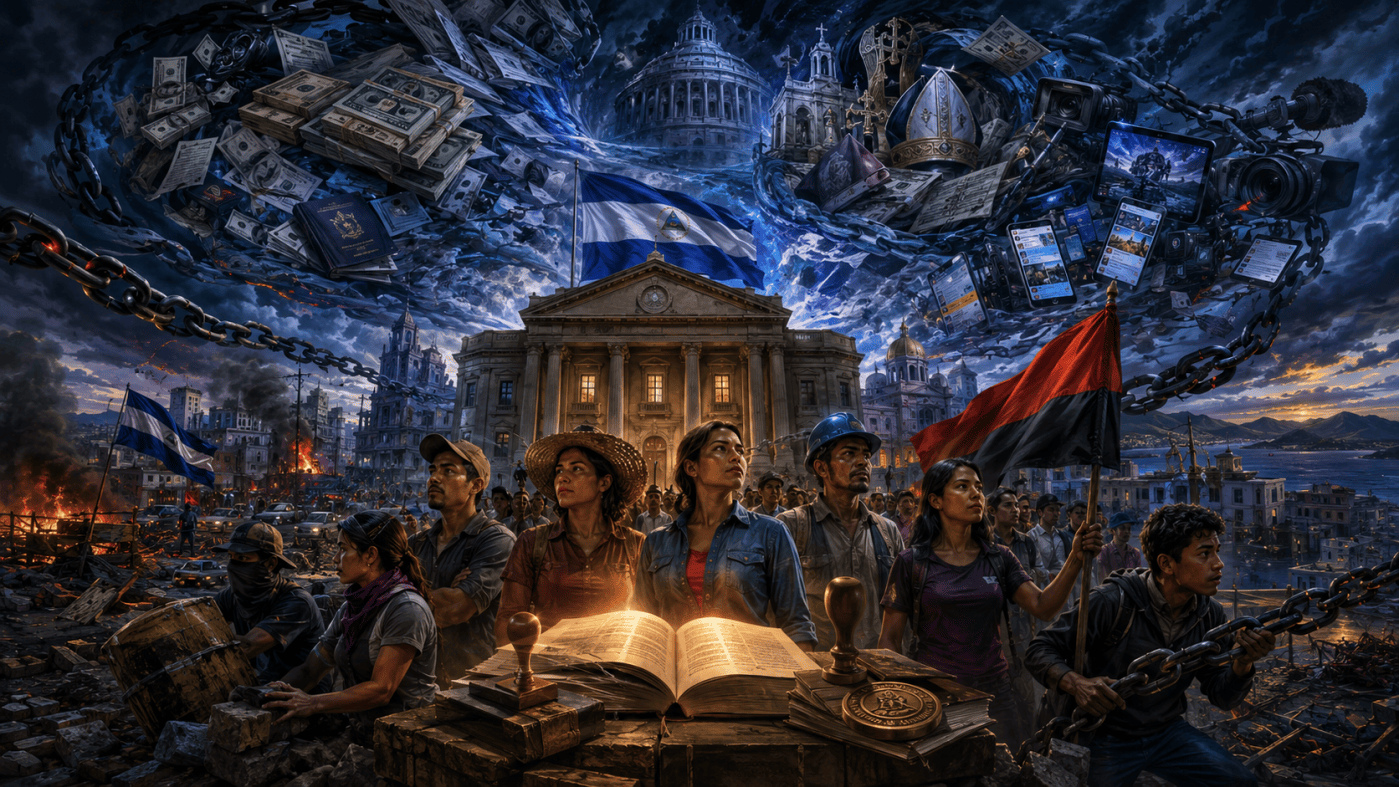
The Associated Press presents Nicaragua’s removal of lawyers from the professional registry as another irrational “crackdown,” amputating the history and material forces that produced the state’s response. The factual record reveals a post-2018 counter-subversion architecture aimed at foreign-funded NGOs, opposition media, sections of the Catholic hierarchy, expatriate political networks, illicit financial channels, and the lawyers and notaries who give those forces legal continuity. The real contradiction is not democracy against dictatorship, but a besieged revolutionary state defending national sovereignty while risking bureaucratic overreach when it fails to distinguish publicly between imperial collaboration, professional misconduct, and ordinary legal practice. International solidarity must therefore reject sanctions and regime-change financing while supporting worker-, peasant-, and anti-imperialist legal efforts to demand transparent evidence, differentiated procedures, and popular control over the defense of the revolution.
Prince Kapone | Weaponized Information | July 13, 2026
When Repression Becomes Its Own Explanation
On July 10, 2026, the Associated Press published Megan Janetsky’s “Nicaragua strips lawyers from practicing in ongoing crackdown on dissent,” a short wire report carrying a very large political conclusion. Lawyers, the article says, discovered that their names and professional credentials had disappeared from Nicaragua’s Supreme Court registry. They received no public explanation, no individualized notification, and no visible opportunity to challenge whatever decision had been taken. That is a serious matter. But AP does not investigate it as a serious matter. It uses it as another tile in a mosaic whose final picture had already been painted.
The headline does most of the ideological labor before the article begins. Nicaragua has “stripped lawyers” of their profession as part of an “ongoing crackdown.” The precise number remains unknown. The article’s principal sources can personally identify several dozen cases, while the larger estimate floats somewhere between hundreds and thousands. No national list is produced. No governing resolution is cited. No legal mechanism is examined. The uncertainty is admitted in the body, after certainty has already been delivered at the door.
The report’s source hierarchy is equally disciplined. Reed Brody, an American human-rights lawyer serving on a United Nations expert panel, supplies the phrase “purge of the legal profession.” Exiled Nicaraguan lawyer Juan Diego Barberena supplies the language of totalitarian control. Their experiences and allegations deserve examination. AP instead treats their interpretation as the event’s natural vocabulary. No serving Nicaraguan judicial official appears. No Sandinista legal analyst is consulted. No defender of the government’s post-2018 security policies is permitted to explain what the state believes it is doing. The accused government declined to answer AP’s request, and into that silence the entire imperial archive politely marches.
The article then performs its most consequential operation: it makes history begin in April 2018. Nicaragua’s recent past becomes a simple procession of peaceful protests, violent repression, imprisoned adversaries, closed organizations, persecuted churches, denationalized exiles, and now disbarred lawyers. Each institution appears as a self-evidently democratic body confronting an inexplicably hostile state. NGOs are merely NGOs. Human-rights organizations are merely human-rights organizations. Church officials are merely religious leaders. Exiles are merely dissenters. Lawyers are merely lawyers. Foreign financing, opposition violence, roadblocks, economic sabotage, sanctions advocacy, and the government’s claim that these institutions formed parts of a coordinated regime-change infrastructure vanish from view.
This is not an accidental omission. It is the article’s organizing principle. AP does not need to prove that every closed organization, expelled cleric, denationalized political actor, or removed lawyer performed the same political function. It simply places them in one moral category and calls the sequence a crackdown. The state’s actions require explanation; the institutions arrayed against it require none. Repression thus becomes both the accusation and the cause of the accusation—a wonderfully economical arrangement in which imperial journalism saves itself the trouble of investigating what happened.
The article’s ideological function is to detach the lawyer removals from the political conflict that produced them. An unresolved administrative operation becomes another parable of dictatorship. Washington’s sanctions, financing networks, and historical intervention disappear, while organizations cultivated within that environment are recast as innocent fragments of democracy awaiting rescue. The concrete question—who was removed, under what law, for what conduct, and through what procedure—is buried beneath a familiar instruction: do not study Nicaragua’s struggle over sovereignty; merely condemn the government that claims to be defending it.
The Machinery That Survived the Barricades
The first fact AP leaves unresolved is the immediate one. Lawyers began discovering that their names and professional identification numbers no longer appeared in the Supreme Court’s public registry of authorized attorneys and notaries. Without that status, they cannot exercise ordinary legal and notarial functions. Reported consequences include denial of the stamped paper required for legal instruments, loss of access to proceedings, and interruption of work involving criminal defense, family disputes, contracts, inheritances, property transfers, corporate documents, and powers of attorney. Yet no complete official list has been published. The available reporting identifies dozens of specific cases, while claims that hundreds or thousands have been affected remain estimates rather than a verified national count.
The action nevertheless occurred inside a legal and administrative structure that AP never examines. Nicaragua’s 2025 Organic Law of the Judicial System reorganized judicial administration and professional regulation, while the judiciary’s existing disciplinary framework authorizes the investigation of complaints and the imposition of warnings, fines, suspensions, and other sanctions upon attorneys and notaries. The Court also maintains a specialized directorate responsible for registration, credentials, seals, notarial books, professional supervision, and the cancellation of records. Removal from a public database is therefore not taking place in a legal vacuum, even though the government has not yet disclosed the individualized findings or administrative categories governing the current operation.
The professional registry also sits inside a much larger financial-security system. Nicaraguan lawyers and notaries have long been treated as obligated subjects responsible for detecting and reporting transactions carrying money-laundering or illicit-finance risks. Their work can establish corporations and nonprofit associations, certify governing boards and beneficial owners, authenticate donations and property transfers, create trusts and powers of attorney, and preserve the legal authority of people living outside the country. On June 17, 2026—only weeks before the removals—the National Assembly strengthened five laws governing money laundering, organized crime, beneficial ownership, virtual assets, confiscation, and institutional coordination. The timing does not establish that every removed lawyer was suspected of a financial offense, but it places the review of professional credentials inside an active state campaign to tighten control over the legal intermediaries through whom assets and institutional authority move.
That campaign cannot be understood apart from the government’s account of 2018. Nicaragua’s White Book on United States Aggressions Against Nicaragua describes the April-to-August conflict as an attempted rupture of the constitutional order organized through foreign-financed civil-society groups, media organizations, opposition networks, armed formations, and approximately 1,171 roadblocks erected across highways and cities. The government documented 198 deaths, 420 people seriously wounded by firearms, attacks on police and Sandinista supporters, kidnappings, destruction of public property, and an estimated $206.5 million in damage to state and municipal infrastructure. These remain the government’s findings rather than uncontested national totals, but they establish the threat assessment that subsequently guided state policy.
Independent and sympathetic research recovered a large body of violence omitted from the dominant international account. The roadblocks restricted transportation and commercial circulation and became sites of robbery, intimidation, kidnapping, assault, and killing. Nicaragua-based research published through the Council on Hemispheric Affairs connected the conflict to approximately 100,000 lost jobs and extensive destruction of schools, hospitals, municipal buildings, roads, and historic property. The social cost did not fall primarily upon officials in Managua. It fell upon workers unable to reach employment, peasants and traders unable to move products, families unable to travel safely, and communities whose public institutions were burned or dismantled.
The foreign financial infrastructure surrounding the uprising was not invented after the fact by the Sandinista government. A USAID inspector-general audit confirms that the Violeta Barrios de Chamorro Foundation administered a U.S.-financed Media Strengthening Program throughout 2018. The National Endowment for Democracy’s own records state that it supported Nicaraguan organizations working in media, civil-society protection, human rights, political participation, and the rule of law. These records do not prove that every recipient organized violence, but they do show that Washington had spent years constructing political, communications, and institutional capacity inside sectors subsequently presented as entirely spontaneous and independent.
The Sandinista government concluded that the 2018 operation depended upon an interconnected institutional field. Foreign resources entered through NGOs, foundations, media programs, religious and human-rights networks, political organizations, and professional intermediaries. Sections of the Catholic hierarchy, originally invited to mediate the National Dialogue, were accused of abandoning mediation, legitimizing demands for the government’s removal, protecting opposition activity, and using ecclesiastical authority to strengthen the roadblocks. The conflict that followed was directed against politically active sectors of the hierarchy and their institutions, rather than against the religious identity of Nicaragua’s Catholic population as a whole.
The laws adopted afterward correspond closely to the mechanisms the government says were used. The 2020 Foreign Agents Law requires recipients of foreign resources used for domestic activity to register their foreign principals and disclose the receipt and use of those resources. The nonprofit regulatory law subjects organizations to reporting, governance, accounting, and inspection requirements. The 2024 international-cooperation law requires projects financed by agencies, international organizations, and diplomatic missions to receive state approval and conform to national development plans. These measures progressively moved foreign cooperation from a privately managed relationship between donors and domestic organizations into a relationship supervised by the Nicaraguan state.
The same sequence includes the prosecution, expulsion, and denationalization of people the government accused of financing destabilization, requesting sanctions, or soliciting foreign intervention. Law 1055 defines participation in coups, organization through foreign financing, advocacy of economic blockades, and solicitation of intervention as injuries to national independence and sovereignty; Law 1145 created the procedure for loss of Nicaraguan nationality. Together with NGO closures, restrictions upon sections of the Church, control over foreign cooperation, and financial surveillance, these measures removed organizations and personnel the state associated with the 2018 operation and its expatriate continuation.
The current lawyer removals appear near the end of that institutional sequence. Attorneys and notaries are the professionals capable of preserving the assets, records, governing authority, contracts, properties, donor relationships, and powers of attorney of organizations whose legal personalities have been canceled or whose directors now live abroad. Tightening their registration can prevent dissolved networks from maintaining themselves through substitute foundations, private companies, trusts, or new legal representatives. The available evidence makes that connection plausible and materially grounded. It does not yet establish that every affected professional represented a foreign-financed organization, concealed assets, participated in the 2018 conflict, or violated the laws governing the profession. That distinction can only be settled through publication of the affected names, governing criteria, individual findings, and procedures for review.
Nicaragua has confronted foreign intervention before through considerably less subtle means. The United States occupied the country, supported the Somoza dynasty, armed and financed the Contras, mined Nicaraguan ports, and waged economic warfare against the Sandinista Revolution. In 1986, the International Court of Justice found that Washington had violated its obligations not to intervene in Nicaragua’s affairs or use force against it. The methods have since shifted toward political financing, sanctions, media cultivation, nonprofit infrastructure, diplomatic isolation, and programs designed to create an “environment” for Nicaragua’s political transition. The present legal campaign developed within that historical continuity—and within the state’s determination that the machinery used in 2018 must not be allowed to assemble itself again.
The Counterrevolution Did Not Disappear When the Barricades Came Down
The Associated Press presents the disappearance of lawyers from Nicaragua’s professional registry as another inexplicable spasm of authoritarianism. The state acts, the lawyers suffer, and “repression” is offered as both description and cause. But states do not reorganize entire legal systems, regulate foreign money, dissolve institutions, expel political actors, confront sections of the Church, and tighten control over lawyers and notaries because they woke one morning offended by dissent. These measures emerged from a concrete historical experience: in 2018, the Sandinista government confronted what it understood as a foreign-supported attempt to break the constitutional order through an ecosystem of political, financial, informational, religious, legal, and territorial power.
The barricades were only the visible edge of that operation. Beneath them stood years of foreign financing, opposition media cultivation, nonprofit infrastructure, youth training, diplomatic pressure, human-rights documentation, elite political coordination, and the steady construction of a domestic bloc whose material support came from outside the country. Once the crisis erupted, those institutions did not remain neutral observers. They helped narrate events, mobilize forces, legitimate the roadblocks, internationalize the conflict, and prepare the political case for sanctions and regime change.
The roadblocks themselves were not symbolic theater. They disrupted the circulation of labor, food, medicine, transport, and commerce. They immobilized workers, isolated communities, destroyed public property, and turned parts of the country into contested zones of authority. Their social cost fell heavily upon the very people whom imperial journalism later removed from the story: wage workers unable to reach jobs, peasants unable to move crops, small traders cut off from markets, families trapped between armed forces, and communities watching public infrastructure burn.
The Sandinista state drew a conclusion from that experience. Modern regime change does not always arrive behind a column of tanks. It can be assembled through foundations, media programs, church networks, nonprofit associations, legal offices, foreign grants, diplomatic missions, and organizations that appear private while operating inside the strategic horizon of a hostile state. The coup form had evolved, and the state responded by attempting to regulate the machinery through which it had been built.
This is the political logic connecting the measures AP lists as unrelated episodes of repression. Foreign-agent laws targeted undeclared external financing. Nonprofit regulations brought donor relationships, boards, accounts, and organizational purposes under state review. International cooperation was moved away from privately negotiated donor channels and placed beneath national supervision. Sanctions advocates and political actors accused of soliciting foreign intervention were expelled or stripped of nationality. Sections of the Catholic hierarchy that had acted as political power centers during 2018 were deprived of the protected institutional position from which they had intervened. Lawyers and notaries now face intensified scrutiny because they give every other part of that system legal form.
A nonprofit cannot reproduce itself through moral language alone. Someone must create its statutes, certify its board, authenticate its donations, control its property, establish its legal representatives, issue its powers of attorney, preserve its records, and move its assets when the organization is dissolved or its directors leave the country. The lawyer and notary stand at the hinge between foreign resources and domestic institutional power. They are not merely courtroom speakers. They are technicians of legal continuity.
The current removals therefore appear to be part of a wider effort to prevent the political ecology of 2018 from rebuilding itself through new foundations, companies, trusts, associations, legal representatives, or property arrangements. The government defeated the territorial phase of the attempted overthrow when it dismantled the barricades. It then moved against the financial channels, nonprofit structures, media networks, ecclesiastical protection, expatriate leadership, and legal machinery capable of preserving the operation after its street phase had collapsed.
That is the story AP cannot tell, because telling it would destroy the innocent category upon which its article depends. “Civil society” would have to be examined as a field of class and imperial power rather than worshipped as a sacred abstraction. “Human-rights organizations” would have to be studied in relation to their funding, political alliances, and role in manufacturing the international record used to justify coercion. Church institutions would have to be treated not only as religious bodies but as landowners, diplomatic actors, communications networks, and political authorities. Exiles would have to be distinguished between ordinary dissidents and those who sought sanctions, foreign intervention, or the economic punishment of their own country.
Most importantly, the United States would have to enter the story not as a concerned spectator but as a historical aggressor. Washington has repeatedly denied Nicaragua the right to determine its own political future. When armed counterrevolution failed, it turned increasingly toward sanctions, political financing, media influence, legal warfare, and the manipulation of international institutions. The instruments changed; the objective remained the same: to make independent development impossible and restore Nicaragua to the obedient condition assigned to it within the imperial order.
From the standpoint of Nicaragua’s working class and peasantry, foreign political financing is not a harmless democratic contribution. It is the conversion of imperial wealth into domestic political leverage. Sanctions advocacy is not merely speech. It is participation in a material attack upon jobs, exports, public revenue, infrastructure, credit, healthcare, and development. The people who pay for these policies are not the officials named in Washington’s declarations. They are workers, farmers, women, children, the elderly, and the poor.
The Sandinista government therefore possesses both the right and the obligation to defend Nicaragua from externally directed subversion. No revolutionary process can permit foreign states to purchase political institutions inside its borders, finance networks committed to its removal, or hide imperial intervention beneath the legal costumes of charity, journalism, religion, and human rights. Sovereignty without the power to regulate foreign money is sovereignty in name only.
But the defense of sovereignty does not abolish the internal class contradiction. If the state removes lawyers without publicly distinguishing between foreign-financed political work, financial misconduct, professional negligence, inactive registration, and ordinary legal practice, it risks turning counter-subversion into undifferentiated bureaucratic discipline. Workers lose defenders. Families lose access to notarial services. Small producers lose the legal instruments required to manage property and contracts. The people are asked to trust an administrative conclusion they are not permitted to examine.
This is not a liberal demand that Nicaragua submit its security policy to Washington, the United Nations, or the international NGO industry. Those institutions have neither the moral standing nor the political neutrality to arbitrate Nicaragua’s sovereignty. It is a revolutionary demand that the defense of the nation remain rooted in popular legality rather than concealed administrative power.
A state can explain why foreign-funded institutions are dangerous without revealing operational secrets. It can distinguish proven collaboration from political disagreement. It can publish categories, procedures, and individual legal findings. Indeed, doing so would strengthen the anti-imperialist case by exposing exactly how foreign influence entered the country and which professionals helped sustain it. Opacity, by contrast, hands imperial media the perfect weapon: every removed lawyer can be presented as an innocent victim because the government has not publicly shown the difference between subversion and ordinary practice.
The central contradiction is therefore not democracy against dictatorship, as AP would have it. It is the contradiction between a sovereign revolutionary state attempting to dismantle the infrastructure of imperial penetration and the danger that defensive centralization may weaken the popular participation upon which revolutionary sovereignty ultimately depends.
The Nicaraguan people do not need Washington to save them from their own state. Washington has spent too much blood and money ensuring that Nicaragua would never truly belong to them. Nor do they need to accept every administrative decision as revolutionary merely because the state making it is under imperial attack. The sovereignty won through Sandino’s struggle and the Sandinista Revolution belongs neither to foreign donors nor to bureaucratic offices. It belongs to the workers, peasants, women, youth, cooperatives, communities, and militants whose sacrifices made national independence more than a word.
The true story is that Nicaragua is attempting to complete a post-coup institutional cleanup: to remove the foreign financing, political networks, ecclesiastical authority, expatriate machinery, and legal infrastructure through which imperial power implanted itself inside the country. Whether that cleanup consolidates popular sovereignty or hardens into administrative overreach will depend upon whether the state can distinguish its enemies from its people—and whether the people remain active subjects of the revolutionary process rather than spectators to decisions made in their name.
No Sanctions, No Blank Checks
The first duty of international solidarity is to defend Nicaragua’s right to dismantle foreign-financed political machinery operating inside its national territory. Washington does not possess a democratic right to purchase media networks, nonprofit institutions, political organizations, religious intermediaries, or professional structures and then cry “repression” when the targeted country regulates them. The immediate struggle in the United States must therefore be directed against H.R. 7055, the Restoring Sovereignty and Human Rights in Nicaragua Act of 2026, which would extend the sanctions architecture, obstruct investment and development financing, expand political funding, and transform Washington’s conflict with the Sandinista government into further punishment of the Nicaraguan people.
Workers, students, churches, legal associations, and community organizations should demand that their representatives reject the bill, refuse co-sponsorship, and oppose every attempt to restrict Nicaragua’s access to trade, credit, investment, and regional development institutions. Union locals should pass resolutions against the legislation and send them directly to the House committees handling it. District offices should be confronted with the material question their humanitarian language conceals: how does destroying employment, public revenue, infrastructure, and agricultural production protect a single Nicaraguan lawyer?
Solidarity cannot stop at opposing Washington. Nicaragua’s popular organizations should be encouraged to establish their own factual record of the removals. The Frente Nacional de los Trabajadores and the Asociación de Trabajadores del Campo can document how disrupted legal and notarial services affect workers, defendants, cooperatives, peasants, women, small producers, inheritance claims, land titles, contracts, and family matters. That testimony would drag the dispute out of the narrow world of expatriate professionals and place it before the classes whose interests a revolutionary state is obligated to defend.
The National Lawyers Guild should organize a follow-up anti-imperialist legal delegation with a tightly defined mandate: determine the actual number removed; distinguish inactive registrations, residence abroad, disciplinary findings, financial-compliance cases, NGO representation, and political-security allegations; examine whether Nicaragua’s own procedures were followed; and document the consequences for active clients. The purpose would not be to place Nicaragua on trial before Washington, but to prevent Washington from monopolizing the language of legality.
The Nicaragua Solidarity Campaign Action Group, supported primarily through trade-union affiliations and individual members, can help internationalize this double struggle through labor delegations, briefings, webinars, parliamentary pressure, and exchanges with Nicaraguan unions. A bilingual public ledger should then circulate through union, peasant, legal, and solidarity networks, separating verified cases from inflated estimates and documented violations from political assumption.
The political line must remain firm. No new sanctions. No foreign tribunal over Nicaragua’s political future. No return of the NED and USAID machinery through the back door of “human rights.” But neither should anti-imperialism become a ritual blessing pronounced over every administrative act. Revolutionary sovereignty is strongest when the people can see what is being defended, who violated it, and by what evidence. The answer to imperial penetration is not secrecy above the people, but organized popular power capable of defending the revolution and correcting it at the same time.


Leave a Reply