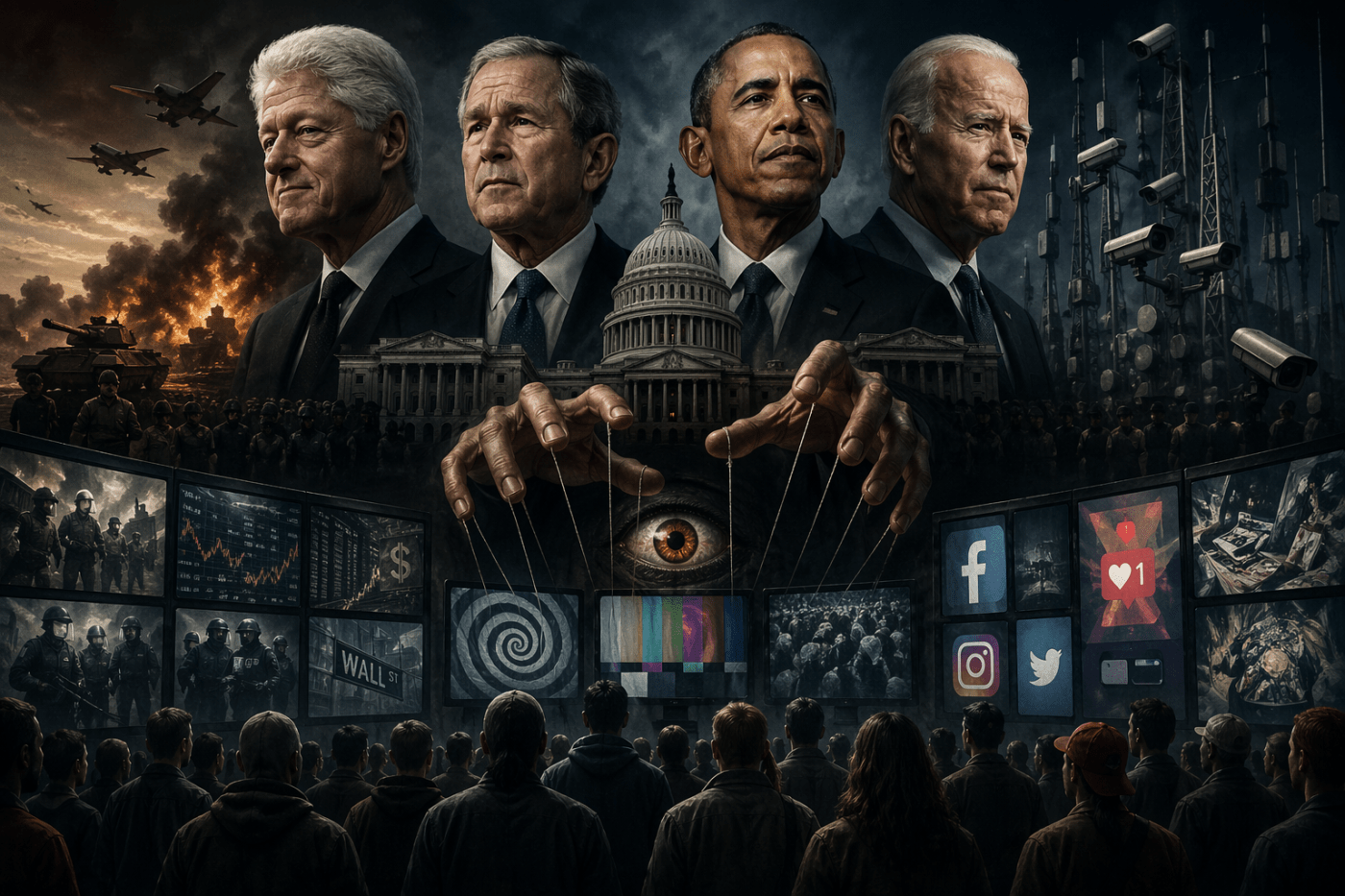
Four former presidents gather under corporate media lights to present democracy as a shared moral inheritance, grounded in unity, civility, and participation. Beneath that performance lies a material history of deregulation, war, surveillance, and repression that produced the very crisis now being discussed. The interview reveals not reflection, but a ruling-class effort to manage legitimacy through nostalgia, abstraction, and selective memory. What is at stake is not the survival of democracy as they describe it, but whether the system they built can continue to command belief.
By Prince Kapone | Weaponized Information | April 22, 2026
The Ex-Presidents’ Choir and the Gospel of Democratic Innocence
“EXCLUSIVE: Clinton, Bush, Obama and Biden Share Message for America250”, aired by NBC News on the Today show and conducted by Jenna Bush Hager, arrives wrapped in the soft lighting of patriotic reassurance. The premise is simple and carefully polished: four former U.S. presidents—Bill Clinton, George W. Bush, Barack Obama, and Joe Biden—gather ahead of the country’s 250th anniversary to offer reflections on service, democracy, national character, and the future. The result is not an interview in the adversarial sense, nor even a genuine inquiry into the causes of the crisis hanging over the country. It is a ritual of elite self-presentation. The former presidents appear not as architects of a troubled order but as elder guardians of the republic, men weathered by history and still tenderly committed to the common good. The segment asks the viewer to look upon them not with suspicion, but with gratitude.
That posture is no accident. NBC packages the piece as part of its “Common Ground Initiative,” a branded exercise in national reconciliation that tells you the political work of the segment before anyone opens their mouth. This is corporate media doing what corporate media does best when the social weather turns rough: converting crisis into mood management. The interview is also tied to a History Channel event produced in partnership with Comcast, NBC’s parent company, which gives the whole affair the scent of institutional pageantry. We are in the presence of concentrated media power talking to concentrated political power about the beauty of democratic continuity, and the scene is presented as though it were simply America talking to itself. But of course it is not America talking to itself. It is one wing of the ruling class interviewing another wing of the same ruling class under the banner of national healing.
Jenna Bush Hager’s role matters here. She is not merely a television host. She is also the daughter of one of the men being interviewed. That fact does not sit awkwardly in the segment; it is one of its emotional assets. The familial intimacy helps dissolve the already weak border between journalism and political kinship. The tone is warm, deferential, affectionate. At no point does the interview threaten to become impolite, and therefore at no point does it threaten to become illuminating. The questions do not probe contradiction; they invite reflection. They do not expose power; they humanize it. The viewer is encouraged to feel they are being welcomed into a room of wise elders, when in fact they are being asked to accept a heavily managed performance of elite legitimacy.
The propaganda devices are not hidden because they do not need to be. The segment leans first on appeal to authority: four former presidents appear on screen, and the office itself is treated as moral evidence. It leans on plain-folks mythology, with the familiar little fables of Scranton and Hope, Arkansas, as if imperial office were simply the next stop after Main Street and not the summit of a class order. It leans on glittering generalities—hope, democracy, freedom, citizenship, unity—those polished abstractions that sound noble precisely because they are spared the burden of material meaning. It leans on narrative framing, arranging the story in a neat arc from sacrifice to service to crisis to resilience, so that the audience receives not a set of facts but a moral journey. It leans on testimonial, with letters, jokes, memories, and little personal gestures—especially that now-famous Altoid anecdote—used to convert the men at the helm of state power into lovable national uncles. And hovering over all of it is omission, the oldest magician in the imperial repertoire. The interview asks the audience to dwell on burdens nobly borne, while vast territories of political life never make it onto the map at all.
That is the real craft of the interview. It does not argue aggressively. It does not foam at the mouth. It smiles. It soothes. It wraps the political class in the language of decency and historical gratitude and invites the public to marvel at the civility of men who, we are told, disagree on much but still believe in the country. The effect is to turn political legitimacy itself into an object of sentiment. The republic is presented less as a structure of power than as a shared inheritance of virtue, and the men who occupied its highest office are cast as living proof that the system, whatever its imperfections, remains sound at the core. In this sense the segment is less a journalistic document than a liturgy of democratic innocence: a corporate-media homily in which empire remembers itself fondly, speaks softly of duty, and asks the congregation to say amen.
The Record They Don’t Speak: Empire, Capital, and the Silences Between Their Words
What the interview refuses to confront directly, the material record makes impossible to ignore. Beneath the soft cadence of reflection and the warm glow of bipartisan nostalgia lies a sequence of decisions, policies, and structures that did not merely accompany the present crisis—they produced it. When Bill Clinton speaks of opportunity and mobility, the historical ledger shows that under his administration the Gramm-Leach-Bliley Act dismantled key pillars of financial regulation, accelerating the fusion of commercial and investment banking and laying groundwork for the financialization that now dominates economic life. At the same time, the celebrated promise of free trade was anchored in agreements like NAFTA, which contributed to the loss of hundreds of thousands of U.S. jobs while intensifying structural imbalances and dislocation. These were not neutral adjustments. They were decisive steps in reorganizing the economy in favor of capital mobility and corporate power.
George W. Bush’s invocation of unity after 9/11 arrives stripped of its consequences. The memory is presented as a moment of collective strength, but the institutional aftermath tells a different story. The post-9/11 order entrenched surveillance as a permanent feature of governance, with research from Brown University’s Costs of War project documenting the expansion and normalization of mass surveillance and technologically enhanced policing systems. At the same time, the wars launched in that period reshaped not only entire regions of the world but the political character of the United States itself. The same project records the long-term human, social, and economic consequences of these wars, while even within establishment circles, the Iraq invasion was recognized as illegal aggression, with U.N. Secretary-General Kofi Annan stating it was in violation of the U.N. Charter. What is remembered as unity was, in material terms, the opening of a permanent war-security regime.
Barack Obama’s language of democratic renewal and constitutional faith similarly floats above a far harsher terrain. His administration presided over a sharp escalation in the state’s relationship to dissent and information. The Committee to Protect Journalists documented how surveillance practices and leak prosecutions created a chilling effect on sources, while legal analysis shows a significant expansion in the use of the Espionage Act against whistleblowers. Abroad, the administration asserted the authority to conduct military operations without prior congressional approval, arguing in its own legal memorandum that it possessed constitutional authority to intervene militarily in Libya without legislative authorization. The gap between democratic rhetoric and executive practice is not incidental—it is structural and by design.
Joe Biden’s call for participation and civic engagement unfolds against a backdrop in which dissent is increasingly policed. As student movements mobilized around Gaza, United Nations experts reported arrests, surveillance, and punitive measures against protesters, while Biden himself emphasized that “order must prevail”. Participation is encouraged, but only within boundaries that do not threaten the underlying structure of power. Outside those limits, the state reveals a different face.
Across all four administrations, the question of who actually governs remains largely untouched in the interview. The formal language of democracy obscures a political system structured by the dominance of wealth. The Brennan Center documents how recent elections have been shaped by unprecedented levels of wealthy-donor and dark-money influence, narrowing the distance between formal representation and oligarchic rule. This is not a matter of perception but of measurable reality: a landmark Princeton–Northwestern study found that economic oligarchs and corporate interests exert decisive influence over U.S. policy, while the preferences of the average citizen have little to no independent effect. Across nearly 1,800 policy outcomes, when the interests of the wealthy diverge from those of the majority, it is the wealthy who consistently prevail. What is presented as democracy in the interview is, in material terms, a system in which policy tracks the priorities of concentrated capital, not popular will—a political order better understood as oligarchic class rule operating behind democratic form.
At the same time, the supposed marketplace of ideas operates within an increasingly concentrated and managed media system. Advocacy groups warn that loosening ownership restrictions deepens corporate control over local media, while consolidation battles like the Nexstar-Tegna dispute highlight the shrinking diversity of news ownership. This concentration now extends far beyond traditional broadcasting into the digital sphere, where a handful of platform monopolies mediate the overwhelming majority of communication. During the post-9/11 period, intensifying through the Obama years, this consolidation advanced alongside the deepening integration of state and technology firms, with revelations showing that major Silicon Valley companies operated within surveillance frameworks such as PRISM, embedding intelligence access into the infrastructure of everyday digital life. At the same time, the broader national security posture normalized mass monitoring, large-scale data capture, and the routine expansion of information control, aligning the interests of state agencies with those of platform monopolies whose business models depend on data extraction and behavioral tracking. The result is not a free marketplace of ideas, but a concentrated and technologically mediated information regime in which corporate power and state security increasingly converge—an environment structurally hostile to independent, non-corporate media and increasingly capable of filtering, shaping, and disciplining public discourse. The freedom being celebrated exists within a system defined not by openness, but by concentration, surveillance, and control.
These omissions are not isolated gaps; they are part of a broader context that gives the interview its real meaning. The United States today is marked by an extreme concentration of wealth, with Federal Reserve data showing the top 1 percent holding a historically high share of total wealth, reaching record levels in 2025. This concentration is not separate from the political system—it shapes it. The same period has seen sustained militarization, with the United States having spent roughly $260 billion annually to counter China militarily since 2012, embedding imperial belligerence into the structure of the economy itself.
Meanwhile, the institutional architecture of surveillance has not receded but hardened. Research shows that mass surveillance remains deeply entrenched decades after 9/11, while oversight bodies confirm the continued centrality of programs such as Section 702 intelligence collection. These are not temporary measures; they are enduring features of governance. At the level of political economy, analysts have connected this landscape to the consolidation of monopoly power, with research linking inequality to concentrated corporate and state power, and further work showing how the digital economy has fused with monopoly-finance capital and the military-industrial system.
Even the cultural and political divisions so often discussed in moral terms reflect deeper structural transformations. Trade agreements, deregulation, and financialization have reshaped the terrain of work and life, producing dislocation and inequality on a scale that cannot be explained by rhetoric alone. The same policies that eliminated jobs and restructured industry also helped generate the social fractures now described as polarization. And behind it all, the costs of imperial policy continue to reverberate. The vast human and economic toll of U.S. wars has not only devastated societies abroad but reinforced secrecy, surveillance, and totalitarian governance at home.
Seen in this light, the interview’s omissions are not accidental oversights. They are the negative space that gives the entire performance its shape. What is left unsaid is precisely what must be understood if the present moment is to be grasped in its full material reality.
When Empire Speaks Softly: The Management of Crisis Through Memory, Civility, and Myth
What looks, at first glance, like a calm and reflective conversation between elder statesmen is something else entirely—a quiet gathering of men who have spent their lives managing the same system, now pausing to recognize one another across time. They do not appear as individuals who simply happened to hold office, but as custodians of a shared project, each responsible for steering the machinery of empire through its different seasons. Their differences in tone—one softer, one sharper, one more polished—belong to the theater of politics. Beneath that surface, the structure remains unchanged. Each played a role in tightening the weave between capital, the state, and the ideological institutions that make domination feel like common sense. What is presented as a moment of democratic reflection is, in truth, a quiet reunion of managers discussing the house they have all helped maintain, even as its foundations begin to crack.
The language they speak is gentle, almost comforting—hope, civility, unity, participation. But this language does not explain the world; it sedates it. It replaces analysis with sentiment, structure with morality. Democracy is treated like an inheritance passed down through good character and shared values, not as a system shaped by wealth, power, and exclusion. In this telling, the crisis we face is not rooted in the concentration of power or the deepening of inequality, but in the decline of manners. People, we are told, have become too angry, too divided, too unwilling to listen. And just like that, the system is absolved. The problem is not what has been built, but how people are behaving inside it.
This is the old trick, dressed up in polite language: separate the appearance of democracy from its material reality. Elections are praised, but the money that structures them disappears. The press is celebrated, but the monopolies that own it remain invisible. Participation is encouraged, but the narrow limits placed on that participation are never questioned. What we are left with is a political façade—clean, familiar, reassuring—while behind it the structure has been remodeled to serve fewer and fewer people. And the audience is asked not to investigate that structure, but to believe in the façade itself, to treat faith as a form of participation.
Even memory is recruited into this psychological operation. Take the invocation of 9/11—a moment recalled as one of unity, shared grief, and national purpose. And yes, that feeling was real for many. But what is carefully removed from the picture is what came after: the expansion of surveillance, the strengthening of executive power, the normalization of endless war. The emotional truth is preserved, while the political consequences are buried. History is not erased—it is arranged. It is curated like a museum exhibit, where the lighting is adjusted so that certain features glow while others fade into shadow.
The same method shapes how the present is explained. What we are living through is framed as a test of character, a moment where citizens must rise to meet the challenge of division and discord. But this framing hides the deeper reality: that today’s instability is not an accident, nor a sudden deviation, but the result of decisions made over decades—policies that concentrated wealth, hollowed out institutions, and expanded coercive power. The very people now reflecting on the crisis helped build the conditions that produced it. Yet in this narrative, they stand not as architects, but as wise observers, watching history unfold as if they were not among its authors.
And so civility becomes the central demand. Speak politely. Disagree respectfully. Lower the temperature. On the surface, this sounds reasonable—who could oppose decency? But beneath it lies a deeper function. By reducing political conflict to a question of tone, the system redirects attention away from material grievances—poverty, insecurity, dispossession—and toward personal behavior. Anger becomes the problem, not the conditions that produce it. The demand is not for justice, but for composure. In this way, civility operates less as a moral principle and more as a method of containment.
The setting itself—the corporate media stage—completes the picture. This is not a neutral space where ideas are exchanged freely. It is a carefully constructed environment designed to present power in its most humane and reassuring form. The lighting is soft, the questions are gentle, the interruptions are absent. There is no real challenge, no rupture, no moment where the narrative is forced to confront its own contradictions. Instead, the viewer is invited into a feeling—a sense that those in charge are thoughtful, reflective, even concerned. The system is not to be examined, but trusted. The medium does not simply carry the message; it shapes it, smooths it, and delivers it in a form that can be easily absorbed.
Seen clearly, the conversation tells us less about the strength of democracy and more about the techniques used to preserve its image. As inequality sharpens, as surveillance expands, as trust erodes, the ideological response is not to confront these realities directly, but to wrap them in stories of unity, continuity, and shared values. These stories do not resolve contradictions—they manage them. They provide a language through which the system can speak about itself without ever having to face what it has become.
What emerges, then, is a form of discourse that feels calm on the surface but is strained underneath. Calm, because it avoids conflict. Strained, because the distance between the story being told and the world as it is continues to grow. The conversation does not bridge that gap—it lives inside it. It is a moment where empire, aware that its narrative no longer fully holds, chooses to lower its voice, to remember selectively, and to ask—once again—not for understanding, but for belief.
From Spectacle to Struggle: Breaking the Spell and Rebuilding Power
If the interview represents the ruling class speaking softly to stabilize its own image, then the task before us is not to answer in the same register. The problem is not that the former presidents failed to say enough. It is that what they said was designed to close off the very questions that must be opened. What is required is not a better conversation within the existing frame, but a break with the frame itself. The spectacle of unity must be met with the organization of struggle.
The first task is clarity. Workers, students, and the colonized inside the United States have to begin naming the system as it actually functions, not as it is described in the language of civility and democratic faith. The concentration of wealth, the dominance of corporate media, the expansion of surveillance, the permanence of war—these are not deviations from an otherwise healthy order. They are the order. Until that recognition becomes widespread, every call for unity will function as a trap, pulling discontent back into a system that reproduces it. Political education must therefore move from abstraction to material analysis, from slogans to structure, from sentiment to strategy.
The second task is organization rooted in real conditions. It is not enough to reject ruling class narratives; they must be replaced with collective forms capable of acting in the world. That means building independent political formations among workers, tenants, students, and the lumpen, formations that are not dependent on corporate funding streams or absorbed into electoral theater. It means strengthening labor organizing where it exists and extending it where it does not. It means constructing networks of mutual aid that are not charity, but infrastructure—ways of meeting immediate needs while building durable relationships of solidarity. Without organization, critique dissipates. With organization, it becomes force.
The third task is reclaiming communication itself. The interview makes clear that corporate media will not expose the system it is embedded within. That work must be carried out elsewhere. Independent media platforms, grassroots journalism, and political education projects must be expanded and linked together, not as isolated voices but as a coordinated counter-apparatus. The goal is not simply to “tell the truth” in the abstract, but to produce analysis that equips people to act—to connect everyday experience to larger structures, to transform confusion into clarity and isolation into collective understanding. The terrain of information is a terrain of struggle, and it must be organized as such.
The fourth task is linking domestic struggle to global realities. The system defended in the interview is not confined within U.S. borders; it is part of a wider imperial order that extracts, disciplines, and dominates across the world. Solidarity with movements resisting that order—from Palestine to Latin America to Africa and Asia—is not a moral add-on. It is a strategic necessity. The same structures that produce inequality and repression at home are sustained by exploitation abroad. To confront one without the other is to fight with one hand tied behind your back. Internationalism must move from rhetoric to practice.
Finally, there is the question of direction. The ruling class offers nostalgia and stability because it cannot offer transformation without undermining itself. But the crises now unfolding—economic, political, ecological—are not temporary disruptions. They are signals that the existing system has reached its limits. The answer to that cannot be a return to an imagined past of bipartisan harmony. It must be the construction of a different future, one grounded in collective ownership, democratic control of resources, and the dismantling of structures built on domination and extraction.
The interview asks the public to believe again. What this moment demands instead is that people begin to see clearly, to organize deliberately, and to act collectively. The spell of civility and nostalgia can be broken, but only if it is replaced with something stronger: a movement rooted in material reality, capable of confronting power, and committed to building a world beyond it.


Leave a Reply