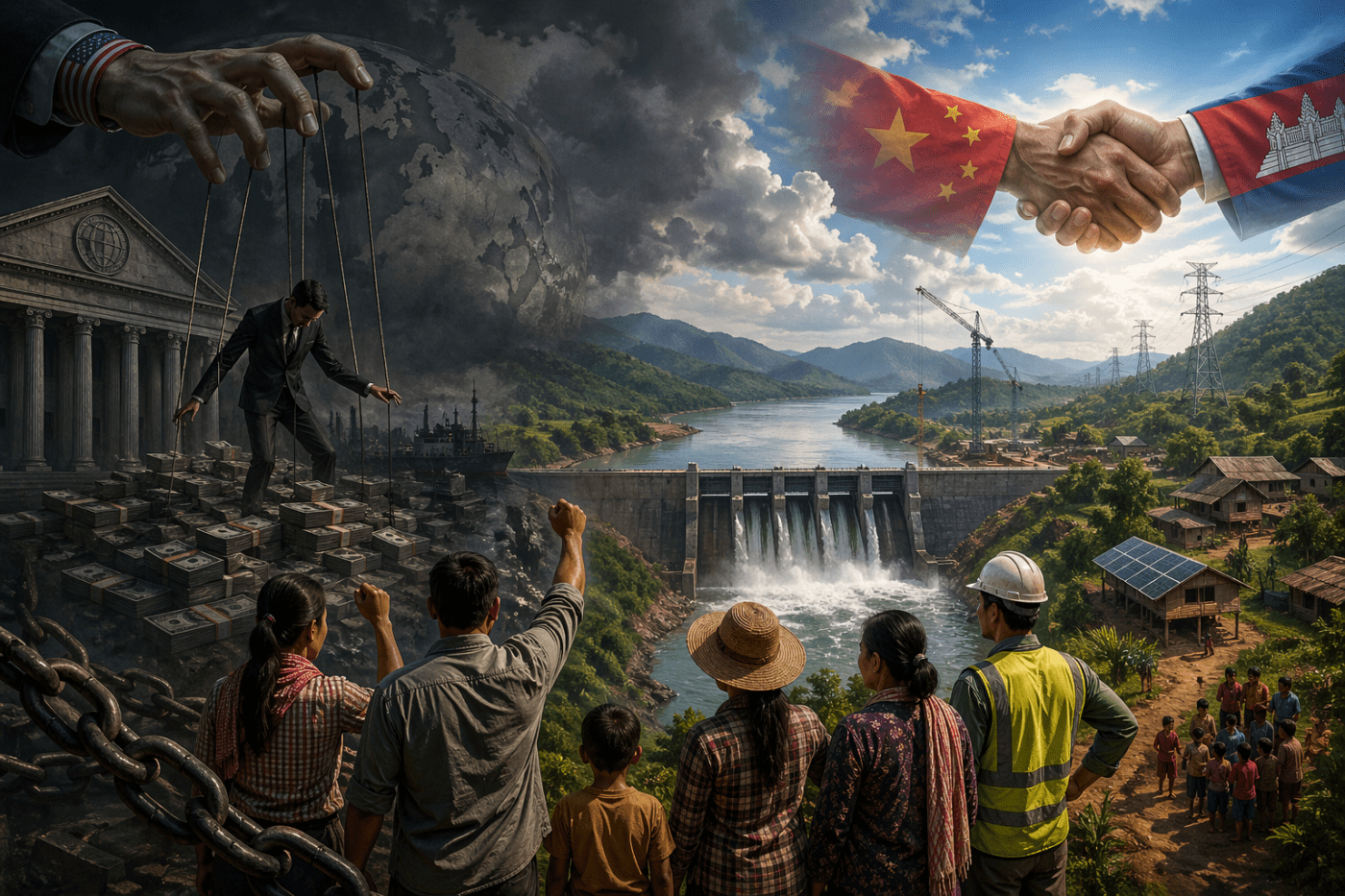
This essay excavates how Western energy media transforms a Cambodian hydropower project into a geopolitical morality play, recoding sovereign development as “Chinese influence.” It reconstructs the material reality beneath that narrative: fuel dependence, state planning, bilateral agreements, regional grid integration, and the political economy of infrastructure. It then reframes the project as a node in the larger struggle between sovereign development and incorporation into an imperial system of accumulation, clarifying the asymmetry between extractive imperial leverage and development that expands national capacity. Finally, it argues that the decisive struggle unfolds where infrastructure meets policy, ecology, and popular forces—determining who controls development and who bears its costs.
By Prince Kapone | Weaponized Information | April 21, 2026
When a Dam Becomes a Geopolitical Allegory
“Cambodia Turns to Hydropower as Fuel Crunch Hits”, published by OilPrice.com on April 20, 2026 and written by Tsvetana Paraskova, arrives wearing the clothes of straightforward market reportage. It tells the reader that Cambodia has broken ground on the Chinese-backed Upper Tatay pumped-storage hydropower project, that the timing is “timely” because of a regional fuel crunch tied to the war around Iran, and that this new installation will help steady Cambodia’s grid while reducing dependence on imported fossil fuels. On the surface, this is a small and efficient piece of energy journalism, the kind of article meant to be read quickly between oil-price updates and shipping anxieties. But beneath that brisk style sits a much older ideological habit: whenever a poor or peripheral country tries to build something substantial with Chinese capital and engineering, the story is quietly reorganized so that local development needs fade into the background while “Chinese influence” strides onto the stage as the true main character.
That class instinct is not accidental. OilPrice.com describes itself as a leading energy news website serving investors, industry professionals, and policymakers, and says its work is widely circulated through major financial outlets. It is owned by Advanced Media Solutions and presents its mission as giving readers actionable insight into the global energy landscape. That is already enough to tell us what sort of world this outlet inhabits. It does not stand on the riverbank with fishers, displaced villagers, line workers, or peasants wondering who will bear the costs of “transition.” It stands inside the information apparatus of the imperial energy order, translating war, infrastructure, scarcity, and state policy into signals for people who move money, manage portfolios, and position themselves within global markets. Even its solemn promise of impartiality carries the familiar tone of empire: the assurance that domination will be narrated calmly, objectively, and for your financial benefit.
The article’s first propaganda device is narrative framing, and it begins almost immediately. China is said to be using the crisis to “boost its footprint” and to “assert influence” across Southeast Asia. Notice what happens there. Cambodia’s demand for electricity, its dependence on imported fuels, the long-term logic of pumped storage, and the developmental urgency of building grid capacity are all subordinated to a geopolitical story about China advancing across the board. In one sentence, a power project becomes a footprint. In the next, an infrastructure build becomes an assertion. This is not innocent phrasing. It is systematic narrative warfare designed to criminalize sovereign development outside Western control. More precisely, it is the ideological expression of a system that treats sovereignty itself as a tradable asset—something to be leveraged, bargained, and positioned within a hierarchy structured by imperial power. What is presented as “realism” is, in fact, the commodification of sovereignty under conditions not of these nations’ choosing. The same imperial system that expanded through military bases, structural adjustment, and debt discipline now recodes non-coercive infrastructure partnerships as encroachment. Concrete is never allowed to be concrete. It must be translated into threat.
The second device is appeal to crisis and urgency. The article leans hard on the “fuel crunch,” the war against Iran, and the claim that Southeast Asia has become the “first victim” of the disruption. This compressed atmosphere does important ideological work. It narrows the reader’s field of vision until the project appears as a reactive maneuver within an unfolding emergency. The effect is to dissolve history—to obscure the longer arc of Cambodia’s energy planning, the structural conditions of its fuel dependence, and the strategic logic behind building storage capacity. Crisis is one of the preferred instruments of imperial information systems because it disciplines perception. Once everything is urgent, nothing needs to be explained. The past disappears, and with it, the material reasons why countries pursue the paths they do.
The third device is source hierarchy. The story is carried almost entirely by approved voices from above: Xinhua, Chinese corporate executives, Cambodia’s energy minister, the Chinese ambassador, and a Cambodia-based analyst cited in support of the project’s benefits. That gives the text an appearance of authority while keeping the conversation tightly fenced. We hear from ministries, ambassadors, corporations, and policy figures; we do not hear from labor, river communities, Indigenous people, displaced families, or those who will live with the consequences of hydropower development. This is not a flaw—it is a function. Imperial-aligned media does not silence reality outright; it curates it, allowing only those voices that reproduce a controlled narrative field. Reality is permitted to speak, but only after passing through institutions aligned with power.
Then comes card stacking and omission, those old workhorses of respectable propaganda. The article assembles favorable indicators with efficiency: electrification gains, renewable growth, tariff stabilization, industrial support, export opportunities for Chinese clean-tech firms. What disappears are the structural contradictions and the material foundations. There is no serious engagement with Cambodia’s underlying energy dependency, no examination of the contractual architecture of the project, no exploration of regional ecological tensions, and no recognition that this development is embedded in a broader reconfiguration of global infrastructure relations. This is not accidental absence. It is ideological filtration. Western corporate media operates by removing material structure and replacing it with intention—substituting systems with motives, contracts with suspicion, and development with geopolitical anxiety. And so the reader is left facing the same familiar portrait: not Cambodia’s struggle for energy sovereignty, but the imperial obsession that any road built outside Western control must lead to a rival power advancing in the dark.
These narratives do not simply describe reality—they actively shape it, influencing investment decisions, policy orientations, and public perception, functioning as operational tools within a global imperialist system that depends on maintaining ideological control over how development outside its structures is understood.
The Grid Beneath the Headline: Reconstructing Cambodia’s Energy Turn in Full
The article gives us a clean narrative—crisis, construction, solution—but the material reality underneath is far denser, structured by contracts, planning documents, regional systems, and historical constraints. At the most immediate level, the core facts are not in dispute. Cambodia has begun construction on the Upper Tatay pumped-storage hydropower project in Koh Kong province, a roughly $1 billion installation expected to come online by 2029. The project is designed as a gigawatt-scale system—around 1,000 MW—using a pumped-storage mechanism that shifts electricity across time by moving water between reservoirs, stabilizing the grid during peak demand. What is presented as a “dam” is in fact a grid technology: a storage infrastructure designed to manage variability in a system that is becoming more electrified and more dependent on intermittent renewable generation.
The article is also correct that Chinese capital and engineering are central to the project. Corporate disclosures make the institutional structure explicit: China National Heavy Machinery Corporation signed implementation, land-lease, and operational agreements with Cambodia’s Ministry of Mines and Energy and the Electricity Authority of Cambodia under a Build-Operate-Transfer model. This is not “influence” in the abstract—it is a legally codified infrastructure arrangement, governed by contracts, timelines, and negotiated control. The language of geopolitics dissolves here into the harder reality of political economy. China’s role in such projects is not accidental, but rooted in its historical trajectory as a post-revolutionary state that has retained centralized planning capacity while developing market mechanisms, allowing it to mobilize capital and infrastructure at a scale unavailable to most post-colonial nations.
The official justification for the project—reducing fuel dependence, improving grid stability, and enabling renewable expansion—also rests on real conditions. Cambodia has undergone a rapid transformation in electrification and generation capacity, and its state planning reflects a clear developmental trajectory. Ministry of Mines and Energy transition documents outline a strategy to reach roughly 70% renewable energy by 2030, while simultaneously expanding storage capacity, grid reliability, industrial efficiency, and cross-border energy integration. This is not a reactive maneuver under crisis conditions. It is a state-directed restructuring of the energy system, unfolding over years through planning, coordination, and institutional execution.
But the article’s framing of a sudden “fuel crunch” obscures the deeper material condition: Cambodia’s structural dependence on imported energy within a global system long shaped by imperial control over fuel flows, refining capacity, and pricing mechanisms. Khmer Times reported that fuel imports exceeded $1 billion in the first quarter of 2026, reflecting a national energy system that relies heavily on external supply chains for refined petroleum products. When disruption hits, the impact is immediate. The state’s response—diversifying fuel import sources and reducing VAT on fuel from 10% to 4%—shows that this is not an abstract vulnerability but a concrete economic pressure shaping policy decisions. Hydropower, in this context, is not opportunistic expansion. It is a strategic attempt to reconfigure dependency under conditions not of Cambodia’s own making.
Seen more broadly, the project is embedded in a formal bilateral framework rather than an improvised response to crisis. Chinese government documentation identifies a memorandum between China’s National Development and Reform Commission and the Council for the Development of Cambodia focused on production capacity and investment cooperation, while the China–Cambodia Joint Communique outlines the “diamond cooperation framework” aligning infrastructure, trade, and industrial development. These are not symbolic gestures. They are institutional mechanisms through which development is coordinated outside the traditional channels of Western financial governance, marking a shift in how infrastructure can be financed and built.
The relationship itself is grounded in material complementarity. Cambodia requires capital, machinery, and infrastructure to expand its productive capacity, while China exports engineering expertise, industrial overcapacity, and development finance without the structural adjustment regimes historically imposed by institutions such as the IMF and World Bank. In this sense, China’s participation functions as a material counterweight to the long-standing dominance of Western-controlled financial institutions, expanding the range of development options available to countries historically constrained by a single model of externally dictated reform. Cambodia–China trade data shows growth in machinery, equipment, and development inputs, reflecting a structural alignment between Cambodia’s development needs and China’s economic capabilities. Chinese reporting further clarifies that the Tatay project is not isolated, but part of a broader integrated wind–solar–hydro–storage energy base, indicating system-level planning rather than piecemeal construction.
At the regional level, the project is inseparable from the wider Mekong and ASEAN energy system. Cambodia’s own planning documents reference cross-border electricity imports and regional grid integration as core elements of its energy strategy, while Chinese policy statements frame the Greater Mekong Subregion as a space for economic complementarity and infrastructure connectivity. The grid, in other words, does not stop at national borders. It is part of a layered regional system in which energy flows, trade, and development are increasingly interconnected.
Yet to understand why such projects emerge with this urgency, we have to widen the frame beyond Cambodia itself and look at the broader structural pressures shaping development choices across the Global South. Bangladesh provides a clear parallel case. The IMF’s combined ECF/EFF program for Bangladesh, totaling over $4 billion alongside additional resilience financing, explicitly ties financial support to policy reform and macroeconomic discipline, demonstrating how access to liquidity is often conditioned on restructuring measures that shape domestic economic policy. At the same time, Bangladesh’s export economy remains heavily concentrated in garments, with national reporting showing the sector dominates export earnings and is deeply dependent on demand from U.S. and European markets, locking development into a narrow external demand structure. This concentration is reinforced by persistent foreign exchange pressures, with Bangladesh Bank managing reserves in the tens of billions while navigating import costs, debt servicing, and currency stability under fluctuating global conditions. Taken together, these dynamics reveal a pattern: development under the imperial financial system is not simply about growth, but about managing dependency within externally imposed constraints.
This broader pattern helps clarify the significance of alternative development pathways. In Pakistan, for instance, official China–Pakistan documentation on the China-Pakistan Economic Corridor highlights cooperation across energy, transport, industry, and financial coordination, including mechanisms aimed at stabilizing economic conditions while expanding productive capacity. Here again, infrastructure is not an isolated project but part of a wider system linking energy generation, logistics, and industrial development. When placed alongside Cambodia’s hydropower expansion, a pattern emerges: Chinese-backed projects are embedded in state-led development frameworks that integrate infrastructure with long-term economic planning rather than subordinating it to short-term financial conditionality.
Yet this same regional system introduces another layer of contradiction that the article leaves unexamined. The Mekong River is not simply an energy resource but a transboundary ecological system. The Mekong River Commission documents how hydropower development affects sediment flows, fisheries, water quality, and downstream livelihoods, while regional assessments estimate billions of dollars in economic activity tied to the river’s ecological balance. Any new project must therefore be understood not as an isolated intervention, but as part of a cumulative process shaping the entire basin.
Finally, the present moment cannot be separated from Cambodia’s longer historical trajectory. Regional institutions note that coordinated Mekong governance emerged after decades of internal conflict and instability, situating current infrastructure development within a broader process of reconstruction and state consolidation. The reliance on external partnerships, the emphasis on infrastructure, and the urgency of energy security all reflect this historical condition: a country rebuilding its material base under the weight of past devastation and ongoing structural constraints.
Put together, these elements reveal a reality far more complex than the article allows. Cambodia’s hydropower turn is not a simple response to crisis, nor merely an instance of external influence. It is a structured effort to resolve energy vulnerability through infrastructure, embedded in bilateral agreements, shaped by regional systems, and conditioned by historical reconstruction within a world still organized by unequal control over energy and development pathways. The dam is only the visible surface. Beneath it lies the grid—economic, political, and ecological—within which both sovereignty and struggle are being forged.
Energy, Sovereignty, and the Dam as a Node in a Constrained World
Cambodia is not waking up one morning and “responding to a crisis” like a man surprised by rain. It has been living inside a structure—tight, unforgiving, and built elsewhere—where energy comes from outside and the bill arrives on time whether the lights stay on or not. When a country has to spend over a billion dollars in a single quarter just to keep fuel flowing, that is not choice. That is discipline imposed by the world market. So when Cambodia turns to something like the Upper Tatay project, we should not speak of ambition with a raised eyebrow, as if the poor have suddenly grown bold. We should recognize what it is: an attempt to loosen the grip of a system that keeps entire nations dependent on what they do not control. The dam is not just concrete and water—it is a move, however constrained, toward breathing space.
But let us not romanticize the matter either. Sovereignty does not arrive here like a flag planted cleanly in the soil. It comes tied up in contracts, stitched together through agreements, negotiated in rooms where engineers, ministers, and financiers speak the hard language of terms and timelines. The Build-Operate-Transfer model is not poetry—it is arithmetic. Who builds, who runs, who collects, and when it changes hands. This is what the newspapers prefer to call “influence,” as if power were a ghost drifting through the jungle. But power here is not a ghost. It is written in clauses, measured in years, and calculated in revenue streams. It is as real as the turbines that will spin and the debts that must be paid.
And this is where the imperial story begins to wobble. Because instead of looking at these structures—these contracts, these plans, these material arrangements—the dominant media prefers to deal in shadows. “Footprints,” they say. “Expansion.” As if history were moved by footprints rather than by steel, labor, and finance. This is not sloppy thinking. It is disciplined misdirection. Western corporate media does not simply misunderstand development; it performs a kind of ideological bookkeeping, removing the ledgers of reality and replacing them with the psychology of suspicion. A power station becomes a plot. A transmission line becomes a strategy. In this way, the world is kept intelligible to those who sit in trading rooms and policy offices, where every road outside their control must lead to a rival.
Now place China inside this picture—not as myth, but as material force. What does China actually do here? It brings capital where capital is scarce. It brings engineering where capacity is limited. It builds within state-to-state frameworks that preserve national development agendas rather than subordinating them to externally imposed restructuring. It does not arrive with a structural adjustment program in one hand and a regime-change manual in the other. That does not make it a savior, and it does not wash away contradiction. But it does change the terrain. It means that a country like Cambodia is no longer forced to walk a single road paved by the IMF and the World Bank, where every loan comes tied to austerity and every reform tightens the noose around the necks of the poor. That is what multipolarity looks like in practice—not speeches, but options, and not merely options, but a restructuring of the global terrain on which development itself becomes possible. Not ideology first, but infrastructure.
Still, we must keep our eyes clear. A new road does not mean the end of struggle; it only changes its direction. The contradictions do not disappear—they line up differently. And they are not all equal. The principal contradiction here is not between small states and large ones, nor between competing powers in the abstract, but between sovereign development and incorporation into an imperial system of accumulation that structures dependency from the outside. That is the principal contradiction, the one that gives shape to all the others. Around it gather the secondary tensions: the river that does not belong to one country alone, the fish that do not recognize borders, the communities whose lives are tied to waters that engineers now seek to discipline. And there is also the question of who speaks and who decides—whether development remains something done over people’s heads or something they can shape with their own hands.
None of this is accidental. It is the inheritance of a world built unevenly, where some countries were allowed to accumulate and others were forced to survive. Cambodia carries the scars of war, destruction, and a long, hard reconstruction. It does not have the luxury of waiting for perfect conditions. It must build with what is available, where it can, and with whom it can. External partnership, in this sense, is not a betrayal of sovereignty. It is one of the few mechanisms through which sovereignty can be assembled, piece by piece, within a system that otherwise restricts its emergence.
So we should stop looking at the dam as if it were just a dam. It is better understood as a junction—a place where different currents meet. Agreements between states, flows of capital, regional energy systems, ecological limits, and the daily needs of ordinary people all collide here. This is what infrastructure really is in our time: not neutral ground, but a battlefield laid out in concrete and water. To call it simply a “project” is like calling a strike a “disagreement.” It misses the point entirely. And not all “leverage” operating on this terrain is the same. Some forms of leverage extract, binding nations tighter into circuits of dependency; others build, creating space—however limited—for development strategies that do not begin and end in external control.
And the ending? There is no neat one. Infrastructure does not come stamped with a political destiny. The same structure can tighten the chains or loosen them, depending on who has their hands on the controls. It can serve accumulation, or it can be bent—through struggle—toward human need. What matters is not just what is built, but who shapes its use, who bears its costs, and who claims its benefits. In that sense, the real question is not whether the dam will stand. It is whether the people who live in its shadow will have the power to decide what it stands for.
From Infrastructure to Struggle: Where the Grid Meets the People
The story does not end at the dam, nor at the contract, nor even at the level of the state. What we are looking at is a process unfolding in real time—one that will be shaped not only by ministries and investors, but by the forces that live within and around the infrastructure itself. The Upper Tatay project is part of a broader restructuring of Cambodia’s energy system, but whether that restructuring serves the people or simply stabilizes accumulation depends on who is able to intervene in its trajectory. Development is never neutral. It is always contested terrain. And today, that terrain stretches far beyond the riverbank—into finance ministries, central banks, export zones, and energy pricing systems where the terms of sovereignty are continuously negotiated under pressure from global markets.
Across the Mekong region, communities, researchers, and regional bodies have already begun to grapple with the cumulative impacts of hydropower. The Mekong River Commission has documented how dam construction alters fisheries, sediment flows, and downstream ecosystems, raising questions not just about individual projects but about the future of the basin as a whole. These are not abstract concerns. They touch the material lives of millions who depend on the river for food, income, and survival. Any serious engagement with development must therefore move beyond the narrow lens of generation capacity and into the broader question of how energy systems interact with ecological systems. The contradiction here is not between development and stagnation, but between different paths of development—one that deepens dependency and one that attempts, however unevenly, to reconfigure it.
At the same time, the expansion of infrastructure opens space for new forms of coordination and struggle. Cambodia’s own development plans emphasize grid expansion, renewable integration, and regional connectivity. But these processes do not unfold in isolation—they intersect with fiscal pressures, energy pricing decisions, and external financial constraints that shape how infrastructure is financed, operated, and paid for. This creates new points of leverage—sites where workers, communities, and social forces can intervene not only at the level of the project, but at the level of policy itself. The question is not whether development will occur, but under what conditions, through which institutions, and for whose benefit.
One example of this dynamic can be seen in the growing role of regional knowledge and advocacy networks engaging with Mekong governance. The Stimson Center’s Mekong Policy Project, alongside regional research institutions and civil society groups, has worked to document hydropower impacts, promote data transparency, and encourage cooperative basin-wide management. While operating within constraints, such initiatives demonstrate that infrastructure is not beyond scrutiny—it can be studied, contested, and shaped through organized intervention. At the same time, they reveal the limits of technocratic engagement alone. Without broader political organization, knowledge risks being absorbed into the same system it seeks to critique.
The task, then, is to move from observation to engagement in a more concrete and disciplined way. This means building forms of participation that operate across the key arenas where this struggle is actually unfolding. First, there must be a demand for full transparency in project agreements, environmental assessments, and operational plans—not as a moral appeal, but as a material requirement for any meaningful public intervention into infrastructure that shapes national development. Second, there must be organized monitoring of ecological and social impacts, drawing on both local knowledge and regional expertise to track how projects affect livelihoods over time and to contest outcomes where necessary. Third, there must be coordination across borders, recognizing that rivers and energy systems do not stop at national boundaries and that effective responses must therefore operate at a regional scale. And fourth, there must be engagement at the level of economic policy itself—where energy pricing, fiscal priorities, and development planning are determined—so that infrastructure is not simply integrated into existing patterns of dependency but directed toward expanding real sovereignty.
In that sense, the real question is not whether the dam will stand, but who will determine the terms under which development proceeds in a world no longer monopolized by imperial power. What is being built here is not only infrastructure, but a shift—partial, contested, and unfinished—in the global balance of who has the capacity to shape the future. Whether that shift deepens into something transformative or hardens into a new form of constraint will depend on the outcome of struggles that are already underway, in places both visible and hidden, wherever the grid meets the people.


Leave a Reply