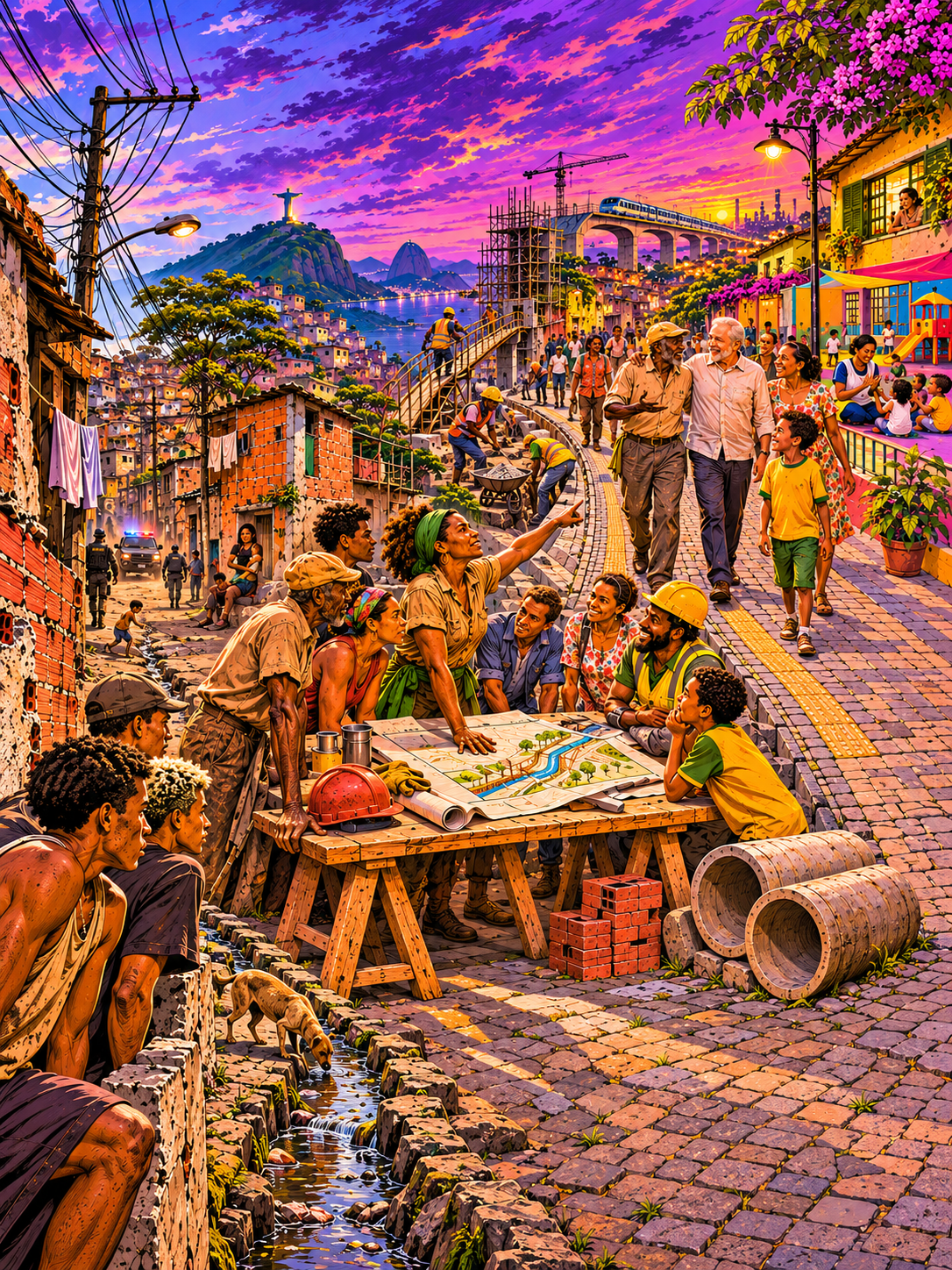
Lula’s reelection kept open a fight over who gets to set the terms in South America. Washington wants a hemisphere it can use as a secure base for U.S. power. Brazil has the factories, public banks and political reach to help its neighbors build an independent pole, and China’s industrial rise gives them more room to choose who they trade with, what they build and how they pay for it. Brazil’s ruling class can see a good deal in all that and still run the factory like its private kingdom. That’s where Brazil’s unfinished revolution comes in. Workers, peasants, Indigenous peoples and quilombola communities have their own fight over who controls the land, the credit and the machinery that’ll build the continent’s future.
Prince Kapone | Weaponized Information | November 3, 2026
I. Brazil Refuses Its Assigned Place
A Brazilian court prosecutes a former president. A Brazilian worker stands to lose a shift. Washington supplied the connection. In July 2025, the White House slapped an additional 40 percent tariff on covered Brazilian goods, listed the prosecution of Jair Bolsonaro among its grievances and reserved the right to change the duties depending on what Brasília did next. An exporter facing higher costs could lean on Brasília for relief or cut shifts and hand the bill to the crew. Washington could set all that in motion with a signature. That’s the U.S. ruling class’s idea of self-government in the Americas. Everybody gets a flag. Uncle Sam still comes around to collect.
On October 25, Brazilians reelected Luiz Inácio Lula da Silva with 51.79 percent of the valid vote, defeating Flávio Bolsonaro. The result kept the Bolsonarist right out of the presidency and returned a government willing to push back against Washington. By election night, a U.S.-backed buyer already held a long-term purchase agreement covering qualifying first-phase output from a rare-earth mine in Goiás, subject to limited exceptions. Lula’s voters settled who’d govern. The buyer could wake up the next morning and call its lawyer about the same damn contract. That deal shows one way U.S. power can reach into Brazil even when Brasília pushes back.
The bigger fight is over what South America can build on its own terms. Washington’s declared pursuit of hemispheric preeminence is the claim behind Fortress America, the project of securing the hemisphere as a base for U.S. power. Brazil has the factories, public banks and political reach to help its neighbors build an independent South American pole. That starts with decisions governments can carry out together. A bridge can get soy to an overseas buyer faster. Give manufacturers on both sides of it access to public credit and dependable orders from their neighbors, and that same bridge can help sustain industries that supply one another. That’s one way to put South American integration to work. Brazil’s neighbors need a real say in what gets built and who benefits. China’s industrial rise gives them more options for markets, machinery and finance. Every option they can put to use makes it harder for Washington to dictate the terms.
The liberals can toast the election and file the tariffs under “trade dispute.” The compradors can wrap themselves in the flag long enough to collect a commission on the next shipment. And some Western Marxists can look at the capitalists on both sides and declare the whole affair a quarrel among bosses. Try telling that to a crew whose plant loses an order because Washington wants Brasília to fold. The ability to find another buyer, finance a plant or get hold of the machinery changes what Brazil can build and what its workers can fight to control. The Brazilian bourgeoisie can use that same freedom to sell more abroad and squeeze the crew at home. A boss can talk a hell of a game about sovereignty until somebody brings it up on the shop floor.
Lula’s record shows how that bargain works. His governments delivered gains worth defending, from higher purchasing power at the minimum wage to electricity in rural communities. They won those gains while bargaining with classes that still own the land, control investment and have the means to roll them back. The right goes into the next legislature with the largest party delegation in the Chamber. Workers, peasants, Indigenous peoples and quilombola communities helped win this election. Now they’ve got demands of their own, and getting those demands met takes organization that can press the government they helped elect.
That’s where Brazil’s unfinished revolution picks up. A government willing to stand up to Washington can give people more room to fight. What gives that fight a socialist direction is what people can make happen with the room they’ve won. Can a crew enforce a shorter week when the boss tries to steal the hours back? Can landless families get land they can live and produce on? Can Indigenous and quilombola communities exercise authority over their territories before a project gets signed off? Can the people whose labor builds an industry have a say in what it makes and who owns it? The answers will help determine what kind of power Brazil brings to South America and who gets to exercise it.
II. What Washington Needed Brazil to Become
On June 4, 2026, the U.S. International Development Finance Corporation disbursed a US$100 million tranche tied to a rare-earth operation in Goiás. The payment satisfied a financing condition for a U.S.-backed buyer to claim all qualifying first-phase output from the Pela Ema project, subject to limited exceptions. By August 21, the parties had met the conditions for the purchase agreement to take effect. On September 3, USA Rare Earth completed its Serra Verde acquisition, the public lender exercised its equity warrants, and the US$100 million tranche was extinguished. The full financing facility had a ceiling of US$565 million. Keep the names straight. One company took ownership of the mine, a public lender exercised an equity right, and a separate buyer got a long-term claim on what came out of the ground.
The owners had good reason to sign. Public money helped finance expansion, guaranteed minimum prices cushioned them against a downturn, and a take-or-pay deal gave them a customer they could count on. The buyer got a claim on material used to make permanent magnets for motors, wind turbines and military equipment. The Brazilian operation already turns ore into mixed rare-earth carbonate, and the agreement lets the seller build separation capacity and deliver higher-value products. There’s money and industrial know-how to be had at every step between a mine and a finished magnet. The purchase agreement update records a claim on production. At closing, deliveries had yet to begin. The paperwork got there first.
It takes a hell of a lot of government to make this free market work. Uncle Sam helps finance the mine and backs the buyer, and the contract puts a floor under the price. Everybody at the signing table gets something they can take to the bank. The people of Minaçu have their own business to settle. Who gets hired, who sets the terms of the work, and how much of the capacity to make a finished product will stay in Brazil? The company gets to call the deal a success while the people who’ll have to live with it are still waiting on answers.
Washington can sweeten the terms when it wants a supplier and jack up the cost when it wants a government to fold. Its 2025 tariff order tied possible changes in duties to Brazilian alignment on matters that included the prosecution of Jair Bolsonaro and judicial actions affecting U.S. tech companies. An exporter facing higher duties has a reason to lean on Brasília for relief. If a boss cuts a shift or puts off an investment, workers can pay for a fight they had no hand in starting. Washington can set that pressure in motion without telling a single boss whose shift to cut. The invoice has acquired a foreign-policy department.
Brazil’s trade ministry broke down two July surcharges in 2026. One hit certain imports with a 25 percent surcharge under a Brazil-specific Section 301 action. The other applied a 12.5 percent surcharge to covered Brazilian goods under a wider investigation. Some goods caught both. The ministry used 2024 export values to estimate exposure, and shipments to the United States had already fallen in the first half of 2026, before either July measure took effect. Crude oil and semi-finished iron and steel accounted for much of that earlier drop. Roll all of that into one big tariff number and you lose sight of which goods got hit, when they got hit, and whose work is on the line.
With Pix, the fight reaches right into the till. Washington argued that Brazilian policies favored Pix over competing U.S. providers. Brasília defended it as open public infrastructure. A Brazilian institution had built a system that lets people and businesses move money without going through any one private payment network. The owner of a payment network understands the problem just fine. A service he figured he could charge for now runs on terms he doesn’t set. When his government brings tariffs into it, a quarrel over who gets a cut at the register can land on the pay stub of somebody who’s never heard of his damn company.
Even while Brasília pushes back, Washington still has people it can call at Brazil’s Defense Ministry. The bilateral defense agreement provides for training, research, logistics and other cooperation. In July 2026, the ministry recorded U.S. interest in closer counternarcotics cooperation and Defense Minister José Mucio’s interest in a partnership. That gives officials on both sides a way to keep doing business through a political fight. To establish operational command, you’d have to show who authorizes missions, directs forces and controls the use of intelligence. At Pela Ema, you can read who gets to buy the qualifying output. In defense, the record shows who’s keeping in touch and what they’re prepared to talk about.
Washington’s strategy calls for restoring U.S. hemispheric preeminence and keeping outside competitors from controlling strategically vital assets. The American Pole is WI’s name for the wider project of consolidating U.S.-led imperial power. Fortress America gives that project a secure base in this hemisphere. Brazil has factories, public banks and political ties that could help South American countries decide together what to build, how to pay for it and how much of the value they produce to keep. China’s industrial strength gives them more room to do it. They could raise the money through their own institutions, spend it on their own factories and still run up against Washington’s claim to call the shots. The empire’s idea of a good neighbor is somebody who asks before putting up a goddamn workshop.
A country trying to build an industry still has to find somebody who’ll sell it equipment, finance a plant and buy what it produces. Some Western Marxists can look at the capitalists lining up to get paid and figure they’ve seen the whole show. Fine. Now try ordering a machine tool from a supplier your creditor can pressure into refusing the sale. The power to choose who you deal with changes what a government can build and what workers can fight to control. Brazil’s owners can use that freedom to get a better price for what they already own. Working people have every reason to defend Brazil’s room to act and fight over what gets done with it.
Flávio Bolsonaro’s defeat shut one route to a presidency more willing to do business on Washington’s terms. Brasília stayed in the hands of a government that’s contested U.S. demands and pursued regional cooperation. The rare-earth deal shows how much Washington can secure all the same. Brazilian officials still decide on licenses, finance and industrial policy. Firms still decide where to put their capital and whose contracts to sign. The voters settled who gets the keys to the presidential palace. Putting that victory to work means taking on people who held the deeds, the contracts and the purse strings long before anybody cast a ballot.
III. The Power the Ballot Didn’t Redistribute
The worker and the landlord each get one vote. Come morning, one of them still owns the land. The banker can turn down a loan, the boss can put off building a plant, and the family without property has to find the rent by Friday. Winning an election changes who runs the ministries and whose demands get a hearing. Then the new government has to build what it promised, and it finds the same people sitting on the land, the factories and the money. Brazil’s history tells us how they got their hands on all that and how working people got organized enough to make them answer for it.
Under Portuguese rule, the Crown handed out land where Indigenous peoples already lived. Sugar estates spread across that territory, and enslaved Africans worked it by force. Planters supplied merchants with sugar and turned the proceeds into political muscle. When Brazil broke with Portugal, the estates and slavery survived the break. The men who got a country of their own already had plenty of property. The people whose labor paid for it still had their freedom to win.
By the middle of the nineteenth century, Brazil’s rulers faced a question that would outlast slavery. How would people get land as the country moved toward formally free labor? The 1850 Land Law generally made purchase the route to acquiring public lands and provided for recognition of certain existing claims. So the question came down to who had the money and whose claim the state would honor. Emancipation ended slavery without a general redistribution of land. A freed person could walk away from a particular boss. With no land to live on, they’d still have to find somebody willing to pay them.
Calling it public land already settled something in the government’s favor. The Crown had treated Indigenous territory as its own to hand out. Later title regimes gave officials and owners fresh ways to decide whose occupation counted. Pull the deed from the file and the whole damn transaction looks peaceful. The people driven off the land are supposed to have the courtesy to stay out of the story.
Industrial growth gave workers a way to hit back. Pack enough people into a factory and they can stop the whole operation together. In the countryside, peasants organized for land while modernization made the big estates more productive. João Goulart’s proposed reforms brought those fights into government. Landowners faced the prospect of agrarian reform, and organized workers could press a reforming government for more than its opponents were willing to give. Business leaders, landowners, governors and parts of the press backed the 1964 coup that overthrew Goulart. Through Operation Brother Sam, Washington prepared logistical help in case the coup met sustained resistance. The generals had friends at home and an empire standing by.
The dictatorship put the state’s guns behind that deal. The generals branded opponents internal enemies and treated fights over wages, land and political rights as threats to security. A boss could command a factory and sleep soundly as a respectable citizen. Let the crew organize over its wages and suddenly the whole damn republic was in danger. Yet the industries the generals wanted to build brought workers together, and their plans to modernize the countryside kept producing fights over who could live and work on the land.
Workers and peasants built organizations that could carry those fights into the democratic opening. The Workers’ Party and CUT grew out of renewed labor struggle. Through occupations and settlements, the MST turned local fights that landowners could more easily crush one by one into a national movement. The 1988 Constitution gave that movement a way to press the state to enforce the social function of rural property. A landless family could make a claim on the government, and organizers could hold the state to an obligation it had put in writing. Then somebody had to get the agency to act and get hold of the land. The owners could still drag the fight through court and lean on their people in Congress.
Under elected governments, a fight over what people are owed can end up in the budget office. Lula’s own administration enacted a fiscal framework that ties growth in covered primary spending to revenue growth and fiscal performance. Its limits and exceptions help determine how much money a ministry can spend turning a promise into a service. That restraint comes from a law passed under an elected government. A boss who puts off an investment gets his leverage from owning the capital. A bloc in Congress can trade its votes for changes in spending or legislation. The president can win an argument in public and still have to settle with three different outfits before anybody gets what was promised.
That’s the Brazil in which Lula’s project took shape. Workers and peasants had built enough power to put their demands before the state and help elect a government that could act on them. The people who controlled land, credit and investment could still make that government bargain. Lulismo grew out of a decision to win gains for the people who brought the Workers’ Party to office while securing cooperation from classes that kept the power to take those gains back.
IV. Lulismo’s Bargain—and the Forces It Preserved
When a family that’s spent years counting coins at the market can finally keep the fridge stocked, that’s a win worth defending. Come Monday, the boss still decides whether the next shift goes ahead, and the bank still wants its installment. The people who made money selling to that family can turn on the government as soon as the worker paying for those groceries gets enough confidence to ask for a bigger share. That’s how lulismo’s bargain could put food on the table and still leave the people who ate well off it in a position to pull the plug.
André Singer’s account helps explain why that bargain won loyalty. In Lula’s first two terms, Bolsa Família put money in poor households, Luz para Todos brought electricity to rural communities, and the minimum wage bought more. Singer links those gains to a shift in Lula’s electoral base as parts of the middle class withdrew their support. There’s room to argue over how much each policy mattered. A family that can finally flip a switch and get light has a reason to stick with the government that no speechwriter could improve on.
Boito Jr. and Berringer follow the money inside the governing alliance. They identify large Brazilian business groups that built up capital of their own and had reasons to fight the advantages international finance and its allies enjoyed in Brazil. These firms could get behind a government that opened markets for Brazilian goods or lent them public money. Workers and peasants came into the broader alliance with demands of their own. The government could deliver real gains to both. A boss who wants workers to spend more in his stores can have a very different opinion about how much say they should get on his shop floor.
In the countryside, Sérgio Sauer’s study argues that deals with agrarian elites helped keep Workers’ Party governments in office while limiting structural land reform. Landless families could organize, press their claims and win a settlement they could live and produce on. The big estates kept the land and political muscle that let their owners steer agricultural policy. One side could bring families together to occupy land. The other could bring money, acreage and votes in Congress. The government called both sides to the table, and the landowner came with half the damn table.
Dilma Rousseff found out how far those arrangements could stretch. A Brazilian study follows construction and auto-parts employers as they went from backing parts of her economic program to backing impeachment. Builders benefited from public housing policy. Auto-parts manufacturers got measures they’d asked for and still struggled to grow. The study traces their turn partly to a sharper fight over wages and labor’s share of income, alongside troubles in the two industries and policies that fell short of what employers expected. That helps explain why those employers turned on Dilma. The wider coalition that removed her had other forces and motives of its own.
Inside a shop, a tight labor market changes what a boss can get away with. The threat of firing carries less weight when there’s a decent chance of finding another job. A crew can push for a raise, fight a speedup or risk a strike it would’ve thought twice about in a slump. Employers could take public support for their businesses and turn on a government under which labor had gained bargaining strength. They liked workers with money in their pockets on Saturday. Come Monday, those same people could tell the boss where to stick his new schedule. The charm wore off quick.
A manufacturer can make goods, hold financial assets and ask Brasília for protection from foreign competition while fighting stronger rights for its own workforce. There’s a reason a factory owner can find common business with a banker. Research on Lula and Faria Lima finds that his third administration defended labor in some fights over who got paid while sustaining policies that let finance draw income from household debt. A raise can put more money in a worker’s hands. By the end of the month, the lender can have a piece of it. The worker really got the raise, and the lender still has a claim on payday.
Judge a reform by what people can do after they’ve won it. Can the crew afford to strike? Can a family grow food on land it’s secured? Can a public bank direct money into something working people need? Those gains are worth defending because they can give people more power in the next fight. Lula’s earlier bargains improved lives and left employers with plenty of say over when the deal was off. His new mandate opens up more choices over credit, technology and trade. Brazil can use the money it lends, the contracts it awards and the markets it opens to demand more in return. Working people need the organized power to decide what that means and make it stick once the people across the table have got what they came for.
V. The International Opening Meets the Domestic Property Question
At Pela Ema, workers pull rare earths out of clay and turn them into mixed rare-earth carbonate. That’s work a Brazilian plant already does. To get a finished magnet, somebody still has to separate the elements, turn them into metals and alloys, and make a magnet to the customer’s specifications. Every step takes machinery, skilled hands and people who know what to do when the machinery quits. Whoever controls one step gets some say over the terms of the next. The deal gives a U.S.-backed buyer a claim on qualifying first-phase output and leaves the seller room to build separation capacity. Brazil has to decide how much of the work it can bring home, who’ll own the plants and whether Brazilian manufacturers can get what those plants make. You can dig up the mineral in your own backyard and still have to call somebody overseas to buy back what it went into.
BNDES and Finep advanced 56 business plans to the next round of their strategic minerals call, ten of them involving rare earths. The plans represented an estimated R$45.8 billion in proposed investment. The call initially offered up to R$5 billion through credit and other financing instruments. One number tells you what the applicants proposed to spend. The other tells you what the public institutions initially put on offer. Anybody who adds them up and declares Brazil a mineral-processing power ought to take us down to the damn plant and show us the crew. The point of the program is that public institutions can finance the work that gets a mineral from the ground into the hands of a Brazilian manufacturer.
What the public gets depends on what it can make the owners agree to. Nova Indústria Brasil gives the government tools that include credit, research support and preferences for domestic production in public purchasing. A public order can give a supplier enough work to buy equipment and train a crew. A public loan can get a plant built when a commercial lender would rather see a profit by next Thursday. Brasília can attach terms covering training, enforceable labor standards and access to the know-how that keeps production running. Somebody has to check the shop floor against the contract and have the power to act when the two tell different stories. Give an owner public money and leave him free to decide what work, knowledge and profit stay in Brazil, and he’ll call it an excellent business climate. From his end of the deal, he’s right.
China’s industrial rise gives Brazil more room to drive a bargain. In the first half of 2026, Brazil sold China US$58.3 billion in goods, against US$17.4 billion in sales to the United States. That’s a market big enough to give Brasília options when Washington leans on it. Ask a worker at a mill that just lost a U.S. order how much of that Chinese demand is coming through the loading dock and you’ll get a more specific answer. Oil, soy, minerals and meat still do much of the work in Brazil’s export trade. The foreign exchange they earn can buy machinery and help build industry. It can also pay for another round of land purchases and bigger shipments of the same goods. The fellow who already owns half the acreage can see the beauty of that second plan without taking his boots off the desk.
At BYD’s Camaçari plant, components that used to arrive assembled started getting welded and assembled locally, with calibration done there too. That brings more work into Brazil and gives the crew experience with processes previously done elsewhere. You can put a Brazilian address on the factory letterhead in an afternoon. Getting local suppliers to make parts to spec and giving Brazilian workers and engineers the means to maintain, adapt and improve the line takes considerably more. So does making the owners answer for the terms of the work. Brazil’s labor prosecutor brought a civil labor case after inspectors documented conditions facing Chinese workers hired through contractors during construction. The parties reached a reported R$40 million agreement and submitted it for court approval. Approval and payment each take their own proof. Labor enforcement belongs on the job from the day the first contractor shows up, when somebody can still do more for the crew than put a price on what happened to them.
The same fight over what Brazil can build runs across its borders. Crews are building the Bioceanic Corridor bridge over the Paraguay River between Carmelo Peralta and Porto Murtinho. Itaipu Binacional is financing it, and Paraguay’s public works ministry is carrying out the project. The road corridor is meant to connect Brazil’s Atlantic ports to Chile’s Pacific terminals through Paraguay and Argentina. Paraguay has its own business in the deal, including what it can build up in transport and logistics in the Chaco. Its institutions are already putting resources to work. Brazil’s separate agreement with Chinese railway planners covers railway feasibility studies that could help develop a link through Peru. A study can get a project moving. A crew putting steel over a river gives you a fair idea of how much farther one of these deals has gone.
Brazil’s regional integration program aims to grow trade within South America and cut the cost of reaching Asian markets. The same bridge can serve both purposes. What matters is what the countries build around it. Exporters can shave time off the run to port. Neighbors can also buy machinery from one another, give regional suppliers dependable orders and decide together where to process what they produce. That takes commitments over who buys what and where the money goes. The people whose land and water are on the line need the power to change a route or contest an industrial license while there’s still a decision to make. A freight company can knock hours off a trip across four countries while the people in all four still wait on somebody elsewhere to decide what’s worth building.
A South American pole starts to take shape when countries can raise the money and carry out those decisions together. Brazil brings factories, public banks and a government that can place orders big enough to keep suppliers in business. China brings productive capacities that give the region more ways to get the job done. That’s the multipolar opening in material terms. Every project South American countries can finance and build on terms they set together narrows Washington’s power to call the shots in the hemisphere. The people making the magnets, living along the corridor and relying on public investment have their own fight over who calls the shots at home. When a contractor breaks a labor agreement, a company takes public money and misses its production commitments, or a community demands that a route be changed, who can make the other side move? You’ll learn more about who got power out of the deal right there than you will from everybody smiling at the signing table.
VI. The People Who Won Must Become a Power That Governs
After the runoff, the Brasil Popular and Povo Sem Medo fronts called a Minas Gerais plenary to decide what to do with the brigades they’d built during the campaign. Those volunteers had knocked on doors, organized block by block and built networks they could still use after election day. The fronts wanted to keep the brigades working in the peripheries and put them behind a fight for reforms. A crew that can turn out the neighborhood to defend a government can turn it out again when that government leaves a promise in a drawer. The campaign office can quit calling. The people who know which street floods every time it rains still have each other’s numbers.
In Rocinha, organizers talked with residents about sanitation, housing, healthcare and what families stood to lose if the right came back. The vote totals in the report come from nearby polling sections. The interviews tell us what people in Rocinha actually organized around. Take sanitation. A promise can become a demand for a project with money behind it, a date for the work to start and somebody who has to explain himself when the crew never shows. The same neighbor who knocked on your door for a vote can knock again to get a delegation down to the agency. Last time they wanted to know when you’d turn out. This time you get to ask when the plumbers will.
João Pedro Stédile has urged Lula to mobilize for reforms and give people more say in government decisions. He recognizes the agrarian victories already won and argues that the countryside is still owed a land reform with a real budget. The MST’s electoral platform puts a seat in parliament to work for the fight outside it. A representative can fight for a budget or lean on an agency to act. The families organized in camps and settlements give that representative something to carry into the building and somebody to answer to on the way out. Lula can open doors inside the government. Keeping them open takes a movement that can pick a fight with whoever tries to shut them, including somebody it helped elect.
The Grupo João Santos deal gives the movement something specific to put on the table. Incra and other federal agencies negotiated an agreement to use the conglomerate’s properties to settle part of its tax debt and make land available for agrarian reform. That gives the state a way to get hold of the land. Families still need legal access, water, housing, credit and technical support to make a living on it. An organized movement can demand a public accounting of which properties have transferred, which families have gained access and which agency owes them the next step. The tax office can tell you down to the cent what the company owed. It ought to be possible to get the same damn precision about when a family gets a tap.
The fight over a mine or a railway starts before anybody puts a shovel in the ground. APIB is demanding protection against violence, progress on Indigenous land demarcation and a say in government decisions. It wants mining kept off Indigenous lands, including when Brasília calls the minerals strategic. CONAQ is pressing for quilombola land titles, protection and effective participation in the decisions that govern community life. These are distinct claims to land and authority. They bear on who gets to draw a route, where a plant can draw its water and which projects get to go ahead at all. Once the money’s committed and the route’s settled, an official can hand you a microphone and call it participation. Try moving the line on his map while there’s still time to move it. That’s when you find out how much say he figured you had.
Brazil’s working-time amendment phases in shorter hours, protects pay and sets out exceptions and rules for the transition. The crew still has to check the schedule against the pay slip, log the time that went unpaid and challenge the boss who tries to pack the old workload into the shorter week. A union can put those cases together and press for an inspection. The same muscle matters on a publicly financed industrial job, where the company can send you to the contractor over your wages and the contractor can send you right back. Enforcement has to reach whoever can change the conditions. A worker needs a fucking rest. The boss can find his productivity miracle somewhere other than the worker’s dinner break.
Hours won back from the boss can disappear into another shift at home. Ipea’s 2022 data analysis puts unpaid domestic and care work at roughly 25 hours a week for women in the poorest fifth, about seven hours more than for women in the richest fifth. The burden also varies by race. A union meeting can be open to every worker and still be out of reach for a woman who’s got nobody to look after her kids or an elderly parent. The National Care Policy gives movements a public commitment they can organize around to win actual services and the money to run them. A childcare spot can give somebody the time to join a fight she’s been carrying on her own for years.
A brigade can get a budget on the books and come back when the money fails to arrive. A union can force an inspection and organize the crew around what it turns up. A territorial movement can make officials reconsider a project before they sign away somebody else’s land and water. Each win can leave people with more time to organize, more people they can count on and more authority over the next decision. That’s how a reform takes on a revolutionary direction. The people who fought for it get something they need now and more power to decide what gets done next.
VII. Defend the Opening, Change the Relations
One of the first things Lula’s government can give a worker who wants to change the country is a few hours to do it. A shorter week at the same pay gives people time with their families, time to make a union meeting, time to knock on doors down the block. Public childcare can free up time for a woman whose second shift starts the minute she gets home. Brasília can put inspectors to work enforcing the new hours and put money for care services in its budget proposals. Unions can get crews together to log the hours the boss tries to steal back, and neighborhood brigades can keep track of which services actually open. The boss who jams six days of work into five will call it a productivity gain. Ask him whose dinner break he found it in.
With time to organize, people have a better shot at making the government move on land. Where federal agencies have agreed to take property against a company’s tax debt, the movement can check which parcels have transferred and which families have gained legal access. Settlers can organize for the water connection they need to grow food and the public contract that gives them somebody to sell it to. The same government that can put a price on every hectare it takes from a debtor can tell a family when they’ll get a damn tap. Indigenous and quilombola peoples have distinct claims to territory and authority. The government has work to do on demarcation, titling and protection. Communities need the power to contest a mine, a processing plant or a transport route while they can still change what happens on their land. Once the ink dries, every official in the building suddenly remembers how binding a contract is.
Take that same fight into the public bank. It can put conditions on a loan, and a government buyer can put requirements in a purchase order. Brazil should use both to build the capacity to separate rare earths and make the metals, alloys and magnets its industries need. A manufacturer asking for support should have to spell out what Brazilian suppliers will be able to make, what workers and engineers will learn and keep, and how a crew can enforce its rights when its paycheck comes from a subcontractor three names down the sheet. Publish the terms and make the next round of support depend on what the company delivers. A firm that needs the public to bankroll its leap into the future can damn well show what the public gets to keep.
At Serra Verde, a buyer and a lender secured their rights before the broader public had its say over the industrial future. Brazil still has decisions to make about financing, purchasing and licensing the work that comes after extraction. Cooperation with China can get Brazil equipment, engineering and training for priorities it sets itself. The test comes when the foreign technicians go home and the line breaks down. Who can get it running? Who knows enough to improve it? The crew has a stake in learning that work because the knowledge can go with them to the next shop. Organized workers can also fight over what the shop makes in the first place.
Brazil can take that strategy across its borders by asking its neighbors what they’d build together and what they’d buy from one another. Itaipu put binational money behind a bridge between Paraguay and Brazil. The industrial question begins where the bridge meets the road. Governments can give regional suppliers a dependable market through joint purchasing, use public credit to build processing capacity across borders and direct transport investment toward the producers and communities it would connect. Paraguay and the other countries involved need a real say in where plants go, who supplies them and how the returns are split. The people living along the route need authority before the bulldozers show up. The freight company’s got a stopwatch. The people along the road have land, water and a living on the line.
That’s how Brazil can help anchor an independent South American pole. Countries that can finance projects together, sell to one another and build more of their own equipment have more room to choose who they deal with. Every decision they can carry out together takes some bite out of Washington’s threat to cut off a market, a loan or a technology. The Brazilian bourgeoisie can see a good thing in that arrangement. A bigger market means more customers, and the boss can go right on running the factory like his private kingdom. A socialist strategy has to put the gains of regional cooperation in the hands of the people whose labor and land make it possible.
The early tests of Lula’s new term will show up on a work schedule, in a land office and on a map somebody has actually had to redraw. Workers should be able to point to hours they got back, families to land they can live and produce on, and communities to projects they had the power to change. Public investment should leave behind plants, skills and know-how Brazil can put to work again. If employers dodge the law, land transfers sit in a file and public money leaves the same owners calling every shot, the old bargain can get right back to business. Where people can force a decision and keep their organizations together after they win it, they’ll have more muscle for the next fight.
Socialists should defend every advance that makes life better and gives people more power to fight for it. Brazil’s voters kept open a political space Washington and the Brazilian right had reasons to close. The unfinished revolution runs through what working people can do with that space, from making the boss honor a shorter week to fighting over who owns the factories and what they’re there to make. An export contract can tell you who gets the shipment. A summit can tell you what the presidents agreed to. A Brazil whose workers and peoples can exercise power at home can bring organized people into the decisions over what South America builds and who gets to live better because it was built.


Leave a Reply