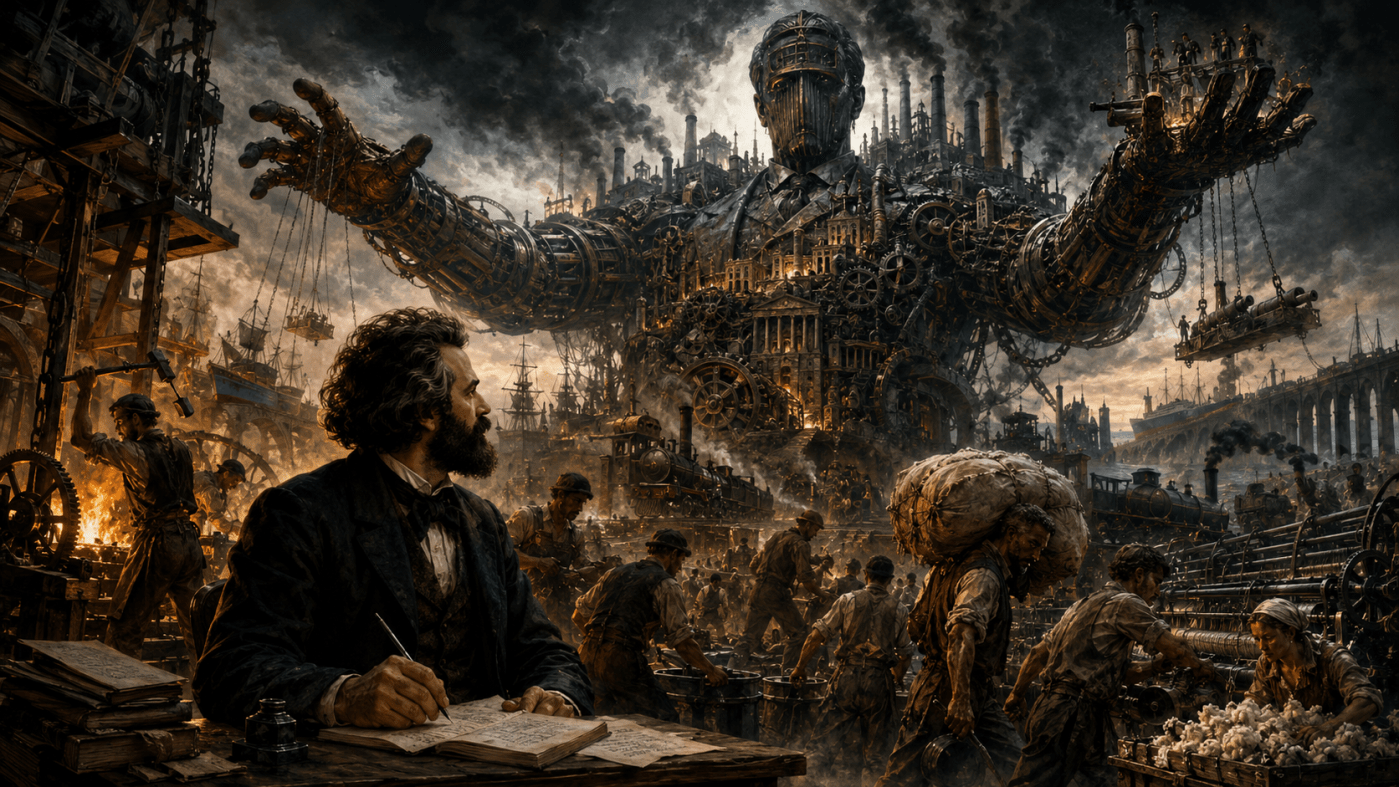
Marx begins with the wage and discovers a deeper inversion: workers create an expanding world of wealth only to confront their own accumulated labour as capital commanding them from the other side. Following that contradiction into estranged labour, private property, colonial history, slavery, law, money and competition reveals what the unfinished manuscripts can see brilliantly—and what their still-philosophical language cannot yet fully explain. Marx then turns the weapon on communism itself, insisting that abolishing the private owner means little if collective productive power continues ruling workers under another name, before forcing his revolutionary humanism through Hegel, Feuerbach and the emerging demands of historical materialism. From the steam-powered factory to algorithmic management and artificial intelligence, the question Marx leaves us still cuts through every celebration of progress: will humanity’s accumulated productive powers belong consciously to the people who created them, or keep returning as machines, markets and institutions that give orders to their makers?
Prince Kapone | Weaponized Information | Weaponized Intellects Book Review | August 29, 2026
The Richer the World, the Poorer the Worker
Marx doesn’t begin the Economic and Philosophic Manuscripts of 1844 (PDF) by asking what capitalism does to the human soul. He begins with wages. More precisely, he begins with a fight. “Wages are determined through the antagonistic struggle between capitalist and worker,” he writes, before adding the conclusion bourgeois economics would rather bury beneath the civilized language of contract: “Victory goes necessarily to the capitalist.” The reason isn’t mysterious. The capitalist can wait longer. He owns property from which income can be drawn, can move capital elsewhere, can combine with other owners, and doesn’t have to sell his capacity to work today in order to eat tonight. The worker does. The wage contract may place two legal persons across the table, but their chairs aren’t bolted to the same material floor. Marx starts from that inequality of survival itself. (“Wages of Labour,” PDF p. 18)
The historical record makes the point sharper without allowing Marx’s compressed language to become scripture. When he says capitalist combination is “customary and effective” while workers’ combination is prohibited, the claim fits the France in which he was writing especially well: the Le Chapelier regime still outlawed workers’ collective organization. Britain had already repealed its blanket Combination Laws in 1824, so the same sentence can’t simply be copied across the Channel as a literal description of British law in 1844. Yet the parliamentary record had openly documented employers combining over wages and working conditions while workers faced prosecution and imprisonment for combinations of their own. The legal forms differed. The material advantage didn’t disappear. Property gave one side room to maneuver that hunger denied the other.
That is why Marx’s next sentence matters more than the melodrama later readers sometimes hang around it. “The worker has become a commodity, and it is a bit of luck for him if he can find a buyer.” (“Wages of Labour,” PDF p. 18) He isn’t saying a wage worker is literally identical to a bale of cotton. He is locating the worker’s continued access to life inside a market relation. Labour must be sold. If demand collapses, the capitalist loses an opportunity for profit; the worker can lose dinner, rent, heat, medicine, eventually life itself. Marx puts the asymmetry with vicious economy a page later: where both worker and capitalist suffer, “the worker suffers in his very existence, the capitalist in the profit on his dead mammon.” (“Wages of Labour,” PDF pp. 19–20) Political economy can record both losses under the same market fluctuation. Marx asks what each loss actually means to the human being living through it.
The industrial world around him supplied plenty of material for the distinction. Britain’s 1833 Factory Act had to prohibit factory labour for children under nine and restrict the hours of older children, while only four inspectors were initially assigned to roughly four thousand mills; Parliament’s own historical account notes widespread evasion of the law. The Factory Act record matters because Marx isn’t inventing a philosophical worker and then assigning misery to him for dramatic effect. He is reading political economy while industrial capitalism is physically reorganizing the day, the family and the human body around production.
But Marx goes somewhere more difficult than “capitalism makes workers poor.” He asks what happens when capitalism succeeds. Suppose social wealth grows. Capital accumulates, production expands, more workers may be demanded, and wages may rise. This ought to be the easy case for the defenders of the system. Marx instead follows prosperity into the workshop. “Capital being accumulated labour,” he writes, advancing wealth means that the worker’s products are taken from him “in ever-increasing degree,” until “his own labour confronts him as another’s property.” (“Wages of Labour,” PDF p. 20) The sentence changes the argument. Poverty is no longer enough to describe the problem. The worker may receive more while the productive world created through labour grows still faster outside the worker’s command.
Read crudely, Marx’s formulation can become a law of ever-deepening absolute misery: capitalism advances, workers must therefore become materially poorer without interruption. The historical evidence won’t carry that weight. Charles Feinstein’s reconstruction instead finds a long period in which industrial output expanded spectacularly while average working-class living standards improved only modestly before stronger gains arrived later. The real-wage evidence narrows the strongest possible reading without touching the deeper contradiction Marx has uncovered. A worker doesn’t have to become poorer every single year for the worker’s own expanding productive power to remain somebody else’s property.
Marx makes that relation explicit when he turns from wages to capital. He quotes Adam Smith describing wealth as giving its owner “a certain command over all the labour, or over all the produce of labour” available in the market. Marx takes the admission and removes the polite wrapping: “Capital is thus the governing power over labour and its products.” (“Profit of Capital,” PDF p. 32) Notice what gives the capitalist this power. Marx says it plainly: not personal genius, not virtue, not some heroic capacity for waking before dawn and checking emails. The capitalist possesses command “inasmuch as he is an owner of capital.” Ownership itself mediates power over living activity.
Then comes the little bomb buried immediately beneath it: “Capital is stored-up labour.” (“Profit of Capital,” PDF pp. 32–33) Put Marx’s two propositions beside each other and the architecture of the problem begins to show. Labour creates. Part of what labour creates accumulates as capital. Capital belongs to an owner. That accumulated labour then gives its owner command over living labour. The worker is helping build a house whose title belongs elsewhere, then returning the next morning to ask permission to enter it for another shift.
The landlord gives Marx another angle on the same inversion. “Landlords’ right has its origin in robbery,” he writes, borrowing Say’s formulation, before quoting Smith on owners collecting rent even from unimproved land and from powers of nature they never produced. (“Rent of Land,” PDF p. 48) Marx’s point isn’t that every receipt of rent can be explained by one original criminal deed. It is that political economy repeatedly treats ownership as though title itself were a productive contribution. Labour improves the land; nature supplies fertility; population and roads increase its usefulness; yet the owner can appropriate the resulting increase because the earth has already been divided into property. Wealth grows socially while the legal claim on that wealth remains private.
Marx has therefore reached something more dangerous than an indictment of nineteenth-century misery. The worker can suffer when the economy contracts. The worker can work harder when it expands. Productivity can rise. Machinery can multiply output. Capital can accumulate. Society can become richer. None of that, by itself, answers who commands the richer world. Political economy can measure wages, profits and rents, describe competition, praise accumulation and count the swelling pile of commodities. What it still hasn’t explained is the fact Marx keeps finding inside its own categories: human labour builds up outside the worker, and that accumulated world acquires the power to give orders back. A balance sheet can record the movement. It can’t yet tell us why the worker’s own productive activity returns wearing somebody else’s name and authority.
When the Product Stands Up and Gives Orders
Marx has reached the point where counting wages, profits and rents won’t carry him any farther. Political economy can describe the worker’s dependence with impressive precision and then shrug at the relation producing it. It can tell us what wages do, how capital accumulates, how competition moves prices and why property earns income. What it can’t explain is why the worker’s own productive activity keeps building a power that stands above the worker. Marx therefore changes the level of the investigation. “We proceed from an actual economic fact,” he writes. (“Estranged Labour,” PDF p. 63) He isn’t abandoning economics for philosophy. He’s forcing political economy to explain the fact its own categories have already exposed.
The fact is immediately concrete. “The worker becomes all the poorer the more wealth he produces, the more his production increases in power and range.” Marx sharpens it further: “The worker becomes an ever cheaper commodity the more commodities he creates.” (PDF p. 63) Read crudely, this can sound like another prediction that every increase in output must reduce the worker’s paycheck. But Marx’s argument is already moving beyond income. The worker produces a growing “world of things,” and that world rises in power while the worker’s own command over it falls. Something has happened between producing an object and possessing the social power embodied in that object. That is what Marx is trying to name.
The translation itself helps keep the distinction sharp. Martin Milligan renders Entfremdung as “estrangement,” while reserving “alienation” mainly for Entäusserung, which carries the stronger sense of something being externalized, transferred or passing into another’s hands. (Translator’s Note, PDF pp. 11–13) Marx often works the two motions together, but they aren’t empty synonyms. Estrangement describes the worker’s separation from activity, product and human powers; alienation can carry the additional material sense of those powers becoming external and standing over the worker.
Marx begins with objectification because production necessarily means putting human activity into something outside the producer. A carpenter turns effort and skill into a table. A machinist leaves knowledge and labour embodied in a part. Generations of workers leave accumulated capacities in machines, buildings, roads, tools and productive systems. Marx calls this “the objectification of labour.” (PDF p. 64) There is nothing inherently pathological about that. Human beings can’t live without acting upon an objective world. We become powerful precisely because thought, skill and cooperation don’t have to remain trapped inside individual bodies. We put them into things.
Under the relations Marx is examining, however, “this realisation of labour appears as loss of reality for the workers; objectification as loss of the object and object-bondage; appropriation as estrangement, as alienation.” (PDF p. 64) The object doesn’t merely leave the worker’s hands because production has created something separate from its maker. It enters a property relation in which the producer no longer commands what has been produced. The worker’s activity has acquired objective existence, but somebody else controls that existence. Objectification has been turned against the person doing the objectifying.
That distinction is the heart of Marx’s breakthrough. If objectification itself were alienation, liberation would require human beings to stop producing an objective world—to stop making tools, buildings, art, machines, institutions, anything that survives the moment of activity that created it. Marx says nothing so absurd. His problem is that “the life which he has conferred on the object confronts him as something hostile and alien.” (PDF p. 64) The hostility doesn’t come from the object having material existence. It comes from the social relation governing that existence. The worker puts life into the product; the product then belongs to a world of property and power separated from the worker. Dead labour doesn’t merely sit there. Under definite social relations, it learns to command the living.
Marx then turns from the finished product to the act of producing it. This move matters because otherwise estrangement could be mistaken for something happening only after work is done, when the product leaves the worker’s hands. Marx asks how the product could confront the worker as alien if the activity creating it weren’t already organized as alien activity. “If then the product of labour is alienation,” he writes, “production itself must be active alienation.” (PDF p. 66) The problem has entered the working day itself.
Here Marx’s language becomes painfully concrete. Labour is “external to the worker”; the worker “does not affirm himself but denies himself”; work “does not develop freely his physical and mental energy but mortifies his body and ruins his mind.” Then comes the decisive formulation: “His labour is therefore not voluntary, but coerced; it is forced labour.” (PDF p. 66) Marx obviously knows the wage worker isn’t legally identical to a slave. His point is that the freedom of the employment contract tells us little about the worker’s relation to activity once access to the means of life depends upon selling that activity. The compulsion is material. Labour becomes “merely a means to satisfy needs external to it.” Work becomes what must be endured so life can be sustained.
That is why Marx says the worker feels at home only when not working and “when he is working he is not at home.” (PDF p. 66) The line isn’t a complaint that every job ought to feel personally fulfilling. Marx has already located the problem deeper than mood. The worker’s living activity is organized as activity for another, under conditions the worker doesn’t command, in order to gain access to necessities outside the labour process. What should be an exercise of human productive power appears instead as a means of reproducing the worker’s dependence upon the very relation commanding that power.
Marx next expands the argument beyond the immediate labour process without abandoning production. Human beings differ from other animals, he argues, because they can make their own life-activity into an object of consciousness and will. They can produce beyond immediate biological necessity, plan, imagine, cooperate, build for people they’ll never meet, reshape environments and accumulate knowledge across generations. Marx calls this capacity our “species-being.” Whatever problems remain in that language, the argument here is concrete enough: human productive life can become conscious, universal activity rather than an immediate reflex of hunger.
Estranged labour reverses that possibility. “Life itself appears only as a means to life.” (PDF p. 68) Productive activity—the capacity through which human beings can consciously reshape their world—becomes primarily the instrument through which the individual secures food, shelter and continued bodily existence. Marx isn’t condemning the need to eat. He explicitly says eating, drinking and reproduction are genuinely human activities. The inversion occurs when maintaining physical existence becomes the overriding purpose for which broader human capacities must be sold. Productive life, which could enlarge human freedom, becomes the price paid for remaining alive.
Once Marx has moved from the object to the activity and from the activity to human social capacity, the argument can no longer stop with an isolated worker confronting an isolated product. “An immediate consequence” is “the estrangement of man from man.” (PDF p. 70) This is where the manuscript becomes difficult to reduce to a philosophy of personal fulfillment. Estrangement takes social form. The worker’s loss appears on the other side as somebody else’s possession.
Marx drives straight at the question. If the product doesn’t belong to the worker, “to whom, then, does it belong?” If the worker’s activity is not his own, whose activity has it effectively become? He briefly tests the old answers. The gods? Nature? Some independent force standing above humanity? No. “The alien being, to whom labour and the produce of labour belongs, in whose service labour is done and for whose benefit the produce of labour is provided, can only be man himself.” Then he strips away the last theological veil: “Not the gods, not nature, but only man himself can be this alien power over man.” (PDF p. 71)
There is the knife. Marx has taken a category inherited from philosophical and religious criticism and forced it through the factory gate. The worker’s powers haven’t floated away into metaphysical nowhere. They have entered a practical relation. If the worker’s product confronts him as an independent power, someone is master of that object. If his activity occurs under alien direction, someone benefits from that activity. If production enlarges a world from which the producer is separated, that separation is organized between human beings. Estrangement is becoming class relation before Marx yet possesses the later language with which he will dissect that relation more precisely.
The worker therefore does something more terrible than manufacture commodities for another person. Marx says that through estranged labour the worker “engenders the relationship” in which another person stands to the worker’s production and product. (PDF pp. 71–72) In producing under these conditions, workers continually reproduce the social position of those who command production. Their activity creates the object, the wealth and the relation through which the non-worker exercises power over them. Living labour creates the conditions under which accumulated labour returns with greater authority over the living.
That brings Marx to a conclusion powerful enough to create a new problem. He declares private property “the product, the result, the necessary consequence of alienated labour.” (PDF p. 72) The claim turns political economy upside down. Instead of accepting private property as the natural beginning from which wages, capital and exchange follow, Marx tries to derive property from the worker’s estranged productive relation itself. But the moment he does so, the question returns with greater force. If alienated labour produces the property relation that confronts labour, then what produced alienated labour in the first place? Marx has found the social relation hidden inside the economic fact. He has not yet found its history.
Marx Finds the Question Before He Finds the History
Marx has pushed the argument to the point where his own method turns around and demands an answer from him. “Private property is thus the product, the result, the necessary consequence, of alienated labour,” he declares after showing how the worker’s activity produces the power of the non-worker over production. Then, almost immediately, he complicates the formula: private property first appears as the cause of alienated labour, reveals itself through analysis as its consequence, and “later this relationship becomes reciprocal.” (“Estranged Labour,” PDF p. 72) Marx has discovered a real circle, but he hasn’t yet separated the different motions inside it.
Once capitalist production exists, the reciprocity makes brutal sense. Workers enter production because the conditions of production belong elsewhere. Their labour produces commodities and wealth that likewise belong elsewhere. Part of that wealth accumulates and strengthens the property power confronting them. They return to work under conditions their own previous labour has helped reproduce. Estranged labour reproduces private property; private property reproduces estranged labour. Marx has captured the circuit. What he hasn’t yet captured is its beginning.
He knows it. That’s what makes the manuscript far more interesting than the tidy philosophical systems later built around it. Having treated estrangement as a fact, Marx suddenly asks: “How, we now ask, does man come to alienate, to estrange, his labour? How is this estrangement rooted in the nature of human development?” (“Estranged Labour,” PDF p. 74) The question is exactly right. But transforming the origin of private property into the problem of alienated labour doesn’t yet give us the history that made labour take this form. Marx has replaced political economy’s unexplained property relation with a deeper question. He hasn’t yet dug out the foundation beneath the factory floor.
That foundation wasn’t laid in one stroke. The familiar shorthand says enclosure created the English proletariat: peasants had land, landlords fenced it off, peasants became wage workers. There’s truth inside that story, but history refuses to march so obediently. Some rural labourers were already heavily dependent on wages before particular parliamentary enclosures; others lost common rights that materially supplemented household survival. The crucial movement was the expanding separation of working families from independent access to the means by which they could reproduce life. Jane Humphries’s work on common rights makes the household dimension impossible to ignore: grazing, gleaning, fuel and other customary resources often mattered especially to women and children. Their erosion didn’t simply dispossess an abstract male “worker.” It made entire families more dependent on wages.
That matters for Marx because the worker entering his argument is already reproduced somewhere. Somebody feeds children before they become labourers. Somebody obtains fuel, cooks, washes, repairs, cares, stretches wages through periods without work and keeps bodies alive long enough to sell labour again. Capital doesn’t create the worker fresh at the factory gate every morning. The 1844 manuscript sees that wages must maintain the worker and family, but it hasn’t yet reconstructed the relations through which a labouring population is actually reproduced. Once those relations enter the picture, proletarianization stops looking like a single theft of land and becomes a longer process through which fallback after fallback is stripped away, monetized or subordinated to the wage.
Organized political power entered that process too. England’s Poor Law system didn’t sit outside a supposedly pure labour market dispensing charity after economics had finished its work. Parliamentary history records that parish relief could supplement the incomes of workers whose wages couldn’t sustain their families, while employers could benefit from precisely that arrangement. The Poor Law therefore entered the material reproduction of wage labour. Courts and local authorities likewise helped discipline labour through master-servant law and coercive apprenticeship. The state wasn’t merely standing beside an already completed private wage relation. Law and administration helped constitute and enforce the conditions under which labour entered the market as supposedly free exchange.
This gives Marx’s fragment on the worker as “living capital” a harder historical meaning. He writes that the worker has the misfortune of being “a capital with needs”—one whose livelihood disappears whenever capital has no use for it. “The worker exists as a worker only when he exists for himself as capital,” because outside that relation political economy no longer recognizes him as economically meaningful. (“Antithesis of Capital and Labour,” PDF p. 76) That insight is sharp. But the historical worker who arrives in that condition had to be made increasingly dependent upon it through property, law, household reproduction, markets and institutions. Hunger may compel labour immediately; history produced the social arrangements that made hunger answerable to the wage.
And even that history is too small if it stops at England.
The industrial capitalism Marx was studying in the 1840s already stretched across labour regimes that looked nothing alike. British cotton mills processed enormous quantities of slave-grown cotton from the United States. In an 1846 parliamentary debate, only two years after Marx wrote these manuscripts, British politicians openly discussed the country’s extraordinary dependence on American cotton. The Manchester wage worker and the enslaved Black cotton worker weren’t living under the same property relation. One sold labour capacity because access to the means of life had been separated from him; the other was legally owned. Collapsing them into one category would turn historical materialism into mush. But separating them into unrelated worlds would be just as false. Their labour met inside the same commodity circuit.
This changes the scale of Marx’s question. If human labour becomes alien power over human beings, the concrete capitalist world already contained multiple ways of organizing that power. The British wage relation didn’t first complete itself nationally and then wander abroad looking for colonies as a hobby. Cotton bound industrial wage labour to racial slavery through production, commerce and finance. Capital could articulate different regimes of coercion without converting all of them into wage labour. Universality therefore can’t mean that every exploited person is secretly the same worker. It has to explain how historically different forms of domination become connected without erasing what makes them different.
India sharpens the problem further. British manufactures didn’t simply defeat some timelessly backward handicraft economy through the innocent majesty of superior machinery. Indian cotton textiles had been internationally competitive. Under Company rule, political power increasingly entered the commercial relation itself. South Indian weavers experienced falling earnings and tighter constraints on their bargaining position; they answered with stoppages large enough to disrupt Company procurement. In 1778 more than a thousand Cuddalore weavers sustained a months-long stoppage, one episode in a wider history of weaver resistance. The Company responded not merely as a trader confronting troublesome suppliers but as a colonial authority capable of reshaping the conditions under which labour and exchange operated.
That resistance matters because domination never reproduces itself frictionlessly. Working people interfere with it. They flee, strike, combine, withhold labour, defend customary rights and force rulers and owners to devise new means of command. Marx’s 1844 cycle—worker produces capital, capital reproduces worker—therefore becomes too smooth if treated as a complete history. Between one turn of the wheel and the next lie struggle, law, coercion, concession, defeat and institutional change.
Company rule also reveals another path by which property became social power. After acquiring revenue authority in Bengal, the East India Company could use Indian tax revenues to purchase Indian goods and support wider imperial-commercial circuits. The exact aggregate scale of the colonial drain remains disputed, but the fiscal mechanism is clearer: conquest produced revenue command; revenue command increased commercial power; commercial power fed a wider imperial economy. Here the force shaping economic relations exceeds the individual capitalist with money in his pocket. Political command enters the organization of accumulation itself.
None of this means “colonialism caused capitalism” can replace “enclosure caused capitalism” as our new magic spell. British industrialization also developed through technical innovation, coal, agricultural transformation, finance, expanding markets, changing labour organization and domestic accumulation. Indian textile decline likewise had causes beyond British coercion alone. Materialism means reconstructing the combination, not choosing whichever single cause shouts our politics the loudest.
What the wider history does establish is more useful. Marx’s reciprocal relation between alienated labour and private property is strongest when read as an account of how capitalist domination reproduces itself once producers and productive conditions have already been separated. Workers create property that confronts them; property compels them back into labour; the relation renews itself. Its historical genesis, however, requires precisely the concrete inquiry Marx demanded from political economy and hadn’t yet completed in 1844: land and law, households and subsistence, slavery and colonial conquest, markets and states, resistance and defeat.
Marx therefore hasn’t failed because he found the wrong question. He has reached the point where his answer needs a larger history than the manuscript yet possesses. And once that history enters the analysis, private property begins to look less like a relation between one owner and one worker than a whole social machinery linking millions of people who may never see one another. Capital no longer needs a single landlord, mill owner or merchant visibly standing over every act of production. The relations they helped create can begin imposing their own discipline through competition, markets and money. Alien power is becoming impersonal.
Capital Learns to Rule Without a Face
The capitalist first entered Marx’s argument as a person who owned what the worker needed in order to work. But Marx is already moving beyond the picture of one boss standing over one worker. In Private Property and Labour, he turns to the history of political economy itself and finds a transformation in what economists think wealth actually is. Mercantilism located wealth in money and precious metal. The physiocrats moved its productive source toward land and agricultural labour. Adam Smith makes the decisive break by recognizing labour in general as the “subjective essence” of wealth. Marx, following Engels, calls Smith “the Luther of Political Economy.” The comparison isn’t praise. Luther brought religion inside the believer; Smith brings wealth inside human activity. But Marx sees the catch immediately: “Under the semblance of recognising man,” political economy incorporates man himself into private property. (“Private Property and Labour,” PDF p. 84)
Political economy has discovered something true and immediately turned the discovery against the person who made it possible. Wealth doesn’t reproduce itself by magic. Labour matters. Yet once labour becomes the recognized essence of wealth, human activity itself enters the economic machinery as something to be organized, divided, priced and accumulated. Political economy no longer has to imagine wealth sitting outside humanity in a chest of gold or an aristocratic estate. It can find wealth wherever productive activity can be subordinated to accumulation. Marx therefore describes the factory system as industry brought to maturity and “industrial capital” as “the accomplished objective form of private property.” Only at that point, he argues, can private property become “in its most general form a world-historical power.” (“Private Property and Labour,” PDF p. 87)
The domination already established between owner and worker now changes shape. The capitalist still gives orders, hires, fires and owns. But capital’s movement can no longer be explained by the private appetites of one proprietor. The individual capitalist can be ruined, bought out, replaced or absorbed into another organization without abolishing the relation. Marx sees part of this in competition. Bourgeois political economy presents competition as the cure for monopoly: multiply owners, make them compete, and concentrated power supposedly dissolves. Marx instead argues that “multilateral accumulation necessarily turns into unilateral accumulation” and that competition clears the way toward concentration. (“Profit of Capital,” PDF pp. 37–38)
His 1844 formulation runs too quickly from competitive pressure to capital concentrated “in the hands of a few.” British industrial development didn’t simply swallow every small producer into a handful of giant firms. Small workshops, family enterprises and specialized producers remained important enough for historians to describe much of the Industrial Revolution as a small-firm phenomenon. But that complication doesn’t dispose of Marx’s insight. It forces us to locate concentration more precisely.
Railways show why. Their construction demanded sums few individual owners could supply, so capital from thousands of shareholders could be pooled into corporations commanding enormous productive systems. By the late 1840s, railway securities had become a dominant part of Britain’s quoted market, while major railway companies could contain thousands of nominal owners. The railway evidence exposes a distinction Marx’s early argument only begins to reach: ownership claims can spread across many hands while effective command over production becomes concentrated in organizations no individual worker controls.
Counting capitalists can therefore conceal the growth of capital. Ten thousand shareholders don’t make a railway ten thousand democratic workshops. The capital is social in its formation—pooled from many sources, mobilizing vast technical systems, dependent upon collective labour—while the productive apparatus confronts workers through a concentrated hierarchy of command. Capital begins to look less like the personal treasure of one proprietor and more like a social machinery whose motion exceeds any single hand on the lever.
Marx approaches the same problem from another direction through division of labour and exchange. Political economy celebrates them because they demonstrate the enormous productive power created through specialization. No individual produces everything needed for life. Human capacities become useful to one another through an increasingly intricate social division of activity. Yet Marx catches political economy praising precisely the relation it can’t reconcile with its own doctrine of private interest. Division of labour and exchange are the phenomena through which the economist “boasts of the social character of his science” while simultaneously describing “the establishment of society through unsocial, particular interests.” (“The Meaning of Human Requirements…Division of Labour,” PDF p. 117)
That sentence reaches the heart of capitalist sociality. Production becomes profoundly social. The miner depends on the machinist, the machinist on transport, transport on fuel, factories on agriculture, and every industry on accumulated knowledge and labour produced far beyond its walls. Yet the people caught inside this interdependence don’t necessarily command it together. Separate property holders pursue separate interests and encounter their dependence upon one another through markets, prices, shortages, bankruptcies, gluts and competition. Society has become more interconnected than ever, but the social relation confronts its members as something they have to obey rather than something they consciously govern.
Marx doesn’t attack division of labour because cooperation is somehow corrupt. His whole argument depends upon the productive power of social activity. The contradiction lies in the form that cooperation takes. Political economy itself admits that division can reduce individual labour to mechanical motion while increasing production on an enormous scale. Marx condenses the tendency into the paired notes: “Splitting up of labour and concentration of capital; the nothingness of individual production and the production of wealth in large quantities.” (PDF p. 117) Collective productive power expands while the producer’s command over the collective process contracts.
Money gives this alien sociality an everyday body. Marx calls money “the pimp between man’s need and the object, between his life and his means of life.” (“The Power of Money in Bourgeois Society,” PDF p. 119) The vulgar reading hears a moral complaint about greed. Marx is describing mediation. Food can exist while the hungry person goes without it. Housing can exist while somebody sleeps outside. Skills, transport, medicine and labour can all exist socially while remaining inaccessible to the person who lacks the monetary claim needed to command them. Social availability and human need no longer meet directly. Money stands between them.
That is why Marx’s harder formulation matters: money is “the alienated ability of mankind.” (PDF p. 122) Money doesn’t know how to grow wheat, build a house, drive a locomotive, perform surgery or compose music. Yet whoever possesses enough of it can command access to those socially existing capacities. Another person may possess real ability, creativity or need and remain socially powerless because those human qualities don’t carry purchasing power. Society’s accumulated capacities appear to individuals through a mediator whose effectiveness depends precisely upon those capacities being separated from direct human command.
Capital, competition, division of labour and money thus carry the contradiction beyond the immediate encounter between employer and worker. No secret committee has to plan the whole system. Capitalists pursue profit because capital that repeatedly fails to reproduce itself ceases functioning as capital. Workers seek wages because commodities stand between them and the means of life. Firms compete because production is privately separated even while becoming socially interdependent. Money mediates that separation. Each actor makes choices, struggles and calculates, yet their combined activity produces necessities that return to discipline them.
Marx’s critique has therefore moved beyond blaming greedy owners. Replace a vicious capitalist with a generous one and the wage relation remains. Replace an executive board and competitive pressures remain. Scatter shares across thousands of investors and concentrated productive command can remain. Alien power has escaped the personality of the proprietor and entered the organization of social production itself. Once Marx gets this far, abolishing the private owner can no longer be the entire communist answer. A society could change the name on the deed while leaving its producers subordinate to their own collective productive power. The question has become harder: not simply who owns the world, but whether the people who produce it have ceased being ruled by it.
If Everybody Is a Worker, Nothing Has Been Liberated
Once capital has become more than the personal power of one proprietor, the communist problem gets harder. If social domination can persist through the organization of labour, competition, money and accumulated productive power, then removing the individual capitalist can’t by itself settle the relation. Marx turns the critique inward. Communism itself has to prove that it has abolished more than the owner.
He begins with a communism that recognizes private property as the enemy but still thinks through the logic of possession. Marx calls it “universal private property.” Its instinct is straightforward: what only a few possess should become available to everybody. Yet the old relation survives beneath the new distribution. “The category of labourer is not done away with, but extended to all men.” (“Private Property and Communism,” PDF p. 88) Everybody has entered the workers’ column. That sounds egalitarian until we remember what Marx has already established about labour under these conditions: productive activity remains an external necessity organized by a social power standing over the producer.
Marx makes the implication explicit. Crude communism becomes “a community of labour,” paying equal wages out of “communal capital”—“the community as the universal capitalist.” (PDF p. 89) The private boss has disappeared, but labour still confronts everybody as the same compulsory condition, capital still stands above labour as the universal social power, and wages still mediate the worker’s relation to production. Equality inside that arrangement doesn’t overcome alienation. It distributes the subordinate position more evenly. A prison hasn’t become freedom because every cell is finally the same size.
Marx is fighting this battle inside the communist and socialist movement, not lecturing it from liberal safety. In his 1843 letter to Ruge, written just before the Paris manuscripts, he criticizes ready-made communist systems associated with currents around Cabet, Dézamy and Weitling. By 1844 the argument has become more material. A movement can negate bourgeois ownership while carrying bourgeois property’s conception of human life into the new society.
Marx sees the problem most brutally in crude communism’s obsession with possession. It treats the wealth monopolized by private owners as something whose emancipation consists in everybody possessing it directly. He pushes that logic into the “community of women,” where woman passes from being imagined as the exclusive possession of one man to “a piece of communal and common property.” Marx calls this the secret of “crude and thoughtless communism.” (PDF pp. 88–90) He isn’t proposing communal sexual possession. He is showing how little has changed when a human being moves from private property to collective property while remaining property.
The point reaches far beyond the ugliness of Marx’s nineteenth-century language. Abolishing exclusive possession means little if the person, activity or object being liberated is still understood primarily through possession. Communism therefore has to do more than divide the existing world differently. It has to transform the social relation through which human beings confront the world they have made.
This is what Marx means by “communism as the positive transcendence of private property.” He describes it as “the real appropriation of the human essence by and for man,” a conscious return of human beings to themselves as social beings “accomplished within the entire wealth of previous development.” (PDF p. 90) The language still carries the philosophical problems the manuscript hasn’t resolved. But the political distinction is concrete. Communism isn’t a retreat from developed productive powers, science, culture and accumulated social knowledge into some sanctified poverty where nobody owns much because nobody has much. Humanity has produced those capacities. The question is how they are socially appropriated.
Marx sharpens the point when he says the positive supersession of private property can’t be conceived “merely in the sense of direct, one-sided gratification—merely in the sense of possessing, of having.” (PDF pp. 93–94) Private property, he writes, has made human beings “so stupid and one-sided” that an object appears truly ours only when we own it, consume it, inhabit it or otherwise hold it as possession. The measure of wealth has narrowed into having. Marx wants to recover a wider field of human relation: creating, understanding, enjoying, developing, sharing and consciously participating in powers that don’t become meaningful only when fenced into private possession.
That wider appropriation doesn’t require dissolving the individual into an abstract collective. Marx warns directly against “re-establishing ‘Society’ as an abstraction vis-à-vis the individual.” His answer is compact: “The individual is the social being.” (PDF p. 92) Language, knowledge, productive skill, culture and even the needs through which individuality develops have social histories. Society isn’t the thing waiting outside the individual with a club. It is part of the material through which individuality becomes possible in the first place.
This gives Marx a different measure of wealth. In place of political economy’s wealth and poverty comes “the rich human being and rich human need.” The rich human being, he writes, needs “a totality of human life-activities.” (PDF p. 98) Capital measures wealth through accumulation. Marx measures it through developed human powers. Can people create, study, care, think, build, participate, love and cultivate capacities that a life organized around necessity leaves stunted? A society can overflow with commodities and remain miserably poor in this sense if most people possess little command over the time and social conditions required to develop themselves.
That is why Marx’s insistence that “communism as such is not the goal of human development” matters so much. (PDF p. 100) He isn’t retreating from communism. He is refusing to turn it into another power standing above humanity. Communism is necessary as the negation of private property and estranged social power, but the negation isn’t the final human purpose. Marx even calls it a necessary phase toward further “human emancipation and recovery.” The revolution exists for human development; human beings don’t exist to serve an abstraction called Communism.
The political problem survives Marx’s later change of vocabulary. In the Critique of the Gotha Programme, common ownership remains connected to cooperative regulation of social labour rather than treated as a magic legal title. That continuity doesn’t authorize us to pronounce judgment on historical socialist formations from the ownership column of a balance sheet. Their actual relations of property, planning, class power, state authority and producer participation would have to be investigated concretely. Marx’s 1844 warning gives us a question, not a shortcut.
And the question now turns back upon Marx. He has moved from abolishing private ownership toward a society in which human capacities become ends rather than fuel for accumulation. He calls this genuinely human appropriation. But the moment he invokes “human essence,” social being and the recovery of humanity’s powers, the economic critique opens into the philosophical inheritance he has been carrying all along. If communism is supposed to restore human life to itself, Marx still has to tell us what this “human” is—and whether he has discovered it in history or brought it with him from philosophy.
The Humanism Marx Has to Break Open
Marx has now made a claim stronger than abolishing private property: communism must make human productive powers genuinely human again. That immediately puts pressure on the word human. Marx knows where much of his language comes from. In the Preface he credits Feuerbach with beginning “positive, humanistic and naturalistic criticism” and calls his work the only writing since Hegel’s Phenomenology and Logic to contain “a real theoretical revolution.” Yet Marx refuses to solve the problem by simply declaring Hegel dead and marching on. He insists that a “settling of accounts with Hegelian dialectic and Hegelian philosophy as a whole” remains necessary. (Preface, PDF pp. 15–17) Marx is trying to escape idealism without throwing away the weapon Hegel forged inside it.
And he gives Hegel his due with a generosity that disappears whenever this intellectual history gets flattened into “idealism bad, materialism good.” The “outstanding thing” in Hegel’s Phenomenology, Marx writes, is “the dialectic of negativity as the moving and generating principle.” More importantly, Hegel understands “the self-genesis of man as a process,” grasps objectification, alienation and their transcendence, and thereby “grasps the essence of labour.” (“Critique of the Hegelian Dialectic,” PDF pp. 131–132) Hegel’s breakthrough is movement. Human beings aren’t finished objects supplied by nature with a permanent inventory of capacities. They make themselves through activity, contradiction, creation and confrontation with an objective world they have helped produce. History enters the definition of humanity itself.
That is precisely what Marx can’t surrender to Feuerbach’s simpler reversal of philosophy. Feuerbach brings thought back toward sensuous human beings, bodily need, nature and relations among people. His critique of religion gives Marx a powerful model: human beings place their own powers outside themselves and then kneel before those powers as though they had descended from heaven. The approved Feuerbach text likewise centers sensuous existence, community and human relation. Marx clearly inherits this terrain. But the economic investigation has already transformed the problem. The alien power Marx found doesn’t live only in heaven. It holds property, buys labour and commands production.
So Marx turns Hegel against Hegel. Hegel understands that humanity develops through labour, but Marx says he sees “only the positive, not the negative side of labour.” Then comes the cut: “The only labour which Hegel knows and recognises is abstractly mental labour.” (PDF p. 132) Hegel had in fact discussed material labour, including the servant’s activity upon the objective world. Marx’s charge therefore makes sense at the level of Hegel’s system rather than as a literal claim that Hegel never noticed physical work. Material objectification ultimately returns as a moment in the development of consciousness and Spirit. The real historical process finds its philosophical truth elsewhere.
That is where Marx refuses the reconciliation. In Hegel, he argues, “the object is only objectified self-consciousness.” Once self-consciousness becomes the true subject, objectivity itself begins to appear as estrangement. Overcoming alienation then means, ultimately, recovering the object within consciousness. (PDF pp. 132–133) But Marx’s economic investigation has led in the opposite direction. The worker’s product isn’t oppressive because it exists outside the worker. The problem is that a real product, made through real labour in a material world, enters a social relation in which someone else commands it. Philosophy can’t abolish that domination by discovering that consciousness was secretly at home in the object all along.
Marx therefore plants his feet deliberately on the ground. He writes of “real, corporeal man, man with his feet firmly on the solid ground, man exhaling and inhaling all the forces of nature.” Such a being acts objectively because he is himself an objective being, dependent upon a world that doesn’t originate in thought. (PDF p. 135) This changes what emancipation can mean. Human beings need things outside themselves. We need food, water, shelter, other people, tools, land, language and accumulated knowledge. Freedom can’t mean escaping dependence upon the objective world. A creature requiring nothing outside itself wouldn’t be liberated. It wouldn’t exist.
“Man is directly a natural being,” Marx continues. Humanity possesses powers and capacities, but humans are also “suffering, conditioned and limited” creatures dependent upon objects beyond themselves. Hunger proves the point better than metaphysics ever could: hunger requires food that exists independently of the hungry person. (PDF p. 136) Marx’s humanism therefore doesn’t begin with a ghostly soul floating above nature. Humanity is bodily, needy and finite. Human power develops through nature and through objective activity within it.
Yet the strength of that materialism exposes the pressure inside Marx’s own vocabulary. He still speaks repeatedly of “species-being,” “human essence,” humanity’s return to itself and the overcoming of the contradiction between essence and existence. Those categories aren’t empty decoration. They let Marx say capitalism does more than distribute wealth badly: it mutilates capacities human beings could develop under different social relations. But they also risk making history answer to a standard of “Man” whose own historical formation remains insufficiently explained.
The strongest defense of Marx against that criticism lies inside the manuscript itself. His species-being is already less abstract than the caricature suggests. When discussing social existence, Marx says even apparently solitary intellectual activity relies upon socially produced material and “even the language in which the thinker is active.” (“Private Property and Communism,” PDF p. 92) Human capacities don’t emerge from an isolated inner essence. Language, knowledge, needs and means of activity develop through relations with other people. “Human essence” is already being pulled toward practical social life.
But that movement isn’t complete. Louis Althusser’s epistemological-break argument bites precisely here. Althusser places the decisive rupture around the Theses on Feuerbach and The German Ideology, arguing that the 1844 Marx still explains history through Man, essence and alienation rather than through the historically specific relations later historical materialism constructs. The criticism has real force. These manuscripts can describe estranged labour more powerfully than they can explain the historical production of the propertyless worker. They can announce universal human emancipation more readily than they can integrate the differentiated wage, colonial, enslaved and reproductive relations already constituting the capitalist world.
But Althusser’s guillotine cuts too cleanly. The same Marx speaking of species-being has already made another human being the bearer of alien power. He has made ownership the basis of command, followed wages into material dependence and accumulated labour into capital, and demanded that private property itself be explained rather than accepted as an eternal fact. His critique of Hegel now insists that real estrangement can’t be dissolved inside consciousness. These aren’t mature categories from Capital. But neither do they belong to an untouched Feuerbachian anthropology. The material discoveries are pushing against the conceptual language through which Marx first names them.
The road out of 1844 therefore runs through both continuity and rupture. Marx doesn’t wake up one morning, throw humanity in the trash and suddenly become scientific. Nor is the mature critique of capitalism already sitting fully formed in Paris under a few outdated philosophical nouns. Marx has discovered relations—worker and owner, labour and property, social production and private power—that his inherited conception of human essence can expose as alien without yet fully historicizing their formation. The concept has begun to crack under the weight of the reality it uncovered.
That crack opens Marx’s revolutionary humanism rather than simply destroying it. If humanity is produced through practical social life, emancipation can’t mean restoring some pristine human nature buried beneath capitalism. It has to mean transforming the historical relations through which human beings make themselves and one another. The human question survives, but now it has to pass through history. And once it does, freedom acquires a concrete measure: whether humanity’s accumulated productive powers remain forces standing over living people, or become capacities consciously organized by the people whose collective labour created them.
The Powers of Humanity Must Belong to Humanity
Near the end of the manuscripts, Marx offers a deceptively simple thought experiment: “Assume man to be man and his relationship to the world to be a human one: then you can exchange love only for love, trust for trust, etc.” (“The Power of Money in Bourgeois Society,” PDF p. 124) After everything Marx has dragged into view, the line no longer reads like sentimental humanism. He is imagining relations in which a person’s effective social powers arise from developed human capacities and reciprocal human activity rather than from possession of an external power capable of purchasing their substitutes.
The worker we met at the beginning of these manuscripts can now be understood more concretely. The problem was never exhausted by poverty. Human beings build an objective world because that is how human power develops: in tools, knowledge, institutions, machines, culture and cooperative capacities that no isolated individual could produce alone. The capitalist inversion occurs when those social powers become separated from their producers and return through property, markets and organized command as necessities the producers have to obey. Marx’s human question survives because the alien world isn’t supernatural. It consists of human powers taking a social form that places them beyond conscious human command.
That is also why the answer can’t be a retreat from development. Marx isn’t dreaming of smashing machinery, abolishing large-scale production or restoring some imaginary innocence before humanity learned to transform nature. The powers accumulated through social production are themselves part of humanity’s achievement. The revolutionary question is who commands them, how they are organized and whether their development enlarges the lives of the people whose collective activity made them possible.
Generative AI makes a useful contemporary stress test precisely because it ruins the cheap prophecy that every new machine simply eliminates workers. The ILO’s 2026 review finds measurable time savings and productivity effects in some forms of work while emphasizing uneven outcomes and limited evidence of broad employment displacement. That evidence doesn’t tell us what saved labour-time must become. It establishes something more useful: technical capacity and social outcome aren’t the same thing.
A system capable of saving an hour of labour contains no built-in instruction saying who receives that hour. Under one set of relations it could contribute to shorter working time. Under another it can raise output expectations, reduce staffing or enlarge the surplus controlled elsewhere. Those possibilities have to be fought over through property, workplace power and collective organization. The machine creates a capacity. Society decides—through relations of power often hidden behind the language of efficiency—whose capacity it becomes.
The same contradiction appears in algorithmic management. Human beings collectively produce technical knowledge capable of coordinating complicated labour processes. Employers can embody that knowledge in systems that assign tasks, track activity, supervise performance and evaluate workers. Social intelligence returns to the individual labourer as an instruction issued by machinery owned and governed elsewhere. Marx couldn’t have imagined the software. What matters is that he had already discovered the relation through which human capacities can become organized as alien command.
Nothing in that relation makes technology itself the enemy. Technical systems acquire their social character through the property and power relations governing their use. The same productive capacity can expand freedom where workers gain greater command over time and production, or deepen subordination where productivity remains somebody else’s power. This is the contemporary force of Marx’s distinction between objectification and estrangement: humanity needs an objective world of accumulated powers. Liberation concerns the social relation through which we inhabit it.
That gives Marx’s communist argument its hardest standard. Common ownership matters because private property separates producers from social power, but ownership has to become an actual capacity to govern collective productive life. The associated producers have to become increasingly capable of deciding what society develops, how its productive powers are used, what burdens are necessary, how social wealth is distributed and how much of human life must remain sacrificed to compulsory labour. Otherwise humanity can continue standing beneath powers produced in its own name.
This is where the revolutionary humanism of 1844 survives the conceptual limits of 1844. Marx’s language of species-being still needs harder historical bones. The propertyless worker has a history the manuscripts haven’t yet reconstructed; the capitalist world surrounding him already contains colonial conquest, slavery, household reproduction, state coercion and differentiated relations of labour that “Man” alone can’t explain. Historical materialism has to transform the human question by putting those concrete relations inside it. But the transformation doesn’t make emancipation disappear. It makes emancipation answerable to history.
And that is why these unfinished notebooks remain revolutionary rather than merely youthful. Marx has discovered that the world standing over the worker is not supernatural. It was made. Capital, machines, markets and social institutions contain human activity congealed into objective forms. If human beings made those powers historically, they can reorganize them historically. The world we build doesn’t have to stand against us. The powers of humanity can belong to humanity—not as a legal fiction, not as a patriotic abstraction, and not as a bureaucratic slogan, but as the conscious social power of people who finally cease producing their own masters.


Leave a Reply