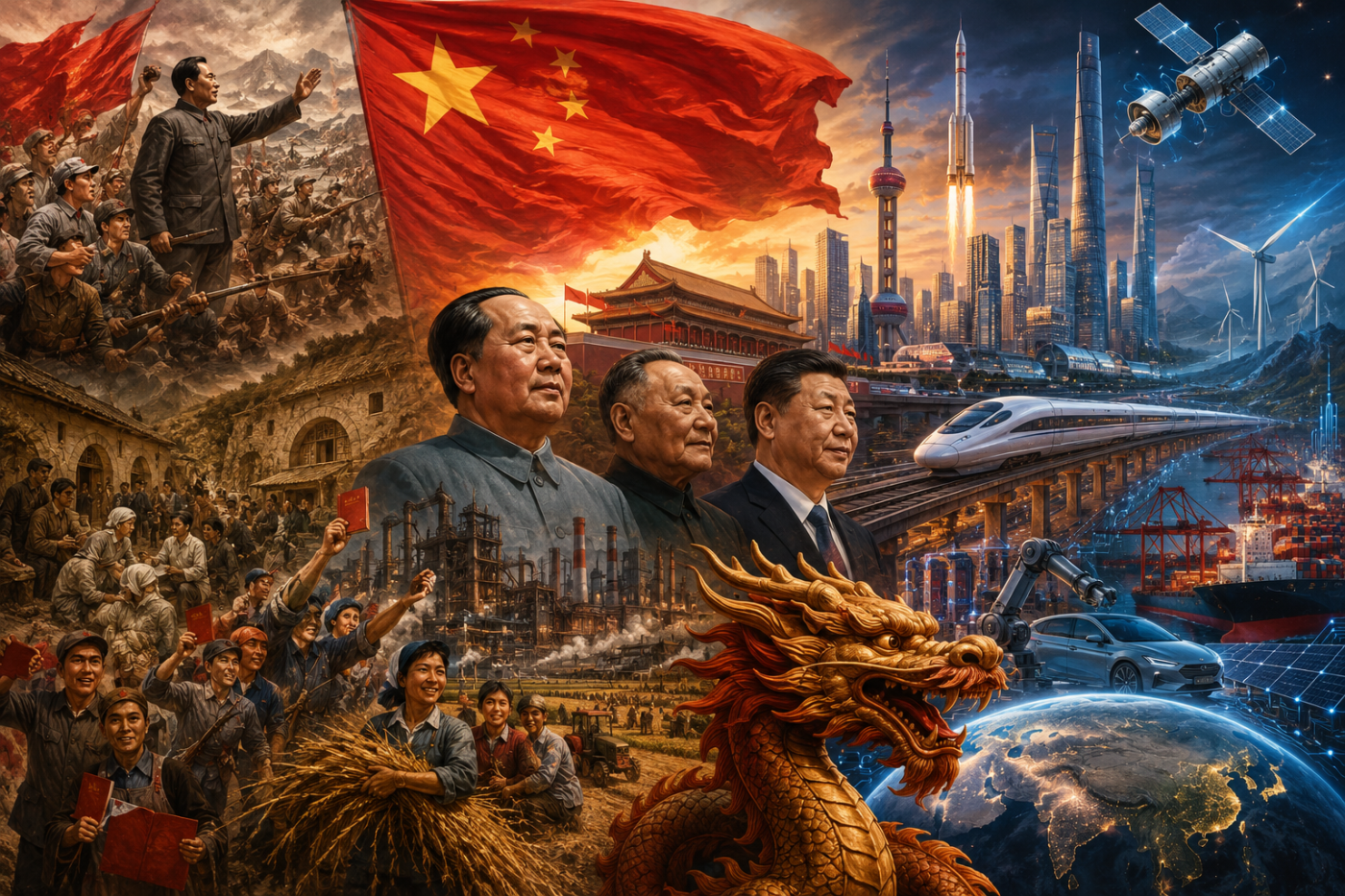
China’s revolutionary path shattered the Cold War myth that socialist states were merely Soviet puppets mechanically following orders from Moscow. From peasant revolution and protracted people’s war to collectivization, the Cultural Revolution, Reform and Opening Up, and the rise of a socialist-market economy, China repeatedly transformed socialism according to its own historical contradictions and material conditions. The Chinese experience reveals socialism not as a rigid institutional template, but as a living historical process shaped by uneven development, anti-imperialist struggle, class conflict, and the continuous attempt to preserve sovereignty while developing productive forces. In the process, China emerged from semi-colonial devastation to become one of the most powerful industrial and technological societies on earth without dissolving Communist Party rule or surrendering fully to neoliberal capitalism.
By Prince Kapone | Weaponized Information | May 8, 2026
The Lie of the Puppet String
One of the oldest and most persistent anti-socialist myths claims that every communist revolution of the twentieth century was merely a puppet regime directed from Moscow. According to this story, the peoples of China, Vietnam, Korea, Cuba, and the wider colonized world were not historical actors struggling through their own contradictions, but passive instruments manipulated by Soviet power. The Chinese Revolution, in this telling, was not truly Chinese at all. It was supposedly a foreign political implant stitched artificially onto Chinese society by Marxist ideologues taking orders from abroad.
This narrative survives not because it explains history well, but because it performs an ideological function for empire. If socialist revolutions can be dismissed as foreign conspiracies, then the material conditions that produced them never need to be confronted. Landlordism disappears. Colonial humiliation disappears. Imperialist domination disappears. Famine, debt peonage, warlord violence, comprador corruption, and foreign occupation all fade quietly into the background. The oppressed cease to appear as people responding rationally to unbearable historical conditions and instead become gullible masses manipulated by outside agitators. The colonial mentality has always struggled to imagine that the colonized can think politically for themselves.
By the time Chinese revolutionaries began searching for a way out of national humiliation, China had already been carved open by a treaty-port order born from the Opium Wars. The Treaty of Nanking opened five ports and ceded Hong Kong to Britain, inaugurating a treaty-port system that expanded from five ports to ninety-two by 1917. Foreign concessions, extraterritorial privileges, foreign banks, missionary networks, consular authority, and colonial commercial enclaves penetrated deeply into Chinese society under the unequal treaties imposed by Britain, France, the United States, Japan, and other imperial powers. By the end of the nineteenth century, roughly 925 to 933 foreign-owned firms operated inside China, heavily concentrated in treaty-port regions tied to foreign capital and maritime trade. In 1949, after a century of imperial pressure, approximately 80 percent of China’s population remained illiterate, while life expectancy hovered around thirty-five to forty years. These were not abstract “backward conditions.” They were the social wreckage of semi-colonial capitalism.
China exposes the bankruptcy of the puppet myth more thoroughly than perhaps any other revolutionary experience of the twentieth century. The Chinese Revolution unfolded not as a carbon copy of the Soviet path, but as a century-long struggle to preserve sovereignty, overcome underdevelopment, and reorganize social life under conditions shaped by imperial domination and uneven development. From peasant revolution and anti-imperialist war to collectivization, industrialization, the Cultural Revolution, Reform and Opening Up, and the contemporary struggle for technological sovereignty, each phase of modern Chinese socialism emerged as an attempt to navigate changing historical contradictions rather than preserve rigid institutional purity.
This immediately distinguishes the Chinese experience from the caricature presented by Cold War ideology. A puppet repeats instructions. A living revolution adapts, experiments, struggles, fails, recalibrates, and transforms through contradiction. China repeatedly diverged from Soviet developmental models precisely because Chinese conditions differed fundamentally from those of Russia. The revolution emerged in a country that was overwhelmingly peasant, economically underdeveloped, fragmented by warlordism, and deeply subordinated to foreign power. In the early twentieth century, roughly 80 to 90 percent of China’s population still lived in the countryside, while industrial workers remained concentrated in limited urban enclaves tied heavily to treaty-port capitalism and foreign investment.
China was not merely poor. It was systematically subordinated. Following the Opium Wars and the unequal treaties, large sections of China’s customs system, transportation infrastructure, trade networks, finance, and major ports fell under varying forms of foreign influence or direct control. Cities such as Shanghai became divided into foreign-administered concessions operating partially outside Chinese sovereignty itself. Western banks, shipping firms, missionary organizations, and comprador intermediaries penetrated deeply into political and economic life. The collapse of the Qing dynasty in 1911 did not resolve this crisis. It intensified fragmentation, producing decades of warlord conflict, regional militarism, inflation, and political instability.
It was under these conditions that Marxism became attractive to Chinese revolutionaries—not because Moscow hypnotized China, but because China’s existing social order had failed catastrophically. Liberal constitutionalism failed to unify the country. The national bourgeoisie remained weak and entangled with foreign capital. Landlords dominated village life through rent extraction and debt dependency. Warlords carved up entire regions through military coercion. Foreign powers continued treating China less as a sovereign civilization than as an object of imperial management.
The May Fourth Movement crystallized these contradictions sharply. When the Treaty of Versailles transferred former German holdings in Shandong not back to China, but to Japan, mass outrage erupted among students, workers, and intellectuals. The movement exposed the fraud of liberal internationalism and intensified the search for revolutionary alternatives capable of restoring sovereignty and transforming Chinese society fundamentally. Marxism spread rapidly during this period because it offered a framework capable of explaining why China remained trapped between imperial domination and internal disintegration.
The Russian Revolution mattered enormously in this context, but not because it supplied a universal blueprint ready for duplication. It mattered because it shattered the assumption that colonized and underdeveloped societies had to wait passively for salvation from the advanced capitalist world. The Bolshevik Revolution demonstrated that imperialism could be challenged successfully and that revolutionary movements could emerge from the weak links of global capitalism rather than its most advanced centers. Chinese revolutionaries studied the Soviet experience seriously, but study is not subordination. Every revolutionary movement learns from previous struggles. The question is whether those lessons are copied ritualistically or transformed through historical practice.
China’s revolutionary trajectory repeatedly demonstrated the latter. Mao Zedong did not replicate Bolshevik urban insurrection strategy because Chinese conditions made such a strategy untenable. The Communist movement increasingly shifted toward rural revolutionary warfare because the peasantry constituted the overwhelming majority of the population and because urban-centered revolution repeatedly collapsed under military repression. The Mass Line, New Democracy, the people’s communes, the Cultural Revolution, Reform and Opening Up, the socialist market economy, and the contemporary emphasis on common prosperity all emerged from attempts to solve problems generated by China’s own developmental contradictions.
The irony is almost unbearable. Capitalism arrived in China through gunboats, opium, unequal treaties, military occupation, foreign banks, missionary networks, and colonial extraction, yet anti-communist discourse rarely describes capitalism as a “foreign ideology.” Marxism, by contrast—the framework Chinese revolutionaries used to understand and resist imperial domination—is treated as alien contamination. Apparently foreign control over Chinese ports, finance, trade, and territory represented “modernization,” while anti-imperialist revolution represented foreign interference. Empire always presents its own domination as natural while treating resistance as artificial.
This essay therefore does not ask whether China copied the Soviet Union. Historically, that question is already answered. China clearly did not. The more important question is how Chinese revolutionaries attempted to transform Marxism into a developmental strategy capable of preserving sovereignty, reorganizing agrarian life, industrializing a semi-colonial society, overcoming mass poverty, navigating market reform, and ultimately competing technologically inside a capitalist world system dominated for generations by Western imperial power.
The Chinese Revolution was never a straight line. It contained disasters, advances, ideological struggles, famines, mass campaigns, bureaucratic crises, market reforms, technological transformations, and unresolved tensions that continue into the present. But contradiction is not evidence that socialism failed. Contradiction is the terrain on which socialist development unfolds. Revolutions do not inherit ideal conditions. They inherit the accumulated wreckage of history and attempt to transform it under immense internal and external pressure.
China’s historical significance lies precisely here. It demonstrated that socialism does not survive through mechanical imitation of foreign models. It survives, if it survives at all, through continual adaptation to changing historical conditions: peasant revolution under semi-colonialism, socialist construction under underdevelopment, reform under global market pressure, and technological modernization under imperial containment. China did not become one of the most powerful industrial and technological societies on earth by copying a script. It did so through a century-long process of revolutionary experimentation aimed at preventing the country from falling once again under foreign domination.
Marxism Was Not Imported Whole — It Was Forged in Struggle
If the anti-communist mythology surrounding China were true, the history of Chinese Marxism would look simple. Soviet agents would arrive carrying ideological blueprints, Chinese revolutionaries would obediently memorize doctrine, and the Communist movement would emerge as a foreign political implant detached from Chinese society itself. But the actual history was almost the complete opposite. Marxism in China emerged through confrontation with the lived crises of semi-colonial society: imperial domination, warlord fragmentation, labor exploitation, peasant misery, failed liberal nationalism, and the collapse of the old imperial order.
The Chinese Communist Party was founded in 1921 in a country fractured politically, economically weak, and deeply subordinated to foreign power. The Qing dynasty had collapsed only a decade earlier, leaving behind no stable national state capable of consolidating sovereignty or overcoming regional militarism. Warlords controlled large territories through shifting military alliances while foreign powers retained privileged access to ports, railways, customs revenues, banking systems, and commercial concessions. Shanghai, one of the most economically important cities in China, existed partially under foreign administration through the International Settlement and French Concession, where imperial powers exercised enormous political and economic influence inside Chinese territory itself.
China’s working class remained relatively small compared to the vast peasant majority, but it occupied strategic positions within the treaty-port economy. Industrial labor concentrated heavily in railways, mines, docks, shipping, textile mills, warehouses, and foreign-owned manufacturing centers tied directly to global capital. Workers endured brutal conditions: twelve- and fourteen-hour shifts, wage theft, overcrowded dormitories, unsafe machinery, corporal punishment, and constant surveillance by factory overseers, colonial police, and private security forces. In many foreign-owned factories, Chinese workers labored under military-style discipline while foreign managers and comprador intermediaries enforced rigid social hierarchy through beatings, fines, and arbitrary dismissal.
The early Communist movement did not grow first among abstractions, but among workers confronting the violence of semi-colonial capitalism directly. At Anyuan in 1922, Communist organizers helped mobilize coal miners and railway workers into one of the Party’s first major labor victories, transforming a poor and heavily disciplined workforce into an organized political force. The movement became a crucial training ground for future Communist leaders and demonstrated how labor militancy could fuse with revolutionary politics under conditions of imperial domination.
In Shanghai, Guangzhou, Tianjin, Wuhan, and other treaty-port cities, workers increasingly recognized that class exploitation and national humiliation were deeply intertwined. Dockworkers unloaded foreign goods while foreign gunboats sat in Chinese waters. Textile workers labored inside factories owned or financed through colonial commercial networks. Railway laborers maintained infrastructure tied directly to foreign trade and imperial penetration. The factory floor and the colonial question increasingly became inseparable.
The May Thirtieth Movement of 1925 intensified this political radicalization dramatically. When British-controlled Shanghai Municipal Police opened fire on Chinese demonstrators protesting labor repression inside the International Settlement, the killings detonated a nationwide anti-imperialist upsurge. Strikes, school walkouts, demonstrations, and boycotts spread rapidly through China’s urban centers. Workers flooded into unions and political organizations. Students marched beside laborers. Anti-imperialist nationalism increasingly fused with class struggle in ways that terrified both foreign capital and sections of the Chinese bourgeoisie.
The Hong Kong-Canton Strike of 1925–1926 showed how powerful this fusion could become. Beginning after the May Thirtieth shootings the strike and boycott lasted more than a year and drew roughly 250,000 Chinese workers out of British-controlled Hong Kong into Guangdong. Hong Kong trade reportedly fell by roughly 50 percent, shipping by 40 percent, and rents by 60 percent during the struggle. Colonial commerce slowed dramatically as workers, sailors, railway laborers, dockworkers, students, and organizers transformed anti-imperialist anger into coordinated economic disruption. Marxism in China was not floating above society as imported theory. It was becoming embedded within labor struggle, anti-colonial resistance, and the daily experience of exploitation itself.
This is the atmosphere in which Marxism spread rapidly through Chinese political life. Liberal constitutionalism had failed to unify the country. Parliamentary politics collapsed into factionalism and military conflict. The national bourgeoisie remained weak and entangled with foreign capital. Western liberal powers, despite all their rhetoric about democracy and civilization, openly supported unequal treaties and imperial domination inside China. Marxism increasingly attracted students, workers, intellectuals, and organizers because it offered a framework capable of explaining why China remained trapped between internal disintegration and foreign subordination.
Yet Chinese Marxists immediately confronted a major problem. China was not the kind of society classical European Marxists originally expected would produce socialist revolution first. It remained overwhelmingly rural, economically underdeveloped, and only partially industrialized. Industrial workers were militant and politically important, but numerically limited relative to the immense peasant population. If Marxism were interpreted mechanically, China appeared historically “unready” for socialist transformation.
Chinese Marxists therefore faced a practical question no slogan could solve: how could a revolutionary theory forged in the furnace of European industrial capitalism become useful in a semi-colonial peasant society fractured by imperialism, warlordism, uneven development, and agrarian exploitation? Figures such as Qu Qiubai, Li Da, Ai Siqi, and later Mao Zedong wrestled with this problem directly. Their importance lies not in having imported Marxism intact, but in having fought to make dialectical and historical materialism usable for Chinese realities: imperial domination, labor militancy, peasant exploitation, national fragmentation, and anti-colonial struggle.
Qu Qiubai played an especially important role in introducing Marxist philosophy into revolutionary discourse. For Qu, philosophy was not an academic luxury but a weapon for understanding and changing reality. China’s crisis demanded more than patriotic outrage or moral denunciation. It required a theory capable of explaining class power, colonial dependency, uneven development, and revolutionary transformation systematically. Li Da similarly emphasized that political struggle and organization could not simply wait passively for capitalism to “mature” China under imperial domination. Ai Siqi helped popularize dialectical materialism beyond intellectual circles, translating complex concepts into political language usable among cadres, workers, and organizers themselves.
The Russian Revolution profoundly influenced this generation, but influence must not be confused with obedience. The October Revolution demonstrated that imperialism could be challenged successfully and that revolutionary movements could emerge from the weak links of global capitalism rather than its most advanced centers alone. Lenin’s analysis of imperialism resonated deeply in China because Chinese revolutionaries recognized their own society inside these dynamics of dependency, foreign domination, and uneven development.
Yet the Russian experience could not simply be copied. China’s revolutionary movement confronted problems no imported blueprint could solve automatically. How could revolution develop in a country where peasants constituted the overwhelming majority? How could anti-imperialist nationalism be fused with class struggle? How could revolutionary organization survive under conditions of foreign intervention, colonial penetration, and warlord fragmentation? What relationship should exist between workers, peasants, intellectuals, and the national bourgeoisie?
The early CCP’s alliance with the Kuomintang reflected one attempt to answer these questions. China’s fragmentation and foreign domination created enormous pressure for broad national unity against warlordism and imperialism. Cooperation between Communists and sections of the nationalist movement initially appeared strategically necessary. Soviet advisors encouraged the united front, but Chinese revolutionaries also entered it because the national crisis itself demanded anti-imperialist coordination.
Yet deep class contradictions existed inside the alliance from the beginning. The Kuomintang was not a unified revolutionary bloc but a coalition containing workers, peasants, military officers, bourgeois nationalists, landlords, financiers, and anti-communist elites simultaneously. As labor militancy expanded and peasant organizing spread through the countryside, these contradictions intensified sharply. Communist influence grew rapidly among workers and sections of the rural poor. Strike waves spread through major cities. Peasant associations multiplied. Revolutionary possibility seemed suddenly alive on a mass scale.
The result was explosive. The CCP grew from a small circle of several dozen founders in 1921 into a rapidly expanding revolutionary movement embedded in labor struggle, student radicalism, anti-imperialist nationalism, and peasant unrest. After the May Thirtieth upsurge, Party membership expanded from roughly 1,000 members in May 1925 to more than 57,000 by 1927. That growth terrified not only foreign capital, but sections of the Chinese bourgeoisie and military leadership who wanted national unity without social revolution.
The breaking point came in 1927. Chiang Kai-shek and right-wing Kuomintang forces unleashed violent repression against communists, workers, labor organizers, and suspected sympathizers during what became known as the Shanghai Massacre and the White Terror. Thousands were executed, imprisoned, disappeared, or driven underground as labor organizations and revolutionary networks were systematically crushed across major urban centers. Workers who had helped secure Shanghai during the Northern Expedition were suddenly hunted through the streets by the very nationalist forces that had previously marched beside them.
This rupture transformed the trajectory of the Chinese Revolution. It destroyed any remaining illusion that major sections of the Chinese bourgeoisie would consistently support revolutionary transformation once mass class struggle threatened property relations directly. It also exposed the vulnerability of urban-centered revolutionary strategy under Chinese conditions. The proletariat remained politically vital, but the cities were heavily penetrated by colonial power, comprador elites, police surveillance, and military repression. The countryside, by contrast, contained the overwhelming majority of China’s population and the deepest reservoirs of anti-feudal discontent.
Mao Zedong’s significance began emerging sharply within this crisis because he increasingly insisted that revolutionaries had to investigate Chinese society concretely rather than rely upon inherited formulas detached from lived reality. His investigations into the peasant movement in Hunan challenged elite assumptions that peasants were politically backward or incapable of revolutionary initiative. The peasantry, Mao argued, was not a passive mass waiting politely outside history. It was a potentially explosive force shaped by generations of exploitation, humiliation, debt, rent extraction, and social abandonment.
By the late 1920s, the broader lesson was becoming impossible to ignore. Marxism in China had survived not because Chinese revolutionaries memorized foreign doctrine more faithfully than others, but because they increasingly rooted revolutionary politics inside the actual struggles of workers, peasants, students, anti-imperialist organizers, and the dispossessed. The revolution was not copied into existence. It was forged in strikes, boycotts, colonial repression, peasant unrest, political rupture, and the violent contradictions of semi-colonial China itself.
When the Cities Fell, the Countryside Rose
The Chinese Revolution did not begin in isolated mountain villages far removed from modern political life. It emerged first within the ports, railways, factories, universities, and working-class districts of a semi-colonial society being violently transformed by imperialism and uneven capitalist development. During the 1920s, cities such as Shanghai, Guangzhou, Wuhan, Tianjin, and Hong Kong became centers of extraordinary political upheaval where labor militancy, anti-imperialist nationalism, and revolutionary organizing increasingly converged.
Shanghai stood at the center of this contradiction. By the middle of the decade, hundreds of thousands of industrial workers labored inside textile mills, docks, warehouses, rail yards, shipping facilities, and factories tied directly to foreign capital and comprador business networks. Chinese workers endured exhausting shifts that routinely stretched twelve or fourteen hours under dangerous and degrading conditions. Factory discipline often resembled military regimentation enforced through fines, beatings, wage theft, and arbitrary dismissal. Entire families crowded into cramped housing districts near polluted industrial corridors while foreign-owned commercial districts flourished nearby under the protection of colonial law and armed force.
Yet exploitation in treaty-port China was never simply economic. It was inseparable from foreign domination itself. British, French, American, and Japanese commercial interests exercised enormous influence over major urban economies through concessions, banks, shipping firms, courts, and military protection. The Shanghai International Settlement functioned partially outside Chinese sovereignty altogether. Chinese workers therefore experienced class exploitation and national humiliation simultaneously. The factory floor and the colonial question became inseparable realities inside everyday life.
Under these conditions, labor militancy expanded rapidly. Railway workers, dockworkers, miners, textile laborers, printers, mechanics, sailors, and tram workers increasingly organized strikes and demonstrations against employers, warlords, foreign corporations, and comprador authorities. Communist organizers gained influence because they connected immediate workplace grievances to broader structures of imperial domination and class power. The revolutionary atmosphere intensified dramatically after the May Thirtieth Movement of 1925, when British-controlled Shanghai Municipal Police opened fire on Chinese demonstrators protesting labor repression inside the International Settlement. The shootings triggered nationwide strikes, boycotts, demonstrations, and student mobilizations that fused anti-imperialist outrage with class struggle on a mass scale.
The Anyuan miners movement and the Hong Kong-Canton Strike demonstrated how deeply revolutionary politics had penetrated sections of the Chinese working class. During the Hong Kong-Canton Strike of 1925–1926, hundreds of thousands of workers participated in one of the largest anti-imperialist labor mobilizations in modern Chinese history. Colonial commerce slowed dramatically as dockworkers, railway laborers, sailors, and organizers disrupted British commercial activity throughout South China. The revolutionary movement increasingly appeared capable not merely of protesting exploitation, but of paralyzing key arteries of colonial capitalism itself.
This growing militancy terrified powerful interests across Chinese society. Foreign capital feared disruption of trade and investment. Landlords feared expanding peasant unrest in the countryside. Military elites feared worker militias and revolutionary unions. Sections of the Chinese bourgeoisie supported anti-imperialist nationalism only so long as it did not threaten property relations or social hierarchy directly. The revolutionary tide that surged through the mid-1920s therefore carried within it enormous class tensions that the First United Front between the CCP and the Kuomintang could not ultimately contain.
The catastrophe arrived in 1927. Section II already established the brutality of the Shanghai Massacre and the White Terror, but their deeper historical significance lay in what they revealed structurally about the limits of urban revolutionary strategy under Chinese conditions. The massacre exposed the vulnerability of concentrated revolutionary organization inside treaty-port cities saturated with police surveillance, comprador networks, foreign interests, organized crime alliances, and centralized military repression. The problem was no longer simply ideological disagreement inside the united front. It was that urban revolutionary politics now confronted the combined coercive power of the bourgeois-nationalist state apparatus, colonial capitalism, and foreign-dominated urban space simultaneously.
The repression devastated Communist networks across the cities. Labor organizations were dismantled. Worker militias were crushed. Cadres disappeared into prisons, execution grounds, and underground cells. The revolutionary tide that had seemed ascendant only months earlier collapsed into fragmentation and retreat. Yet the significance of 1927 lies not only in defeat. As one Cambridge study argues, the catastrophe inaugurated a more protracted revolutionary process rather than ending the revolution outright. The destruction of the urban movement forced the Communist Party to confront Chinese reality on entirely new terrain.
Mao Zedong’s investigations into the peasant movement in Hunan emerged precisely within this atmosphere of collapse and reassessment. Mao spent weeks traveling through villages, observing peasant associations directly, speaking with organizers, examining local conflicts, and studying agrarian conditions firsthand. What he encountered transformed his understanding of revolutionary possibility. The countryside was not politically dormant. It was already in motion.
In his Report on an Investigation of the Peasant Movement in Hunan, Mao described peasant associations overturning the authority of “local tyrants,” “evil gentry,” and “lawless landlords” while challenging clan hierarchies, patriarchal authority, corrupt officials, and traditional structures of village domination. Peasant meetings filled ancestral halls and village squares. Account books and rent records were seized and examined publicly. Debt claims were challenged. Poor peasants who had spent generations bowing before landlords suddenly confronted them openly. Women entered political life in growing numbers, sometimes denouncing forced marriages, patriarchal abuse, or landlord violence directly before village assemblies.
The rural contradiction was not abstract peasant misery romanticized from afar. It was a concrete structure of extraction and domination. Tenant farmers, estimated in one account at roughly 26 to 30 percent of the farming population, often paid rents amounting to around half of annual produce, with extreme cases reaching even higher levels. Around this rent burden clustered taxes, debts, usury, militia coercion, famine vulnerability, and social dependence. In bad harvest years, families sold possessions, fled villages, borrowed at crushing rates, or starved. Rural China contained not simply poverty, but deeply rooted antagonisms embedded within daily life itself.
Mao increasingly concluded that any revolutionary movement disconnected from the peasantry would remain isolated from the overwhelming majority of Chinese society. Roughly four-fifths of China’s population still lived in the countryside. Industrial workers remained politically vital, but geographically concentrated and militarily exposed. The peasantry, by contrast, represented a vast social force shaped by generations of exploitation, rent extraction, warlord predation, debt peonage, and social abandonment.
After 1927, the countryside ceased to be viewed merely as a support zone for urban insurrection. It increasingly became the principal terrain upon which revolutionary survival itself depended. Communist forces established rural base areas in mountainous and remote regions where state power remained weaker and peasant grievances ran deep. The Jiangxi Soviet emerged as the most significant of these revolutionary territories during the early 1930s.
Jiangxi represented far more than a temporary guerrilla refuge. It became an embryonic revolutionary state under conditions of siege. Communist organizers experimented with land redistribution, labor law, taxation reform, literacy campaigns, rudimentary healthcare systems, women’s participation initiatives, local governance structures, and election procedures while facing constant military encirclement. Between 1928 and 1934, revolutionary authorities issued multiple land laws and agrarian regulations aimed at weakening landlord power and reorganizing village life materially.
Rural transformation also increasingly touched patriarchal relations themselves. Revolutionary marriage regulations introduced during the Jiangxi period challenged forced marriage, child marriage, arranged marriage practices, and the commodification of women as property within clan structures. Women gained expanded rights to divorce and remarriage under revolutionary law. These reforms remained uneven and contested, especially under wartime conditions, but they reflected the broader reality that agrarian revolution was destabilizing multiple layers of traditional authority simultaneously.
The Red Army survived not simply because of military maneuvering, but because it increasingly embedded itself socially within peasant communities. Guerrilla warfare depended upon food, recruits, shelter, local intelligence, transportation, and popular legitimacy. Revolutionary discipline therefore became politically decisive. The famous Three Rules of Discipline and Eight Points for Attention instructed soldiers not to confiscate peasant property arbitrarily, abuse civilians, damage crops, or mistreat villagers. In a countryside long brutalized by warlord armies, tax collectors, militia violence, and predatory militarism, this behavior carried enormous significance. Villagers compared revolutionary forces not to abstract ideals, but to the armies they already knew.
This did not mean rural struggle unfolded peacefully. Agrarian class relations themselves were violent. Landlord authority rested not only upon custom, but upon debt enforcement, militia coercion, political influence, and economic domination. Revolutionary upheaval therefore generated conflict inevitably. Anti-communist histories often isolate revolutionary violence while erasing the coercive foundations of the old agrarian order itself.
Chiang Kai-shek’s government understood the growing danger posed by these rural revolutionary bases and launched repeated encirclement campaigns against them during the early 1930s. Communist territories faced blockades, military offensives, scorched-earth tactics, and systematic attempts at annihilation. The revolutionary movement survived several campaigns through guerrilla mobility and local support, but eventually the balance in Jiangxi became unsustainable.
The result was the Long March. Beginning in 1934, Communist forces broke out of encirclement and retreated across some of the harshest terrain in China under constant military pursuit. Tens of thousands began the march. Only a fraction survived. Hunger, disease, exhaustion, cold, injury, starvation, desertion, and continuous fighting consumed enormous numbers along the way. Revolutionary columns crossed mountains, marshes, rivers, grasslands, and snow-covered passes while carrying the remnants of a movement that had already endured years of war and repression.
The Long March should not be remembered primarily as revolutionary romance. It was attrition and survival at the edge of collapse. Entire units disappeared. Cadres marched with infected wounds, inadequate food, and almost no certainty that safe territory even existed ahead. By the time Mao and the surviving forces reached northern Shaanxi in 1935, only a small remnant remained from the tens of thousands who had begun the retreat. Yet the movement survived politically because the countryside had already become more than geography. It had become the social foundation of revolutionary reconstruction itself.
The Long March also transformed the internal balance of the Communist movement. Strategies centered on mobile guerrilla warfare, political mobilization, and peasant-based revolutionary struggle increasingly displaced earlier assumptions rooted primarily in urban insurrectionary models. The revolution had been forced through catastrophe into strategic reorientation by history itself.
By the late 1930s, the Chinese Communist movement had become something fundamentally different from the organization that existed during the early urban revolutionary wave. It was now a mass anti-imperialist and agrarian revolutionary movement embedded across significant sections of the countryside through guerrilla warfare, peasant mobilization, local governance experiments, political education, and revolutionary survival networks. Out of massacre, retreat, hunger, and defeat, the revolution had reconstructed itself on entirely new social foundations.
Yan’an would emerge from this process not simply as a military refuge, but as the political and philosophical laboratory where Chinese Marxism increasingly developed its own coherent revolutionary framework under the pressures of war, scarcity, peasant struggle, and anti-imperialist resistance.
Yan’an and the Making of a Chinese Marxism
By the time the Communist movement established itself in Yan’an after the Long March, the Chinese Revolution had already been transformed by massacre, retreat, peasant struggle, guerrilla warfare, and prolonged survival under conditions of near annihilation. The urban revolutionary tide of the 1920s had collapsed beneath military repression. Rural soviets had risen and fallen under encirclement campaigns. Tens of thousands had crossed mountains, marshes, rivers, snowfields, and hostile territory simply to keep the revolutionary movement alive. Out of this brutal historical process emerged a Communist movement increasingly convinced that revolutionary theory could not survive as memorized formula detached from lived conditions.
Yan’an became the center of this transformation. It was not a capital of abundance or a polished revolutionary metropolis. It was a wartime base carved into the loess plateau of Shaanxi province where cadres, soldiers, students, writers, medics, organizers, and peasants lived inside cave dwellings hollowed into hillsides under conditions of extreme scarcity. Food shortages were common. Clothing, medicine, paper, fuel, and equipment remained limited. Newspapers were printed with scarce materials. Study sessions unfolded in caves illuminated by oil lamps. Traveling cadres crossed rough terrain between villages organizing literacy classes, anti-Japanese resistance networks, political meetings, and agrarian campaigns while the broader war against Japanese occupation consumed enormous sections of China.
Yet it was precisely under these conditions of scarcity, war, and improvisation that Yan’an evolved into the political, ideological, educational, and cultural laboratory of the Chinese Revolution. During the anti-Japanese war years, Yan’an’s population reportedly increased at least tenfold as cadres, soldiers, officials, artists, intellectuals, and thousands of students poured into revolutionary schools and resistance institutions across the region. The revolution was no longer surviving merely through military retreat. It was constructing systems of education, governance, political culture, and mass organization under wartime conditions.
Anti-communist mythology often portrays communist ideology as rigid indoctrination imposed mechanically from above. But the intellectual life of Yan’an was shaped by intense struggle over how Marxism should actually function within the conditions of a semi-colonial peasant society engaged in anti-imperialist war. Mao Zedong’s philosophical writings during this period emerged directly from these organizational and strategic problems rather than detached academic speculation.
Mao’s essays On Practice and On Contradiction, written in 1937 and delivered as lectures at the Anti-Japanese Military and Political College in Yan’an, became foundational precisely because they attempted to solve concrete revolutionary problems rather than merely restate inherited doctrine. The Communist movement had already suffered devastating defeats partly because sections of the Party treated revolutionary theory as fixed formula disconnected from Chinese reality itself. Mao increasingly argued that revolutionary knowledge develops through investigation, struggle, practice, and continuous engagement with material conditions rather than passive memorization of texts.
This orientation became sharply expressed in Mao’s attack on “book worship.” In Oppose Book Worship, Mao famously argued that “no investigation, no right to speak.” This was not anti-intellectualism. It was an attack on political abstraction detached from social reality. Investigation meant entering villages, examining rent structures, studying debt relations, observing agricultural production, understanding women’s conditions, mapping landlord influence, identifying local grievances, and analyzing the actual balance of forces before issuing political line. Revolutionary theory ceased functioning as sacred quotation and increasingly became tied to disciplined inquiry into lived conditions.
Yan’an institutionalized this method materially. Cadre education expanded dramatically during the late 1930s and early 1940s. Study circles, party schools, literacy campaigns, and military-political training programs spread throughout revolutionary base areas. The Anti-Japanese Military and Political University reportedly trained more than 200,000 cadres during the War of Resistance. This was not education as elite credentialing. It was wartime cadre formation: political study, military preparation, literacy work, village investigation, organizational discipline, and anti-Japanese guerrilla coordination fused together under revolutionary conditions.
Cadres were increasingly expected to immerse themselves within peasant society rather than operate as detached intellectual administrators. Investigation teams entered villages to study rents, taxes, debt burdens, agricultural yields, class relations, patriarchal practices, local conflicts, and peasant grievances concretely. Literacy workers organized classes for peasants who had previously been excluded almost entirely from formal education. Political meetings took place in village courtyards, caves, schools, and peasant homes. Traveling organizers carried newspapers, pamphlets, songs, reports, and political discussion between isolated communities linked together through revolutionary networks under wartime conditions.
This broader orientation culminated politically in what became known as the Mass Line. In Some Questions Concerning Methods of Leadership, Mao argued that revolutionary leadership had to combine leadership with the masses and the general with the particular. Cadres were expected to gather dispersed ideas, grievances, and experiences from ordinary people, synthesize them politically through revolutionary analysis, and return them to the masses in the form of organized line and practical policy. “From the masses, to the masses” became one of the defining organizational principles of Chinese revolutionary practice.
The Rectification Movement of the early 1940s reflected these priorities directly. Anti-communist narratives often reduce the movement simply to ideological coercion, but its broader historical function was to consolidate a revolutionary political culture rooted in investigation, discipline, mass orientation, and strategic coherence under wartime conditions. Mao repeatedly criticized dogmatism, bureaucratism, sectarianism, and commandism inside Party life. Cadres were encouraged to unite theoretical study with concrete investigation rather than rely upon memorized formulas detached from reality.
This does not mean the Rectification Movement unfolded without coercive dimensions or political pressure. Self-criticism campaigns, confessions, and ideological struggle sessions could become emotionally intense and politically harsh. But reducing the movement purely to repression obscures the larger process underway: the Communist Party was attempting consciously to produce a revolutionary political culture capable of surviving war, scarcity, internal fragmentation, and imperialist invasion while remaining socially rooted among peasants and ordinary people.
Cultural production became a central component of this revolutionary reconstruction. Yan’an’s political life was not confined to military strategy meetings or philosophical study sessions. Newspapers circulated through villages and military units. Revolutionary songs spread through resistance networks. Theater groups traveled through rural communities performing dramas about landlordism, anti-Japanese struggle, women’s liberation, peasant organizing, and revolutionary sacrifice. “Living newspapers” and political performances carried current events and revolutionary education into villages where formal literacy remained limited.
The Yan’an Forum on Literature and Art in 1942 became one of the defining moments in the formation of revolutionary cultural theory. Mao argued that literature, music, theater, journalism, and art could not remain isolated within elite intellectual circles detached from workers and peasants. Revolutionary culture had to serve the struggle against imperialism and contribute to the liberation of ordinary people. Writers and artists were encouraged to immerse themselves within village life, labor, military struggle, and peasant society rather than produce culture for narrow urban intellectual audiences alone.
Institutions such as the Lu Xun Academy of Arts embodied this orientation directly. Wartime artistic education increasingly fused political discipline, anti-imperialist commitment, mass participation, and cultural experimentation under conditions where revolutionary survival depended upon mobilization at every level of society. Songs, plays, poems, sketches, newspapers, and wall posters became instruments of political education, morale building, anti-Japanese resistance, and social transformation simultaneously.
The Japanese invasion intensified these developments profoundly. Entire cities were bombed or occupied. Villages were burned. Millions were displaced through warfare, famine, and military violence. Under these conditions, Communist base areas often combined anti-Japanese resistance with rent reduction, literacy work, rudimentary healthcare, local elections, agrarian organization, and forms of participatory governance. These efforts remained uneven and constrained by war, scarcity, and internal contradiction, but they expanded the social legitimacy of the Communist movement across broad sections of the rural population.
By the early 1940s, the CCP had evolved from a persecuted revolutionary organization into a mass political force possessing expanding territorial influence, military capacity, educational institutions, cadre networks, and administrative structures. The Eighth Route Army and associated resistance forces developed deep roots across many rural areas while revolutionary governance became increasingly embedded within everyday life itself.
This process fundamentally reshaped the relationship between Marxism and Chinese society. Marxism in Yan’an ceased functioning primarily as imported intellectual theory studied by isolated radicals and increasingly became embedded within systems of governance, anti-imperialist warfare, agrarian organization, political education, literacy work, cultural production, and mass participation. Mao Zedong Thought emerged from this historical process not as nationalist deviation from socialism, but as an attempt to synthesize Marxist theory with the concrete contradictions of Chinese revolutionary development under conditions of invasion, peasant struggle, and uneven development.
The irony for anti-communist narratives is devastating. The period during which the Chinese Revolution became most organizationally successful was also the period during which it became most strategically and philosophically independent. The movement survived because it increasingly learned how to investigate Chinese reality directly rather than subordinate revolutionary practice to inherited formulas detached from lived conditions.
By the end of the Yan’an period, the foundations of a distinctly Chinese revolutionary path had become unmistakable. The revolution was rooted among peasants, sustained through guerrilla warfare and anti-imperialist resistance, organized through the Mass Line, shaped by continuous investigation into social conditions, and reproduced through institutions embedded deeply within local society. Soviet experience remained influential, but China was no longer searching abroad for ready-made answers. It was constructing its own revolutionary trajectory through the contradictions of Chinese history itself.
This transformation would soon reshape the balance of forces across the entire country. The anti-Japanese war weakened old political structures profoundly while strengthening the organizational and social foundations of the Communist movement. As the Second World War moved toward conclusion, the revolutionary movement forged in Yan’an would increasingly contend not merely for survival, but for power over the future direction of China itself.
Standing Up: New Democracy, Socialist Solidarity, and the First Contradictions of Construction
When Mao Zedong declared on October 1, 1949 that the Chinese people had stood up, he was not announcing the arrival of a finished socialist society. He was announcing the birth of a new state on the ruins of a century of humiliation, invasion, civil war, famine, landlord rule, comprador corruption, and imperial plunder. The revolution had seized political power, but it had not inherited abundance. It inherited wreckage. Railways had to be repaired. Inflation had to be crushed. Grain had to move. Land had to be redistributed. Industry had to be rebuilt almost from nothing. A country that had been carved open by gunboats now had to construct sovereignty with hungry peasants, exhausted workers, scarce machinery, limited technicians, and hostile imperial armies circling its borders.
This is why the early People’s Republic cannot be understood as if China simply woke up one morning in 1949 and copied the Soviet Union like a student copying homework. That is the fairy tale of people who confuse historical analysis with anti-communist bedtime stories. The new China had to solve problems that no slogan could solve automatically: how to rebuild a shattered economy, consolidate national unity, complete the agrarian revolution, defend the revolution against imperialist attack, and begin socialist construction in a poor, overwhelmingly peasant country. The question was no longer how to survive in caves, villages, and guerrilla bases. The question was how to govern and transform the largest population on earth.
The first framework for this transition was New Democracy. In On New Democracy, Mao had argued that China’s revolution could not mechanically repeat the bourgeois revolutions of Europe or leap by proclamation into fully developed socialism. China was semi-colonial and semi-feudal. Its revolution therefore had to destroy imperialism, feudal landlordism, and bureaucrat-comprador capitalism while uniting the working class, peasantry, petty bourgeoisie, and patriotic sections of the national bourgeoisie under proletarian leadership. New Democracy was not a retreat from socialism. It was the transitional form through which China could reconstruct sovereignty, reorganize class power, and prepare the conditions for socialist transformation.
The new state reflected this transitional reality. The Chinese People’s Political Consultative Conference brought together Communists, democratic parties, mass organizations, national minorities, overseas Chinese representatives, and patriotic social forces to establish the political basis of the People’s Republic. The Common Program functioned as a provisional constitution, defining the early state as a people’s democratic dictatorship led by the working class and based on the worker-peasant alliance. This was not liberal parliamentarism dressed in red clothing, nor was it a finished socialist state without contradictions. It was a revolutionary state form born from civil war and anti-imperialist struggle, broad in its social alliance but clear about which class force had to lead if the revolution was not to be strangled in its cradle.
That leadership mattered because the old enemies had not politely retired from history. Landlords still held village power in many regions. Comprador capital still had roots in the cities. Kuomintang forces remained active. The United States protected Chiang Kai-shek in Taiwan, tightened pressure around the mainland, and treated the new republic as a disease to be quarantined. So the early PRC had to centralize authority, restore order, and suppress counterrevolution while also mobilizing millions into reconstruction. Bourgeois historians call this “authoritarianism,” as if shattered countries rebuild themselves by politely requesting exploiters to stop exploiting. Revolutions do not survive by asking the old ruling classes to behave nicely.
The most immediate democratic task was land reform. The 1950 Land Reform Law abolished landlord ownership and redistributed land to peasants. This was the agrarian revolution the Chinese bourgeoisie had been too weak, too compromised, and too frightened of the masses to complete. Poor peasants entered village meetings not as beggars asking landlords for mercy, but as political actors of a new China. Land deeds changed hands. Rent books were challenged. Grain stores, tools, draft animals, and houses became questions of public struggle. Peasants’ associations and village militias displaced the old landlord and clan authorities that had governed rural life for generations. The social world of the village, once organized around landlord power, debt, patriarchal hierarchy, and fear, was thrown into upheaval.
The scale was staggering. Contemporary reporting from the period stated that roughly 46 million hectares of land were redistributed and that peasants were freed from annual rent payments amounting to nearly 30 million tons of grain. Other estimates place the redistribution at roughly 700 million mu of land and productive property transferred to around 300 million peasants. These were not symbolic reforms for newspaper headlines. This was the material destruction of landlord rule across the largest peasant society on earth.
This was not merely an economic reform. It was a class earthquake. Land reform destroyed the material base of landlord domination and gave the peasantry a direct stake in the new state. Meisner’s figures reveal the class structure the revolution confronted: landlords comprised only about 4 percent of the rural population while controlling roughly 30 percent of cultivated land. Rich peasants represented around 6 percent of the population yet accounted for nearly half of agricultural production. The policy therefore was not reckless leveling. The revolution relied on poor peasants and agricultural laborers, united with middle peasants, neutralized rich peasants where possible, and in many areas even allowed former landlords enough land to survive by labor. This was not vengeance masquerading as politics. It was a calculated restructuring of class power designed to prevent rural collapse while uprooting feudal domination.
In later bourgeois accounts, the peasant is often treated as a passive victim of ideology, as though hundreds of millions of people could be moved by pamphlets alone. But peasants did not need a professor to explain landlordism to them. They had lived under it, paid rent to it, buried children beneath it, and watched grain leave their homes because another class owned the earth beneath their feet. Land reform meetings and class investigations became moments where decades of humiliation, debt, forced labor, and violence were dragged into the open and politicized publicly.
Yet land reform also produced a new contradiction. Redistributing land broke landlord power, but it did not automatically solve the problem of rural production. Millions of peasants now possessed land, but many still lacked draft animals, tools, fertilizer, irrigation systems, seed, credit, and security against bad harvests. Smallholding could liberate peasants from landlords, but if left to the blind pressures of the market, it could also reproduce inequality. By the mid-1950s Mao himself warned that new rich peasants were emerging, prosperous middle peasants were attempting to become rich peasants, while poor peasants lacking means of production were falling into debt, renting out land, or selling it altogether. The old landlord order had been smashed, but market relations were already generating new forms of differentiation inside the countryside.
This is why mutual aid and cooperation emerged as practical answers to material problems rather than fantasies imposed from above. Mutual aid teams allowed peasants to share labor, draft animals, tools, irrigation work, and seasonal agricultural tasks. Elementary cooperatives and later higher cooperatives developed from the same contradiction: how could small peasants defend the gains of land reform without sliding back into debt, usury, rich-peasant domination, and renewed class polarization?
William Hinton’s village-level work is indispensable here because it captures the concrete texture of this transition. In Long Bow village, land reform — Fanshen, “turning over” — transformed the political life of the countryside by breaking landlord authority and establishing peasant participation. But what followed was Shenfan, “deep plowing”: the difficult process through which peasants experimented with pooling labor, livestock, tools, and land into cooperative forms. Cooperation did not emerge because cadres dreamed abstractly about collectivism. It emerged because fragmented household farming alone could not build dams, irrigation systems, roads, schools, clinics, or modern agriculture on the scale China required.
Mao’s writings on mutual aid and cooperation and later on agricultural cooperation show clearly that the issue was never simply “state versus peasant.” It was which road the countryside would take after landlordism had been defeated. Zhun Xu’s work is especially useful because it frames the agrarian debate as a struggle among three roads: a capitalist road that would reconcentrate land and revive class domination, a populist small-producer road based on fragmented household farming, and a socialist road that sought collective organization to stabilize production, build infrastructure, and support national industrialization.
By the summer of 1956, roughly 100 million peasant households had already been organized into approximately 485,000 agricultural production cooperatives. This was one of the largest reorganizations of agrarian social relations in human history. Bourgeois narratives often present collectivization as if cadres simply descended upon passive villages with ideological blueprints. In reality, the movement developed unevenly through experimentation, local contradictions, persuasion, pressure, enthusiasm, resistance, and material necessity. Ancient agriculture could not be modernized one isolated household at a time.
At the same time, the revolution needed international support. Here again, anti-communist mythology reaches for the puppet string and finds only its own imagination. The Sino-Soviet alliance was not the subordination of China to Moscow. It was proletarian internationalism under imperialist encirclement. The Sino-Soviet Treaty of Friendship, Alliance and Mutual Assistance, signed in 1950, strengthened cooperation between the first victorious socialist state and the newly founded People’s Republic. The treaty emphasized friendship, economic cooperation, defense against revived Japanese militarism and allied aggression, and peace in Asia.
This relationship should be understood without liberal gossip and without childish romance. Stalin had initial caution toward the Chinese Revolution, shaped by the harsh geopolitical arithmetic of the postwar world. But after 1949, and especially under the pressure of the Korean War, the alliance became materially decisive. Soviet assistance included technical specialists, industrial planning expertise, machinery, scientific training, engineering support, and aid for large-scale industrial projects. The famous Soviet-assisted 156 Projects included collieries, machine works, steel facilities, chemical plants, transportation systems, and power generation infrastructure. These were not abstractions on planning paper. They were the heavy bones of sovereignty.
Korea made the stakes unmistakable. In 1950, U.S. power did not remain politely on the far side of the Pacific. It intervened in Korea, militarized the Taiwan Strait, and pushed war to China’s border. China’s decision to resist U.S. aggression and aid Korea was not adventurism. It was the military expression of the same anti-imperialist contradiction that had shaped the Chinese Revolution itself. The Chinese people had not fought through invasion, famine, and civil war simply to watch U.S. forces establish themselves permanently along the Yalu River.
Chinese sources on the War to Resist U.S. Aggression and Aid Korea emphasize opposition to U.S. intervention in Korea and Taiwan and frame the war as part of the broader anti-imperialist struggle in Asia. The DPRK requested assistance, and China responded through the Chinese People’s Volunteers. This was proletarian internationalism in uniform: China defending its revolution, aiding Korea, and resisting encirclement by the most powerful imperial state on earth.
The Korean War also intensified the urgency of industrialization. A revolution without steel, machine tools, power generation, rail transport, chemicals, and defense industry remains vulnerable to every empire with bombers and aircraft carriers. The United States understood this perfectly. That is why Washington waged not only military war but economic war against the PRC. Shu Guang Zhang’s study of the U.S. embargo against China demonstrates that economic warfare functioned as a substitute for direct full-scale war, with sanctions, trade restrictions, and embargoes designed to isolate and weaken the new revolutionary state.
The First Five-Year Plan emerged in this context. It was not a technocratic development scheme detached from geopolitics. It was the concentrated attempt to build the industrial skeleton of a sovereign socialist society under siege. The plan prioritized heavy industry, state-owned enterprises, transport, coal, steel, machinery, chemicals, electric power, and national defense. With Soviet assistance, factories, mines, railways, industrial cities, and machine-building centers began to rise where semi-colonial underdevelopment had left weakness and fragmentation.
The achievements were real. State planning stabilized the economy, expanded public ownership, increased industrial production, trained technical personnel, and began shifting China away from dependence on foreign-controlled commercial enclaves. A country once reduced to exporting raw materials and importing humiliation began constructing its own industrial base. For workers and peasants, steel mills and power stations were not abstractions. They were material defenses against returning to the world of concessions, comprador dependency, and foreign domination.
But success generated contradiction. The Soviet model provided indispensable assistance, but it also carried structural tendencies: emphasis on heavy industry, centralized planning, technical hierarchy, urban bias, and extraction of agricultural surplus to finance industrial growth. In the Soviet Union these methods emerged under its own historical conditions. China, however, remained overwhelmingly peasant, economically underdeveloped, recently devastated by war, and immediately threatened by imperialist encirclement. Learning from the Soviet Union was necessary. Mechanically reproducing the Soviet path was not.
By the mid-1950s, Mao and other Chinese leaders increasingly recognized these tensions. The issue was not whether Soviet aid had been valuable. It plainly had been. The issue was whether socialism in China could develop by copying another historical experience as if history itself were transferable by stencil. In On the Ten Major Relationships, Mao explicitly attempted to summarize China’s experience while drawing lessons from the Soviet Union. He raised questions about the balance between heavy industry and light industry, industry and agriculture, coastal and interior development, central authority and local initiative, and state planning and mass participation.
This marked the emergence of a more explicitly Chinese socialist road. Mao did not reject planning. He opposed the ossification of planning into bureaucratic command divorced from mass initiative. He did not reject industrialization. He wanted agriculture and rural development to advance alongside heavy industry. He did not reject Soviet solidarity. He rejected dogmatic transplantation. The question increasingly became how China could “walk on two legs”: industry and agriculture, central planning and local initiative, technical expertise and mass mobilization.
These contradictions also had political and ideological forms. The Hundred Flowers campaign emerged from Mao’s attempt to address contradictions within socialist society itself. In On the Correct Handling of Contradictions Among the People, Mao defended the policy of “letting a hundred flowers blossom and a hundred schools of thought contend” as a method for advancing socialist culture, science, and political life. The underlying concern was that revolutionary authority could decay into bureaucracy if criticism disappeared and officials became socially separated from the masses.
This was not liberal pluralism painted red. It was an attempt to handle non-antagonistic contradictions within socialism through criticism, ideological struggle, and participation. But the campaign also revealed profound tensions between intellectual strata, Party authority, socialist legitimacy, and anti-socialist currents. The subsequent Anti-Rightist turn reflected the unresolved difficulty of distinguishing criticism aimed at strengthening socialism from forces seeking bourgeois restoration.
By 1957, the early People’s Republic had already accomplished extraordinary tasks in an astonishingly short historical period. It had unified the country, stabilized the economy, redistributed land, initiated agricultural cooperation, resisted U.S. military pressure in Korea, defended its sovereignty, launched large-scale industrialization, and begun grappling with the contradictions of socialist construction itself. Not bad for a starving, war-ravaged, semi-colonial country supposedly doomed to permanent backwardness.
But these victories did not abolish contradiction. They created new contradictions. Planning had to be reconciled with mass initiative. Heavy industry had to be balanced with agriculture. Soviet experience had to be learned from without becoming a cage. Land reform had to advance beyond fragmented smallholding without alienating the peasantry. Bureaucracy had to be checked without weakening revolutionary authority. Criticism had to be encouraged without opening the door to bourgeois restoration.
The Great Leap Forward did not descend from the sky in 1958 like a random outburst of ideological madness. It emerged from the accumulated contradictions of the first stage of socialist construction. The early PRC had stood up, defended itself, redistributed land, and begun industrialization. Now the revolution confronted the next question: could China break through the limits of underdevelopment by mobilizing its own countryside, its own collective labor, and its own revolutionary energies to forge a path beyond the inherited Soviet model? The answer would become one of the most ambitious, controversial, tragic, and misunderstood experiments in socialist history.
The Great Leap Forward: Mass Mobilization, Uneven Development, and the Contradictions of Socialist Construction
By the late 1950s, the Chinese Revolution confronted a problem far deeper than simply increasing industrial output. The revolution had unified the country, broken landlord power, redistributed land, expanded agricultural cooperation, defended Korea, stabilized inflation, and begun constructing the foundations of modern industry. Yet beneath these achievements remained a harsh reality: China was still overwhelmingly rural, desperately poor, technologically underdeveloped, and marked by immense inequalities between city and countryside. The central question facing socialist construction was no longer whether the revolution could seize power, but whether it could transform the countryside itself without reproducing the same hierarchies and uneven development that had defined China under capitalism and semi-colonial domination.
Mao and many other revolutionary leaders increasingly feared that a narrowly Soviet-style developmental path centered primarily on heavy industry, centralized ministries, technical elites, and urban accumulation could recreate a system in which peasants remained subordinate suppliers of grain and labor for industrial growth elsewhere. China’s revolution, however, had been carried to victory largely through peasant mobilization. A socialist project that left hundreds of millions of peasants trapped in stagnation risked hollowing out the very social foundations upon which the revolution itself had been built.
In On the Ten Major Relationships, Mao argued that socialist construction required balancing heavy industry and agriculture, centralization and local initiative, expert knowledge and mass participation, and coastal and interior development. Industrialization itself was not the issue. The deeper question was what kind of industrialization would emerge, who would direct it, and whether the countryside would remain permanently subordinate to the cities or become an active force in socialist transformation.
The Great Leap Forward emerged from this historical dilemma. It was an attempt—uneven, experimental, and ultimately partially catastrophic—to construct a different path of socialist modernization under conditions of scarcity and international pressure. Mobo Gao describes it as “a disastrously failed trial of a different model of development that embraced local enterprise and decentralized industry, a work force that could be both industrial and agricultural, and a community that was not solely urban or rural.” :contentReference[oaicite:0]{index=0} The Great Leap therefore cannot be understood simply as irrational fanaticism or abstract utopianism. It represented an effort to confront real structural problems facing a poor peasant-majority socialist society attempting rapid transformation inside a hostile capitalist world-system.
The people’s communes became the institutional centerpiece of this experiment. Bourgeois histories often portray the communes as little more than giant collective farms imposed mechanically from above. In practice, they attempted to reorganize social life across multiple dimensions simultaneously. Agricultural production, irrigation, education, childcare, healthcare, welfare, militia organization, literacy campaigns, women’s participation in public labor, and local industry increasingly became integrated into broader collective structures. The commune was envisioned not merely as an economic institution, but as a new social foundation for overcoming the fragmentation, poverty, and infrastructural weakness that had long defined rural China.
Dongping Han’s research on Jimo County in Shandong is particularly important because it reconstructs socialist transformation from the standpoint of rural participants themselves rather than urban elite memoirs or Cold War ideological narratives. Han shows that collectivization was experienced not simply as an agricultural policy, but as an interconnected attempt to overcome the structural poverty, insecurity, and ecological vulnerability that had shaped village life for generations. Before collectivization, only 18,900 mu out of more than 2 million mu of farmland in Jimo County was irrigated, while roughly 600,000 mu in the northwest region suffered chronic flooding and repeated crop failures. Through mutual aid teams, cooperatives, and later communes, peasants collectively dug 7,738 irrigation wells in 1952 alone, followed by another 6,178 wells and 2,033 mechanical water pumps over the next two years. By 1955, irrigated land had increased by more than 153,300 mu—over eight times the pre-liberation level. During the Great Leap Forward, Jimo constructed four major reservoirs between 1959 and 1960 with combined storage capacities exceeding 95 million cubic meters of water, alongside the large Chahe irrigation project, together consuming more than 10.5 million labor days and nearly 8.4 million yuan in investment. Han recalls collective labor brigades working deep into the night carrying dirt, digging canals, hauling stone, and building embankments under lantern light while village women entered public labor and political meetings in unprecedented numbers. Commune loudspeakers broadcast production updates, literacy campaigns met after evening work, and newspaper-reading circles gathered in village courtyards where many peasants were encountering political education and formal literacy for the first time. Collective organization also laid foundations for rural industry: by August 1959, Jimo had established 2,854 commune- and brigade-run enterprises employing nearly 48,000 people producing tools, machinery, fertilizer, paper goods, and basic industrial equipment.
William Hinton’s village studies similarly reveal the countryside as a living terrain of exhaustion, experimentation, conflict, hope, coercion, and transformation rather than the static horror landscape imagined by anti-communist mythology. Collective labor brigades built canals, terraces, roads, reservoirs, and flood-control systems through enormous mobilization campaigns. Newspaper-reading groups, literacy circles, militia drills, work-point debates, women’s associations, and public criticism meetings became woven into daily village life. These processes were uneven and frequently contentious, but they represented genuine attempts to transform social relations in regions where landlord domination, patriarchy, illiteracy, and infrastructural collapse had historically defined the limits of social existence.
The commune system also attempted to solve practical problems generated by fragmented smallholding agriculture itself. Land reform had redistributed land, but millions of peasant households still lacked sufficient tools, draft animals, machinery, fertilizer, transportation infrastructure, irrigation systems, and protection from ecological instability. Rural underemployment remained widespread. Floods and droughts repeatedly devastated isolated regions. The communes sought to pool labor power, coordinate irrigation and infrastructure projects on a larger scale, expand mechanization, and prevent the countryside from re-fragmenting into renewed patterns of rural inequality and peasant differentiation.
It is crucial for us to understand why these issues mattered politically. The countryside stood at a crossroads. One possibility was renewed rural stratification, debt dependence, and capitalist differentiation. Another was the development of collective structures capable of supporting socialist industrialization while preserving broader social equality. Of course, collective outcomes varied sharply according to local revolutionary history, ecological conditions, cadre legitimacy, and the depth of mass participation. Where revolutionary leadership had deep roots among poor peasants, collectives often developed stronger legitimacy and organizational capacity. Where collectivization hardened into rigid administrative command detached from local participation, commune structures could become alienated and bureaucratically distorted.
The Great Leap also attempted to industrialize the countryside directly rather than waiting decades for urban heavy industry to gradually transform rural life from above. Local workshops, fertilizer plants, repair stations, machine-building projects, hydroelectric facilities, and decentralized industrial production spread rapidly during the Leap years. This reflected a broader developmental strategy aimed at narrowing the divide between town and countryside by integrating industrial and agricultural labor more closely together. Later township and village enterprises that expanded during the reform period would partially emerge from foundations established during these earlier rural industrial experiments.
The infamous backyard furnaces exposed both the ambition and the limitations of this strategy. Much of the steel produced proved low quality. Fuel and labor were wasted. Agricultural tools were sometimes melted down. Technical capacity frequently lagged behind political enthusiasm. China urgently needed steel, machinery, and industrial capacity under conditions of Cold War encirclement and technological backwardness, but revolutionary urgency often outran administrative coordination and material capability.
Massive infrastructural construction nevertheless occurred throughout the period. Minqi Li notes that “an enormous amount of industrial and agricultural infrastructure was built (much of it continues to be used even today), and hundreds of millions of peasants gained preliminary experience and knowledge of modern industrial production.” Reservoirs, canals, irrigation systems, flood-control works, roads, terraces, and local industrial facilities spread across large sections of the countryside. Rural China was not standing still during the Great Leap. Something immense and transformative was being built, even amid chaos, exhaustion, and mounting crisis.
Yet the same mobilizational energy that accelerated transformation also generated dangerous distortions. Production targets escalated rapidly. Local cadres competed to demonstrate revolutionary enthusiasm through increasingly impossible claims. The “exaggeration wind” spread as officials reported absurd harvest figures disconnected from reality. Minqi Li notes that production targets surged “by several dozens, several hundreds of times,” while reports circulated claiming yields of 25,000 kilograms of corn per mu and even 150,000 kilograms of sweet potatoes per mu. Procurement decisions based on inflated figures increasingly disconnected state grain collection from actual local conditions. Labor was diverted into steel production and infrastructure campaigns during critical agricultural periods. Administrative coordination struggled to keep pace with the speed and scale of mobilization.
These failures reflected more than individual irrationality or bad intentions. They emerged from structural pressures generated by rapid mobilization under conditions of scarcity, weak communication systems, uneven administrative capacity, political competition, and immense developmental urgency. As communes expanded rapidly, supervision and reliable feedback mechanisms often weakened. Fear of appearing conservative encouraged local officials to inflate success while suppressing reports of difficulty. In some regions, communal kitchens that had symbolized collective abundance only months earlier struggled to feed exhausted laborers whose work capacity had already begun collapsing from hunger and overwork. Villages that had mobilized tens of thousands of labor days for reservoirs and irrigation projects suddenly found themselves confronting shrinking harvests, weakened workers, and procurement demands disconnected from reality.
Natural disasters intensified the crisis significantly. Floods, droughts, typhoons, and crop disease struck different regions unevenly during the famine years. Minqi Li estimates that natural disasters may have accounted for between 25 and 50 percent of the total grain-output decline between 1958 and 1960. Yang Songlin’s Telling the Truth further criticizes simplistic narratives that erase migration patterns, household-registration distortions, demographic uncertainty, and ecological instability from historical analysis. Natural disasters alone did not produce the catastrophe, but they sharply worsened a system already strained by procurement distortions, labor dislocation, and administrative breakdown.
The famine was real. The suffering was immense. Serious policy failures occurred across multiple levels of the system, and Mao bears major political responsibility as the leading figure of the period. But anti-communist historiography often isolates famine mortality from the broader realities of postcolonial underdevelopment, historical famine cycles, Cold War encirclement, ecological instability, infrastructural transformation, and the immense pressures facing a poor revolutionary state attempting rapid socialist development. The result is a morality tale in which socialism itself becomes synonymous with irrational mass murder while the larger historical process disappears almost entirely.
The historical debate itself remains contested. Yang Songlin, Mobo Gao, and Minqi Li have all challenged simplistic demographic methods that inflate mortality estimates through “missing birth” calculations, migration distortions, and assumptions about household-registration systems during periods of major social upheaval. Gao also notes that many detailed village case studies—including those conducted in provinces later described as among the worst affected—do not report famine experiences that correspond neatly to the homogenized extermination narrative common in Cold War discourse. This does not negate the reality of famine. It demonstrates that the historical experience was regionally uneven, politically complex, and deeply entangled with broader developmental and ecological pressures.
The Communist Party’s own 1981 Resolution on CPC History identified multiple causes behind the crisis, including Great Leap errors, struggles against “Right opportunism,” natural calamities, and the withdrawal of Soviet assistance and contracts. Even the Party’s later official summation rejected monocausal explanations. The disaster emerged through the interaction of political line struggle, bureaucratic distortion, environmental instability, uneven development, and the immense pressures of socialist accumulation inside a poor postcolonial society.
What anti-communist narratives erase most effectively is that the Great Leap period also transformed the Chinese countryside materially and socially in ways extending far beyond the famine itself. Rural infrastructure expanded dramatically. Educational access widened. Women entered social labor on an unprecedented scale. Local healthcare systems developed further. Commune structures later supported the expansion of barefoot doctors, work-study schools, irrigation management, and local welfare systems. Collective organization also laid foundations for later rural industrial development. The famine years did not define the totality of Mao-era rural transformation.
The broader Mao-era developmental record matters historically. China’s life expectancy rose dramatically between 1949 and the late 1970s. Literacy expanded across the countryside. Infant mortality declined sharply. Industrial capacity grew from extremely low postwar levels into one of the largest industrial systems in the world. None of this erases the suffering of the Great Leap famine. But neither does the famine erase the broader transformation of Chinese society produced through decades of socialist construction under extraordinarily difficult historical conditions.
The deepest consequence of the Great Leap was political. The catastrophe intensified Mao’s growing fear that bureaucracy, hierarchy, and administrative command could reproduce new forms of domination inside socialism itself. Cadres could separate from the masses. Technical experts could dominate political life. Ministries and planning organs could become insulated from popular supervision. Local officials could distort reality upward while coercing downward. Formal socialist ownership alone could not guarantee revolutionary transformation if new hierarchies hardened inside the Party-state apparatus itself.
The Great Leap Forward therefore cannot be reduced either to heroic socialist triumph or irrational catastrophe. It was one of the largest and most contradictory developmental experiments in modern history: an attempt to transform a poor peasant-majority society through collective mobilization, rural industrialization, socialist accumulation, and mass participation under conditions of scarcity, uneven development, and imperial encirclement. Its failures were grave. Its ambitions were enormous. Entire regions were transformed through irrigation projects, schools, clinics, reservoirs, roads, and local industry even as famine and administrative breakdown devastated other areas. Out of this collision of aspiration and catastrophe emerged Mao’s growing conviction that the greatest danger to socialism might no longer come primarily from defeated landlords or foreign imperialism alone, but from the possibility that the revolutionary state itself could harden into a new hierarchy separated from the masses it claimed to represent. Beneath the exhaustion and recovery of the early 1960s, another storm was already gathering inside the Chinese Revolution.
The Revolution Turns Against Itself
The Cultural Revolution did not emerge from irrationality or some mysterious Chinese tendency toward chaos, as Cold War mythology has spent decades insisting. It emerged from tensions generated inside socialist construction itself. After the crisis years of the Great Leap Forward, China entered a period of recovery and readjustment between 1961 and 1965. Agricultural production rebounded sharply. Compared to 1960, grain output rose by 36 percent, cotton by 98 percent, and oilseeds by 87 percent by 1965. Production stabilized, shortages eased, and administrative order returned. But recovery came through methods Mao and the revolutionary left increasingly viewed with suspicion: stronger authority for managers and experts, renewed material incentives, expanding city-country gaps, and the consolidation of a privileged administrative layer inside the socialist state.
Maurice Meisner described this period as a kind of “Thermidorian Reaction,” not because capitalism had fully returned, but because the revolutionary egalitarianism of the late 1950s gave way to a more conservative and technocratic orientation. Administrative expertise regained prestige. Material incentives returned. Intellectuals and managers recovered authority over workers and peasants. Temporary and contract workers remained subordinate to permanent state workers. Mao feared that China was drifting toward the Soviet model, where a bureaucratic stratum stood above the masses while still speaking in the language of socialism.
This anxiety lay beneath the slogans of the Cultural Revolution. Socialism had abolished landlords and compradors. It had collectivized agriculture, built industry, and established a planned economy. But could socialism survive if public ownership remained controlled by officials insulated from mass supervision? Could factories still reproduce exploitation if workers exercised little authority over production? Could communes become hierarchical if local cadres monopolized political power? Could schools reproduce privilege if elite examinations filtered out the children of peasants and workers? Capitalism did not need to return wearing a top hat and carrying a stock certificate. It could return through hierarchy, expertise, privilege, and the separation of mental and manual labor.
The Socialist Education Movement emerged as the immediate precursor because these tensions had become impossible to ignore. The campaign targeted corruption, commandism, bureaucratic arrogance, and “capitalist tendencies” in the countryside. It attempted to revive the mass line and reconnect cadres with ordinary villagers. Yet it also revealed the limits of collectivization itself. Landlords had been defeated, land redistributed, and communes established, but many villagers still lacked sufficient power to supervise local leadership. The revolution had transformed ownership structures faster than it had transformed political culture.
The Cultural Revolution therefore became a struggle over what Mao called the “three great differences”: the differences between city and countryside, worker and peasant, and mental and manual labor. These were not abstractions for professors to juggle like glass beads. They were lived social realities. Urban residents had better access to education, healthcare, rationed goods, and secure employment. Intellectuals and technicians often exercised authority over ordinary producers. Cadres increasingly occupied positions above the masses rather than among them. Women formally gained equality under socialism, yet patriarchal habits persisted in family life, work assignments, and everyday expectations.
Minqi Li’s broader political economy helps place this struggle in national perspective. Mao had long criticized Soviet-style planning for overcentralization, excessive concentration on heavy industry, coastal bias, and neglect of agriculture, light industry, hinterland provinces, and local initiative. The commune system was not simply a farming arrangement. It was designed to mobilize underused rural labor, build agricultural infrastructure, develop rural industry, and decentralize planning toward provinces, localities, and grassroots producers. The Cultural Revolution intensified this Maoist struggle by asking whether development could be carried out with the masses rather than merely for them.
This is also where Mao’s charismatic authority mattered. The Cultural Revolution depended partly on Mao’s ability to speak over the heads of the Party apparatus and summon students, workers, peasants, soldiers, and cadres into direct political struggle. That charisma could break bureaucratic paralysis. It could also become a substitute for durable socialist institutions. Millions moved because Mao called them to move; but a revolution cannot permanently rest on the authority of one revolutionary, however historic. The unresolved problem was how to transform mass mobilization into stable organs of proletarian power.
When mass politics exploded in 1966, it burst through the normal channels of Party administration. Big-character posters covered walls. Students criticized school authorities. Workers challenged factory management. Millions of young people traveled across China to exchange political experiences and participate in struggle. Red Guard organizations denounced “capitalist roaders” and attacked old hierarchies with revolutionary zeal. For many participants, politics ceased being a ritual delivered from above and became something argued, painted, debated, shouted, and fought over publicly.
Yet this eruption also revealed the unstable character of mass politics itself. Mobo Gao records the early two-line struggle around Liu Shaoqi’s work teams, which entered Beijing schools and universities and targeted many students and teachers at Beijing University as class enemies and counterrevolutionaries. Mao accused Liu’s line of “striking against the broad sector” of the masses in order to protect a smaller group of entrenched officials. This was not merely a personality dispute among Party leaders. It was a struggle over whether criticism would remain contained within bureaucratic channels or whether it would be unleashed against authority itself.
The movement unleashed extraordinary democratic energy, but it also unleashed factionalism, vendettas, humiliation, and violence. Political labels became weapons. Old grievances hid behind revolutionary rhetoric. Some criticism campaigns exposed genuine abuses of power. Others degenerated into persecution and cruelty. To reduce the entire period to irrational mob violence is lazy anti-communism. But romanticizing every aspect of the upheaval is equally dishonest. A materialist analysis has no need for either mythology.
Workers became decisive actors. Rebel workers challenged factory bureaucracies, attacked wage differentials and bonuses, opposed temporary and contract labor systems, demanded greater participation in management, and criticized authoritarian factory discipline. Meisner documents that some worker demands produced real institutional changes: the Ministry of Labor and trade union bureaucracy were abolished; piece-rate systems and bonuses were attacked; cadres and technicians were required to spend at least one-third of their time on factory floors; workers’ management teams participated in planning; and revolutionary committees combined workers, cadres, and soldiers inside new governance structures.
The Shanghai January Storm briefly raised the possibility of a radically new form of political power inspired partly by the Paris Commune. Workers attempted to challenge the municipal apparatus and establish more direct forms of mass authority. Yet the Shanghai Commune was quickly transformed into the more controlled structure of revolutionary committees. In theory, these “three-in-one” organs institutionalized popular supervision. In practice, the army and experienced cadres often regained dominance. Meisner’s caution is essential: many worker reforms were weakened or partially reversed in the early 1970s, labor mobility remained tightly controlled, and by the mid-1970s many provincial revolutionary committee leaders were people who had held bureaucratic posts before the Cultural Revolution. The old machinery, like a bad landlord in a new suit, kept finding its way back into the room.
The countryside experienced the Cultural Revolution differently from the elite urban memoirs that later dominated Western narratives. Zhun Xu recounts villagers openly criticizing local leaders during mass meetings. A long-serving team head named Yang was criticized for arrogance and poor treatment of the masses, resigned twice, and then returned because others lacked the experience needed to manage production. In another case, commune leaders stood through two full days of criticism while peasants denounced them from dawn until evening. These episodes reveal both the possibilities and limits of rural democracy: villagers gained mechanisms to supervise authority, but productive administration still depended on experienced cadres.
William Hinton’s work on Long Bow widens the frame beyond a single county. In Fanshen, land reform meant “turning over”: peasants overturned the old landlord order. In Shenfan, Hinton followed the deeper process of “deep plowing”: peasants experimented with mutual aid, pooled land, livestock, and tools, formed cooperatives, joined communes, built dams, reservoirs, and railroad beds, and later entered the factional struggles of the Cultural Revolution. Hinton notes that national grain output doubled after 1952, rising from roughly 150 million metric tons to a stable level above 300 million metric tons. He also refused fairy tales: roughly one-third of cooperative units did well, one-third lagged because of bad management or despotic rule, and another third required loans or subsidies. Socialist transformation was real, uneven, and fought over.
Dongping Han’s research on Jimo County gives village-level flesh to this national process. During the Cultural Revolution decade, Jimo’s agricultural production more than doubled, while rural industry grew from negligible levels before 1966 to nearly 36 percent of the county economy. Production team leaders were elected rather than simply appointed. Beginning in March 1967, Jimo organized annual spring “ten-thousand-person meetings,” bringing together county leaders, commune cadres, brigade representatives, and production team leaders to discuss yearly production plans. Han contrasts this with the commandism of the Great Leap, when quotas and projects were often handed down from above with little village input.
The material results were substantial. In Jimo, grain output per mu rose from 83.5 kilograms in 1965 to 180 kilograms in 1976, while total grain output increased from 163,956 tons to 344,000 tons. Wheat yields rose from 49 kilograms per mu to 126 kilograms, and corn yields increased from 100 kilograms to 226 kilograms. Per capita grain possession among rural residents rose from 230 kilograms in 1965 to 421 kilograms in 1975. Rural per capita income more than doubled, from 37 yuan to 79.6 yuan. This was not capitalist-style “development” where the countryside feeds the city and gets a lecture on patience in return. It was a partial narrowing of the material distance between town and village.
Infrastructure and mechanization pushed that transformation further. All eight medium-sized reservoirs operating in Jimo by 1987 were built during the Cultural Revolution decade, along with 19 of the county’s 37 small reservoirs. From April to June 1970 alone, Jimo completed 1,636 wells, ponds, and dams, increasing irrigated acreage by 400,000 mu, about one quarter of the county’s arable land. In the winter of 1971, 100,000 farmers built 63 drainage channels and 645 irrigation channels totaling more than 300 kilometers. Mechanical power rose from 8,272 horsepower in 1965 to 116,586 horsepower in 1975, and in 1976, 35 commune farm-machine factories produced 5,112 pieces of agricultural equipment.
Rural industry expanded alongside agriculture. Jimo’s rural industrial enterprises grew from only 10 enterprises employing 253 people in the early 1960s to 2,557 enterprises employing 54,771 people by 1976, with annual output worth 91.36 million yuan. South River Village shows what this meant in concrete life. In 1966, the village began a small collectively owned welding workshop with twenty yuan, two hammers, and two pairs of scissors. By 1976, that workshop had become a village factory with 179 skilled workers, electric welders, lathes, planers, presses, drills, gas cutters, and annual profits of roughly 300,000 yuan. That was not a romantic peasant commune hiding from modernity. That was rural socialist industrialization crawling out of underdevelopment with calloused hands.
Education was central to this transformation. Nationally, Minqi Li shows that adult illiteracy fell from 47.1 percent in 1970 to 32.9 percent in 1980, and then to 9.1 percent by 2000. During the Cultural Revolution, primary schools extended into remote rural areas, primary and secondary enrollment surged, peasants gained more say over teachers and materials, tuition fees and entrance barriers were weakened or abolished in many contexts, spare-time and work-study programs expanded, and education was linked to local production. This was an attempt to break the monopoly of mental labor by urban elites and bring intellectual life closer to workers and peasants.
Zhun Xu’s Songzi County data shows the scale of rural educational expansion. Primary enrollment rose from 88,918 students during 1966–1970 to 119,941 during 1971–1975 and 134,489 during 1976–1978. Middle-school enrollment rose from 6,052 to 22,883 and then 47,363 across the same periods. High-school enrollment exploded from only 442 students during 1961–1965 to 5,313 during 1966–1970 and 16,195 during 1971–1975. Han’s Jimo evidence shows why this mattered economically: village middle schools and commune high schools trained rural youth to repair diesel engines, electric motors, water pumps, radios, cultivate seed crops, conduct agricultural experiments, care for animals, and treat animal diseases.
By 1972, Jimo had 695 agricultural experimental teams employing 4,043 people. By 1974, there were 851 such teams, while roughly 1,015 production teams had set up experimental groups. These teams tested over 1,000 seed varieties, conducted more than 10,000 controlled experiments, and selected dozens of improved strains of wheat, corn, sweet potatoes, peanuts, sorghum, beans, millet, and rice. Intellectual labor was not abolished. It was pushed into the fields, workshops, clinics, and production teams.
The worker-peasant-soldier student system reflected this same orientation. Universities were disrupted, and the old examination system was criticized as a mechanism of class reproduction. But the goal was not simply to destroy education. It was to reconnect intellectual work with productive labor and prevent higher learning from becoming an exclusive ladder into elite separation. Some of Us records the chronology clearly: schools closed in 1966, reopened in 1968, pilot worker-peasant-soldier college admissions began in 1970, and nationwide expansion followed in 1971. Admission criteria included job performance and recommendations from coworkers, peasants, and local officials.
Healthcare underwent an equally dramatic restructuring. Before the Cultural Revolution, medical resources were concentrated overwhelmingly in cities. Mao criticized the Ministry of Public Health for serving only 15 percent of the population and sarcastically called it the “Ministry of Urban Gentlemen’s Health.” The response was to decentralize medical care into the countryside. Urban hospitals and medical schools established rural clinics and teaching institutes. Mobile medical teams went into villages. Medical training was shortened from six years to three. Millions of barefoot doctors provided health education, preventive medicine, sanitation campaigns, maternal care, vaccinations, and treatment of common illnesses.
This was not charity. It was institutional transformation built on commune, brigade, and team-level collective structures. In Jimo, 105 villages established clinics in 1967. By 1969, 525 villages had clinics. By 1970, 910 villages — 93 percent of the county — had village clinics and rudimentary cooperative medical insurance. In some villages, each villager paid only 50 cents annually for basic care. In Songzi County, life expectancy rose from 28.3 years in 1947 to 59.73 years by 1979, while mortality fell from 1.04 percent to 0.71 percent between 1957 and 1985. Even Western medical historians have acknowledged that the Cultural Revolution marked a decisive turning point in China’s rural public health infrastructure. The historical record itself refuses the fantasy that nothing was produced except destruction.
Culture itself became a battlefield. Mobo Gao argues that revolutionary art rejected a cultural world dominated by emperors, prime ministers, generals, scholars, and decorative women, and instead placed workers, peasants, soldiers, and revolutionary women at the center of representation. From 1972 to 1975, China held four national fine arts exhibitions, selecting more than 2,000 works from 12,800 recommended pieces. These exhibitions drew 7.8 million viewers in Beijing alone, and 65 percent of exhibited works were created by amateurs rather than professional artists. By 1976, China had 542 official journals and magazines, 182 newspapers, and more than 86,000 cinema and film projection units, up from about 20,000 in 1965. So much for the “cultural wasteland.” What frightened the old cultural elite was not the death of culture, but the entry of workers and peasants into cultural production.
The gender question exposed the same uneven dynamic. Mao-era socialism challenged feudal patriarchy and drew millions of women into production, education, politics, and public life. Yet formal equality did not automatically eliminate patriarchal social relations. Some of Us: Chinese Women Growing Up in the Mao Era refuses the cheap Western memoir formula in which Mao-era women appear only as victims awaiting liberal salvation. The editors identify the actual tensions: liberation and self-repression, women and youth, egalitarianism and class divides, party and state, socialism and statism. Wang Zheng’s reflection on being called qingnian, “youth,” rather than simply funü, “woman,” captures a real social opening. The revolutionary category of youth could loosen inherited gender expectations and allow girls to imagine themselves as political and social actors rather than domestic appendages.
Rustication sharpened these tensions further. Beginning in the late 1960s, millions of urban youth were sent “up to the mountains and down to the countryside” in an attempt to narrow the gulf between city and countryside and reconnect educated youth with manual labor and peasant life. For many participants, especially young women, the experience was difficult and traumatic. Yet it also forced urban youth to confront rural China directly rather than merely govern it from afar. Naihua Zhang’s recollections of friendship with rural women show both solidarity and inequality. Rustication could encourage empathy and political growth, but it could not erase generations of uneven development overnight.
The costs of the Cultural Revolution were real and cannot be ignored. People were humiliated, beaten, imprisoned, tortured, and killed. Factional warfare erupted in certain regions. Schools and workplaces were disrupted. Families were torn apart. Mobo Gao himself recounts being placed under house arrest as a teenager and subjected to nightly struggle sessions for two weeks. Yet Gao also rejects the simplistic reduction of the decade to “ten years of calamity.” The violence emerged from multiple sources: class struggle, factional rivalry, personal revenge, bureaucratic manipulation, ideological confusion, and local power conflicts. The same process that expanded participation also created opportunities for abuse and chaos.
Anti-communist narratives freeze the Cultural Revolution in its most destructive early years and then project that image across the entire decade. This is historically dishonest. The period also included mass educational expansion, rural healthcare transformation, experiments in worker participation, national improvements in literacy, local industrialization, cultural democratization, rural medical infrastructure, and serious attempts to reduce the social distance between intellectuals and ordinary producers. The destructive and constructive dimensions were inseparable. The same assault on bureaucracy opened space for democratic participation and factional violence. The same critique of expertise democratized education while sometimes undermining necessary technical knowledge. The same attempt to supervise cadres empowered ordinary people while also enabling persecution. This was historical motion in all its unevenness, not cartoon history.
By the early 1970s, the mass phase had begun to recede. The Party rebuilt itself. Old cadres returned to positions of authority. The People’s Liberation Army increasingly stabilized political life. Revolutionary committees became less organs of popular participation and more mechanisms of administrative order. Meisner notes that after 1969, many worker reforms weakened or were partially reversed, while political struggle increasingly shifted back into elite Party channels hidden from public participation. The Cultural Revolution had shaken bureaucracy, but it had not solved the deeper problem of how to permanently subordinate administration to mass democratic control. As we shall see, this unresolved question became decisive after Mao’s death.
This is the historical significance of the Cultural Revolution. It was not proof that socialism failed. It was proof that socialism confronts problems capitalism never even attempts to resolve. Capitalism does not worry about managers dominating workers; domination is its organizing principle. Capitalism does not agonize over cities extracting from the countryside; it calls that modernization. Capitalism does not question the separation of mental and manual labor; it institutionalizes it through class education systems. The Cultural Revolution, for all its failures and violence, asked a more difficult question: how can ordinary people continue exercising power after a revolution has already seized the state?
China still needed industrial growth, science, technology, expertise, and administrative coordination. But it also needed equality, mass supervision, rural uplift, socialist culture, and protection against the rise of a new privileged class. How could productive forces develop rapidly without reproducing capitalism? How could expertise be used without creating expert rule? How could order be restored without restoring bureaucratic domination? How could China open to the world economy without eventually being subordinated to it? These unresolved tensions would shape the next phase of Chinese history: Reform and Opening Up.
Opening the Window Without Letting the House Collapse
When Mao Zedong died in 1976, the Chinese Revolution stood at a historic crossroads. The revolutionary period had transformed China profoundly. The country was more politically unified, industrialized, literate, medically developed, and sovereign than at any previous point in modern Chinese history. Foreign domination over Chinese territory had been broken. Landlordism had been destroyed. Basic healthcare and education had expanded across vast sections of the countryside. Life expectancy had more than doubled since 1949. Industrial foundations existed where little meaningful heavy industry had existed before.
Yet enormous contradictions remained unresolved. China was still relatively poor compared to the advanced capitalist powers. Technological development lagged behind the industrial West and Japan. Large sections of the countryside remained underdeveloped. Economic coordination problems persisted. The Cultural Revolution had generated deep political exhaustion across parts of society and significant instability inside the Party-state apparatus. Many leaders increasingly concluded that continuous mass mobilization alone could not sustain long-term modernization, technological advancement, and rising living standards.
The question confronting the post-Mao leadership was therefore not whether socialism should survive, but how socialist development should proceed under conditions of continued global inequality, technological backwardness, and geopolitical pressure. This distinction matters enormously because anti-communist narratives routinely portray the reform era as simple capitalist restoration. But the actual debates inside China centered far more on how to develop productive forces without surrendering political sovereignty or dissolving Communist Party leadership altogether.
Deng Xiaoping emerged as the central figure of this new orientation. Anti-communist discourse often portrays Deng as a hidden capitalist who quietly dismantled socialism from within. But this interpretation flattens the real historical contradictions confronting China during the late 1970s. The revolutionary state had succeeded in building sovereignty, literacy, basic industry, public health systems, and national integration under extraordinarily difficult conditions. Yet hundreds of millions of people still lived in relative poverty, technological development remained uneven, and productivity levels lagged significantly behind the advanced industrial powers.
Deng and the reform leadership increasingly argued that poverty itself was not socialism. If socialism was to survive and maintain legitimacy, it had to improve material living conditions, modernize industry, expand productive capacity, and overcome underdevelopment on a massive scale. This required strategic flexibility rather than rigid attachment to every institutional form developed during earlier revolutionary stages.
Reform and Opening Up therefore emerged not as abandonment of socialism, but as a controversial attempt to resolve the contradiction between socialist political power and economic underdevelopment. The leadership increasingly pursued market mechanisms, foreign investment, technological exchange, and decentralized economic experimentation while attempting to maintain overall Party-state control over the commanding heights of the economy and the broader political system.
One of the first major reforms occurred in agriculture through the Household Responsibility System. Collective land ownership formally remained intact, but agricultural production became increasingly organized through household-level contracts that allowed peasants greater control over output and surplus. Anti-communist narratives often describe this simply as privatization, but the reality was more contradictory. Land itself generally remained collectively owned rather than transformed into fully commodified private property. The reform instead reorganized how production and incentives functioned within rural society.
Agricultural output rose significantly during the early reform period. Rural incomes improved in many areas. Peasants gained greater flexibility over production decisions after years of rigid commune administration. Yet the reforms also generated new inequalities and weakened certain collective welfare structures that had existed under the commune system. Rural healthcare and educational coordination became more uneven in some regions as collective institutions declined faster than replacement systems fully developed.
These contradictions reflected a broader pattern that would define the reform era itself: market mechanisms generated rapid growth and productive dynamism, but they also produced new inequalities, regional disparities, and social tensions that the socialist state continually struggled to manage and contain.
Township and Village Enterprises became one of the most important institutional innovations of the reform period. These enterprises often operated through hybrid arrangements combining collective ownership, local state coordination, market incentives, and decentralized production. Rural industrialization expanded dramatically through these mechanisms during the 1980s and 1990s, helping absorb labor, increase local revenue, and accelerate economic diversification beyond agriculture alone.
The Special Economic Zones represented another major experiment. Cities such as Shenzhen, Zhuhai, Xiamen, and Shantou became controlled laboratories for foreign investment, export-oriented production, technological transfer, and market-oriented development. Shenzhen’s transformation became especially symbolic. Once a relatively small fishing town near Hong Kong, it rapidly evolved into one of the largest manufacturing and technological centers in the world.
Anti-communist discourse often points to Shenzhen as proof that capitalism “won” in China. But what distinguished the Chinese reform model from neoliberal shock therapy elsewhere was precisely the continued presence of state coordination and political control over the broader developmental process. China did not dismantle the Communist Party. It did not rapidly privatize all major industry. It did not surrender monetary sovereignty to international financial institutions. It did not fully liberalize land ownership. It did not abandon long-term planning altogether.
State-owned enterprises remained dominant within major strategic sectors such as energy, banking, telecommunications, transportation, steel, and infrastructure. The banking system itself remained overwhelmingly state-controlled, allowing the government to direct investment on a massive scale according to long-term developmental priorities rather than leaving national development entirely to private capital and speculative finance.
This distinction becomes especially clear when compared to the post-Soviet collapse during the 1990s. Russia underwent rapid privatization, oligarchic consolidation, financial chaos, deindustrialization, declining life expectancy, and severe social collapse after embracing neoliberal shock therapy. China pursued a radically different trajectory. Market mechanisms expanded, but the Party-state retained significant control over finance, infrastructure, land policy, industrial planning, and strategic sectors of the economy.
The Five-Year Plans continued functioning as major instruments of long-term developmental coordination throughout the reform era. Industrial policy remained central. Infrastructure expansion accelerated on a scale unprecedented in modern history. Highways, ports, airports, telecommunications systems, power grids, and manufacturing corridors expanded rapidly across the country. Hundreds of millions of people moved out of extreme poverty over the course of the reform period as industrialization and urbanization accelerated dramatically.
Foreign capital certainly entered China on a massive scale, but the Chinese state attempted continuously to structure and discipline this integration according to broader developmental goals. Technology transfer requirements, joint venture arrangements, export coordination, capital controls, and strategic industrial planning all shaped how global capital interacted with the Chinese economy. China integrated into global capitalism without fully subordinating itself politically to neoliberal governance structures dominated by the West.
This balancing act produced extraordinary results as well as profound contradictions. China became the manufacturing center of the world. Industrial capacity expanded enormously. Technological development accelerated. Urban infrastructure transformed dramatically. Living standards improved for hundreds of millions of people. By the early twenty-first century, China had emerged as one of the largest economies on earth and a major geopolitical force capable of challenging Western dominance directly.
Yet the reform era also generated widening inequalities, corruption, speculative behavior, labor exploitation, environmental degradation, and growing regional disparities between coastal and inland areas. Billionaires emerged inside a socialist state. Migrant workers labored under harsh conditions in export industries. Housing costs surged in major cities. Rural-urban inequalities persisted. New forms of class differentiation expanded across Chinese society.
These contradictions fueled intense debate both inside and outside China. Liberal critics argued that China had simply become capitalist in everything but name. Some ultra-left critics argued that socialism had effectively ended after Mao’s death. Yet both perspectives often treated socialism as a static institutional purity test rather than a contradictory historical transition developing unevenly under concrete material conditions.
The Chinese leadership increasingly argued instead that China remained in the “primary stage of socialism”—a long developmental phase in which markets could function as tools for building productive capacity under continued Communist Party leadership and strategic state coordination. Whether one accepts this argument fully or not, it reflected a fundamentally different conception of socialist transition than either Cold War anti-communism or simplistic restoration narratives allowed.
The reform era therefore cannot be understood honestly through binary categories alone. China neither preserved the exact institutional forms of the Mao period nor simply dissolved into neoliberal capitalism. It developed a hybrid and deeply contradictory system in which market mechanisms expanded within an overarching framework still shaped significantly by state planning, public ownership in strategic sectors, Party control, and long-term developmental coordination.
This contradiction became one of the defining features of modern Chinese socialism itself. The Party increasingly sought to “open the window” to global markets, foreign capital, and technological exchange while preventing those forces from completely overwhelming socialist political authority and national sovereignty. The danger was understood clearly even by the reform leadership: opening the window could let in fresh air, but it could also let in flies.
The Tiananmen crisis of 1989 intensified these tensions dramatically. Western narratives generally portray the protests exclusively as a democratic uprising crushed by authoritarian repression. Certainly many participants raised legitimate frustrations involving corruption, inequality, inflation, bureaucratic privilege, and political reform. But the broader historical context also included fears inside the Chinese leadership that rapid destabilization could produce fragmentation, foreign intervention, elite collapse, or a trajectory resembling the eventual disintegration of the Soviet Union.
The Soviet collapse deeply shaped Chinese strategic thinking during the 1990s. Chinese leaders watched as rapid neoliberal restructuring devastated large sections of the former Soviet economy, empowered oligarchic elites, weakened state capacity, and reduced Russian geopolitical influence dramatically. For many inside China, the Soviet experience reinforced the belief that surrendering Party control and abandoning long-term developmental coordination could destroy socialist states altogether.
The reform era therefore evolved through continual adjustment rather than straightforward ideological conversion. Some sectors were liberalized aggressively while others remained tightly controlled. Market competition expanded alongside state planning. Private capital grew rapidly while public ownership remained dominant in strategic sectors. China increasingly integrated into global trade networks while preserving substantial state influence over finance, infrastructure, land, and industrial policy.
This complex developmental trajectory repeatedly confounded both Cold War anti-communist assumptions and simplistic modernization theory. Liberal capitalism had long assumed that marketization would inevitably produce Western-style political liberalization and gradual subordination to U.S.-led global structures. Instead, China used market mechanisms to strengthen national development, industrial capacity, technological advancement, and geopolitical sovereignty under continued Communist Party rule.
By the beginning of the twenty-first century, the results were undeniable. China had undergone one of the fastest large-scale developmental transformations in human history. Yet the reform era had also generated powerful new contradictions involving inequality, corruption, speculative capital, labor exploitation, environmental crisis, and uneven development. The next stage of the Chinese Revolution would increasingly revolve around how to manage, regulate, and rebalance these contradictions without abandoning the developmental gains achieved through reform itself.
The Dragon Enters the World Market
By the beginning of the twenty-first century, the Chinese Revolution had entered an entirely new historical phase. The revolutionary state that once struggled merely to survive encirclement, famine, invasion, and underdevelopment now stood at the center of the global economy itself. China had become the workshop of the world, the largest industrial producer on earth, a technological power, a major trading state, and an increasingly decisive geopolitical actor. Hundreds of millions of people had been lifted out of extreme poverty through rapid industrialization, infrastructure expansion, urbanization, and sustained economic growth on a scale unprecedented in human history.
Yet this transformation generated a new contradiction at the heart of Chinese socialism. The more China integrated into global markets and expanded productive capacity, the more market forces, private capital, inequality, and social stratification expanded internally as well. The very reforms that accelerated development also created conditions capable of undermining socialist legitimacy if left unchecked.
Coastal regions surged ahead economically while many inland areas lagged behind. Billionaires emerged alongside migrant workers laboring under harsh conditions in export industries. Real estate speculation intensified. Corruption expanded within sections of the Party-state apparatus. Environmental degradation accelerated under the immense pressures of industrial growth. Air pollution, contaminated waterways, unsafe labor conditions, and uneven public services became increasingly visible social problems.
Western analysts frequently interpreted these developments as proof that China had already become fully capitalist and that Communist Party rule would eventually collapse under the contradictions of modernization. Liberal modernization theory long assumed that market development would inevitably produce Western-style liberal democracy, privatization, and political fragmentation similar to what occurred across much of the former Soviet bloc.
But China’s trajectory again diverged sharply from these expectations. Rather than surrendering strategic control over development, the Party-state increasingly attempted to manage, discipline, and redirect market expansion while preserving long-term political authority and national sovereignty. This balancing act became even more pronounced after the global financial crisis of 2008.
The 2008 crisis profoundly altered global perceptions of capitalism and accelerated strategic shifts inside China itself. Western financial institutions collapsed under speculative excess, debt bubbles, and systemic instability generated by decades of neoliberal financialization. The United States and Europe entered severe economic crisis while unemployment, austerity, and political disillusionment spread across much of the capitalist world.
China, by contrast, responded through massive state-directed stimulus, infrastructure investment, credit expansion, and industrial coordination. High-speed rail networks expanded rapidly across the country. Urban infrastructure projects accelerated. Public investment stabilized growth while much of the capitalist world entered recession and stagnation. The contrast reinforced growing confidence inside China that long-term state planning and strategic control over finance provided major advantages over neoliberal market fundamentalism.
The scale of China’s infrastructure transformation during this period was extraordinary. Tens of thousands of kilometers of high-speed rail were constructed within little more than a decade. Entire urban transit systems emerged across major cities. Ports, airports, bridges, telecommunications systems, and energy infrastructure expanded at immense speed. China increasingly became not only a manufacturing power, but also a global leader in logistics, industrial coordination, renewable energy production, and large-scale construction capacity.
Poverty reduction accelerated dramatically as well. Extreme poverty was reduced on a scale unmatched in modern history. Rural infrastructure, electrification, healthcare access, transportation systems, and educational development expanded into regions historically marginalized under earlier patterns of uneven development. By the early 2020s, the Chinese government officially declared the elimination of extreme rural poverty according to its national standards after decades of targeted development campaigns.
Anti-communist narratives often attempt to attribute these achievements purely to capitalism while treating the socialist state as irrelevant or obstructive. Yet this interpretation struggles to explain why similar market reforms imposed through neoliberal shock therapy elsewhere frequently produced deindustrialization, oligarchic concentration, mass impoverishment, and social collapse rather than coordinated developmental transformation.
China’s development remained heavily shaped by state planning, public ownership in strategic sectors, capital controls, industrial policy, infrastructure coordination, and centralized political authority. The banking system remained overwhelmingly state-directed. Land ownership continued operating through systems distinct from fully commodified Western property markets. Five-Year Plans continued structuring long-term developmental priorities. Major technological sectors increasingly developed through coordinated state investment rather than unrestricted market competition alone.
This distinction became even clearer during the Xi Jinping era. Western media often portrays Xi primarily through the language of authoritarianism detached from material context. Yet Xi’s leadership emerged partly as a response to the contradictions generated during earlier phases of reform itself: corruption, inequality, speculative capital expansion, environmental crisis, regional imbalance, and fears that sections of the Party-state apparatus were becoming increasingly detached from socialist legitimacy and national developmental goals.
The anti-corruption campaign launched under Xi became one of the largest political discipline campaigns in modern Chinese history. Hundreds of thousands of officials across multiple levels of government faced investigation, punishment, or removal. Anti-communist discourse often dismisses the campaign entirely as factional consolidation, and certainly political struggle existed within it. But reducing the campaign purely to internal power maneuvering ignores the genuine social crisis corruption had produced inside China after decades of rapid market expansion.
The Xi era also marked a renewed emphasis on Party discipline, ideological cohesion, poverty reduction, environmental regulation, technological sovereignty, and “common prosperity.” These priorities reflected growing recognition inside the leadership that uncontrolled inequality and speculative expansion could threaten long-term social stability as well as socialist legitimacy itself.
“Common prosperity” emerged specifically as an attempt to address widening wealth disparities generated during the reform period. Regulatory pressure increased against certain forms of speculative finance, monopolistic platform capital, private tutoring industries, and unrestrained real estate expansion. Technology corporations that had accumulated immense economic and social power increasingly faced stronger Party oversight and regulatory intervention.
This again sharply distinguished China from neoliberal developmental models dominant in much of the capitalist world. In the United States, Big Tech corporations increasingly merged with finance capital, state surveillance systems, military contracting, and monopolistic platform power with relatively limited democratic accountability. China instead moved toward tighter state regulation and strategic discipline over major private firms as concerns grew over inequality, financial risk, and national technological dependence.
Technological sovereignty became another defining feature of this period. The Chinese leadership increasingly viewed dependence upon Western-controlled technology supply chains as a major strategic vulnerability, especially as U.S.-China tensions intensified. Massive state investment expanded across semiconductors, artificial intelligence, telecommunications, renewable energy, electric vehicles, robotics, aerospace, and advanced manufacturing.
The Belt and Road Initiative further reflected China’s evolving global role. Western narratives often portray the initiative simply as imperial expansion or debt-trap diplomacy. Yet the project emerged partly from China’s enormous industrial capacity, infrastructure expertise, and desire to build alternative trade corridors less vulnerable to U.S. naval dominance and Western geopolitical containment.
Railways, ports, highways, pipelines, industrial corridors, and energy projects expanded across large sections of Asia, Africa, Latin America, and parts of Europe through Chinese financing and construction partnerships. Certainly contradictions and asymmetries exist within these relationships, and not every project has succeeded equally. But reducing the Belt and Road entirely to colonial replication ignores major differences between Chinese infrastructure financing and the structural adjustment regimes historically imposed through Western-dominated financial institutions.
China’s global rise increasingly destabilized the geopolitical assumptions that had dominated the post-Cold War world. For decades, U.S. strategists assumed integration into global capitalism would subordinate China permanently within a Western-led international order. Instead, China used global integration to build industrial capacity, technological development, financial influence, military modernization, and geopolitical leverage capable of challenging U.S. hegemony directly.
This shift transformed China from a developmental success story into the principal strategic rival identified by the United States. Trade wars, technology restrictions, sanctions, military encirclement, propaganda escalation, and attempts to contain Chinese technological advancement intensified sharply during the late 2010s and early 2020s. Western political discourse increasingly reframed China not as a future liberal partner, but as a systemic challenge to U.S.-led global dominance itself.
Yet this geopolitical conflict also revealed something deeper about the Chinese revolutionary trajectory. The Communist Party had not simply dissolved into global capitalism as many Cold War analysts predicted. Instead, China had produced a hybrid socialist-market developmental model capable of generating enormous productive growth while preserving centralized political authority, long-term industrial planning, and national sovereignty outside direct Western control.
This does not mean China resolved all socialist contradictions successfully. Significant inequalities remain. Labor struggles continue. Migrant workers still confront exploitation and precarious conditions. Capital accumulation has generated new class stratifications and social tensions. Environmental contradictions persist despite major renewable energy expansion. Real estate speculation and financial risk remain ongoing concerns. Market forces continue generating pressures capable of undermining egalitarian goals and socialist legitimacy.
But historical materialism does not evaluate revolutions according to fantasies of contradiction-free purity. It evaluates concrete developmental trajectories under real historical conditions. China began the twentieth century as a semi-colonial society fractured by imperial domination, mass illiteracy, landlordism, warlordism, famine, and underdevelopment. By the twenty-first century, it had become one of the most technologically advanced, industrialized, and economically powerful states on earth while remaining governed by a Communist Party that still officially defines its trajectory as socialist development.
This is precisely why the simplistic “Moscow puppet” narrative collapses so completely under historical scrutiny. China’s revolutionary path repeatedly diverged according to its own changing contradictions and developmental conditions: peasant revolution instead of urban insurrection, protracted people’s war instead of rapid seizure of industrial centers, mass line politics instead of rigid bureaucratic administration alone, market reforms without neoliberal state collapse, and global integration without direct subordination to Western capitalist governance.
The Chinese Revolution did not survive by mechanically preserving every institutional form inherited from earlier periods. Nor did it survive by surrendering entirely to neoliberal capitalism. It survived through continual adaptation, strategic experimentation, state coordination, and ideological struggle across radically changing historical conditions over more than a century of revolutionary development.
This is the deeper lesson the Chinese experience poses for socialism generally. Socialist revolutions are not static blueprints imposed identically across history. They are historical processes unfolding unevenly through contradiction, experimentation, retreat, reconstruction, and adaptation within specific material conditions. The Chinese path demonstrates that socialism survives not by freezing itself in time, but by struggling continuously to develop productive forces, preserve sovereignty, manage class contradictions, and maintain political legitimacy under changing historical realities.
Annotated Bibliography & Further Reading
The following works provide the historical, theoretical, political-economic, and empirical foundation for this essay’s analysis of the Chinese revolutionary path from 1921 to 2026. These sources were selected because they directly support the essay’s central argument: that China did not mechanically copy the Soviet model, but developed a historically specific socialist path through anti-imperialist struggle, peasant revolution, socialist construction, reform, market experimentation, and renewed attempts to discipline capital under Party leadership.
Marxism, Mao Zedong Thought, and the Sinification of Marxism
Nick Knight, Marxist Philosophy in China: From Qu Qiubai to Mao Zedong, 1923–1945
Essential for understanding how Chinese Marxists transformed Marxism into a revolutionary method rooted in Chinese conditions. Knight traces the philosophical development from Qu Qiubai, Li Da, and Ai Siqi to Mao Zedong, showing how debates over determinism, agency, contradiction, and practice shaped the emergence of Mao Zedong Thought.
Mao Zedong, On Practice
A primary text for the essay’s argument that Marxism is a method, not a script. Mao argues against dogmatism and empiricism by grounding knowledge in practice, investigation, struggle, and the transformation of reality.
Mao Zedong, On Contradiction
Central for understanding why China’s revolutionary path had to identify its own principal contradictions rather than copy foreign models mechanically. This text directly supports the essay’s treatment of Chinese socialism as a dialectical process shaped by changing historical conditions.
Land Reform, Peasant Revolution, and Village-Level Socialist Transformation
William Hinton, Fanshen: A Documentary of Revolution in a Chinese Village
One of the most important village-level studies of land reform in revolutionary China. Hinton’s account of Long Bow village provides concrete evidence for the essay’s analysis of landlordism, peasant mobilization, class struggle, and the social foundations of revolutionary legitimacy.
William Hinton, “Background Notes to Fanshen”
Useful supplementary material explaining Hinton’s method, field experience, and political context. This source helps ground the essay’s treatment of land reform as lived social transformation rather than abstract policy.
Dongping Han, The Unknown Cultural Revolution: Life and Change in a Chinese Village
A crucial corrective to elite-centered Cultural Revolution narratives. Han documents rural education, healthcare, infrastructure, village industry, political participation, and ordinary peasant experience during the Mao period.
Mao-Era China, the Cultural Revolution, and Socialist Construction
Mobo Gao, The Battle for China’s Past: Mao and the Cultural Revolution
Important for challenging the dominant anti-Mao historical narrative. Gao argues that elite and urban intellectual memories have disproportionately shaped mainstream accounts while rural workers and peasants are often erased from the historical record.
Lin Chun, The Transformation of Chinese Socialism
A major theoretical study of Chinese socialism from 1949 through the reform period. Lin is especially useful for framing China’s socialist project as an alternative modernity shaped by revolution, state formation, global capitalism, and internal contradiction.
Karen Eggleston, Jean C. Oi, Scott Rozelle, Ang Sun, and Xueguang Zhou, “Will Demographic Change Slow China’s Rise?” / related mortality research
Useful for demographic context, but should be paired with more directly Mao-era health research below. Helps situate long-term population, health, and development changes in China’s broader transformation.
Karen S. Babiarz et al., “An Exploration of China’s Mortality Decline under Mao: A Provincial Analysis, 1950–80”
A key empirical study showing that China experienced one of the fastest sustained increases in life expectancy in documented global history between 1950 and 1980. This supports the essay’s claim that Mao-era China produced enormous public health gains despite poverty and international isolation.
Youngsub Lee, “The Turning Point of China’s Rural Public Health during the Cultural Revolution Period: Barefoot Doctors”
Important for the essay’s discussion of barefoot doctors and rural healthcare expansion. This article helps explain how Mao-era public health policy attempted to redistribute medical resources toward the countryside.
Monthly Review, “China’s Health and Health Care in the ‘New Era’”
Useful for connecting Mao-era public health achievements to contemporary healthcare contradictions. The article notes major life expectancy gains and helps place China’s healthcare development within a socialist political-economic framework.
Reform and Opening Up, Decollectivization, and Socialist Market Development
Zhun Xu, From Commune to Capitalism: How China’s Peasants Lost Collective Farming and Gained Urban Poverty
A Marxist critique of decollectivization and reform-era rural transformation. Useful for the essay’s treatment of Reform and Opening Up as contradictory: productive forces expanded, but rural collective institutions weakened and new inequalities emerged.
Christopher Marquis and Kunyuan Qiao, Mao and Markets: The Communist Roots of Chinese Enterprise
Valuable for showing that China’s post-1978 economic success did not emerge from a clean break with Mao-era socialism. The book argues that Mao-era institutions, ideology, campaigns, and organizational forms continued shaping Chinese enterprise and development.
Deng Xiaoping, Selected Works of Deng Xiaoping
Primary source material for understanding the theoretical basis of Reform and Opening Up, modernization, productive force development, and the argument that China remained in the primary stage of socialism.
World Bank, “Lifting 800 Million People Out of Poverty”
Empirical source documenting China’s reduction of extreme poverty since Reform and Opening Up. Useful for grounding the essay’s claim that China achieved poverty reduction at a scale unmatched in modern history.
World Bank and Development Research Center of the State Council, Four Decades of Poverty Reduction in China
A major empirical report on China’s poverty reduction, reform policies, rural transformation, and state-led developmental strategy. Especially useful for the sections on Reform and Opening Up, poverty reduction, and the role of state capacity.
Xi Era, Common Prosperity, Poverty Alleviation, and Technological Sovereignty
State Council Information Office, Poverty Alleviation: China’s Experience and Contribution
Primary source outlining China’s targeted poverty alleviation campaign, including the official claim that extreme rural poverty was eliminated by 2020. Useful for the essay’s treatment of common prosperity and state-organized poverty eradication.
State Council Information Office, “China’s Rail Network Continued to Break Records in 2024”
Useful empirical source for China’s infrastructure buildout. The report notes China’s railway system reached 162,000 kilometers by the end of 2024, including 48,000 kilometers of high-speed rail.
International Energy Agency, An Energy Sector Roadmap to Carbon Neutrality in China
Important for the essay’s discussion of ecological civilization, clean energy planning, and long-term state-directed energy transition. The IEA examines China’s pathway toward carbon neutrality and the major role of renewable energy expansion.
International Energy Agency, Global EV Outlook 2023
Useful for documenting China’s centrality in electric vehicle markets and battery demand. Supports the essay’s treatment of China’s technological upgrading, industrial policy, and clean energy manufacturing capacity.
International Federation of Robotics, World Robotics 2024: Industrial Robots — Executive Summary
Useful empirical source for China’s industrial automation and technological upgrading. Supports the essay’s claim that China has become a major advanced manufacturing and robotics power.
Zhang Weiwei, The China Wave: Rise of a Civilizational State
Useful for understanding China’s own civilizational-state framing, critique of Western universalism, and emphasis on political, social, and capital power being balanced under Chinese governance.
Imperialism, Uneven Development, and Global South Political Economy
Samir Amin, Delinking: Towards a Polycentric World
Foundational for understanding why Global South development cannot simply follow the path prescribed by the capitalist core. Useful for framing China’s development as an effort to preserve sovereignty while navigating the world capitalist system.
Utsa Patnaik and Prabhat Patnaik, A Theory of Imperialism
Essential for analyzing imperialism, tropical commodity extraction, and unequal relations between the Global North and Global South. Supports the essay’s broader framework on underdevelopment, dependency, and anti-imperialist socialist development.
John Smith, Imperialism in the Twenty-First Century
Important for understanding global labor arbitrage, superexploitation, and the structure of contemporary imperialism. Useful for interpreting China’s integration into global production chains and its attempt to move beyond low-value manufacturing dependence.
Walter Rodney, How Europe Underdeveloped Africa
Although focused on Africa, Rodney’s method is indispensable for understanding colonial underdevelopment as a historical process produced by imperial extraction. His framework helps situate China’s semi-colonial condition within a wider Global South history.
Multipolarity, Hyper-Imperialism, and the Contemporary Global Order
Tricontinental Institute for Social Research, Hyper-Imperialism: A Dangerous Decadent New Stage
Useful for situating China’s rise within the broader crisis of U.S.-led imperialism, NATO expansion, military encirclement, sanctions regimes, and the changing structure of global power.
Tricontinental Institute, Looking Over the Horizon at China
A useful Global South-oriented source for understanding China’s poverty reduction, socialist development, international position, and geopolitical significance outside the usual Western liberal framework.
Concluding Note
These works do not all agree with one another. Some defend Mao-era socialism more strongly, others emphasize contradictions in reform, others provide empirical data without adopting a socialist framework, and still others situate China within global imperialism and multipolarity. Their value lies in the fact that, taken together, they allow the Chinese revolutionary path to be studied historically rather than mythologically: as a century-long process of anti-imperialist struggle, agrarian revolution, socialist construction, reform, contradiction, technological development, and ongoing contestation over the future of socialism.


Leave a comment