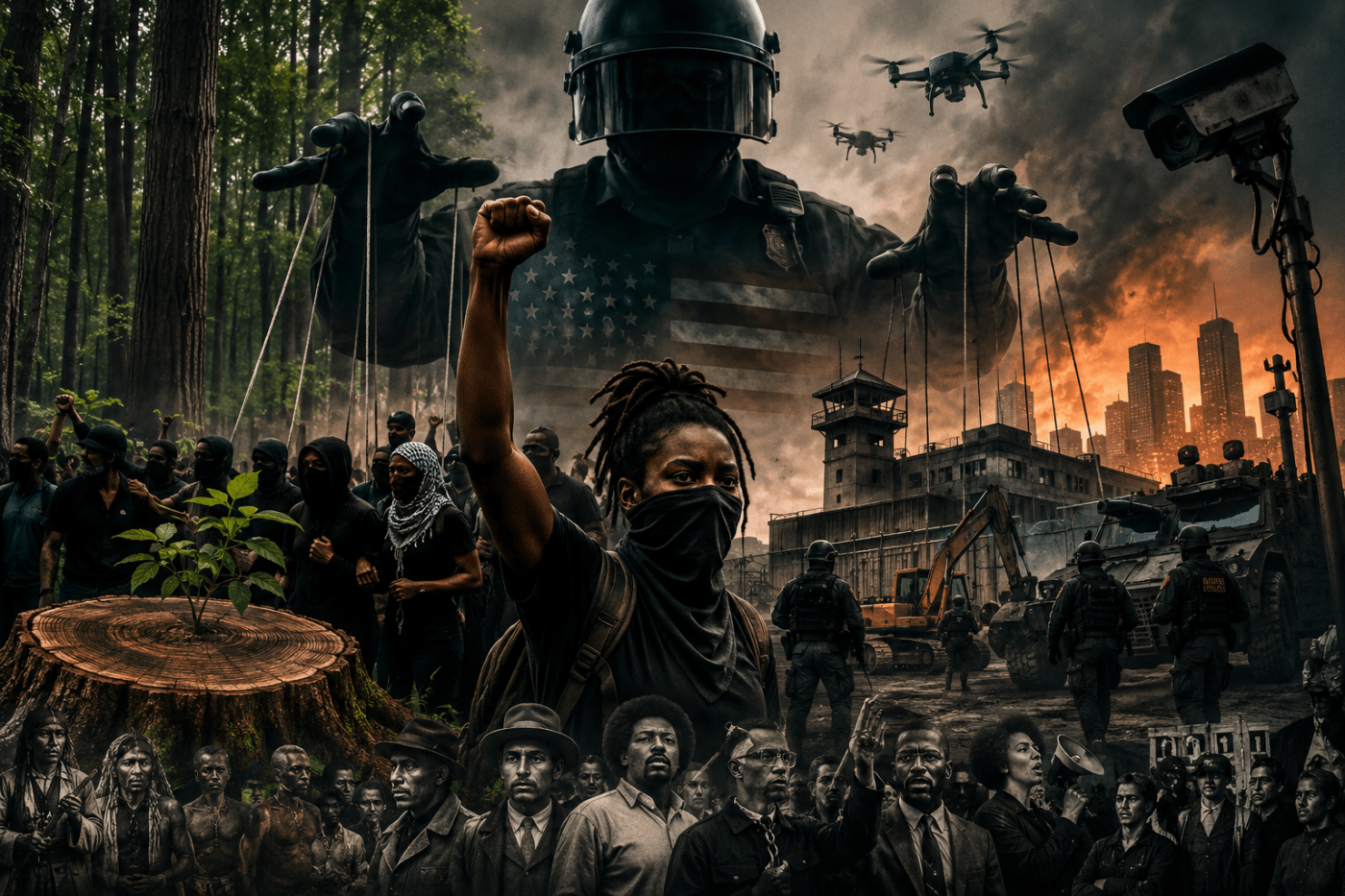
The Guardian sounds the alarm on Trump’s “antifa” prosecutions, but keeps the fire mostly inside the courthouse instead of following it into the police-state basement. The facts show a federal indictment built after failed state prosecutions, standing atop Weelaunee’s history, Cop City’s public-private police architecture, and the long U.S. chain of settler conquest, slave patrols, Red Scares, COINTELPRO, the drug war, mass incarceration, and the War on Terror. The real story is not Trump inventing repression, but Trump 2.0 accelerating the old white ruling-class counterinsurgency machine into its technofascist phase. The answer is organized defense: support the defendants, strengthen bail and legal infrastructure, expose the police foundations and corporate contractors, and connect Stop Cop City to Black liberation, Indigenous land defense, abolition, antiwar struggle, migrant defense, and anti-fascist resistance.
By Prince Kapone | Weaponized Information | June 26, 2026
The Liberal Alarm Bell Rings Inside the Police Station
The Guardian’s “Trump administration targets Cop City protesters in latest push to prosecute ‘antifa’”, written by Timothy Pratt and published on June 26, 2026, enters the scene with a useful alarm. The article reports that the federal government is moving against Stop Cop City protesters through the language of “antifa” terrorism after state prosecutions over the same basic terrain failed. It sees danger. It hears the machinery grinding. It understands that when the state turns political opposition into a terrorism category, the jailhouse door begins to swing wider than the formal charge sheet admits. For that much, the article should not be dismissed. But a fire alarm is not a fire map. The Guardian rings the bell while leaving the architecture mostly unnamed.
This is the familiar strength and weakness of liberal journalism. It can recognize abuse when the wrong faction of the ruling class speaks too loudly. It can identify prosecutorial excess, executive overreach, and threats to civil liberties. It can quote the lawyer, the scholar, the concerned expert, the person who knows how bad things look when the Constitution is being chewed like old tobacco by the men in uniform. But it has a harder time naming the whole animal. It wants to say the Trump administration is doing something dangerous, which is true. It does not want to say that the danger lives inside the normal bloodstream of the American state, which is more true.
The Guardian occupies that peculiar place in the imperial media system where conscience is allowed, even encouraged, so long as it remains housebroken. It is not Fox News, barking from the porch of reaction. It is not the Pentagon press room wearing a newspaper costume. It is a liberal outlet with real reporters, real investigations, and enough institutional independence to offend the worst people from time to time. Yet its political location remains inside the permitted opposition of the imperial world. It can criticize repression as scandal, but it rarely treats repression as structure. It can denounce the club when Trump swings it, but it hesitates to explain who forged the club, who pays for the armory, and why every administration seems to find the weapon waiting on the table.
Timothy Pratt’s reporting is careful and materially useful within those limits. He has followed Cop City and the repression around it closely, and this article does what competent legal reporting should do: it tracks the prosecutions, identifies the language shift, names the danger of “antifa” as a prosecutorial fiction, and lets attorneys and researchers explain how the state is building a case out of narrative before evidence. Pratt is not writing like a police stenographer. That matters. But his professional location is still that of the liberal correspondent moving through courts, lawyers, experts, and institutional voices. The people in struggle appear, but the movement’s own revolutionary interpretation does not command the frame. The result is a story that describes repression from the sidewalk outside the courthouse, not from the long memory of the people who have seen this courthouse built and rebuilt over their bodies.
The first propaganda technique at work is narrative framing. The article frames the danger as a Trump administration campaign to prosecute “antifa,” which is accurate as far as it goes. But the frame narrows the field of vision. It makes the central drama appear to be the administration’s present legal maneuver rather than the deeper function of state power. In this frame, the problem is that Trump is stretching the law. In the real world, the law has often been made of stretchable material whenever the poor, the Black, the Indigenous, the migrant, the socialist, the antiwar militant, or the organized worker steps beyond acceptable complaint. The article shows the elastic snapping forward, but not the factory where the elastic is made.
The second technique is omission, not in the crude sense of lying by silence, but in the more polished liberal form: reporting enough to appear brave while leaving the foundations undisturbed. The article mentions police militarization and the danger of terrorism language, but it does not excavate the wider state tradition that makes such language powerful. It does not yet show how “antifa” functions as the newest mask placed on an older domestic enemy. Liberal journalism loves the present tense because the present tense keeps history from testifying.
The third technique is source hierarchy. The article’s moral and analytical weight rests largely on attorneys, authors, and researchers. These are not bad sources; many of them sharpen the piece considerably. But the hierarchy matters. The lawyer explains the case. The expert explains the terminology. The researcher explains the danger. The organized people appear as defendants, protesters, victims, or symbols. This is how liberal media often domesticates struggle: it lets the movement bleed, then asks credentialed observers to interpret the wound.
The fourth technique is concision. A short article can only do so much, we are told, and this is the innocent excuse by which empire hides in the footnotes. Concision becomes political when it compresses a system into an incident. A prosecution becomes a case. A case becomes a controversy. A controversy becomes a quote from a lawyer and a quote from a scholar. By the time the reader reaches the bottom, the machinery has been reduced to a legal abnormality. The butcher shop is presented as one unfortunate knife.
The fifth technique is doublespeak exposure without full rupture. The article does well to show how the state’s vocabulary mutates: fireworks become explosives, communities become cells, anti-fascist politics become terrorism. This is valuable. The ruling class survives by controlling the dictionary. It calls theft development, cages safety, war peacekeeping, surveillance protection, and repression law and order. Here, The Guardian lets the reader see the trick. But it does not fully break the spell. It exposes the word game without naming the class game beneath it.
The sixth technique is the liberal personalization of danger. Trump appears as the great accelerator, the loud villain, the man who says the quiet part with a bullhorn. Fine. He is that. But the article’s structure risks letting the rest of the state appear more innocent than it has any right to appear. This is the old magic trick of American liberalism: place all evil in the vulgar man at the podium so the institutions behind him may continue wearing clean shirts. The reader is encouraged to fear Trump’s use of the machine, but not necessarily to understand the machine as the permanent property of a ruling class.
This is why the article is useful but insufficient. It gives us evidence of a dangerous legal turn, but not the total map of power. It identifies the immediate mechanism, but not the historical engine. It tells us that the state is creating a boogeyman called “antifa,” but does not fully explain why ruling classes always require monsters when the people begin to organize. The monster is never the point. The monster is the costume. Behind it stands property, police, courts, contractors, foundations, intelligence agencies, and a state that has never been neutral when the oppressed refuse obedience.
So we read The Guardian against itself. We take its facts, note its warnings, and refuse its limits. The article rings the bell. Our task is to follow the smoke down into the basement, where the old machinery is still running.
The Long File Behind the New Indictment
The immediate facts of the case are clear enough. The Guardian reports that federal prosecutors have indicted Katie Marie Kloth and Tyler John Norman after Georgia state efforts tied to the same 2022 protest outside the offices of Brassfield & Gorrie, the lead construction company behind the Atlanta police training center, collapsed in court. The protest, according to the article, involved roughly fifty people, banners, chants, fireworks, and alleged property damage. The state first folded the incident into the sweeping Georgia RICO prosecution brought in 2023, but that indictment was dismissed by a Fulton County judge. Georgia then tried again in Cobb County, where Judge Robert Flournoy dismissed the case after finding that the delay between the alleged conduct and indictment violated the defendants’ due-process rights.
The federal indictment arrived after those state failures. The Justice Department placed the prosecution inside the language of Donald Trump’s national-security campaign against anti-fascism. The Guardian notes that the federal action was presented as part of National Security Presidential Memorandum 7, which directs federal action against what it describes as violent and terroristic activity under the umbrella of self-described anti-fascism. That memorandum followed Trump’s executive order designating “Antifa” as a domestic terrorist organization. In the indictment language reported by The Guardian, words such as “explosives,” “fire,” “riot,” and “civil disorder” are attached to the alleged events, while critics quoted in the article argue that the state is turning fireworks and protest activity into a terrorism narrative.
The Guardian also places the Cop City indictment beside the Prairieland anti-ICE case in Texas. In that case, The Guardian reports that defendants received long terrorism-related sentences after prosecutors connected protest activity to “antifa” allegations. The article’s central factual thread is therefore a sequence of prosecutorial movement: state cases failed or were dismissed, federal prosecution followed, and the federal prosecution was tied to a new presidential national-security framework around anti-fascism.
The facts omitted from the article widen the field. The police training center is located in Weelaunee Forest, and Climate Justice Alliance identifies Weelaunee as land of the Muscogee Creek people that later became a plantation and then the Old Atlanta Prison Farm. The University of Michigan’s Technology Assessment Project also notes that the site’s history includes Indigenous dispossession, plantation use, and prison-farm use before becoming the proposed location of the police training facility. These details are not background decoration. They are factual parts of the site’s public history.
The Atlanta Police Foundation is also central to the project’s public structure. The Atlanta Police Foundation describes itself as an organization that brings together business, philanthropic, and civic leadership to support policing initiatives in Atlanta. The City of Atlanta stated that the training center’s original projected cost was roughly $90 million, with the Atlanta Police Foundation expected to generate a major share through philanthropic contributions, private financing, and tax-credit mechanisms. Later reporting placed the final cost above the original estimate, with the Associated Press reporting a cost of about $109 million. These facts show that the project was not only a municipal police matter but also a public-private financing arrangement.
The repression around Stop Cop City extended beyond the two federal defendants named in the Guardian article. The ACLU warned that RICO and domestic-terrorism charges against Cop City activists treated a decentralized protest movement as a criminal conspiracy and sent a chilling message to protest movements. The NAACP Legal Defense Fund objected to Department of Homeland Security intelligence characterizations that treated Stop Cop City activists as domestic violent extremists. Investigative reporting by Drilled found that federal intelligence records and post-9/11 terrorism infrastructure shaped the state’s response to environmental and anti-police activists in Atlanta.
Surveillance of the movement also appears in public reporting. The Brennan Center reported that Atlanta police records revealed monitoring of Cop City opponents, including political activity and ordinary social gatherings connected to the movement. Wired later reported that DHS-linked materials characterized common protest conduct such as masks, cameras, bikes, livestreaming, and avoiding identification as potential violent tactics. These are concrete examples of ordinary movement behavior being placed under police and intelligence interpretation.
The larger historical record is also factual and documented. U.S. domestic counterinsurgency did not begin with the present administration. Research on U.S. counterinsurgency has traced its colonial roots through the military campaigns commonly called the Indian Wars. The NAACP explains that modern policing in the United States has historical roots in slave patrols created to capture fugitives, suppress revolt, and control enslaved Black people. An ethnic-studies overview published through LibreTexts similarly states that U.S. policing developed through slavery, colonialism, and control of the working class.
The Red and Black scares of the early twentieth century form another documented layer. The FBI’s own history of the Palmer Raids states that federal authorities targeted radicals including Emma Goldman and Alexander Berkman for deportation after the First World War and the Russian Revolution. The First Amendment Encyclopedia describes the Palmer Raids as mass arrests and deportation efforts carried out against alleged radicals, often with weak evidence, denial of counsel, and abusive warrants. The National WWI Museum describes the Red Summer of 1919 as a wave of anti-Black violence across dozens of U.S. communities in the aftermath of the First World War, a period in which Black self-defense, labor unrest, and fear of radical politics overlapped in the public record.
McCarthyism extended the anti-communist machinery into employment, education, culture, unions, government, and public life. The Miller Center describes McCarthyism as a period in which accusations of communist influence led to firings, blacklists, investigations, and social destruction. The National Archives explains that the Attorney General’s List of Subversive Organizations created an official federal blacklist structure before McCarthy himself became the symbol of the era. The U.S. Capitol’s historical materials note that HUAC targeted the motion-picture industry and that the Hollywood Ten were imprisoned after refusing to answer questions about political affiliations.
The counterintelligence record of the 1960s and 1970s is also public. The UC Berkeley Library’s FBI files project notes that the FBI targeted the Black Panther Party, Martin Luther King Jr., Malcolm X, Elijah Muhammad, and other Black leaders and organizations under domestic intelligence programs. Monthly Review’s account of the discovery of COINTELPRO states that the program sought the “neutralization” of Black radical formations and other political movements. Ward Churchill and Jim Vander Wall’s Agents of Repression documents FBI campaigns against the Black liberation movement and the American Indian Movement, including repression surrounding Wounded Knee and Leonard Peltier.
The drug war and mass incarceration created another layer of state practice. The ACLU writes that the drug war helped make the United States the world’s largest incarcerator while failing to reduce drug supply or demand. The Equal Justice Initiative cites Nixon adviser John Ehrlichman’s admission that the drug war was designed to criminalize Black people and antiwar radicals. Ruth Wilson Gilmore’s Golden Gulag examines mass incarceration through surplus land, labor, finance capital, and state capacity in California’s prison expansion.
The post-9/11 national-security apparatus expanded federal and local policing powers. The Brennan Center describes fusion centers as federal, state, and local intelligence-sharing entities built after 9/11 that have raised civil-liberties concerns. Costs of War research reports that post-9/11 police militarization deepened through federal equipment transfers, counterterror funding, and domestic policing programs. Black Alliance for Peace identifies the 1033 Program as a mechanism by which the Department of Defense transfers military equipment to federal, state, and local law-enforcement agencies.
The present Cop City fight therefore stands within a much wider documented policy environment. Black Agenda Report’s discussion of Confronting Counterinsurgency: Cop Cities and Democracy’s Terrors connects Cop City, ICE, the School of the Americas, settler colonialism, slavery, and contemporary militarized policing. Pluto Press describes the same book as a collection that examines “Cop Cities” as part of a counterinsurgency infrastructure linking policing, colonialism, and repression. Peter Dale Scott’s work offers another documented vocabulary for this terrain: his own description of deep politics names political practices and arrangements that are usually repressed rather than acknowledged.
Weaponized Information has previously placed the Trump-era “antifa” campaign within this wider domestic-security trajectory. In “The Enemy Within: Trump, Lawfare, and the Criminalization of Antifascism,” Weaponized Information examined how federal lawfare, surveillance, police power, and enemy construction were being organized around anti-fascist dissent. In “The Rolling Conquest: When Empire Calls Itself Democracy,” Weaponized Information connected domestic repression, executive violence, anti-ICE struggle, anti-police struggle, Palestine solidarity, and antiwar politics inside one broader repressive field.
The factual terrain is therefore larger than the federal indictment alone. It includes the immediate prosecution, the failed state cases, the federal anti-fascism memorandum, the executive order, the Prairieland sentences, the public-private structure of the police training center, the history of the Weelaunee site, the surveillance and prosecution of movement activity, and the documented historical layers of U.S. domestic repression from settler conquest and slave patrols through Red Scares, McCarthyism, COINTELPRO, the drug war, mass incarceration, post-9/11 fusion centers, police militarization, and the present national-security language attached to protest.
The Machine Did Not Begin With Trump
The real story is not that the Trump administration discovered repression and dragged it into American life like some strange beast from the woods. The beast was already here. It had a uniform before it had a red hat. It had a badge before it had a campaign slogan. It had a fort, a patrol, a blacklist, a file, a raid, a prison bed, a watchlist, a fusion center, and a training ground long before it learned to say “antifa” with the smug little grin of a prosecutor who thinks he has invented fire. Trump 2.0 is not the origin of this machinery. It is the present acceleration of an old counterinsurgent state now speaking with less shame.
The Guardian article shows us the immediate legal turn: a federal indictment arriving after state cases failed, a memorandum and executive order supplying national-security language, and a protest case pushed into the vocabulary of terrorism. But the factual terrain beneath that turn tells a longer story. The United States has always kept one version of itself for schoolbooks and another for the people it intended to discipline. The first version talks about democracy, rights, due process, and public safety. The second version arrives on horseback, in patrol wagons, through federal files, with grand juries, with narcotics squads, with armored vehicles, with intelligence memos, with prosecutors who discover that history is most useful when it can be sealed inside an indictment.
Cop City stands on land where the old order has already left its signatures. Indigenous dispossession, plantation use, prison-farm labor, and now a police training facility are not separate moral tragedies floating in different centuries. They are layers of one political geography. The land itself becomes an archive of state power. First the land is taken. Then labor is chained to it. Then captivity is administered on it. Then police infrastructure rises from it. The official language changes each time, because every ruling order prefers fresh paint on old walls. But the wall remains.
This is why the “public safety” story is so thin. Public safety for whom? Safety from what? The working poor ask for housing, schools, healthcare, clean air, trees, wages, stability, and a life not organized by fear. The state answers with training grounds, police foundations, surveillance, and legal categories broad enough to swallow a movement. The people ask for the means of life. The ruling bloc builds the means of pacification. That is not a misunderstanding. That is government doing class work.
The “antifa” label enters as the newest costume for the oldest domestic enemy. The enemy has been renamed across the centuries because each period requires its own demon. The Indigenous resister, the fugitive slave, the Black rebel, the striking worker, the immigrant radical, the Bolshevik, the Communist teacher, the Panther, the antiwar organizer, the Puerto Rican independentista, the Indigenous militant, the drug criminal, the Muslim terrorist, the migrant invader, the forest defender, the anti-fascist — the names change because propaganda must stay fashionable. The function does not change. The label isolates rebellion from the people. It tells the anxious middle layers that the danger is not the ruling class above them but the organized poor below them.
The Red and Black scares taught the state how to fuse different fears into one monster. Labor militancy, immigrant radicalism, Black resistance, anti-capitalist thought, and international revolution could all be folded into one image of contagion. McCarthyism refined the technique. It did not need to imprison everyone. It made work insecure, friendship suspect, speech dangerous, culture obedient, and association itself a punishable smell. The genius of repression, if we may call such a diseased thing genius, is that it teaches people to police themselves before the policeman knocks.
COINTELPRO carried that political grammar into the era of liberation movements. The state looked at movements that fed children, defended communities, opposed imperial war, built international solidarity, studied socialism, challenged police terror, and demanded power for colonized people inside the empire. It did not answer them as democratic participants. It answered them as internal enemies. It infiltrated, disrupted, divided, smeared, prosecuted, and neutralized. The polite word was counterintelligence. The honest word is counterinsurgency.
The drug war then made this counterinsurgency ordinary. It did not have to call Black rebellion by its name. It could call it crime. It could flood communities with police, build prison capacity, normalize raids, manufacture informants, shatter households, mark millions with records, and explain the whole operation as law enforcement. The cage became policy. The raid became routine. The wreckage became statistics. The language of public order did what open white terror could no longer say so plainly.
After 9/11, the old domestic machine received new wires, new databases, new agencies, new intelligence channels, new money, and new ideological permission. The war on terror did not invent surveillance or militarized policing, but it consolidated them into a more integrated apparatus. Federal agencies, local police, intelligence centers, immigration systems, equipment transfers, and counterterror categories became part of the same governing habit. The state learned to see threat everywhere, especially where people gathered, resisted, documented, masked, marched, defended one another, or refused to identify themselves to power.
This is the deep politics of Cop City. Not a fantasy of hidden puppeteers in a smoke-filled room, but the real hidden-in-plain-sight structure of American power: city government, police foundations, contractors, prosecutors, federal security frameworks, surveillance categories, public-private financing, and terrorism language moving together beneath the decorative language of democracy. The deep state here is not a partisan conspiracy against Trump. It is the durable security-corporate-intelligence apparatus that Trump inherited and now drives with the recklessness of a man who mistakes the accelerator for a steering wheel.
The failed state prosecutions and the federal indictment do not sit outside that history. They fit inside it. When one jurisdiction fails, another appears. When ordinary charges wobble, terrorism language stiffens the spine. When a movement refuses to dissolve, the state looks for wider nets. When the facts are too small for the punishment desired, the narrative is enlarged. Fireworks become explosives. Social networks become cells. Legal support becomes conspiracy. Protest becomes civil disorder. Anti-fascism becomes domestic terrorism. The state does not merely prosecute acts. It manufactures political meaning around them.
That is why due process alone cannot contain the danger, even when due process wins a round. A dismissed case is not nothing. It matters. But the process itself has already done work: fear, delay, cost, exhaustion, isolation, surveillance, headlines, donor panic, job loss, travel restrictions, and the slow pressure that tells everyone watching to think twice before standing in the road, in the forest, at the jail, outside the contractor’s office, or beside a defendant. The courtroom is not only where repression is judged. It is one of the places repression happens.
Cop City is therefore not preparation for crime in any simple sense. It is preparation for crisis. A society that cannot solve housing crisis, ecological crisis, police violence, racialized poverty, migrant displacement, imperial decline, and social abandonment prepares instead to manage the people who will inevitably resist those conditions. When legitimacy thins, coercion thickens. When the ruling class cannot offer a future, it builds a training center to manage the refusal.
This is Technofascism in its domestic form: executive power, federal memoranda, police militarization, surveillance logic, public-private policing, corporate contractors, legal overcharging, terrorism categories, and media language assembled into a single political weapon. It is not fascism as costume drama, not merely flags and mobs and theatrical strongmen. It is fascism as infrastructure, fascism as administration, fascism as database, fascism as procurement contract, fascism as indictment, fascism as training facility built on stolen land and called safety.
The central contradiction is not order versus disorder. It is organized property against organized people. On one side stand those who treat land, labor, Black life, Indigenous memory, public budgets, and urban space as objects to be disciplined. On the other side stand those who insist that communities have the right to resist police occupation, ecological destruction, corporate rule, and state terror. The state calls the second side extremism because it cannot admit the first side is class power.
Trump’s contribution is to say the quiet part louder. He gives the old machine a new enemy name and a new permission structure. But the machine itself is older than him, wider than him, and more dangerous than him precisely because it does not depend on him. It has moved through liberal and conservative hands. It has survived scandals, reforms, commissions, exposés, lawsuits, elections, and apologies. It does not vanish when one administrator leaves the office. It waits. It adapts. It files the old language away and reaches for the new.
The real story buried beneath the Guardian article is that the American state is rehearsing a future. It is rehearsing how to turn anti-fascism into terrorism, how to turn environmental defense into conspiracy, how to turn bail support into criminal infrastructure, how to turn Black and Indigenous resistance into domestic threat, how to turn opposition to police militarization into proof that more militarization is needed. This is not a malfunction. It is the system thinking ahead.
To report this truthfully is to strip the state of its favorite disguise. The issue is not merely Trump’s excess, not merely prosecutorial overreach, not merely one bad indictment. The issue is a long counterinsurgent state entering a sharper phase under conditions of crisis. Cop City is one node in that phase. The “antifa” campaign is one vocabulary of that phase. The federal indictment is one instrument of that phase. The people are being told that resistance to fascism is terrorism because the ruling class knows that anti-fascist common sense, once joined to Black liberation, Indigenous sovereignty, working-class struggle, migrant defense, abolition, and anti-imperialism, becomes far more dangerous than any fictional cell the state can invent.
That is the story. The machine did not begin with Trump. But under Trump 2.0, it is being tuned for open war against the people.
Build the Defense Before the Knock Comes
The answer to this machinery is not panic, liberal pleading, or waiting for the courts to discover a conscience. The answer is organization. The state is building durable infrastructure for repression, so the people must build durable infrastructure for defense. That means supporting the formations already doing the work on the ground, especially the Black-led, abolitionist, anti-imperialist, legal-defense, and anti-surveillance forces that understand Cop City not as one bad project but as one front in a wider domestic war machine.
Start with the organizers rooted in Atlanta itself. Community Movement Builders has organized against Cop City as a Black-led formation confronting police occupation, corporate-backed repression, and the lease of Weelaunee Forest to the Atlanta Police Foundation. This work should be materially supported, shared, and studied, not treated as a distant headline for spectators. Their struggle shows that the question is not only whether one facility is built, but whether Black working-class communities will be ruled through police foundations, contractors, tactical training, and philanthropic laundering while basic social needs are pushed to the side.
The anti-imperialist layer must also be strengthened. Black Alliance for Peace has connected domestic police militarization to U.S. war infrastructure, including the 1033 Program that transfers military equipment from the Department of Defense to police agencies. This is the correct scale of analysis and action. The same society that sends weapons abroad sends war equipment into neighborhoods at home. The same ruling class that calls occupation “security” overseas calls police militarization “public safety” here. Support for BAP’s domestic militarization work helps join antiwar struggle, Black liberation, anti-police struggle, and anti-imperialist education into one field of resistance.
Legal-defense infrastructure must be defended before it is isolated. Atlanta Solidarity Fund has provided bail and legal-support infrastructure around movement repression, and bail-fund organizers themselves have been arrested in the course of the Stop Cop City repression. That fact alone tells us what the state understands: a movement without defense infrastructure is easier to crush. Bail support, court support, jail support, family support, transportation, fundraising, and public attention are not charity. They are the logistics of survival under repression.
The legal front also requires organized movement lawyers and trained legal observers. The National Lawyers Guild has condemned the indictments against Stop Cop City protesters and maintains legal observer infrastructure for monitoring police conduct during demonstrations. Every city with serious organizing should be developing legal-observer capacity, rapid-response attorney networks, defendant-support teams, and know-your-rights education. The state prepares before it strikes. The people must prepare before the sirens arrive.
Abolitionist political education must become ordinary movement practice. Critical Resistance has identified Stop Cop City as part of the struggle against the prison-industrial complex and continues to organize around abolishing policing as a system of social control. That work helps break the narrow liberal trap that treats each prosecution, each jail, each police budget, and each training center as separate problems. The prison, the police, the prosecutor, the surveillance office, and the training campus are not strangers. They know one another very well.
The surveillance front must be treated as a battlefield of its own. Stop LAPD Spying Coalition organizes against predictive policing, surveillance, data-driven policing, and the police intelligence systems that turn communities into targets before any charge is filed. Its work is especially useful for understanding how the post-9/11 security apparatus has been localized through databases, suspicious-activity reporting, fusion-center logic, and algorithmic policing. Movements should study these tools, identify their local versions, file public-records requests, expose agency partnerships, and teach people how surveillance turns ordinary political life into an intelligence file.
The corporate-police structure must be named and pressured directly. The American Friends Service Committee has documented companies and foundations connected to Cop City, while reporting on records requests has shown how the Atlanta Police Foundation’s public role has raised transparency questions. This gives organizers a concrete terrain: expose donors, pressure contractors, confront insurers, investigate procurement channels, map board memberships, and make police foundations politically toxic. The ruling class likes to hide behind charity language. Drag the checkbook into daylight.
The referendum fight also leaves lessons for future struggle. Stop Cop City organizers gathered more than 116,000 signatures for a ballot initiative, showing that mass opposition can be organized at a scale the city cannot easily dismiss. The lesson is not that petitions alone will liberate anyone. The lesson is that electoral terrain, direct action, legal defense, political education, media work, and grassroots organizing can reinforce each other when placed under movement discipline rather than liberal illusion.
The tactical direction is therefore concrete. Build local anti-repression committees before repression arrives. Create court-support teams, jail-support teams, bail-support networks, legal-observer teams, and rapid-response communication systems. Hold political-education sessions on COINTELPRO, McCarthyism, the drug war, mass incarceration, the War on Terror, fusion centers, police foundations, and domestic terrorism law. File public-records requests on local police partnerships, training contracts, surveillance tools, university collaborations, and federal task-force participation. Map every corporate donor, contractor, foundation board member, and public official tied to police militarization. Make the machinery visible, then make collaboration costly.
This struggle must not remain isolated as an Atlanta issue. The Center for Constitutional Rights describes the Stop Cop City movement as rooted in abolitionist, Indigenous, environmental, and racial-justice struggle. That is the correct basis for solidarity. Stop Cop City must be connected to anti-ICE struggle, Palestine solidarity, Black liberation, Indigenous land defense, prison abolition, labor militancy, antiwar organizing, migrant defense, and anti-surveillance work. The state already understands these fronts as connected. The people must become at least as intelligent as their enemies.
The call is simple: defend the defendants, support the organizers, expose the funders, study the machinery, build local defense infrastructure, and refuse the isolation of any one front. When they call anti-fascism terrorism, answer by organizing more people against fascism. When they criminalize bail support, build stronger bail support. When they hide police power behind foundations, follow the money. When they turn protest into conspiracy, turn solidarity into discipline. The state is preparing for the people. The people must prepare for the state.


Leave a comment