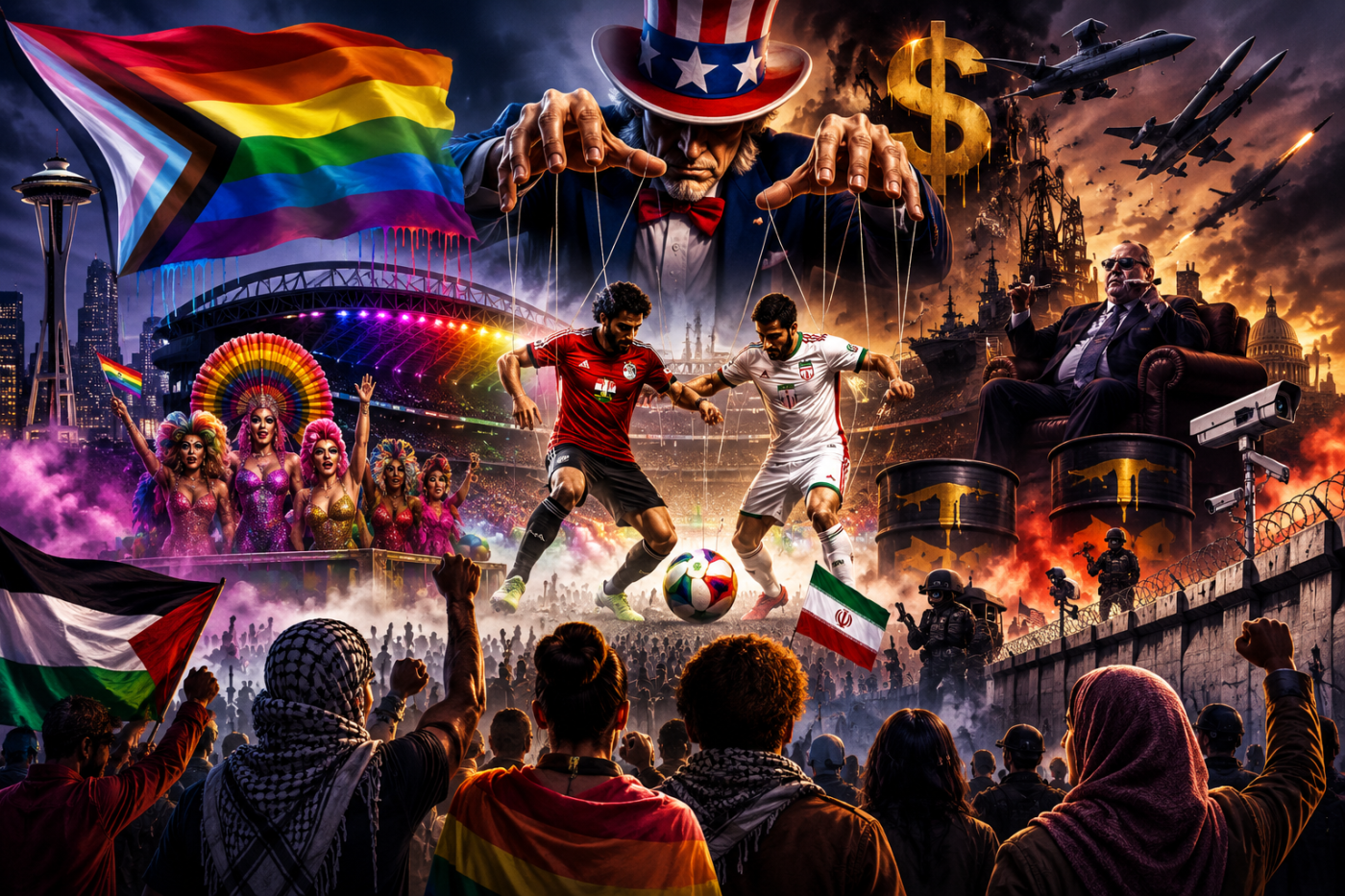
Seattle’s Pride Match exposes how liberal propaganda turns an international football match into a civilizing lesson for two Muslim-majority nations. Beneath the rainbow branding sits a harder machinery of sanctions, travel restrictions, FIFA capital, public subsidy, surveillance, corporate donors, military finance, and Egypt’s role in the U.S. regional war network. The real story is not Pride versus homophobia, but empire using the language of inclusion to lecture the Global South while hiding the banks, bombs, bases, and borders beneath the ceremony. The answer is not conservative backlash or liberal applause, but anti-imperialist organization against war, sanctions, corporate sport, militarized borders, and the colonial arrogance of Western universalism.
By Prince Kapone | Weaponized Information | June 26, 2026
The Rainbow Classroom of Empire
Mouhamad Rachini’s CBC article, “Iran and Egypt will headline Seattle’s ‘Pride Match.’ Here’s why that’s controversial”, published on June 26, 2026, presents tonight’s World Cup match between Iran and Egypt in Seattle as a clash between Seattle’s Pride culture, FIFA’s stadium rules, and the objections of two predominantly Muslim countries. The article reports that Seattle’s local World Cup organizers designated the match as a “Pride Match,” that rainbow flags will be allowed in the stadium, that FIFA will not officially market the game under that branding, and that both Iran and Egypt objected to Pride-related activities being attached to the match. On the surface, then, the story appears to be about tolerance, visibility, football, and controversy. But the deeper structure of the article is not neutral reporting. It is a carefully polished piece of liberal ideological management, one that allows the imperial host city to appear as the enlightened adult in the room while Iran and Egypt are positioned as the backward children who must be instructed beneath the bright lights of Seattle’s moral stage.
CBC/Radio-Canada occupies the position of a Western public broadcaster, not a street-corner fascist rag, which is precisely why the article deserves close excavation. This is not the slobbering Islamophobia of the right wing, barking about “civilization” with a mouth full of empire. It is the softer, more educated, more dangerous version. It speaks in the language of inclusion, human rights, joy, visibility, and welcome. It wears clean shoes. It thanks the reader for listening. It does not shout that the Muslim world must be civilized; it simply arranges the story so that the reader arrives there politely. The colonial conclusion is served without the colonial vocabulary, like poison poured into a glass of sparkling water.
Rachini’s own position gives the article a more careful texture than the average imperial sermon. CBC identifies him as a Canadian Lebanese journalist and producer who writes about Muslim and Middle Eastern communities as well as soccer. That background matters because the article is not a crude hit piece against Arabs, Persians, Muslims, or the Global South. It includes discomfort. It gives space to Nima Tavallaey, the Iranian-Swedish soccer journalist who warns that these spectacles do not necessarily help the people they claim to defend and who directly calls attention to Western blood guilt in Gaza. But even with that complication, the article remains trapped inside the liberal humanitarian frame. Muslim-majority countries appear as problems of culture. Seattle appears as a city of values. FIFA appears as a neutral administrator. The imperial country hosting the match appears almost nowhere as an empire. That absence is not accidental. It is the work the article performs.
The first propaganda device is narrative framing. The article does not simply report that Seattle attached Pride branding to a match between Iran and Egypt. It frames the controversy as a test of whether Pride visibility can confront the anti-LGBTQ policies of two countries described as among the most hostile in the world. This may sound factual, but the frame does political work before the reader has time to object. Seattle becomes the subject of moral courage. Iran and Egypt become the objects of moral scrutiny. The United States becomes the stage, not the culprit. The host city becomes the teacher, not the imperial administrator. The football match becomes less a match between two national teams than a classroom in which the Global South is expected to sit quietly while the liberal West explains progress.
The second device is card stacking. The article includes voices from Seattle organizers, FIFA, fans, journalists, and critics, but the cards are arranged so that the central question remains whether Pride visibility should proceed despite objections. The more explosive questions are pushed to the margins. Who gave Seattle’s local organizing apparatus the authority to convert an international match into a vehicle for its domestic political identity? What does it mean for two predominantly Muslim countries to be placed under a political-cultural banner they explicitly reject? Why does the imperial host state get to define the terms of moral performance while its own machinery of war, sanctions, borders, policing, and corporate spectacle remains outside the frame? The article lets these questions hover like ghosts, but refuses to give them a body.
The third device is appeal to virtue. Seattle is described through the language of freedom, welcome, visibility, and celebration. The city is allowed to narrate itself as generous and inclusive, as though the good intentions of the host dissolve the power relation between host and guest. This is the old colonial trick with a fresh municipal logo. The colonizer rarely says, “I dominate you because I enjoy domination.” He says, “I bring education.” He says, “I bring rights.” He says, “I bring modernity.” Now the liberal city says, “I bring visibility.” The vocabulary has changed, but the posture remains: one side speaks as universal humanity, the other is summoned as a culture in need of correction.
The fourth device is omission. The article tells us that Iran and Egypt objected. It tells us that rainbow flags will be allowed. It tells us that Seattle’s Pride Week dates back to 1974. It tells us that FIFA wants official neutrality. But it does not seriously interrogate the imperial relation that makes this controversy possible. It does not ask whether a U.S. city, hosting under FIFA capital and American state power, should attach a domestic ideological banner to a match involving sovereign nations from the Muslim world. It does not ask why “human rights” become so urgent when they can be used to discipline Iran and Egypt, but become so negotiable when they collide with U.S. war policy, border policy, police policy, corporate sponsorship, or allied state violence. The silence is not empty. It is full of empire.
The fifth device is bait and switch. The article appears to ask whether this Pride Match will “change minds.” But that question already accepts the imperial premise. It assumes the problem is how to move Iran and Egypt closer to Seattle’s values. It does not ask whether Seattle should have staged the question in the first place. It does not ask whether the U.S. working class has been trained to mistake local progressive branding for internationalist politics. It does not ask whether the liberal city is using Pride less as an expression of community and more as a civilizing banner under which other peoples are expected to perform. The article invites the reader to debate sensitivity, not sovereignty; optics, not power; feelings, not imperial structure.
The sixth device is controlled contradiction. Tavallaey’s criticism is allowed into the article, but it is contained as one perspective inside a broader liberal frame. His warning that Western nations carry blood on their conscience, particularly in relation to Gaza, is explosive enough to break the story open. But the article does not follow that road. It quotes the critique, nods respectfully, and returns to the safer terrain of FIFA rules, flags, and city values. This is how liberal media handles danger: it does not always erase the radical objection. Sometimes it displays it briefly, like a museum artifact, then locks the glass case.
What emerges, then, is not a simple article about a controversial football match. It is a small machine of imperial common sense. It allows Seattle to appear brave without proving humility. It allows FIFA to appear neutral while governing the spectacle. It allows Iran and Egypt to appear mainly as cultural offenders. It allows the reader to feel morally elevated without ever asking what gives the imperial host the authority to place other nations beneath its chosen banner. The propaganda is effective because it does not sound like propaganda. It sounds like concern. It sounds like inclusion. It sounds like a rainbow flag fluttering over a classroom where the empire still writes the lesson plan.
The Machinery Beneath the Match
Before the slogans are examined, the machinery must be put on the table. Tonight’s Egypt–Iran World Cup match is not an abstraction, not a floating argument in the clouds of liberal morality, not a seminar on “values” held by angels with press credentials. It is a concrete event, in a concrete city, governed by concrete institutions, financed through concrete corporate networks, secured by concrete police and surveillance systems, and staged under the authority of a U.S.-hosted FIFA spectacle. SeattleFWC26’s own match schedule lists Egypt versus Iran at Seattle Stadium on June 26, 2026, at 8 p.m. Pacific time. That is the fixture around which the controversy turns. The match is happening tonight, in Seattle, during Pride weekend, under a host-city apparatus that has chosen to attach Pride branding to the event even after the draw placed two predominantly Muslim countries at the center of the stage.
The local organizers have not hidden the branding. SeattleFWC26’s Pride Match Day page describes the event as part of Pride Weekend programming connected to World Cup hosting, with language about visibility, belonging, neighborhoods, community, and local business participation. This is not merely a matter of individual fans carrying flags, nor is it only a question of what FIFA permits inside the stadium. The local host committee has built a civic program around the match and has folded that program into its broader language of legacy. Reuters reported that Seattle designated the June 26 match as a “Pride Match” before the World Cup draw paired Iran and Egypt, and that Seattle organizers decided to proceed after the matchup became known. That sequence matters. The original designation may have preceded the draw, but the decision to continue after the identities of the teams were known was not an accident of scheduling. It was a choice made inside the host-city apparatus.
FIFA has tried to draw a line between the match itself and the city’s surrounding Pride programming. The Guardian reported that FIFA confirmed rainbow flags and other LGBTQ+ symbols would be allowed inside the stadium while also saying that Seattle’s organized Pride festivities were independent of the official match presentation. In other words, FIFA wants the benefit of human-rights language without full responsibility for the political theater produced by the host city. It keeps one hand on neutrality and the other on the machinery of inclusion. This distinction is institutionally useful, but it does not dissolve the contradiction. The match, the stadium, the host city, the local organizing committee, FIFA rules, fan zones, public security, and civic programming all form one lived event for the people who must move through it.
Iran and Egypt did not remain silent about the matter. Reporting on the objections from both federations describes demands that FIFA remove Pride-linked symbols and promotional associations from the match. Their objections have been reported in the Western press largely as evidence of cultural backwardness or anti-LGBTQ policy, but the empirical fact is more specific: two sovereign national federations objected to a political-cultural branding campaign being attached to their match. Reuters reported that Egypt’s coach Hossam Hassan tried to keep attention on football, while Iran’s side also raised complaints about the conditions it has faced in the United States. The teams came to play football. The host apparatus made the match bigger than football.
The conditions surrounding Iran’s participation are not minor background details. Iran entered the tournament under U.S. travel restrictions, with reporting describing the team’s constrained movement before those restrictions were partially eased ahead of tonight’s match. The same host state that permits Seattle to posture as a teacher of freedom has restricted the movement of the Iranian team on U.S. soil. This is not an incidental contradiction. It is the material floor beneath the symbolic ceiling. The Iranian players are invited into the spectacle, but not as free participants in a neutral world. They arrive through the gates of a state that sanctions their country, restricts their movement, and then places them under a moral banner chosen by the host city.
The sanctions architecture is not hidden either. On June 22, 2026, the U.S. Treasury’s Office of Foreign Assets Control issued General License X, temporarily authorizing certain transactions involving Iranian-origin crude oil, petroleum products, and petrochemical products only through August 21, 2026. A temporary license is not freedom. It is the master briefly loosening the chain and asking to be thanked for the gesture. The United States maintains the power to decide which Iranian transactions may occur, under what conditions, and for how long. That is the context in which Iran arrives in Seattle tonight. Not as a simple football team from a country with different social values, but as a national team from a country subjected to U.S. financial coercion.
This coercion did not begin with the present tournament. The National Security Archive documents the U.S. and British role in the 1953 coup against Iran’s Prime Minister Mohammad Mossadegh, a foundational wound in Iran’s modern struggle for sovereignty. The old colonial hand that helped overthrow an Iranian nationalist government now appears in Seattle wearing the gloves of human rights. It is not necessary to romanticize the Iranian state to understand this. One only has to remember the history that liberal media prefers to misplace in the attic. The United States has long treated Iran not as an equal sovereign country, but as a problem to be managed, punished, isolated, destabilized, and instructed.
Egypt enters tonight’s match through a different but equally revealing corridor of empire. It is a predominantly Muslim country, yes, and one whose football federation objected to the Pride branding. But Egypt is also a major pillar in the U.S. regional military network. The U.S. Government Accountability Office reported that Egypt received about $1.3 billion annually in Foreign Military Financing, money used to purchase U.S.-manufactured military goods and services. The same GAO report states that U.S. goals for military assistance to Egypt included access to the Suez Canal, access to overflight routes, and improved interoperability between Egyptian and U.S. forces. This is the practical language of empire: canals, airspace, interoperability, procurement, passage. No poetry, no rainbow, no sermon. Just routes of power.
The relationship is older than the current World Cup and older than the current administration. U.S. State Department historical records from the early Cold War framed military assistance to Egypt in relation to the Canal Zone and the proposed Middle East Defense Organization. Egypt’s strategic geography has long made it a prize in the imperial imagination: North Africa, West Asia, the Red Sea, the Suez corridor, the Mediterranean, the approaches to the Gulf. When liberals speak of Egypt only as a country with the wrong social values, they erase Egypt’s material place in the U.S. imperial system. The empire does not simply oppose Muslim-majority states. It disciplines some, arms others, recruits some, sanctions others, and uses all of them according to the needs of imperial circulation.
The economic dimension is just as concrete. The IMF approved an expanded $8 billion program for Egypt while pressing reforms including exchange-rate flexibility and reducing the state’s economic role. Egypt is therefore not simply a sovereign cultural actor in some abstract debate about values. It is a state under military partnership with Washington and financial discipline through Western-dominated institutions. The workers and peasants of Egypt live inside those pressures. They do not need Seattle’s liberals to use their country as a prop in a morality play. They need the chains named clearly.
The local machinery in Seattle is equally important. SeattleFWC26 identifies itself as Seattle’s Local Organizing Committee for the FIFA World Cup, responsible for delivering the city’s host role and legacy programming. This is not a random civic club passing out scarves. It is the local institutional node through which the global tournament is translated into Seattle’s public life. SeattleFWC26’s Legacy page places “Pride Match” inside official host-city legacy programming alongside advisory committees and community initiatives. This means the Pride Match belongs to the governing architecture of the host city. It is not merely spontaneous culture from below. It is managed culture from above, even when it borrows the language of community.
The City of Seattle is formally tied to this apparatus. Seattle Ordinance 126881 authorized an agreement between the City of Seattle and the Seattle International Soccer Hosting Local Organizing Committee. That does not prove that the mayor personally designed the Pride Match branding, and the available public record does not establish that claim. But it does prove that the city is not a bystander watching FIFA from the sidewalk. Mayor Katie Wilson’s office has publicly partnered with SeattleFWC26 on World Cup programming, including a youth-access initiative. The political point is therefore institutional rather than personal. The mayor, the city, SeattleFWC26, FIFA, public subsidy, corporate donors, and security planning form an interlocked apparatus. Empire rarely needs a single villain twirling a mustache. It has committees for that.
The democratic character of this apparatus is also limited. SeattleFWC26’s own Legacy page says advisory committee meetings are not open to the public. Yet these advisory committees help legitimate the public-facing language of community, inclusion, and human rights. The people are asked to celebrate a legacy that is shaped through institutions they cannot directly enter. The working class gets the bill, the traffic, the police, the cameras, the moral lecture, and the souvenir. The decisions are made elsewhere.
Follow the money and the picture sharpens. SeattleFWC26’s donor page lists corporate and institutional donors including Boeing, Deloitte, Bank of America, Airbnb, Expedia, F5, Nordstrom, PCL Construction, the Port of Seattle, the Public Stadium Authority, Puget Sound Energy, and the Washington State Department of Commerce. This is not a people’s festival standing outside capital. It is a civic-corporate formation. The same page that speaks of community sits beside the names of firms and agencies embedded in finance, logistics, construction, energy, technology, transport, stadium authority, and state economic development. The vocabulary is soft. The structure is hard.
Boeing is only the most obvious military-industrial name in that list. Boeing’s 2024 Form 10-K states that 42 percent of its revenues were earned pursuant to U.S. government contracts, including Foreign Military Sales through the U.S. government. That is not a side hustle. That is a structural dependence on the state war machine. Brown University’s Costs of War project, publishing research by William Hartung and Stephen Semler, found that from 2020 to 2024 private firms received $2.4 trillion in Pentagon contracts and that $771 billion went to just five weapons companies, including $115 billion to Boeing. Boeing’s name on a local World Cup donor list is therefore not a neutral decoration. It is a local footprint of the national war economy.
That war economy is active in the very region being pulled into tonight’s spectacle. Al Jazeera reported in March that billions of dollars had already been spent by the United States on weapons in the war with Iran, making the conflict highly profitable for defense contractors. Al Jazeera also reported today that defense contractors, energy companies, and investment banks have been among the sectors whose profits rose as the war on Iran and its market shocks unfolded. The point is not that every sponsor fired a missile. The point is that the tournament’s corporate ecosystem overlaps with the wider military-industrial-financial order that profits from war, sanctions, volatility, security, and crisis.
Bank of America widens this terrain from weapons production to finance, sponsorship, and patriotic spectacle. Bank of America, the official bank of FIFA World Cup 2026, announced a $2 million donation through Vet Tix to provide World Cup tickets to veterans, current military, first responders, and their families across all eleven U.S. host cities. FIFA’s own announcement states that the partnership would provide tickets for veterans, current military, and first responders. Here the tournament openly fuses sport, finance, military appreciation, policing, and national commemoration. One does not need to invent a conspiracy. The press release is sufficient. The empire is very proud of itself.
Bank of America is also not merely a bank floating in isolation from the larger architecture of finance capital. Public market data lists major Bank of America holders including institutional investors such as Vanguard, BlackRock, State Street, and Berkshire Hathaway. BlackRock’s iShares U.S. Aerospace & Defense ETF explicitly tracks U.S. aerospace and defense companies, including commercial and military aircraft manufacturers. This is how the war economy travels through modern finance: not only through bombs and contracts, but through indexes, funds, portfolios, sponsorships, and the quiet ownership of everything by the same giants. The ruling class does not need to gather in a smoky room. It gathers through asset allocation.
The public cost of the spectacle must also be named. OPB reported that Washington public entities are spending about $120 million on the World Cup while officials project hundreds of millions in local economic impact. Cascade PBS reported that Seattle alone is spending nearly $32 million to host six matches, with much of the money directed toward police, emergency management, and related operations. The people pay for the city to host the world. The sponsors harvest the visibility. FIFA protects the brand. Police manage the perimeter. The liberal class applauds the legacy. Somewhere in the middle of all this, the worker is told that the arrangement is a celebration.
The security layer is not symbolic. Axios Seattle reported that the city activated contentious CCTV cameras near the stadiums as part of World Cup security preparations. FOX 13 Seattle reported that a $32 million FEMA grant was funding security measures including screening checkpoints, K-9 units, active CCTV cameras, and drone restrictions. These are not the instruments of liberation. They are the instruments of managed spectacle. The same event that speaks of belonging also expands surveillance. The same city that says “welcome” says it through cameras, checkpoints, dogs, barricades, and police command.
FIFA’s human-rights framework makes the contradiction more visible, not less. The FIFA World Cup 2026 Human Rights Framework requires host cities to develop human-rights outreach, risk assessment, and action plans. This means human rights are not outside the tournament machinery as a moral correction to it. They are part of its governance language. SeattleFWC26 says FIFA gave all sixteen host cities a common Human Rights Framework and that SeattleFWC26 convened a Human Rights Advisory Committee to set local priorities. The rights vocabulary therefore belongs to the institutional operation of the event. It helps the machine speak gently while it moves heavily.
The framework also clarifies that responsibility is distributed. The 2026 Human Rights Framework separates responsibilities among FIFA, FWC26, host city committees, federal authorities, state and local authorities, and stadium authorities. This matters because no single institution can be allowed to hide behind the others. FIFA says the city handles Pride events. The city says FIFA runs the tournament. The local committee says it reflects community values. The police say they provide safety. The sponsors say they support fans. The state says it manages borders. Each points elsewhere, and yet together they produce the event. That is how modern power avoids fingerprints.
Even the public language of legacy reveals the political function of the match. The Guardian reported SeattleFWC26 leadership saying Pride Match Day was always “bigger than the actual soccer match”. That statement should be read carefully. It means the football match became a vehicle for a host-city narrative. Egypt and Iran are not only teams in competition; they are bodies moving through a civic script written elsewhere. The match is tonight, but the branding was prepared before them, retained despite them, and defended over their objections.
Put together, the factual terrain is clear. Tonight’s match is not a clean moral confrontation between enlightened Seattle and backward Muslim countries. It is a U.S.-hosted FIFA event in which Iran arrives under the shadow of sanctions, travel restrictions, and war; Egypt arrives as both a Muslim-majority country and a key node in U.S. military access; Seattle’s local organizing apparatus attaches Pride branding through closed advisory structures and corporate-backed legacy programming; public money funds policing and security; surveillance cameras watch the streets; FIFA protects the spectacle; Bank of America wraps the tournament in military appreciation; Boeing and other corporate actors connect the local donor network to the broader war economy. These are the facts beneath the match. The rainbow is what they want us to see first. The machinery is what we are required to see clearly.
The Empire’s Lesson Plan
The buried story is not that Seattle celebrates Pride and Iran and Egypt object. That is the surface conflict, the shiny wrapper, the bait left on the table. The deeper contradiction is between imperial universalism and the sovereignty of nations and peoples. Tonight’s match becomes intelligible only when we see that the United States is not merely hosting football; it is hosting the world inside a political order where its own values, institutions, sponsors, borders, and wars appear as the natural atmosphere of humanity. Seattle does not have to announce itself as a civilizing power. The whole apparatus already teaches that lesson before a word is spoken.
This is the modern form of the old colonial classroom. Yesterday the empire sent missionaries, administrators, gunboats, anthropologists, and schoolmasters to instruct the colonized. Today it sends host-city committees, human-rights frameworks, corporate sponsors, bank partnerships, security plans, and liberal civic branding. The empire has not abandoned the civilizing mission. It has updated the interface. The doctrine no longer arrives in the language of conquest alone; it arrives in the vocabulary of inclusion, visibility, belonging, safety, and community. It is domination without the crude manners of domination, which only makes it more difficult for the comfortable to recognize.
The dialectic is cruel because the social question being invoked is not imaginary. Gender and sexual oppression exist, as do religious reaction, patriarchal control, state repression, and social hierarchy. But imperialism does not raise these contradictions in order to resolve them. It raises them in order to organize the world into a moral geography: freedom here, backwardness there; humanity here, intolerance there; teacher here, pupil there. A real contradiction inside oppressed societies is taken from its historical soil, lifted into the air, stripped of class content, and returned as a weapon in the hands of the very empire that sanctions, bombs, surrounds, finances, and disciplines those same societies. This is how liberal imperialism metabolizes oppression: it does not abolish it; it converts it into leverage.
That is why the issue cannot be reduced to Pride versus Islam, or tolerance versus intolerance, or Seattle versus two uncomfortable visitors. Those binaries are too clean for a dirty world. Iran and Egypt occupy different positions inside the same imperial field. Iran is punished because it stands as a target of U.S. coercion, sanctions, encirclement, and military pressure. Egypt is incorporated because its ruling apparatus has been tied to Washington’s regional needs through military aid, access, passage, debt, and strategic management. One is disciplined as defiance; the other is managed as utility. Yet both can be placed under the same Western moral spotlight when the empire needs a lesson for its own population.
This is the function of the spectacle. FIFA and Seattle do not create the imperial order, but they translate it into culture. They take the hard facts of sanctions, bases, banks, police, military contracts, borders, and corporate finance and soften them into an event called global unity. The stadium becomes a theater where unequal power appears as shared celebration. The host city becomes the friendly face of the imperial state. The sponsor becomes a community partner. The security perimeter becomes safety. The advisory committee becomes democracy. The bank becomes generosity. The war contractor becomes a donor. The oppressed nation becomes a symbol to be corrected. Capital is very good at laundering violence into ceremony.
Here the rainbow banner functions not as liberation but as an ideological surface. It covers more than it reveals. Beneath it sits a tournament financed by banks, surrounded by surveillance, subsidized by public money, sponsored by corporations tied to the war economy, and hosted by a state that claims the right to decide which nations may trade, travel, arm, govern, and even speak with legitimacy. This does not mean every person waving a rainbow flag intends domination. Intentions are not the measure of power. The worker who waves the flag may believe he is expressing decency. The institution that raises it over Iran and Egypt is doing something else. It is teaching the worker to identify his decency with the empire’s authority.
That is the class lesson buried inside the event. The U.S. worker is invited to see himself not as a member of the global working class, but as a junior ambassador of the imperial core. He is given moral superiority in place of power, representation in place of wages, spectacle in place of housing, and civic pride in place of internationalism. He is trained to look across the ocean and see backward peoples rather than look upward and see the banks, contractors, landlords, police budgets, military appropriations, and corporate sponsors feeding from his labor. The empire gives him a flag to wave so he does not notice the receipt in his pocket.
A revolutionary view reverses the identification. The people of Iran and Egypt are not raw material for Seattle’s moral self-expression. They are peoples with their own histories, class struggles, internal contradictions, social conflicts, anti-colonial injuries, and battles over sovereignty. Their workers and peasants do not need humiliation from the imperial core. They need freedom from sanctions, debt discipline, militarism, comprador rule, social reaction, foreign domination, and the domestic ruling classes that mediate imperial pressure. The U.S. worker does not need another lesson in how to feel superior to Muslims. He needs to learn how his own city, taxes, stadiums, police, banks, and progressive language are used to reproduce imperial power.
The real story buried by the CBC article is therefore not a controversy over flags. It is a lesson in how modern empire manufactures consent through moral spectacle. Western values are promoted as universal human values precisely at the moment when Western power is most in need of moral laundering. Human rights become detached from sovereignty. Sport becomes detached from political economy. Pride becomes detached from class struggle. Inclusion becomes detached from empire. The pieces are separated so the public cannot see the machine. The task of revolutionary journalism is to put the machine back together.
Once the machine is visible, the meaning of tonight’s match changes. It is no longer a progressive city courageously standing for inclusion against two backward countries. It is a U.S. host city projecting moral authority over Muslim-majority nations while the imperial state wages political, economic, military, and cultural war across the same region. It is FIFA capital dressing hierarchy as unity. It is finance and war capital hiding behind civic celebration. It is the local security state expanding beneath the language of safety. It is Western universalism rehearsing itself before a global audience. The empire raises a flag and calls it freedom; the revolutionary task is to show the pole, the police, the sponsors, the sanctions, and the class power holding it up.
No Pride in Empire, No World Cup for War States
A spectacle this loud must be answered by a people organized enough to see through it. The purpose of exposing the Pride Match is not to nurse private outrage while FIFA, SeattleFWC26, the banks, the sponsors, the police, and the war contractors walk cleanly into the next ceremony. The point is to tear away the curtain. The machinery operates in public budgets, donor lists, advisory committees, surveillance plans, immigration enforcement, military contracts, bank sponsorships, and the ideological theater where the United States appoints itself teacher of humanity. If Seattle wants to speak of human rights tonight, then the first truth it must face is simple: no imperial Pride Match, no U.S. war on Iran, no colonial humiliation of Egypt, no travel bans, no sanctions, no FIFA corporate occupation of public life, and no working-class money for a spectacle that wraps empire in the language of welcome.
Seattle’s World Cup organizers have placed “human rights” at the center of their public story, and that story must now be turned back upon them. SeattleFWC26 presents its Human Rights Advisory Committee as part of the local World Cup apparatus, but a committee does not become meaningful because it borrows the language of justice. It becomes meaningful only if the people can force it to confront the actual power relations beneath the event. Human rights cannot mean the right of a host city to lecture Muslim-majority nations while ignoring sanctions, border restrictions, surveillance, policing, militarized security, corporate donor influence, and the use of foreign teams as props in a domestic morality play. If this is really a people’s legacy, then release the Pride Match decision records. Release the Human Rights Advisory Committee recommendations. Release the donor agreements. Release the security memoranda. Release the surveillance policy. Release the City–SeattleFWC26 implementation documents. Open the books, or retire the sermon.
The antiwar forces already in motion show that another kind of politics is possible. Black Alliance for Peace identifies itself as a people-centered human rights project against war, repression, and imperialism, and this framework is essential because it refuses the liberal trick of separating rights from empire. A right that arrives on the back of sanctions is not liberation. A right that is staged beneath police cameras is not liberation. A right that is used to humiliate the Muslim world while U.S. banks, weapons contractors, and military bases organize the planet is not liberation. The struggle against militarism, NATO, AFRICOM, sanctions, police power, and U.S. hypocrisy gives this World Cup controversy its proper coordinates. The U.S. working class must learn to stop mistaking its rulers’ moral vocabulary for emancipation.
Here in Seattle, that work is already close to the ground. Seattle Anti-War Coalition identifies itself as a coalition of antiwar groups in Seattle opposing endless wars and U.S. militarism. Fight Back! reported that Seattle activists held an emergency rally at Westlake Park against Israeli attacks on Lebanon and Iran through Seattle’s Hands Off Iran Coalition. These formations point toward the politics that should surround tonight’s match and everything after it: Hands off Iran, end the sanctions, stop the war drive, no colonial lectures from the empire, and no use of Seattle’s civic machinery to humiliate Muslim-majority nations under the cover of progressive branding. The task is not to make the spectacle more polite. The task is to expose the spectacle as part of the war order.
National antiwar forces are also confronting the same terrain. ANSWER Coalition is organizing emergency actions against war on Iran and states that donations are processed through Progress Unity Fund, giving people a practical channel to oppose escalation beyond the little theater of social media outrage. Veterans For Peace publishes its financial reports and frames its mission around abolishing war as an instrument of national policy, which matters because the World Cup itself is being folded into the rituals of military appreciation. When Bank of America and FIFA turn veterans, active-duty military, first responders, and patriotic commemoration into part of the tournament pageant, antiwar veterans are uniquely positioned to say: do not use our bodies, our uniforms, or our dead as decoration for empire.
The global base network must also be dragged into the light. World BEYOND War’s No Bases campaign maps and opposes foreign military bases and the global infrastructure of U.S. militarism. This matters because tonight’s match does not sit outside the world military order. Iran is attacked, sanctioned, and surrounded. Egypt is incorporated into U.S. regional access through military aid, overflight arrangements, and the Suez corridor. Seattle’s corporate and civic donors sit inside the finance-war-security ecosystem. The World Cup is not merely being held in the United States. It is being hosted by a rogue regime with bases across the planet, a regime that claims the honor of welcoming the world while refusing to stop policing it.
The border and worker front must not be separated from the antiwar front. KUOW reported that Seattle labor groups, including Working Washington, prepared workers for possible ICE activity during the World Cup, and Fair Work Center organizes workers around workplace rights and enforcement. This is not a side issue. Empire does not only act through aircraft carriers and sanctions. It acts through the workplace raid, the visa denial, the police checkpoint, the surveillance camera, the deportation threat, the hotel boss, the stadium contractor, and the security perimeter. Defending workers, migrants, fans, vendors, and stadium labor from ICE, wage theft, racist harassment, police escalation, and surveillance is part of the same struggle as opposing the war on Iran.
The anti-pinkwashing current already visible in Seattle should be sharpened into an anti-imperialist line. Real Change reported that Seattle queer activists have used the slogan “No Pride in Genocide” against corporate Pride sponsorship and complicity in genocide. That slogan points in the right direction when it is rooted in anti-imperialism rather than folded back into NGO liberalism. For this struggle, the line must be even clearer: No Pride in Empire. No World Cup for War States. No Sanctions, No War, No Colonial Lectures. Football Is Not a Classroom for Empire. These are not decorative phrases. They are weapons against confusion, short enough for a sign, sharp enough for a chant, and clear enough to break the spell.
The people of Seattle should not allow the donor layer to remain invisible. The names behind the spectacle must be mapped and named: SeattleFWC26 donors, FIFA sponsors, Bank of America, Boeing, Deloitte, public subsidy, police spending, surveillance infrastructure, military appreciation branding, and the war economy that sits behind the smiling public relations language. Seattle officials, FIFA, SeattleFWC26, Bank of America, Boeing, Deloitte, and the local corporate donors should all be made to answer the same question: why is a tournament wrapped in human-rights language tied to the machinery of war, policing, borders, finance capital, and military honor? The contradiction should be made impossible to bury.
The cultural struggle must be waged with precision. The point is not to repeat conservative talking points against Pride, nor to pretend that gender and sexual oppression do not exist. The point is to refuse the imperial use of any banner as a weapon against oppressed nations. Western values are not universal human values simply because the West has the stadium, the microphone, the bank sponsor, and the police permit. The global working class and peasantry do not need sermons from the same regime that sanctions Iran, militarizes Egypt, arms Israel, cages migrants, polices Black and Brown workers, and plants bases across the earth like metal weeds. The U.S. working class must learn to ask a different question: not how to teach the world its values, but how to stop its rulers from using our cities, our money, our labor, and our language to dominate the world.
The practical line is therefore simple. Join antiwar organizing. Support Hands Off Iran actions. Circulate worker and migrant defense resources. Expose the sponsors. Demand the records. Challenge the surveillance. Oppose the sanctions. Oppose the bases. Oppose the use of FIFA and SeattleFWC26 as civic masks for corporate and imperial power. Defend Iranian, Egyptian, Arab, Muslim, immigrant, and working-class fans from racist harassment and police intimidation. Redirect anger away from the peoples of the Muslim world and toward the empire that stages them, sanctions them, arms their rulers when useful, attacks them when disobedient, and lectures them whenever it needs a clean conscience. The task is not to make the spectacle nicer. The task is to break its spell and organize the people against the machinery beneath it.


Leave a comment