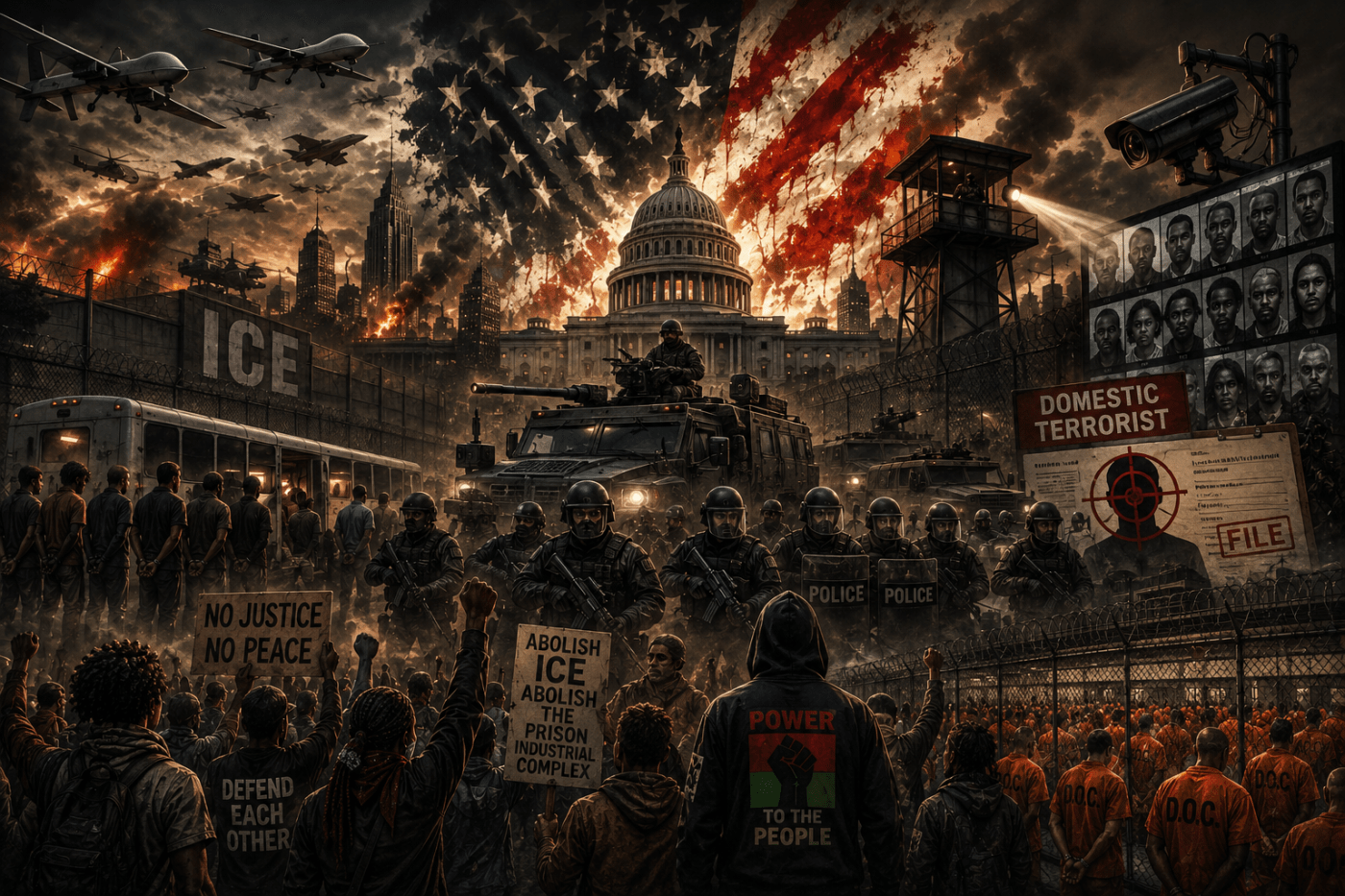
A liberal alarm about Trump’s “rolling coup” correctly identifies the expanding machinery of repression but mistakes it for a betrayal of American democracy rather than the latest stage in a much older settler-colonial and imperial project. By excavating what the article says, reconstructing what it omits, reframing the crisis from below, and identifying real movements already organizing against it, we discover that the danger is not merely authoritarianism but the consolidation of an empire increasingly willing to govern through open coercion. The institutions now preparing watch lists, detention centers, emergency powers, and counterterrorism authorities were not invented by Trump; they were built across generations and are now being turned inward as the legitimacy of the ruling order erodes. The answer is neither liberal nostalgia nor constitutional worship, but organized anti-imperialist solidarity capable of defending the people against the machinery of repression while building the foundations of a different future.
By Prince Kapone | Weaponized Information | June 23, 2026
The Republic Discovers Its Own Machinery
“The Rolling Coup”, written by Richard Gephardt and Timothy Wirth and published by The Nation on June 22, 2026, presents itself as an emergency warning from two old sentries of the republic. The authors argue that the Trump administration is methodically constructing an authoritarian apparatus through counterterrorism directives, domestic military preparation, political prosecutions, ICE expansion, emergency planning, and election interference. Their central claim is simple enough: unless Americans “wake up,” democracy will be destroyed not by tanks in the street on one dramatic morning, but by the quiet assembly of legal, bureaucratic, police, and military mechanisms that will make repression appear lawful before it becomes irreversible. In this narrow sense, they are not hallucinating. They see a machine. The trouble is that they describe the machine as if it fell from the sky in a red hat.
The Nation occupies a familiar place in the U.S. political ecosystem: progressive, liberal-left, reformist, alarmed by authoritarian excess, loyal to the best myths of the republic, and forever hoping that the constitutional house can be saved if only the arsonists are voted out and the smoke detectors are repaired. It is not Fox News. It is not the Wall Street Journal editorial board. It is not the polished mouthpiece of oil barons and war contractors. But neither is it a revolutionary paper of the colonized, the incarcerated, the deported, the occupied, or the working poor. Its radicalism too often stops at the courthouse steps, where it removes its hat, lowers its voice, and begins speaking in the sacred grammar of American democracy. This is the paper’s contradiction. It can identify danger with moral seriousness, yet it often cannot name the deeper system without trembling before its own inheritance.
The authors carry the same contradiction in human form. Richard Gephardt and Timothy Wirth are not writing from the shop floor, the reservation, the prison yard, the barrio, the Black neighborhood under police occupation, or the migrant shelter under raid. They write as retired managers of the imperial state, men who spent decades inside Congress, inside the constitutional machinery, inside the bipartisan theater where empire argues with itself over procedure while the bombs keep falling and the cages keep filling. Their warning therefore has the tone of institutional panic. The old house servants of the republic have smelled smoke in the master bedroom and now announce that the building may be unsafe. Those of us who have been living in the basement, breathing mold and dodging clubs, might be forgiven for asking where they have been.
The article’s first major device is an appeal to authority. The authors ask the reader to believe them because they have served “for seven decades” through Watergate, Vietnam, civil rights struggles, Iran-Contra, post-9/11 surveillance debates, and impeachments. This history is meant to establish credibility, and in a narrow procedural sense it does. They know the halls of power. But that is also the problem. To know the palace from the inside is not the same as knowing the empire from below. Their biography becomes both evidence and blindfold. They have witnessed many crimes of the state, but their conclusion is not that the state is criminal in its structure. Their conclusion is that Trump is making the state abnormal. This is how liberal authority works: it confesses enough to sound brave, then stops just before the confession becomes revolutionary.
The second device is fear. The article is saturated with the language of imminent collapse: democracy destroyed, emergency powers unleashed, political prisoners, domestic enemies, secret watch lists, military force, detention camps, and elections lost by decree. Much of this fear is not invented. But fear without historical depth becomes a recruiting poster for nostalgia. The reader is not invited to ask what kind of democracy already required mass incarceration, imperial war, police militarization, migrant cages, colonial occupation, and FBI disruption of Black liberation movements. The reader is invited to defend “our democracy” before asking who the “our” has ever included. That little pronoun does a great deal of dirty work. It launders conquest into citizenship, class rule into civic inheritance, and settler order into common property.
The third device is omission, the grand old cathedral bell of liberal propaganda. The article names repression but not settler colonialism. It names emergency power but not empire. It names political prisons as a threat but not the prison nation already built on Black, Brown, Indigenous, and poor bodies. It names domestic counterterrorism but not the long counterinsurgency tradition that targeted communists, antiwar organizers, Puerto Rican independentistas, Indigenous militants, Black Panthers, Muslims, migrants, and every other population that dared mistake the Bill of Rights for a shield. In the article’s world, repression becomes historically meaningful when it threatens the respectable opposition. Before that, apparently, it was merely policy.
The fourth device is bait and switch. The authors begin with real developments: memoranda, budgets, detention expansion, watch lists, prosecutions, and legal maneuvers. But the interpretation then shifts from the machinery of class and colonial rule to the morality tale of a republic under siege by one executive faction. The reader is handed evidence of state repression and then sold a remedy of institutional restoration. Congress must reassert itself. Governors must protect citizens. Newsrooms must connect the dots. Citizens must speak out in classrooms, pulpits, podcasts, union halls, workplaces, and kitchens. All fine as far as it goes. But it does not go far enough to frighten power. The fox is in the henhouse, yes; but the henhouse was designed by poultry capital, guarded by wolves, and built on stolen land. Calling animal control is not yet a revolution.
The fifth device is glittering generality. “Democracy,” “rule of law,” “balance of powers,” “social justice,” “empowerment of all citizens,” and “our avowed commitments” float through the piece like patriotic incense. These phrases are made to sound universal, but they are historically particular. In the United States, democracy has always been braided with exclusion, property, race, empire, and violence. The rule of law ruled over enslaved Africans, deported migrants, colonized Indigenous nations, striking workers, and bombed peoples abroad. The balance of powers balanced slave states against free states, capital against labor, settlers against the colonized, and imperial management against popular sovereignty. To speak of these ideals without their material history is not analysis. It is civic hymn-singing with a police siren in the background.
The sixth device is source hierarchy. The crisis is interpreted through the eyes of former federal officials, constitutional guardians, legal institutions, and elite political witnesses. The oppressed appear only indirectly, as potential victims of what may come, not as the people who have already endured the system in its mature form. This hierarchy matters because it determines where the story begins. If the story begins with Trump, then the solution is anti-Trump constitutional restoration. If the story begins with settler colonialism, slavery, empire, counterinsurgency, and racial capitalism, then Trump appears not as an asteroid but as a harvest. The liberal sees a monster entering the republic. The revolutionary sees the republic giving birth in public.
This is why the article must be excavated, not merely rejected. It contains real alarm, but the alarm is trapped inside settler common sense. It sees the rolling coup but not the rolling conquest. It sees the executive sharpening the knife but not the centuries-old kitchen where such blades are forged. It sees the possibility that Americans may be arrested for opposition, but it does not begin from the fact that America has always defined entire populations as enemies whenever they obstructed land theft, labor discipline, imperial expansion, or capitalist order. The task, then, is not to mock the warning. The task is to strip it of its patriotic anesthesia and put the machinery back into history.
The question is not whether Trump is dangerous. He is. The question is whether we will allow liberalism to make him exceptional in order to rescue the innocence of the system that produced him. A republic built through genocide, slavery, patriarchy, deportation, prison labor, imperial war, and anti-communist repression does not suddenly become authoritarian when its violence turns inward against more respectable citizens. It becomes honest. And when the ruling class becomes honest, the people must become organized.
The Facts the Republic Can See, and the History It Refuses to Name
The facts inside Gephardt and Wirth’s warning are serious enough. On September 25, 2025, Trump signed National Security Presidential Memorandum 7, titled “Countering Domestic Terrorism and Organized Political Violence,” a document sent to the secretaries of State, Treasury, Homeland Security, the attorney general, and other senior officials. The White House’s own fact sheet says the memorandum created a “comprehensive strategy” to “investigate, disrupt, and dismantle” organized political violence and domestic terrorism, which means the article is not inventing the existence of a federal counterterrorism turn against domestic political life. The later 2026 U.S. Counterterrorism Strategy sharpened the ideological blade by naming “violent left-wing extremists, including anarchists and anti-fascists,” alongside “narcoterrorists and transnational gangs” and “legacy Islamist terrorists.” In plain English, the state wrote a national security script in which left opposition, migrant criminalization, and foreign enemy construction all sit in the same theater of repression.
The detention side of the story is also not fantasy. In July 2025, Congress authorized $45 billion for ICE detention through fiscal year 2029, pushing immigrant detention into a scale that even liberal legal organizations described as unprecedented. The American Immigration Council reported that this funding came as ICE detention reached roughly 59,000 people, the highest level in U.S. history, while the Brennan Center warned that the budget could expand detention capacity from about 56,000 beds to more than 100,000. This was not simply a matter of “processing” migrants with paperwork and folding chairs. It was a material expansion of cages, guards, contracts, surveillance, transport, and legal abandonment, with the Brennan Center noting that private prison firms stood to benefit because nearly 90 percent of people in ICE custody were held in facilities run by for-profit companies. When a state pours billions into detention, it is not merely preparing policy. It is building infrastructure for human capture.
The article is also right that the foreign and domestic counterterrorism fronts are beginning to resemble one another. In the Caribbean and eastern Pacific, U.S. forces have carried out repeated strikes on boats labeled as “narcoterrorist” vessels, and the Associated Press reported on June 22, 2026, that a new strike brought the campaign to 60 strikes since September and more than 210 deaths. PBS similarly reported that U.S. Southern Command had released strike footage while providing no evidence that a targeted boat was involved in narcotrafficking. Here we see the old imperial habit: name a category, declare a threat, erase the human being, and let the missile become judge, jury, and executioner. The same vocabulary now wanders home in a different uniform. Abroad, “narcoterrorist” makes killing administratively convenient. At home, “domestic terrorist” makes dissent legally vulnerable.
But the article’s great weakness is that it treats this machinery as if it were only now becoming American. The United States already runs a vast prison system, and the Prison Policy Initiative’s 2026 analysis counts nearly two million people locked up across prisons, jails, detention centers, and other carceral institutions. That is not a footnote to democracy. That is one of its central domestic architectures. The Equal Justice Initiative describes U.S. prisons and jails as overcrowded, violent, and inhumane institutions that often fail to provide treatment, education, or rehabilitation. So when liberal officials warn that political prisons may be coming, the first correction is simple: the prison state is already here. What may be coming is not the birth of cages but the enlargement of their political target list.
The same is true of political repression. The Church Committee documented abuses by U.S. intelligence agencies after decades of surveillance, disruption, and illegal activity, while the Senate’s own historical summary identifies the committee as a response to investigations into FBI, CIA, IRS, and NSA abuses. Berkeley’s archive on FBI records notes that in 1967 the Bureau launched a covert operation targeting civil rights groups and Black leaders, including the Black Panther Party, Martin Luther King Jr., Elijah Muhammad, and Malcolm X. This matters because the “rolling coup” thesis becomes dishonest if it begins the history of federal political repression in 2025. The American state did not discover domestic enemies under Trump. It has always manufactured them when the poor, the Black, the Indigenous, the migrant, the communist, the antiwar militant, or the colonized refused to remain governable.
The police side of the omitted history is just as concrete. The Defense Logistics Agency explains that the LESO/1033 program allows excess Defense Department property and equipment to be transferred to federal, state, and local law enforcement agencies. The agency’s own program page says thousands of federal, tribal, state, and local law enforcement agencies have participated. This is the domestic face of empire’s military closet: the tools of war flow back into the hands of police, and then the police tell the poor they are being served and protected. The liberal article sees the danger of domestic military deployment, but it does not dwell on the already existing militarization of policing, where the soldier’s equipment becomes the cop’s costume and the neighborhood becomes a low-intensity battlefield.
Nor are Presidential Emergency Action Documents new inventions of Trumpian madness. The Brennan Center explains that PEADs are draft executive orders, proclamations, and messages to Congress prepared in advance of emergency scenarios. The same institution notes that these documents belong to a continuity-of-government system whose modern form developed under Cold War emergency planning, with later officials reviewing these secret powers after 9/11. The point is not that PEADs are harmless. The point is that the architecture of exception was not built by one vulgar real estate baron with a television addiction. It was built by the national security state, maintained across administrations, and hidden from the public under the old excuse that democracy must be protected by powers democracy is not allowed to see.
Weaponized Information has already named the deeper terrain that this article approaches but cannot fully cross. In “Race/Class 101: The Dialectics of Nation, Class Struggle and Revolutionary Rupture in the United States,” WI argued that the United States has never been a genuine multiracial democracy but a settler empire formed through genocide, slavery, racialized labor control, and colonial domination. That prior analysis is essential here because it prevents the present crisis from being reduced to Trump’s personality or Republican wickedness. Trump did not invent the border regime, the prison regime, the police regime, the intelligence regime, or the emergency regime. He inherited them, sharpened them, and gave their old colonial grammar a new campaign hat.
This is the factual terrain Gephardt and Wirth partly uncover and partly bury. Their article correctly identifies a federal turn toward domestic counterterrorism, a massive detention buildout, lethal executive violence abroad, emergency planning, and a threat to political opposition. But the omitted record is larger and older: mass incarceration already cages millions; COINTELPRO already targeted liberation movements; military equipment already flows into police departments; PEADs already sit inside the secret emergency state; ICE expansion already enriches detention capital; and U.S. imperial violence abroad already normalizes execution by designation. The facts do not show a democracy suddenly invaded by authoritarianism from outside. They show a settler empire entering a new stage of domestic consolidation, where the tools long used against the colonized are being reorganized for a broader crisis of rule.
The Coup Is the Republic Taking Off Its Gloves
The real story is not that American democracy is being destroyed by some foreign substance injected into the bloodstream of the republic. The real story is that the settler state, under pressure from crisis, is withdrawing the democratic courtesies it once distributed unevenly among the more comfortable layers of its population. The liberal mind experiences this as apocalypse because it mistakes the manners of empire for the nature of empire. It saw the smile, the handshake, the flag pin, the marble building, the civics textbook, the oath, the seal, the robes, and the polished wood of congressional ceremony, and from this stagecraft concluded that the United States was essentially democratic. But the colonized know better. The poor know better. The prisoner knows better. The migrant knows better. The Black mother whose child was stolen by police violence knows better. The Indigenous nation whose land was converted into constitutional property knows better. They have met the state without its perfume.
Gephardt and Wirth are correct to see machinery. They are wrong to see innocence. The machinery they describe did not emerge as a sudden deformation of a healthy body politic. It grew inside the same republic that built the prison system, militarized police, secret emergency powers, immigration cages, intelligence disruption, and imperial execution abroad. The contradiction is not democracy versus authoritarianism in the abstract. The contradiction is settler democracy versus the people it must govern, exploit, discipline, deport, incarcerate, surveil, and pacify in order to remain itself. Every empire prefers consent until consent becomes too expensive. Every ruling class prefers legality until legality becomes too slow. Every settler order prefers myth until the myth can no longer quiet the dispossessed. Then come the memoranda, the watch lists, the detention budgets, the special authorities, the new enemy categories, and the familiar old sermon about security.
This is why the language of the “rolling coup” is both useful and insufficient. It is useful because it identifies the step-by-step construction of an apparatus. It is insufficient because it treats the apparatus as a betrayal of the republic rather than a development of it. The state is not simply being seized from democracy; democracy itself has always been organized through exclusions enforced by the state. For the property-owning classes, democracy has meant elections, courts, speech, contracts, and orderly disagreement. For the oppressed, it has often meant patrols, warrants, raids, cages, deportation buses, intelligence files, and the soldier’s boot. The same Constitution that liberals now clutch like a family Bible did not prevent this history. It housed it. It regulated it. It gave it procedure. It taught violence to wear a necktie.
The counterterrorism turn must therefore be understood as counterinsurgency in domestic dress. The imperial state has long divided the world into legitimate civilization and threatening disorder. Abroad, it names the enemy communist, terrorist, rogue, narcotrafficker, dictator, extremist, or criminal network. At home, it names the enemy agitator, rioter, gang member, illegal alien, anti-American, extremist, or domestic terrorist. These are not neutral descriptions. They are instruments of classification. Once the state names the enemy, it organizes public fear, legal permission, financial tracking, police coordination, and physical force around that name. The human being disappears behind the category. The category becomes a target. The target becomes a file. The file becomes a raid. The raid becomes a lesson.
Here the foreign and domestic fronts converge. The boat destroyed at sea and the organizer investigated at home are separated by geography but joined by method. In both cases, the state claims the right to define danger before the people can examine evidence. In both cases, executive power expands through the magic words of national security. In both cases, the enemy is made killable, cageable, searchable, deportable, bank-freezable, and prosecutable by designation. This is the logic of militarized imperialism returning to the core. The empire has trained itself abroad to act without trial, without patience, without accountability, and without apology. Now the imperial technique comes home like a veteran with medals and bad habits.
The detention buildout is not an administrative accident. It is the architecture of class rule in concrete, razor wire, software, contracts, and beds. Capital does not merely support repression from a distance; it feeds on it. The cage is a business model, a labor discipline, a racial sorting device, a border weapon, and a political warning. The prison and the detention center tell the worker, the migrant, the dissident, and the poor: this is what happens when you become surplus, disobedient, undocumented, unprofitable, or ungovernable. The liberal sees a detention budget and asks whether due process will survive. The revolutionary sees a market in captivity and asks which class profits from human disappearance.
This is technofascism not as a slogan thrown at every ugly thing with a badge, but as a concrete fusion of state power, monopoly interests, surveillance systems, policing, border enforcement, emergency law, and ideological purification. It is not the cartoon fascism of a man with a funny mustache and a marching band. It is the spreadsheet fascism of budgets, databases, risk scores, interagency centers, private contracts, biometric capture, legal memoranda, and press releases written in the language of public safety. It does not need to abolish every institution at once. It can inhabit the institutions, rewire them, and make legality itself into the conveyor belt of repression. The coup rolls because the machinery is already on wheels.
The liberal response fails because it wants to defend the institutions from Trump without asking what those institutions have always done to the oppressed. Congress should reassert itself, they say. But Congress funded cages, wars, police, sanctions, and intelligence powers across administrations. Governors should shield citizens, they say. But governors have deployed police and troops against workers, students, prisoners, migrants, and Black rebellion when order required it. Newsrooms should connect the dots, they say. But newsrooms have spent generations teaching the public to fear the very people most targeted by the state. The problem is not that these measures are useless in every immediate sense. The problem is that they are politically inadequate when treated as the horizon of struggle.
To defend people against Trump’s repression, we do not have to defend the myth of the republic. That is the trap. The ruling class wants the people to choose between authoritarian brutality and liberal nostalgia, between the open fist and the velvet glove, between Trump’s emergency state and the old bipartisan order that built the tools he now sharpens. But the worker, the migrant, the prisoner, the colonized, and the poor owe no sentimental loyalty to the architecture of their domination. We can fight the raid without praising the old police chief. We can oppose political repression without pretending the FBI was ever a friend of liberation. We can resist detention camps without forgetting the prison nation. We can reject emergency rule without canonizing the Constitution that made Black bodies property and Indigenous land spoil.
The real contradiction is the crisis of imperial rule inside the imperial homeland. The United States can no longer govern as smoothly through abundance, legitimacy, and bipartisan mythology. Its empire is contested abroad. Its economy disciplines the working class at home. Its cities are marked by abandonment and police saturation. Its border regime grows more violent because its own policies help produce migration and then punish the migrant for arriving. Its political class cannot offer a future, so it offers enemies. It cannot repair the house, so it points to intruders. It cannot feed the people, so it expands the guard tower. This is imperialist decay in domestic form: the old ruling order, less able to manufacture consent, begins manufacturing emergencies.
The phrase “enemy within” is not an innovation. It is the settler state speaking its native language. The enemy within has always been the enslaved who might revolt, the Indigenous nation that might resist removal, the worker who might strike, the communist who might organize, the Black radical who might teach self-defense, the migrant who might refuse invisibility, the student who might connect tuition debt to war budgets, the mother who might ask why her child is dead, the prisoner who might write, the journalist who might name the system. The state does not fear violence in the abstract. It fears organized refusal. It fears the people discovering that the empire is not a natural condition but a political arrangement that can be broken.
This is why our task is not to repeat the liberal alarm in louder language. Our task is to reframe the crisis from below. The danger is real, but the danger is not that paradise may be lost. The danger is that a settler-colonial and imperial state, entering deeper crisis, is expanding the zone of people it is willing to govern by open coercion. The answer is not sleepy faith in institutional restoration. The answer is organized popular defense, anti-imperialist clarity, class struggle, abolitionist courage, and solidarity across the domestic and international fronts of repression. We do not need to save the mask. We need to stop the fist, disarm the machinery, and build power among the people who were never fooled by the costume in the first place.
Build the Shield Before the Knock Comes
If the state is building machinery for repression, then the people must build machinery for defense. Not panic. Not liberal candlelight therapy. Not another petition begging the arsonist to respect the fire code. Organization. The first duty is to join the struggles already confronting the domestic and international arms of this system. The Black Alliance for Peace, fiscally sponsored through Community Movement Builders, has already placed the question where it belongs: U.S. militarism abroad and police repression at home are not separate departments of evil, but two offices in the same imperial building. Its Divest from the Military campaign gives organizers a concrete line of attack: force cities, counties, unions, churches, campuses, and community institutions to break with militarized budgets, police-state logic, Pentagon contractors, and the machinery that turns public money into public fear.
The work must also be rooted in Black working-class community defense. Community Movement Builders, whose nonprofit filings are available through ProPublica’s nonprofit database, offers one model of organizing against displacement, over-policing, and the local class forces that make repression profitable neighborhood by neighborhood. This matters because the emergency state does not arrive only as a presidential memorandum. It arrives as a cop on the corner, a landlord’s eviction notice, a school resource officer, a surveillance camera, a city council budget, a jail contract, and a nonprofit poverty manager telling the people to calm down while capital walks away with the block. Any serious response must be local enough to know the police precinct, the jail, the courthouse, the employer, the landlord, and the city budget by name.
On the legal-defense front, organizers should connect with the National Lawyers Guild Mass Defense Program, whose organizational filings are listed through ProPublica. The point is not to worship lawyers, because the law has never been neutral ground for the oppressed. The point is to use every available tool while building power beyond the courtroom. Legal observers, Know Your Rights trainings, jail support, court support, rapid-response hotlines, protest defense, and repression documentation must become ordinary community infrastructure. The people should not wait until the raid, arrest, or indictment to learn the phone number, find the lawyer, locate the jail, or organize the support team. The shield must be built before the knock comes.
The migrant-defense front is equally urgent. The National Day Laborer Organizing Network, whose nonprofit profile is available through Charity Navigator, offers concrete examples of worker-centered resistance to ICE raids, deportation terror, wage theft, and the criminalization of migrant labor. Communities should organize ICE watch and raid-response networks around day-labor corners, schools, workplaces, courthouses, apartment complexes, shelters, and transit hubs. Every neighborhood should know how to document raids, alert families, protect children, raise bond funds, support detained workers, and confront employers who collaborate with immigration enforcement while profiting from migrant labor. The empire creates the migrant through war, sanctions, extraction, and dependency, then punishes the migrant for surviving the journey. Our answer must be defense without apology.
The detention economy must be attacked directly. Detention Watch Network, whose filings are available through ProPublica, has long organized against immigrant detention and the expansion of ICE’s cage system. This is where the abstract talk about democracy must become a concrete fight over beds, contracts, transport companies, county agreements, private prison firms, bond systems, and local officials who sell human beings to the federal machine by the head. Organizers should expose every detention contract, pressure counties to end ICE agreements, oppose new facilities, defend people facing deportation, and connect detention abolition to prison abolition. The cage is not an unfortunate excess of policy. It is a profit center, a racial weapon, a labor discipline, and a political warning.
The antiwar front must not be treated as separate from domestic repression. CODEPINK, whose public nonprofit filings are available through ProPublica, and the ANSWER Coalition, whose donation page identifies Progress Unity Fund as its fiscal sponsor, remain useful vehicles for mobilizing against the wars, sanctions, bases, occupations, and military budgets that feed the domestic police state. The same ruling class that labels boats “narcoterrorist” before blowing them apart will label organizers “domestic extremists” before raiding their homes. The same state that normalizes execution abroad normalizes detention at home. Every antiwar demonstration must therefore carry an anti-repression line, and every anti-repression campaign must carry an anti-imperialist line. Otherwise we are fighting the right hand while the left hand reloads.
The tactical direction is clear. Build local defense committees. Hold public study sessions on NSPM-7, ICE expansion, COINTELPRO, PEADs, police militarization, and the detention economy. Pressure unions to refuse collaboration with ICE and police militarization. Push churches, campuses, city councils, and community organizations to divest from military contractors, surveillance firms, and private prison profiteers. Create rapid-response trees for raids, arrests, and political prosecutions. Train legal observers. Build court support teams. Protect migrants and political organizers. Defend prisoners. Oppose new detention beds. Track local police access to military equipment. Refuse the separation of foreign policy from domestic policy. Above all, teach the people that repression is not an argument against struggle. It is proof that struggle has entered serious terrain.
Solidarity here must be concrete. Solidarity with migrants against ICE. Solidarity with Black communities against police occupation. Solidarity with Indigenous nations against the settler state. Solidarity with prisoners against the cage. Solidarity with antiwar organizers against surveillance and prosecution. Solidarity with the peoples abroad marked for sanctions, bombs, coups, and “counterterror” murder. The liberal says democracy is in danger and asks us to save the republic. We say the people are in danger and must organize to save one another from the republic’s machinery. The answer to the rolling coup is not a return to the old order that built the wheels. The answer is disciplined, rooted, anti-imperialist people’s power strong enough to stop the machine and begin building something human in its place.


Leave a comment