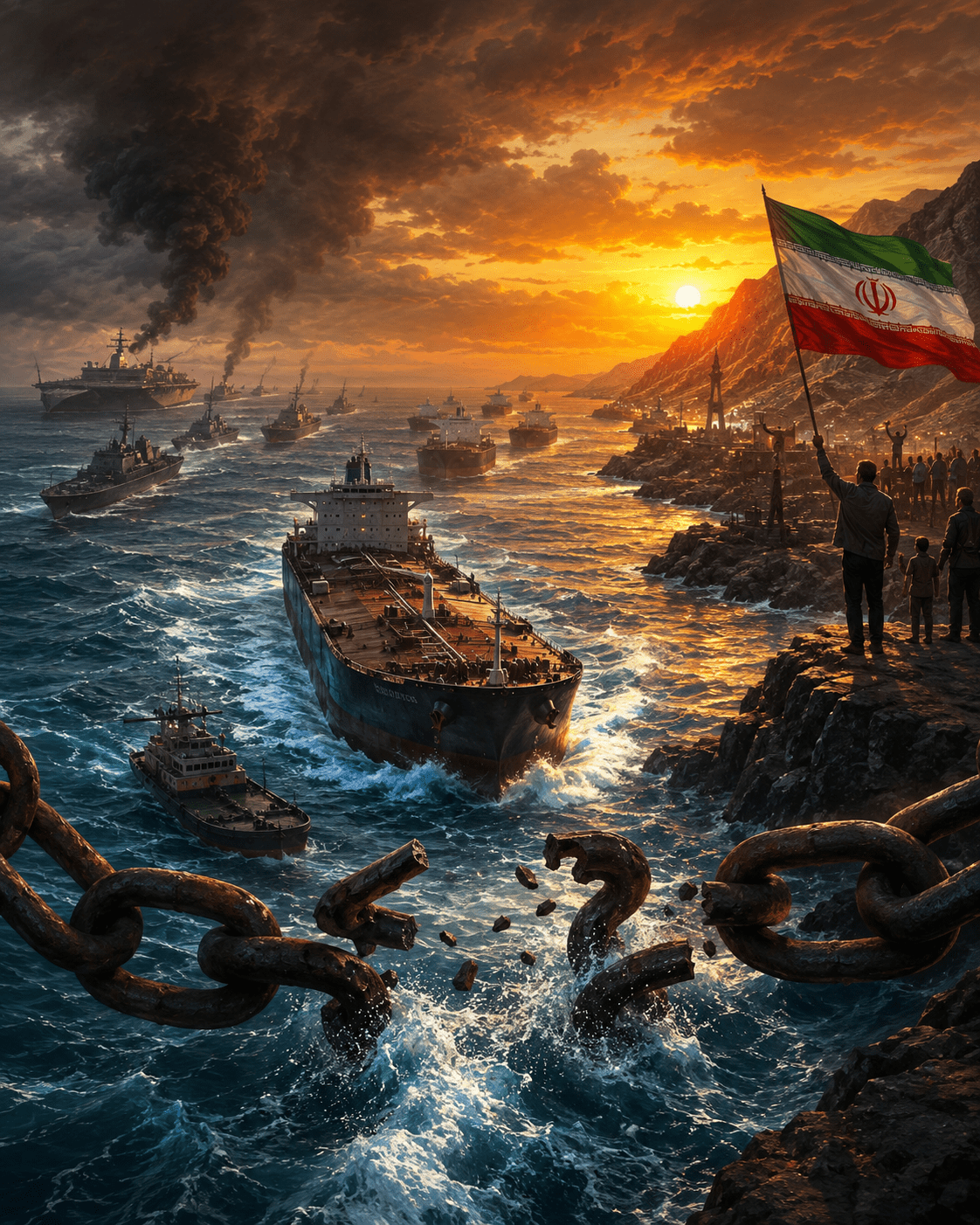
Politico turns Washington’s retreat into a Trump command performance, centering the president while Iran and the agreement itself disappear behind the spectacle. The fourteen-point MoU reveals a settlement rooted in Iranian demands, regional mediation, the lifting of U.S. coercion, and Washington’s failure to impose its declared war aims. Iran converted military resistance and control over Hormuz into diplomatic leverage, forcing the empire to sign terms it had gone to war to prevent. The task now is to organize workers, students, unions, and anti-imperialist movements to enforce the agreement and stop Washington’s retreat from becoming its next reload.
Prince Kapone | Weaponized Information | June 15, 2026
The President Who Authorized the End of His Own Blockade
In “Trump says Iran and US have reached deal to stop war,” published June 14, 2026, Politico reporters Diana Nerozzi and Aaron Pellish announce what appears, at first glance, to be the sudden arrival of peace after nearly four months of war. Donald Trump declares that the agreement is complete. Commercial shipping will resume through the Strait of Hormuz. The United States will remove its naval blockade. Oil will flow again. A formal signing ceremony will follow in Switzerland. The details, Politico concedes, remain largely unknown. Yet the headline has already delivered its verdict: Trump has made the deal, Trump has stopped the war, and Trump has reopened the sea.
The frame matters because Politico is not reporting from some neutral hilltop above the battlefield. It is a commercial Washington political-intelligence operation owned by Axel Springer, a transatlantic media corporation controlled principally by Friede Springer and Mathias Döpfner. Politico explains that its journalism is financed through advertising, sponsorships, and Politico Pro subscriptions purchased largely by corporations, organizations, policy professionals, and government agencies. Its reporters work within the political marketplace of Washington, where presidents speak first, officials define the reasonable limits of discussion, and the powerful are treated not merely as sources but as the natural authors of history.
That professional reflex determines the article’s source hierarchy. Trump speaks repeatedly and at length. His Truth Social posts provide the chronology, the language, and the drama. Pakistan’s prime minister enters mainly to certify Trump’s announcement. An analyst from an American investment bank explains what may happen to shipping and oil prices. Iran—the country without whose agreement no agreement could exist—is silenced. No Iranian official is quoted. No Iranian explanation of the memorandum is offered. The article therefore does not merely report Trump’s message; it allows Trump’s message to organize the reality being reported.
The central propaganda device is narrative framing. Trump does not simply announce that the parties have reached an understanding. He “authorizes” the reopening of Hormuz and “authorizes” the removal of the American blockade, as though the world’s sea lanes were private doors in one of his hotels. Politico reproduces this language without pausing over its comic imperial grandeur. The man who announces the withdrawal of his own blockade becomes the benefactor who has granted navigation to humanity. “Ships of the World, start your engines,” he commands, and the newspaper dutifully hands him the captain’s hat.
Omission and card stacking complete the performance. Politico foregrounds oil prices, mines, shipping delays, and Trump’s demand that Iran abandon its nuclear program. It acknowledges that other terms are unknown, but this uncertainty remains subordinate to the triumphant announcement. The absence of an authenticated text does not weaken the headline. The absence of Iranian voices does not disturb the narrative. The possible military, territorial, sanctions, reconstruction, and implementation provisions remain outside the frame because including them might complicate the image of Trump standing astride the Strait, personally waving the tankers through.
Finally, vagueness launders the conflict itself. “Ongoing hostilities,” “back-and-forth,” and strikes launched by “both sides” turn war into weather—a violent front that drifted into the region without origin, structure, or responsibility. Politico’s article does not need to invent a spectacular lie. Its method is quieter and more respectable: center the emperor, narrow the field of vision, remove the voices that might contest him, and announce his version before the terms themselves can speak.
The Fourteen Points Behind the Trump Spectacle
Politico reported on June 14 that Donald Trump had announced an agreement ending nearly four months of war between the United States and Iran. The article said the arrangement would remove the U.S. naval blockade, reopen the Strait of Hormuz and lead to a formal signing ceremony in Switzerland on Friday. It acknowledged that no text had been released, Iran had not publicly commented on Trump’s announcement and the nuclear question remained unresolved. Oil prices fell, although damaged infrastructure, naval mines and the gradual return of tanker traffic meant that neither Hormuz nor global energy markets would immediately return to their prewar condition.
By June 15, events had moved beyond Politico’s Sunday account. Trump said the agreement was “all signed,” while Vice President JD Vance said it had been signed digitally on June 14. Senior U.S. officials identified the signatories as Trump, Vance and Iranian Parliament Speaker Mohammad Bagher Qalibaf. Iran’s Supreme National Security Council announced that the text had been finalized through the Islamabad talks, military operations on all fronts—including Lebanon—were ended immediately and permanently, and the naval blockade was terminated immediately and completely. The June 19 gathering in Geneva became the formal public ceremony for an MoU already electronically signed, while release of the authenticated text remained pending.
The memorandum did not originate as a Trump proposal. Pakistan traced the agreement to Iran’s original fourteen-point proposal, reviewed repeatedly in Tehran and Washington during sixty days of Pakistan-mediated negotiations. Qatar joined the final diplomatic effort, and Iran’s security council thanked both states for their mediation. Foreign Minister Abbas Araghchi described the fourteen provisions as one interconnected package divided into an immediate end-of-war stage and a second stage covering the nuclear file, sanctions and reconstruction. This Iranian disclosure provides the most detailed public baseline for the signed framework until the final text is released.
The disclosed MoU begins with an immediate and permanent end to war on all fronts, including Lebanon; U.S. noninterference; written respect for Iranian sovereignty; complete removal of the blockade within thirty days; withdrawal of U.S. forces from Iran’s vicinity; and reopening Hormuz within thirty days under Iranian arrangements. It suspends sanctions on Iranian oil and petrochemicals, restores access to Iranian financial resources and requires reconstruction proposals totaling at least $300 billion. A sixty-day second phase would address enriched material, enrichment levels, removal of U.S. primary and secondary sanctions, relevant UN and IAEA measures and Iran’s reconstruction program. Iran would reaffirm its NPT commitment not to produce nuclear weapons, while Washington would add neither forces nor sanctions during the negotiations.
The remaining provisions establish the sequence. The text calls for the release of $24 billion in blocked Iranian funds, with half available before final negotiations; a monitoring mechanism; and eventual UN Security Council ratification of a comprehensive agreement. The second phase would not begin until half of the funds had been released, oil sanctions suspended and the blockade lifted. Its agenda would be confined to enriched materials and enrichment, sanctions relief and reconstruction; Iran’s missile program and support for resistance organizations were removed from the table. Araghchi independently confirmed the frozen-assets provision, reconstruction mechanism, two-stage sequence, Iranian-Omani authority over Hormuz and Iran’s position that enriched material could be diluted only inside Iran.
Implementation immediately became contested. Iran’s security council stated that final negotiations would not begin until the United States fulfilled its MoU obligations. U.S. officials told Reuters that sanctions relief and frozen funds would depend upon Iranian cooperation on nuclear issues and what Washington called regional “radicalism,” while Israeli withdrawal from Lebanon was not a condition. Iran maintained that Lebanon was inseparable from the cessation and that American implementation preceded the second phase. The dispute now concerned what the parties had signed and who was required to act first.
The war did not begin as an unexplained exchange of “hostilities.” The UN secretary-general identified the February 28 use of force by the United States and Israel against Iran, followed by Iranian retaliation. Washington declared that Operation Epic Fury would obliterate Iran’s missile arsenal and production capacity, annihilate its navy, destroy security infrastructure, sever support for regional allies and close its nuclear pathway. The first-stage MoU instead ended the war and blockade while reserving a limited nuclear, sanctions and reconstruction agenda for later talks.
The negotiations also belonged to a longer history. U.S. records acknowledge Washington’s role in the 1953 overthrow of Mohammad Mossadegh; Trump abandoned the JCPOA and restored sanctions in 2018; and his administration renewed maximum pressure in 2025 with the goal of driving Iranian oil exports toward zero. The MoU’s provisions on sovereignty, oil sales, blocked funds and reconstruction addressed instruments of coercion already used against Iran.
Hormuz gave the conflict global weight. More than one-quarter of world seaborne oil trade, around one-fifth of global petroleum consumption and roughly one-fifth of LNG trade normally pass through the Strait. By May, Middle Eastern production shut-ins averaged 11.3 million barrels per day, inventories were being depleted and a return to prewar production and trade patterns was not expected before early 2027. Weaponized Information had already documented Washington’s inability to reopen normal maritime circulation through force, while its reporting traced Pakistan’s rise as the channel through which proposals moved between Tehran and Washington. The MoU emerged from that military, economic, maritime and diplomatic sequence—not from a presidential social-media post.
Washington Went to Break Iran—and Signed Iran’s Terms Instead
Let us speak plainly. The United States did not go to war with Iran because it wanted a reasonable agreement. It did not send the bombers, tighten the blockade, choke the oil trade, freeze Iranian money, and tear up the region because Donald Trump had suddenly developed a passion for diplomacy. Washington went to war to break Iran. It said so itself. It wanted Iran’s missiles destroyed, its navy crushed, its defense industry crippled, its nuclear program bent to American command, and its ties to the resistance severed. The empire walked into this war demanding Iran’s surrender. It walked out signing a framework built from Iran’s fourteen-point proposal.
That is the story Trump’s victory parade is supposed to hide. The MoU did not fall out of Trump’s mouth fully formed. Iran put the proposal on the table. Pakistan carried it between Tehran and Washington. The two sides worked through it for weeks. Qatar helped close the final gaps. Then the United States signed. Trump can holler at the world’s ships like some casino boss ordering valets around his parking lot, but the shouting cannot change the paper beneath his hand. Washington signed a framework written around the demands of the country it had tried to force to its knees.
And look at where the agreement begins. It does not begin with Iran disarming. It does not begin with Iran surrendering its enriched material, dismantling its missiles, abandoning its allies, or crawling into another inspection chamber with its hands over its head. It begins with ending the war. Ending the blockade. Respecting Iranian sovereignty. Releasing Iranian resources. Addressing sanctions and reconstruction. Pulling back the machinery of war. Reopening Hormuz under arrangements made by Iran and Oman.
Washington has to start undoing what Washington did before the next round even begins. That order matters. Empire usually writes these deals the other way around. The oppressed country must give up everything first and wait patiently for the imperial power to keep its word later. Disarm first. Open your economy first. Cut off your friends first. Accept the inspectors first. Hand over your leverage first. Trust us, they say. The reward is coming.
It never comes. The sanctions stay. The money stays frozen. The bases stay open. The promises turn into “conditions.” The conditions turn into new demands. The country that surrendered is then accused of failing to surrender properly. Iran’s framework flips that old colonial script. The government that imposed the blockade must lift it. The power that blocked Iranian oil must suspend the restrictions. The state sitting on Iranian money must release it. The side that launched the war must begin stepping back before it demands another concession from the country it attacked. That is not some technical detail buried in diplomatic fine print. That is where the defeat is written.
Not the final defeat of imperialism. Not the end of American power. Not a fairy-tale victory after which everybody goes home and the danger disappears. But a real defeat measured against Washington’s own declared aims. The United States went in demanding control over Iran’s missiles, navy, nuclear program, regional alliances, and strategic independence. It came out with a later negotiating agenda narrowed to nuclear material, enrichment, sanctions, and reconstruction. The missile program stayed off the table. Iran’s support for the resistance stayed off the table. Washington demanded the whole house and ended up arguing over one room.
Hormuz is where the empire learned that bombs are not the same thing as control. The United States could strike Iran. It could blockade ports. It could destroy infrastructure and send threats across every television screen in the Western world. But it could not attack Iran and keep the global economy untouched. The Strait carried too much oil, too much gas, too much trade. The empire wanted to set the kitchen on fire while keeping dinner service running. Iran’s position at Hormuz made that impossible.
The Strait turned geography into leverage. It showed that the world economy still moves through real places—ports, pipelines, shipping lanes, narrow waters beside sovereign countries. These things cannot be ordered around by a man posting in capital letters. The United States had the bigger guns, but Iran could still impose costs Washington could not contain. The empire could cause destruction. It could not command the consequences.
So Trump did what imperial politicians do best: he took a retreat, wrapped it in a flag, and sold it as an act of generosity. He declared that he had “authorized” the reopening of Hormuz, as though Iran and Oman were janitors waiting for the landlord to hand over the keys. But Washington did not grant Iran authority over the Strait. Washington negotiated its way back into a waterway the war had made dangerous and expensive to use. Trump lifted his own blockade and demanded applause for freeing the ships from himself. The robber opened the door he had locked and asked to be thanked for letting everybody out.
The same crooked logic runs through the talk of sanctions relief. Iranian oil revenues are treated like American property. Iranian assets are discussed as money Washington may graciously return. Reconstruction is presented as a favor to be negotiated by the very power that helped produce the destruction. First they block your money. Then they call the theft “pressure.” Then they offer to release part of it and call that diplomacy. A man steals your coat in winter, hands back one sleeve, and demands proof that you are grateful.
Iran was also not standing alone in a room built and guarded by Washington. Pakistan carried the negotiations. Qatar helped mediate. Iran stood inside BRICS and the Shanghai Cooperation Organisation. None of that made American power disappear. But it meant Washington no longer owned every door, every table, every messenger, and every witness. Iran had somewhere else to stand. It had other channels through which to speak. The empire could still threaten, but it could not completely monopolize the terms of the conversation.
For working people, the end of the fighting is not an abstraction. Workers did not plan this war, but workers paid for it. They paid through rising fuel costs, disrupted transport, shortages, lost production, and public money poured into weapons and destruction. The generals moved pieces on a map. The people were handed the bill.
Stopping the war and lifting the blockade are real gains. We should say that without embarrassment. But a gain is not a guarantee. A signed agreement is not the same thing as an honest empire. Washington signed the framework and immediately began explaining that it did not mean what Iran said it meant. American officials started tying Iranian money and sanctions relief to new conditions. They dragged Iran’s regional role back into the conversation. They denied obligations connected to Lebanon. The bombs had barely stopped before the battle over the meaning of the agreement began.
This is not simple confusion. Washington failed to impose its terms through war, so it will now try to impose them through interpretation, delay, selective enforcement, anonymous briefings, and Israeli sabotage. The empire could not break Iran on the battlefield. It will try to pick apart the agreement paragraph by paragraph.
That is why we should recognize the victory without falling asleep beside it. Iran forced Washington into a retreat. Washington signed a framework shaped by Iranian demands. That is a major defeat for Western imperialism. But the empire has not become peaceful, honest, or reconciled to what it signed. A wounded beast remains a beast. Sometimes it steps backward because it has learned humility. More often, it steps backward because it wants room to lunge again.
Trump did not stop this war out of mercy. Iran resisted until Washington could no longer get what it wanted at a price it was willing to pay. Iran carried that resistance to the negotiating table and turned it into terms. The United States signed those terms, ran to the cameras, and pretended the whole thing had been Trump’s idea.
Empire has a thousand words for victory and not one honest word for retreat. But the paper tells the truth. Washington went to war to break Iran. It signed Iran’s framework instead.
Make the Empire Obey What It Signed
The war has entered a new phase, and so must the movement. The bombs may have stopped for the moment, but imperialism has not packed its bags, closed its bases, unfrozen Iran’s wealth, or abandoned its appetite for domination. Washington signed because resistance made the war too costly to continue on Washington’s preferred terms. Our task inside the belly of the beast is to make sure this retreat does not become a reload.
The immediate organizing center should be the Black Alliance for Peace’s campaign of mass resistance in solidarity with Iran and Palestine. BAP has already called for demonstrations, labor resolutions, political education, walkouts, strikes, pickets, sit-ins, and coordinated local actions against the war. Its Divest from the Military campaign gives communities a concrete method for attacking the material base of the war machine through unions, pension funds, universities, churches, municipalities, and public institutions.
Every union local should introduce its own version of the Boston Teachers Union’s “No War on Iran” resolution. The BTU unanimously connected the war to cuts in education, social services, and public resources, and directed its members toward protests, antiwar coalitions, public statements, and pressure on elected officials. Teachers, nurses, transit workers, postal workers, port workers, warehouse workers, public employees, and industrial workers should adapt that model to demand full implementation of the MoU: lift the blockade, release Iranian assets, stop the sanctions, respect Lebanon, and reject every attempt to smuggle Iran’s missiles and regional alliances back onto the negotiating table.
Students have already shown how quickly action can move when young people refuse to wait for respectable permission. Edina High School students organized a grassroots walkout against the war, linking regime change and military spending to Iranian self-determination and the burdens imposed on ordinary people. That example should spread through high schools, colleges, and universities as teach-ins, walkouts, student-newspaper interventions, classroom resolutions, and campus divestment campaigns.
The movement must also establish a public MoU Implementation Watch. Every clause should be tracked: the blockade, shipping advisories, frozen assets, oil sanctions, reconstruction, Lebanon, U.S. troop movements, and the opening of final negotiations. Washington has already begun telling the press that the agreement means something different from what Iran says it signed. We should not allow anonymous officials and corporate editors to rewrite the document clause by clause while the public sleeps.
Existing emergency protest networks should maintain their contact lists, speakers, marshals, graphics, transportation plans, and rapid-response infrastructure. Any renewed U.S. bombing, continued blockade, sanctions sabotage, seizure of Iranian resources, attack on Lebanon, or refusal to implement the agreed sequence should trigger demonstrations, workplace resolutions, student walkouts, congressional disruptions, and coordinated media interventions.
The demand is simple: enforce the agreement, end the coercion, and keep the imperial war machine off Iran. Washington signed because Iran forced it backward. The masses inside the imperial core must organize to keep it moving backward.
 Weaponized Information
Leave a comment