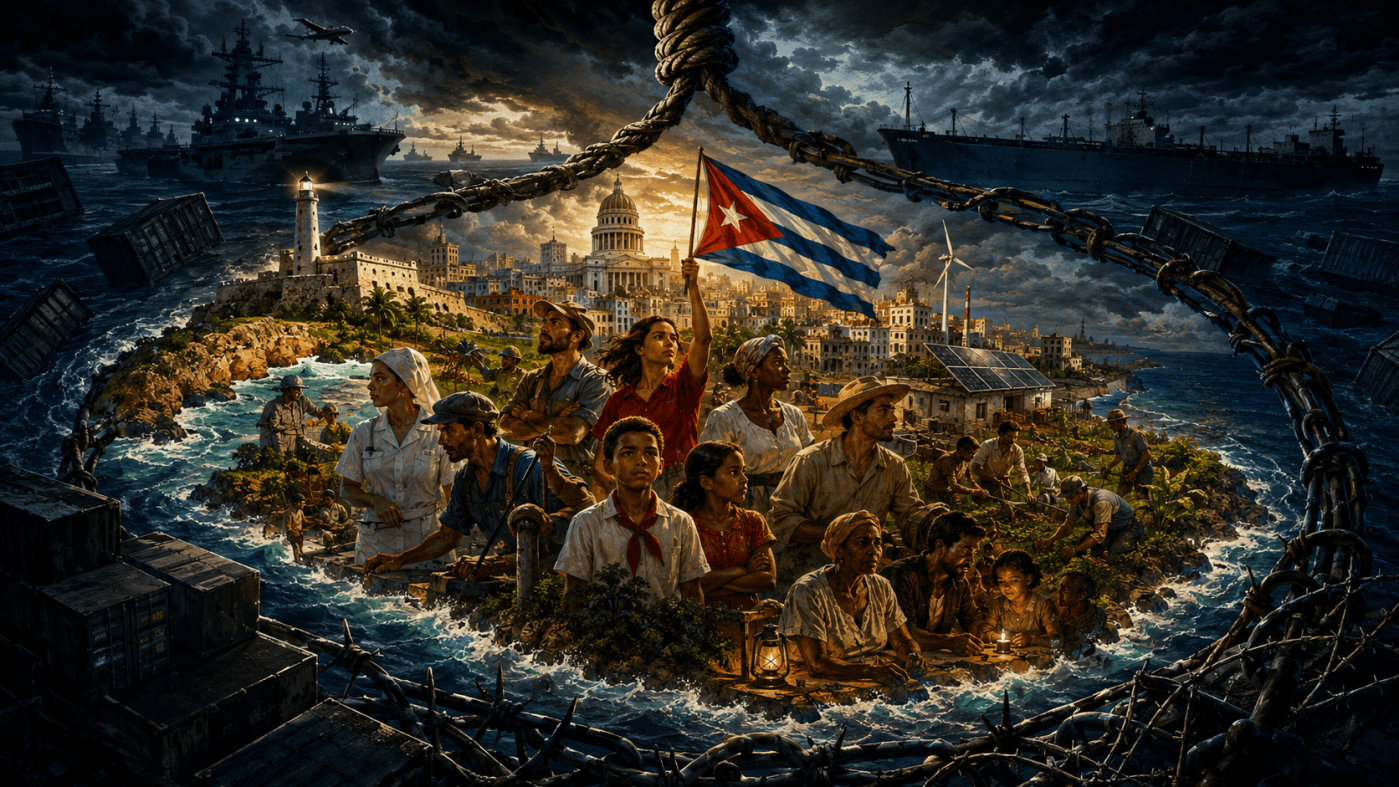
The Associated Press arranges Cuba’s reform announcement as a confession that socialism has failed, while quietly laundering Washington’s coercion into the background. The facts reveal a broad restructuring of planning, enterprise management, agriculture, foreign investment and municipal power taking place under an escalating economic siege. Cuba’s catastrophe is not the natural outcome of socialist dogmatism, but the accumulated damage of imperial warfare designed to manufacture hunger, exhaustion and political surrender. Defending the Revolution now requires organized resistance through anti-blockade mobilization, material aid, labor action and international solidarity with Cuba and the oppressed nations of the Global South.
Prince Kapone | Weaponized Inforation | June 14, 2026
The Confession AP Wrote Before Cuba Had Finished Speaking
On June 12, 2026, Associated Press correspondent Andrea Rodríguez published “Díaz-Canel announces economic reforms to attract investment and involve Cubans abroad,” a report from Havana on a forthcoming Cuban reform package involving foreign investment, diaspora participation, municipal administration and foreign trade. The article contains genuine news. Cuba is preparing significant changes, Díaz-Canel says the present course cannot continue, and the country is struggling through fuel shortages, food insecurity and power cuts. But AP does not merely report that Cuba is changing. It arranges the story so that socialism appears to enter the courtroom, lower its head and confess that the prosecution was right all along.
The institutional voice matters. The Associated Press describes itself as a global, independent, not-for-profit news cooperative, and its leadership says it is run as a business whose revenue is reinvested into its operations. This does not place the wire service outside bourgeois journalism. AP sits upstream in the information industry: its dispatches provide language and cues that other outlets reproduce at industrial speed. One sentence in Havana can become common sense in a thousand newsrooms.
Rodríguez is reporting from Havana rather than issuing decrees from a Washington think tank, and the problem is not her personal morality or hidden intention. The problem is the professional machinery visible in the text. Cuban officials provide the announcement, but they are not permitted to define its meaning. Díaz-Canel’s remarks about using crisis as an opportunity for growth are placed beside economist Pedro Monreal, whose credentials are supplied before he declares centralized planning a failure with only two respectable exits. Cuba speaks; authority interprets. The Revolution supplies the facts, while the approved expert supplies the verdict.
This is source hierarchy disguised as balance. AP stresses that Díaz-Canel offered few details and no timetable, yet it never grants equal space to the aims Cuba attaches to reform. There is no inquiry into what decentralization should accomplish, which sectors would remain under public control, how investment would be regulated, or whether the measures are intended to repair socialism rather than bury it. Vagueness becomes a one-way weapon: Cuban proposals are too undefined to be taken seriously, but “economic liberalization” is precise enough to carry Washington’s program without explanation.
The report practices card stacking with remarkable efficiency. Fuel shortages, food insecurity, humanitarian shipments, a “centralized, vertical system,” independent workers and private enterprises are arranged in a neat descending line. Each item is recognizable; together they manufacture a predetermined destination. The reader is guided from scarcity to state control and from state control to failure without being shown the missing steps. The arrangement performs the ideological labor an open argument would have been forced to defend.
A bait and switch follows beneath the neutral tone. The announced subject is Cuban economic reform. By the end, Washington’s demand for political and economic liberalization in exchange for sanctions relief has entered the story as though it were an ordinary negotiation between equal parties. The power imposing deprivation becomes a stern creditor offering reasonable terms, while the pressured country becomes a debtor refusing common sense. Coercion is washed, pressed and returned wearing the suit of policy.
AP never needs to openly declare that socialism has failed. It only needs to organize every fact so that no other conclusion appears respectable. Cuba’s attempt to revise its economic mechanisms becomes a retreat from ideology into reality, rather than a struggle over how reality should be organized and for whom. The confession has been written before the reform program has even been published. All that remains is for Cuba to sign it.
What Cuba Is Changing, and the Conditions in Which It Must Change
The Associated Press reports that Miguel Díaz-Canel announced a forthcoming package of economic reforms intended to attract foreign investment, broaden economic participation by Cubans living abroad and decentralize parts of state administration. It also reports that the measures had not yet been issued in full and that no implementation timetable was provided. Díaz-Canel nevertheless identified foreign trade, exports, supply chains and logistics as areas under review, including the possible elimination of compulsory state intermediaries in import and export operations and tariff advantages for those bringing raw materials into the country for production. The article places the announcement amid fuel shortages, food insecurity and severe power cuts, and records the June arrival of nearly 100 tons of Colombian food, medicine, hospital supplies, electrical materials and solar panels after an earlier shipment of 1,700 tons from Mexico and Belize. It further states that Cuba currently produces about 40 percent of the oil it consumes.
The fuller Cuban presentation supplies details that AP leaves largely outside the frame. The Economic and Social Program for 2026 was submitted to public discussion in late 2025, revised after proposals emerged from that consultation and then examined with specialists before being prepared for consideration by the Communist Party Political Bureau and the National Assembly of People’s Power. The program addresses more than twenty areas of economic and social policy. Cuban officials also compared the country’s circumstances with the reform experiences of China and Vietnam while stressing that neither model can be mechanically transferred to Cuba.
The proposed decentralization would give municipalities greater authority to organize local production, administer development projects, approve certain investments and coordinate relationships among economic actors. These actors would include state enterprises, cooperatives, private firms, foreign investors and Cubans residing abroad. National planning would retain responsibility for strategic priorities, while municipalities would receive greater control over the productive systems and resources operating within their territories.
State enterprises would remain central to the economy but would receive greater operating autonomy over wages, suppliers, customers, retained earnings, production beyond state assignments and direct participation in foreign trade. Enterprises would be expected to fulfill designated state responsibilities while developing additional production for domestic demand and export. The program also calls for stronger worker participation in enterprise decisions, expanded lawful activities for non-state firms and faster approval of state and private micro, small and medium enterprises.
The agricultural and trade measures are similarly concrete. The program proposes faster allocation of idle land, improved access to productive inputs and foreign currency, and wider associations among state, cooperative, private and foreign-investment producers. It also proposes removing mandatory import-export intermediaries in suitable cases and restructuring tariffs to favor machinery, raw materials and other productive inputs over finished consumer goods. These measures address shortages in domestic production, export earnings, logistics and industrial supply rather than merely enlarging private retail commerce.
The current package continues an earlier reform process. Cuba legally established micro, small and medium enterprises through Decree-Law 46 in 2021 and replaced that initial framework with Decree-Law 88 in 2024. By November 2025, the country reported 376 businesses with foreign capital from forty countries. Thirty-two businesses approved during the first ten months of that year carried committed capital of approximately $2.1 billion. Cuban authorities had already announced revised banking arrangements, simplified approval procedures and foreign-currency mechanisms intended to keep investments operating despite external payment and financing obstacles.
Those obstacles include measures adopted during Donald Trump’s second administration. On January 29, 2026, the White House declared Cuba an “unusual and extraordinary threat” and established a process for imposing tariffs on goods from countries selling or supplying oil to the island. A February order ended the additional tariff actions authorized in January but left the underlying national emergency and non-tariff measures in place. On May 1, the administration expanded its sanctioning authority under the International Emergency Economic Powers Act against persons and entities associated with Cuban government institutions and material support for the state.
These measures sit on top of a longer extraterritorial structure. The Cuban Democracy Act restricted Cuban commerce conducted through foreign subsidiaries of U.S. firms and prohibited vessels engaged in Cuban trade from loading or unloading freight in U.S. ports for 180 days without authorization. The Helms-Burton Act later codified major embargo provisions and tied their suspension to political conditions established by Washington. The intended use of economic deprivation had already been recorded in an April 1960 State Department memorandum recommending measures to deny Cuba money and supplies, reduce monetary and real wages, produce hunger and desperation and bring about the overthrow of the government.
Cuba’s current reform options are also connected to economic relations outside the U.S.-dominated market. Cooperation with Vietnam includes rice cultivation, machinery, agricultural inputs, technical training and infrastructure rehabilitation. A Vietnam-Cuba agricultural project recorded a 2025 pilot yield of 7.2 tons per hectare compared with a reported local average of 1.6 tons, with the harvested rice designated for sale to the Cuban state as a replacement for imports. Cuba has also developed biotechnology and pharmaceutical production and research relationships with Vietnam and China, including joint ventures, technology exchange and pharmaceutical development.
The international setting is therefore broader than a bilateral disagreement between Havana and Washington. On October 29, 2025, the United Nations General Assembly adopted its thirty-third resolution calling for an end to the U.S. economic, commercial and financial embargo by 165 votes to seven, with twelve abstentions. Cuba is preparing changes to planning, enterprise management, agriculture, investment, municipal administration and foreign trade while the legal, financial, shipping and energy restrictions surrounding the island remain in force.
The Revolution Has Never Been Allowed to Breathe
The Associated Press wants the reader to see a socialist economy finally cornered by reality. Cuba, in this telling, experimented with planning, resisted the wisdom of the market, exhausted its options and has now begun retreating toward the economic truths it spent decades denying. But this story rests upon a fraud so enormous that bourgeois journalism must reduce it to background noise in order to proceed. Cuba has never been permitted to develop its economic system under conditions of peace, sovereignty or ordinary exchange. From the first years of the Revolution, its institutions have been forced to operate inside a state of siege imposed by the most powerful capitalist state on earth.
This distinction is not secondary. It is the beginning of the analysis. The Cuban model was not designed in a quiet laboratory where planners were free to select the most efficient combination of institutions, incentives, investments and trade relationships. It was conceived and constructed while the country was being denied money, supplies, markets, shipping, credit and technological access. The state was compelled to concentrate resources, control foreign trade, protect strategic industries and organize economic survival under conditions in which dependency could be weaponized at any moment. What AP calls a rigid model was never free to develop as its architects intended. It was a model built while somebody was tightening a hand around the country’s throat.
That siege did not merely obstruct Cuban socialism from the outside. It entered the model and shaped its internal development. When ordinary commercial relationships are closed, alternatives become necessities. When access to fuel, machinery, investment and credit can be interrupted by hostile power, the state is forced to allocate scarcity through administrative means. When shipping companies and foreign subsidiaries can be punished for trading with the island, economic decisions that would otherwise concern production become matters of national defense. When survival itself depends upon securing reliable partners, dependence upon those partners can deepen beyond what would have been desirable under different conditions. Imperialism first narrows the field of available choices and then condemns Cuba for the choices made inside the prison yard.
None of this requires pretending that every Cuban policy was correct. Bureaucratic delay is real. Weak incentives are real. Agricultural underproduction, inefficient administration and poor enterprise performance are real. A revolutionary government does not become infallible merely because its enemy is monstrous. But to acknowledge internal contradictions is not to erase the material environment that continually reproduces and magnifies them. An inefficient enterprise is one problem; an inefficient enterprise denied regular fuel, financing, replacement parts, shipping and access to suppliers is another. Imperial propaganda merges the two, subtracts the siege and presents the remainder as a scientific verdict upon socialism.
The trick depends upon circular reasoning. Washington restricts Cuba’s ability to produce, import, export and finance development. The resulting scarcity is then cited as proof that Cuban economic institutions cannot function. The blockade creates the wound, the corporate press photographs the wound, the approved expert diagnoses it as a hereditary disease, and the government responsible for the injury offers medicine on the condition that the patient surrender political control of the hospital. This is not an accidental contradiction in U.S. policy. It is the method. Economic suffering becomes evidence against the social order that suffering was designed to overthrow.
That method is becoming more severe. Cuba is now being forced to reorganize its economy while energy access, foreign trade and productive supply are subjected to intensified pressure. The present reforms are therefore not the product of a peaceful national conversation over abstract economic preferences. They are emergency adaptations being developed under conditions intended to make normal social reproduction increasingly difficult. Municipal authority, enterprise autonomy, new investment arrangements, expanded non-state activity and direct participation in foreign trade are being introduced because the existing mechanisms cannot simply continue unchanged while the external constraints surrounding them grow tighter.
This creates a contradiction more dangerous than the easy slogans of either camp admit. Cuba must change. It must increase production, improve incentives, decentralize decisions, attract investment and release productive initiative now trapped inside procedures that no longer correspond to present conditions. But the very pressure making reform necessary also seeks to shape the social forces that reform will empower. Washington does not oppose every form of Cuban economic activity. It openly prefers those economic actors that can be separated from the revolutionary state, connected to foreign capital and developed into a social bloc with material interests opposed to socialist planning. The blockade does not merely demand economic change. It attempts to preselect the class character of that change.
The danger therefore comes from two directions. If the Revolution refuses necessary reform, productive paralysis can deepen scarcity, informal accumulation and popular exhaustion. Administrative immobility does not preserve socialism merely because it preserves old procedures. When the formal economy cannot reproduce the worker or supply production, unregulated markets and private networks expand beyond public control. But reform without socialist discipline carries its own danger. Foreign investment can become foreign command. Private enterprise can become class power. Decentralization can become fragmentation. Wealth generated as a tool of recovery can become the foundation of an oligarchy capable of purchasing influence and redirecting the state.
The dividing line is sovereignty. Markets, private businesses, differentiated wages and foreign capital do not by themselves determine the social character of the system. The decisive question is who commands them, who benefits from them and what political power they are permitted to accumulate. A socialist reform remains socialist when investment is directed toward national development, when strategic sectors remain under public authority, when workers participate in management, when cooperatives are given genuine room to grow, and when private wealth cannot convert itself into sovereignty over the nation. The issue is not whether Cuba uses economic instruments associated with markets. The issue is whether those instruments remain subordinate to the Revolution or begin to reorganize the Revolution around capital.
This is why China and Vietnam cannot be reduced to moral fables about pragmatism while Cuba is assigned the role of dogmatism. Their experiences show that socialist states can revise economic mechanisms without formally surrendering political authority or strategic planning. But Cuba has been denied the same room to maneuver. It has not been offered normalization, secure access to markets or freedom from coercive pressure in exchange for reform. It is being ordered to reform while the hand around its throat tightens, and then told that any attempt to defend its sovereignty proves that it has learned nothing.
The catastrophe AP displays as the failure of socialism is therefore something else. It is the intended product of economic warfare. The shortages, blackouts, infrastructure failures and productive dislocations are not evidence that the blockade does not matter. They are evidence that it works exactly as designed. This is the brutality at the core of capitalist imperialism: an entire people can be subjected to material deprivation until exhaustion itself becomes a political weapon, and their suffering can then be presented as a neutral market judgment against the social system they chose.
But this is only a partial imperial victory. The siege has inflicted enormous damage. It has distorted development, narrowed choices, deepened weaknesses and forced the Revolution into repeated defensive adaptations. What it has not yet done is restore U.S. command, dissolve Cuban sovereignty or overthrow the political power created by the Revolution. Cuba’s task now is not to prove that every inherited economic mechanism was correct. It is to change those mechanisms without changing sides—to reform enough to defeat the siege without allowing the siege to dictate the social meaning of reform.
That is the real story. Cuba is not fleeing socialism because socialism has finally met reality. Cuba is attempting once again to preserve socialism inside a reality deliberately engineered to make socialist survival impossible. What AP presents as a confession of failure is a revolutionary society struggling to breathe while imperialism boasts about the pressure in the room.
Put the Organized World Between Cuba and the Hand Around Its Throat
Solidarity with Cuba cannot remain an opinion held quietly while Washington attempts to turn fuel, medicine and food into weapons of regime change. The National Network on Cuba has called an International #NoWarOnCuba Week of Action from June 28 through July 4, 2026, with rallies, teach-ins, car caravans, banner drops, workplace forums, cultural events, aid drives and coordinated political pressure. Its member-controlled structure is sustained through organizational participation and dues. Every union local, congregation, student organization, neighborhood formation and antiwar coalition capable of acting should register an event, adopt the campaign’s demands and make opposition to the blockade visible where people live and work.
Political struggle must be joined to material solidarity. IFCO/Pastors for Peace is preparing a shipment of 60,000 pounds of aid to Cuba, continuing a tradition of Friendshipment Caravans that refuses to accept Washington’s authority to isolate one people from another. Its public nonprofit filings document its independent organizational existence. Readers should contribute money and requested supplies, establish local collection points and invite IFCO organizers into communities—not as missionaries delivering pity, but as political workers explaining why medicine must be smuggled past the humanitarian pretensions of the richest state on earth.
Healthcare workers possess a particular responsibility. Global Health Partners is raising funds to supply Cuban surgeons with urgently needed sutures and has maintained a Cuba Medical Project for more than two decades. Its public IRS filings provide an organization-specific record of its finances. Nurses, doctors, pharmacists, medical students and hospital unions should organize institutional collections, demand hospital-to-hospital partnerships and transform every missing surgical supply into public testimony against the blockade.
CODEPINK has already joined an international convoy carrying thousands of pounds of medicine and medical equipment to Cuba, while its public tax filings disclose its formal nonprofit structure. Its delegations provide a vehicle for breaking isolation, witnessing conditions directly and returning with testimony that can challenge the imperial media apparatus at home. These missions should be expanded and connected to permanent local organizing rather than treated as episodic acts of conscience.
The struggle must also be situated inside the wider war upon the sovereignty of the Global South. The Black Alliance for Peace’s Zone of Peace campaign links the defense of Cuba to demands for the return of Guantánamo, the dismantling of U.S. military infrastructure and an end to sanctions and foreign intervention throughout Our Americas. BAP, which identifies Community Movement Builders as its fiscal sponsor, gives Black working-class and anti-imperialist formations a concrete framework for connecting Cuba with Haiti, Venezuela, Puerto Rico and the broader colonial contradiction. Organizations and individuals should endorse the campaign, circulate its political education and build local anti-militarist committees.
Organized labor must move beyond resolutions of sympathy toward the strategic points where the siege is enforced. Britain’s Cuba Solidarity Campaign has built a broad system of union affiliation, delegations, education and material aid while stating that it receives no grants and depends upon members and supporters. In Brazil, the Petróleo para Cuba campaign has mobilized oil workers and popular movements to demand an emergency fuel shipment through Petrobras; the federation’s statutes identify its organizational resources and independence. Dockworkers, maritime workers, oil workers, truckers and logistics unions elsewhere should study this example and exert power over the chokepoints through which imperial policy becomes Cuban deprivation.
Join the #NoWarOnCuba actions. Fill the aid containers. Supply the hospitals. Build delegations. Pass union resolutions and then organize the leverage to enforce them. Demand fuel for Cuba, trade with Cuba, the return of Guantánamo and the complete dismantling of the blockade. Cuba has carried doctors, teachers, soldiers and internationalist solidarity into the struggles of oppressed humanity. The global working class must now place its organized strength between the Cuban Revolution and the empire trying to suffocate it.
 Weaponized Information
Leave a comment