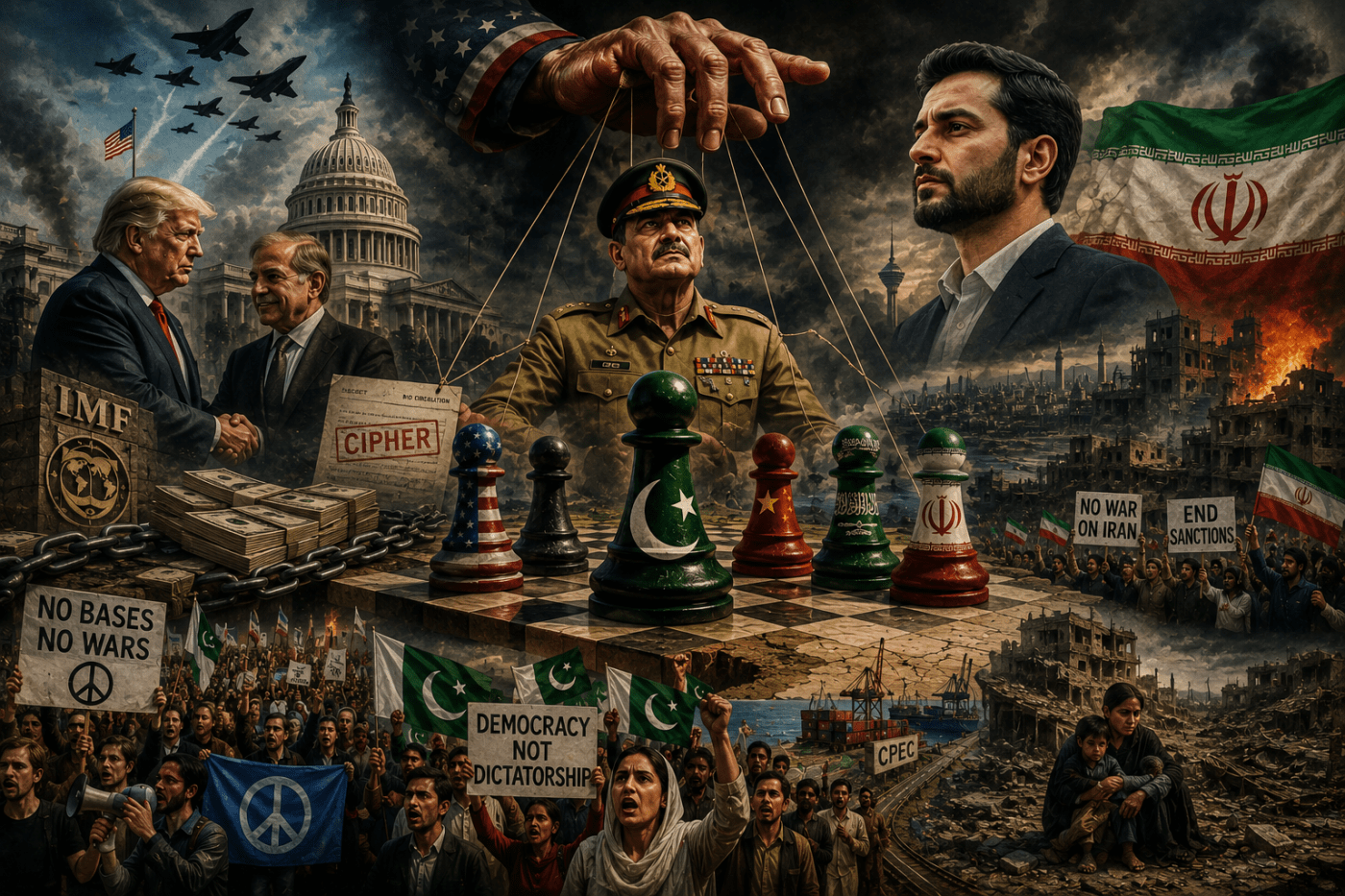
Drop Site’s investigation into Pakistan’s role as mediator in the U.S.-Iran war reveals how military-managed diplomacy functions as political rehabilitation for regimes useful to Washington during the crisis of unipolar power. The leaked Pakistani diplomatic cypher, IMF maneuvering, Ukraine weapons transfers, and the slowing of CPEC expose the deeper machinery of imperial alignment, geopolitical pressure, and comprador survival beneath the language of “peace talks.” Pakistan’s balancing act between Washington, Beijing, Tehran, and the Gulf monarchies reflects the wider fragmentation of the old imperial order as states across the Global South attempt to maneuver through the escalating contradictions of Cold War 2.0. The growing antiwar and anti-imperialist movements emerging across the United States, Europe, and Eurasia point toward the necessity of building international solidarity against sanctions, militarized coercion, debt dependency, and the permanent war architecture sustaining imperial decline.
By Prince Kapone | Weaponized Information | May 18, 2026
The Mediator Wearing the General’s Uniform
Drop Site News’ “From Mutual Suspicion to Political Embrace: How the U.S. Learned to Stop Worrying and Love Pakistan”, written by Waqas Ahmed, Murtaza Hussain, and Ryan Grim and published on May 17, 2026, is not enemy propaganda in the ordinary sense. It is a piece of fraternal investigative journalism, produced from within the anti-imperialist atmosphere, that gives us valuable material for understanding how Pakistan’s military-led state has repositioned itself in the middle of the U.S.-Iran war. The article tells the story of a state that Washington once viewed with suspicion, especially after the collapse of the U.S. war in Afghanistan and Imran Khan’s refusal to permit American bases on Pakistani soil, but which has now been rehabilitated as a useful intermediary for U.S. regional strategy. Pakistan appears in the article not simply as a mediator, but as a military-managed state apparatus attempting to turn obedience into diplomatic prestige.
The basic report is straightforward and explosive. Pakistan’s current rulers, led by Prime Minister Shehbaz Sharif under the shadow of Field Marshal Asim Munir, have presented themselves as central actors in negotiations around the U.S.-Iran war. Former Pakistani officials celebrate this as a national triumph, as if Pakistan has suddenly climbed onto the high balcony of world diplomacy. But Drop Site digs beneath the ceremonial language and shows something uglier: a military regime born out of the removal of Imran Khan, sustained through repression and electoral manipulation, and rewarded by Washington for gradually restoring Pakistan to the obedient posture expected of a semi-dependent state. The article moves from the theater of mediation into the machinery beneath it: the CIA, the Pentagon, the IMF, Ukraine arms transfers, nuclear command politics, the slowing of CPEC, Saudi military coordination, Trump-family crypto deals, and rare-earth promises dangled before Washington like a servant presenting gifts at court.
Drop Site positions itself inside the article as reader-funded, independent journalism, free from corporate and government backers. This matters because the piece is not written from the normal imperial press box, where “democracy” means obedience to Washington and “stability” means the generals have everybody properly frightened. The outlet presents its Pakistan reporting as possible precisely because it is not dependent on the institutions that usually manufacture respectable ignorance. The authors occupy the professional location of adversarial investigative journalists, operating in the zone between foreign-policy reporting, leak-based documentation, and anti-establishment critique. This is not RAND writing policy memos for the arsonists while pretending to study the fire. It is journalism attempting to recover the fingerprints from the lighter.
The article’s strongest device is narrative framing. Pakistan’s mediation is framed not as innocent peace work, but as the public costume of a military regime seeking rehabilitation in Washington. The generals are not presented as neutral statesmen rising above conflict. They are shown as political survivors who understand that in the imperial order, usefulness is often more important than legitimacy. Serve the empire well enough and the same officials who lecture the planet about democracy will suddenly forget the prisoners, the stolen election, the broken constitution, and the boots on the throat of the people. The piece therefore reframes mediation as an instrument of political laundering: a way for the Pakistani military regime to cleanse itself through diplomatic usefulness.
A second device is card stacking, though in this case it works in a fraternal and investigative direction. Drop Site piles up the evidence like a prosecutor building a case: leaked documents, former officials, election repression, IMF leverage, weapons transfers, lobbying operations, nuclear negotiations, and the Trump family’s business entanglements. The cumulative effect is not subtle, nor should it be. The article wants the reader to see the pattern. Pakistan’s rulers did not stumble into favor by accident. They made themselves available. They delivered what Khan would not. They opened doors, softened positions, slowed alternative alignments, and learned the ancient prayer of comprador politics: forgive us, Washington, for we have remembered our place.
The article also relies on source hierarchy. Its authority comes from leaked state documents, insider interviews, official statements, and contradictions inside the ruling class itself. This is important because the subject matter is exactly the sort of thing imperial media normally buries under words like “complexity,” “partnership,” and “strategic cooperation.” Drop Site reverses the hierarchy. It does not begin with what Washington says about democracy. It begins with what Washington does when a government refuses bases, refuses bloc discipline, refuses to cancel a Moscow visit, and refuses to stand at attention during the opening march of the Ukraine war. This is where the article’s use of the March 7, 2022 Pakistani diplomatic cypher becomes central. The document gives the article documentary weight, especially around the reported pressure from U.S. Assistant Secretary Donald Lu and the now infamous phrase that “all will be forgiven” if Khan were removed. The cypher functions like a crack in the marble wall of diplomacy: through it, we glimpse the rough imperial hand behind the polished language.
There is also a controlled use of omission by compression. Because the article is focused primarily on U.S.-Pakistan realignment, it does not fully excavate Iran’s own sovereign position, the wider U.S.-Israeli war architecture, the maritime struggle around Hormuz, or the deeper regional movement away from permanent American command. This does not make the article hostile. It makes it incomplete in the way even strong investigative journalism can be incomplete when the central object is one corridor of the imperial machine rather than the whole factory. Our task, then, is not to denounce the article, but to deepen it. Drop Site gives us the wire. We must trace where it runs: through Islamabad, Washington, Tehran, Riyadh, Beijing, Gaza, Hormuz, and the decaying command centers of the old unipolar world.
Finally, the article uses an appeal to democratic legitimacy. Imran Khan’s removal, the repression of PTI, the jailing of Khan and Bushra Bibi, and the manipulation of Pakistan’s electoral process become the moral anchor of the story. This is effective because it exposes the fraud at the heart of imperial democratic language. Washington does not oppose military rule when military rule behaves. It does not oppose repression when repression produces alignment. It does not oppose corruption when corruption passes through approved channels. The empire does not hate dictatorship. It hates disobedience. Drop Site’s article understands this well enough to show that Pakistan’s “rise” as mediator is not the triumph of diplomacy over war, but the return of a military-managed state to the warm kennel of American approval.
The Price of Rehabilitation in the Age of Permanent War
Pakistan’s Foreign Ministry confirmed in April 2026 that Iranian Foreign Minister Abbas Araghchi and senior Iranian officials traveled to Islamabad for what were formally called the “Islamabad Talks”, a diplomatic initiative centered around efforts to manage and potentially de-escalate the expanding U.S.-Iran war. Pakistani officials repeatedly described their role as one of “good offices” and facilitation, presenting Islamabad as a responsible regional actor attempting to prevent a wider catastrophe. At the same time, Reuters reported that Iran transmitted revised proposals through Pakistani mediation channels to the United States, while Iranian media confirmed that Pakistan had become one of the conduits through which Tehran was communicating its negotiating position. Pakistan’s role therefore was not invented out of thin air. Islamabad did become an active diplomatic channel. But the meaning of that role cannot be separated from the political and geopolitical transformations that preceded it.
The leaked March 7, 2022 Pakistani diplomatic cypher provides one of the clearest glimpses into those transformations. The cable documented a meeting between Pakistani Ambassador Asad Majeed Khan and U.S. Assistant Secretary Donald Lu shortly after Imran Khan’s controversial Moscow trip at the opening of the Ukraine war. According to the document, Washington expressed anger over Pakistan’s “aggressively neutral position” and linked future bilateral relations to Khan’s removal through a parliamentary no-confidence vote. The now famous line — that “all will be forgiven in Washington” if Khan were removed — did not emerge from internet conspiracy culture or partisan rumor. It emerged from the internal diplomatic communications of the Pakistani state itself. The document further showed Pakistani diplomats warning against forcing countries to “choose sides” during the Ukraine crisis and expressing concern that Washington increasingly viewed Pakistan through the lens of confrontation with China and Russia rather than through Pakistan’s own regional priorities.
The political crisis surrounding Khan’s removal unfolded directly alongside this diplomatic confrontation. After Khan’s ouster, PTI faced escalating repression, including the loss of its electoral symbol and exclusion from reserved parliamentary seats despite PTI-backed independents winning the largest bloc of seats in the 2024 election. Khan and his wife Bushra Bibi were imprisoned under corruption and national security charges while the military consolidated authority behind the Sharif government. The same Western governments that lecture the world daily about democratic norms, constitutionalism, electoral integrity, and human rights suddenly developed a severe case of strategic amnesia. Ballot manipulation became “stability.” Political imprisonment became “rule of law.” Military management became “partnership.” One almost has to admire the athleticism with which imperial ideology can leap over its own principles whenever geopolitical obedience is at stake.
In July 2023 the IMF approved a $3 billion standby arrangement for Pakistan, providing the military-backed government critical financial breathing room during a severe economic crisis. Simultaneously, reporting later revealed that Pakistan had become a quiet but significant supplier of artillery shells and munitions for Ukraine through U.S.-linked channels. The relationship between geopolitical obedience and financial stabilization was never openly declared in public by Washington because empires prefer the language of “shared values” over the language of transactions. But the sequence of events spoke with remarkable clarity. Pakistan’s leadership changed. Pakistan aligned more closely with U.S. strategic priorities. Pakistan assisted the Western proxy war effort in Ukraine. IMF support materialized. The generals who once presided over a state viewed with suspicion in Washington were now welcomed back into respectable society.
The transformation also unfolded alongside a major restructuring of Pakistan’s relationship with China. The China-Pakistan Economic Corridor had originally been launched as the flagship corridor of the Belt and Road Initiative, involving tens of billions of dollars in infrastructure, energy, transportation, and industrial projects. CPEC was not simply a collection of roads and power stations. It was an attempt to materially reorganize Pakistan’s economic geography around Eurasian integration. Yet by 2024 major friction had emerged around unpaid dues to Chinese power producers and repeated security failures involving attacks on Chinese workers. Drop Site further reported that Pakistan privately discussed allowing a Chinese naval facility at Gwadar in exchange for major strategic concessions including military modernization and nuclear second-strike support. According to the reporting, Beijing refused these demands, viewing them as excessive and destabilizing. What remained afterward was a visibly cooled relationship in which CPEC’s second phase slowed dramatically while Pakistan simultaneously deepened coordination with Washington and Saudi Arabia.
During the present Iran war, Pakistan deployed military assets and personnel to Saudi Arabia under the framework of a mutual defense arrangement. This materially complicates the image of Pakistan as a neutral peace broker. Pakistan is not standing outside the regional conflict as an uninvolved observer. It is simultaneously a mediator, a military partner of Saudi Arabia, a state dependent on IMF stabilization, a recipient of American strategic rehabilitation, and a country attempting to balance relations between Washington, Beijing, Tehran, and the Gulf monarchies. The mediation process therefore unfolds inside a dense web of military obligations, economic dependencies, geopolitical pressures, and survival calculations.
Iran’s own position in these negotiations has also been systematically flattened within Western discourse. Iranian officials repeatedly stressed that Tehran does not trust Washington and views negotiations as inseparable from the reality of war, sanctions, and military coercion. Reuters further reported that Iran’s proposals centered around ending hostilities, restoring oil exports, lifting restrictions, and addressing the material conditions created by the war before deeper nuclear questions could be resolved. Yet Western political discourse consistently portrays Iran as the primary obstacle to peace whenever it refuses to negotiate while bombs, sanctions, blockades, and threats remain actively in force. The empire first places its boot on your neck and then denounces you as unreasonable for objecting to the pressure.
The broader regional environment surrounding Pakistan’s mediation efforts reveals a Middle East and South Asia undergoing profound geopolitical recalibration. Weaponized Information previously analyzed the Hormuz crisis as part of a larger struggle over sovereignty, sanctions, maritime chokepoints, and the decline of unipolar American command. Earlier WI analysis also examined the growing regional search for alternative security arrangements beyond permanent U.S.-Israeli escalation. Pakistan’s current diplomatic role sits directly inside this wider historical movement. States across West Asia, South Asia, and the Global South increasingly seek room to maneuver inside a world where American military dominance remains immense but no longer uncontested. The old imperial order still possesses aircraft carriers, sanctions regimes, intelligence networks, and military bases stretching across continents. But it no longer possesses uncontested legitimacy, uncontested obedience, or uncontested control over the political direction of the Global South.
This is the larger terrain hidden beneath the spectacle of Pakistan’s “rise” as mediator. What appears on television screens as diplomacy between statesmen is in reality the visible surface of deeper struggles over sovereignty, dependency, bloc alignment, economic survival, regional integration, and imperial management during the long crisis of the unipolar order. Pakistan’s generals are not suddenly beloved in Washington because peace broke out in the hearts of empire. They are useful because they learned how to navigate the narrow corridor available to semi-dependent states trapped between Chinese infrastructure, Gulf capital, IMF discipline, military dependency, and American geopolitical command. Mediation, in this context, becomes not simply a search for peace, but a strategy of political rehabilitation in a world system increasingly shaped by instability, coercion, and imperial decline.
The Empire’s Favorite Generals and the Crisis of Obedience
The real story buried beneath the diplomatic theater is not simply that Pakistan became a mediator between Iran and the United States. The real story is that a military-managed state, disciplined through debt, geopolitical pressure, and strategic dependency, discovered that the quickest path back into Washington’s good graces was to make itself useful during a moment of imperial crisis. Pakistan’s ruling military apparatus did not suddenly transform into a global peace movement. It repositioned itself inside the changing architecture of power emerging from the collapse of uncontested American unipolarity.
The liberal imagination always portrays diplomacy as if it exists above material interests, floating somewhere in the clouds alongside the speeches of statesmen and the poetry of international law. But diplomacy under imperialism functions more like organized pressure management. Behind every smiling handshake stands a structure of coercion: sanctions, debt, military dependency, intelligence coordination, aid conditionality, arms flows, political interference, media pressure, and the constant threat of destabilization. The empire does not merely govern through invasion. It governs through calibration. States are disciplined, rewarded, punished, rehabilitated, isolated, and reorganized according to their usefulness inside the larger strategic order.
The leaked Pakistani diplomatic cypher matters because it accidentally revealed this machinery in motion. It stripped away the moral language and exposed the underlying grammar of imperial management. Pakistan was not being pressured because Washington suddenly discovered a passionate love for Ukrainian sovereignty. Pakistan was being pressured because the outbreak of the Ukraine war accelerated the formation of a renewed bloc structure inside the international system. The United States demanded alignment. Imran Khan attempted maneuverability. That contradiction became intolerable.
What made Khan dangerous was not that he represented some revolutionary rupture with imperialism. He did not. Pakistan remained deeply entangled within global capitalism, military dependency, IMF vulnerability, and Gulf financial networks under his leadership just as it does now. His danger lay elsewhere. He represented instability inside the chain of obedience. He refused American bases after the Afghanistan withdrawal. He pursued relations with China. He maintained communication with Russia. He attempted to preserve room for Pakistani maneuverability during the opening phase of the Ukraine war. In the age of escalating imperial recalibration, even limited independence begins to look suspicious.
This is the contradiction at the heart of the present international order. The United States continues to operate as the dominant military power on earth, yet its ability to produce unquestioned political obedience is weakening. The old unipolar system depended not only upon aircraft carriers and financial institutions, but upon ideological legitimacy — the belief that American leadership represented stability, democracy, development, and order. That ideological architecture is collapsing under the weight of permanent war, sanctions regimes, genocidal alliances, economic stagnation, and the visible hypocrisy of imperial governance. Washington now increasingly governs through naked pressure because the mythology no longer works as effectively as before.
Pakistan’s military leadership understood this changing terrain perfectly. They recognized that the emerging New Cold War against China and the wider process of multipolar recalibration created new opportunities for comprador survival. The generals repositioned Pakistan not around a coherent sovereign development strategy, but around strategic usefulness to competing centers of power. This explains the strange and contradictory posture now visible in Islamabad. Pakistan simultaneously courts China while slowing the deeper strategic implications of CPEC. It mediates with Iran while deepening military coordination with Saudi Arabia. It speaks the language of peace while remaining embedded within American security structures. It negotiates sovereignty while dependent on IMF stabilization and external financial management.
None of this is irrational. It is the political logic of a semi-dependent state trapped inside the crisis of imperialism. Pakistan’s rulers are attempting to survive inside overlapping systems of pressure without fully committing to any single bloc. But the problem with this balancing act is that imperialism tolerates maneuverability only so long as maneuverability does not interfere with strategic priorities. The moment neutrality begins to obstruct containment strategy, neutrality itself becomes criminalized.
This is why the language surrounding Iran is so revealing. Western discourse constantly frames Tehran as the unreasonable actor, the destabilizing force, the obstacle to peace. Yet Iran’s actual position throughout the negotiations has been remarkably straightforward: sovereignty cannot exist while bombardment, sanctions, blockades, assassinations, and threats remain actively in force. The Islamic Republic understands something the liberal order desperately tries to conceal — negotiations conducted under siege are not negotiations between equals. They are negotiations between a besieged nation and an imperial coalition attempting to dictate the terms of survival.
Pakistan’s mediation therefore becomes a form of sovereignty theater. The image presented to the world is one of responsible diplomacy, civilized dialogue, and peaceful conflict resolution. But beneath the performance sits an unresolved material reality: the war architecture itself remains intact. The sanctions architecture remains intact. The military encirclement remains intact. The regional hierarchy enforced through American military power remains intact. The negotiations are allowed to exist only within limits compatible with imperial strategic interests.
The same contradiction appears in Pakistan’s relationship with China. CPEC originally represented something potentially dangerous to the unipolar order because infrastructure changes political gravity. Railways, ports, energy systems, logistics corridors, industrial development, and Eurasian integration create alternative circuits of accumulation outside exclusive Atlantic control. This is why the Belt and Road Initiative provoked such hostility across Western policy circles. It was never merely about roads. It was about the possibility that the Global South could begin reorganizing trade, finance, and development through institutions not entirely subordinate to Washington.
Yet the slowdown of CPEC reveals the immense pressures facing states attempting to navigate this transition. Pakistan’s military leadership sought to preserve ties with China while simultaneously restoring relations with Washington. But these two trajectories increasingly pull in opposite directions. The United States views Chinese infrastructural expansion through the lens of strategic containment. China views long-term investment through the lens of stability and predictability. Pakistan’s ruling bloc attempted to extract benefits from both sides while avoiding full confrontation with either. The result is a state constantly maneuvering between dependency and autonomy without fully escaping either condition.
This entire process reflects the broader crisis of imperialism unfolding across the Global South. American power remains overwhelming, but it increasingly encounters resistance, hesitation, recalculation, and strategic drift among states no longer fully convinced that the future belongs to the Atlantic order. Some move toward BRICS frameworks. Others deepen regional integration. Others attempt balancing strategies. Others collapse into instability under pressure. But nearly all now operate under the shadow of a changing world-system in which unipolar command no longer appears permanent.
The tragedy for the peoples of countries like Pakistan is that this geopolitical struggle unfolds through ruling-class apparatuses whose primary objective is not liberation, but survival. The generals seek regime stability. Washington seeks alignment. Gulf monarchies seek regional hierarchy. Chinese capital seeks secure corridors. International finance seeks repayment and discipline. Meanwhile ordinary Pakistanis inherit inflation, repression, debt, unemployment, political instability, and shrinking democratic space. The workers, peasants, and urban poor are told to celebrate “international prestige” while living under austerity managed by generals who discovered that imperial approval is often more profitable than popular legitimacy.
This is why the article ultimately reveals far more than it initially intends. It is not merely an investigation into Pakistan’s diplomatic rise. It is a portrait of how imperialism manages unstable allies during a period of global transition. It shows how sovereignty becomes conditional, how democracy becomes negotiable, how mediation becomes political laundering, and how military-managed states attempt to reposition themselves inside the fractures of a declining unipolar order. The empire still commands enormous power. But increasingly it governs through anxious recalibration rather than confident hegemony. And that anxiety now stretches from Washington to Islamabad, from Gaza to Hormuz, from Ukraine to the South China Sea.
Beyond Mediation: Building Solidarity Against Imperial Management
The peoples of Iran and Pakistan do not need another generation of imperial “stabilization.” They have already lived through the consequences of it: coups, sanctions, debt discipline, proxy wars, military rule, intelligence manipulation, political repression, structural adjustment, and endless lectures about democracy from governments actively financing genocide and war across the region. The task before anti-imperialist movements in the United States, Europe, and Eurasia is therefore not to cheer for one ruling bloc against another, nor to romanticize military-managed diplomacy as liberation. The task is to build concrete international solidarity against the machinery of permanent war and coercive geopolitical management now tightening across West Asia and the Global South.
World BEYOND War has been organizing campaigns opposing escalation against Iran and the wider expansion of U.S.-Israeli military operations. Their campaigns against foreign military bases, sanctions, and war escalation create important openings for connecting antiwar organizing to broader struggles against militarized imperialism and the permanent war economy.
In Britain, the Stop the War Coalition has continued mobilizing around opposition to bombing campaigns, escalation against Iran, NATO expansion, and the wider architecture of permanent intervention. The significance of organizations like Stop the War lies not simply in protests themselves, but in their ability to expose how European governments continue subordinating public resources, energy policy, and democratic space to Washington’s geopolitical confrontations.
The International Peace Bureau and associated Peace Wave initiatives have also continued coordinating transnational anti-militarist organizing across Europe, Asia, and North America. While often less visible in Western media cycles, these transnational peace infrastructures matter because they help connect local antiwar struggles into broader international campaigns against sanctions, military spending, nuclear escalation, and imperial bloc confrontation.
At the same time, solidarity with the people of Pakistan requires refusing the false binary imposed by both Western liberalism and the Pakistani military establishment itself. One does not have to romanticize Imran Khan, PTI, or any particular faction of Pakistan’s ruling class to recognize the dangerous precedent established through military-managed political restructuring under conditions of external geopolitical pressure. Across the Pakistani diaspora, especially in Britain, Canada, and the United States, grassroots mobilizations emerged against electoral repression, political imprisonment, media censorship, and military domination of civilian politics. These contradictions should be studied carefully and engaged critically by anti-imperialists rather than dismissed through simplistic Cold War logic.
The deeper challenge is political education. Millions of people across the West are taught to interpret every geopolitical conflict through the mythology of humanitarian intervention and “good versus evil” statecraft. Meanwhile the actual structures organizing the world — sanctions architecture, debt dependency, military encirclement, resource corridors, financial coercion, arms markets, logistical chokepoints, and intelligence operations — remain largely invisible to ordinary people. The antiwar movement must therefore move beyond moral outrage alone and develop a materially grounded understanding of how imperial power functions in practice.
This means building campaigns that connect Iran to Gaza, Pakistan to IMF austerity, CPEC to the New Cold War against China, sanctions to inflation, militarism to collapsing public infrastructure, and endless foreign wars to the domestic immiseration spreading across the imperial core itself. The same governments claiming there is no money for housing, healthcare, education, or wages somehow maintain unlimited resources for aircraft carriers, military aid packages, intelligence operations, sanctions enforcement, and global surveillance systems. Imperialism is not simply foreign policy. It is the international management system through which ruling classes reorganize wealth upward while disciplining populations both abroad and at home.
Concrete organizing must therefore move in several directions simultaneously. Antiwar organizations should intensify pressure against sanctions escalation and direct military confrontation with Iran. Labor organizers and community formations should expose the relationship between militarism and austerity inside the imperial core. Independent journalists and guerrilla intellectuals should continue excavating the hidden infrastructure of geopolitical coercion, especially the relationship between IMF discipline, military dependency, intelligence coordination, and regime management across the Global South. Diaspora communities should deepen people-to-people solidarity networks that bypass both imperial propaganda and comprador state narratives.
Above all, movements must reject the illusion that imperial management can produce genuine peace. Peace built on sanctions is not peace. Peace built on military encirclement is not peace. Peace built on nuclear apartheid, forced dependency, and economic coercion is merely organized instability administered more quietly. The peoples of Iran, Pakistan, Palestine, and the wider Global South have the right to sovereignty, development, security, and political self-determination free from the permanent intervention of declining imperial powers attempting to reorganize the world through fear, pressure, and calibrated chaos.


Leave a comment