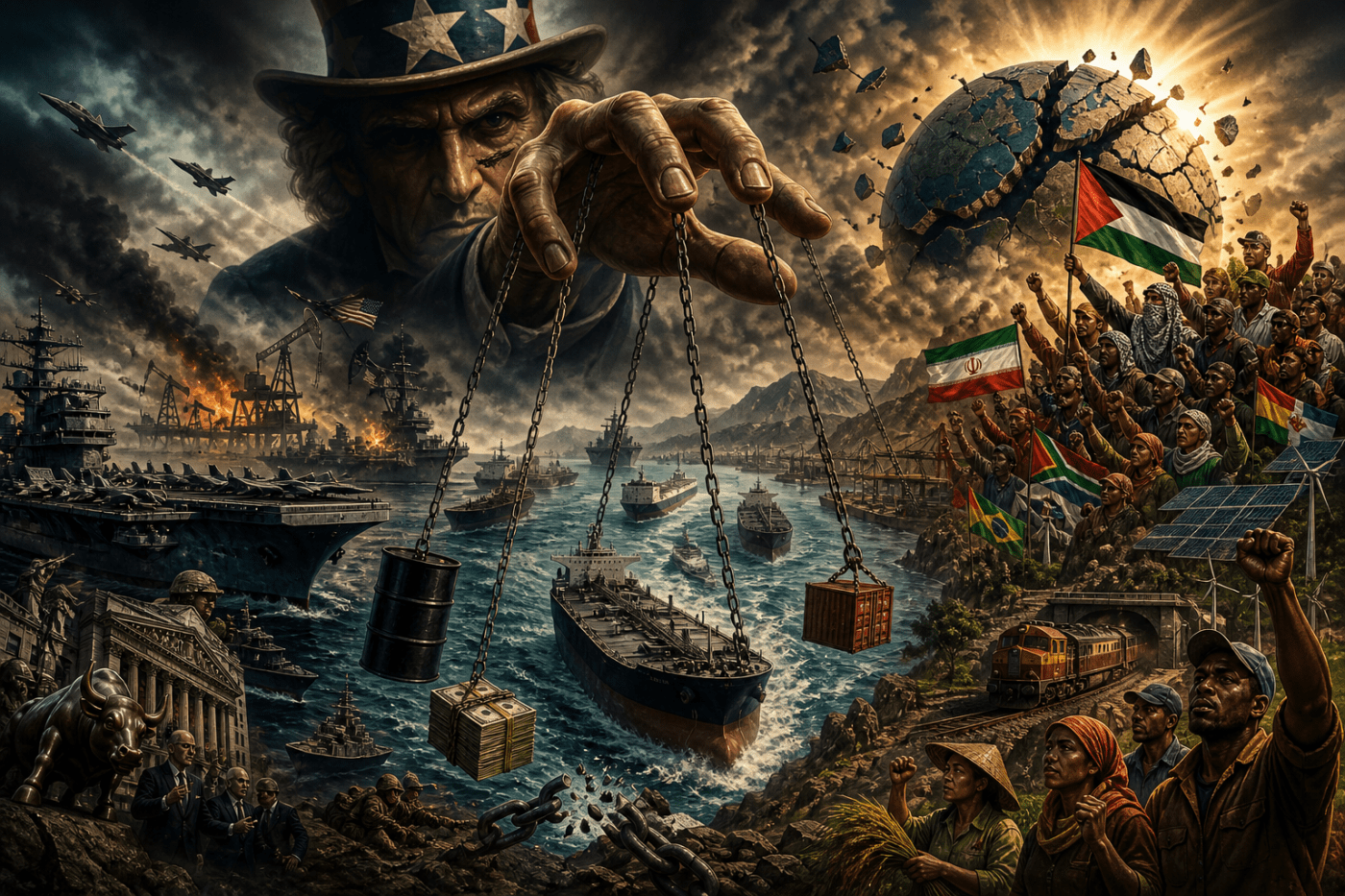
The New York Times reduces imperial warfare against Iran into a debate over Trump’s tactics while burying the machinery of sanctions, blockade, and coercion underneath the language of “strategy” and “deal-making.” Beneath the media spectacle lies a material struggle over energy chokepoints, maritime control, sanctions architecture, and the future organization of global power in an increasingly multipolar world. The Hormuz crisis reveals an empire still capable of immense destruction but increasingly unable to convert military supremacy into stable political obedience as sanctioned states build alternative corridors of survival beyond direct U.S. control. Across the Global North and South, antiwar, peasant, ecological, labor, and anti-imperialist movements are beginning to converge against the shared structures of militarized imperialism, economic warfare, and planetary crisis.
By Prince Kapone | Weaponized Information | May 5, 2026
The Empire Searches for a Magic Trick
On May 5, 2026, The New York Times published Steven Erlanger’s news analysis, “Trump Looks for a Silver Bullet to End the Iran War. There May Be None.” The article presents President Trump as a frustrated strongman searching for the right lever to force Iran into submission: first airstrikes, then a joint U.S.-Israeli bombing campaign, then a blockade of Iranian shipping, and now a vague plan to escort stranded vessels through the Strait of Hormuz. The basic argument is simple enough. Trump believes one more act of pressure will break Tehran. The experts quoted in the piece are less convinced. They argue that Iran is unlikely to surrender without some “face-saving” compromise, that economic pressure may not work quickly enough, and that Trump has misread the political psychology of the Islamic Republic. This is the frame: not empire versus sovereignty, not war versus peace, not coercion versus self-determination, but Trump versus the stubborn problem of Iranian endurance.
The institutional voice carrying this frame is not neutral. The New York Times is one of the premier newspapers of the U.S. ruling class: corporate-owned, subscription-driven, advertisement-supported, and deeply embedded in the ideological circuits of imperial legitimacy. It does not need to sound like the Pentagon to perform a Pentagon function. Its more refined role is to translate imperial violence into the language of policy debate. Bombing becomes “pressure.” Blockade becomes “leverage.” Economic strangulation becomes “sanctions.” Regime-change warfare becomes a question of whether Washington has selected the correct instrument from the imperial toolbox. Here the reader is not invited to ask whether the United States has any right to bomb, blockade, threaten, starve, or discipline Iran. The reader is asked whether Trump’s tactics are clever enough to produce the desired result. This is how bourgeois journalism launders the crime scene. It turns the arsonist into a fire-management analyst.
Erlanger’s own professional location matters. He is not a street reporter listening to dockworkers, oil workers, Iranian families, Yemeni sailors, Gulf migrants, or the millions whose lives are thrown into instability by imperial adventure. He is a veteran diplomatic correspondent of the Western press corps, trained in the language of embassies, think tanks, policy shops, and “serious” imperial reflection. His sources are drawn from that world: Brookings, Chatham House, the International Crisis Group, risk consultants, and unnamed officials. Their criticism of Trump is real, but narrow. They do not fundamentally oppose the imperial premise. They question the efficiency of the method. They are the mechanics gathered around the plantation machine, clucking their tongues because the overseer keeps pulling the wrong lever.
The article’s first major propaganda device is narrative framing. The war is organized around Trump’s search for a “silver bullet,” a phrase that makes U.S. aggression appear almost childish, impulsive, personal, and tactical. The problem becomes Trump’s overconfidence rather than the imperial system that gives any U.S. president the power to bomb another country, blockade its ports, and gamble with global energy flows. This frame reduces structural violence to presidential temperament. It is the old trick: when empire misfires, blame the personality of the emperor, not the empire. Caesar was too rash. The legions, apparently, were just innocent tourists with swords.
The second device is omission. The article says a great deal about Iran’s refusal to capitulate and much less about the historical machinery that produced Iran’s distrust. There is no serious excavation of the long U.S. campaign to dominate Iran, no central place for the destroyed nuclear agreement, no meaningful account of sanctions as warfare, no treatment of the blockade as collective punishment, and no reckoning with the fact that “deal-making” under bombardment is not diplomacy but extortion with better stationery. The reader is asked to enter the story after the gun has already been placed on the table and then admire the sophistication of the negotiations.
The third device is source hierarchy. Iranian interpretation appears mostly as an object to be analyzed by Western specialists rather than as a sovereign political position to be seriously engaged. The experts explain what Iran thinks, what Iran wants, what Iran fears, and what Iran may tolerate. But the architecture of explanation remains located in the imperial metropole. This is not accidental. Source hierarchy is one of the great hidden weapons of corporate media. Whoever gets to explain reality gets to govern the moral universe of the article. In this case, Iran is present, but mainly as a problem to be interpreted by the same imperial world that has spent decades trying to discipline it.
The fourth device is doublespeak. The article repeatedly moves through a vocabulary of “pressure,” “blockade,” “deal,” “compromise,” and “face-saving.” These are not innocent words. They soften the violence of the situation. “Pressure” means economic strangulation backed by military force. “Blockade” means an act of war dressed up as maritime administration. “Deal” means surrender terms if one side is being bombed while the other writes the contract. “Face-saving” means allowing the victim of coercion to pretend it was not coerced. The language is polite because the reality is ugly.
The fifth device is appeal to authority. The article depends heavily on elite analysts who are allowed to speak as sober interpreters of geopolitical reality. Their criticisms of Trump provide the article with a liberal aura of balance. Yet the range of permissible thought remains tightly managed. The question is not whether Iran has the right to resist coercion. The question is how much coercion will work, how fast it will work, and what kind of off-ramp might make coercion more successful. This is the politics of the imperial seminar room: disagreement without rupture, criticism without opposition, realism without justice.
Finally, the article relies on vagueness at precisely the points where clarity would indict the system. What would a “deal” actually require? What guarantees would Iran need after Washington tore up the last agreement? What does it mean for the United States to blockade another country while claiming to seek peace? What gives Washington the right to decide the acceptable limits of Iranian sovereignty? These questions hover over the article like ghosts, but they are never allowed to sit down at the table. Instead, the reader is left with the image of Trump searching for a magic formula. But there is no magic here. There is only the familiar arithmetic of empire: bombs plus sanctions plus media framing equals “diplomacy,” until the targeted nation refuses to kneel. Then the empire calls that refusal irrational.
The Strait, the Siege, and the Machinery of Pressure
Strip away the theatrical language about Trump searching for a “silver bullet,” and the material terrain underneath the crisis comes sharply into view. The central fact is not presidential frustration. The central fact is that the United States is openly attempting to impose military and economic control over one of the most critical energy chokepoints on earth. The U.S. Energy Information Administration reports that roughly 20 million barrels of petroleum liquids moved through the Strait of Hormuz per day in 2024, representing approximately one-fifth of total global petroleum liquids consumption. This narrow waterway linking the Persian Gulf to the Arabian Sea is not merely a regional passage. It is one of the beating arteries of the global capitalist economy itself. Oil flowing through Hormuz powers factories in China, heats homes in South Asia, fuels cargo fleets, stabilizes currencies, and underwrites industrial production across entire continents. When imperial strategists speak of “freedom of navigation,” what they are really discussing is the preservation of uninterrupted imperial access to the circulation routes of global accumulation.
The article correctly notes that Washington is attempting to force or reopen shipping through the strait, but the scale and implications of this effort are softened through the language of “escort missions” and “security operations.” The Washington Post reported that U.S. officials described “Project Freedom” as a military-supported operation to move commercial shipping through Hormuz. At the same time, Reuters confirmed that Secretary of State Marco Rubio publicly acknowledged the existence of a U.S. blockade directed at Iranian ports and maritime activity. This distinction matters enormously. A blockade is not diplomacy. It is an act of war. Historically, blockades have been instruments of collective punishment, designed not simply to isolate governments but to suffocate entire economies through the disruption of trade, energy exports, shipping access, insurance systems, and logistics chains. Yet within the imperial media vocabulary, blockade is transformed into “pressure,” as though strangling a nation’s economy were merely an aggressive form of negotiation etiquette.
Iran’s own public position on the crisis is almost entirely absent from the article’s interpretive framework. Iranian President Masoud Pezeshkian stated that instability in the Persian Gulf and Strait of Hormuz stems from U.S.-Israeli military aggression, attacks on Iranian infrastructure, and interference with Iranian shipping. This omission is politically significant because it erases the fact that Iran does not view the current confrontation as an isolated diplomatic dispute, but as part of a long continuum of coercion, sabotage, sanctions, and military encirclement. The article instead treats Iranian distrust as a psychological or ideological characteristic of the regime itself, detached from historical experience. Yet states do not emerge from a vacuum. They develop strategic cultures through concrete historical struggle.
That historical terrain is essential to understanding the current moment. The U.S. National Security Archive has published documentation confirming the CIA’s central role in the 1953 coup against Iranian Prime Minister Mohammad Mossadegh, whose government had nationalized Iranian oil resources previously dominated by Anglo-Iranian petroleum interests. The overthrow of Mossadegh was not simply a Cold War maneuver. It was a defining act of modern imperial intervention: the destruction of a sovereign nationalist project that attempted to exercise independent control over strategic resources. The coup reinstalled monarchical rule under the Shah and tied Iran’s political economy more tightly to U.S. geopolitical interests for decades. This history is not background decoration. It is part of the living political memory through which contemporary Iranian policy is shaped. When Iranian officials speak about sovereignty, foreign interference, or distrust of Washington, they are speaking from inside a historical experience of regime change and external domination.
The current confrontation is also inseparable from the collapse of the Joint Comprehensive Plan of Action. IAEA monitoring reports from 2018 stated that the agency continued verifying Iran’s compliance with its nuclear commitments under the agreement. Nevertheless, the U.S. Treasury’s Office of Foreign Assets Control formally confirmed the full reimposition of sanctions on Iran following Trump’s unilateral withdrawal from the deal in 2018. The article gestures toward this history but does not adequately explain its consequences. From the standpoint of Tehran, the lesson was brutally simple: even full compliance with an internationally negotiated agreement does not guarantee sanctions relief or normalization if Washington decides strategic conditions have changed. In practical terms, the destruction of the JCPOA communicated to Iran and much of the Global South that agreements with the United States remain structurally unstable because they are subordinate to shifting imperial priorities.
The economic dimensions of the crisis stretch far beyond Iranian oil exports alone. The EIA reports that approximately 20 percent of global liquefied natural gas trade also moved through Hormuz in 2024, much of it originating from Qatar. Nearly all Persian Gulf LNG exports must transit the strait before reaching Asian markets. The International Energy Agency further notes that almost 90 percent of LNG exported through Hormuz in 2025 was destined for Asian markets. This means the conflict is not simply a bilateral U.S.-Iran dispute. It directly threatens energy security across Asia, intensifies inflationary pressure globally, destabilizes shipping markets, and increases volatility across supply chains already strained by years of geopolitical fragmentation and sanctions warfare. The crisis therefore radiates outward from the Gulf into the entire architecture of global production and trade.
Iran, meanwhile, has not remained strategically static under sanctions pressure. Al Jazeera reported that Iran has increasingly explored land transport routes through Pakistan to bypass maritime disruptions and move stranded commercial cargo. This is not merely a logistical adjustment. It reflects the broader adaptation of sanctioned states to an international system increasingly fragmented by economic warfare. Alternative transport corridors, regional trade agreements, non-dollar financial arrangements, and strategic partnerships are becoming mechanisms of survival for states targeted by Western sanctions regimes. In this context, Iran’s integration into non-Western geopolitical blocs takes on heightened importance. Iranian officials have described the country’s BRICS membership as a major strategic achievement, while Iran and Russia signed a long-term Comprehensive Strategic Partnership Treaty in January 2025. These alignments are not abstract ideological gestures. They are material attempts to construct alternative diplomatic, financial, infrastructural, and security relationships outside direct U.S. control.
Even major international institutions increasingly acknowledge that the consequences of the Hormuz crisis extend far beyond regional rivalry. UNCTAD warned that disruptions in the Strait of Hormuz threaten global trade flows and development prospects, especially for import-dependent economies already facing debt crises, inflation, and post-pandemic instability. At the same time, the EIA’s Short-Term Energy Outlook reported that disruptions to Hormuz shipping forced multiple Gulf producers to shut in substantial crude production capacity. The result is a crisis whose consequences extend from Tehran and Washington outward to fuel prices in Africa, industrial costs in Asia, food transport systems worldwide, and the economic stability of entire import-dependent regions.
What emerges from this factual terrain is not the image of a reckless president merely searching for better tactics. What emerges is a picture of an increasingly militarized international order in which sanctions, naval deployments, shipping corridors, financial systems, energy infrastructure, and diplomacy itself are fused into a single machinery of coercion. The article presents the confrontation largely as a test of Trump’s deal-making instincts. But the deeper reality is that the United States is attempting to maintain strategic dominance over a critical node of global circulation while Iran seeks to preserve sovereignty, economic survival, and regional maneuverability under conditions of long-term siege. The Strait of Hormuz has therefore become more than a shipping lane. It has become one of the central pressure points through which the contradictions of the emerging world order are now being fought.
The Empire Starts Choking on Its Own Chokepoints
The imperial press wants you to believe this whole crisis comes down to Trump being too reckless, too impatient, too loud, too stupid, or maybe just not enough of a “master negotiator.” One day he pushed too hard. The next day he didn’t leave enough room for diplomacy. Tomorrow they’ll probably say he forgot to read the right think tank memo before breakfast. But this is how empire launders its crimes. It reduces structural violence into the personality defects of individual rulers. The problem, we are told, is not the empire itself — only the management style of the current CEO of imperialism. As though the issue with colonial domination was ever bad customer service.
Once you clear away the fog machine, the real contradiction becomes obvious. What is unfolding in the Strait of Hormuz is not a crisis of presidential temperament. It is a crisis of imperial decline. The United States is confronting a world it can still bomb, sanction, blockade, threaten, destabilize, and terrorize — but can no longer fully command. That is the deeper panic hiding underneath all the chatter about “off-ramps” and “de-escalation.” The empire is discovering that aircraft carriers do not automatically produce obedience anymore. Cruise missiles do not magically manufacture legitimacy. Sanctions do not guarantee surrender. The old formulas are malfunctioning.
For decades Washington sat at the center of the global capitalist system like a bloated mafia accountant with nuclear weapons. It controlled the sea lanes, the reserve currency, the banking systems, the trade institutions, the insurance markets, the military alliances, and the ideological machinery that told the world this arrangement was called “freedom.” Countries that obeyed the imperial order were described as responsible members of the international community. Countries that tried to control their own resources, direct their own development, or maintain independent foreign policies suddenly became “rogue states,” “security threats,” or “authoritarian dangers.” Funny how sovereignty only becomes dangerous when poor nations try exercising it against rich empires.
Iran ran headfirst into this contradiction generations ago. The overthrow of Mossadegh was not some dusty Cold War side quest buried in a university archive nobody reads except exhausted graduate students surviving on coffee and despair. It was one of the clearest expressions of imperial power in the twentieth century. Iran attempted to exercise sovereign control over its oil, and the empire responded exactly how empires always respond when somebody reaches for their stolen property: with sabotage, destabilization, and regime change. That lesson never disappeared from Iranian political memory. You cannot spend decades being threatened, sanctioned, infiltrated, isolated, and surrounded by military bases and then wake up one morning talking like a Scandinavian diplomat at a Davos brunch panel about “mutual trust.”
This is why the destruction of the nuclear agreement mattered far beyond centrifuges and uranium enrichment percentages. The JCPOA was essentially a test case. Could a sanctioned state negotiate its way back into the global economy without surrendering its sovereignty outright? Iran complied. International inspectors verified compliance. And then Washington ripped the agreement apart anyway the moment imperial priorities shifted. That single act taught much of the Global South a brutal but valuable lesson: agreements with empire remain conditional on empire remaining comfortable. The contract only lasts as long as imperial dominance feels secure. Once the geopolitical winds shift, the signatures suddenly become decorative artwork.
The Strait of Hormuz now concentrates all these contradictions into one narrow corridor where the empire’s nerves are fully exposed. This little strip of water is one of the main arteries of global capitalism. Oil flows through it. LNG flows through it. Shipping routes, insurance systems, industrial production chains, energy prices, food transport systems — all of it intersects there. That is why the United States treats the strait like a sacred imperial bloodstream. Whoever controls the circulation routes of the global economy possesses immense leverage over the entire international order. Empire understands this very well. It is why every discussion about “freedom of navigation” somehow ends with American warships parked near somebody else’s coastline.
But here the empire runs into a contradiction of its own making. The United States spent decades weaponizing every part of the global system. Banking became a weapon. SWIFT became a weapon. Shipping insurance became a weapon. The dollar became a weapon. Food systems became weapons. Technology became a weapon. Trade became a weapon. Energy became a weapon. Entire populations were disciplined through sanctions, isolation, and financial suffocation. And now Washington acts shocked — absolutely shocked — that targeted states are building alternative systems outside direct U.S. control. The empire strangled the global economy with one hand and is now horrified that the world has started looking for another set of lungs.
Iran’s turn toward BRICS, toward Russia, toward China, toward alternative transport corridors and parallel financial relationships is not some cartoonishly evil anti-Western conspiracy like the Atlanticist media keeps implying. It is adaptation. It is survival. When sanctions can erase your access to global banking overnight, sovereignty starts looking a lot less like abstract nationalism and a lot more like figuring out how to keep medicine moving, ports functioning, fuel flowing, and trade alive under siege conditions. In this environment, logistics becomes geopolitics. Shipping routes become political weapons. Infrastructure becomes strategy. Railways, ports, pipelines, payment systems, and fiber optic cables become the trenches of the twenty-first century.
This is also why the phrase “freedom of navigation” deserves to be laughed at with the same level of respect one gives a banker preaching charity or an oil company preaching environmental ethics. The United States talks about open commerce while sanctioning countries into starvation. It talks about free movement while freezing sovereign assets and threatening shipping firms that trade with the wrong governments. It talks about international law while enforcing blockades thousands of miles from its own shores. Freedom, inside imperial language, has always meant freedom for imperial capital to circulate under imperial supervision. Everybody else gets inspections, restrictions, blacklists, and cruise missiles.
Even the nuclear issue itself sits inside this grotesque hierarchy. The same powers sitting atop mountain ranges of nuclear warheads lecture sanctioned states about “global security.” The same countries funding genocidal military campaigns suddenly become philosophers of international peace the moment an adversarial state develops civilian nuclear infrastructure. The issue was never nuclear morality. Empire has no moral objection to overwhelming military violence. The issue is monopoly power. Nuclear regulation becomes another mechanism through which sovereignty is selectively distributed according to geopolitical obedience.
Meanwhile ordinary people across the planet absorb the consequences of this imperial gangsterism. Fuel prices rise. Food prices rise. Transportation costs rise. Inflation spreads. Entire regions already drowning in debt and austerity get hit with another wave of instability generated by strategic games between ruling classes. Workers in Africa, Asia, Latin America, and even inside the imperial core itself end up subsidizing the maintenance costs of a decaying global order they never voted for and never benefited from equally in the first place. This is one of the ugliest truths of modern imperialism: the empire privatizes power upward while socializing crisis downward.
And this is the deeper reality the article cannot fully admit. The crisis in Hormuz reveals an empire slowly losing its ability to discipline the world without simultaneously accelerating resistance against itself. Every sanction creates pressure for alternative financial systems. Every blockade creates pressure for alternative trade corridors. Every act of coercion pushes more states toward strategic realignment outside the Atlantic sphere. The empire still possesses terrifying destructive capacity, but destruction alone no longer guarantees stable rule. The old imperial architecture is beginning to crack under the weight of its own overreach. What we are witnessing in the Persian Gulf is not simply another Middle Eastern conflict. It is one battlefield in the long, uneven, and increasingly visible transition away from uncontested U.S. unipolar domination.
From Chokepoints to Solidarity Corridors
The confrontation unfolding in the Strait of Hormuz is not a crisis that can be understood or resisted through narrow electoral thinking, patriotic flag-waving, or the exhausted rituals of liberal humanitarian concern. The machinery driving this conflict is global in scope: sanctions systems, naval deployments, financial coercion, logistical warfare, media management, and strategic competition over the circulation routes of energy and trade. Any meaningful resistance must therefore become equally international, equally organized, and equally material. Fortunately, such formations are already beginning to emerge. Across the Global North and Global South alike, movements, organizations, peasant networks, antiwar coalitions, ecological campaigns, and anti-imperialist formations are increasingly recognizing that the wars against Iran, Palestine, Yemen, Lebanon, and the broader Global South are not isolated crises. They are interconnected fronts within a larger struggle against militarized imperial domination itself.
Mass demonstrations against the 2026 war on Iran have already erupted across major cities in the United States and internationally, signaling that significant layers of people inside the imperial core are refusing to quietly absorb another cycle of sanctions, escalation, and war propaganda. Yet protest alone is not enough. Empire has survived decades of symbolic outrage. What threatens imperial power is not temporary moral discomfort but durable organizational infrastructure rooted inside working-class communities and oppressed populations. This is where organizations like Black Alliance for Peace become politically significant. BAP has explicitly linked the war drive abroad to the expansion of policing, surveillance, ICE repression, and militarized state power inside the United States itself. This linkage is crucial because imperialism has always operated as a two-way process. The technologies of domination tested abroad inevitably return home. The drone circles overseas before hovering above the domestic colony. The sanctions regime abroad becomes austerity at home. The militarized border overseas becomes the militarized police zone in the inner city.
At the same time, the anti-imperialist front is widening beyond traditional ideological boundaries. La Via Campesina has increasingly framed war, sanctions, famine, and food sovereignty as interconnected global contradictions. This development matters enormously because it reveals how deeply imperial warfare penetrates everyday material life. A blockade in the Persian Gulf is not simply a military event. It influences fertilizer prices, transport costs, fuel access, agricultural production, and food inflation across entire regions. The peasant struggling for seed access in the Global South, the truck driver facing rising diesel costs, the urban worker paying inflated food prices, and the family surviving under sanctions are all increasingly caught inside the same planetary architecture of coercion. The anti-imperialist struggle therefore cannot remain confined to military questions alone. It must increasingly become a struggle over food systems, logistics, labor, energy, ecology, and survival itself.
This widening convergence is also visible in the growing solidarity infrastructure linking Palestine to broader anti-imperialist movements worldwide. Networks of Palestinian, African, Asian, and Latin American intellectuals and organizers are increasingly articulating a common framework of South-South solidarity against imperial domination. Palestine has become a kind of political bridge connecting struggles that were once treated as geographically separate. The same systems of surveillance, sanctions, military financing, border militarization, propaganda management, and resource control imposed against Palestine increasingly appear across multiple theaters of imperial intervention. This is why organizations such as the Palestinian Youth Movement, Samidoun Palestinian Prisoner Solidarity Network, and numerous antiwar coalitions increasingly situate Iran, Palestine, Lebanon, Yemen, and broader Global South sovereignty struggles inside the same political horizon.
Ecological movements are also beginning to expose another contradiction long buried beneath imperial rhetoric. Friends of the Earth International and allied environmental formations have increasingly identified militarism itself as a driver of ecological destruction. This is an important political development because empire has historically hidden its environmental devastation behind nationalist spectacle and security discourse. Aircraft carriers burn enormous quantities of fuel. Bombed infrastructure poisons land and water systems. Sanctions disrupt environmental protections and public health systems. Militarized trade corridors intensify extractive dependency and ecological degradation. The same imperial order that claims to defend “global stability” simultaneously accelerates climate instability, resource exhaustion, and environmental collapse. In this sense, anti-imperialism and ecological survival are becoming materially inseparable struggles.
Organizations such as ANSWER Coalition, CODEPINK, and the United National Antiwar Coalition therefore play an increasingly important role not simply because they organize protests, but because they help preserve institutional memory and antiwar infrastructure inside the imperial core itself. Every empire attempts to isolate resistance into disconnected moments: one march here, one outrage there, one petition somewhere else. Durable antiwar organizations interrupt that fragmentation. They create continuity, political education, communication networks, logistical coordination, and strategic memory capable of surviving beyond media attention cycles. Without such infrastructure, every antiwar eruption risks dissolving back into atomized frustration once the headlines shift elsewhere.
Yet the challenge ahead is larger than protest coordination alone. The contradictions revealed in the Hormuz crisis point toward the necessity of building forms of dual and contending power capable of resisting imperial pressure materially rather than symbolically. Communities require independent media infrastructure capable of countering imperial propaganda. Labor organizations must increasingly challenge the logistical and industrial machinery of war itself. Local food systems, tenant networks, mutual aid infrastructures, political education formations, migrant defense campaigns, and anti-surveillance organizing become part of the same broader terrain of struggle. Empire sustains itself not merely through bombs but through dependence. Resistance therefore increasingly requires constructing social, political, and economic relationships less vulnerable to imperial management and coercion.
The emerging anti-imperialist terrain is still fragmented, uneven, and filled with contradictions. But something historically significant is beginning to crystallize beneath the surface. The war on Iran is helping expose the connective tissue linking sanctions, ecological destruction, militarized policing, energy insecurity, food instability, surveillance, logistics warfare, and imperial decline into a single global structure. As these connections become clearer, broader sectors of humanity are beginning to recognize that the struggle against empire can no longer remain compartmentalized into isolated national or issue-specific movements. The task now is transforming this growing awareness into organized international solidarity durable enough to confront an imperial system that increasingly governs through coercion, fragmentation, and permanent crisis.
“`
 Weaponized Information
Leave a comment