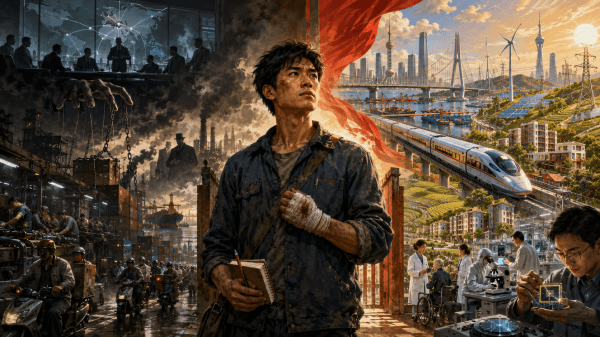
Jacobin's critique of Chinese worker Xiao Hai's memoir misrepresents the entire Chinese Revolution as a failed experiment based on exploitation. While Xiao Hai's story merits recognition, the narrative frames the factory's plight as representative of the whole nation, ignoring China's transformation from a colonial past into a sovereign socialist state. The real conflict lies not between the state and its workers, but rather over how the fruits of development serve the people's dignity versus capital's control. Exploitation exists, but it's the state that counters this with public power, proving not every wound validates Western perspectives of failure. Thus, the critique deflects from recognizing China's unique developmental trajectory amid global capitalism's inequities.
Empire’s Digital Panic: China, Xinjiang, and the War Over Who Controls the Future
The Associated Press investigation reveals a shocking truth: Silicon Valley's complicity in building the surveillance apparatus that the West now demonizes in China. While framing China as a "digital police state," the report subtly shields the very imperial system enabling such technologies. It highlights a deeper confrontation—one where the U.S. grapples with losing its monopoly on development and technology. As the New Cold War intensifies, the true danger emerges: not the surveillance itself, but the realization that a socialist-oriented state can achieve modernization and stability without Western control. The empire's fear lies in losing its grip over a future it desperately seeks to define and dominate.
Rare Earthquake: When Empire Can’t Keep the Lights On
China’s resource sovereignty is shattering Europe’s industrial illusions—and marking a new phase in the global class war By Weaponized Information June 5, 2025 Rare Earths, Real Power, and the Empire’s Media Shell Game The Reuters article, “Some European auto supplier plants shut down after China’s rare earth curbs,” is co-written by Victoria Waldersee and Christoph... Continue Reading →