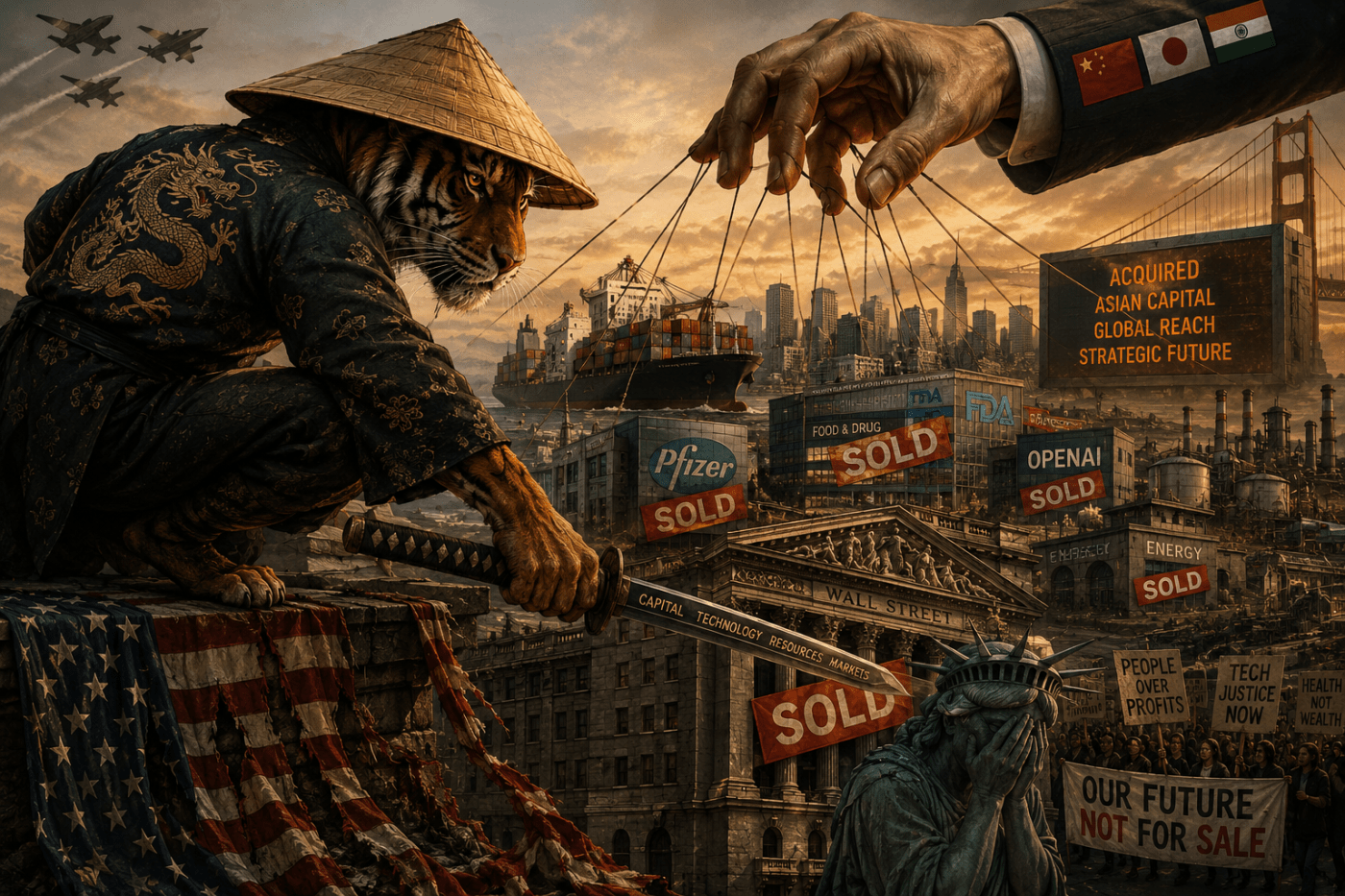
Behind the glossy business headlines about Asian firms buying American assets lies a deeper story about imperial decline and capitalist restructuring. The essay excavates the propaganda framing of the Asia Times article before reconstructing the real economic terrain driving the acquisition wave: tariff escalation, industrial warfare, energy insecurity, and the collapse of neoliberal globalization. It then situates these developments inside the broader crisis of unipolar power and the growing convergence between monopoly capital, technology, and state coercion. The conclusion turns toward the social movements and worker struggles already confronting the privatization of the future itself.
By Prince Kapone | Weaponized Information | May 19, 2026
The Checkbook Discovers the Empire
In “Asia is quietly and quickly buying up America,” Chris Chen, writing for Asia Times on May 13, 2026, presents what appears at first to be a simple business trend: Asian firms, flush with capital and ambition, are no longer waiting politely at the gates of the American market. They are buying their way in. Sun Pharma buys Organon. Mitsubishi moves into U.S. natural gas. SoftBank pours money into OpenAI’s Stargate project and acquires Ampere Computing. The numbers pile up like trophies on a boardroom table, and the lesson Chen draws is directed not to workers, not to nations, not to the people who actually produce the world, but to Asian founders: stop thinking small, stop waiting to be acquired, and learn to acquire.
This is the article’s basic function. It is not a lament. It is not a warning. It is a motivational sermon for the investor class of Asia, dressed in the language of historical transition. For fifty years, Chen tells us, American capital bought Asia, funded Asia, disciplined Asia, and consumed what Asia produced. Now the direction has begun to reverse. Asian capital is buying American assets, and the next generation of Asian business founders must adjust their mental model accordingly. The empire, in this telling, is no longer simply the buyer. It is also the thing being bought.
There is something useful in that observation, but the article handles it with the delicate fingers of a man counting somebody else’s dividends. Asia Times presents itself as an Asian-centered outlet covering geopolitical and economic affairs across the region, and Chen writes from a clearly identifiable class location: not as a worker, not as a shop-floor organizer, not as a public-health advocate, not as a critic of monopoly power, but as an angel investor and founder of a Singapore-based accelerator. This matters. The article does not speak from the standpoint of labor, peasants, patients, tenants, energy consumers, or communities living beside the infrastructure being bought and sold. It speaks from the standpoint of founders who want a sharper acquisition strategy. In other words, it is less an autopsy of empire than a PowerPoint slide for ambitious capital.
The central propaganda device is narrative framing. The article frames this acquisition wave as a question of Asian confidence and business maturity. Asian firms, we are told, must stop dreaming of being purchased by American capital and start purchasing American firms themselves. This turns a brutal question of ownership into a cheerful question of mindset. Who owns pharmaceutical pipelines? Who owns gas reserves? Who owns AI infrastructure? Who owns computing capacity? Who controls the labor process, the patents, the prices, the data, the energy flows, and the public subsidies underneath all this private accumulation? These questions do not enter the room. They are left outside with the workers, where respectable business commentary prefers them to remain.
The second device is omission. The article gives us deal size, corporate names, acquisition targets, and founder lessons, but it gives us almost nothing about labor, public control, antitrust, technological dependency, environmental consequences, or the communities forced to live under these new ownership arrangements. A pharmaceutical acquisition becomes a women’s health opportunity. A gas acquisition becomes a strategic energy play. An AI infrastructure investment becomes a bold move into the future. But the article never asks the elementary political-economic question: future for whom? For the worker whose job is rationalized away? For the patient priced out of medicine? For the public that pays for the grid while private firms monetize the data center? For the community whose air and water are sacrificed so another corporation can call itself resilient?
The third device is glittering generality. Words such as “resilience,” “global ownership,” “strategic objective,” and “capability acquisition” float through the article like incense in the temple of capital. They make private ownership sound like historical progress. They turn acquisition into wisdom. They make corporate expansion appear almost civilizational. But this is the old trick with a new passport. Capital buys, capital consolidates, capital crosses borders, and then capital tells the rest of us that this is destiny. The only thing missing is a choir singing hymns to shareholder value.
The fourth device is card stacking. The article lines up impressive examples—Sun Pharma, Mitsubishi, SoftBank, Toyota Industries, Sumitomo—and lets the scale of the transactions do much of the persuasive work. Big numbers become evidence of inevitability. Large acquisitions become proof of strategic maturity. The reader is invited to feel the momentum without being given the full terrain. Failed deals, regulatory constraints, debt burdens, class consequences, political backlash, and the possibility that this is simply another round of monopoly consolidation are not given equal weight. The deck is not hidden. It is stacked in plain sight, but with such polished language that the stacking is presented as analysis.
The fifth device is appeal to founders. Chen’s article is not addressed to the people of Asia or the people of the United States. It is addressed to Asian business founders who, in his view, remain trapped in an outdated mental model. The worker is not the historical subject here. The founder is. The people do not make history; executives with acquisition teams do. This is bourgeois common sense at its most innocent-looking and therefore its most dangerous. It teaches the reader to see the world through the eyes of those who buy, not those who build.
Finally, the article relies on vagueness, especially in its use of “Asia.” Asia becomes a single rising business actor, as if Japanese trading houses, Indian pharmaceutical giants, Chinese firms, Singaporean investors, Gulf capital, and Korean industrial combines all share one unified historical mission. This smooths over real differences in state structure, class formation, imperial alignment, industrial policy, and political economy. The result is a clean business story where there should be a messy struggle over power, ownership, sovereignty, and class.
That is why the article is worth excavating. It contains a real signal buried inside a class-distorted frame. Yes, the old one-way movement of American capital into Asia is no longer the whole story. Yes, the imperial center is now also an object of purchase. Yes, something is shifting in the world economy. But Chen’s article takes that shift and translates it into advice for capitalists. Our task is to translate it back into the language of the people. The issue is not whether Asian firms have learned to buy America. The issue is what it means when the house of empire becomes an asset class, and the workers of the world are still told to celebrate because the new landlord speaks a different language.
When the Empire Starts Selling the Furniture
Beneath the triumphant investor language of the Asia Times piece lies a real and measurable shift in global capital flows. The acquisitions mentioned in the article are not imaginary. They are concrete expressions of a changing world economy shaped by tariffs, industrial warfare, technological competition, supply-chain fragmentation, energy insecurity, and the long crisis of American unipolar dominance.
Sun Pharma’s acquisition of Organon was indeed one of the largest overseas purchases ever carried out by an Indian pharmaceutical corporation. The deal gives Sun Pharma expanded access to women’s health products, biosimilar production capacity, regulatory infrastructure, and distribution networks inside the United States and Europe. This is important because pharmaceutical production is not simply about selling pills. It is about control over patents, licensing, regulatory pipelines, research capacity, insurance systems, and long-term technological positioning. India’s pharmaceutical sector has spent decades building manufacturing capacity under conditions where Western firms dominated intellectual property, advanced regulatory access, and premium global markets. Acquiring existing infrastructure inside the imperial core is far faster than waiting decades to build equivalent institutional access organically.
Likewise, Mitsubishi Corporation’s move into U.S. natural gas assets tied to the Haynesville shale basin was not merely a speculative investment. The Haynesville region sits close to Gulf Coast liquefied natural gas export infrastructure, one of the most strategically valuable energy corridors in the world as Europe, Japan, and much of Asia continue scrambling to secure long-term non-Russian energy supplies amid the restructuring of global energy markets after the Ukraine war and the broader sanctions war against Eurasia. The deal reflects a growing reality: Japanese capital increasingly views direct ownership over energy infrastructure as a matter of strategic survival in an unstable global system where shipping routes, sanctions regimes, and geopolitical conflicts threaten resource security.
The same logic appears in the technological sphere. SoftBank’s massive financial commitments to OpenAI and Stargate, alongside its acquisition of Ampere Computing, reflect the escalating global struggle over artificial intelligence infrastructure, compute power, semiconductor architecture, cloud systems, and energy-intensive data-center expansion. AI is no longer viewed simply as a consumer technology sector. It is increasingly treated by states and monopoly capital alike as strategic infrastructure comparable to railroads, oil pipelines, telecommunications networks, or naval logistics in earlier eras of capitalism.
This broader movement is visible in the aggregate numbers as well. Asia-Pacific mergers and acquisitions activity surged dramatically through 2025, with Japan, Greater China, and India all recording major increases in outbound transactions. At the same time, Japan remained the single largest foreign direct investor inside the United States, with hundreds of billions of dollars already embedded across manufacturing, technology, logistics, energy, and finance. What the article presents as a sudden reversal is therefore better understood as an acceleration of trends already developing beneath the surface for years.
But the article omits the structural pressures driving these acquisitions. One of the most important is the transformation of U.S. trade policy itself. The legal battles surrounding Trump’s tariff regime exposed the increasingly improvised nature of American economic statecraft. Tariffs were struck down under one legal authority and rapidly reimposed through others. Export controls multiplied. Industrial subsidies expanded. Restrictions targeting Chinese technology firms intensified. The result was not the restoration of stable American industrial supremacy. The result was a growing incentive for foreign firms to bypass tariffs entirely by purchasing production capacity directly inside the United States.
In other words, the American state unintentionally helped create the conditions for foreign acquisition. The more Washington weaponized tariffs and market access, the more rational it became for Asian capital to physically relocate itself behind the tariff wall. This is one of the central contradictions of the present period. Protectionism intended to defend national industry increasingly incentivizes foreign ownership of domestic assets. The wall remains American. The factories behind it increasingly are not.
The article also omits the extent to which these acquisitions are tied to the long crisis of globalization itself. For decades, American corporations externalized industrial production into Asia while retaining control over finance, intellectual property, branding, logistics, and high-end technological ecosystems. That arrangement generated immense profits for monopoly capital but also hollowed out large sections of U.S. industrial infrastructure. The result is that many strategically valuable American assets now sit inside an economy burdened by deindustrialization, infrastructure decay, financialization, labor fragmentation, and enormous debt dependence.
Under these conditions, acquisition becomes easier. The empire that once purchased the world increasingly finds parts of itself available for purchase.
At the same time, the United States still remains the gravitational center of global capitalism. UNCTAD data shows that global capital flows continue pouring heavily into the United States and other advanced capitalist economies because the dollar system, deep financial markets, military power, and institutional dominance of Western finance still structure the world economy. This is not a story of American collapse in the simplistic sense promoted by internet doomers and nationalist fantasists alike. It is a story of uneven imperial recalibration.
Nor is “Asia” itself a unified historical actor. Japanese acquisitions reflect one set of pressures rooted in decades of stagnation, demographic contraction, and dependence on imported energy. Indian pharmaceutical expansion reflects another rooted in India’s position inside the global generics and biotech supply chain. Chinese outbound investment increasingly focuses on energy security, logistics corridors, mining access, industrial supply chains, and technological sovereignty under conditions of escalating Cold War pressure from Washington. Gulf capital seeks strategic diversification beyond oil dependency. Singaporean finance capital seeks intermediary leverage inside a fragmented world market.
The article compresses all of these contradictory forces into a single triumphant narrative of “Asia buying America.” Reality is more complicated. These are not unified civilizational actors marching together under one flag. These are different fractions of global capital maneuvering inside a rapidly fragmenting world system where the old certainties of globalization no longer hold.
What also disappears from the article is labor itself. Workers appear nowhere in Chen’s story except indirectly as abstractions hidden behind words like “capability,” “resilience,” and “growth.” Yet every acquisition named in the article involves workers whose labor built these industries in the first place. Pharmaceutical workers. Semiconductor engineers. Logistics workers. Gas-field workers. Data-center construction workers. Port workers. Coders. Researchers. Nurses. Manufacturing laborers. Entire social systems of human labor disappear beneath the language of strategic investment.
This disappearance is not accidental. It is essential to the ideological function of business journalism under capitalism. The reader is taught to see ownership as the main drama of history while labor becomes scenery in the background. One billionaire buys another billionaire’s assets and the newspapers call it dynamism. Workers produce the actual wealth and are told to feel lucky the shareholders are feeling optimistic this quarter.
There is another omission buried even deeper beneath the surface: these acquisitions are occurring alongside a broader geopolitical transition already visible across the international system. Weaponized Information has already identified how tariffs, technological warfare, sanctions escalation, militarized containment, and supply-chain fragmentation are driving states and corporations alike toward new forms of strategic positioning. Capital no longer trusts the stability of the old globalization model. States no longer trust unrestricted interdependence. Strategic sectors increasingly become matters of national security.
That is the real terrain hidden beneath the smiling optimism of the Asia Times article. This is not merely a story about ambitious Asian founders dreaming bigger dreams. It is a story about a world economy entering a more unstable phase of capitalist competition where ownership over energy systems, AI infrastructure, pharmaceutical production, logistics networks, and industrial capacity becomes increasingly tied to geopolitical struggle itself.
The empire is not simply being “bought.” The empire is restructuring itself under pressure. And as always under capitalism, the bill for that restructuring will be handed to the workers of the world unless they organize themselves as an independent force capable of fighting for a completely different future altogether.
The Empire Goes on the Auction Block
The liberal mythology of globalization always rested on a quiet assumption: history had ended inside the architecture of American power. Capital would move outward from Wall Street, Silicon Valley, London, and the Atlantic financial centers into the factories, mines, ports, and labor pools of the Global South. The United States and its allies would own the commanding heights of finance, technology, military power, logistics, and intellectual property while the rest of the world competed for access to Western markets, Western consumers, and Western capital. That arrangement was treated not merely as policy, but as nature itself. Economists called it efficiency. Journalists called it modernization. The empire called it “the rules-based international order,” which is always a poetic way of saying: the rules were written by us.
What makes the Asia Times article significant is not that Asian capital is suddenly buying American assets. Foreign ownership inside the United States has existed for decades. What matters is the psychological shift beneath the transactions. The imperial center is no longer appearing to sections of global capital as an untouchable throne above the world economy. It increasingly appears as contested terrain inside a fractured and unstable global system.
This is one of the clearest expressions yet of the larger Crisis of Imperialism now unfolding across the Atlantic order. The United States still possesses immense military power, enormous financial leverage, technological dominance in critical sectors, and the central reserve currency of the global capitalist system. But imperial hegemony is not merely a question of military inventories or GDP tables. It is also a question of confidence. Confidence in the stability of institutions. Confidence in the predictability of policy. Confidence in long-term economic direction. Confidence that the imperial center can continue organizing the world economy according to its interests without destabilizing itself in the process.
That confidence is beginning to erode.
The tariff wars, sanctions escalations, technological embargoes, industrial subsidies, supply-chain disruptions, proxy conflicts, banking warfare, and increasingly improvised forms of economic coercion coming out of Washington are all symptoms of an empire attempting to manage decline without admitting decline exists. This is why the current period is best understood not simply as protectionism or nationalism, but as Imperialist Recalibration. The American ruling class recognizes that the age of uncontested unipolar supremacy is ending. What it seeks now is not the restoration of the old globalization model, but the construction of a more militarized and controlled version of global capitalism where strategic sectors are secured behind tariff walls, technological restrictions, financial coercion, and geopolitical blocs.
Yet this strategy immediately generates contradictions. The more the United States weaponizes market access, the more foreign capital seeks direct ownership inside the American economy itself. The more Washington attempts to discipline global production through tariffs and export controls, the more rational it becomes for Asian firms to physically position themselves behind the American barrier system. In this sense, the empire begins reproducing the very conditions it claims to be resisting.
This contradiction reveals something deeper about the present phase of capitalism. The old neoliberal fantasy of a borderless global market has collapsed under the weight of geopolitical struggle. States no longer trust unrestricted interdependence. Monopoly capital no longer trusts stable supply chains. Industrial capacity, semiconductors, pharmaceutical infrastructure, rare earth processing, shipping corridors, AI compute power, and energy systems increasingly appear not as neutral economic sectors but as strategic assets tied directly to sovereignty, military capability, and long-term geopolitical survival.
This is why acquisitions that once might have been viewed as ordinary business transactions now carry civilizational significance inside elite discourse. A pharmaceutical company is no longer just a pharmaceutical company. It is intellectual property, biotech sovereignty, regulatory access, healthcare leverage, and geopolitical positioning. A gas field is no longer merely energy extraction. It is industrial continuity, alliance security, shipping leverage, and insulation against sanctions shocks. AI infrastructure is not merely software. It is the emerging nervous system of twenty-first century capitalism itself.
The article unintentionally exposes how multipolarity actually develops under capitalism. Multipolarity is not born first through idealistic speeches about harmony among nations. It emerges through material shifts in production, capital accumulation, industrial capacity, technological development, military power, and state coordination. It emerges because the old imperial core can no longer monopolize the productive and financial architecture of the world system in the way it once did.
But the article simultaneously conceals the class character of this transformation. The reader is encouraged to celebrate “Asia buying America” as though ownership changing hands between monopoly capitalists somehow represents emancipation for humanity. This is the ideological sleight of hand at the center of bourgeois internationalism. When American firms bought factories, ports, mines, farmland, pipelines, and industries across the Global South, Western economists called it modernization. Now that Asian firms increasingly buy American assets, business journalists call it strategic maturity. In both cases, labor remains subordinate while capital remains sovereign.
This is why the workers of the world cannot afford to confuse multipolarity with socialism or anti-imperialism automatically. A Japanese conglomerate purchasing American gas infrastructure does not abolish exploitation. An Indian pharmaceutical giant acquiring Western healthcare assets does not eliminate monopoly power. A Chinese or Singaporean investor purchasing strategic sectors abroad does not inherently place those sectors under democratic control. Capitalism does not cease being capitalism because the shareholder speaks Mandarin, Hindi, Japanese, Arabic, or Korean instead of English.
At the same time, it would be equally foolish to deny the progressive dimensions of the broader geopolitical shift underway. The weakening of unipolar domination opens political space for nations historically subordinated beneath Atlantic monopoly power. The rise of competing centers of industrial and financial capacity creates room for states to maneuver more independently. Sanctions regimes become harder to enforce universally. Alternative payment systems emerge. Infrastructure corridors bypass Western chokepoints. Technological sovereignty becomes thinkable outside direct U.S. supervision. The global balance of forces begins to change.
This is precisely why the Western ruling classes have become increasingly obsessed with narratives of “national security,” “foreign influence,” “Chinese infiltration,” and “economic warfare.” The empire senses the ground shifting beneath it. What was once treated as globalization is now reclassified as threat whenever the flow of capital, industry, or technological capability no longer remains firmly under Atlantic control.
The irony is almost Marxist in its cruelty. American capital spent decades teaching the world how to globalize production, centralize capital, pursue acquisitions, optimize supply chains, and subordinate national boundaries to the logic of accumulation. Now the students arrive carrying larger checkbooks and suddenly the teachers rediscover patriotism.
But beneath all of this lies the deeper contradiction the article cannot confront because bourgeois business journalism is structurally incapable of seeing it clearly: capitalism itself has become too globally integrated to remain politically stable under conditions of uneven imperial decline. The productive forces created by globalization now collide violently with the geopolitical architecture built during the unipolar moment. States attempt to reassert sovereignty over systems that capital itself spent decades internationalizing. The result is fragmentation, instability, trade warfare, militarization, sanctions escalation, technological blocs, and a growing convergence between monopoly capital and state power.
This is the terrain from which forms of Technological Sovereignty, Economic Nationalism, and emerging forms of Technofascism increasingly arise across both the imperial core and parts of the Global South. Artificial intelligence, semiconductors, energy infrastructure, pharmaceutical production, and digital systems are no longer treated as ordinary economic sectors. They are treated as strategic command centers within a world entering a more openly competitive and conflictual phase of capitalist development.
And so the real story is not that “Asia is buying America.” The real story is that the architecture of unipolar globalization is beginning to fracture under the pressure of its own contradictions. Capital still rules. Empire still dominates. Workers are still exploited. But the old hierarchy inside global capitalism no longer appears as eternal or uncontested as it once did.
The empire is not collapsing in one dramatic explosion. It is entering a long historical period where its dominance must increasingly be defended through coercion, economic warfare, technological control, militarized containment, and intensified ideological management. That is why the ruling classes speak so obsessively now about resilience, strategic industries, secure supply chains, and national competitiveness. They are not speaking the language of confidence. They are speaking the language of a system that understands, somewhere deep beneath the propaganda, that history has started moving again.
Who Should Own the Future?
If the old neoliberal era taught workers to fear the state while trusting the market, the present moment is teaching something very different. The market itself has become openly geopolitical. Artificial intelligence infrastructure, pharmaceutical systems, semiconductor production, energy corridors, cloud architecture, ports, logistics chains, and strategic industrial capacity are now treated by ruling classes across the world as instruments of state power and long-term geopolitical survival. The era of pretending that capitalism was simply a neutral arena of “free exchange” is ending before our eyes.
But the answer to this crisis cannot be a retreat into chauvinism, anti-Asian panic, or nationalist hysteria about “foreign ownership.” The American ruling class spent decades globalizing capital when it benefited Wall Street and Silicon Valley. Now that competing centers of capital accumulation are emerging, the same elites suddenly rediscover the sacred language of sovereignty and patriotism. Workers must reject this scam entirely. We do not owe loyalty to monopoly capital simply because the shareholder carries an American passport.
The real political question is not whether strategic infrastructure is owned by American billionaires or Asian billionaires. The question is whether humanity itself will exercise democratic control over the systems increasingly determining social life in the twenty-first century.
That struggle is already beginning to emerge across multiple fronts. One of the clearest examples can be seen in the growing grassroots backlash against the explosive expansion of AI data centers across the United States. Food & Water Watch’s “Stop Data Centers Now!” campaign has begun organizing communities resisting the enormous water consumption, energy demands, ecological destruction, and utility burdens tied to the AI infrastructure boom. These facilities are being sold to the public as symbols of innovation while entire regions absorb the environmental costs so monopoly tech firms can construct the computational backbone of the next phase of capitalist accumulation.
At the same time, MediaJustice’s organizing around data-center expansion has increasingly connected this infrastructure boom to older histories of racialized extraction, environmental sacrifice zones, surveillance expansion, and digital inequality. In many cases these projects are being concentrated in poor, Black, brown, rural, and politically marginalized communities where corporations assume resistance can be more easily managed. The language may now be “AI infrastructure” instead of pipelines or refineries, but the underlying social logic remains hauntingly familiar: private accumulation for a tiny ownership class, socialized costs for everybody else.
This terrain of struggle is critically important because artificial intelligence increasingly represents not merely another consumer technology industry, but the emerging command infrastructure of contemporary capitalism itself. Whoever controls compute power, cloud systems, semiconductor access, data architecture, and energy-intensive AI infrastructure will possess enormous influence over labor systems, communications, military planning, logistics, finance, education, policing, and cultural production for decades to come.
That is why workers cannot afford to remain passive observers while governments and monopoly capital decide the future behind closed doors.
Inside organized labor, there are already signs that sections of the working class are beginning to understand the stakes involved. The AFL-CIO’s Workers First AI initiative has begun pushing demands centered on worker protections, anti-surveillance safeguards, bargaining rights, and democratic oversight over workplace AI deployment. This matters because the dominant ruling-class vision of AI is fundamentally about labor discipline. The point is not merely efficiency. The point is deeper managerial control, intensified surveillance, workforce reduction, algorithmic command systems, and the weakening of labor’s bargaining power across entire sectors of the economy.
The same contradiction appears inside the pharmaceutical sector exposed by the Sun Pharma-Organon acquisition. Medicine under capitalism is treated first and foremost as intellectual property. Human survival becomes subordinate to patents, licensing rights, monopolized production chains, and shareholder returns. This is why organizations like Patients for Affordable Drugs have emerged to challenge monopoly pricing systems and corporate domination over access to medicine. The issue is larger than one merger or one acquisition. The issue is whether healthcare infrastructure exists to serve humanity or to function as another arena of financial extraction.
These struggles may appear fragmented on the surface—AI infrastructure here, drug pricing there, labor surveillance elsewhere, environmental resistance somewhere else entirely—but in reality they are all converging around the same underlying contradiction: who controls the productive and technological systems increasingly organizing modern life?
That question cannot be answered through passive consumer politics or NGO liberalism. It requires organization rooted in the working class itself. It requires political education capable of exposing how “innovation” and “investment” are routinely used to conceal new forms of monopoly control. It requires rebuilding traditions of labor militancy, anti-imperialist consciousness, technological literacy, and democratic struggle that neoliberalism spent decades attempting to destroy.
Most importantly, it requires refusing the false choice increasingly offered by competing factions of global capital. Workers are told they must either rally behind American monopoly power in the name of national security or celebrate every foreign acquisition as proof of multipolar progress. Both positions leave the commanding heights of society in private hands.
The task before us is more difficult and far more necessary: to fight for public, democratic, and worker-centered control over the infrastructures now shaping the future of humanity itself.
That means demanding public ownership and democratic oversight over AI infrastructure, energy systems, pharmaceutical production, logistics networks, and strategic industries. It means organizing labor not merely around wages but around technological control itself. It means linking environmental struggles, labor struggles, anti-war struggles, anti-racist struggles, and anti-monopoly struggles into a broader political movement capable of confronting the increasingly fused power of the state, finance capital, and technological monopoly.
The old world is fragmenting in front of us. The ruling classes know it. That is why they speak constantly now about resilience, competitiveness, strategic industries, and economic security. They understand that control over infrastructure will define power in the coming era.
The only unanswered question is whether the workers of the world will organize themselves strongly enough to ensure that this new historical period belongs to humanity rather than simply a new generation of globally integrated monopolists competing over who gets to own the machinery of the future.


Leave a comment