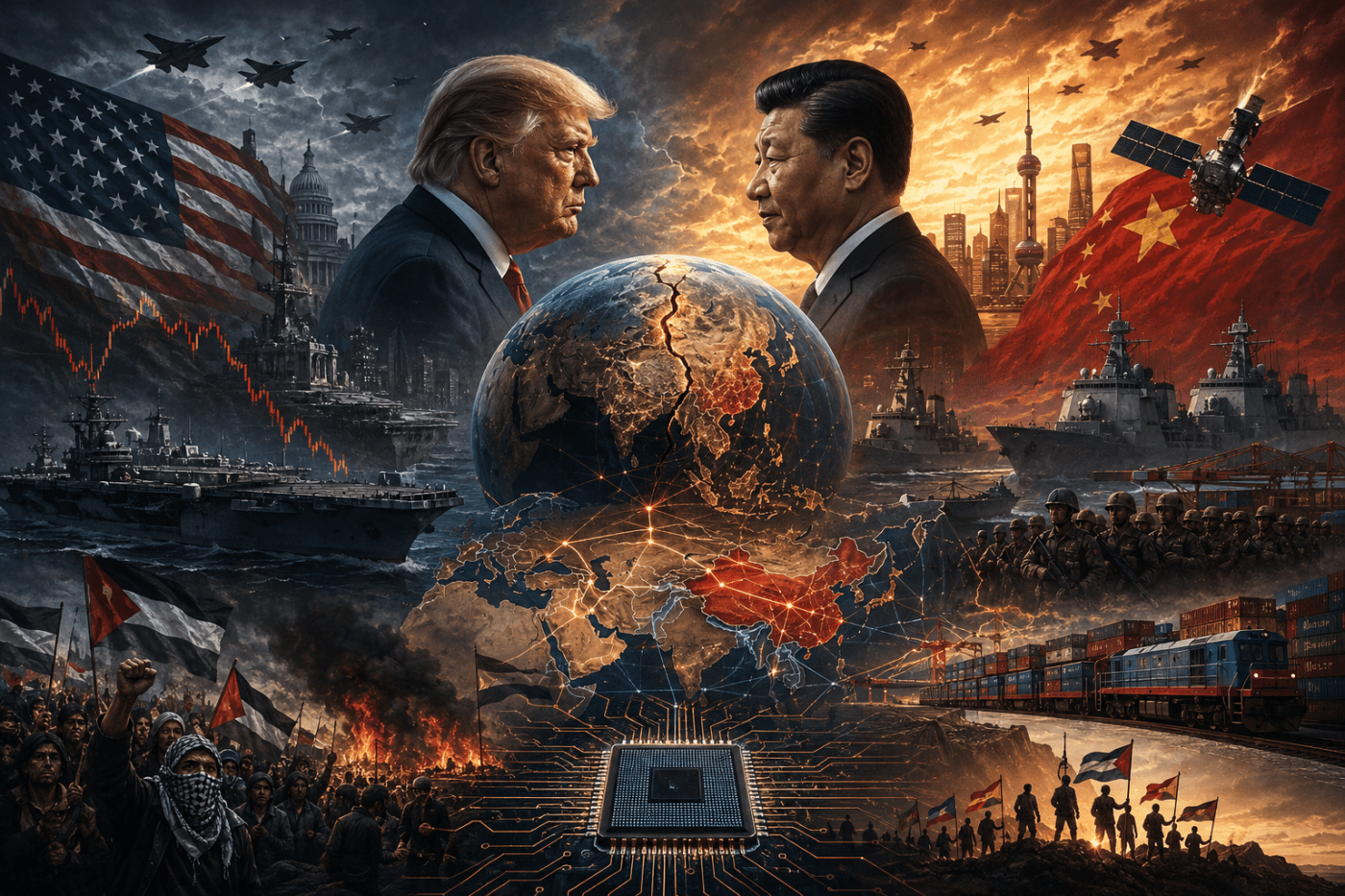
Washington arrived in Beijing carrying sanctions, aircraft carriers, and the exhausted myths of neoliberal supremacy, while Silicon Valley and Wall Street arrived carrying spreadsheets, supply-chain dependencies, and demands for access to the very industrial system the empire now seeks to contain. Beneath the summit’s choreography unfolded a deeper crisis of hyper-imperial decline, where deindustrialization, financialization, technological warfare, and collapsing Western legitimacy have forced the United States into negotiated rivalry with China. The struggle over chips, AI, Taiwan, Iran, chokepoints, and Eurasian integration revealed that the New Cold War is a battle over who will control the infrastructure of the twenty-first century. Yet the summit also exposed the reopening of history itself, where imperial decline creates dangers of war and technofascism, but also openings for anti-colonial struggle, proletarian internationalism, and revolutionary transformation.
By Prince Kapone | Weaponized Information | May 16, 2026
The Empire Arrives in Beijing
Beijing received Donald Trump with the full choreography of state power: honor guards, national anthems, a military band, a 21-gun salute on Tian’anmen Square, polished floors, smiling diplomats, ancient trees at Zhongnanhai, and the solemn theatrical beauty of two great powers pretending, for a few days, that the world was not trembling beneath their feet. The scene was elegant. It was also awkward as hell. Because Trump did not arrive in China merely as president of the United States. He arrived as the political broker of an empire in crisis, carrying behind him the boardroom aristocracy of American monopoly capital. Executives and representatives from Apple, Nvidia, Boeing, BlackRock, Goldman Sachs, Qualcomm, Tesla, Visa, Mastercard, Micron, GE Aerospace, and other major corporations accompanied the U.S. delegation. Washington spent years shouting about decoupling from China, only for the captains of American capital to board the plane like hungry men invited back to the kitchen.
The summit opened under conditions of global instability. The U.S. ruling class arrived with several urgent problems pressing down on its imperial skull: tariff disputes, disrupted supply chains, technological restrictions, rare-earth vulnerability, the AI and semiconductor war, the Taiwan question, the war crisis around Iran and the Strait of Hormuz, and the larger anxiety that China can no longer be bullied into the old subordinate position assigned to the Global South. China, for its part, did not frame the summit as surrender, reconciliation, or sentimental friendship. Xi Jinping defined the goal as building a “constructive China-U.S. relationship of strategic stability,” grounded in cooperation as the mainstay, competition within limits, manageable differences, and “expectable peace”. That language was careful. It did not deny contradiction. It tried to discipline contradiction.
Trump’s stated aim was different in tone and content. He came looking for deals, spectacle, deliverables, and the performance of restored American leverage. His banquet remarks leaned heavily into business opportunity, commercial optimism, and the promise of expanded U.S.-China cooperation. In the Chinese record of the talks, Trump praised Xi, praised China, and then made the contradiction plain enough for a child to understand: he told Xi that he had brought “the best representatives of American businesses,” that they “respect and value China,” and that he strongly encouraged them to expand cooperation with China. There it was, under the chandeliers: the U.S. state wants containment, while U.S. capital wants access. One hand prepares sanctions; the other hand reaches for contracts. One hand points missiles across the Pacific; the other asks for supply-chain stability. The empire wants to rob the house and still be invited to dinner.
The Chinese hosts understood the contradiction perfectly. Xi reminded Trump that U.S. businesses are deeply involved in China’s reform and opening up, and that China welcomes more mutually beneficial cooperation from the United States. This was not decorative diplomacy. It was a statement of material reality. American capital helped build the very industrial world Washington now fears. For decades, U.S. corporations treated China as factory, market, logistics platform, labor reservoir, and growth engine. Now Washington wants to transform China into an existential enemy without severing the profit arteries that run through Chinese production. History, unfortunately for empire, does not obey press releases.
The topics discussed showed the scale of the contradiction. The two presidents discussed trade, military-to-military communication, agriculture, health, tourism, people-to-people exchange, law enforcement, the Middle East, Ukraine, the Korean Peninsula, APEC, and the G20. Taiwan stood as the sharpest red line. Xi called Taiwan the most important issue in China-U.S. relations and warned that mishandling it could lead to “clashes and even conflicts”. Iran and Hormuz hovered over the meeting as another sign that the United States can still set fires across the world but increasingly needs others to help manage the smoke. AI chips and rare earths revealed that the struggle is not only over territory or trade, but over the machinery of modern life itself.
The public outcomes were thinner than the imperial theater suggested. The summit ended without major breakthroughs on trade, Iran, rare earths, or advanced AI-chip access. Western media emphasized the absence of decisive agreements on Iran, Taiwan, and artificial intelligence. But the deeper meaning of the summit was not that it solved the contradictions. It exposed them. The United States arrived still powerful, still armed, still arrogant, but no longer able to dictate the terms of the world order without negotiation. China received the delegation calmly, defended its red lines, welcomed business cooperation, and framed the encounter as a long struggle for stability inside a turbulent historical transition.
This essay argues that the Beijing summit represented neither peace nor the end of the New Cold War. It was a strategic pause inside a larger struggle over the future organization of world civilization. The summit revealed the limits of American coercive power, the dependence of U.S. monopoly capital on Chinese productive capacity, the technological bifurcation of the world economy, the crisis of Atlantic capitalism, and China’s strategy of tactical stabilization while pursuing long-term sovereign development. The sections that follow examine these contradictions in their concrete forms: the crisis of the American pole, the silicon front of AI and semiconductors, Chinese strategic patience and ideological struggle, the geopolitical corridors of Iran and Taiwan, and finally the revolutionary tasks facing workers and oppressed peoples as history breaks open beyond the old imperial order.
The Empire of Debt Meets the World It Can No Longer Command
The Beijing summit did not emerge from American confidence. It emerged from imperial exhaustion. The United States still possesses the largest military apparatus on earth, the dominant reserve currency, sprawling intelligence networks, hundreds of overseas bases, and the power to destabilize entire regions with sanctions, drones, naval blockades, and financial warfare. Yet beneath this mountain of coercive power lies a much weaker foundation than Washington likes to admit. The summit became necessary because the Atlantic system has entered a stage where military supremacy can no longer fully compensate for economic fragmentation, industrial decline, financial instability, and the gradual erosion of unipolar legitimacy.
For decades the United States sat atop the capitalist world-system like a landlord collecting rent from history itself. Wall Street dominated global finance. NATO enforced Atlantic military order. The IMF and World Bank disciplined weaker economies into neoliberal restructuring. Silicon Valley monopolized key digital infrastructures while Hollywood exported the mythology that American capitalism represented freedom, modernity, and the natural endpoint of civilization. Empire always introduces itself as universal morality before presenting the invoice.
But the modern Atlantic order now confronts what Tricontinental describes as a crisis of “hyper-imperialism,” where military dominance increasingly compensates for weakening productive supremacy and declining global legitimacy. The empire remains heavily armed, but the old foundations of uncontested industrial and ideological leadership have begun to crack. The United States can still sanction, bomb, sabotage, and pressure. It struggles more and more to organize stable global consent.
The contradiction is deeply rooted in the internal development of American capitalism itself. The Fortress America framework developed by WI identifies the current period as one of imperial recalibration under conditions of decline. The outward aggression against China, migrants, Iran, and the Global South mirrors an inward consolidation of surveillance, labor discipline, border militarization, austerity, and technocratic social management. The empire abroad and the police architecture at home increasingly function as twin mechanisms for stabilizing a decaying accumulation system.
Trump’s political language reflects this contradiction constantly. Tariffs sit beside billionaire worship. “America First” nationalism coexists with massive subsidies for monopoly capital. Anti-globalist rhetoric is delivered by a ruling class whose fortunes were built through decades of global outsourcing and financial integration. The spectacle often resembles a casino owner denouncing gambling addiction while quietly counting chips in the back room.
Michael Hudson’s analysis of the U.S. tariff regime notes that many of Washington’s anti-China measures end up damaging sections of the American economy itself because U.S. capitalism dismantled so much of its own industrial infrastructure during the neoliberal period. For decades American corporations relocated production abroad in pursuit of cheaper labor, weaker environmental standards, higher short-term returns, and shareholder enrichment. Entire industrial regions across the United States were hollowed out while Wall Street celebrated globalization as the final triumph of capitalist modernity.
Now the same ruling class suddenly speaks the language of industrial sovereignty and national resilience as though deindustrialization were a natural disaster instead of a deliberate class project carried out by capital itself. Factories disappeared. Infrastructure decayed. Productive labor was replaced by debt, speculation, and logistics dependency. Then the architects of this social catastrophe blamed China for the consequences of their own accumulation strategy. Capitalism possesses a remarkable talent for burning down the house and then arriving dressed as the fire department.
This contradiction shaped the summit from beginning to end. Trump arrived in Beijing surrounded by executives from companies deeply dependent on Chinese manufacturing capacity, Chinese markets, Chinese logistics networks, Chinese rare earths, and Chinese consumers. The corporate delegation itself functioned as material evidence that Washington cannot simply “decouple” from the productive structure it helped construct over the last forty years. The United States seeks containment while sections of American capital still require integration. That contradiction is no longer temporary. It has become structural.
Xi Jinping openly emphasized during the summit that China-U.S. economic relations are “mutually beneficial and win-win in nature,” while noting that “equal-footed consultation is the only right choice” where disagreements exist. This was not diplomatic sentimentality. It was a recognition that the world economy has become too interconnected for unilateral coercion to function as smoothly as it once did. Washington can still inflict enormous damage. But sanctions, tariffs, and export controls increasingly ricochet back into the arteries of the Atlantic economy itself.
Sanctions exhaustion forms part of this wider crisis. Over the last two decades the United States increasingly substituted financial punishment for productive leadership. Countries that resisted Atlantic discipline faced sanctions regimes, asset seizures, banking restrictions, technology bans, or exclusion from dollar-based financial systems. Yet the overuse of coercive mechanisms gradually encouraged states across Eurasia, Africa, Latin America, and the broader Global South to seek alternative payment systems, trade corridors, currency arrangements, and diplomatic alignments outside direct U.S. control.
Tricontinental notes that the Atlantic bloc increasingly relies on escalation precisely because older mechanisms of uncontested hegemony are weakening. The empire’s ability to command obedience through ideological legitimacy has deteriorated. Military pressure and technological choke points therefore become more central to preserving hierarchy. The summit itself reflected this reality. Washington came to Beijing still armed with sanctions, chip restrictions, and military alliances, but also needing stabilization from the very power it seeks to contain.
The broader geopolitical situation intensified this urgency. The summit unfolded amid growing instability surrounding Iran, the Strait of Hormuz, and the wider crisis in Western Asia. WI’s analysis of the war on Iran demonstrates how attacks on Iran increasingly intersect with efforts to preserve dollar hegemony, maritime control, and Atlantic dominance over Eurasian integration. Yet the more the United States pressures these regions militarily, the more it accelerates the formation of alternative economic and diplomatic alignments.
This is one reason the summit repeatedly emphasized “stability.” Stability now functions as a strategic necessity for sections of both the American and Chinese ruling structures, though for entirely different reasons. China seeks stability in order to continue long-term development, technological upgrading, and sovereign expansion without catastrophic confrontation. Washington increasingly seeks stability because imperial overstretch has become expensive, politically volatile, and economically destabilizing.
The emerging contradiction between declining unipolarity and rising multipolar development forms the deeper historical backdrop of the summit. China’s rise did not emerge from some mysterious civilizational accident. It emerged through socialist revolution, state planning, industrial coordination, infrastructure development, and integration into global production from a position still shaped by sovereign state capacity rather than pure financialization. China contains contradictions of its own, but it did not fully dismantle the developmental mechanisms neoliberal capitalism systematically hollowed out across much of the Atlantic world.
This difference matters enormously. The United States increasingly governs through debt expansion, speculative finance, military expenditure, and monopoly rents extracted from technological and financial dominance. China, despite market reforms and capitalist pressures, still retains stronger state direction over infrastructure, industrial planning, banking coordination, and long-term strategic sectors. That divergence helps explain why the confrontation between the two powers increasingly centers not only on trade, but on the future structure of modern accumulation itself.
The summit therefore reflected something larger than ordinary diplomacy. It reflected an empire attempting to stabilize a world it can no longer fully command through unilateral force alone. The United States remains dangerous, wealthy, militarized, and capable of inflicting immense destruction. But the age when Atlantic power could simply dictate the terms of global development without meaningful resistance is eroding. The empire still commands aircraft carriers and sanctions systems. It now confronts a world increasingly searching for exits from imperial dependence.
That is why the contradiction now shifts toward technology. As productive supremacy weakens and financial legitimacy deteriorates, the United States increasingly turns toward control over digital infrastructure, semiconductors, artificial intelligence, data systems, communications architecture, and technological choke points as mechanisms for preserving global hierarchy. The crisis of American accumulation therefore leads directly into the technological war itself. The next battlefield of imperial stabilization is not only territorial. It is computational.
The Silicon Front and the War Over the Future
The deeper logic of the Beijing summit was never confined to tariffs, banquet speeches, or ceremonial diplomacy. Beneath the language of “strategic stability” stood a much more dangerous struggle over who will control the technological architecture of the twenty-first century. Chips, artificial intelligence, telecommunications infrastructure, quantum systems, cloud computing, rare earths, data networks, and semiconductor manufacturing now occupy the same strategic position that oil, railroads, and steel occupied during earlier phases of capitalist development. The conflict between the United States and China increasingly centers on the machinery through which modern civilization itself is organized.
This is why the technological question haunted the summit even when officials attempted to downplay it publicly. U.S. Trade Representative Jamieson Greer insisted during the meetings that semiconductor export controls were “not a major topic” of discussion. The statement itself revealed the opposite. Everyone involved understood perfectly well that the technology war now sits at the center of the larger geopolitical confrontation. One does not nervously deny the importance of semiconductors unless semiconductors have become critically important.
The contradiction is rooted in the changing structure of global capitalism. During the neoliberal era, the United States gradually shifted away from broad productive supremacy toward control over financial systems, intellectual property monopolies, software ecosystems, digital infrastructure, and high-end technological chokepoints. Wall Street and Silicon Valley became the twin command centers of late Atlantic capitalism. Production increasingly dispersed globally while control over advanced technological systems remained concentrated inside the American-led bloc.
Congressional reports on U.S.-China technology competition openly frame advanced semiconductors, artificial intelligence, quantum systems, and telecommunications infrastructure as strategic national-security assets. The phrase “national security” now stretches across nearly every area of technological development. Chips are national security. Data is national security. Supply chains are national security. Cloud computing is national security. Artificial intelligence is national security. Apparently the only thing not considered national security inside modern American politics is the actual material security of ordinary people trying to survive collapsing healthcare, housing costs, poisoned water systems, and permanent debt servitude.
The campaign against Huawei exposed the real structure of this conflict years ago. WI’s analysis of the war against Huawei identified the deeper issue as technological sovereignty rather than simple espionage concerns. Washington portrayed Huawei as a unique surveillance threat while simultaneously presiding over a global surveillance architecture so vast that even George Orwell might have demanded a cigarette break halfway through reading the files. The actual danger Huawei represented was that a non-Western power was developing advanced telecommunications systems outside direct Atlantic control.
Technological dependence has long functioned as one of the hidden pillars of imperial power. Control the software, and you influence the infrastructure. Control the chips, and you influence the machines. Control the operating systems, cloud services, satellite networks, and communications architecture, and you quietly shape the terrain through which economies, governments, militaries, and populations operate. Modern empire increasingly governs not only through territory and finance, but through code.
This is why Silicon Valley became inseparable from the American national-security state. WI’s analysis of the AI grid crisis shows how Big Tech, monopoly finance capital, the Pentagon, intelligence agencies, and digital infrastructure increasingly function as one integrated regime of accumulation and social control. The mythology of the rebellious tech entrepreneur masks a much older historical reality: American technological supremacy was heavily incubated through military funding, defense contracts, intelligence partnerships, university research programs, and Cold War state investment.
The summit itself reflected this fusion clearly. Trump did not arrive in Beijing accompanied by factory workers or small manufacturers. He arrived with executives tied directly to the commanding heights of the digital economy: Nvidia, Qualcomm, Apple, Tesla, BlackRock, and major financial institutions deeply entangled with advanced technological infrastructure. The delegation openly showcased the integration of monopoly capital and state strategy. The American state seeks to slow China technologically while American corporations still seek profit from Chinese technological development itself.
Nvidia’s presence carried particular symbolic weight. Advanced GPUs now sit at the center of the global AI race, powering machine learning systems, surveillance infrastructures, military simulations, predictive analytics, cloud computing, and automated logistics. The modern world increasingly runs on semiconductor architecture the way industrial capitalism once ran on coal and steel. Whoever controls advanced chips gains leverage over the future organization of labor, finance, communications, warfare, and governance.
Taiwan therefore occupies a strategic position extending far beyond conventional geopolitics. Taiwan is not simply a territorial flashpoint. It is deeply connected to semiconductor production and the digital infrastructure of the world economy itself. The Pacific now contains both aircraft carriers and fabrication plants. The chip war and the military encirclement of China increasingly overlap as parts of the same imperial strategy.
Yet the harder Washington pushes technologically, the more contradictions emerge. Export controls, sanctions, and restrictions were designed to freeze China beneath a technological ceiling permanently controlled by the Atlantic bloc. Instead, they accelerated Chinese efforts toward technological self-reliance. Analysis of China’s semiconductor strategy noted that Beijing increasingly approached the chip war through long-term adaptation, industrial coordination, and strategic patience rather than immediate escalation. Pressure forced China to deepen investment in domestic semiconductor ecosystems, alternative supply chains, and sovereign innovation capacity.
The irony is almost painful. American capitalism spent decades preaching the gospel of free markets, globalization, and competition. Now Washington attempts to block technological competition precisely because another state became too successful at operating inside the global production system neoliberalism itself helped construct. Capitalism celebrates competition only until the monopoly starts losing market share.
Artificial intelligence intensifies these contradictions even further. China’s recent AI breakthroughs increasingly reflect the strengths of coordinated industrial planning, state-supported infrastructure, scientific investment, and large-scale developmental coordination. The United States still possesses immense advantages in research, finance, software, and computational power, but China now possesses the industrial scale, engineering workforce, manufacturing depth, and state capacity necessary to contest sectors once monopolized almost entirely by the Atlantic world.
The AI race is not simply economic competition. It is rapidly becoming a struggle over the future organization of society itself. Artificial intelligence now intersects with predictive policing, labor automation, battlefield management, financial speculation, algorithmic propaganda, biometric surveillance, logistics coordination, and population management. Under monopoly capitalism, AI increasingly functions less as human liberation than as a dream of frictionless control. The ruling class looks at artificial intelligence the way plantation owners once looked at mechanization: a tool for extracting more labor while disciplining the people who produce wealth.
WI’s analysis of “Empire’s Digital Panic” situates the technology war within the broader crisis of imperial decline. The United States is not merely competing with China economically. It is attempting to preserve dominance over the infrastructure through which modernity itself is increasingly organized. Whoever controls digital systems shapes not only commerce, but consciousness, labor relations, military doctrine, communications, and the global division of technological dependency.
This technological conflict increasingly overlaps with military planning as well. Recent Pentagon strategic planning openly frames advanced technologies as central to long-term confrontation with China. AI, semiconductors, quantum systems, satellite infrastructure, cyber capabilities, and telecommunications networks are all treated as strategic assets inside preparation for prolonged geopolitical rivalry. The New Cold War therefore differs from the original Cold War in one decisive respect: the infrastructure of civilian digital life and the infrastructure of military competition have become deeply fused together.
This is where technofascism emerges as a useful analytical category. Under conditions of capitalist stagnation, imperial decline, and social instability, monopoly capital increasingly turns toward digital surveillance, AI integration, predictive analytics, algorithmic governance, and information control as mechanisms for maintaining order. The merger of Big Tech, finance capital, intelligence systems, and military infrastructure produces a form of political-economic power that governs populations not only through ideology or force, but through data extraction and behavioral management embedded directly into everyday life.
The summit exposed these contradictions without resolving them. American corporations still desperately want access to Chinese markets, Chinese consumers, Chinese manufacturing ecosystems, and Chinese technological growth. Washington simultaneously continues constructing export-control regimes designed to slow China’s rise. Capital seeks integration while empire seeks containment. The same ruling structure attempts both simultaneously, which increasingly produces strategic incoherence.
Yet the harder the United States pushes technologically, the more China turns toward strategic patience, sovereign development, civilizational framing, and ideological alternatives to Atlantic universalism. The technology war therefore pushes the confrontation beyond economics and into the realm of historical worldview itself. The next contradiction is no longer merely about chips or AI. It concerns how different societies interpret sovereignty, development, modernity, and the future trajectory of civilization under conditions of systemic crisis.
Strategic Patience and the Long Memory of Revolution
One of the central weaknesses of Western analysis is that it persistently attempts to understand China through categories invented for Atlantic liberal capitalism. American political discourse examines China the way a colonial missionary examines an ancient civilization: with deep confidence, selective curiosity, and the unshakable assumption that history naturally culminates in the West. China is therefore endlessly portrayed as either a collapsing authoritarian system, an unfinished capitalist transition, or a future liberal democracy temporarily delayed by stubborn Communists refusing to cooperate with destiny.
But much of contemporary Chinese ideological discourse begins from a fundamentally different premise altogether: that the liberal “End of History” moment following the collapse of the Soviet Union was not the final stage of civilization, but a historically specific phase of Atlantic dominance now entering structural crisis. The Chinese New Left emerged largely through opposition to neoliberal globalization, Francis Fukuyama’s End of History thesis, and the assumption that Western liberal capitalism represented the inevitable endpoint of modern development. For broad sections of Chinese intellectual life, the crisis now unfolding across the Atlantic world is not an accident interrupting liberal modernity. It is evidence of the contradictions inside liberal modernity itself.
This ideological terrain shaped how many Chinese intellectuals interpreted the Beijing summit. Western coverage largely treated the summit as a transactional diplomatic event involving tariffs, trade, optics, and military tension. Much Chinese discourse interpreted it instead as a symptom of a deeper historical transition involving the weakening of unipolarity, the fragmentation of neoliberal globalization, and the growing instability of Atlantic political legitimacy itself.
Xi Jinping framed the summit around “transformations not seen in a century,” asking whether China and the United States could avoid the “Thucydides Trap” and build a “constructive China-U.S. relationship of strategic stability”. That language matters because it situates the confrontation inside a long historical transition rather than a temporary diplomatic dispute. Chinese political discourse increasingly interprets the current moment not as a passing trade war, but as a restructuring of the world system itself.
Across contemporary Chinese ideological life, there exists no single unified interpretation of this transition. China contains liberals, Marxists, developmental theorists, nationalists, technocrats, neo-Maoists, market reformers, and various overlapping tendencies attempting to understand the changing world order. Yet despite their differences, many of these currents increasingly share one broad conclusion: the United States remains structurally hostile to any long-term Chinese rise capable of weakening Western supremacy.
This assumption now runs through significant sections of contemporary Chinese political thought. Following the summit, nationalist scholar Jin Canrong argued that Washington has been forced to recognize China can no longer be treated as a subordinate state operating within a U.S.-dominated international order. The importance of this interpretation lies not in nationalist triumphalism, but in its underlying assessment of changing material conditions. Within much of Chinese political discourse, the summit was understood as evidence that the global balance of power has shifted sufficiently to constrain the unilateral power the United States exercised during the unipolar era. Washington did not suddenly abandon containment because it became more conciliatory or enlightened. It entered negotiations because decades of economic warfare, military encirclement, sanctions pressure, technological restrictions, and diplomatic coercion failed to halt China’s rise or prevent the broader movement toward a multipolar international system.
Much of this outlook emerges directly from China’s revolutionary historical memory. Modern Chinese political consciousness was not shaped through uninterrupted capitalist expansion or the accumulated privileges of colonial domination. It was forged through the experience of semi-colonial subjugation during the so-called “Century of Humiliation”, the political fragmentation of the Warlord Era, recurring episodes of mass famine and social collapse, the violence of foreign imperial intervention and unequal treaties, the devastation of the Japanese occupation, prolonged civil war, and ultimately the victory of a revolutionary movement rooted in anti-imperialist national reconstruction. The Chinese Revolution emerged not from the stable development of capitalism, but from the violent breakdown of an older colonial and semi-feudal order that large sections of Chinese society had come to view as incapable of defending national sovereignty or social survival itself. Questions of sovereignty within Chinese political discourse are therefore rarely treated as abstract legal principles detached from material history. They are tied to concrete historical experiences of invasion, fragmentation, occupation, humiliation, and the struggle to prevent national disintegration under foreign domination.
This historical memory helps explain why many Chinese thinkers reject liberal universalism so sharply. Debates surrounding the Chinese New Left repeatedly challenge the assumption that Western political forms represent universally applicable models of modernization. The argument is not necessarily that China possesses a flawless system. It is that modernization, as such, does not require submission to Atlantic ideological frameworks. This distinction is crucial because it directly undermines one of the central ideological assumptions of post-Cold War liberalism: that history naturally converges toward Western capitalist institutional forms.
The idea sometimes described as “modernization without Westernization” emerges from this contradiction. China’s rise increasingly demonstrates that large-scale industrialization, technological advancement, infrastructural development, poverty reduction, and state modernization can occur outside direct Western political supervision. The existence of such a path destabilizes the ideological legitimacy of Western universalism itself. The danger China represents to the West is therefore not merely military or economic. It is civilizational and ideological.
The work of Wang Hui repeatedly critiques the depoliticizing effects of neoliberal market reform, the elevation of market logic into an unquestionable social principle, and the tendency to reduce political life to the management of capitalist accumulation. In essays such as “Depoliticized Politics, From East to West”, Wang argues that marketization and technocratic governance produce widening inequality, weaken democratic political struggle, and naturalize capitalist social relations as if they were historically inevitable. These concerns reflect broader anxieties within significant sections of the Chinese New Left, particularly fears that deeper integration into global capitalism could subordinate sovereign development to transnational financial power, external dependency, and the institutional logic of the neoliberal world order. Wang’s broader intellectual project consistently warns against allowing modernization to become synonymous with wholesale submission to Western capitalist models or the ideological assumptions embedded within them. From this perspective, the summit appeared not as a pathway toward ideological convergence with the West, but as a tactical mechanism for managing geopolitical and economic contradictions while preserving China’s long-term developmental autonomy and strategic sovereignty.
More explicitly Marxist and neo-Maoist tendencies often push this analysis further. Left-nationalist and neo-Maoist discourse associated with Utopia (乌有之乡) increasingly frames the confrontation with the United States as part of a broader anti-imperialist struggle involving technological sovereignty, financial independence, military encirclement, and resistance to Western ideological domination. Within these currents, the summit represented tactical coexistence under hostile conditions rather than genuine strategic trust.
This helps explain why the language of “strategic patience” has become so important inside Chinese discourse. Patience here does not mean passivity. It means refusing premature confrontation while continuing to strengthen productive capacity, technological independence, military preparedness, infrastructural integration, and diplomatic influence. Time itself becomes strategic. Chinese leadership increasingly appears convinced that the historical trajectory favors long-term sovereign development so long as catastrophic military escalation can be avoided.
Li Minqi’s world-systems analysis argues that the capitalist world economy is entering a prolonged structural crisis shaped by ecological exhaustion, financial instability, and the declining hegemonic capacity of the United States. Drawing heavily from the world-systems tradition of Immanuel Wallerstein and Giovanni Arrighi, Li argues that China’s rise is destabilizing the historical foundations of Atlantic-centered capitalist accumulation itself rather than smoothly integrating into a stable liberal order. In works such as “The Collapse of American Hegemony and the Challenges of the 21st Century”, Li frames the contemporary period as one of accelerating hegemonic decline, systemic instability, and geopolitical transition. Within this framework, the Beijing summit becomes part of a much larger historical process involving the uneven weakening of unipolar power and the emergence of a more fragmented multipolar order. The significance of China therefore lies not merely in national development, but in the broader destabilization of Western monopoly power and the historical limits of the neoliberal world system itself.
Importantly, these Chinese ideological currents are not free from contradiction themselves. Some developmental theorists continue defending strategic integration into global markets under strong state guidance. More critical neo-Maoist tendencies warn that excessive integration with global finance capital risks strengthening inequality, market dependency, and capitalist restoration pressures inside China itself. These internal debates matter because they shape how different ideological tendencies interpret relations with the United States, the meaning of sovereignty, and the future of socialism under conditions of global capitalist crisis.
Taiwan sits at the center of many of these contradictions. WI’s analysis of Taiwan as the unfinished wound of Chinese sovereignty captures why the issue carries such enormous political and historical weight across Chinese ideological life. Taiwan is not widely interpreted inside China as a simple territorial disagreement. It is viewed as the surviving fracture line of civil war, foreign intervention, Cold War partition, and historical national fragmentation imposed during the era of imperial domination.
This is why U.S. policy toward Taiwan has nothing to do with democratic solidarity and everything to do with strategic encirclement disguised in moral language. Washington speaks constantly about peace and stability while surrounding China with military alliances, naval patrols, missile systems, arms transfers, intelligence infrastructure, and technological containment regimes across the Pacific. The empire calls itself defensive while steadily extending the geography of confrontation.
Even the Council on Foreign Relations acknowledged following the summit that Taiwan remained central to Beijing’s conception of strategic stability. This is crucial to emphasize because it demonstrates that China’s emphasis on stability does not mean ideological surrender or geopolitical passivity. China seeks stabilization while defending what it considers core sovereign interests with increasing firmness.
The broader historical significance of these debates extends beyond China itself. China’s rise must be situated within the wider anti-colonial process through which formerly subordinated societies seek greater sovereignty over development, infrastructure, finance, and technological capacity. From this perspective, the weakening of Western dominance does not simply represent a “Chinese rise.” It reflects the broader crisis of a world order constructed through centuries of colonial pillage and imperial exploitation.
This does not mean China is some sort of utopia. Chinese society contains labor tensions, class contradictions, inequality, market pressures, and unresolved struggles over the future direction of socialist development. But the historical importance of China lies less in perfection than in rupture. China disrupted the assumption that Western capitalism represented the uncontested horizon of modernity itself.
That rupture terrifies sections of the Atlantic ruling class because imperial legitimacy depends heavily on the belief that no viable alternative developmental path exists outside liberal capitalism. The ideological crisis of the West therefore runs deeper than inflation, debt, elections, or military overstretch. It is a crisis of historical confidence. The liberal order no longer appears inevitable even to many people living inside the Western world itself.
This is why Chinese discourse surrounding the summit often sounds so calm rather than triumphant. The contradictions with the United States are widely understood as structural and long-term. Strategic stabilization may be possible. Permanent reconciliation appears far less likely. China increasingly approaches the confrontation through patience, development, and long-duration planning while the Atlantic world oscillates between panic, militarization, sanctions escalation, and ideological exhaustion.
And this strategic patience increasingly connects China to wider processes already reshaping the Global South: Eurasian integration, BRICS expansion, alternative financial systems, anti-hegemonic restructuring, energy corridors, maritime realignment, and sovereign-development projects stretching from Iran to Latin America to Africa. The summit therefore cannot be understood merely as a bilateral dispute between two powers. It sits inside a much larger historical transition involving the fragmentation of Western hegemony and the uneven emergence of a multipolar world order.
The Corridors of Defiance
The contradictions exposed at the Beijing summit do not float in the air as abstract geopolitical theories. They are rooted in concrete geography: sea lanes, pipelines, ports, semiconductor corridors, military bases, fiber-optic cables, rare-earth routes, shipping chokepoints, energy systems, and industrial supply chains stretched across the surface of the earth like the nervous system of modern capitalism itself. The New Cold War is not simply a conflict of ideologies or national ambitions. It is a struggle over who will control the arteries through which the world economy breathes.
This is why Iran, Taiwan, the South China Sea, the Strait of Hormuz, and the Pacific containment architecture all hovered silently over the summit even when diplomats spoke politely about “stability” and “cooperation.” Behind every handshake stood maritime corridors, military calculations, sanctions systems, and the growing realization that the old Atlantic order can no longer fully organize global trade, energy, finance, and development on unilateral terms.
Iran occupies a central position in this geography of transition. The US-Iraeli war on Iran is inseparable from the struggle over Eurasian integration, energy sovereignty, maritime chokepoints, and the weakening of dollar-centered imperial power. Iran is not simply another target in Washington’s long list of regime-change fantasies. It sits at the crossroads linking China, Russia, Central Asia, the Persian Gulf, and the broader Belt and Road architecture. Weakening Iran therefore serves a much larger strategic objective: preventing the consolidation of alternative political-economic corridors outside Western command.
The Strait of Hormuz remains one of the most important arteries in the world economy. A substantial portion of global energy flows continues to move through Hormuz, making the region essential not only to Western economies, but increasingly to China’s long-term energy security as well. Every tanker moving through the Gulf carries not simply oil, but the unstable balance of the capitalist world-system itself. This explains why conflict around Iran repeatedly sends panic through financial markets. Modern capitalism still runs on hydrocarbons even while pretending it has spiritually evolved into an app.
The petrodollar system historically tied global energy trade to U.S. financial dominance. Control over energy systems strengthened the dollar’s position at the center of world trade while reinforcing American geopolitical leverage over allies and rivals alike. But as China expands long-term energy partnerships across Eurasia and the Global South, alternative payment systems, currency arrangements, and trade mechanisms increasingly emerge outside direct U.S. supervision. The crisis confronting Washington is therefore not merely military. It is monetary, logistical, and civilizational.
This is one reason the U.S.-Israeli confrontation with Iran increasingly intersects with the larger struggle against China. The war pressure surrounding Iran directly connects to efforts to preserve dollar hegemony, contain Eurasian integration, and destabilize alternative developmental corridors. The US ruling class understands that a fully integrated Eurasian economic space stretching from China through Central Asia into Western Asia and beyond would weaken the predatory leverage Washington historically exercised through maritime dominance and financial centralization.
China’s response has largely emphasized infrastructural integration rather than direct military confrontation. Rail corridors, energy agreements, port investments, industrial partnerships, logistics systems, telecommunications infrastructure, and development financing increasingly form the material basis of Beijing’s global strategy. Western analysts frequently describe Belt and Road expansion as “Chinese influence operations”, which is a polite imperial phrase meaning “other countries are building relationships outside our supervision.” The Western world spent centuries conquering continents with gunboats and debt peonage. China builds railroads and suddenly everyone in Washington starts talking like a nervous colonial governor watching the locals buy construction equipment.
Yet the Pacific remains the sharpest military front in this emerging geography of multipolar transition. Taiwan stands at the center of this confrontation. Taiwan is both a historical wound produced through civil war and Cold War partition and a strategic pressure point through which Washington seeks to contain China militarily and technologically. Taiwan is simultaneously a sovereignty issue, a semiconductor hub, a military chokepoint, and a symbolic frontline in the larger struggle over the future structure of Asia.
During the summit, Xi Jinping warned directly that mishandling Taiwan could produce “clashes and even conflicts” between China and the United States. This was not rhetorical decoration. Taiwan increasingly functions as the fault line where military containment, semiconductor dependency, nationalist legitimacy, and imperial strategy converge. The United States publicly claims to support stability while continuously expanding weapons transfers, alliance coordination, naval patrols, intelligence integration, and military positioning across the Pacific theater.
The U.S. alliance architecture involving Japan, South Korea, Okinawa, Australia, and Pacific military infrastructure increasingly forms a containment network directed toward China. The Atlantic bloc now seeks to extend NATO-style strategic logic into the Pacific, transforming East Asia into a permanent theater of military pressure. The New Cold War therefore differs from earlier periods not simply in geography, but in the fusion of military containment with technological and economic fragmentation.
This fusion becomes visible most clearly through sanctions architecture. The United States increasingly weaponizes access to banking systems, software ecosystems, semiconductor technologies, insurance markets, logistics networks, and dollar-clearing systems as instruments of geopolitical coercion. Financial infrastructure itself has become militarized. Sanctions now function as economic siege warfare carried out through algorithms, institutions, and payment systems instead of blockades alone.
Yet the overuse of such flagrant coercion produces its own contradictions. The more Washington weaponizes global systems, the more states seek alternatives. BRICS expansion, regional development banks, cross-border currency agreements, alternative settlement systems, and South-South integration increasingly emerge as defensive responses to the instability produced by Atlantic financial power. Multipolarity therefore does not arise from abstract ideological enthusiasm. It emerges materially from the attempt of states across the Global South to reduce vulnerability to imperial coercion.
The growing contradiction between declining unipolarity and emerging multipolar development increasingly reorganizes global alignments. Countries across Africa, Latin America, Western Asia, and Eurasia now attempt to navigate between competing power centers while seeking greater autonomy over development, trade, infrastructure, and technological capacity. This process remains uneven, contradictory, and deeply shaped by capitalism itself, but it nonetheless signals the weakening of uncontested Atlantic command.
The summit in Beijing reflected this changing terrain with unusual clarity. The United States arrived still capable of immense destruction, still militarily dominant, still controlling major financial and technological systems. But it no longer arrived as the sole architect of the world order. China approached the summit from the position of a rising industrial power increasingly integrated into wider Eurasian and Global South networks resistant to unilateral Western control.
This is why the contradictions discussed throughout the summit increasingly converge geographically. The crisis of American accumulation pushes Washington toward technological containment. Technological containment pushes China toward sovereign development and strategic patience. Strategic patience pushes China deeper into Eurasian integration, Belt and Road expansion, and Global South realignment. Those processes then collide with the military geography of Taiwan, Hormuz, the Pacific alliance system, and the maritime chokepoints through which capitalism still circulates.
The New Cold War therefore cannot be understood simply as a diplomatic rivalry between two powerful states. It is the geopolitical anatomy of a deeper systemic transition involving imperial decline, technological fragmentation, sovereignty struggles, sanctions warfare, energy insecurity, military encirclement, and the crisis of neoliberal globalization itself. The summit exposed all these contradictions without resolving any of them.
And that is precisely why the summit matters historically. The world order constructed under Atlantic supremacy is no longer stable enough to govern through consensus alone, yet no new global arrangement has fully consolidated in its place. We are living through an interregnum where the old imperial architecture still possesses enormous coercive power, but the emerging multipolar terrain increasingly resists unilateral command. The result is a prolonged and dangerous transition where every port, pipeline, chip factory, currency agreement, naval corridor, and telecommunications network becomes part of the struggle over who will organize the future of world civilization itself.
Strategic Stability or Strategic Pause?
The Beijing summit revealed something far more historically important than a temporary easing of tensions between Washington and Beijing. What emerged across those carefully choreographed meetings, ceremonial handshakes, business delegations, and diplomatic formulations was the visible appearance of a world-system entering a new and deeply unstable historical phase. The summit was not the end of the New Cold War. It was the recognition by both sides that the contradictions driving the New Cold War can no longer be managed through the old assumptions of uncontested American supremacy. The United States arrived in Beijing still possessing immense military force, enormous financial leverage, and unparalleled destructive capacity, yet increasingly unable to convert those instruments into stable global leadership. China approached the summit not from a position of surrender or ideological convergence with the Atlantic order, but from the position of a state attempting to navigate the dangerous transition between an aging imperial system and an emerging multipolar world whose final shape remains unresolved.
For nearly half a century neoliberal globalization functioned as the central operating mechanism of Atlantic capitalism. Production was fragmented across the globe in pursuit of cheaper labor, weaker environmental regulations, and higher rates of return, while finance capital consolidated unprecedented power over states, institutions, media systems, and international governance structures. The United States stood at the center of this arrangement not merely because of military power, but because it controlled the institutional architecture through which globalization itself was organized: the dollar system, the Bretton Woods institutions, the major technological platforms, the core logistics networks, and the military alliances necessary to discipline dissent. The empire presented this order as the natural culmination of human civilization itself. Francis Fukuyama famously declared history finished, as though several centuries of colonial domination, anti-colonial revolution, capitalist crisis, and world war had merely been an elaborate waiting room for Wall Street deregulation and American consumer culture.
Yet the very mechanisms that consolidated American-led globalization simultaneously undermined the productive foundations of American hegemony. Capital pursued short-term profitability with all the long-term planning capacity of a gambling addict sprinting toward a pawn shop. Industrial infrastructure was hollowed out across large sections of the United States while finance, speculation, monopoly rents, and debt increasingly replaced broad-based productive growth. Entire regions were deindustrialized in the pursuit of labor arbitrage abroad. Infrastructure decayed. Social cohesion deteriorated. Political legitimacy fractured. Meanwhile China absorbed enormous productive capacity, technological expertise, logistical integration, and industrial development through a state-managed process that never fully surrendered strategic control over finance, infrastructure, and long-term planning to the chaos of private capital accumulation.
The result is the contradiction now sitting at the center of the world economy: the United States seeks to contain the very industrial system upon which enormous sectors of American monopoly capital remain materially dependent. This contradiction haunted every dimension of the summit. Washington speaks the language of decoupling while Boeing seeks aircraft contracts, Nvidia seeks market access, BlackRock seeks financial integration, Apple seeks supply-chain stability, and American investors continue searching for growth opportunities inside the Chinese economy. The American state increasingly treats China as a strategic adversary while American capital continues behaving as though China remains indispensable to the long-term reproduction of global accumulation itself. One part of the empire prepares for confrontation while another quietly calculates quarterly earnings projections tied directly to continued Chinese development.
This contradiction extends far beyond trade. The technological war now unfolding between the United States and China reveals the degree to which digital infrastructure, artificial intelligence, semiconductors, telecommunications systems, cloud architecture, logistics platforms, surveillance technologies, and military planning have fused into a single integrated terrain of geopolitical struggle. The old neoliberal fantasy that technology existed outside politics has collapsed completely. Silicon Valley no longer functions merely as a commercial sector; it increasingly operates as an extension of military strategy, intelligence coordination, financial concentration, and imperial management. The chip war therefore represents not simply an economic dispute but a struggle over who will control the technological architecture through which twenty-first century social life itself will increasingly be organized.
Yet the harder Washington pushes technologically, financially, and militarily, the more it accelerates the very fragmentation it seeks to prevent. Export controls stimulate Chinese semiconductor development. Sanctions encourage alternative financial arrangements. Military encirclement deepens Eurasian coordination. Attempts to isolate China increasingly expose the declining ability of the Atlantic bloc to monopolize global legitimacy. Much of the Global South no longer interprets American power through the moral mythology of liberal internationalism, but through the historical memory of sanctions, coups, invasions, proxy wars, debt restructuring programs, and developmental sabotage. Iraq remembers. Libya remembers. Palestine remembers. Latin America remembers. Africa remembers. Asia remembers. The crisis confronting the Atlantic order is therefore not merely economic. It is civilizational and ideological. Liberal universalism increasingly struggles to present itself as universal while attached to military encirclement, digital surveillance, financial coercion, and permanent war.
China’s response to this transition differs fundamentally from the increasingly panicked tempo of the Western political class. Much of contemporary Chinese political thought — from state developmentalism to New Left currents and neo-Maoist tendencies — approaches the current moment through the historical memory of anti-colonial struggle, socialist state formation, and long-duration civilizational continuity. This does not mean China exists free of contradiction, class struggle, capitalist pressures, or internal tensions. It means Chinese strategic thinking is shaped by a different historical rhythm. Where Washington increasingly operates through crisis management and short-term electoral spectacle, Beijing approaches the transition through the language of strategic patience, sovereign development, infrastructural integration, technological self-reliance, and managed stability. China’s leadership understands that time itself has become a geopolitical variable.
This is precisely why the summit should not be interpreted as reconciliation. The contradictions between the United States and China remain profound and potentially catastrophic. Taiwan remains a militarized fault line inside the Pacific. The technological war continues intensifying. NATO expansion into Asia continues. Sanctions architectures continue expanding. Military preparations continue accelerating. The Pacific and Eurasia are increasingly being reorganized around competing logistical, financial, technological, and military blocs under conditions of mounting capitalist instability. The summit did not resolve these contradictions because they cannot be resolved through diplomatic atmospherics alone. They emerge from deeper structural transformations inside the capitalist world-system itself.
What the summit represented instead was a negotiated attempt to stabilize a deteriorating global order whose underlying mechanisms are increasingly breaking apart. The neoliberal phase of globalization is fragmenting, yet no stable replacement order has fully consolidated. Multipolarity is emerging unevenly, chaotically, and under conditions of profound danger. New sovereign spaces are opening across the Global South while old imperial institutions struggle to maintain cohesion. Regional powers seek greater autonomy while financial instability, ecological crisis, militarization, technological fragmentation, and imperial decline intensify simultaneously. History, which the Atlantic ruling class once declared finished, has resumed moving with tremendous force.
But multipolarity by itself guarantees nothing. A world containing multiple capitalist power centers does not automatically abolish exploitation, class domination, labor precarity, ecological destruction, chauvinism, or imperial violence. The decline of uncontested American hegemony creates openings, fractures, and strategic possibilities, but openings alone do not produce emancipation. The ruling classes of every nation remain fully capable of wrapping exploitation in the flags of sovereignty and calling it liberation. There is no progressive algorithm hidden automatically inside geopolitical transition. History offers possibilities, not guarantees.
This is why revolutionary forces cannot afford either liberal nostalgia for Atlantic supremacy or naïve romanticism about multipolar capitalism. The task is not to choose between competing elites managing different zones of accumulation. The task is to understand how the fragmentation of imperial coordination creates new opportunities for anti-colonial struggle, labor organization, sovereign development, and proletarian internationalism under changing historical conditions. The weakening of unilateral American dominance opens political space for nations previously suffocated under direct imperial discipline. It weakens sanctions consensus. It disrupts military coordination. It fractures ideological monopolies. It creates contradictions inside the capitalist core itself. Those fractures matter enormously. But they become historically meaningful only if organized political movements intervene consciously within them.
The struggle therefore moves simultaneously along multiple fronts. Revolutionary movements must oppose imperial war not because they harbor illusions about peace under capitalism, but because militarization increasingly functions as the mechanism through which ruling classes attempt to manage systemic crisis. They must oppose technofascism because digital surveillance, algorithmic governance, artificial intelligence, and predictive control systems are becoming central instruments for disciplining labor and containing social unrest inside both imperial and non-imperial societies. They must defend sovereignty struggles across the Global South because national liberation remains one of the principal barriers against total subordination to monopoly-finance capital. They must reject chauvinism because capitalist crisis continuously attempts to redirect popular anger toward migrants, foreign populations, racialized communities, and geopolitical enemies instead of toward the structures of accumulation producing mass precarity itself.
Above all, revolutionary forces must recover the capacity to think historically again. The greatest ideological achievement of neoliberalism was convincing humanity that no alternative future could exist beyond the horizon of markets, finance, privatization, and imperial management. That illusion is now disintegrating in real time. The Beijing summit revealed a world entering a new epoch of instability, fragmentation, and transformation in which the old certainties no longer hold. The Atlantic order remains dangerous precisely because it is declining, not because it remains historically invincible. China rises, but under conditions filled with contradiction. Multipolarity advances, but unevenly. Capitalism mutates technologically while ecological pressures intensify globally. The future remains profoundly unresolved.
And that unresolved character is precisely what makes the present historical moment so dangerous — and so full of possibility. The old world has not fully died. The new world has not fully arrived. Between them stands an exhausted empire still armed with aircraft carriers, sanctions systems, financial weapons, artificial intelligence infrastructures, and enough military hardware to threaten civilization itself. But standing opposite that empire now are billions of people across the Global South, across the industrial corridors of Asia, across the fractured working classes of the West itself, all increasingly confronting the same historical reality: the system organizing modern life no longer possesses the legitimacy, stability, or developmental capacity it once claimed for itself.
The Beijing summit was therefore not merely diplomacy. It was a glimpse into the unstable birth of a new historical terrain upon which the struggles of the twenty-first century will unfold. The question now is no longer whether the neoliberal order is entering crisis. The question is what forces will emerge from that crisis strong enough, organized enough, and disciplined enough to shape what comes next.


Leave a comment