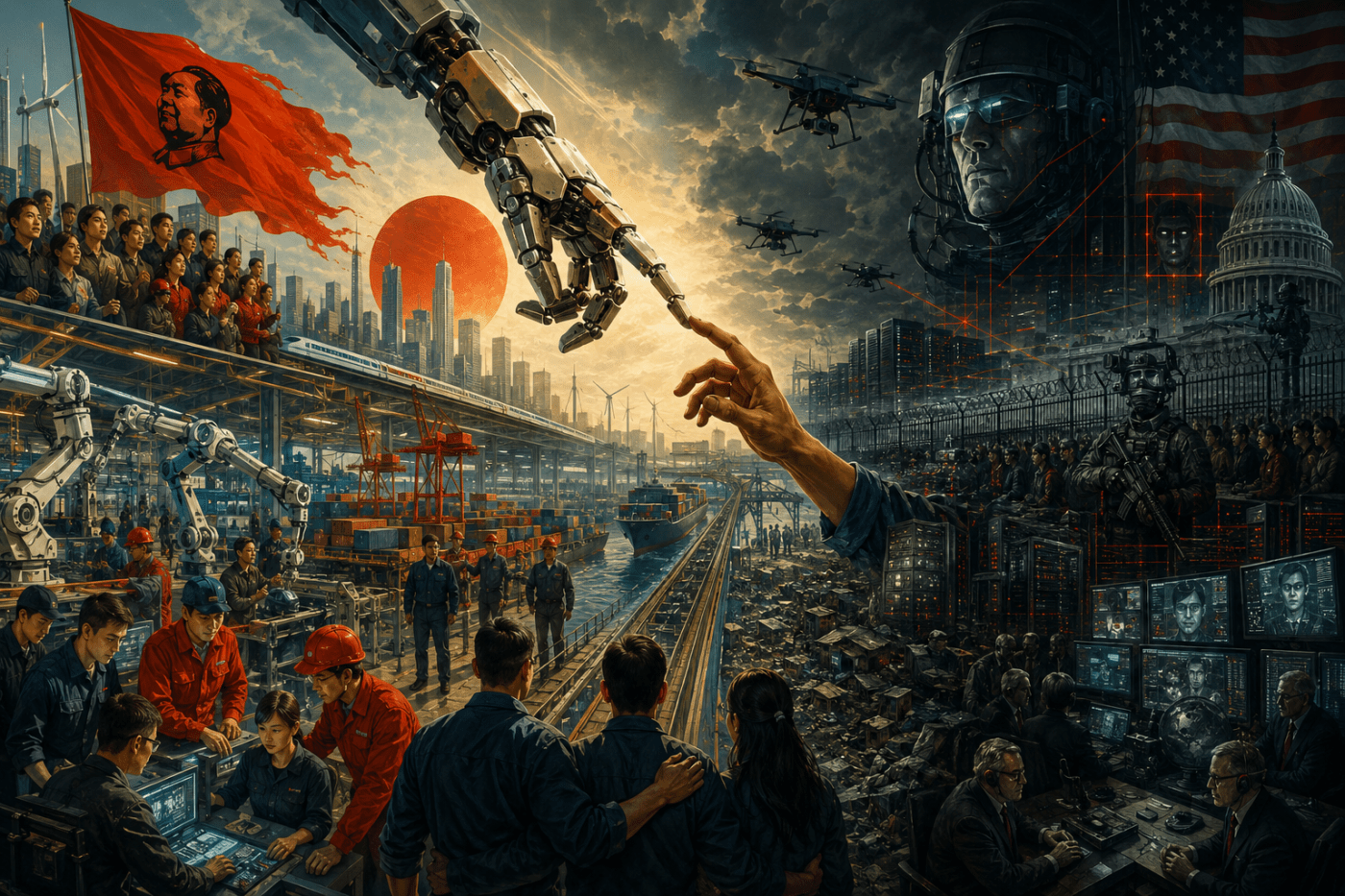
China’s rise from low-end assembly platform to intelligent manufacturing power is not simply an economic story, but a historical rupture in the Atlantic monopoly over industrial command, technological sovereignty, and the productive forces themselves. As the United States responds through sanctions, semiconductor blockades, surveillance systems, and infrastructural warfare, artificial intelligence increasingly becomes the terrain upon which hyper-imperial decline and the emerging American technofascist order attempt to stabilize themselves. Yet the contradiction runs deeper still: even socialist modernization faces unresolved struggles over technocracy, labor participation, bureaucratic command, and who ultimately controls intelligent production in the age of AI. The future therefore hinges not on the machine itself, but on whether humanity can wrest automation, infrastructure, and technological development out of the hands of monopoly capital and reorganize them toward collective human liberation.
By Prince Kapone | Weaponized Information | May 18, 2026
From the World’s Workshop to the Command of the Machine
China did not fall from the sky as an industrial power. It was not delivered by the invisible hand, blessed by Wall Street, or summoned into existence by the fairy dust of “free markets,” that old bedtime story capital tells workers after it has picked their pockets. China became the workshop of the world through a long, uneven, disciplined, and deeply contradictory process of national development, foreign investment, export production, mass urbanization, infrastructure construction, and proletarian formation. It entered the circuits of capitalist globalization not as a passive victim waiting to be swallowed, but as a post-revolutionary state attempting to use the world market against the historic underdevelopment imposed by imperialism.
This distinction matters because the dominant Western mythology still treats globalization as though nations simply “integrated” into neutral markets governed by efficiency and comparative advantage. In reality, the world market has always been structured by imperial power. The Atlantic system opened space for China’s rise only within carefully managed limits. China could industrialize, but not command. It could manufacture, but not monopolize. It could assemble the commodity, but the higher architecture of technological civilization — patents, standards, semiconductors, operating systems, finance, cloud infrastructure, shipping insurance, and strategic logistics — was expected to remain concentrated inside the imperial core. This was the unwritten constitution of neoliberal globalization.
The old imperial arrangement therefore expected China to remain useful but subordinate. Western corporations wanted the labor, the ports, the roads, the disciplined production networks, the massive supply chains, and the cheap commodities. They wanted the Chinese worker’s hands, but not China’s brain. They wanted the assembly line, but not technological command. They wanted “Made in China” stamped on the back of the product, while the patents, chips, software, branding, finance, and final profits remained safely tucked away in the vaults of Apple, Intel, Qualcomm, Microsoft, Wall Street, Tokyo, Seoul, Taipei, Berlin, and Silicon Valley. In this arrangement, China could manufacture the body of the machine, but the imperial core still expected to own its nervous system.
This was the great contradiction inside the first stage of China’s manufacturing rise. China became central to global production, but not yet fully sovereign over the highest layers of production. Research on China’s emergence as the workshop of the world shows how export manufacturing, vertical specialization, and participation in global value chains helped pull China into the center of world industrial production. But participation is not command. To assemble the commodity is not the same as controlling the technology, the standards, the intellectual property, the high-end components, the operating systems, the logistics platforms, or the financial architecture that determine who captures the wealth.
This is where the mythology of the “free market” begins to collapse under its own contradictions. The same Atlantic powers that preached globalization as an inevitable law of history quietly reserved the commanding heights of that globalization for themselves. Manufacturing could be dispersed. Labor could be outsourced. Pollution could be exported. But technological sovereignty, platform command, and infrastructural coordination were treated as strategic monopolies. The empire did not merely seek profit from production. It sought control over the chokepoints through which production itself moved.
The iPhone became the perfect little altar of this imperial division of labor. In the bourgeois imagination, it appears as a miracle of innovation born in California, kissed by design, and delivered to grateful consumers by the genius of Silicon Valley. In reality, it is a concentrated map of global class relations. Studies of who profits from innovation in global value chains showed how China could assemble a high-value product while capturing only a small portion of the final value, because the commanding profits were lodged in design, components, software, intellectual property, and branding controlled elsewhere. Later research on smartphone global value chains showed both the persistence of this problem and the beginning of China’s movement beyond it, as Chinese firms increased domestic value capture through brands like Xiaomi and OPPO.
This is why the phrase “Made in China” was always too thin. It described the surface of the commodity, not the social relations buried inside it. A product could be assembled in Shenzhen while its profits migrated to California, its chips came from Taiwan or South Korea, its software from the United States, its optical equipment from Japan, and its legal monopoly from patent regimes enforced by the imperial state system. The factory floor was in China, but the whip hand still reached across the Pacific.
Yet the very process designed to subordinate China generated the conditions for China’s ascent. Global production transferred not only machinery and investment, but industrial knowledge, engineering capacity, logistical coordination, workforce discipline, and infrastructural density. Hundreds of millions of workers were drawn into industrial production. Entire cities were reorganized around manufacturing ecosystems. Ports, railways, telecommunications systems, electrical grids, technical institutes, industrial clusters, and supply-chain corridors emerged at historic scale. China did not simply become a giant factory. It became an integrated industrial civilization.
This is precisely what many Western analysts failed to understand. Industrial production is not static. It educates. It accumulates technical capacity. It generates institutional memory. It develops engineering ecosystems. It teaches coordination. It creates the material basis for technological upgrading. An empire can outsource factories more easily than it can outsource the historical consequences of industrialization itself. The Atlantic ruling classes wanted China to remain a permanent labor reservoir inside the world economy. Instead, they helped midwife the rise of the largest manufacturing power in human history.
China’s leadership understood the contradiction clearly. The point was never simply to become large. A nation can be large and still be dependent. It can produce oceans of commodities and still be trapped at the lower end of the value chain. It can have workers, machines, ports, and railways, yet remain vulnerable if the decisive technologies are controlled elsewhere. This is the meaning of the now famous recognition in Made in China 2025 that China was “large but not strong” in manufacturing. That was not a slogan of weakness. It was an admission of contradiction. China had built scale. Now it had to build command.
Made in China 2025 was therefore not some mysterious sinister plot, despite the fever dreams of Washington think tanks that discovered, with great horror, that Chinese people also know how to read engineering textbooks. It was a national industrial strategy aimed at moving from quantity to quality, from assembly to innovation, from dependence on foreign core technologies to greater technological sovereignty. Its target was not merely more production, but a different position inside production: high-end equipment, advanced manufacturing, intelligent systems, industrial software, robotics, aerospace, new-energy vehicles, biomedicine, and the technologies required for a modern industrial civilization.
The significance of this transition cannot be understood narrowly as “economic policy.” What China increasingly threatened was not merely the profitability of Western firms, but the broader architecture of hyper-imperial command itself. The Atlantic system had long maintained supremacy through layered monopolies over finance, standards, chips, software, logistics, military infrastructure, data architecture, and technological chokepoints. China’s movement upward inside the productive forces therefore represented a deeper historical rupture: the possibility that advanced industrial civilization could emerge outside direct Atlantic control.
This shift did not emerge from nowhere. China’s participation in global value chains created real contradictions, but also real capacities. Studies of China, global value chains, and the middle-income trap show that China used industrial agglomeration, domestic demand, state policy, and supply-chain learning to avoid being permanently locked into low-end production. Research on China’s evolving role in global value chains likewise shows that Chinese firms did not simply sit obediently at the bottom of the chain. They climbed, learned, absorbed, adapted, competed, and upgraded from within the very networks that were supposed to keep them subordinate.
This is the historical-material basis of intelligent manufacturing. Artificial intelligence does not descend into society as a ghost in the machine. It requires factories, workers, engineers, electrical grids, logistics networks, machine tools, industrial data, sensors, robotics, telecommunications infrastructure, ports, warehouses, and planning capacity. The cloud has a body. The algorithm has a factory behind it. The so-called digital economy, stripped of bourgeois mysticism, is still sitting on minerals, electricity, labor, machines, and human knowledge accumulated through production.
This is an especially important point because much Western discourse treats AI as though it were primarily a software phenomenon floating weightlessly through cyberspace. In reality, intelligent manufacturing rests on enormous material infrastructures: semiconductor foundries, rare earth supply chains, industrial machinery, electrical generation, undersea cables, cloud architecture, logistics corridors, warehouses, data centers, ports, satellites, and telecommunications systems. Whoever commands these infrastructures increasingly commands the productive metabolism of modern civilization itself.
That is why China’s transition toward intelligent manufacturing is not merely a technological upgrade. It is the next stage of a long industrial transformation. The 14th Five-Year Plan for Intelligent Manufacturing gives this shift concrete form through targets for digitalized and networked manufacturing, smart factories, industrial internet platforms, intelligent equipment, industrial software, and integrated supply-chain systems. The broader 14th Five-Year Plan and 2035 Long-Range Objectives situate this effort inside the struggle for technological self-reliance, innovation, domestic demand, and national security. Here, the machine is no longer merely a tool of export processing. It becomes part of a planned effort to reorganize production itself.
The meaning of this transformation can already be seen in the language of Chinese industrial policy. Intelligent manufacturing links artificial intelligence, robotics, digital twins, industrial internet platforms, automated inspection, advanced equipment, predictive maintenance, and supply-chain coordination into one expanding system of production. Chinese reporting on AI reshaping China’s manufacturing landscape describes the use of AI across design, production, decision-making, and industrial systems. State-linked reporting on the global upgrade of Chinese manufacturing frames the movement as a shift away from low-end processing toward semiconductors, AI, high-end equipment, and new energy. This is not the old sweatshop model with a few robots sprinkled on top for decoration. It is an attempt to build an industrial nervous system.
The scale matters. China is not attempting this transformation from the position of a small experimental economy. It is doing so from the position of the largest manufacturing power on earth. Chinese reporting states that China’s manufacturing value-added reached 34.7 trillion yuan in 2025, about 25 percent of GDP, with China expected to remain the world’s largest manufacturer for the sixteenth consecutive year. Independent anti-imperialist analysis has emphasized that China produces roughly 35 percent of global gross manufacturing output, more than the next major industrial powers combined. The historical irony is almost too rich. The imperialists outsourced production to weaken labor at home and fatten profits abroad, and then woke up screaming when the workshop began learning how to command the tools.
The newer language of “new quality productive forces” marks the political vocabulary of this next stage. Chinese state reporting says that China had nearly 10,000 digitalized workshops and intelligent factories by 2024, including more than 400 national benchmark smart factories. The concept points toward productive forces that are high-tech, high-efficiency, intelligent, green, and less dependent on foreign-controlled bottlenecks. Whether one accepts every official formulation or not, the direction is clear: China is attempting to move from being the world’s most important manufacturing base to becoming a leading organizer of advanced industrial systems.
This is also where the contradiction sharpens. China’s rise has not abolished vulnerability. Integrated circuits remained China’s largest imported product in 2025, worth roughly $425 billion, a reminder that the commanding heights of semiconductor production remain a battlefield. Washington understands this very well, which is why the United States imposed October 2022 export controls targeting China’s access to advanced computing chips, supercomputing, and semiconductor manufacturing capacity, then expanded those measures through new semiconductor restrictions announced in December 2024. Under this pressure, China has moved to strengthen domestic capacity, including efforts to push chipmakers toward greater use of domestic semiconductor equipment.
This vulnerability does not negate the industrial transformation. It defines its urgency. Intelligent manufacturing is not simply about efficiency. It is about sovereignty over the material systems that make modern life possible. It is about whether a country can produce, repair, redesign, upgrade, and coordinate the machinery of its own development, or whether it must wait for permission from the same imperial powers that bomb, sanction, blockade, and lecture the world in the name of freedom while guarding every patent like a dragon sleeping on stolen gold.
This is why anti-imperialist analysis has correctly treated China’s technological rise as a challenge to monopoly power, not merely as another national success story. Tricontinental’s study of how China is shattering U.S. technological hegemony argues that China treats AI less as a speculative toy for venture capital and more as a tool for upgrading productive forces. Friends of Socialist China has similarly linked breakthroughs such as DeepSeek to the advantages of China’s long socialist developmental trajectory. The point is not that every contradiction has been solved. The point is that the machine is being pulled into a different historical project than the one imagined by Silicon Valley’s billionaires, those overfed prophets of human redundancy.
But no serious revolutionary analysis can stop at celebration. Intelligent manufacturing contains a real emancipatory possibility: less dangerous labor, shorter working time, higher productivity, more coordinated production, ecological repair, better infrastructure, and a material basis for abundance. Yet machinery does not liberate workers by itself. A robot has no class consciousness. An algorithm does not know justice. A smart factory does not automatically become a socialist factory because it is efficient. The decisive question is social command: who owns the machine, who plans its use, who benefits from its productivity, and who bears the cost of its disruptions.
Under social planning, intelligent manufacturing can become part of the struggle to reduce necessary labor time and expand human development. Under imperial management, the same productive systems increasingly become instruments of surveillance, labor discipline, social sorting, and geopolitical control. This is the deeper contradiction now emerging inside the world system itself: one road attempts to subordinate intelligent production to development, while the other increasingly subordinates intelligence itself to the preservation of imperial hierarchy.
China’s passage from workshop to intelligent manufacturing therefore does not end the struggle over production. It raises that struggle to a higher level, where the battle is no longer only over who makes the commodity, but over who commands the productive forces, infrastructures, chokepoints, and technological systems shaping the future of civilization itself.
When the Workshop Refused to Stay in Its Place
Washington did not panic when China was sewing shirts, assembling toys, soldering circuit boards, and carrying the heavy industrial burden of globalization on the backs of hundreds of millions of workers. That arrangement suited the imperial core just fine. American corporations could close factories at home, discipline labor through outsourcing, fatten profits abroad, and then return to lecture the world about efficiency, freedom, and the genius of markets. China was welcome inside globalization so long as it performed the role assigned to it by monopoly capital: produce the goods, absorb the pollution, train the workers, build the ports, move the containers, and leave the highest layers of technological command to the Atlantic ruling class and its junior partners.
This arrangement was never simply economic. It was geopolitical architecture masquerading as market logic. The Atlantic system organized globalization through layered monopolies over finance, standards, patents, cloud infrastructure, semiconductor design, shipping insurance, digital platforms, military logistics, and reserve currency power. Production could be geographically dispersed so long as command remained centralized. The factories could move south. The ownership structures, technological chokepoints, and strategic coordination mechanisms would remain north Atlantic. This was the deeper structure of hyper-imperialism: a world economy integrated materially, but governed asymmetrically through concentrated infrastructural power.
The problem began when China refused to remain merely useful. The crisis was not that China became a manufacturing power. The crisis was that China began moving from manufacturing for imperial capital toward commanding advanced productive systems in its own name. Even hostile U.S. institutions have understood this clearly. The U.S.-China Economic and Security Review Commission describes Made in China 2025 as a strategy to turn China into a manufacturing powerhouse, climb the technology value chain, and build a world-leading industrial system by 2049. Strip away the congressional alarm bells, the patriotic hand-wringing, and the usual “national security” incense, and the meaning is simple: China is attempting to escape the position assigned to it in the imperial division of labor.
That division of labor has always been the polite economic name for global hierarchy. The Global South supplies cheap labor, raw materials, agricultural goods, energy, migration pressure, debt payments, and sacrifice zones. The imperial core controls finance, patents, software, standards, insurance, shipping, military routes, reserve currency, high-end machinery, and the legal architecture of ownership. This is how dependency reproduces itself even when formal colonial flags come down. The empire no longer needs to directly govern every territory when it can govern the terms of development itself. It can own the operating system of the world economy while pretending everyone is free to click “agree.”
Intelligent manufacturing threatens this hierarchy because it is not just another export sector. It touches the command structure of production itself: chips, robotics, industrial software, artificial intelligence, batteries, ports, railways, telecommunications, machine tools, smart grids, cloud systems, and digital platforms. These are not decorative technologies. They are the bones, arteries, and nervous systems of modern civilization. A country that can coordinate industrial production through advanced computing, automate dangerous and repetitive work, build resilient supply chains, integrate transport and energy systems, and develop domestic technological standards is no longer merely asking for a better seat at the imperial table. It is helping build a different table.
This is why the language of “national security” must be read like ruling-class poetry, which is to say, as confession wearing a helmet. The United States says it is protecting security when it blocks China’s access to advanced chips, semiconductor equipment, and AI computing capacity. But the actual policy record shows technological containment. In May 2026, Reuters reported that chip export controls remained unresolved during U.S.-China talks while U.S. officials continued framing advanced chips as a strategic national-security issue. This is not a side dispute. It is the struggle over who controls the machinery of the next industrial epoch.
More specifically, it is a struggle over chokepoints. When an empire can no longer command the entire world directly, it increasingly attempts to command the infrastructures through which the world must pass. Semiconductors, cloud architecture, subsea cables, rare-earth processing, logistics corridors, payment systems, satellite networks, industrial software, and shipping lanes become instruments of geopolitical management. Under conditions of imperial contraction, infrastructural dominance becomes a substitute for uncontested hegemony. The goal is no longer merely expansion. The goal becomes preserving asymmetrical leverage over the productive metabolism of the planet itself.
The United States is not only trying to restrict American firms. It is trying to drag the rest of the advanced capitalist bloc into the blockade. The logic behind the MATCH Act is precisely to prevent China from bypassing U.S. restrictions by acquiring chipmaking equipment from allies such as Japan and the Netherlands. Reuters reported that China criticized the U.S. chip equipment bill as Washington sought tighter allied controls in the run-up to Beijing talks. Here we see the real structure of “free markets.” The market is free until a socialist-oriented state starts catching up. Then suddenly the invisible hand becomes a customs officer, a sanctions lawyer, and a Pentagon planner.
The broader strategic doctrine is not hidden. The 2025 U.S. National Security Strategy places military power, economic leverage, technological advantage, and “America First” management of the world system inside one governing framework. This is the old imperial grammar translated into the age of chips and platforms. The United States does not fear Chinese authoritarianism in the abstract. Washington has supported every species of dictatorship known to political zoology when the dictator in question keeps the mines open, the bases available, and the profits flowing north. What it fears is technological sovereignty outside its command.
This is what increasingly distinguishes the emerging trajectories of China and the American Pole. China’s developmental strategy remains centered around expanding productive capacity, industrial integration, infrastructural coordination, and technological upgrading. The Atlantic core, by contrast, increasingly governs through sanctions, platform monopolies, financial leverage, military encirclement, surveillance infrastructure, and chokepoint management. One trajectory attempts to build new productive systems. The other increasingly attempts to preserve declining monopoly control over existing ones.
China’s answer has not been autarky. It has not retreated into some fantasy of national isolation. It is pursuing self-reliance and global integration at the same time, which is precisely what makes the strategy so dangerous to the imperial order. China is not trying to unplug from the world economy. It is trying to participate from a stronger position, with more domestic command over the technologies, platforms, standards, and industrial systems that determine whether development is sovereign or dependent.
The industrial internet is one of the clearest signs of this shift. China’s 2026–2028 policy direction reportedly aims for more than 450 influential industrial internet platforms, 120 million connected industrial devices, and platform penetration above 55 percent by 2028. This is not simply “digital transformation” as a consultant’s slogan, that miserable phrase usually used to sell software to managers who want fewer workers and more dashboards. In China’s case, it is part of a broader attempt to knit together industrial production, data, logistics, equipment, energy systems, and planning capacity on a national scale.
Provincial development shows how this becomes concrete. Jiangsu, one of China’s major industrial provinces, has been pushing AI into production as part of its upgrading drive. Reuters reported that Jiangsu had more than 1,500 AI companies, 66 large AI models, 283 registered algorithms, and AI-powered production lines in sectors such as automotive and environmental equipment. This is where the abstract talk of “AI” comes down from the clouds and enters the workshop, the laboratory, the logistics hub, the energy corridor, and the machinery of provincial development.
China is also attempting to reduce dependence on foreign AI hardware. Reports indicate that Beijing is building domestic approved supplier lists around companies such as Huawei and Cambricon while excluding Nvidia from key official procurement channels. Tom’s Hardware reported that China has begun creating government-approved AI hardware supplier lists that include Cambricon and Huawei but not Nvidia. This is substitution under pressure, but not the weak substitution of a besieged economy merely trying to survive. It is the substitution of a continental industrial system trying to close the gap between production scale and technological command.
Semiconductor production remains contradictory. China is still constrained at the advanced edge, but it is not helpless. Reuters reported that SMIC said foreign clients were shifting orders back to China, while China’s legacy-node capacity continues to expand under pressure. The Western press often treats this as proof of Chinese weakness because China has not instantly conquered every frontier of chipmaking. But this is childish analysis. Industrial history does not move like a superhero movie. Capacity is built through bottlenecks, substitution, learning, state direction, accumulated engineering, and repeated confrontation with dependency.
The Global South dimension is what makes all of this geopolitically explosive. If China were merely producing advanced goods for itself, Washington would still be hostile. But the deeper fear is that China can export infrastructure, industrial systems, energy corridors, digital platforms, telecommunications, railways, ports, and manufacturing capacity to countries long trapped in dependency. Tricontinental’s study of China’s challenge to U.S. technological hegemony argues that China’s rise became intolerable once it began breaking the monopoly over advanced technologies that keeps the Global South subordinate. That is the heart of the matter.
The old colonial order said the darker nations could produce raw materials, assemble commodities, borrow dollars, host military bases, and accept lectures from institutions that have never developed a poor country in their miserable lives. The new possibility opened by China’s rise is different: industrialization without first kneeling before the IMF, infrastructure without handing the country to Wall Street, technology without permanent obedience to Silicon Valley, and development without accepting NATO’s worldview as the price of admission into modernity.
This is why debates over patents, export bans, and technology pricing are not technical disputes. They are class struggle at the level of the world market. The South China Morning Post has argued that U.S. patents, export bans, and price-gouging function as mechanisms that lock the Global South out of technological development. Whether the author says it in Marxist language or not, the structure is obvious. Monopoly is not an accident of the system. It is the system defending itself.
China’s wider development agenda must be understood in this light. The Global Development Initiative situates industrialization, digital economy, connectivity, green development, and South-South cooperation inside a broader framework of development. The Chinese Foreign Ministry’s Progress Report on the Global Development Initiative links these themes to poverty reduction, food security, industrialization, digital connectivity, and sustainable development. One does not need to confuse diplomacy with revolution to understand the material significance here. A world where development options multiply is a world where imperial discipline weakens.
The Belt and Road Initiative belongs to the same historic terrain. Reuters Breakingviews noted that China’s resurgent Belt and Road supports its export engine while challenging the U.S.-centric global order. The Green Finance & Development Center’s 2025 BRI investment report tracks investment flows into energy, mining, supply-chain resilience, and new technologies. These are not neutral roads and ports floating above class struggle. Infrastructure determines the routes of development, the direction of trade, the location of industry, the circulation of energy, and the practical ability of nations to escape dependency.
Even hostile Western policy shops are forced to admit the scale of the shift. The Information Technology and Innovation Foundation reports that China’s manufacturing exports to developing economies grew more than 44-fold while U.S. exports grew only 2.5-fold, and China’s 2024 manufacturing exports to the Global South were more than twice America’s. The authors intend this as alarm. They are right to be alarmed, though not for the reasons they imagine. What they are describing is not simply commercial competition. It is the erosion of the Atlantic monopoly over the material pathways of development.
The old empire could tolerate China as a disciplined worker in the global factory. It cannot tolerate China as a builder of alternative industrial capacity. That is why every Chinese advance is translated into the language of threat. A chip becomes a weapon. A port becomes a trap. A railway becomes influence. A loan becomes coercion. A solar panel becomes overcapacity. A battery becomes national security. Meanwhile, U.S. aircraft carriers floating off other people’s coasts are called stability, sanctions are called rules, and the permanent right to dominate global technology is called democracy.
Western analysts understood the substitution strategy very early. MERICS described Made in China 2025 as a program aimed at technology substitution and import replacement. Again, the hostile source tells us what matters. China’s crime was not secrecy. China openly stated that it wanted to reduce dependence and move upward. The scandal was that a formerly colonized and semi-colonized civilization, led by a Communist Party, refused to accept permanent technological childhood under the supervision of the imperial adults, those same adults who have spent five centuries burning down the house and then selling fire insurance.
This is the real geopolitico-economic meaning of intelligent manufacturing. It is not only about China producing smarter factories. It is about the possible weakening of a world market ruled from the Atlantic. If advanced production systems can be built, financed, transferred, adapted, and integrated through networks not controlled by Washington, Wall Street, Silicon Valley, the IMF, NATO logistics, or Western intellectual-property monopolies, then the entire structure of dependency begins to tremble. Not collapse overnight. Not magically dissolve. But tremble.
The conflict, then, is not democracy versus authoritarianism. That is the children’s menu version served to people the empire assumes will never read beyond a headline. The real struggle is over who commands the next stage of the productive forces. On one side stands Atlantic monopoly capital, trying to preserve its control over chips, platforms, finance, logistics, standards, sanctions architecture, and infrastructural chokepoints. On the other side is a contradictory but historically significant multipolar development process in which China’s industrial rise gives the Global South more room to maneuver against the technological monopoly that has kept it dependent.
This does not mean China abolishes capitalism by exporting trains, batteries, platforms, and industrial parks. It does mean that the material architecture of the old order is being challenged. The imperialists know this. That is why they are moving from sermons to blockades, from market worship to export controls, from globalization to technological siege. The workshop has learned the machine. The machine is beginning to travel. And the masters of the old plantation are discovering, with the usual theatrical shock of a ruling class losing its grip, that the future may no longer require their permission.
The Machine Does Not Choose Sides
The machine has no politics of its own. A robot does not wake up in the morning committed to socialism, capitalism, fascism, or human liberation. An algorithm cannot distinguish between emancipation and domination any more than a hammer can distinguish between building a hospital and cracking a worker’s skull. The social meaning of intelligent manufacturing depends on power: who owns the systems, who directs production, who receives the gains in productivity, who absorbs the shocks of automation, and what historical project the technology ultimately serves.
This is the great fraud hidden beneath most Western discussions of artificial intelligence. The bourgeois press talks about AI as if it were a supernatural force descending from the heavens to either save humanity or destroy it. One day the machine is presented as a magical productivity genie. The next day it becomes Skynet with a stock portfolio. In both cases, class power disappears from the analysis. The ruling class prefers it that way. If technology appears autonomous, then nobody is responsible for how it reorganizes labor, concentrates wealth, intensifies surveillance, disciplines society, or recalibrates imperial power. History becomes software. Exploitation becomes innovation. Layoffs become destiny.
What is increasingly emerging globally are not simply different “AI models,” but different historical projects competing to subordinate intelligent systems toward radically different ends. One trajectory attempts to integrate AI into productive development, infrastructural coordination, industrial upgrading, and long-term planning. The other increasingly integrates AI into financial extraction, labor discipline, predictive governance, border militarization, social surveillance, and the management of imperial decline. In this sense, the struggle over artificial intelligence is ultimately a struggle over civilization itself.
China’s current development path offers one possible direction for intelligent manufacturing, though a contradictory and unfinished one. Beijing’s policy orientation increasingly frames AI not merely as a speculative sector for billionaire enrichment, but as part of a broader industrial and social strategy tied to productivity, infrastructure, technological sovereignty, and national development. China’s 2026 policy blueprint promotes AI deployment across the economy while presenting it as a way to create jobs, offset aging pressures, and absorb millions of graduates entering the labor force. This is a fundamentally different political language than the one used by Silicon Valley executives who speak about workers as disposable variables inside spreadsheets of shareholder optimization.
Chinese officials have openly acknowledged the labor contradictions involved in automation. China’s human resources minister stated the government aims to stabilize employment for young people, graduates, and migrant workers while managing AI-related labor disruptions over the next five years. This matters because it reveals that the Chinese state is not approaching automation as a purely private corporate affair. Employment stability itself remains part of the governing equation.
The broader strategic direction is becoming increasingly explicit. Reuters reported that China’s new five-year plan calls for AI deployment throughout the economy alongside decisive breakthroughs in core technologies and a sweeping “AI+” action plan. China has made sweeping advances in AI, robotics, quantum technology, biomedicine, and independent semiconductor research. Meanwhile, China now possesses the world’s largest number of AI patents, an AI industry worth more than 1.2 trillion yuan, and over 6,200 AI companies. Whether every official figure proves perfectly accurate is less important than the trajectory itself: the machine is being embedded into a long-term developmental project.
This distinction is crucial because China’s approach treats AI less as an isolated speculative asset class and more as productive infrastructure integrated into wider systems of manufacturing, logistics, transportation, energy coordination, urban management, and industrial planning. The machine is not being imagined primarily as a replacement for society, but as an instrument for reorganizing and upgrading the productive forces of society itself.
Shenzhen offers a glimpse into what this can look like materially. According to official reporting from Shenzhen, AI systems are increasingly being integrated into factories, robotics, transportation systems, public services, urban governance, and even courts. Here the machine appears less as an isolated corporate product and more as infrastructure woven into everyday social coordination. The significance is not that China has invented some flawless cybernetic utopia. It has not. The significance is that intelligent systems are being linked to industrial planning, municipal governance, and long-term development rather than treated solely as speculative financial assets floating above society.
Yet this developmental trajectory also opens a deeper socialist contradiction increasingly visible inside Chinese debate itself. The question is no longer merely whether China can develop advanced productive forces, but what kind of social relations will govern those productive forces once intelligent manufacturing becomes central to economic life. Chinese socialist debates increasingly argue that “new quality productive forces” require corresponding “new quality productive relations.” In other words, artificial intelligence, automation, industrial internet systems, and advanced manufacturing cannot simply be layered mechanically onto old relations of management, labor separation, privatization, or bureaucratic command without generating new contradictions.
This debate reaches back into earlier socialist struggles over industrial governance itself. Online discussions around the Angang Constitution emphasized worker participation in management, cadre participation in labor, integration between workers and technicians, and opposition to rigid Taylorist management structures. One of its core formulations — “两参一改三结合” (“two participations, one reform, three-in-one combination”) — attempted to prevent industrial modernization from producing a detached technocratic stratum standing above the working class. Today, under conditions of intelligent manufacturing and AI governance, those old questions return with surprising force.
This is what makes the current Chinese socialist discussion so theoretically important. The contradiction is no longer simply capitalism versus socialism in the abstract. The contradiction increasingly concerns the political command of intelligent production itself. Can advanced industrial systems deepen collective development, labor participation, and public welfare? Or do they risk reproducing new forms of bureaucratic hierarchy, brain-labor separation, algorithmic authority, and technocratic elitism even under socialist modernization?
Chinese socialist commentary is increasingly explicit on this point. A March 2026 Utopia article asking “What Would Mao Do in the AI Era?” argued that artificial intelligence could either reduce labor intensity and shorten socially necessary labor time or become “a feast for capital” that intensifies inequality and social insecurity. The article insists that AI itself is not the enemy; the decisive issue is who commands it socially and for what purpose.
This question cuts directly to the heart of intelligent manufacturing. The productive-force dimension of AI is historically enormous. Dangerous labor can be automated. Repetitive labor can be minimized. Transportation systems can become more efficient. Energy systems can be coordinated more rationally. Industrial waste can be reduced. Medical systems can process data faster. Infrastructure can be planned with greater precision. Universal technical education becomes materially achievable when knowledge itself can be socially distributed at unprecedented speed.
AI is not merely another consumer technology or digital commodity. Integrated into industrial systems, it potentially alters the metabolism of society itself: how energy circulates, how goods move, how labor is organized, how infrastructure is coordinated, how agriculture is managed, how transportation is optimized, how environmental systems are monitored, and how production is socially planned. The productive potential embedded in these systems is historically enormous.
Marx understood long ago that machine industry was never merely about machinery. In a recent discussion of Chapter 13 of Capital Volume I, Chinese theorists revisited Marx’s argument that machinery transforms not only the factory but the total organization of social life: labor relations, education, family structures, law, agriculture, urbanization, and humanity’s relationship to nature itself. Artificial intelligence increasingly represents the contemporary extension of this process. The machine is escaping the factory and reorganizing society as a whole.
Yet Marx also understood the central tragedy of capitalism: every increase in productivity becomes another opportunity for layoffs, wage suppression, austerity, precarity, and concentrated wealth. The machine that could shorten the working day instead becomes a weapon for making workers permanently disposable. Capitalism develops the productive forces with one hand while strangling humanity with the other.
This is why the socialist question inside intelligent manufacturing matters so profoundly. Advanced productive forces alone do not guarantee emancipation. The organization of production matters. Ownership matters. Participation matters. Social command matters. A highly automated economy can still reproduce hierarchy if workers remain excluded from decision-making while technical-managerial strata monopolize expertise and planning authority.
Chinese debate increasingly recognizes this danger. Discussions around collective economy in the AI era argue that intelligent production must ultimately strengthen collective welfare, public guarantees, healthcare, housing, education, elder care, and labor security rather than merely increase technical efficiency. The article warns that if AI remains subordinated to capital accumulation alone, technological development risks undermining humanity itself. Here the issue is no longer simply productivity, but civilization.
None of this abolishes contradiction. China still faces youth unemployment, labor displacement pressures, regional inequality, wage tensions, and the danger that automation could intensify social stratification if productivity gains are not redistributed through public systems and planning. A smart factory can still produce unemployed workers. An AI platform can still become a mechanism of labor discipline. Technological sovereignty does not automatically equal social liberation. The machine can strengthen socialism, but it can also deepen hierarchy if productive forces become detached from socialist participation and collective oversight.
This internal contradiction inside socialist modernization becomes even clearer when contrasted with the trajectory emerging across the Atlantic world. In the United States, AI is increasingly being absorbed into monopoly capital as a system of labor discipline, managerial surveillance, workforce reduction, and algorithmic control. A May 2026 labor poll reported by The Guardian found that 95 percent of U.S. workers support requiring a human final decision-maker in AI-related employment decisions, while 92 percent support guardrails and transparency around workplace AI systems. Only 7 percent said employers had disclosed how AI was monitoring their labor. Workers already understand something the ruling class hopes to obscure: under capital, the machine usually arrives carrying a pink slip and a surveillance camera.
This trajectory increasingly reflects the broader logic of the American Pole itself. As the Atlantic system loses uncontested economic supremacy, intelligent systems are being integrated not primarily into universal social development, but into the management of contraction, instability, labor precarity, migration pressure, and political fragmentation. Under these conditions, AI becomes less a technology of emancipation than a technology of stabilization for an empire struggling to maintain asymmetrical control amid decline.
The rise of so-called “bossware” makes this even clearer. The National Employment Law Project defines bossware as workplace surveillance and automated management systems used for scheduling, wage-setting, task allocation, productivity scoring, discipline, and performance evaluation. The modern workplace increasingly resembles a digitized Taylorist experiment where every second of labor is measured, ranked, predicted, and optimized. The old overseer with a stopwatch has been reborn as software.
Here the irony becomes historically devastating. Earlier socialist critiques inside China explicitly warned against reproducing Taylorist labor regimes through excessive managerialism, rigid technical hierarchy, and separation between intellectual and manual labor. Yet the Atlantic system is now perfecting exactly those tendencies through algorithmic management, predictive analytics, and cybernetic workplace discipline. The machine becomes not an instrument for reducing toil, but a mechanism for maximizing extraction down to the movement of the worker’s wrist.
Workers are already resisting this transformation. Reuters reported that Meta employees protested mouse-tracking technology shortly before mass layoffs, with many workers fearing they were effectively being forced to train AI systems that could later replace them. Train the machine. Improve the machine. Lose your job to the machine.
This is not isolated to Meta. According to Business Insider’s 2026 layoffs tracker, more than 30 major corporations announced layoffs tied in part to AI restructuring, including firms such as Amazon, Coinbase, Block, and Walmart. Amazon alone reportedly cut roughly 16,000 corporate jobs in early 2026. The machine under monopoly capital does not primarily arrive as liberation from labor. It arrives as labor rendered insecure.
Logistics reveals the deeper logic at work. Warehouses increasingly function through algorithmic command systems that monitor movement, productivity rates, route efficiency, scanning speed, bodily motion, and behavioral compliance. Automated scheduling systems calculate labor needs with machine precision while treating human exhaustion as a variable to optimize rather than a social condition to overcome. The “smart workplace” under capitalism becomes the old factory whip translated into sensors, dashboards, biometric data, handheld scanners, predictive analytics, and performance scores.
Increasingly, the worker is treated not as a citizen, human being, or social participant, but as infrastructure: measurable, trackable, optimizable, replaceable. This is one of the defining characteristics of technofascist development. The population itself becomes an object of cybernetic management. Human beings are broken into behavioral data points, productivity scores, risk assessments, migration patterns, biometric signatures, consumption metrics, and predictive models to be administered through integrated systems of algorithmic governance.
This is why intelligent manufacturing cannot be separated from the wider architecture of surveillance and counterinsurgency. The same technologies used to monitor warehouse workers increasingly merge with border enforcement, predictive policing, migration control, urban surveillance, and military systems. Under technofascist tendencies already emerging inside the Atlantic world, AI becomes not merely a labor-management tool but a social-management infrastructure.
The convergence is already visible. The American Immigration Council reported that ICE contracted Palantir to develop ImmigrationOS, an AI-powered system designed to identify, track, and deport migrants through integrated data analysis. Here the machine ceases to be merely economic. It becomes administrative repression at scale.
At the same time, WIRED reported that the Department of Homeland Security is testing autonomous surveillance drones and vehicles along the U.S.-Canada border, using military-style ISR language associated with battlefield “kill chains.” Meanwhile, The Washington Post reported that AI-enabled Flock license plate surveillance systems now operate across more than 6,000 U.S. communities, generating detailed vehicle “fingerprints” while provoking backlash over privacy, immigration enforcement, and democratic accountability. The machine increasingly sees everything because capital increasingly trusts nothing—not workers, not migrants, not communities, not even its own collapsing legitimacy.
The same integrated systems shaping industrial production increasingly overlap with military logistics, domestic policing, border enforcement, predictive analytics, and urban management. This is why Palantir matters so much historically. It functions as a bridge between corporate data extraction, military intelligence, logistics coordination, predictive governance, and domestic social management. The warehouse, the smart city, the battlefield, the border checkpoint, and the surveillance platform increasingly begin speaking the same technological language.
The green transition under imperial management reproduces similar contradictions. Official rhetoric speaks endlessly about sustainability, clean energy, and saving the planet. Yet under monopoly capital, green technology increasingly resembles a new extractive frontier. Lithium, cobalt, rare earths, copper, nickel, bauxite, and battery minerals become the strategic resources of a new industrial scramble. The empire wants an electrified future without surrendering imperial hierarchy.
Dialogue Earth warned that U.S. critical-minerals strategy risks reproducing extraction without helping Global South countries develop their own industrial sectors. Likewise, intensifying U.S. interest in Guyana’s bauxite, oil, and mineral sectors amid concern over Chinese influence in Latin America. The language changes from oil security to green security, but the underlying logic remains hauntingly familiar: control the resources, control the routes, control the terms of development.
This reveals another decisive contradiction. Even the ecological transition itself is now becoming divided between competing historical trajectories. One path attempts to integrate green technology into coordinated development, industrial planning, electrified infrastructure, and long-term productive expansion. The other increasingly attempts to subordinate the green transition to mineral monopolies, geopolitical containment, financial speculation, militarized supply chains, and extractive control over the Global South.
This is why the machine itself becomes the terrain of struggle. Intelligent manufacturing, AI, robotics, industrial automation, green infrastructure, and digital systems are already reorganizing human society. The question is not whether this transformation will occur. It is already underway. The real question is whether these productive forces will be subordinated to human development, ecological repair, collective prosperity, and democratic planning—or captured by monopoly capital as instruments of austerity, surveillance, displacement, border militarization, imperial extraction, and technofascist control.
The machine does not choose sides. Human beings do. Classes do. States do. Historical projects do. And in the twenty-first century, the struggle over who commands intelligent production may ultimately become one of the decisive conflicts shaping whether the future belongs to collective emancipation or digitally administered barbarism.
The Future Must Be Taken Out of Corporate Hands
Capitalism wants humanity to believe the future already belongs to somebody else. The billionaires own it. The hedge funds own it. The cloud platforms own it. The military contractors own it. The data-center landlords own it. Somewhere inside a sealed boardroom filled with polished tables, dead-eyed executives, and enough cocaine-fueled PowerPoint presentations to power a small nation, the future has supposedly already been decided for the rest of humanity. Our role, according to the ruling class, is simply to adapt ourselves to whatever technological order monopoly capital chooses to impose.
But the future is not private property. It is not a patent. It is not a software subscription. It is not a Pentagon procurement contract. As Tricontinental argues in its dossier on the future, the future is a terrain of struggle shaped by political conflict, social organization, historical vision, and collective power. The ruling class wants society trapped inside capitalist realism, where people can imagine the end of jobs, the end of privacy, the end of public life, and even the end of the planet more easily than they can imagine democratic control over production. Yet history has never moved automatically toward justice. Every gain won by working people was fought for against the owners of wealth and empire.
This is why the central political question of the twenty-first century is increasingly becoming a question of command over the productive forces themselves. The machines are being built. The data systems are being integrated. The industrial networks are expanding. The logistics chains are becoming automated. The cloud infrastructure is already embedded into everyday life. The question is no longer whether society will become technologically integrated. It already has. The question is whether intelligent systems will remain subordinated to monopoly capital and imperial management, or whether they can be seized, democratized, socialized, and redirected toward collective human development.
Intelligent manufacturing therefore cannot remain the private playground of monopoly capital. If AI, robotics, industrial automation, logistics systems, and digital infrastructure continue to develop under corporate command, they will deepen the same system that already produced mass precarity, endless war, ecological collapse, algorithmic surveillance, and planetary inequality. The machine will not rescue humanity from capitalism if capitalism owns the machine.
Increasingly, the Atlantic ruling classes are attempting to transform intelligent systems into mechanisms for managing imperial decline itself. Under the emerging logic of the American Pole, AI becomes intertwined with labor discipline, predictive governance, digital surveillance, migration management, supply-chain militarization, and infrastructural chokepoint control. The productive capacities of automation are subordinated less toward collective development than toward stabilizing a system of deepening inequality, political fragmentation, and imperial contraction.
This is why workers must fight for direct power over how automation enters the workplace. The labor movement is already beginning to recognize this reality. The AFL-CIO’s AI and Labor campaign frames artificial intelligence as a working-class issue tied directly to rights, economic security, and collective bargaining power. Likewise, polling reported by The Guardian found overwhelming worker support for human oversight, transparency, and guardrails around workplace AI systems. Workers intuitively understand what consultants and politicians try desperately to obscure: automation is not neutral when bosses control deployment, data, discipline, and profits.
The immediate demand is not to smash the machine like desperate peasants attacking a loom while the landlord quietly buys another factory down the road. The demand is democratic command over the machine. Workers must have the right to collectively bargain over automation, algorithmic management, AI deployment, data collection, productivity metrics, and workplace surveillance. No algorithm should possess the unilateral authority to hire, fire, discipline, rank, schedule, or terminate human beings without democratic oversight and worker protections.
This principle is already gaining support. More than forty organizations called on Congress in 2026 to center workers in federal AI legislation, demanding protections around labor rights, algorithmic accountability, and workplace governance. These are not abstract ethical debates for university symposiums where tenured liberals discover exploitation every few years like tourists stumbling across a historical monument. These are concrete class struggles over power inside production itself.
But democratic control over automation cannot stop at the workplace floor. Intelligent manufacturing rests upon vast infrastructures: data centers, cloud systems, semiconductor supply chains, electrical grids, telecommunications architecture, logistics corridors, ports, satellites, and compute capacity. If these infrastructures remain concentrated inside private monopolies, then democratic society itself becomes permanently subordinate to corporate command systems operating beyond meaningful public accountability.
The same logic applies to logistics and platform monopolies. Organizations such as the Athena Coalition have linked the fight against Amazon’s corporate empire to broader struggles over labor rights, public health, ecological destruction, and technological governance. Amazon is not merely a retailer. It is a model of digital capitalism itself: warehouse surveillance, algorithmic labor discipline, platform dependency, cloud infrastructure concentration, and logistical command fused into one sprawling corporate organism. If left unchecked, this model becomes the template for the wider economy.
Under these conditions, society increasingly risks being reorganized around privately governed cybernetic systems where populations are treated as data streams to be managed rather than democratic participants in social life. The same integrated infrastructures coordinating commerce can easily coordinate surveillance. The same cloud systems storing industrial information can store biometric data. The same AI systems optimizing logistics can optimize policing, migration enforcement, labor discipline, and predictive social management. This is why the struggle over infrastructure ownership is inseparable from the struggle over democracy itself.
But regulating Big Tech is not enough. Society must move toward socializing the digital infrastructure itself. Broadband, cloud systems, data storage, communications platforms, and AI infrastructure increasingly function like electricity, transportation, or water systems. They are becoming essential public utilities. Leaving them under private monopoly control is like allowing nineteenth-century railroad barons to own oxygen.
Concrete alternatives already exist. Community broadband advocates documented growing municipal broadband initiatives resisting state restrictions on public digital infrastructure. These efforts point toward a broader principle: public broadband, public cloud infrastructure, public data trusts, publicly accountable compute systems, and democratically governed municipal data centers. Communities should possess veto power over hyperscale AI infrastructure projects that extract public subsidies, consume enormous energy and water resources, and provide little democratic accountability in return.
Resistance to extractive AI infrastructure is already emerging across the United States. The Guardian reported on growing opposition to hyperscale AI data centers, including successful efforts in Wisconsin to require voter approval for major tax deals tied to large-scale data-center construction. National polling cited in the report found widespread opposition to these projects in local communities. Ordinary people are beginning to recognize that the so-called “cloud” is not floating in heaven beside the angels. It is concrete, electricity, land seizure, water consumption, tax giveaways, and industrial extraction imposed onto real communities.
Energy becomes central here. AI infrastructure cannot be separated from power generation, mining systems, industrial production, and ecological planning. If the energy transition remains subordinated to private capital, then green technology will simply reproduce the same imperial patterns under cleaner branding. Billionaires will build electric empires while workers inherit higher utility bills, precarious jobs, and poisoned extraction zones painted green for public relations purposes.
This contradiction increasingly defines the global “green transition” itself. One path attempts to integrate energy systems into public planning, coordinated infrastructure, electrified transit, ecological repair, and long-term social development. The other attempts to transform decarbonization into a new frontier for mineral monopolies, speculative finance, extractive accumulation, and geopolitical competition. The struggle over intelligent manufacturing therefore overlaps directly with the struggle over energy sovereignty, ecological planning, and the material future of the planet.
This is why organizations such as Trade Unions for Energy Democracy are so important. TUED argues for democratic control and public ownership of energy systems as part of a just transition rooted in social planning rather than corporate accumulation. Intelligent manufacturing linked to public energy systems opens entirely different horizons: ecological restoration jobs, electrified mass transit, green public housing, coordinated infrastructure investment, resilient public utilities, and production organized around human need rather than quarterly shareholder panic attacks.
Data itself must also become a terrain of democratic struggle. Under monopoly capital, data is increasingly weaponized against the very populations producing it. Workers generate data. Communities generate data. Migrants generate data. Entire societies generate data. Then corporations and security agencies harvest it, privatize it, monetize it, and deploy it back onto the population as surveillance, predictive policing, consumer manipulation, immigration enforcement, and behavioral control.
Increasingly, data functions as a form of infrastructural power. Whoever controls data architecture controls enormous portions of social coordination itself: transportation systems, communications, labor management, consumption patterns, predictive analytics, financial systems, public administration, and security infrastructure. This is why the struggle over data ownership is not merely a privacy issue. It is a struggle over whether social intelligence itself remains monopolized by corporations and security states or democratized under collective control.
Organizations such as Data for Black Lives have therefore insisted that data must become a tool for social liberation rather than political oppression. Similarly, the Algorithmic Justice League has organized around AI harms, algorithmic bias, and democratic accountability. These struggles are essential because predictive policing, biometric surveillance, facial recognition systems, ICE data-mining, and automated racial profiling are not unfortunate “bugs” inside digital capitalism. They are logical extensions of a society organized around hierarchy, extraction, policing, and social control.
This means any serious democratic technological project must include the abolition of predictive policing systems, the dismantling of mass biometric surveillance, strict public limits on workplace data extraction, community control over public technologies, and the prohibition of AI systems designed for racialized social management. Technology cannot be emancipatory if entire populations experience it primarily through policing, deportation, debt collection, and surveillance.
Importantly, these struggles are not theoretical possibilities waiting for some distant revolutionary future. They already exist. Amazon workers are organizing against algorithmic exploitation. Municipal broadband movements are fighting privatized communications monopolies. Communities are resisting AI data-center expansion. Workers are demanding protections against algorithmic management. Civil-rights organizations are challenging surveillance technologies. Antiwar organizations are confronting the new Cold War against China. The embryo of another technological politics is already alive inside the contradictions of the present.
International solidarity becomes decisive here. The Global North left cannot allow its ruling classes to monopolize the language of technological development while simultaneously weaponizing sanctions, chip blockades, export controls, and “national security” rhetoric against the Global South. Campaigns such as CODEPINK’s “China Is Not Our Enemy” initiative directly challenge the attempt to transform technological competition into permanent civilizational warfare. This matters because technological containment is not merely about China. It is about preserving a world where the Atlantic powers retain exclusive authority over advanced development.
This point is decisive. The same ruling classes claiming to defend “freedom” through semiconductor blockades, sanctions regimes, and military encirclement are simultaneously imposing austerity, surveillance, precarity, privatization, algorithmic management, and infrastructural decay onto their own populations. The workers of the United States have no material interest in preserving Atlantic monopoly domination over the productive forces of the world. They have an interest in public infrastructure, democratic planning, shorter working hours, stronger unions, ecological reconstruction, and peaceful international development.
A genuinely internationalist position must therefore reject both liberal technocracy and chauvinist Cold War politics. Workers in the United States do not benefit from semiconductor blockades, military encirclement, sanctions regimes, or technological siege warfare against Asia. They benefit from public infrastructure, democratic planning, shorter working hours, stronger unions, social guarantees, and peaceful international development. The same ruling class that says workers must fear Chinese industrial growth is simultaneously automating their jobs, crushing their unions, privatizing their healthcare, surveilling their neighborhoods, and looting their cities through financial speculation.
The machines are already here. The automated factory is here. The algorithmic workplace is here. The smart city is here. The AI logistics network is here. The digital border is here. The question is not whether society will be transformed by intelligent systems. That transformation has already begun. The real question is who commands the transformation and toward what end.
Under monopoly capital, automation becomes a whip. Under democratic planning, it can become liberation from exhausting labor. Under empire, AI becomes surveillance and geopolitical domination. Under collective control, it can become infrastructure for human development. Under oligarchy, the machine concentrates wealth and power upward. Under socialism, the productive forces can finally be directed toward shortening labor, repairing ecological damage, expanding education, and enriching human life itself.
The struggle over intelligent manufacturing is therefore not ultimately about technology. It is about civilization. Whether humanity enters a future of digitally managed barbarism or a future of collective abundance will depend not on what the machine decides, but on whether working people seize the political power necessary to decide what the machine is for.


Leave a comment