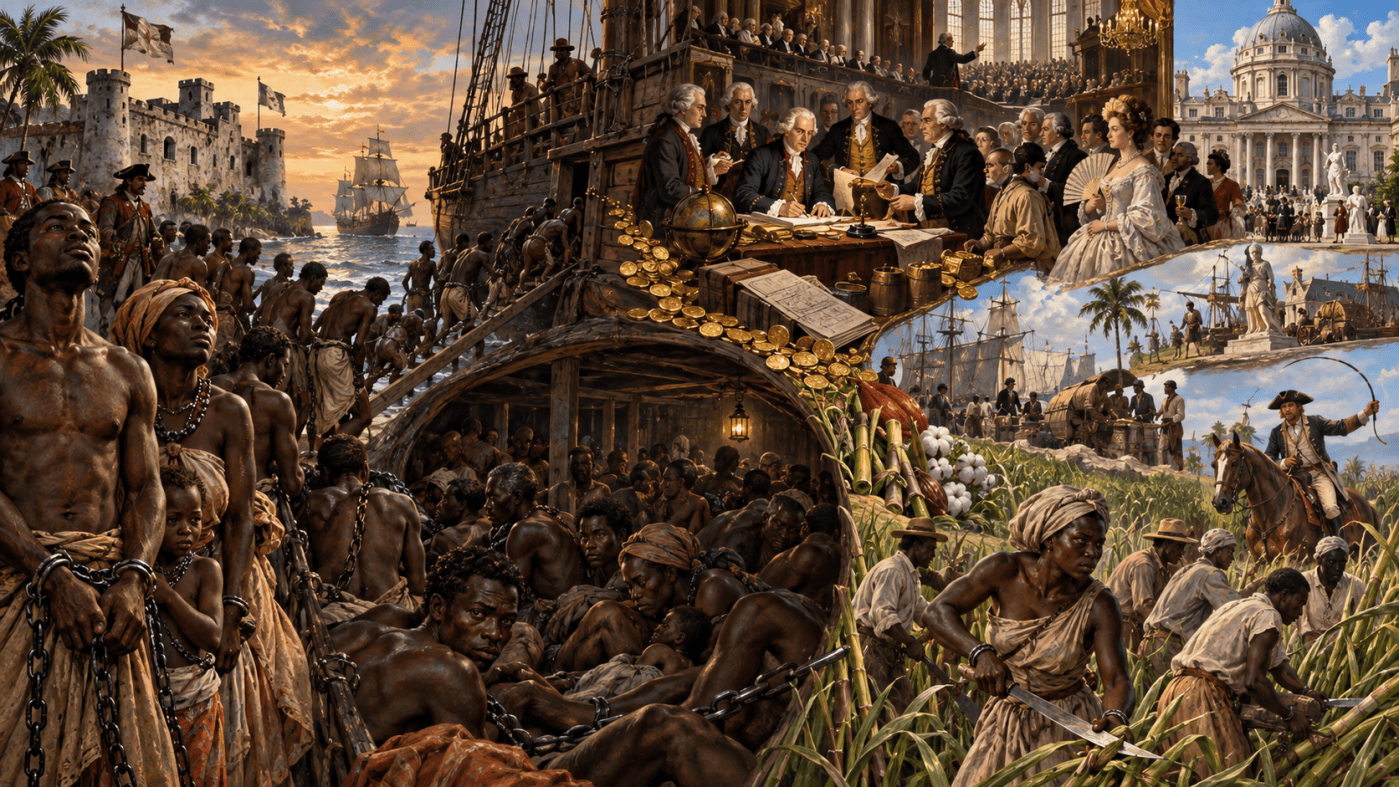
Britain’s slave trade wasn’t a barbaric exception sitting outside the rise of its modern institutions; merchants fought for commercial freedom inside a property system that turned African people into commodities. When Parliament broke monopoly power, it widened the market for slave traders, while wealth drawn from Atlantic slavery traveled home into property, industry, science, hospitals and respectable civic life. Abolition eventually shattered legal human ownership, but the state compensated former owners and forced the formerly enslaved through apprenticeship, exposing just how deeply freedom had been organized around property. Today, historians, descendants, Caribbean governments and reparations movements are reopening the ledger and reconnecting Britain’s celebrated institutions to the accumulation buried beneath them.
Prince Kapone | Weaponized Information | September 17, 2026
I. The Paradox Has an Alibi
Gerard DeGroot’s September 17, 2026 review in The Times, “The Hard Truth: Britain Was a Nation of Slave Traders,” doesn’t give us the usual patriotic fairy tale. Reviewing William Pettigrew’s Britain’s Slave Traders: A Forgotten History, DeGroot puts the ugliness on the table. Pettigrew’s research project has identified roughly 13,000 people financially connected to British slave-trading voyages and companies responsible for carrying more than three million African men, women and children across the Atlantic. They weren’t some hidden caste of pirates operating beneath respectable society. They included monarchs, merchants, doctors, philosophers, artists, women, children and pillars of polite British life. The Register of British Slave Traders has dragged their names back into daylight.
DeGroot deserves credit for refusing the most comfortable national escape route. Britain, he writes through Pettigrew, has too often remembered the trade through the “comforting lens of abolition,” as though Wilberforce arrived at the end of the story to wash two centuries of blood off the flag. The review instead follows slave money through the ordinary rooms of British society. A medicine merchant invests in trafficking Africans. Coal and steel meet the manufacture of restraints. Slave-linked fortunes help finance hospitals for Britain’s poor. Scientific prestige grows in a society busily manufacturing theories of African inferiority. Men celebrated for liberty and enlightenment appear in the same account books as human cargo.
Yet when these worlds collide, the review reaches for the language of paradox. Slave traders help advance liberty. Profits from human misery finance charity. Respectable citizens participate in industrial cruelty. The word registers the shock, but it also quietly lets the machinery off the hook. A paradox makes two things appear side by side, staring awkwardly at each other across the drawing room. It doesn’t tell us whether a pipe runs beneath the floorboards connecting them.
That limit is clearest in DeGroot’s praise for Pettigrew’s “detachment.” The traders become disturbing precisely because they were normal people who could build hospitals, compose music, practice medicine and still invest in the transportation of chained Africans. Fair enough. But normality itself needs explaining. If participation in human trafficking could sit comfortably inside respectable British life for generations, then respectability can’t be the answer. Neither can individual wickedness. The article has already demolished that excuse.
Pettigrew’s evidence pushes toward a harder question than the review finally asks. Britain’s philanthropy, commercial freedom, science and slave trading may look like grotesque contradictions when placed beside one another. But before calling them paradoxes, somebody has to follow the money, the institutions and the power connecting them. Otherwise the ledger is open, the names are finally visible, and the accounting still stops one column too soon.
II. Freedom Opened the Market
The names in Pettigrew’s register matter, but names alone can make a system look like a collection of personal sins. Beneath them sat an apparatus. By 1672 the Royal African Company joined royal authority, London investors, fortified positions on the West African coast and a monopoly over English commerce there. It trafficked close to 150,000 enslaved Africans over the following decades, most of them toward plantation colonies in the Caribbean and Americas. The Crown didn’t simply watch merchants discover a profitable market. Political authority helped organize the terms on which that market operated.
Then the fight changed. Independent merchants wanted in. After the Glorious Revolution they attacked the company’s monopoly in Parliament and in print, claiming the rights of Britons to trade freely. William Pettigrew’s earlier study, Freedom’s Debt, reconstructs the argument without euphemism: men shut out of the African trade invoked natural rights and commercial liberty to demand access to buying and transporting enslaved people. Parliament broke the monopoly in 1698. Private traders flooded into the opening, and the English slave trade grew. The state hadn’t disappeared from commerce; Parliament had changed who could enter it.
Africa, meanwhile, wasn’t an empty shoreline waiting for Europeans to arrive. On the Gold Coast, British companies operated inside African political worlds they didn’t simply command. Rebecca Shumway’s history of the Fante Atlantic world reconstructs merchants, workers, political authorities and coastal communities who negotiated trade, exploited European rivalries and responded to the upheavals created by expanding slave commerce. Some African political and commercial actors participated in captive exchange; other Africans were kidnapped, sold, transported or forced into labor. British expansion entered a divided and changing political landscape, and Atlantic demand helped transform it.
The connections didn’t end at the dock. The institutions of respectable Britain could be tied directly to the same commercial world. The Royal Society itself held African Company shares from 1682 until 1699. Its scientific networks also reached through Cape Coast Castle. Royal Society correspondence shows officials asking about West African diseases, medicines and antidotes, while a Royal African Company employee later sent descriptions and samples of medicinal plants learned from African practitioners. The resulting account entered the Society’s publications while the African medical experts who supplied much of that knowledge generally disappeared from the record.
Money traveled just as effectively. Barts Health now acknowledges that gifts and legacies from people connected to slave trafficking became part of the historical wealth behind St Bartholomew’s and the London Hospital. Those funds helped care for London’s poor. The social benefit was real. So was the source of part of the money. Once a return from Atlantic commerce had become a bequest, an endowment or a building, the violence that produced the fortune no longer had to be visible in the institution spending it.
The wider economic effects also went beyond a handful of notorious fortunes. Using slave-owner compensation records and other historical data, economists Stephan Heblich, Stephen Redding and Hans-Joachim Voth found that places receiving more slavery-derived wealth later showed higher manufacturing employment, more cotton mills and higher property values. Their model estimates an aggregate effect equivalent to roughly a decade of economic growth. Their finding is not that slavery was necessary for British industrialization, but that slavery-derived wealth significantly accelerated economic growth and structural change. The older picture of slave wealth as an offshore sideline is increasingly difficult to defend.
Slavery also produced its own counterforces. From the late eighteenth century, abolitionists built committees, circulated evidence and drove mass petitioning campaigns into Parliament. Their politics didn’t descend from another planet. Pettigrew traces how arguments about natural rights that independent merchants had earlier used against monopoly could later be widened against the trade itself. Parliament records waves of anti-slavery petitions pressing legislators while merchants, planters and other interests fought to preserve the system.
Nor did the story end when Parliament prohibited British participation in the transatlantic trade in 1807. Enslaved people remained enslaved across much of the British Empire for another twenty-six years. When Parliament finally legislated emancipation in 1833, it set aside £20 million in compensation for former slave owners. UCL’s reconstruction of the settlement identifies more than 40,000 owners in the British Caribbean, Mauritius and the Cape at the moment of abolition. The formerly enslaved received no compensation.
Even freedom arrived with another turn of the screw. The 1833 abolition settlement converted most formerly enslaved adults into compulsory “apprentice” laborers, tying them to estates and requiring unpaid work during a transition that lasted until 1838. Parliament abolished legal ownership of human beings, but the settlement still protected the economic claims of those who had owned them. The trader was gone from the deck, the monopoly had disappeared, and slavery itself was finally struck from British colonial law. Yet when the state closed the account, it was the former owner who presented the bill.
III. The Free Man and the Human Commodity
The easy word is hypocrisy. Britain talked freedom and practiced slavery. Merchants praised liberty while buying human beings. Hospitals healed the poor with fortunes touched by the trade. Men of science gathered knowledge in institutions tied to companies that trafficked Africans. Call the whole thing hypocrisy and the moral case is settled before lunch. The historical problem remains untouched. Hypocrisy tells us that words and deeds didn’t match. It doesn’t tell us why they could live together so comfortably for generations, or why widening commercial freedom could actually enlarge the traffic in enslaved Africans.
The harder answer begins with property. British merchants fighting the Royal African Company wanted freedom from monopoly: the right to enter a profitable market from which another group of proprietors had excluded them. Their liberty had material content—the right to buy, sell, invest, contract and accumulate. The enslaved African entered that same market from the opposite direction. One side arrived as a property holder demanding more room to exercise his rights. The other arrived inside the ledger as property.
That is the contradiction beneath Pettigrew’s paradoxes. The free merchant and the human commodity occupied opposite positions inside the same property relation. Expand the merchant’s freedom to enter the trade and you could expand the number of owners competing over people who possessed no comparable freedom to refuse the sale, leave the plantation or carry the fruits of their labor home. This is where all the sentimental talk about free markets starts coughing blood. Competition tells us how proprietors confront one another. It says nothing by itself about the freedom of the person being bought.
State power moved through this relation from beginning to end. The Crown helped construct monopoly. Parliament widened commercial entry. Imperial law protected the relations through which Atlantic commerce operated. Later, organized abolitionist pressure helped force another transformation. When slavery became politically untenable, Parliament changed the legal form again. The state first protected corporate privilege, then widened the field of commerce, then prohibited the trade, and finally abolished human ownership while compensating those whose property claims it had once defended.
Once the wealth crossed the Atlantic, its appearance changed. A captive body could disappear from sight while the value extracted through the system survived as a share, a building, a mill, a piece of property or an endowment. Money is useful that way. It travels without dragging the plantation behind it. By the time a fortune arrives at a hospital door, it no longer smells like the hold of a ship. The patient receiving treatment doesn’t need to know where every pound came from. The doctor may do real good with it. The building may genuinely save lives. The benefit is real, and so is the road the money traveled.
That matters for Britain’s poor and working population too. A poor Londoner treated in a hospital built partly from slave-linked wealth didn’t become a slave trader. A worker employed in an industry touched by Atlantic commerce didn’t command the plantation. Britain contained its own class antagonisms, poverty and exploitation. But an imperial order can redistribute part of the wealth accumulated through domination abroad without dissolving exploitation at home. The poor can receive a hospital bed without receiving the merchant’s balance sheet.
Race helped stabilize the property boundary. African people were treated as inheritable and saleable laboring property inside a system that had to explain and reproduce that unequal status. Racial ideology supplied part of that explanation, making domination appear natural, permanent and deserved. Law, commerce and institutions then carried the classification forward. The relationship became mutually reinforcing: the property order gave racial hierarchy material force, while racial hierarchy helped defend the property order.
Africans still acted inside this history. Political authorities negotiated, merchants traded, communities maneuvered among European rivals, and enslaved people resisted the conditions imposed upon them. Some African commercial actors participated in captive exchange; others were sold, transported or forced into labor. Agency doesn’t erase asymmetry. A merchant bargaining over a captive and the captive being sold are both historical actors, but they don’t occupy equivalent positions in the relation. The expanding Atlantic system concentrated command over ships, markets, plantation demand and imperial law far beyond the power of the people it converted into commodities.
Freedom itself became contested terrain. The language of natural rights that merchants once used against monopoly could later be widened against slavery. Ideas matter, but their political content is fought over. The merchant wanted freedom to enter the market. The enslaved demanded freedom from being the market’s object. Those claims aren’t equivalent simply because both can be spoken in the grammar of liberty. One widens the rights of the proprietor. The other attacks the boundary that made a human being property in the first place.
Abolition finally forced the contradiction into the open. Human ownership was struck from British colonial law, but the old property relation didn’t vanish like smoke. The state paid former owners for the loss of what it had once recognized as their property, while the formerly enslaved were pushed through apprenticeship before full freedom arrived. The legal category changed before the accumulated power built through it disappeared. That is why the compensation settlement matters beyond its brutality. When human property died on paper, property still presented its invoice.
This is what the language of paradox keeps at arm’s length. Britain’s philanthropy, science, commerce and slave trading were distinct institutions, but they weren’t sealed worlds accidentally colliding in the same century. Money moved between them. Property rules connected them. State power organized them. Racial ideology helped reproduce them. The ledger tied together what respectable memory later preferred to file in separate cabinets. Once those relations are restored, the mystery shrinks. The free man and the human commodity weren’t embarrassing exceptions to the same age. They were opposite positions inside the order that age built.
IV. Reopen the Ledger
The historical fight has moved onto the archive because the archive can reconnect what respectable memory pulled apart. A name can be tied to a voyage, a shareholding, an estate, an endowment or a compensation claim. The UCL slavery databases turn scattered records of ownership and compensation into a public map of who held property and where that wealth traveled. Its Valuable Lives project pushes the record in the other direction, reconstructing enslaved people as historical persons and, where possible, reconnecting them with descendant communities.
Caribbean governments are working another lever. The CARICOM Reparations Commission has built a regional program around public education, advocacy, civil-society partnerships and dialogue with former colonial powers. Its 2026 delegation carried that campaign directly into Britain, seeking to strengthen international support for reparatory justice. The British government remains an organized counterforce: it continues to reject reparations liability for historical slavery. The dispute therefore sits between documented historical claims, organized political pressure and a state defending its refusal to provide the remedy being demanded.
Grassroots campaigners push from below. Stop the Maangamizi organizes public education, campaigning and movement-building around Afrikan reparatory justice, turning historical evidence into sustained public pressure. In Parliament, the Afrikan Reparations APPG gives campaigners and parliamentarians a formal arena to examine reparations, restitution and possible policy responses. These forces don’t occupy the same political position, but they work different parts of the same terrain: public organization outside Parliament and scrutiny within it.
Jamaica has opened a legal front as well. In September 2026 it filed a petition for Privy Council consideration of questions including slavery’s historical legality and whether Britain may bear a legal obligation to provide a reparatory remedy. Filing the petition doesn’t settle those questions. It forces claims about history, law and responsibility into a forum where they have to be argued precisely rather than dissolved into ceremonial regret.
The leverage is concrete. Researchers recover the property trail. Descendant-centered projects restore people erased by owners’ records. Grassroots organizations turn evidence into public pressure. Parliamentary campaigns force political scrutiny. Caribbean governments build diplomatic pressure, while legal initiatives test claims of responsibility against institutions Britain still recognizes. The point of reopening Britain’s slave-trading ledger isn’t to collect better villains for a museum wall. It is to reconnect accumulation to inheritance, institutions to the wealth that entered them, and Britain’s celebrated freedom to the people placed outside its protection. Once those connections are restored, arguments over responsibility have to begin from the full account rather than the cleaned books.
 Weaponized Information
Leave a comment