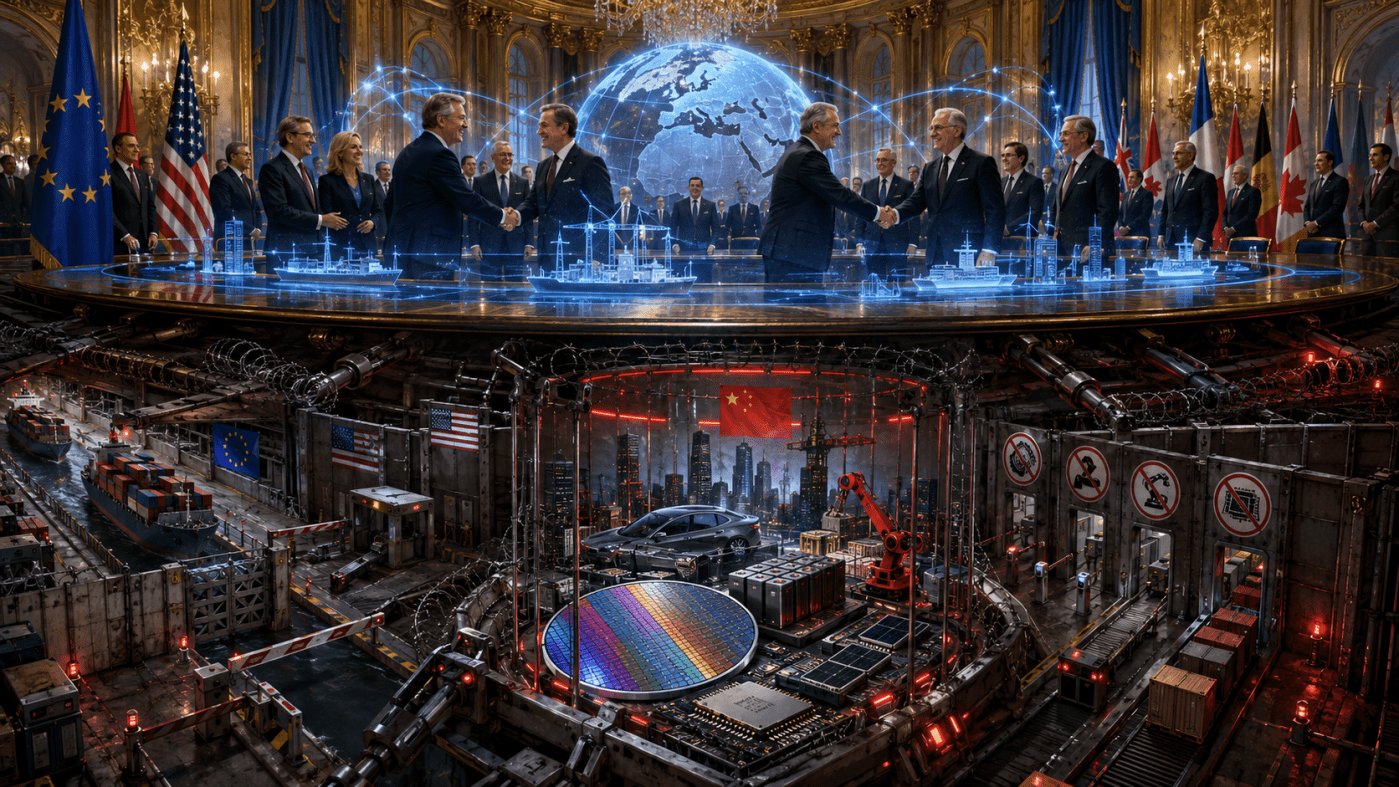
The Council on Foreign Relations declares that free trade can only be saved by surrounding China with tariffs, blacklists, investment controls and politically conditioned agreements. Beneath that sermon lies a trading system that opens procurement, investment and resource markets for Western capital while restricting the developmental tools and technological sovereignty of its rivals. China’s real offense is not state intervention but using production, planning and industrial power to escape the subordinate position imperialism assigned it. The answer is an anti-war movement capable of exposing economic containment in the treaty text, organizing workers against the manufactured “China threat” and resisting the trade war before it becomes a shooting war.
Prince Kapone | Weaponized Information | July 23, 2026
Free Trade Now Requires a Barricade Around China
The Council on Foreign Relations announces that Europe must “take on China” to rescue free trade. The contradiction is already packed neatly into the headline. Trade will remain free, we are told, once Europe imposes more tariffs, screens more investments, restricts more imports, polices more supply chains and recruits more countries into a coordinated commercial front against the largest manufacturing economy on Earth. Freedom enters the room dressed as a customs officer.
The argument comes from Shannon K. O’Neil, CFR’s senior vice president of studies and Maurice R. Greenberg Chair. Published on July 20, 2026, through CFR’s Greenberg Center for Geoeconomics and originally appearing in Bloomberg Opinion, the article arrives from the respectable conference room where corporate strategy is translated into foreign-policy wisdom. CFR describes itself as a national membership organization, think tank, educator and publisher. Here it performs that educational function by teaching Europe how economic discrimination can be presented as fidelity to universal rules.
O’Neil begins by contrasting Europe’s supposedly principled trade agreements with Donald Trump’s crude Agreements on Reciprocal Trade. Europe lowers tariffs, protects labor standards, regulates investment and preserves the established system. Trump muscles weaker countries into bilateral concessions. But this distinction begins collapsing almost as soon as it is introduced. The Trump agreements are condemned as discriminatory, unstable and vulnerable to presidential whim, yet their campaign against China is praised for understanding what Europe allegedly refuses to see. Investment screening, export controls, transshipment restrictions, blacklists and restraints upon third-country relations are objectionable when attached to Trump’s executive commands but become promising raw material when Europe can seal them inside permanent treaties.
This is policy laundering through institutional etiquette. The article stacks China’s trade surplus, subsidies and industrial expansion on one side of the scale while removing Western subsidies, European procurement advantages, investor protections and market restrictions from the other. Chinese productive success becomes evidence that China is gaming the system. European attempts to obstruct that success become enforcement of the system. The imperial privilege is hidden inside the vocabulary: Europe possesses legitimate “tools,” while China exhibits threatening “behavior.” Europe protects its manufacturers; China distorts the market. Europe organizes allies; China must be isolated. By the end, “free trade” no longer describes commerce governed by rules applying equally to all. It names a commercial hierarchy in which Europe remains free to enter markets, secure resources and protect its capital, while China must be contained whenever its industrial power interferes with Western command.
The Rules Open Markets for Europe and Close Developmental Space for Everyone Else
The trade imbalance at the center of the Council on Foreign Relations argument is real. In 2025, the European Union imported €559.4 billion in goods from China while exporting €199.6 billion, producing a goods deficit of €359.8 billion. The quarterly deficit increased from €65 billion at the beginning of 2024 to €98 billion in the first quarter of 2026. Europe has already responded through commercial restrictions. Chinese battery-electric vehicles face EU countervailing duties ranging from 7.8 to 35.3 percent following the European Commission’s anti-subsidy investigation.
The United States has attached tariff concessions to a wider set of economic-security requirements. The US Agreement on Reciprocal Trade with Malaysia requires cooperation against transshipment, alignment with unilateral US export controls, enforcement involving entities placed on US sanctions and export-control lists and consideration of US-style investment screening. Washington may also terminate the agreement if Malaysia concludes another agreement that the United States judges harmful to its essential interests. The conditions reach beyond tariffs into the investment, technology and external commercial decisions of the partner state.
Europe’s agreements are likewise more than declarations of equal commercial liberty. The World Trade Organization’s most-favored-nation rule holds that an advantage granted to one trading partner should ordinarily be extended to the others. Bilateral and regional trade agreements operate as permitted exceptions to that nondiscrimination principle, creating preferential zones whose benefits do not automatically extend to countries outside them. The CFR article also places agreements at different legal stages into a single category. European Commission records distinguish agreements already in force, agreements provisionally applied, negotiations that have concluded and texts still awaiting adoption or ratification.
The obligations secured through these arrangements extend beyond customs duties. The modernized EU agreement with Mexico provides European companies access to federal and subnational public procurement and contains provisions governing investor protection, cross-border data transfers, export taxes, dual pricing and state monopolies involving raw materials. Such clauses shape how participating governments award public contracts, regulate foreign investment, manage data and administer strategic resources.
The subsidy estimate used to distinguish China from its competitors is methodologically disputed. The claim that Chinese industrial support amounts to 4.4 percent of gross domestic product appears in an IMF publication whose executive-board material records objections to the comparison. China’s executive director stated that the figures assigned to China, Europe and the United States were assembled from different definitions and categories of state support and therefore were not directly comparable. Western governments also mobilize large public resources for strategic industries. The European Chips Act combines regulatory measures, public programs and investment mechanisms intended to mobilize more than €43 billion for the semiconductor sector.
US restrictions already reach into China’s productive capacity. In August 2025, the Commerce Department removed authorization that had allowed several foreign-owned semiconductor manufacturers to receive US technology at facilities in China without individual export licenses. The Bureau of Industry and Security stated that licenses could be granted to continue operating existing fabrication plants but would not be granted to expand their capacity or upgrade their technology. The policy regulates not only the sale of finished semiconductors but the future development of the facilities producing them.
These controls confront a country whose modern history includes direct foreign control over trade, territory and technology. European and other imperial powers imposed unequal treaties, extracted commercial privileges and reduced China to a semi-colonial condition before the 1949 Revolution abolished those formal privileges. China’s present development strategy places domestic productive capacity and reduced dependence upon foreign technological control among its central priorities.
The commercial relationship nonetheless remains deeply integrated. European exports to China include machinery, electrical equipment and vehicles, while European imports include large volumes of Chinese machinery, electronics and other manufactures. China’s development plans place the real economy, industrial upgrading, emerging industries and greater scientific and technological self-reliance at the center of state planning.
European and US controls are also being coordinated across the Atlantic. The United States and European Union have committed themselves to cooperation on investment screening, export controls, tariff evasion, technology security and measures addressing what they define as non-market practices. Chinese authorities have opposed the European electric-vehicle duties while continuing negotiations and emphasizing the industrial scale, technological development and public support operating throughout the international new-energy sector. The existing record therefore includes major trade imbalances, substantial economic interdependence, Western industrial subsidies and a growing network of tariffs, licensing requirements, investment controls and treaty obligations.
China’s Crime Is That the Workshop Learned to Command the Machinery
The dispute is not about whether governments support industry. Every serious power does. Europe mobilizes public resources for semiconductors. The United States determines which fabrication plants may expand and which technologies they may acquire. Trade agreements protect investors, open procurement markets and constrain how states regulate data and strategic resources. State intervention becomes scandalous only when China uses it to build productive power beyond Western control.
That double standard rests upon history. China entered the modern world economy through unequal treaties, foreign commercial privileges and the reduction of its sovereignty beneath imperial command. The Revolution abolished the formal structure of that domination, but a flag and a seat at the United Nations could not by themselves overcome technological dependence. A country that cannot manufacture what it needs, control its productive apparatus or develop advanced industries remains vulnerable to those who command the machinery.
China’s development has begun to overturn the position assigned to it. It is no longer confined to cheap labor and low-value production while Europe and the United States monopolize technology, finance and the upper reaches of industry. It now competes in sectors the old imperial centers had grown accustomed to ruling. That is the emergency concealed beneath the trade statistics. The workshop has learned to design the machines.
This is why identical practices acquire opposite names. European subsidies are investments; Chinese subsidies are distortions. European industrial strategy is foresight; Chinese planning is manipulation. Western licensing restrictions are security measures; China’s pursuit of technological self-reliance is aggression. The principle changes according to who is gaining power and who is losing the ability to dictate the terms.
Trade agreements are instruments in this struggle because they determine more than tariff rates. They shape who may enter public markets, how governments may control resources and investment, and how much economic freedom weaker states surrender in exchange for access to wealthier ones. The agreement with Malaysia extends that authority into relations with third countries. Commercial concessions become leverage over sanctions enforcement, investment policy and technological exchange. The market arrives with a political officer attached.
CFR does not reject this coercive machinery. It objects to Trump’s handling of it. His method is too crude, too openly discriminatory and too dependent upon presidential whim. Europe is instructed to take the same strategic objective and bury it beneath treaties, commissions and legal procedures. Coercion becomes respectable once it acquires several appendices and a dispute mechanism.
No single restriction needs to resemble a blockade. One tariff can be presented as a remedy. One investment review becomes prudence. One blacklist is called security. One export license appears technical. But when such measures are coordinated across states, they govern access to markets, technology, capital and future productive capacity. Fragmented restrictions become a cumulative architecture of containment.
Europe cannot construct that architecture without colliding with its own dependence upon the relationship it seeks to discipline. European firms sell into China, while European production relies upon Chinese machinery, electronics and manufactured inputs. This is rivalry within interdependence. European capital wants continued access to China’s market and industrial system, but it does not want Chinese firms acquiring equivalent power in the sectors where monopoly profits and technological command are concentrated.
The desired arrangement is therefore selective integration. China may remain connected where its labor, production and consumer market generate profit for Western capital. It must be restricted where its development changes the balance of power. “Free trade” becomes the freedom of the imperial centers to enter China while reserving the right to close their own doors when Chinese industry arrives as an equal competitor.
The conflict cannot be reduced to free trade versus protectionism. It concerns who possesses the right to plan production, master technology and determine the conditions under which nations participate in the world economy. Western powers claim the privilege of using the state to preserve their dominance while placing the developmental instruments of formerly subordinated nations permanently on trial.
Nor does defending China against economic containment require pretending that sovereignty abolishes class struggle. The wealth created through industrial development still raises the question of who commands it and whose lives it serves. But those contradictions cannot be resolved by Washington and Brussels deciding which industries China may build, which technologies it may acquire or which countries may trade with it. Imperial restriction does not empower Chinese workers. It strengthens the powers seeking to subordinate them alongside workers everywhere else.
The trade deficit is therefore the surface of a deeper struggle. China’s ascent has exposed the political foundation beneath the supposedly neutral market. The rules remain universal only while they reproduce the old hierarchy. Once a formerly colonized country begins using production, planning and technology to escape its assigned position, the guardians of free trade discover that freedom must be fortified, licensed and selectively withdrawn.
Organize Before the Trade War Becomes a Shooting War
The trade war must be fought as part of the wider struggle against war. Tariffs, blacklists, export controls and investment restrictions prepare the economic and ideological ground upon which military confrontation becomes thinkable. Anti-war organizations, unions and political-education formations must therefore oppose the conversion of European trade agreements into instruments for containing China rather than waiting until economic coercion gives way to missiles.
Britain’s Stop the War Coalition has committed itself to challenging the manufactured “China threat,” exposing the danger of British military involvement in the Pacific and building opposition to a wider war. Its work is sustained through individual supporters and affiliated organizations, and the coalition states that it receives no government grants or financial backing from commercial sponsors. Stop the War offers one verified organizational vehicle in Britain, not a substitute for building equivalent anti-war work inside US unions, campuses, community organizations and independent political formations.
The first task is to drag the agreements themselves out of the lawyer’s office. Organizers should turn the US Agreement on Reciprocal Trade with Malaysia and related texts into clause-by-clause educational materials showing where tariff concessions become cooperation with US export controls, sanctions lists, investment screening and restrictions upon independent relations with third countries. These materials should circulate through union halls, classrooms, reading groups, community spaces and independent media, placing the legal machinery beside the polished language of “resilience,” “fairness” and “economic security.”
Workers must force the issue inside their own organizations. Union locals can hold hearings, adopt resolutions against anti-China economic alignment and demand industrial policies based upon secure employment, public ownership, technology sharing and worker control rather than corporate subsidies tied to trade war. Independent media can map each tariff, license, blacklist and investment review, identify the institutions imposing it and show which productive capacity it is designed to obstruct. That work must also confront the anti-Chinese racism and security suspicion used to turn workers, students and scientists into domestic extensions of the foreign enemy.
The decisive task is to build an anti-war movement capable of recognizing economic warfare before the bombing begins. Every treaty clause exposed, every union resolution passed and every “China threat” narrative broken weakens the machinery being assembled for a new global confrontation. The fine print is already becoming a front line. Our work is to organize on it.


Leave a Reply