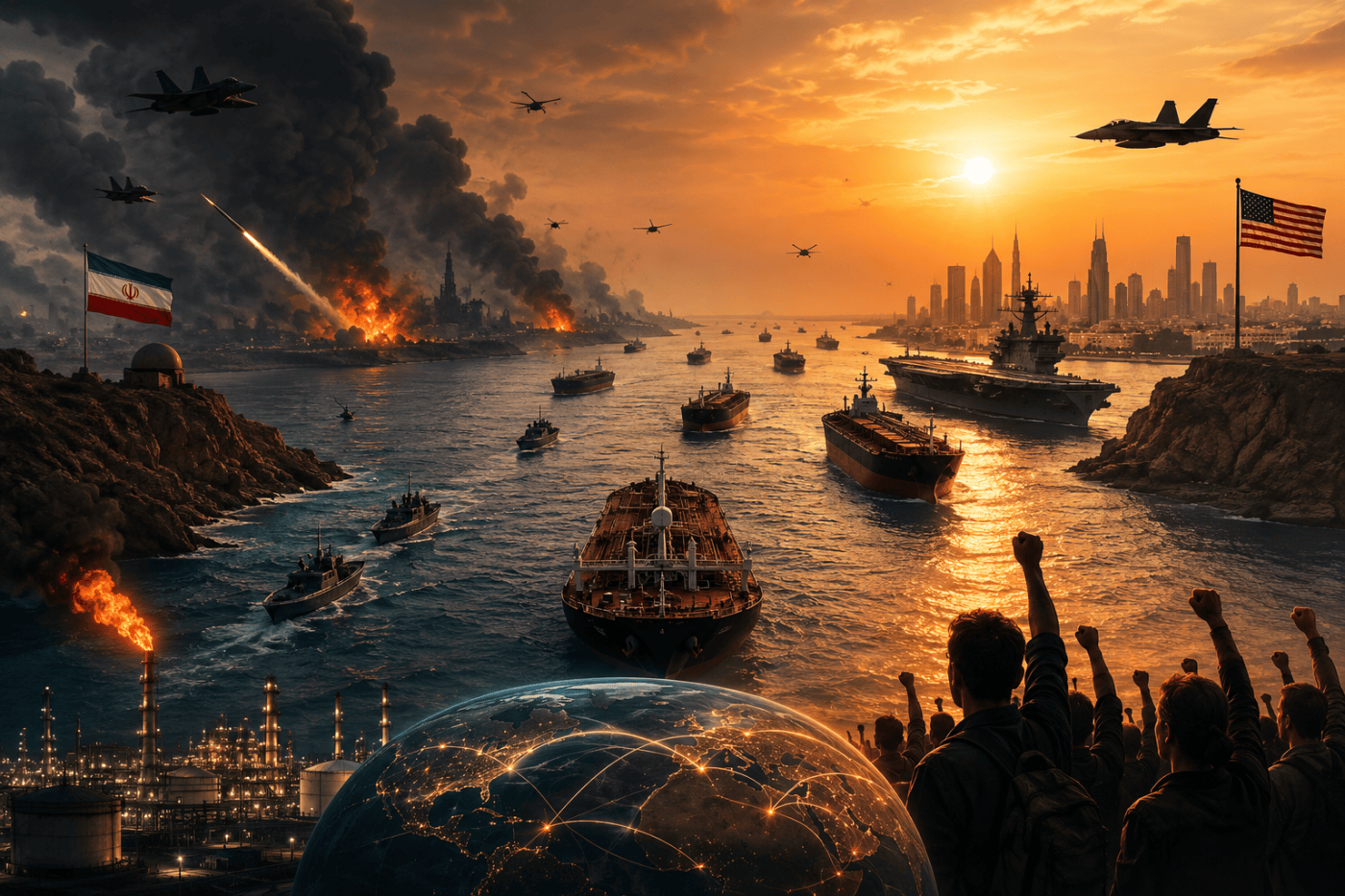
The BBC begins with Iranian retaliation and buries the U.S.-Israeli attack that turned the Strait of Hormuz into a battlefield, allowing the arsonist to return as fire marshal. Beneath the headlines lies a struggle between an Iran–Oman coastal mechanism and a foreign navy claiming the power to blockade Iranian ports, redirect commercial vessels and tax a waterway over which it possesses no sovereignty. Trump’s proposed 20 percent charge exposes “freedom of navigation” as freedom under American command—the right of the empire to forbid Iran from doing precisely what Washington reserves for itself. Against this maritime protection racket, workers must make the machinery of war visible in the ports, bases, corporations, campuses, pension funds and political offices that carry imperial violence from the Gulf into everyday life.
Prince Kapone | Weaponized Information | July 13, 2026
The Arsonist Appoints Himself Fire Marshal
On July 13, the BBC published “UAE condemns Iran’s ‘brazen’ attack on tankers as US launches fresh strikes,” a report by Jaroslav Lukiv and Bernd Debusmann Jr. The immediate facts are grave. The United Arab Emirates accused Iran of firing cruise missiles at two Emirati tankers in the Strait of Hormuz, killing an Indian crew member and injuring eight others. The United States launched a third consecutive night of attacks on Iran. Donald Trump announced that Washington would resume blockading Iranian ports, claim control of the Strait and charge 20 percent on all cargo passing through it. Yet the article arranges these facts so that the war appears to begin each morning with whatever Iran did the night before.
The trick is performed through chronology. The alleged Iranian attack occupies the opening scene. Trump’s bombardment enters as a response. The blockade becomes a security measure. Only much later does the article acknowledge that the present war began when the United States and Israel attacked Iran on February 28. The initiating violence is not denied; it is buried. Aggression is pushed into the background while retaliation is placed beneath the headline. By the time the reader reaches the origin of the war, the aggressor has already been dressed as policeman, escort captain and reluctant keeper of the peace.
Israel, meanwhile, nearly disappears from the active narrative. Having helped start the war, it slips behind the curtain while the conflict is repackaged as an escalating dispute between Washington and Tehran. This disappearance detaches the attacks on shipping, Gulf bases and regional infrastructure from the military assault that turned one of the world’s central energy arteries into a battlefield. The Strait appears dangerous because Iran is dangerous, not because a foreign coalition brought war to Iran’s coastline.
The article’s language completes the laundering. The United States is not described as attempting to seize authority over waters lying between Iran and Oman. It will supposedly “provide safety,” “support traffic flow” and receive reimbursement for its trouble. A naval blockade becomes maritime administration. Military force becomes public service. Tribute becomes a fee. Trump first demanded that Iran open the Strait without charge; now he proposes to collect one-fifth of the value of everything passing through it. The BBC notices the reversal but declines to name what it reveals.
The ideological work is simple. American violence is presented as management, while Iranian violence appears as the crisis being managed. Washington bombs, blockades and claims command; the article translates these acts into the language of order. The arsonist has returned with a fire hose, appointed himself fire marshal and sent the neighborhood a bill.
I’ve stripped out the source-attribution scaffolding and restored the section as a direct factual reconstruction, with the links carrying the evidentiary burden inside the prose.
Who Closed the Strait, and Who Claims the Right to Reopen It?
Two Emirati tankers were struck in the southern shipping lane on July 13, killing one Indian crew member and injuring eight others, including six Indian and two Ukrainian seafarers. These were workers aboard commercial vessels moving through a waterway that had been turned into an active war zone. Their deaths and injuries belong to the material record of the conflict, not to the abstractions through which states excuse it.
Trump answered by renewing the blockade of Iranian ports, ordering further attacks on Iran and demanding payment equal to 20 percent of all cargo shipped through the Strait of Hormuz. CENTCOM announced that vessels approved by Washington would be allowed passage while traffic connected to Iran would remain subject to interception. The same fleet would escort one ship and obstruct another, calling the first act protection and the second enforcement.
The war did not begin with the July tanker attack. The United States and Israel attacked Iran on February 28. Iran retaliated against Israel and U.S. military facilities across the Gulf, and commercial traffic through Hormuz collapsed as the fighting spread. The Strait was not struck by a sudden outbreak of Iranian madness. It was dragged into a war launched against the country forming its northern shore.
Iran did not simply seal the passage and abandon commercial shipping. Tehran registered a temporary maritime corridor with the International Maritime Organization under notice S14/2026. The route had been cleared of technical and military obstacles and organized through the Islamabad memorandum and arrangements with Oman. Washington instead directed vessels toward a separate southern route under American military protection.
That difference matters. Iran and Oman had already formed a joint committee to address navigation and security in Hormuz. Iran occupies the northern shore and Oman the southern shore. The two coastal states were negotiating how passage would be organized before Trump, from several thousand miles away, appointed the United States guardian of their waterway.
The June Islamabad memorandum did not hand the Strait to Washington. Paragraph 5 placed Iran and Oman at the center of arrangements for secure passage. The Muscat talks dealt with navigation through Hormuz, not the wider political and military surrender later advertised by Trump. Washington treated Iranian authorization requirements as a violation of the agreement. Iran treated renewed coercion and continued Israeli military action as the prior breach. Beneath the legal dispute stood a more concrete question: whether passage would be organized by the coastal states or imposed by a foreign navy.
Iran’s security measures also emerged from the military geography of the war. U.S. bases, radar systems, logistics facilities and neighboring territory supported operations against Iran. The southern shore was therefore not an empty line on a commercial map. It contained the infrastructure through which attacks were coordinated, supplied and sustained. Gulf governments could call themselves bystanders, but the American installations on their soil were participants.
The blockade is not a neutral escort service. It gives the United States the power to stop vessels approaching Iranian ports, obstruct exports and decide which commercial relationships may continue. During the earlier phase of enforcement, American forces redirected approximately 100 commercial vessels and disabled four. The blockade placed Iran’s maritime economy under military supervision and turned ordinary trade into an activity conducted only with Washington’s permission.
Only days earlier, the United States demanded that Iran open the Strait without tolls, registrations or selective authorization. Trump then announced that Washington would collect 20 percent on cargo moving through the same passage. Abbas Araghchi replied that Iran had long guarded Hormuz and mocked the American rate as excessive. Apparently a toll becomes piracy when Tehran proposes it and maritime civilization when Washington sends the invoice.
The stakes reach far beyond the Gulf. Before the war, roughly one-quarter of the world’s oil and one-fifth of global liquefied natural gas passed through Hormuz. Restricted traffic, missile attacks and blockade enforcement drove up insurance costs, delayed shipments and placed new pressure on energy prices. Those costs do not remain inside shipping ledgers. They enter electricity bills, freight charges, fertilizer prices, food production, factories and household budgets. The seafarer meets the war first. The worker, farmer and consumer meet it soon after.
The Tollbooth at the Edge of Empire
The contradiction at the center of the Strait of Hormuz is plain. The United States speaks in the language of universal navigation while enforcing a blockade against Iran. It declares that commerce must move freely, then claims the power to decide which ships may pass, which ports may trade, which route is legitimate and who must pay for passage. The principle appears universal only because Washington reserves for itself the right to suspend it.
Hormuz is more than a narrow body of water. It is a material artery of the world economy, carrying energy, freight, industrial inputs and price shocks across continents. Whoever commands passage through it gains leverage far beyond the Gulf. The Strait therefore joins territory to circulation: Iran and Oman occupy its shores, but global production depends on the movement of commodities through it. The struggle over Hormuz is a struggle over who possesses the authority to organize that movement.
Washington approaches the Strait through military power disguised as administration. Its warships escort approved vessels while obstructing commerce connected to Iran. Its blockade divides trade into permitted and prohibited streams. Bombardment attacks Iran’s military and productive capacity; interdiction attacks its circulation; the escort regime reorganizes commerce around American permission. These are different operations within one system of domination.
Trump’s proposed 20 percent charge gives that system a price tag. The United States helped create the war zone, proclaimed itself indispensable to managing the resulting danger and then demanded payment from world commerce for the cost of its military presence. The empire becomes both the source of disorder and the vendor of protection. It breaks the window, stations an armed guard outside the shop and invoices the owner for security.
This reversal is more than hypocrisy. Washington opposed Iranian authorization and compensation because those measures represented Iranian power over a strategic chokepoint. Once the United States imagined itself in command, the same extraction became a legitimate service fee. Imperial morality follows ownership: an act condemned as coercion when performed by the targeted state becomes order when performed by the empire.
The competing navigation systems embody rival forms of authority. The Iran–Oman process begins from geography, proximity and the sovereignty of the coastal states. The American corridor begins from the ability of a foreign navy to impose its route through force. These are not symmetrical management proposals. One rests on the authority of states whose shores form the Strait; the other rests on extraterritorial military supremacy.
A materialist analysis must also preserve the contradiction within Iranian resistance. Iran confronts a real war, blockade and network of foreign bases. Its security concerns are not invented. Yet resistance that endangers civilian mariners and neighboring populations transfers part of the war’s burden onto workers who neither designed nor commanded the conflict. Recognizing that contradiction does not erase the chain of causation. The U.S.-Israeli assault, the blockade and the regional basing system created the military structure within which these retaliatory acts unfolded.
The base network is central to that structure. Washington distributes the machinery of war across neighboring states while retaining strategic command. Gulf governments receive military integration and promises of protection, but their territory becomes a launch platform, a target and a transmission belt for retaliation. The United States keeps control; the peoples of the region inherit the danger.
The ceasefire could suspend fire but could not resolve these antagonisms. The blockade remained available. The bases remained in place. Israeli freedom of action survived. Iran’s security concerns remained unanswered. Competing claims over the Strait were left unsettled. Diplomacy was asked to reconcile the conflict while preserving the machinery that produced it.
The BBC’s narrative depends upon breaking this totality into fragments. The tanker attack appears as one event, the American strikes as another, the blockade as a separate policy and the proposed charge as a Trumpian eccentricity. The Iran–Oman mechanism recedes into the background, while the regional base network disappears into the scenery. Once separated, these facts produce the image of an erratic Iran disrupting a waterway that Washington reluctantly stabilizes. Reassembled, they reveal a foreign power using a war it helped initiate to claim authority over a strategic passage outside its jurisdiction.
That is the real story. Washington is not defending an existing freedom of navigation. It is redefining navigation as movement under American command. It is building a maritime order in which sanctioned states are denied ordinary economic life while approved commerce receives protection. Military domination becomes economic administration, and the cost of enforcing it is passed to the same world whose trade has been endangered.
Hormuz condenses the wider crisis of imperialism. The United States still possesses enormous force, but every new attempt to convert that force into lawful authority exposes the contradiction beneath its claims. It invokes law while operating outside jurisdiction, freedom while imposing blockade and stability while multiplying the conditions of war. Trump’s tollbooth is ridiculous because the imperial entitlement beneath it is so naked.
The decisive divide is not between an orderly United States and a disruptive Iran. It is between an imperial system that treats strategic waterways as extensions of American command and the uneven struggle of regional states to recover authority over their own territory, security and economic circulation. Iran’s resistance carries contradictions, but Washington’s project is structurally clear. The United States did not come to Hormuz to open the Strait. It came to decide who may open it.
Make the War Machine Visible
The movement against this war already exists. “Hands Off Iran” demonstrations have brought anti-war, socialist, Palestinian-solidarity and Black radical formations into the streets across the United States, including Seattle. The next step is to move beyond emergency protest and organize against the institutions that allow Washington to bomb Iran, blockade its ports and claim authority over Hormuz.
Workers can introduce union resolutions demanding an end to the attacks and blockade, disclosure of pension investments in military contractors and opposition to the use of union labor for war-related cargo. This work must be developed with rank-and-file workers, not imposed on ports and warehouses from outside. Longshore workers, truck drivers, railroad crews, aerospace workers, refinery workers and logistics workers understand the routes through which weapons, fuel and military equipment move. Their knowledge can turn a distant war into a concrete workplace issue.
Seattle organizers should map the local war economy. That means identifying the contractors producing military systems, the banks financing them, the port facilities handling military or dual-use cargo, the fuel companies supplying operations and the elected officials receiving defense-industry money. Each node suggests a corresponding tactic: worker education, public delegations, pickets, divestment campaigns, investigative reporting and pressure at congressional offices. The object is not to protest an abstraction called “war.” It is to expose and confront the machinery that makes the war possible.
Students and educators can organize teach-ins, walkouts and institutional campaigns tied to specific demands: disclosure of military research contracts, divestment from named arms corporations, protection for anti-war speech and removal of military recruiters from campuses. Shipping and logistics campaigns can investigate companies participating in blockade enforcement, transporting military supplies or profiting from war-risk premiums. These campaigns should target the corporate infrastructure of the war without indiscriminately disrupting civilian shipping or transferring the burden onto workers.
Congressional pressure must also move beyond polite appeals. Constituents can organize office delegations, town-hall interventions, coordinated call-in days and public scorecards naming every representative who supports continued strikes, blockade enforcement or supplemental military funding. The demand should be direct: terminate unauthorized military action, end the blockade and reject any American toll or protectorate over Hormuz.
The narrative struggle is part of the organizing struggle. Public education should begin with the February 28 U.S.-Israeli attack, identify the regional base network and place Trump’s demand for toll-free passage beside his proposed 20 percent charge. Maps, timelines, short videos and workplace discussions can show how war costs enter fuel, freight, food and utility prices. The point is not merely to circulate information. It is to help workers recognize where imperial policy touches their wages, their pensions, their workplaces and their communities.
No one should wait for a foundation-funded peace industry to authorize resistance. Build from unions, classrooms, neighborhoods, independent media and existing anti-war networks. Oppose attacks on civilian shipping without surrendering to the fiction that Washington is an impartial guardian. The task is not to help the empire administer Hormuz more responsibly. It is to organize against its claim to administer the region at all.


Leave a Reply