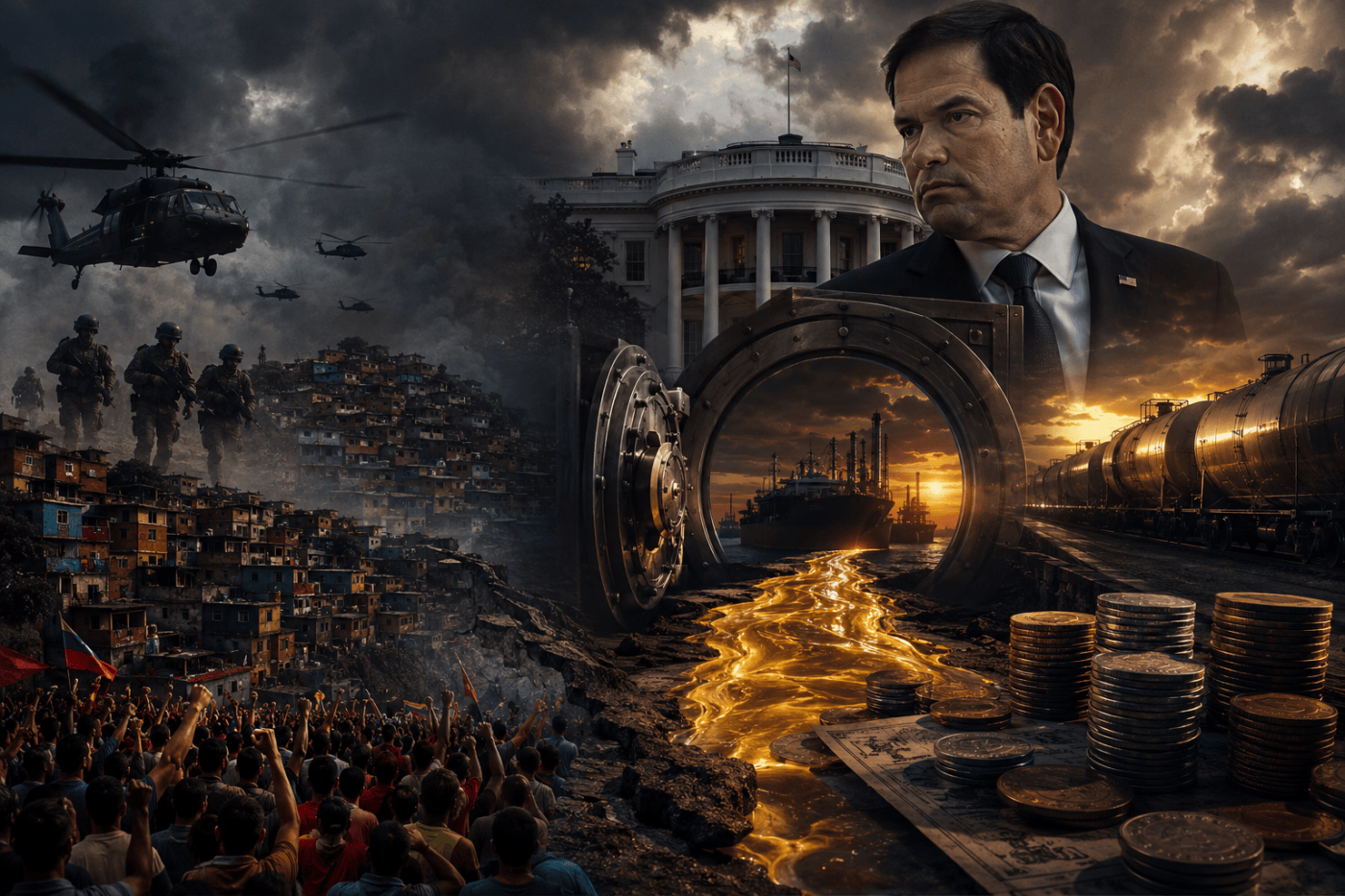
The New York Times describes Marco Rubio as Venezuela’s distant viceroy, turning a system of military, financial, and political domination into a portrait of one ambitious imperial administrator. Behind that personality story lies the machinery of conquest: presidential abduction, Treasury custody of oil revenues, sanctions converted into commercial licenses, petroleum restructuring, and a vast debt settlement through which creditors may acquire claims upon Venezuela’s future labor and wealth. Washington has captured much of the state’s strategic summit without conquering the Bolivarian mountain below, leaving the Rodríguez government suspended between resistance to complete oligarchic restoration and transmission of imperial demands. The struggle now falls to Venezuela’s organized people and anti-imperialist forces inside the United States to dismantle the sanctions regime, recover the stolen revenues, challenge creditor rule, and prevent a coerced retreat from becoming permanent colonial administration.
Prince Kapone | Weaponized Information | July 13, 2026
The Viceroy and the Newspaper of Record
On July 11, 2026, The New York Times published Tyler Pager and Anatoly Kurmanaev’s “How Marco Rubio Is Running Venezuela From Afar,” an extraordinary article whose central revelation is contained plainly in its title. Six months after U.S. forces attacked Venezuela and seized President Nicolás Maduro, Secretary of State Marco Rubio effectively controls the country’s revenues, natural resources, sanctions permissions, senior appointments, foreign relations, security cooperation, public messaging, opposition leadership, and electoral timetable. The paper does not describe ordinary diplomatic influence. It describes the machinery of colonial administration.
The article even supplies the proper historical title. Rubio, we are told, is known among officials as the “viceroy,” the name once given to imperial governors who ruled Spain’s colonies on behalf of the crown. The irony is almost too generous. Venezuela fought a war of independence to expel the viceroys of Madrid, only to find one operating two centuries later from Washington by WhatsApp. Rubio does not require a palace in Caracas. The Treasury holds the revenues, the sanctions licenses control commerce, the military threat disciplines the government, and the telephone carries the orders. Empire has discovered remote work.
Yet the Times performs a curious act of ideological laundering. It records the substance of colonial power with remarkable candor, then repackages that power as a personality profile. The seizure of a sovereign country becomes a story about Rubio’s diligence, temperament, access to Trump, and possible presidential future. The State Department, Treasury, military, intelligence services, prosecutors, and U.S. corporations dissolve into the figure of one ambitious man. A system appears as a biography.
The article further normalizes the relationship through intimacy. Rubio and acting President Delcy Rodríguez exchange birthday greetings, selfies, gossip, and messages in Spanish. Trump jokes about sending Rubio to govern Caracas. Rodríguez submits statements for approval and seeks permission before appearing on television. These palace anecdotes are not trivial, but their presentation domesticates coercion. The relationship created through bombardment and the threat of further attack is narrated with the texture of an office friendship, as though the occupation of sovereignty were simply an unusually demanding group chat.
The criticism offered by the Times is real but carefully contained. The article acknowledges violations of sovereignty and international law, compares Rubio with the U.S. administrator of occupied Iraq, and quotes critics questioning Washington’s authority. But it repeatedly returns to administrative questions: Is Rubio controlling corruption? Will investors enter? Can Rodríguez maintain stability? When will elections occur? Will this strengthen Rubio’s presidential ambitions? The fundamental crime—one state claiming the right to seize another state’s president, revenue, resources, and political future—is treated less as an imperial structure than as a risky policy experiment.
Most revealing is who disappears. Venezuelan workers, peasants, communards, oil workers, socialist organizers, rank-and-file Chavistas, and the millions shaped by the Bolivarian process are absent as political subjects. Venezuela becomes a chessboard populated by Rubio, Rodríguez, Trump, investors, prosecutors, military officials, creditors, and María Corina Machado. The people are reduced to inflation, unrest, humanitarian need, and electoral preference. They suffer, wait, and clamor—but they do not organize, deliberate, defend institutions, or exercise power.
This erasure allows the article to present Washington’s victory as nearly complete. It sees the summit of the state, where revenues, appointments, licenses, and diplomatic decisions are controlled, but not the social mountain beneath it. The result is a confession wrapped in triumphalism: the newspaper of record has described a colony, admired the efficiency of its viceroy, worried about its management, and neglected the people whom the empire has not yet conquered.
The Machinery Behind the Viceroy
The colonial authority described by The New York Times is not confined to diplomatic pressure or personal influence. Its own reporting presents a nearly complete inventory of sovereign functions placed under Washington’s supervision. Most Venezuelan export revenue is routed through the United States Treasury, where Marco Rubio’s team determines the conditions under which funds return to Venezuela’s banking system and who may spend them. His office oversees the licenses deciding which companies can trade, invest, drill, mine, transport petroleum, sell equipment, or provide financial services. Delcy Rodríguez reportedly consults Washington over senior appointments, while her government has cooperated in extraditions, intelligence operations, foreign-policy decisions, public messaging, opposition management, and the still-undefined electoral timetable. The newspaper does not ask its readers to infer the existence of imperial command. It lists its administrative functions one by one.
That relationship did not emerge from an ordinary diplomatic settlement. On January 3, U.S. forces entered Venezuela and removed President Nicolás Maduro and Cilia Flores. Venezuela’s Foreign Ministry described an armed incursion that left losses among civilians and military personnel and extensive damage to public installations. Venezuelan officials identified control of the country’s oil, gas, minerals, and strategic resources as the material objective of the attack. The operation established the balance of force under which the subsequent political and financial arrangements were negotiated.
The attack removed the president but did not dissolve the state. The Supreme Tribunal authorized Rodríguez to assume the acting presidency, while the ministries, National Assembly, armed institutions, PSUV structures, petroleum authorities, and public administration continued to function. Venezuelan diplomatic reporting described the state as retaining institutional control under the protection of the national armed apparatus. Washington therefore did not replace the entire governing structure. It exercised pressure through institutions that survived the attack.
The military operation was followed by a financial regime. A White House executive order placed designated Venezuelan oil proceeds held through the U.S. Treasury beyond attachment and under U.S. jurisdiction. Its language was direct: the funds would be administered in furtherance of United States foreign-policy objectives. OFAC licenses then determined which petroleum, banking, gold, investment, transportation, equipment, and service transactions could proceed. The sanctions system was not dismantled. Washington retained the authority to determine which firms, banks, buyers, and transactions would be admitted.
This authority rested upon an economic siege built over years. Financial sanctions restricted Venezuela’s access to new borrowing and refinancing, while the blocking of PDVSA property and transactions struck the institution responsible for the country’s principal source of foreign currency. Restrictions on buyers, payments, shipping, swaps, insurance, equipment, and credit narrowed the state’s ability to maintain production and purchase imports. In the Venezuelan debate, even analysts critical of the government have identified the sanctions regime as a decisive force in deepening the country’s economic catastrophe. These measures did not create oil dependency, corruption, administrative failure, or domestic class conflict, but they intensified those contradictions and obstructed the paths through which Venezuela might have addressed them.
The coming debt restructuring extends the struggle beyond current cash flow. Venezuela announced that it intended to restructure the external obligations of the republic and PDVSA after nearly a decade in default. The acting central-bank leadership placed unpaid liabilities above $150 billion, while subsequent estimates reported a possible total approaching $240 billion. Government and PDVSA bonds account for a large portion of the claims, but the creditor field also includes China, Russia, Paris Club governments, development banks, oil companies, suppliers, arbitration claimants, and investors pursuing Venezuelan assets through foreign courts.
The restructuring will determine which claims enter the settlement, how much creditors recover, which assets remain exposed, and how future petroleum income is distributed. Citgo occupies a central place because creditors continue seeking recovery through its court-supervised sale under U.S. jurisdiction. China’s oil-backed lending, Russian loans, European corporate claims, bondholder demands, and arbitration awards will compete over the same future income. The debt inventory reported by Reuters includes roughly $102 billion in bond claims with accumulated interest, approximately $25 billion in bilateral obligations, multilateral debt, and more than $20 billion in arbitration awards and court judgments. Treasury control over petroleum proceeds gives Washington influence over the financial channels through which those competing obligations may be addressed.
Venezuela’s petroleum law changed within this altered balance of force, but the reform was not created from nothing after January 3. The National Assembly incorporated productive-participation contracts already used under the Anti-Blockade Law and argued that these arrangements had helped restore production to approximately 1.2 million barrels per day in 2025. The consultation included PDVSA officials, private-sector representatives, and proposals submitted from different sectors. Legislative leaders presented the reform as a means of obtaining investment while maintaining public ownership of the subsoil and petroleum reserves. Its roots therefore preceded the attack, even as its adoption after January made it compatible with the licensed commercial reopening supervised by Washington.
The surviving state became the terrain through which U.S. demands were transmitted. The Times reports that Washington pressed for personnel removals, influenced major appointments, sought the detention and extradition of Alex Saab, received intelligence used against Niño Guerrero, compelled the removal of Venezuela’s criticism of the U.S. attack on Iran, and retained influence over political transition. The significance of these developments is not limited to petroleum. They concern the personnel, coercive authority, diplomatic speech, and constitutional direction of the state.
The June earthquakes intensified the pressure on that state. Venezuela required medicine, housing, rescue capacity, infrastructure repair, cash, and support for displaced families while access to its export earnings remained externally supervised and creditors prepared their claims. Institutions of popular power nevertheless continued to function. The second National Popular Consultation of 2026 had been scheduled for July 12, but communal representatives requested its postponement and the redirection of its allocated resources toward families affected by the earthquakes. The decision was coordinated through communal self-government structures, demonstrating continuing territorial organization and influence over locally allocated public resources.
That continuity does not settle the question of political power. Communes may remain active without commanding petroleum policy, debt negotiations, foreign relations, security, or national reconstruction. Within the Bolivarian process, the meaning of survival is openly disputed. In a Tatuy interview, Geo Maher argued that any future revolutionary renewal must emerge through Chavismo and the social forces it organized rather than through an opposition project constructed against them. Other Venezuelan critics describe the expanding fiscal, petroleum, diplomatic, and political supervision as a de facto protectorate. These positions disagree over whether accommodation represents a compelled retreat, an effort to preserve the state, or an advancing capitulation.
Before that argument is resolved, the factual terrain is already severe. Washington holds extraordinary authority over Venezuela’s current export revenue, commercial access, and strategic decisions just as the debt restructuring opens a struggle over the country’s future income, assets, creditors, and development. The state, communes, Chavista organizations, and Bolivarian political identity remain alive inside that imposed structure. The contradiction lies precisely there: the machinery of foreign command has advanced farther than the conquest of the people upon whom that machinery must still depend.
Empire Took the Summit, but Not the Mountain
The New York Times has described a colonial arrangement and hidden it inside the biography of a colonial administrator. Marco Rubio appears as the protagonist because bourgeois journalism prefers power in the form of a man it can photograph. It is more comfortable with personalities than structures, with palace intrigue than class rule, with WhatsApp messages than the machinery that makes those messages commands. Rubio did not create this system. He is the junction through which military force, Treasury power, sanctions law, intelligence access, prosecutorial authority, corporate appetite, and diplomatic coercion are coordinated.
The attack on Venezuela did not end when the shooting stopped. It changed instruments. The military operation removed the president and established the balance of force beneath every agreement that followed. Treasury custody converted armed superiority into fiscal authority. Sanctions licenses converted blockade into permission. Influence over appointments and diplomacy extended that authority into the political organs of the state. The first stage arrived with commandos. The next arrived with accounts, licenses, contracts, and creditor claims.
This is what Washington calls stabilization. It restricts a country’s access to buyers, credit, payments, equipment, assets, and markets, then returns selected openings as favors. It seizes the revenue, controls the gate, and praises itself for restoring order. The robber keeps the vault, hands the victim lunch money, and calls the arrangement sound economic stewardship.
The emerging debt restructuring carries this power beyond Venezuela’s present income and into its future. A debt stock approaching hundreds of billions of dollars is not merely a technical problem waiting for clever accountants. It is accumulated history: oil dependence, public borrowing, sanctions, nationalizations, unpaid interest, corporate claims, bilateral loans, and the long struggle over who owns the country’s wealth. Capital places all these histories into one ledger and asks only how much the creditors will recover.
But the real question is who has the authority to decide which claims are legitimate and whose needs come first. A bond purchased for speculation is not the same social obligation as a loan used for public development. An arbitration award arising from the recovery of national resources is not politically identical to a supplier invoice. A debt made unpayable by sanctions cannot be treated as though it matured in an ordinary marketplace untouched by coercion. Yet creditor power erases these distinctions and presents repayment as a moral duty owed by the people to capital.
Control of petroleum revenue gives Washington leverage over that coming judgment. The power able to direct income can influence which creditors are paid, which contracts survive, which foreign relationships retain weight, and how much remains for wages, housing, medicine, reconstruction, and communal production. Fiscal custody therefore reaches beyond the present budget. It threatens to mortgage future labor. The attack seized the leadership; the Treasury seized the revenue; the creditors now arrive with claims on tomorrow.
And yet the U.S. victory remains incomplete. Empire captured much of the summit without conquering the mountain. At the summit lie the commanding levers of the state: petroleum income, foreign investment, sanctions permissions, creditor negotiations, diplomatic alignment, security cooperation, and political transition. Beneath it remain the ministries, armed institutions, PSUV structures, communes, territorial organizations, and political consciousness formed through the Bolivarian process.
The mountain is not untouched. It is fractured, exhausted, constrained, and politically unresolved. Years of economic warfare weakened the material basis of popular power. Internal failures and class contradictions did their own damage. The January attack altered the balance of forces. But weakened is not the same as erased. Washington’s need to govern through the surviving Bolivarian apparatus rather than simply handing the state to María Corina Machado reveals the limit of its conquest. It could remove a president. It could not instantly manufacture authority.
This gives the Rodríguez government its contradictory character. It remains a barrier to complete oligarchic restoration because the traditional opposition has not captured the ministries, armed institutions, party structures, or communal system. The state was not delivered whole to the forces that spent years calling for its destruction. At the same time, the government transmits and implements demands imposed by the empire that holds Maduro, controls access to revenue, licenses commerce, influences foreign relations, and supervises the proposed transition.
The same state apparatus can therefore perform opposed functions. It can preserve institutional continuity while carrying foreign commands. It can block the immediate return of the old oligarchy while opening channels for imperial capital. It can defend the existence of communes and popular organizations while conceding authority over the resources they require. It can speak in the name of sovereignty while administering decisions whose limits were set elsewhere.
To recognize coercion is not to suspend judgment. A concession extracted under threat remains evidence of the threat, but it can still create laws, contracts, institutions, and interests that outlive the emergency. Retreat may be necessary. It may preserve the forces without which no advance is possible. But a trench dug for survival can become the boundary of permanent defeat.
State continuity is not revolutionary command. The ministries operate. The communes deliberate. Chavista identity continues to organize loyalty. But revolutionary command means the capacity to determine the use of petroleum wealth, rank the creditors, choose international relationships, direct security, guide investment, and reconstruct the country according to popular need. That capacity has been gravely compromised.
The danger is not that popular power has disappeared. The danger is that it may survive in an enclosed form while imperial power occupies the strategic heights. The people may decide which neighborhood receives a clinic while creditors decide how much money remains for public health. They may redirect a communal budget toward earthquake relief while banks, ministries, foreign governments, and corporations negotiate the future distribution of national wealth. They may administer scarcity below while empire commands surplus above.
This is the line separating tactical retreat from structural capitulation. A tactical retreat preserves organized forces, independent institutions, reversible concessions, autonomous alliances, political clarity, and a strategy for recovering initiative. Capitulation begins when exceptional arrangements become ordinary law, foreign custody becomes normal administration, debt discipline becomes development policy, and the population is taught to rename submission as stability.
The communes occupy the decisive unresolved position. They matter because they give the revolution a territorial life beyond the palace and party headquarters. They preserve the memory of a process in which the poor ceased to be merely the objects of policy and attempted to become the authors of national life. But popular power can be celebrated and contained simultaneously. The revolution may be permitted to organize the neighborhood while capital organizes the republic.
Washington’s retention of Rodríguez rather than Machado becomes intelligible from this contradiction. The traditional opposition possesses foreign sponsors and elite recognition, but not the accumulated institutional reach or social authority of the surviving Bolivarian state. A government openly installed from outside could provoke fracture, resistance, and administrative collapse. A coerced Chavista administration can carry concessions while still drawing upon the legitimacy of a process born against oligarchic rule.
Empire has often governed in precisely this manner. It does not always abolish local institutions; it empties and repurposes them. It does not always replace the flag; it changes who controls the treasury beneath it. It does not always dissolve popular organizations; it confines them to tasks that do not threaten the extraction of wealth. Colonial rule becomes most economical when the dominated state performs its own domination.
Rubio’s viceroyalty is therefore not a personal eccentricity. It is the concentrated form of an American Pole under construction: enough military force to decapitate resistance, enough financial control to discipline the surviving state, enough licenses to reorganize commerce, enough debt leverage to shape future development, and enough local institutional continuity to administer society without direct occupation.
Venezuela is being turned into a demonstration of how formal sovereignty can survive after its material content has been seized. The state may keep its ministries, uniforms, speeches, and elections, provided another power determines the flow of revenue, the admission of capital, the hierarchy of creditors, the limits of foreign policy, and the acceptable timetable of political change.
But history has not been settled by the viceroy or the bondholders. The Bolivarian process remains wherever the poor remember that they entered political life not to manage austerity more efficiently, but to transform the ownership and purpose of the nation’s wealth. That force has suffered a grave defeat, yet it remains the only force capable of turning survival back into sovereignty.
The decisive struggle is therefore over command. Who will determine the use of Venezuela’s oil, the legitimacy of its debts, the direction of its alliances, the terms of reconstruction, and the future of its state? The answer cannot be Rubio, the creditors, the arbitration courts, or the opposition politicians waiting in Washington’s antechamber. Nor can survival alone answer it. The Venezuelan people must recover the summit without abandoning the mountain from which every genuine revolution draws its strength.
The Viceroy Must Be Fought at Home
Solidarity with Venezuela begins by refusing Washington’s oldest fraud: the claim that the United States may seize another nation’s president, control its revenues, license access to its resources, supervise its foreign relations, and still speak the language of democracy. The immediate political line is clear. Venezuela’s oil income and overseas assets must be returned to Venezuelan control. The sanctions architecture must be dismantled. Nicolás Maduro and Cilia Flores must be released. Unauthorized U.S. military, intelligence, and security operations must end. Reconstruction after the earthquakes must be directed by Venezuelan public and communal institutions rather than used to tighten the hand of the power that helped create the country’s vulnerability.
The forces already organizing against this colonial arrangement provide a base from which broader struggle can grow. The Black Alliance for Peace condemned the U.S. intervention and linked it to the longer history of imperial attacks on Venezuela, Haiti, Panama, and the wider Caribbean. It has also demanded the removal of sanctions and the return of Venezuelan wealth for reconstruction rather than creditor recovery. BAP’s political importance lies in its refusal to separate the attack on Venezuela from the war waged against Black and colonized peoples inside the United States. The same state that places Venezuelan revenue under Treasury custody places Black communities under police occupation, prison expansion, austerity, and surveillance. Anti-imperialism abroad and struggle against domestic colonial power belong to one political field.
The ANSWER Coalition has organized emergency demonstrations and national antiwar actions against the attack on Venezuela, creating spaces where workers, students, migrants, socialists, and Latin American communities can confront the intervention from inside the country directing it. These mobilizations matter because empire depends upon distance. Washington needs its population to experience sanctions as paperwork, oil seizures as commercial policy, and military attacks as brief television events. Demonstrations, teach-ins, pickets, and public forums collapse that distance by naming the aggressor and making the machinery visible.
But protest alone is not enough. The colonial system described in this essay is distributed across institutions, and resistance must follow it into those institutions. Congressional offices should be forced to disclose the executive orders, Treasury accounts, OFAC licenses, petroleum arrangements, military authorizations, intelligence agreements, and instructions governing U.S. power over Venezuela. The public should know where the money is held, who approves its release, which companies receive access, which creditors are being privileged, and what conditions are attached to reconstruction and elections. What Washington fragments among departments must be reconstructed politically as one system of command.
Labor has a particular role because every barrel of oil passes through human hands. Dockworkers, refinery workers, transport workers, technicians, clerical workers, financial workers, and union members across the energy chain should debate resolutions against handling Venezuelan resources obtained through military coercion and foreign fiscal custody. The point is not to punish working people or interrupt humanitarian supplies. It is to expose the class relation hidden beneath the phrase “energy security.” Venezuelan oil captured for U.S. strategic objectives does not belong to American corporations, bondholders, or consumers by imperial right. It belongs to the Venezuelan people whose labor and land produced it.
The coming debt restructuring must also become a public political question rather than a private negotiation among ministries, banks, law firms, creditors, and arbitration claimants. Solidarity organizations should demand a transparent accounting of the debt, the publication of creditor claims, protection of social spending, and priority for housing, medicine, wages, public infrastructure, communal production, and earthquake recovery. The right of bondholders to collect cannot be placed above the right of a people to live. A debt incurred, enlarged, or made unpayable under sanctions cannot be treated as though it emerged from an ordinary marketplace untouched by coercion.
Independent media must break the monopoly through which Washington and elite Venezuelan actors speak for the entire country. The testimony of communards, oil workers, peasants, socialist critics, rank-and-file Chavistas, and families living through blockade and disaster must circulate alongside scrutiny of the acting government’s concessions. Revolutionary solidarity does not require silence about the contradictions inside the Bolivarian process. It requires that those contradictions be debated by the people living them, not resolved by the state that attacked Venezuela and now presents itself as the referee.
The liberal promise that Washington will eventually deliver a proper election must be rejected at its root. An election scheduled by the power controlling the revenue, licensing the economy, influencing the candidates, and supervising the transition cannot restore the sovereignty that made the vote meaningful in the first place. Nor should anti-imperialist solidarity become automatic applause for every concession made under siege. The political commitment must remain with Venezuela’s organized people: against invasion, against sanctions, against oligarchic restoration, against creditor rule, and against the normalization of foreign tutelage through surviving national institutions.
The viceroy does not rule alone. Behind him stand the Treasury official, the sanctions lawyer, the oil trader, the prosecutor, the intelligence officer, the bondholder, the newspaper editor, and the politician who votes to fund the machinery. That is why the struggle must be waged here as well as in Venezuela. The task is to raise the cost of imperial command, obstruct the institutions that administer it, return what was stolen, and defend the right of the Venezuelan people to recover the summit of their state without surrendering the communal mountain from which the Bolivarian Revolution drew its power.


Leave a Reply