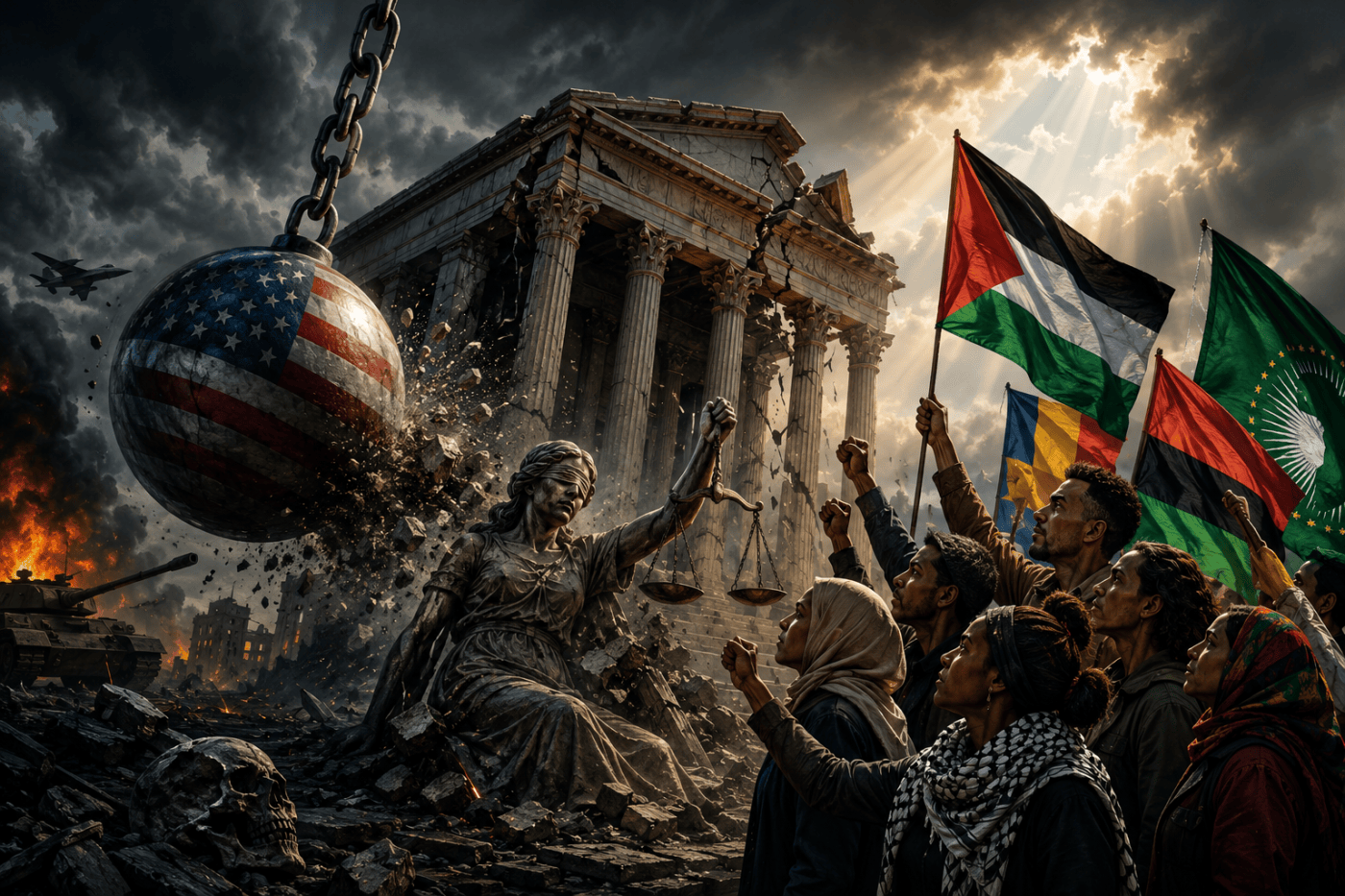
The Guardian exposes Marco Rubio’s claim that the International Criminal Court threatens U.S. sovereignty, yet confines the confrontation within a liberal defense of institutions whose unequal history remains largely unexamined. Palestine’s accession to the court, the sanctions imposed on Palestinian evidence-producing organizations, and Washington’s decades-long campaign against jurisdiction over U.S. personnel reveal that the issue is not sovereignty but the preservation of imperial exemption. The United States embraces international law when it disciplines rivals and attacks it when Palestinian evidence, African criticism, or judicial proceedings begin reaching the architects of occupation and empire. Against this architecture of impunity, Palestinian organizations, Global South governments, Black anti-imperialist movements, and working people are beginning to transform legal judgments into material struggle through evidence preservation, logistics disruption, arms embargoes, and organized non-cooperation.
Prince Kapone | Weaponized Information | July 14, 2026
The Court Is Dangerous Only When It Looks Upward
On July 14, 2026, The Guardian published “EU rejects Trump administration claims that ICC threatens US sovereignty,” by Ashifa Kassam and Cate Brown. The article reports on the European Union’s response to Secretary of State Marco Rubio’s declaration that Washington intends to “systematically disable” the International Criminal Court. Eleven court officials had already been placed under U.S. sanctions, their credit cards cancelled, their accounts closed, their travel restricted, and their access to the ordinary machinery of digital life disrupted. Rubio then widened the threat, warning that governments receiving U.S. assistance could face pressure if they continued supporting the court. Empire, it seems, has discovered a novel definition of sovereignty: every country is sovereign until Washington orders it to surrender the treaties it signed.
The article correctly punctures Rubio’s most obvious deception. The ICC does not place sovereign states in the dock; it prosecutes individuals accused of genocide, war crimes, crimes against humanity, and aggression. Nor does it claim general authority over acts committed inside the United States. Its jurisdiction arises from the Rome Statute, territorial consent, nationality, or referral by the United Nations Security Council. Rubio nevertheless conjures the image of American border agents and elected officials being dragged before foreign judges, as though magistrates in The Hague were preparing amphibious landings on the Potomac. This is fear used as policy laundering: a campaign to protect officials from accountability is packaged as the defense of ordinary people from an invading bureaucracy.
Yet The Guardian contains the confrontation within the comfortable borders of liberal institutionalism. Its principal voices are an EU spokesperson, Western legal specialists, a former Human Rights Watch director, and a former U.S. sanctions official. Palestinians appear mainly as the possible beneficiaries of a court whose neutrality is presumed rather than investigated. African states and jurists, whose long struggle against the court’s selective prosecution helped expose the inequalities built into international criminal law, are absent. The sanctioned judges and prosecutors from the Global South are counted but rarely allowed to speak. The article opposes Rubio from within the same political geography that produced the crisis: Europe defends the institution, American experts explain its rules, and the peoples whose dead bodies supply the evidence remain somewhere beyond the frame.
This source hierarchy performs delicate ideological work. It allows readers to condemn Trump’s excesses without asking why hostility toward international jurisdiction has persisted across U.S. administrations. The campaign is personalized through Trump and Rubio, while the American Servicemembers’ Protection Act, bilateral immunity agreements, resistance to the Afghanistan investigation, and bipartisan protection of Israel disappear into the fog behind them. What emerges is the story of an imperial government attacking the international “rules-based order,” rather than a ruling class defending a durable doctrine: international law may discipline designated enemies, but it must never acquire enough independence to judge the empire or its armed dependencies.
The article’s most important omission is therefore not a missing legal technicality but the political center of the offensive itself. Palestine enters late, folded into a quotation about possible future investigations, even though Palestinian accession to the court, Palestinian documentation of crimes, and proceedings concerning Israeli officials stand at the heart of Washington’s escalation. The assault on the ICC is presented as a general institutional dispute when it is also a concrete attempt to break the chain connecting Palestinian victims, investigators, evidence, prosecutors, and judges. By shrinking that struggle into a disagreement between Washington and Brussels, the article replaces the colonized subject with the enlightened European spokesman.
The Guardian exposes Rubio’s lie but stops before excavating the system that requires it. Its liberal criticism defends the court from Trump while leaving intact the mythology that international law ordinarily floats above imperial power. The deeper truth is more combustible. Washington does not fear a foreign court because it threatens American sovereignty. It fears any institution—however compromised, selective, or weak—that might cease looking downward at conquered states and begin, even briefly, to look upward at those who arm the bombers, finance the occupation, sanction the witnesses, and write immunity into the architecture of the world.
The Jurisdiction Washington Claims for Itself
Palestine entered the International Criminal Court through a deliberate legal process, not through a discretionary favor granted by Europe. On December 31, 2014, the State of Palestine accepted the court’s jurisdiction over alleged crimes committed in occupied Palestinian territory beginning on June 13, 2014. It deposited its instrument of accession to the Rome Statute the following day and formally became a state party on April 1, 2015. Palestine later referred the situation on its territory to the prosecutor, placing alleged crimes committed in Gaza and the West Bank, including East Jerusalem, before the court.
The territorial scope of that jurisdiction was examined by the court itself. On February 5, 2021, the ICC’s Pre-Trial Chamber ruled that the court’s jurisdiction in the Palestine situation extends across Gaza and the West Bank, including East Jerusalem. The decision did not claim general authority over conduct inside the United States or Israel. It applied the Rome Statute’s territorial rule: alleged crimes committed on the territory of a state party may fall within ICC jurisdiction even when the accused is a national of a state that has not joined the court. On March 3, 2021, the prosecutor opened the formal investigation, covering alleged crimes committed since June 13, 2014. The court later reiterated that this mandate remained in force during the assault on Gaza beginning in October 2023.
Palestinian legal organizations constructed much of the evidentiary record upon which any prosecution would depend. Al-Haq, Al Mezan Center for Human Rights, and the Palestinian Centre for Human Rights have documented killings, forced displacement, siege conditions, detention, settlement activity, attacks on civilian infrastructure, and other alleged violations. Their work includes field investigation, victim representation, evidence preservation, legal submissions, universal-jurisdiction litigation, corporate-accountability research, and campaigns concerning third-state obligations. Al-Haq’s public advocacy archive records years of joint Palestinian engagement with the ICC and with governments whose military, financial, and diplomatic relationships affect conditions in occupied Palestine.
On November 8, 2023, the three organizations submitted material to the ICC prosecutor concerning alleged crimes committed during Israel’s assault on Gaza. Their communication addressed bombardment, siege, mass displacement, deprivation of necessities, and attacks affecting civilians. The submission formed part of a longer body of Palestinian documentation rather than an isolated response to one phase of the war. Separate institutional archives maintained by Al Mezan and the Palestinian Centre for Human Rights preserve reports, witness accounts, field investigations, and legal interventions produced from within Gaza and occupied Palestine.
The United States subsequently designated Al-Haq, Al Mezan, and PCHR under the sanctions authority created by Executive Order 14203. Washington’s stated basis was that the organizations had assisted ICC efforts involving Israeli nationals. The order authorizes the blocking of property under U.S. jurisdiction and prohibits covered transactions by U.S. persons. Because banks, payment processors, technology companies, contractors, donors, publishers, and institutional partners frequently operate through U.S.-linked systems, the designations threatened the organizations’ access to services required for research, documentation, communication, salaries, archiving, and legal representation.
The sanctions campaign extended across the institutional path by which evidence becomes a case. Washington designated ICC prosecutors and judges involved in proceedings concerning U.S. or Israeli personnel and also targeted UN special rapporteur Francesca Albanese following her investigation of the governmental and corporate structures supporting Israel’s occupation. The measures were directed at Palestinian evidence-producing organizations, international investigators, prosecutors, and judicial officers rather than at one court official or one disputed ruling.
This confrontation developed from a longer U.S. policy. Washington signed but never ratified the Rome Statute and later declared that it did not intend to become a party. Congress then enacted the American Servicemembers’ Protection Act of 2002, restricting cooperation with the court and authorizing the president to use “all means necessary and appropriate” to secure the release of certain U.S. or allied personnel held at the ICC’s request. The United States also negotiated bilateral agreements intended to prevent other governments from surrendering U.S. nationals to the court.
The same jurisdictional dispute emerged in Afghanistan. Afghanistan joined the Rome Statute in 2003, bringing alleged crimes committed on its territory within the court’s territorial mandate. The investigation included alleged conduct by the Taliban, Afghan forces, and personnel from foreign states. The first Trump administration sanctioned ICC prosecutor Fatou Bensouda and another senior court official after the investigation was authorized. The Biden administration later revoked those sanctions and supported the court’s proceedings concerning Russian officials in Ukraine, while rejecting ICC action involving Israeli leaders. The succession of policies established selective cooperation with the court alongside continuing rejection of proceedings reaching U.S. personnel or protected allies.
African governments had already challenged the inequalities surrounding the ICC from a different direction. The court’s early proceedings were concentrated heavily in Africa, while the United Nations Security Council retained authority to refer situations involving non-member states. Three permanent members capable of shaping or vetoing referrals—the United States, Russia, and China—were themselves outside the Rome Statute. The African Union’s ICC withdrawal strategy recorded objections concerning geographical concentration, Security Council referral and deferral powers, disputes over immunity, and the unequal obligations imposed upon African states. African governments did not adopt one uniform response: some supported withdrawal, while others favored institutional reform, continued membership, or expanded African legal mechanisms.
The Security Council arrangement places referral authority in a body structured by permanent-member veto power. It can send a situation involving a non-party state to the ICC, yet any permanent member can obstruct comparable action through the veto. States outside the Rome Statute therefore retain substantial influence over which non-member countries become exposed to court jurisdiction, while remaining beyond ordinary treaty obligations themselves.
Global South states have begun moving from criticism of unequal enforcement toward coordinated implementation. At the Hague Group’s Emergency Conference on Palestine in Bogotá, governments from Africa, Asia, Latin America, the Caribbean, Europe, and North America considered measures for enforcing international legal obligations through domestic institutions. Thirteen states—Bolivia, Colombia, Cuba, Indonesia, Iraq, Libya, Malaysia, Namibia, Nicaragua, Oman, Saint Vincent and the Grenadines, South Africa, and Türkiye—committed to begin implementing a common program.
The Bogotá measures include preventing transfers of arms, munitions, military fuel, military equipment, and dual-use items to Israel; denying transit, docking, and port services to vessels carrying such matériel; restricting transport aboard ships registered under participating states’ flags; reviewing public contracts connected to the occupation; conducting domestic or international investigations; and supporting universal jurisdiction. These commitments locate enforcement inside ports, customs systems, shipping registries, procurement offices, courts, and national legislation rather than leaving compliance solely to declarations issued by international institutions.
Palestine accepted a defined treaty jurisdiction over alleged crimes committed on its territory. Washington answered with sanctions capable of reaching Palestinian organizations, foreign judges, international investigators, banks, technology providers, and governments outside the United States. The two forms of authority operate through different material capacities: the ICC depends upon the cooperation of participating states, while U.S. sanctions derive their reach from control over finance, commercial services, travel access, aid relationships, and digital infrastructure.
Empire Demands Immunity, Then Calls It Sovereignty
The real story is not that Donald Trump and Marco Rubio have suddenly declared war on an otherwise harmonious system of international justice. The real story is that the United States has reached the point where even the limited, uneven, compromised mechanisms of international law become intolerable the moment they threaten to move upward through the chain of power. The court was acceptable so long as it remained a tribunal for the weak, a legal theater in which defeated governments, isolated leaders, and African defendants could be marched before the world while the architects of invasion, occupation, siege, and proxy war remained wrapped in flags and vetoes. The scandal begins only when the machinery turns, however slowly and imperfectly, toward those protected by imperial power.
Rubio presents this as a defense of sovereignty. But whose sovereignty? Palestine accepted the court’s jurisdiction over crimes committed on Palestinian territory. Afghanistan did the same within its own territorial jurisdiction. States joined a treaty, exercised legal personality, and submitted defined questions to an institution they had recognized. Washington then declared that the nationality of the accused outweighs the sovereign decision of the territory where the alleged crime occurred. In this doctrine, sovereignty belongs in full only to the powerful. The occupied may sign treaties, invoke courts, submit evidence, and represent victims, but their decisions remain provisional until approved by the state arming their occupier.
The contradiction is almost comic in its arrogance. The United States rejects the ICC because it supposedly projects authority beyond legitimate borders, then reaches through the dollar system, banking networks, travel controls, technology platforms, aid relationships, and corporate compliance regimes to punish judges, prosecutors, investigators, and Palestinian organizations spread across several continents. A court whose power depends on voluntary state cooperation is denounced as an empire, while the actual empire converts a designation issued in Washington into frozen accounts, broken contracts, cancelled services, blocked travel, and institutional suffocation around the world. The landlord accuses the tenant of trespassing while changing the locks on the entire building.
This is lawfare in its imperial form. Law is not rejected; it is divided. One law is reserved for enemies, another for allies, and a third for the sovereign center itself. The United States may support prosecution when the accused belongs to a rival camp. It may praise international accountability when the courtroom strengthens its foreign policy. But when Palestinian evidence threatens Israeli officials, when Afghan jurisdiction reaches U.S. personnel, or when investigators examine the infrastructure sustaining occupation, the language changes. The same court becomes illegitimate, the same procedures become persecution, and the same claim to universal justice becomes an attack on national sovereignty.
The continuity across administrations matters because it strips away the comforting liberal fable that Trump invented the contradiction. Trump sharpened the weapon, removed the velvet covering, and swung it openly. Yet the architecture was already standing: refusal to ratify the Rome Statute, legislation protecting U.S. personnel, bilateral non-surrender agreements, pressure on weaker states, resistance to the Afghanistan investigation, selective cooperation when adversaries were targeted, and rejection when Israeli officials entered the frame. The policy dispute inside Washington has concerned tactics, timing, and presentation. The strategic principle has remained stable: the empire will not permit a legal institution it cannot command to exercise judgment over those who enforce its order.
Palestine exposes this structure because the struggle does not begin in the courtroom. It begins under occupation, bombardment, siege, forced displacement, imprisonment, and the destruction of civilian life. The legal case is produced from within that material violence. Palestinian researchers gather testimony. Field workers preserve records. Lawyers assemble submissions. Victims authorize representation. Prosecutors review evidence. Judges consider jurisdiction and warrants. Washington’s sanctions move deliberately along this chain because imperial impunity depends not only on protecting the accused but on disabling the oppressed people’s ability to establish the record of what was done to them.
The attack on Palestinian organizations is therefore not collateral damage from a dispute between states. It is central to the project. The people subjected to violence are denied not only military power and territorial control but also the institutional means to name the crime, preserve the evidence, and pursue the perpetrators. The colonized are permitted to suffer, permitted to appeal, perhaps even permitted to speak—provided their speech never acquires legal consequence. Once documentation begins to threaten warrants, sanctions descend upon the documenters. Once testimony enters an international process, the witnesses’ institutions are placed under economic siege. The message is plain: the empire does not merely contest the verdict; it claims authority over who may gather the evidence.
None of this transforms the ICC into a neutral court floating above history. African governments and jurists had already exposed its unequal geography. Its early concentration on Africa, dependence on state cooperation, and relationship with a Security Council dominated by great-power privilege revealed a system in which international criminal law traveled most easily toward those with the least power to resist it. That criticism remains valid. A tribunal that repeatedly descends upon Africa while the crimes of imperial states encounter vetoes, exemptions, and diplomatic barricades cannot plausibly call its practice universal.
But there is a decisive difference between the Global South critique of selective justice and Washington’s campaign for protected impunity. The first says that international accountability has been applied unequally and must cease being a weapon directed primarily at weaker states. The second says that accountability must not reach the empire or its strategic dependents at all. One exposes the hierarchy in the court; the other seeks to preserve that hierarchy by destroying any proceeding that crosses its limits. To confuse these positions would be to mistake the prisoner’s indictment of a crooked judge for the jailer’s demand that no judge may ever enter the prison.
This distinction is essential for revolutionary politics. Oppressed nations do not have the luxury of waiting for pure institutions. They fight across contaminated terrain. They use courts shaped by imperial history, treaties written within unequal systems, and international bodies whose enforcement depends on states that routinely violate the principles they proclaim. They enter these arenas not because law has replaced power, but because every opening can become a site of struggle. A compromised court may still preserve evidence, recognize territorial claims, issue warrants, expose chains of command, and raise the political cost of impunity. The oppressed may use such institutions without worshipping them, just as a worker may use bourgeois law against an employer without imagining the courthouse has ceased to belong to capital.
The Hague Group begins to reveal the material limit of legal judgment. A warrant without enforcement is paper. A ruling without ports, customs offices, procurement systems, courts, shipping registries, and governments willing to act remains suspended in the air. The turn by Global South states toward arms restrictions, port controls, contract reviews, domestic prosecutions, and universal jurisdiction shifts the question from whether international law has spoken to whether organized political power will make its words real. This is the terrain Washington fears most: not moral condemnation, but the conversion of legal findings into material obstruction.
That emerging struggle also clarifies the relationship between sovereignty and internationalism. Anti-imperialist sovereignty does not mean that states possess an unlimited right to murder, occupy, or destroy beyond scrutiny. Nor does it mean submitting the world to institutions dominated by imperial powers. It means defending the capacity of oppressed nations to control their territory, invoke the legal obligations they have accepted, cooperate with one another, and resist the extraterritorial coercion of the dominant state. Palestine’s appeal to the ICC and the Hague Group’s enforcement measures are not opposites. One asserts jurisdiction from the standpoint of an occupied people; the other begins assembling the state power required to prevent that jurisdiction from remaining ceremonial.
The deeper conflict, then, is not between the United States and a court in The Hague. It is between two conceptions of world order. In the first, imperial power decides when law applies, whom it disciplines, and which crimes disappear behind national security. In the second, oppressed peoples and sovereign states begin to seize fragments of international law, strip them of imperial monopoly, and attach them to organized material force. The ICC crisis matters because it exposes how fragile the language of universal justice becomes when it approaches the ruling nations—and how quickly those nations reveal that their cherished rules were written for everyone but themselves.
Washington calls this sovereignty because “impunity” lacks the necessary grandeur. It calls sanctions self-defense because “obstruction of justice” sounds too much like a confession. It speaks of protecting Americans while shielding a global hierarchy in which workers and oppressed peoples supply the corpses, the witnesses, the evidence, and the defendants, but almost never the judges of empire. The court becomes dangerous only when it forgets its assigned place. The colonized become dangerous only when their suffering is transformed into documentation, their documentation into accusation, and their accusation into a demand that power answer to those it has buried.
Turn the Judgment Into a Material Force
The attack on the ICC will not be defeated by asking the empire to rediscover its conscience. Washington’s campaign works through banks, ports, shipping firms, technology platforms, universities, public contracts, visa systems, and the quiet cowardice of institutions that would rather abandon Palestinians than risk friction with the United States. Resistance must therefore move along the same material routes. The task is not merely to defend a court in The Hague. It is to defend the Palestinian chain of evidence, break the machinery that carries weapons and impunity, and force governments and institutions to choose between international obligations and imperial obedience.
The first front is the preservation and circulation of Palestinian evidence. Al-Haq, Al Mezan, and the Palestinian Centre for Human Rights have spent years documenting crimes, representing victims, preparing legal submissions, and pursuing accountability across international and domestic forums. Their reports must be read, archived, mirrored, taught, and circulated directly rather than filtered through Western newsrooms. Al-Haq’s public archive alone contains extensive work on ICC proceedings, universal jurisdiction, corporate complicity, arms transfers, and third-state responsibility. Libraries, unions, independent media, universities, legal associations, and movement organizations should preserve these materials across multiple platforms so that sanctions, account closures, or corporate deletions cannot erase the record.
The second front is logistics. The Palestinian Youth Movement’s Mask Off Maersk campaign has shown how research can be converted into pressure against a corporation embedded in the movement of military cargo. Its importance lies not in symbolic denunciation but in identifying ships, routes, contracts, ports, warehouses, and executives, then organizing around those pressure points. Local movements should map nearby shipping terminals, military contractors, transport hubs, and public contracts; bring resolutions into dockworker, warehouse, transport, and public-sector unions; and demand that port authorities deny services to vessels carrying arms, military fuel, or dual-use matériel for Israel. Social media should serve this organizing by naming the ship, the cargo, the company, the port, the responsible officials, and the exact demand—not by producing another flood of outrage that disappears by morning.
The Hague Group’s Bogotá measures provide a concrete political program around which such pressure can be organized. Participating states committed themselves to blocking arms and military fuel transfers, denying port access and services to vessels carrying war matériel, reviewing public contracts connected to occupation, pursuing investigations, and supporting universal jurisdiction. These commitments must be dragged from conference declarations into customs offices, shipping registries, pension boards, procurement departments, universities, municipalities, and union halls. Where national governments refuse to act, movements can fight for city procurement bans, pension divestment, university vendor exclusions, port non-cooperation policies, disclosure of military contracts, and institutional refusal to assist unlawful transfers.
Inside the United States, the Black Alliance for Peace offers the clearest anti-imperialist framework for connecting Palestine to the machinery of war at home. Its organizing places Zionism within the wider structure of U.S. militarism, policing, colonial domination, sanctions, and the suppression of self-determination. That connection matters because the same state that punishes Palestinian investigators also militarizes Black communities, disciplines workers, criminalizes dissent, and redirects public wealth into war. Readers should join political education, local organizing, coalition work, and anti-war campaigns that expose sanctions not as clean diplomatic instruments but as weapons enforced through hunger, blocked finance, technological exclusion, and institutional fear.
Legal workers also have a concrete role. Bar associations, law students, movement lawyers, unions, and civil-liberties networks should defend organizers, researchers, and institutions targeted through sanctions, employment retaliation, banking exclusion, doxxing, disciplinary proceedings, and anti-boycott laws. They should demand transparency when banks close accounts, challenge universities that sever Palestinian partnerships, defend workers punished for solidarity actions, and create rapid-response structures for organizations threatened by government or corporate retaliation. The empire relies heavily on anticipatory obedience: institutions often go further than the law requires because abandoning the vulnerable is cheaper than resisting power. That habit must be made politically expensive.
Every campaign should therefore identify a material target and a measurable demand. Which bank closed the account? Which company removed the archive? Which university contracts with the supplier? Which vessel is entering the port? Which pension fund holds the shares? Which public agency is buying the technology? Which official has the authority to act? Organization begins where vague outrage ends. A campaign that cannot name the institution, the connection, the demand, and the next escalation is not yet a campaign; it is commentary wearing a protest sign.
The final warning is against surrendering this struggle to liberal defense of the “rules-based order.” The ICC has never stood above imperial power, and the Global South has already paid the price of its selectivity. The objective is not to teach the court better manners or restore faith in institutions built within an unequal world. It is to defend the oppressed people using every available legal opening, protect those gathering the evidence, and build enough organized power to enforce what the law alone cannot. A warrant becomes meaningful when ships are stopped, contracts are cancelled, weapons are blocked, archives are preserved, workers refuse complicity, and governments are compelled to act. Justice that never leaves the paper belongs to the diplomats. Justice made material belongs to the people.


Leave a Reply