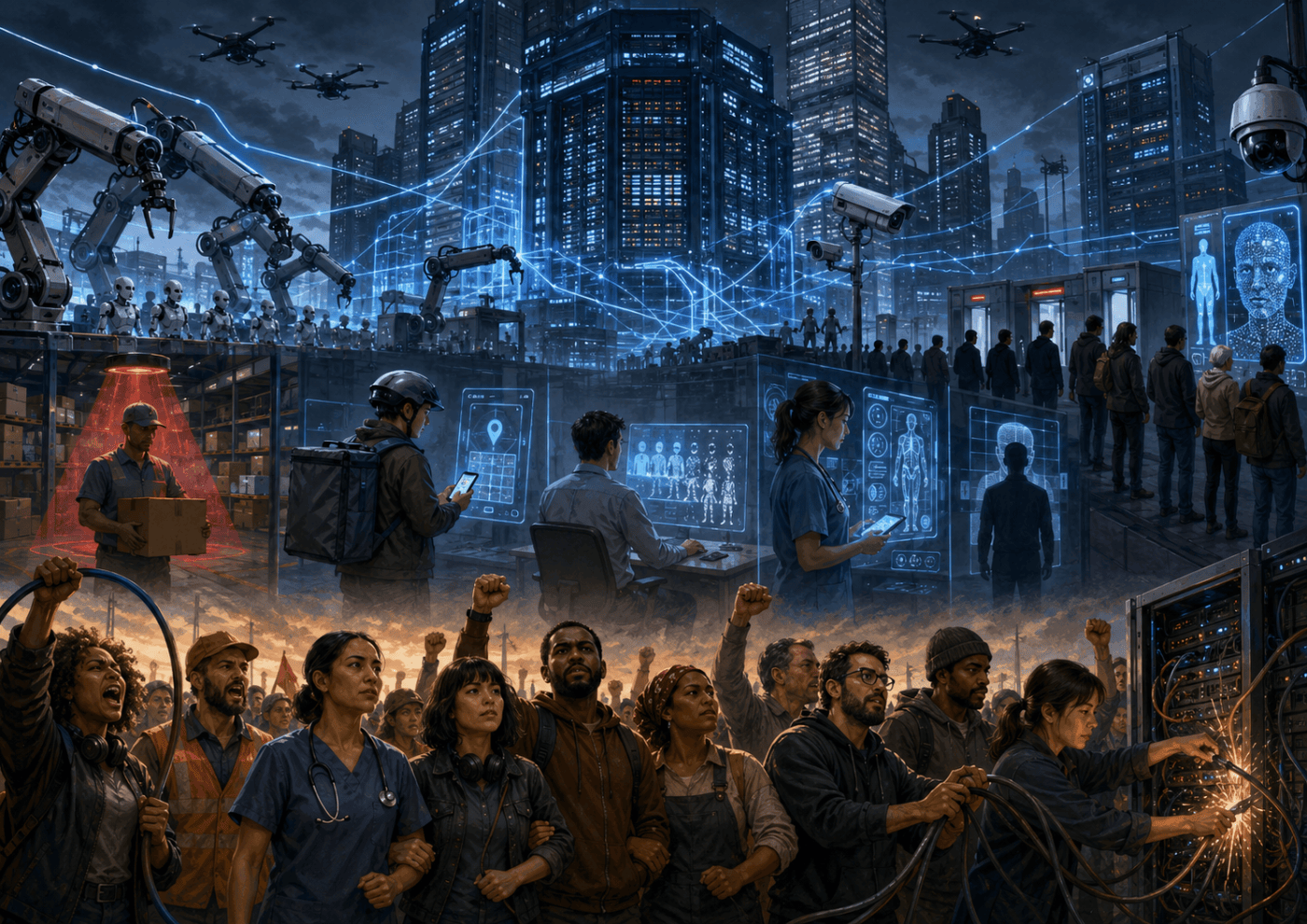
Hundreds of economists warn that artificial intelligence may leave workers behind, but their appeal conceals the corporations, state institutions, and class interests already directing the transformation. Across warehouses, digital platforms, hiring systems, public-benefit programs, military networks, and surveillance agencies, the machinery of automated discipline and exclusion is already operating. The real danger is not an autonomous technology escaping human control, but a capitalist ruling bloc reducing its dependence upon labor while expanding the digital infrastructure needed to administer the people it renders surplus. Against this emerging technofascist order, workers are building the only guardrails capital respects: organization, collective bargaining, refusal, international solidarity, and the power to stop the machine.
Prince Kapone | Weaponized Information
July 14, 2026
The Experts Discover the Fire After Selling the Matches
More than two hundred economists, computer scientists, Nobel laureates, and technology executives have issued what NBC News presents as an urgent warning about artificial intelligence and mass job displacement. AI, the signatories explain, may become radically more powerful within the next decade. It could transform the economy faster than the Industrial Revolution, cast millions out of work, and concentrate its rewards unless society constructs the proper “incentives, guardrails, and institutions.” The scientists have inspected the smoke rising from the factory floor and concluded, with admirable seriousness, that someone should perhaps look for a fire extinguisher.
The problem is not that the warning is false. The problem is that its political vision stops precisely where the real investigation should begin. AI enters the article as an independent force descending upon society from the clouds, as though no class owns the data centers, finances the laboratories, controls the platforms, orders the layoffs, purchases the surveillance systems, or writes the laws governing their use. Technology acts; workers suffer; enlightened institutions intervene. The capitalist disappears from capitalism, leaving behind only an unfortunate technical dilemma for experts to manage.
This sleight of hand is reinforced by the article’s source hierarchy. Workers threatened with displacement do not speak. Unions confronting algorithmic management do not speak. People rejected by automated hiring systems, disciplined by electronic monitoring, or forced to plead their humanity before computerized benefit systems do not speak. The authorized voices belong overwhelmingly to universities, research institutes, and corporations standing near the commanding heights of the AI economy. Executives from firms helping construct the machinery are permitted to appear among those protecting society from the machinery. The arsonist has joined the fire-safety commission.
The article also pushes the crisis safely into the future. The danger supposedly lies in what AI may do over the next ten years, not in what employers and states are already doing with it. This futurization transforms present class struggle into speculative forecasting. Existing surveillance, deskilling, workforce reduction, automated exclusion, and managerial control fade behind an approaching technological horizon.
Finally comes the language of policy laundering: “democratic choices,” “guardrails,” “incentives,” and institutions that will make AI “benefit society.” These phrases sound substantial while naming no power capable of enforcing them. There is no worker veto over deployment, no collective claim upon productivity gains, no reduction of working time without loss of pay, no public ownership of essential infrastructure, and no challenge to the corporations directing the transformation. The petition therefore performs a useful ideological service. It acknowledges the coming devastation while preserving the innocence of the class preparing it, reducing a battle over ownership and power to a request that the rulers govern their offensive with greater wisdom.
The Machine Is Already at Work
The economists’ letter describes a future in which artificial intelligence may become radically more powerful, produce an economic transformation faster than the Industrial Revolution, and displace workers on a massive scale. Yet the institutions commanding this transformation are not standing at the edge of an unknown future. They have already announced their priorities, deployed the machinery, and begun reorganizing labor around it.
The federal government’s own program leaves little mystery about the direction of travel. America’s AI Action Plan declares that the United States is in a race for global AI dominance and organizes policy around accelerating private-sector adoption, dismantling regulatory barriers, building data centers and energy infrastructure, expanding military use, exporting American technological systems, and tightening control over advanced computing. Its worker agenda consists largely of AI literacy, labor-market monitoring, skills development, and rapid retraining for people displaced by technological change. It establishes no worker veto over deployment, no employment guarantee, no reduction of working time, and no collective claim upon the productivity gains being created.
The corporations do not require economists to explain that AI can reduce their dependence upon labor. Amazon chief executive Andy Jassy has already told employees that the company will need fewer people performing some existing jobs and expects AI efficiency gains to reduce its total corporate workforce. Inside Amazon’s warehouses, the system of technological labor control is already mature. Workers’ rates, task times, and periods of inactivity are continuously measured against company benchmarks, while failure to keep pace brings pressure, discipline, and possible termination. A Senate investigation found that Amazon rejected injury-reducing measures when senior leadership feared they would lower productivity, even after internal studies connected higher work speeds to greater injury risks. The same corporation preparing to eliminate sections of its office workforce has spent years refining the electronic supervision of the workers it still requires.
On digital labor platforms, the algorithm has already assumed many of the powers once exercised by a visible foreman. It allocates work, influences wages, monitors performance, processes customer ratings, and decides whether workers may continue earning a living. Among the platform workers surveyed in Texas by Human Rights Watch, more than one-third had been deactivated at least once. Many received no adequate explanation, could not understand the appeal procedure, or were later cleared of wrongdoing after losing days or weeks of income. The worker is formally called an independent contractor but remains subject to a private government whose rules are hidden, whose decisions are automated, and whose sentences take effect before any appeal can be heard.
Workers understand the arrangement more clearly than the institutions speaking on their behalf. A national labor survey found that 95 percent wanted a human being to make final decisions affecting employment, 92 percent supported workplace guardrails and transparency, and 85 percent wanted workers to shape technological design. Only 7 percent of employed respondents said their employer had disclosed how or when AI was monitoring their work, while 70 percent said no disclosure had occurred. Employers are demanding the freedom to know more about workers while reserving the right to tell workers almost nothing about the systems judging them.
Automated sorting also operates at the gates of employment. The Equal Employment Opportunity Commission intervened in litigation alleging that Workday’s AI-powered screening system excluded an applicant from more than one hundred positions because he was Black, over forty, and disabled. The commission argued that algorithmic screening systems can perform the same referral and exclusion functions as traditional employment agencies, determining whether applicants are ever considered by an employer. The machine does not need to announce a racial, age, or disability preference. It can reproduce exclusion through the data, criteria, and institutional practices built into its operation.
Nor does algorithmic administration end when employment disappears. States have used facial recognition to verify unemployment claims despite delays and wrongful denials, while more than two dozen states have deployed algorithms linked to reductions in Medicaid-funded home-care hours. In Arkansas, an automated assessment system replaced evaluations by nurses and arbitrarily reduced assistance needed by older and disabled people to eat, bathe, attend medical appointments, and live independently. Technology is therefore being installed on both sides of the labor market: first to select, measure, and remove workers, and then to determine which of the excluded remain eligible for the support required to survive.
The scale of exposure is already global. The International Labour Organization calculates that one in four workers holds an occupation with some exposure to generative AI. Women occupy a disproportionate share of the highest-exposure category, while clerical, professional, and highly digitized work face growing transformation. Most occupations will not disappear in a single stroke; their tasks, staffing levels, skill requirements, wages, and systems of supervision can be reorganized piece by piece.
The ownership of this transformation is extraordinarily concentrated. UN Trade and Development projects that the AI market will reach $4.8 trillion by 2033, while one hundred corporations, located mainly in the United States and China, already account for 40 percent of global corporate research-and-development spending. The gains from automation frequently flow toward capital rather than labor, while countries without their own computing infrastructure, data systems, skilled personnel, or industrial capacity face deeper technological dependency. One hundred and eighteen countries—most of them in the Global South—remain absent from the principal forums shaping AI governance, and fewer than one-third of developing countries possess national AI strategies.
The civilian AI economy and the military-security state are also being constructed through the same corporations, cloud systems, chips, data centers, and government contracts. In 2026 the Pentagon reached agreements with SpaceX, OpenAI, Google, Nvidia, Microsoft, Amazon Web Services, and other firms to place their systems on classified military networks for planning, logistics, targeting, and other sensitive operations. Within five months, more than 1.3 million Defense Department personnel had used the Pentagon’s principal generative-AI platform. The infrastructure being sold as the next great engine of commercial productivity is simultaneously being incorporated into the machinery of war.
This union of technological development and coercive power rests upon an older domestic foundation. The Senate’s Church Committee documented how U.S. intelligence agencies used surveillance and covert action to disrupt civil-rights organizations, the antiwar movement, Martin Luther King Jr., and other people deemed threats to the social order. The methods have changed, but organized dissent remains an intelligence target. More than 2,300 pages of Atlanta police records revealed the monitoring of Cop City opponents engaged in canvassing, town halls, community conversations, pizza nights, and study groups. Those intelligence reports were circulated among local authorities, counterterrorism agencies, the FBI, the Department of Homeland Security, and universities.
The factual terrain is therefore much larger than a coming shortage of jobs. AI is being installed across the entire social field: in corporate restructuring, warehouse discipline, platform wages, hiring decisions, unemployment systems, disability services, military networks, international technological controls, and the surveillance of political opposition. The institutions being asked to build humane guardrails are already building something far more extensive.
The Surplus Population and the Digital State
The petition begins from the premise that artificial intelligence may one day escape the control of society and leave millions of workers behind. But the evidence establishes a different sequence. AI has not escaped society. It has been seized by the class that already owns the workplaces, the platforms, the data centers, the cloud systems, the research laboratories, and the commanding institutions of the state. The central danger is not an independent machine moving faster than human wisdom. It is capital moving through the machine with greater speed, reach, and precision.
Every technological revolution raises the same political question: who commands the new productive power, and toward what end? Under a social order governed by human need, machinery that reduces necessary labor could shorten the working day, eliminate exhausting tasks, expand leisure, and distribute abundance. Under capitalist ownership, the same productive capacity appears to the worker as a threat. Time saved becomes labor eliminated. Greater efficiency becomes smaller staffs, intensified workloads, tighter surveillance, and a larger share of social wealth captured by owners. The machine does not dictate this outcome. Property relations do.
The ruling class therefore does not need economists to warn it that AI can reduce employment. Corporate executives are already announcing smaller workforces, while employers use automated systems to measure, discipline, and remove the workers who remain. Platform companies have gone further, dissolving the visible foreman into software that allocates jobs, adjusts wages, records performance, and terminates access to income. The worker confronts authority everywhere but can find no responsible human being anywhere. Management has not disappeared. It has concealed itself inside the algorithm.
This transformation divides the working class while pressing downward upon it as a whole. One section remains employed but is compelled to work beneath continuous electronic supervision. Another is pushed into unstable platform labor, where access to income can be withdrawn without meaningful explanation or appeal. Applicants encounter automated gates before reaching an employer. Those excluded from work meet another set of automated gates when applying for unemployment assistance, health care, or home support. The same social order that makes livelihoods less secure is constructing systems that decide, with increasing impersonality, who deserves relief from the insecurity it has produced.
This is the expansion of the relative surplus population in digital form. Capital does not render people useless to society. It renders growing numbers unnecessary to profitable employment under the conditions chosen by capital. Their knowledge, data, habits, movements, voices, and past labor remain valuable. Their secure existence does not. They may still be needed as consumers, applicants, contractors, data sources, or temporary workers, but they are denied the stability through which workers can plan, organize, resist, and exercise collective power.
The process is deliberate without requiring a secret room in which every capitalist agrees upon a master plan. Corporations consciously pursue labor-saving efficiency. Employers knowingly install automated discipline. The federal government deliberately removes regulatory obstacles, finances infrastructure, expands adoption, and treats technological dominance as a national objective. Military institutions deliberately place the same corporate systems inside classified networks. Administrative agencies deliberately automate decisions governing access to public support. These separate decisions converge because they arise from the same class interest: increase productivity, reduce labor costs, concentrate control, and preserve the political order through which the gains are privately appropriated.
The petition’s language of “guardrails” conceals this convergence. It imagines the ruling institutions standing outside the transformation, ready to steer it toward the public good. Yet those institutions are not neutral referees. They are participants. The corporations developing commercial AI are also connected to the infrastructure of military planning and targeting. The state that promises to study displacement is simultaneously accelerating deployment. The employers asking workers to embrace innovation refuse even basic transparency about how workers are monitored. The institutions being summoned to protect society are already organized around objectives that place accumulation, dominance, and control above working-class security.
The military incorporation of AI exposes the wider meaning of the transformation. The same technical architecture that promises efficiency in the office and warehouse is being adapted to planning, logistics, targeting, and classified operations. Commercial productivity and organized coercion do not develop along separate tracks. They draw upon the same corporations, computing power, data systems, and public investment. The digital economy is therefore not simply producing new commodities. It is strengthening the capacity of dominant institutions to classify environments, anticipate behavior, coordinate force, and act at scales inaccessible to ordinary people.
That coercive capacity has a domestic history. Surveillance and disruption of civil-rights and antiwar movements were not deviations from an otherwise democratic state. They were methods used when organized people threatened established power. Contemporary monitoring of political opposition demonstrates that the object remains familiar even as the instruments become more sophisticated. A system capable of extracting more labor from fewer workers must also prepare for the social resistance created by insecurity, exclusion, and arbitrary control. Technofascism is the political form emerging from this contradiction: concentrated economic power fused with digital surveillance, automated administration, military infrastructure, and the monitoring of dissent.
This regime is not racially neutral. Automated hiring disputes, unequal occupational exposure, and algorithmic administration reveal that the new systems enter a society already structured by racial, gender, age, disability, and class inequality. Technology absorbs the records and practices of that society, then reproduces them behind a veil of mathematical objectivity. Populations long treated as suspect, disposable, or administratively burdensome become the testing grounds for systems later extended more broadly. The expansion of insecurity into larger sections of the working class does not abolish the hierarchy. It enlarges the population governed through it.
Internationally, the same contradiction appears between nations. A handful of corporations and powerful states command the research capacity, computing infrastructure, capital, standards, and military applications of AI, while most countries remain outside the institutions deciding its future. The Global South is invited to adapt to a transformation it did not control, purchase systems it did not design, and absorb disruptions generated elsewhere. Technological dependence becomes another mechanism through which wealth and decision-making power flow upward toward the centers already dominant in the world economy.
The real story, then, is not that society has carelessly forgotten to prepare for AI. The dominant institutions are preparing intensely. They are preparing the infrastructure, the corporate freedom, the military applications, the automated workplaces, the employment filters, the benefit systems, and the surveillance networks. What they have not prepared is a future in which workers possess the power to determine how technology is used or to claim the abundance their labor and knowledge have made possible.
The economists fear that AI may accidentally leave workers behind. The material record reveals something more severe: a dominant capitalist bloc reducing its dependence upon labor, accepting displacement as a cost of accumulation, and strengthening the machinery required to administer the people it increasingly treats as surplus. The question is no longer whether the rulers understand the danger. The question is why anyone still expects the architects of this order to rescue its victims.
The Machine Must Meet Organized Resistance
The answer to technofascist labor recalibration will not come from another committee of economists asking monopoly capital to install kinder guardrails. Workers require organizations capable of stopping deployment, withholding cooperation, interrupting production, and imposing binding limits upon the corporations converting their labor, knowledge, and bodies into automated systems. The issue is not whether workers receive a seat at the ethics table after the machinery has been purchased. The issue is whether capital retains the unilateral right to decide who works, who is monitored, whose knowledge is captured, and who is discarded.
National Nurses United offers one of the strongest models already in motion. Representing more than 225,000 registered nurses, the union has combined workplace organization, public demonstrations, legislative struggle, and a Nurses and Patients’ Bill of Rights demanding human judgment, safety testing, public oversight, and protection against displacement and deskilling. Nurses have marched against unsafe automation, fought for authority to override algorithmic decisions without retaliation, and confronted hospital executives attempting to scale AI while cutting labor costs. Their struggle establishes the first principle of resistance: no technology affecting staffing, discipline, workload, safety, or professional judgment should enter a workplace without advance disclosure, collective bargaining, and the enforceable right of workers to reject it.
SAG-AFTRA has demonstrated what becomes possible when such demands are backed by strike power. Its members have forced employers to negotiate over consent, compensation, disclosure, specified uses, digital replicas, and the continuing control of performers over their own work. These principles must be generalized across the labor process. No employer should be permitted to seize a worker’s voice, image, writing, code, movement, judgment, or accumulated workplace knowledge and convert it into a replacement system without collective consent, compensation, and an enforceable right to refuse.
Workers need rank-and-file technology committees capable of mapping every algorithm operating inside the workplace—from hiring and scheduling to productivity measurement, layoffs, customer ratings, discipline, and benefits. These committees should collect testimony, compare outcomes across race, gender, age, disability, and employment status, demand access to impact assessments, and prepare grievances, legal complaints, public exposure, and collective action. The lesson of the Meta workers who organized a mass petition and legal challenge against AI-linked surveillance and layoffs is that even workers without a recognized union can begin by identifying one concrete abuse, organizing privately, forcing disclosure, and escalating beyond individual complaint.
The struggle must also cross the borders and subcontracting arrangements through which corporations divide the technological workforce. African content moderators have organized unions, pursued litigation, and built an international alliance linking workers in Kenya, Ghana, Colombia, Poland, Turkey, and the Philippines. Their movement exposes the hidden labor beneath the mythology of autonomous intelligence: people who train, clean, classify, and police corporate systems while receiving a fraction of the wealth they create. Organizing engineers while abandoning moderators, contractors, warehouse workers, data labelers, and platform workers would merely reproduce capital’s own hierarchy inside the labor movement.
Petitions can identify supporters, but they become dangerous to capital only when attached to escalation: workplace meetings, informational pickets, coordinated refusal, regulatory complaints, public testimony, contract campaigns, strike authorization, and strikes. Workers must demand no layoffs from AI deployment, reduced working time without reduced pay, employer-funded income protection, staffing floors, and collective ownership of productivity gains. They must also expose contracts connecting their labor to police, military, intelligence, border, and occupation systems. The point is not to humanize the machine while capital retains the switch. The point is to build the organized power capable of taking the switch away.


Leave a Reply