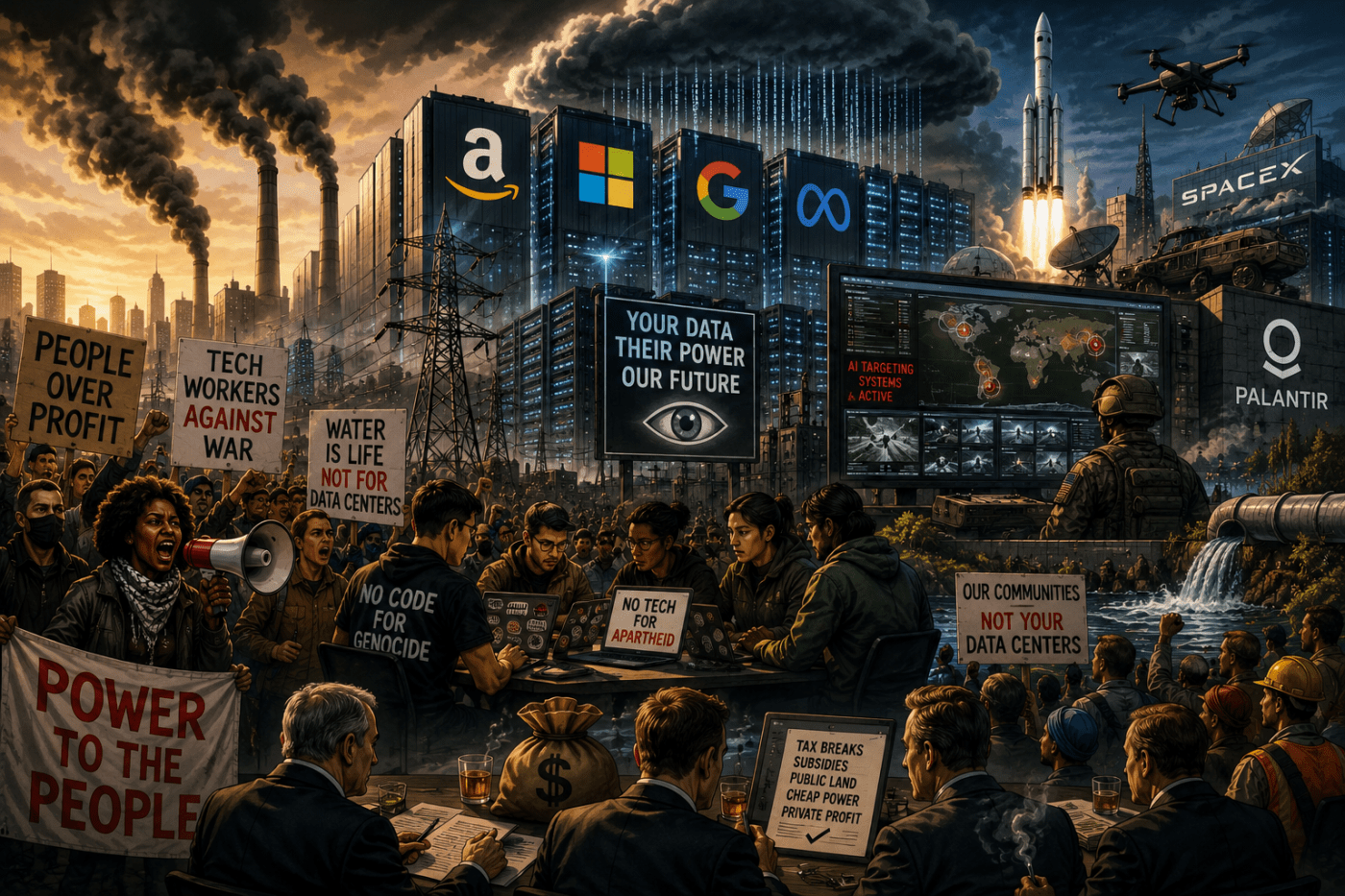
The FT reports the panic from inside the casino, where falling stocks are treated as tragedy while the machinery behind them is politely hidden. The facts reveal that Big Tech’s AI boom and SpaceX’s market fantasy rest on public infrastructure, military contracts, energy hunger, water extraction, and labor discipline. The real story is not a sell-off but a rupture in the speculative regime of monopoly capital, where the “cloud” has a landlord, a power bill, and a war contract. The task now is to organize workers, communities, and public-power struggles to pull the future out of the hands of finance capital and empire.
Prince Kapone | Weaponized Information | June 23, 2026
The Casino Reports on Its Own Fire
The Financial Times article “Big Tech leads sell-off in global stocks,” written by William Sandlund and Emily Herbert and published on June 23, 2026, presents the latest convulsion in global markets as a problem of investor nerves, stretched valuations, higher interest-rate expectations, and a spectacular reversal in SpaceX shares. The basic report is simple enough: Big Tech stocks fell, Asian and European markets followed, SpaceX lost hundreds of billions in paper value after its IPO rally cooled, and the Federal Reserve’s hawkish turn spooked investors who had grown accustomed to treating the AI boom as a money-printing machine with server racks. In the FT’s telling, the markets are anxious, tech is overextended, and investors are beginning to wonder whether the glorious digital future has been priced a little too generously. One can almost hear the soft clink of crystal glasses in the background as the servants of capital discover, with great professional seriousness, that a balloon eventually meets a pin.
This is the Financial Times doing what the Financial Times was built to do: translating the convulsions of capitalism into the language of asset managers. It is not a workers’ paper, not a people’s paper, not a paper of the colonized, the dispossessed, the communities sitting beside the data centers, the laid-off workers whose “efficiency” became some executive’s AI strategy, or the nations watching their digital sovereignty swallowed by American cloud empires. It is a newspaper of finance capital, written for those who read the world through indexes, yields, trading desks, analyst notes, and the emotional life of investors. Its ownership by Nikkei places it inside the respectable architecture of global business journalism, where monopoly capital is not interrogated as a social force but watched carefully like a weather system. The storm is described; the landlords of the storm are rarely named.
The authors write from inside this professional world of market interpretation. Their terrain is not the factory floor, the power grid, the military contract, the public subsidy, the family crushed by layoffs, or the country forced into technological dependency. Their terrain is the market screen. Sandlund and Herbert report what the market says about itself, and like all serious market journalism, the article pretends that the investor class is not merely one class among others but the natural voice of reality. When bankers, strategists, and portfolio managers speak, their words arrive as sober analysis. When workers and communities are absent, their absence is not treated as a political choice. It is treated as professionalism.
The first propaganda device operating here is narrative framing. The FT frames the crisis as a “sell-off,” a “valuation concern,” and a shift in “sentiment.” These are not false terms, but they are narrowing terms. They shrink the event down to market motion. They do not ask what made these valuations possible, whose money and infrastructure stand behind them, why AI became the new altar of speculation, or how a company like SpaceX can be treated as a private growth stock while feeding from the trough of the imperial state. The reader is invited to watch the numbers fall, not to ask who built the ladder up.
The second device is source hierarchy. The article turns to Barclays, BNY, RBC BlueBay, and the priesthood of market strategy. These are not neutral observers. They are interpreters of capital speaking to capital about capital. Their authority comes from proximity to money, not from proximity to truth. No tech worker appears. No antiwar organizer appears. No public-power advocate appears. No community fighting data-center extraction appears. No Global South critic of digital dependency appears. The people who produce the digital world, power it, cool it, police it, suffer under it, and resist it are outside the frame. The market speaks; society is muted.
The third device is omission. SpaceX is presented as the dramatic casualty of the day, a company whose shares dropped sharply after a feverish IPO rally. But SpaceX is not simply a rocket firm that became overvalued because retail investors got a little too excited by Elon Musk’s halo. It is a creature of state power, military procurement, satellite infrastructure, and imperial logistics. The FT can tell us what SpaceX lost in market capitalization, but in this excavation section we must notice what the article does not even try to ask: what kind of “private company” becomes so central to public war planning, communications infrastructure, and U.S. strategic power that its stock-market drama must be treated as a global financial event?
The fourth device is vagueness. The article repeatedly invokes the “AI boom,” but the phrase floats like perfume over a landfill. AI, in this presentation, is a sector, a rally, an investor theme, a question of capex and valuation. What disappears is the material body of AI: electricity, water, chips, land, rare minerals, data centers, cooling systems, transmission lines, public permits, public subsidies, and workers made disposable in the name of machine intelligence. The cloud is made to sound weightless. Capital loves this trick. It turns steel into software, labor into “efficiency,” extraction into “innovation,” and militarized infrastructure into “growth.”
The fifth device is card stacking. The article gives us market facts, but only the kind that keep the reader inside the investor’s worldview. We learn who fell, how much they fell, what the futures indicate, what the strategists fear, and what rates might do to valuations. But the deeper accounting is withheld. There is no ledger of public cost. No ledger of state dependency. No ledger of ecological burden. No ledger of military integration. No ledger of class discipline. The card deck is stacked so that the crisis appears as a problem of excessive market enthusiasm rather than a symptom of a whole accumulation regime beginning to tremble under its own contradictions.
The result is a polished little dispatch from inside the casino while smoke creeps under the door. The FT sees the gamblers panic and reports that the mood has changed. It hears the dealers whisper about rates and valuation multiples. It watches SpaceX stumble and Big Tech wobble. But it does not ask why the casino was built with public money, why the lights are powered by strained grids, why the security guards wear Pentagon badges, why the workers are being replaced by machines, or why the house always calls its winnings innovation and its losses a market correction. That is the work of excavation: not to deny the facts the article reports, but to pull away the velvet curtain and ask what kind of system must hide behind such careful language.
The Numbers Fall, the Machinery Appears
The facts the Financial Times gives us are not useless. They are simply incomplete, presented in the narrow language of the investor class, as if the entire drama of modern capitalism can be understood by watching numbers bleed red across a screen. On June 23, 2026, the paper reported that global stocks fell as Big Tech led the retreat, with fears of higher U.S. interest rates and a sharp reversal in SpaceX shares souring market sentiment. The article described South Korea’s tech-heavy Kospi plunging, Samsung Electronics and SK Hynix dropping sharply, Europe’s Stoxx 600 weakening, and ASML falling in early trading. It also reported that SpaceX shares closed down more than 16 percent at $154.60, wiping roughly $400 billion from the company’s market value after a feverish IPO rally had briefly lifted the firm toward the heavens, where all speculative bubbles believe they have purchased permanent residence.
The market explanation was equally straightforward. The Nasdaq had already been bruised in June after a powerful AI-driven rally, investors were beginning to ask whether Big Tech valuations had run ahead of reality, and the Federal Reserve’s posture toward inflation had tightened the noose around speculative assets. Reuters reported that the Fed’s June 2026 signals pushed investors to reconsider the path of interest rates as inflation risks remained unresolved. This matters because the whole glorious temple of tech valuation has rested on a familiar capitalist miracle: cheap money, heroic projections, public infrastructure, and the confident assumption that tomorrow’s profits can be eaten today. When interest rates rise, fictitious capital is forced to remember that it still lives in a world of gravity. The market calls this “repricing.” Workers might call it the ruling class discovering arithmetic after a long drunk.
But the omitted reality begins where the FT’s market report stops. SpaceX is not merely a private company whose stock price got ahead of itself. It is a state-dependent imperial contractor, a firm whose value is inseparable from the U.S. government’s militarization of space, communications, surveillance, launch systems, and battlefield infrastructure. In May 2026, Reuters reported that the U.S. Space Force awarded SpaceX a $4.16 billion contract for a satellite system intended to track and target airborne threats. TechCrunch likewise reported that SpaceX received $6.45 billion in Space Force contracts ahead of its IPO. There is the little secret tucked behind the market drama. The “innovator” is not floating above the state. The “disruptor” is holding a government purchase order. The “private genius” is attached to the imperial treasury by a golden umbilical cord.
The same is true of the AI boom that carried Big Tech upward before the correction. The FT names the AI rally but does not reconstruct the material body underneath it. Monthly Review identifies Microsoft, Amazon Web Services, Google/Alphabet, and Meta as the great houses of early-2026 AI data-center investment, the monopoly platforms pouring capital into the physical infrastructure required to make artificial intelligence appear magical. This is crucial because AI is sold ideologically as immaterial intelligence, as pure computation, as the mind of capital finally freed from the messy flesh of labor and nature. But in reality, AI is one of the most material technologies on earth. It is land. It is electricity. It is water. It is concrete. It is chips. It is cooling. It is transmission. It is public permitting. It is extraction hidden behind the word “cloud.”
Monthly Review’s political economy of AI forces us to look at what the investor story conceals: data centers are massive energy-consuming industrial facilities, with hyperscale operations requiring continuous power and data-center electricity demand projected to surge dramatically. Peoples Dispatch has warned that AI data centers consume enormous quantities of water for cooling, with estimates placing possible global AI-related freshwater demand in the trillions of gallons by 2027. This is not the clean, frictionless, digital future advertised by the prophets of Silicon Valley. It is an industrial reorganization of society in which capital tries to seize the grid, the watershed, the land-use board, the zoning meeting, the ratepayer bill, and the worker’s nervous system, then calls the whole thing intelligence.
The burden has already become visible to local governments and communities. Reuters reported that mayors from 40 cities formed a Global Urban Data Centres Pact to confront the strain data centers place on electricity grids, water systems, land, and communities. The United Nations secretary-general called on AI firms to reveal their environmental costs, with Reuters reporting that AI infrastructure could consume more energy than all but five countries by 2030 if current trends continue. Here the market’s cheerful abstraction collapses into something concrete. The AI boom is not simply a valuation story. It is a struggle over public resources. The server farm arrives in the language of progress, but it drinks from the public tap, feeds from the public grid, and hands the bill to ordinary people who were never asked whether they wanted their future auctioned to a machine-learning landlord.
The fossil-fuel connection is equally direct. Barron’s reported that Chevron and Microsoft reached a 20-year natural-gas power deal for AI data centers in West Texas. Strip away the green slogans and we find the old empire of carbon smiling beneath the new empire of computation. AI is sold as the future, but its appetite is dragging capital back to gas plants, long-term power contracts, and the familiar violence of fossil infrastructure. This is how capitalism performs its magic trick: it markets a product as post-industrial while building it on the industrial stomach of the old order. It calls the server “clean” because the smoke rises somewhere else.
Nor is the matter limited to electricity and water. The AI boom is also a labor strategy. Tricontinental’s dossier on Big Tech treats the power of technology monopolies as a question of class struggle, labor control, social discipline, and monopoly power. This is the missing class content. AI is not merely a tool that may raise productivity in the abstract. Under capitalist ownership, it becomes a weapon used to reorganize labor, intensify work, justify layoffs, discipline wages, and centralize control over knowledge. When corporate executives speak of efficiency, workers should reach for their wallets, their union cards, and perhaps a sturdy chair. Efficiency, in the capitalist dictionary, often means that fewer workers are expected to produce more wealth for people who produce nothing.
The military side of the machine is just as central. Rosa Luxemburg Stiftung’s study “Big Tech Goes to War” documents how major technology corporations are drawn into U.S. war machinery through lucrative military and security contracts. Peoples Dispatch has likewise connected Silicon Valley AI systems to the kill chains of contemporary warfare. This is not an accidental side hustle. The Pentagon does not knock politely on Big Tech’s door after the innovation is complete. The military, the intelligence state, and the technology monopolies are co-producing the infrastructure of command. AI, satellites, cloud computing, targeting systems, and communications networks are being fused into one imperial nervous system.
This gives SpaceX’s stock-market drama a different meaning. A fall in SpaceX shares is not simply a billionaire’s bad afternoon or a retail investor’s hangover. It is a flicker inside a wider system where private valuations are inflated by public military dependency and imperial necessity. The U.S. state needs launch capacity, satellite networks, targeting systems, communications redundancy, and space-based surveillance. SpaceX needs contracts, legitimacy, launch monopolies, and the aura of national destiny. Finance capital then prices this fusion as if it were simply enterprise value. The result is a company that looks private in the prospectus and public in the purchase order, libertarian in mythology and statist in metabolism.
The broader global context is even more serious. UNCTAD warns that the digital economy risks concentrating benefits among a few countries and corporations while deepening environmental pressures and leaving many developing countries behind. Global South analysts have described digital colonialism as a condition in which data, infrastructure, platforms, and cloud dependence reproduce unequal power between the imperial core and the Global South. The African Union’s Continental AI Strategy centers data sovereignty, infrastructure, and an Africa-focused development path for artificial intelligence. These are not abstract policy debates. They are struggles over whether the digital future will be owned by a handful of U.S. corporations and their state backers, or whether oppressed and neocolonized nations can build sovereign technological capacity on their own terms.
This is why the United States fights so hard against digital sovereignty. Reuters reported that the Trump administration ordered U.S. diplomats to oppose data-sovereignty initiatives abroad that could restrict American AI and cloud firms. There, in one instruction, the whole imperial doctrine is exposed. When Global South states try to protect their data, their infrastructure, their cloud systems, or their AI futures, Washington calls it a barrier. When U.S. firms dominate the cloud, capture the data, write the standards, and lock whole economies into dependency, Washington calls it openness. The empire has always preferred open doors when it owns the battering ram.
Weaponized Information has already analyzed this fusion of platform power, state violence, and capitalist command in its work on Palantir and the digital leviathan of Silicon Valley state violence, as well as in its prior analysis of the AI grid crisis as a crisis of privatized infrastructure, public burden, and monopoly demand. The FT article gives us the surface motion of stocks. The larger factual terrain shows something deeper: Big Tech valuations are tied to military contracts, public infrastructure, energy and water extraction, labor restructuring, and the global fight over digital sovereignty. What appears as a market correction is in fact a small rupture in the ideology of the whole machine. The numbers fell, and for a moment, the machinery underneath became visible.
The Cloud Has a Landlord, a Power Bill, and a War Contract
The Financial Times gives us a market story. What stands behind it is a class story. Big Tech did not fall because the gods of finance woke up in a bad mood. SpaceX did not stumble because history suddenly became rude to Elon Musk. The Nasdaq did not tremble because investors became philosophers overnight. The market convulsion exposed, for one brief hour, the hidden machinery of a whole accumulation regime: monopoly platforms, military contracts, artificial intelligence, fossil power, data centers, state subsidy, labor discipline, and the imperial struggle to command the digital future.
The ruling class calls this “innovation” because theft sounds better in a hoodie. It calls this “AI” because artificial intelligence sounds cleaner than public water siphoned into private cooling systems, electricity grids bent toward server farms, gas contracts dressed up as progress, workers threatened with redundancy, and the Pentagon quietly fastening its belts around the whole apparatus. The cloud, we are told, floats above us. In reality, it sits on land, drinks water, burns energy, consumes minerals, hires guards, signs military contracts, and sends the bill downward. It is not weightless. It is heavy with class power.
The SpaceX story is the most vulgar expression of the same contradiction. Here is a company sold to the public as frontier romance: rockets, Mars, genius, boldness, the old settler fantasy with better branding and worse facial hair. But beneath the myth stands the state. Beneath the state stands the military. Beneath the military stands empire. The stock price rises on the promise of privatized destiny, but the company’s real body is stitched into public procurement, satellite warfare, communications command, and imperial logistics. The market calls this enterprise value. The rest of us might call it welfare for warlords with launchpads.
This is why the FT’s language of “valuation concern” is so politically useful to capital. It makes the crisis appear technical. It suggests that the basic problem is not the social organization of technology, not the militarization of space, not monopoly control over computation, not public infrastructure captured by private firms, but simply that investors got a little carried away. In this telling, the house is structurally sound; a few gamblers merely overbid the furniture. But the facts point elsewhere. The house itself is wired through with contradiction.
AI under capitalism is not a neutral tool waiting for wise hands. It is born inside the command structure of capital, and therefore carries the logic of capital into every circuit. Under democratic social control, advanced computation could help plan energy use, reduce drudgery, support medical research, coordinate logistics, improve public services, and free human beings from miserable labor. Under monopoly ownership, it becomes another machine for accumulation and discipline. It is used to eliminate jobs, intensify surveillance, cheapen labor, concentrate knowledge, expand military targeting, and strengthen the platforms that already stand over society like private ministries.
The contradiction is not technology versus humanity. That is the fairy tale told by both Silicon Valley priests and reactionary romantics. The contradiction is social ownership versus monopoly command. It is whether the infrastructure of the future will be governed by the people who need it, build it, power it, and suffer its consequences, or by investors who see every watt, every worker, every data trail, every city, every battlefield, and every child’s attention span as a revenue stream. The question is not whether machines can think. The question is why capital is allowed to think for society.
The AI boom is also a crisis of imperialism. The imperial core wants to own the compute, host the cloud, train the models, dominate the platforms, control the standards, and then call this domination “openness.” When oppressed nations seek digital sovereignty, the empire screams about fragmentation. When U.S. corporations control the pipelines of data, the storage of public records, the software of hospitals, the cloud of ministries, and the platforms of everyday communication, the empire calls this the free market. This is an old colonial grammar wearing a new interface. The colonial power once demanded open ports. Now it demands open data.
The Global South understands this because dependency has never been abstract. It arrives as debt, as trade rules, as sanctions, as military bases, as structural adjustment, as intellectual-property regimes, and now as cloud contracts, AI standards, platform monopolies, and data extraction. The raw material is no longer only rubber, copper, oil, cobalt, or sugar. It is also behavior, language, images, movement, public records, biometric traces, consumer habits, and the social knowledge of entire peoples. Digital colonialism does not abolish older forms of extraction. It sits on top of them, feeds from them, and makes them faster.
This is why the sell-off matters beyond Wall Street. A fall in tech stocks is not liberation. A capitalist bubble bursting does not automatically produce people’s power. Crashes can discipline workers as brutally as booms enrich billionaires. But a rupture in the fantasy can reveal the terrain of struggle. It shows that Big Tech is not magic. It shows that AI is not inevitable in its capitalist form. It shows that SpaceX is not the heroic child of genius but the contractor-child of empire. It shows that the “private sector” is often just the state in a costume, coming to the public trough in libertarian drag.
The market correction therefore exposes a deeper crisis of imperialist decay. The old productive dynamism of capital has curdled into speculation, monopoly, surveillance, rent extraction, and militarized infrastructure. Finance capital does not merely invest in technology; it demands that technology become a new terrain of conquest. It must monetize thought, automate command, enclose data, discipline labor, and convert public systems into private toll roads. When returns look infinite, the ruling class calls this the future. When the bubble shakes, it calls for calm, liquidity, and perhaps another public rescue.
Here the sarcastic little joke of bourgeois economics returns with a bayonet attached: the market is independent until it needs the state, private until it needs contracts, innovative until it needs subsidies, efficient until it needs public grids, green until it needs gas, peaceful until it needs the Pentagon, and democratic until the people ask for control. Then suddenly all the sweet hymns to freedom become lectures about competitiveness, national security, investor confidence, and the dangers of regulation. Capital wants freedom for itself and discipline for everyone else.
From the standpoint of the working class, the answer is not nostalgia for a smaller capitalism or moral panic about machines. The answer is control. Public control over energy. Democratic control over data. Worker control over technological deployment. Antiwar struggle against the military capture of AI and space. Sovereignty for oppressed nations trying to build their own digital infrastructure outside the imperial cloud. Technology must be pulled out of the hands of monopoly capital and placed under social command, because the future cannot be left to firms whose idea of progress is a data center guarded by soldiers and powered by a gas plant.
The FT reports that Big Tech led a sell-off. The people’s report is sharper: monopoly capital has built a digital empire on public infrastructure, militarized contracts, energy hunger, worker dispossession, and Global South dependency. The numbers flickered, and the curtain lifted. Behind the “AI boom” stood the old beast: capital, armed with servers, rockets, satellites, police, and debt, trying once again to make humanity pay rent to its own future.
Pull the Plug on the Machine They Built Over Us
The answer to this crisis is not to weep for investors who mistook a war contractor for a rocket-shaped lottery ticket, nor to ask politely that the lords of computation develop a nicer conscience. The answer is organization at every pressure point where this machine touches ordinary life: the workplace, the power grid, the water table, the zoning board, the university lab, the public contract, the cloud agreement, and the military pipeline. Tech and digital workers should begin where their power is most immediate, by organizing through CODE-CWA, the union campaign for tech, game, and digital workers, backed by a broader labor structure whose finances rest on member dues and per-capita funding, not the sweet poisoned grants of empire. The people who build the tools know where the wires run. They know which “innovation” is really surveillance, which “efficiency” is a layoff notice in a lab coat, and which cloud contract is only the Pentagon with a friendlier user interface.
This means workers inside Microsoft, Amazon, Google, Meta, Oracle, SpaceX, Palantir, Anduril, and the whole miserable alphabet soup of imperial technology should form workplace committees that can do three things at once: defend jobs against AI speedup, demand disclosure of military and intelligence contracts, and refuse the lie that engineers and warehouse workers have no politics because their bosses call murder “enterprise services.” The Tech Workers Coalition describes itself as a coalition of tech workers, labor organizers, community organizers, and allies, and its chapter infrastructure has used transparent fiscal hosting through Open Collective, making it a useful terrain for worker-to-worker education and coordination. Workers should hold lunch-and-learns on military contracting, circulate internal petitions, map their employer’s public-sector contracts, support fired or retaliated comrades, and build the confidence to say what every empire fears hearing from its technicians: not with our labor.
That same line must move from the workplace into the communities being forced to host the physical body of AI. Data centers do not descend from heaven like progress in a steel box. They come with tax abatements, secret deals, water demands, power demands, diesel backups, gas plants, transmission corridors, and local politicians mumbling about jobs while the utility bill quietly prepares its knife. The Food & Water Watch “Stop Data Centers Now” campaign offers communities a practical model for opposing data-center extraction, while its public financial materials provide Form 990 filings and organizational finance disclosures. People should demand moratoriums on new data centers until companies disclose water use, projected electricity demand, diesel-generator pollution, tax subsidies, grid-upgrade costs, and emergency-service burdens. If the machine wants the people’s water and power, then the machine can face the people in public.
In Virginia, where data-center sprawl has become a warning flare for the whole country, the Piedmont Environmental Council has documented the energy-demand crisis created by data centers and helped build public-facing tools for residents confronting this expansion, while its annual reporting identifies it as a donor-supported 501(c)(3) with public annual reports. That kind of local infrastructure matters. Residents should pack planning meetings, demand cumulative-impact studies, file public-records requests, pressure county councils, oppose tax giveaways, and force every elected official to answer a simple question in plain English: why should working households pay higher bills so trillion-dollar corporations can train machines to replace them?
There is also a research front in this struggle. The people need receipts. Good Jobs First has documented how poorly states disclose data-center subsidies and how costly these deals can become, while its organizational materials identify it as a nonprofit watchdog focused on corporate accountability and public subsidies. This makes it a weapon for organizers who want to expose the quiet theft hidden inside “economic development.” Every community fight should ask: what did the company get, what did the public give, who pays for the grid upgrades, how many permanent jobs are actually created, and what penalties exist if the promises turn out to be vaporware? Capital loves secrecy because daylight has a bad habit of making parasites visible.
The tactical horizon must also be internationalist. The struggle against Big Tech’s AI regime is not only a fight over U.S. ratepayer bills or layoffs in Seattle, Austin, Atlanta, or Northern Virginia. It is a fight over whether the Global South will be locked into cloud dependency, data extraction, and U.S. platform rule. When Washington attacks digital sovereignty abroad, working people in the imperial core have a duty to oppose that pressure. Solidarity here means defending the right of oppressed and neocolonized nations to build public cloud infrastructure, data protections, sovereign AI capacity, and South-South technological cooperation outside the command of Silicon Valley and the Pentagon. It means refusing the imperial fairy tale that U.S. corporate control is “open” while national sovereignty is “authoritarian.” The plantation always calls the fence freedom when it owns the gate.
The work, then, is practical and immediate. Organize the workers who build the systems. Organize the communities being asked to host them. Track the subsidies. Block the military contracts. Demand public hearings. Fight for public power. Defend water as a commons. Expose SpaceX, Palantir, Microsoft, Amazon, Google, Meta, and the rest not as miracle firms but as monopoly infrastructures of class command. The market has already shown that its digital empire is unstable. Our task is not to wait for the next crash. Our task is to build the organized power capable of turning every exposed contradiction into a site of struggle, until the future is no longer something capital rents back to humanity at interest.


Leave a comment