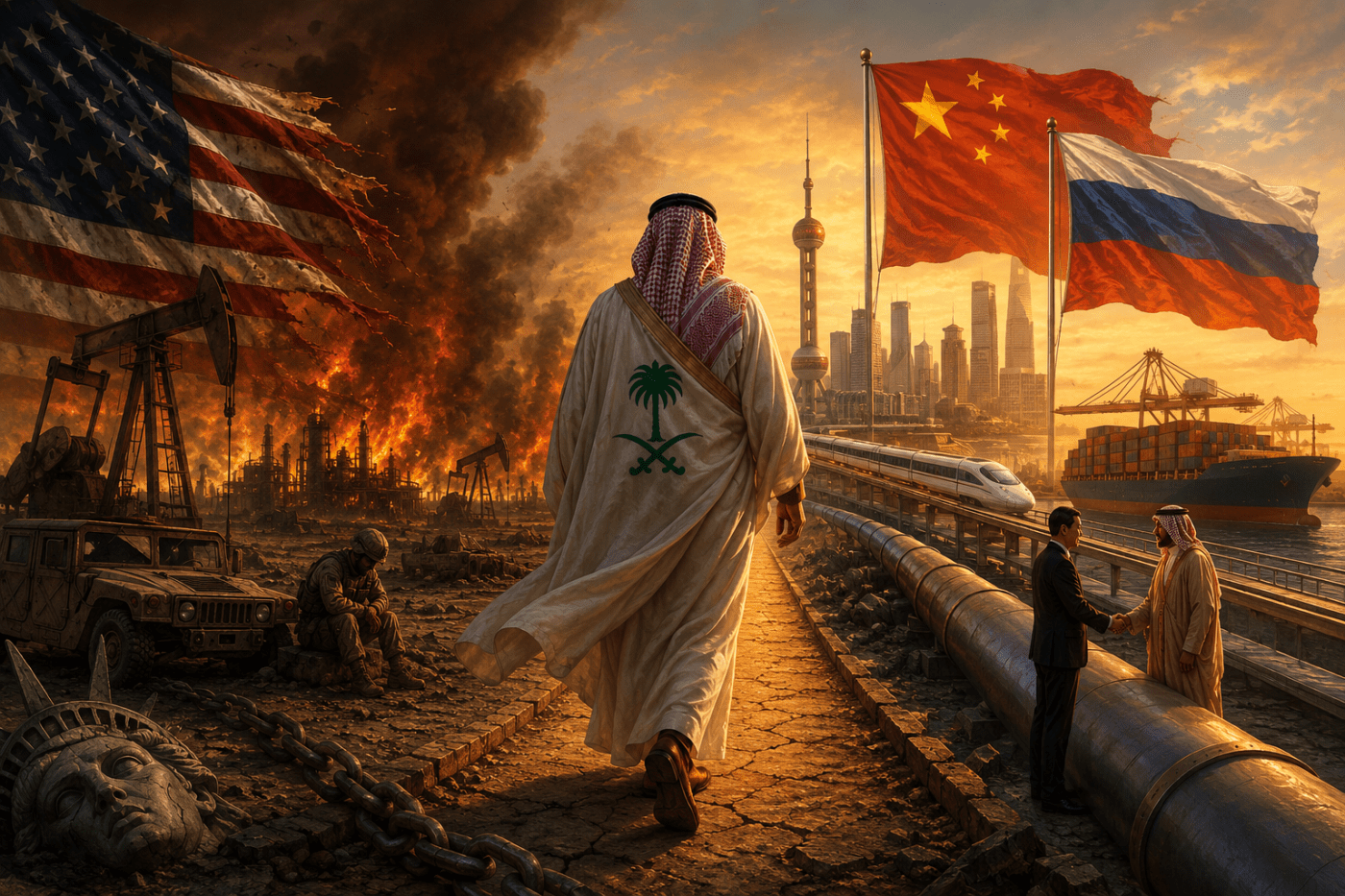
Oilprice.com turns Saudi Arabia’s China pivot into market drama while hiding the deeper failure of the U.S. security order. The facts show Riyadh deepening energy, industrial, and diplomatic ties with China because U.S. militarism has made the Gulf more vulnerable, not less. The real story is not Saudi liberation but imperial decay, as even Washington’s favored oil clients search for exits from a burning house. The task now is to organize against the war machine where it touches working people: budgets, ports, weapons contracts, universities, pension funds, and household costs.
By Prince Kapone | Weaponized Information | June 23, 2026
The Empire’s Security Blanket Has Holes in It
On June 23, 2026, Oilprice.com published Simon Watkins’s “Saudi Arabia’s Decided Who Its Future Superpower Partner Is, And It’s Not the US”, an energy-market dispatch dressed up as geopolitical prophecy. The article argues that Saudi Arabia, shaken by the aftermath of the Iran conflict and disappointed by the limits of U.S. protection, is now turning again toward China and Russia as its future strategic partners. It walks the reader through a familiar oil-market chronology: the 1945 U.S.-Saudi bargain of oil for security, the 2014–2016 oil price war, the rise of OPEC+, China’s patient courtship of Mohammed bin Salman, the Aramco IPO drama, and recent high-level China-Saudi energy meetings. On the surface, it reads like a clean report on shifting alliances. Beneath the surface, it is a confession that the old imperial machinery is sputtering, wrapped in the language of market analysis so nobody has to say the quiet part too loudly.
Oilprice.com is not a people’s tribunal, not a workers’ paper, not a dispatch from the oil fields where laborers sweat and soldiers bleed so traders can speculate. It is a market-facing energy outlet, a clearinghouse for oil prices, commodity analysis, investor signals, geopolitical risk, and the daily anxieties of capital trying to predict where the next profit stream might flow. Its audience is not the refinery worker coughing fumes, the Yemeni child under blockade, the Iranian family living under sanctions, or the Saudi migrant laborer building the glittering fantasy of Vision 2030. Its implied reader is the investor, the trader, the policy watcher, the oil executive, the professional class functionary trying to understand whether the pipelines are safe, whether the tankers will sail, whether the dollar will hold, and whether Washington still knows how to keep the empire’s gas station open.
Watkins’s own professional location matters here. He is presented by Oilprice as a former senior foreign-exchange trader and financial journalist, which helps explain the eye through which the world is being viewed. The central drama is not sovereignty, war, class power, sanctions, or imperial violence. The drama is currency, valuation, market credibility, supply security, and the movement of state power as a guarantee for capital. He sees the cracks in U.S. power, but through the tinted glass of the trading desk. He understands that something has shifted, but his framework still treats the region as a chessboard of states, firms, pipelines, and superpowers rather than as a living terrain of oppressed peoples, exploited workers, comprador elites, imperial armies, and histories of violence that do not fit neatly into a commodity-price chart.
The first device at work is narrative framing. The headline tells us that Saudi Arabia has “decided” who its future superpower partner is, and “it’s not the US.” This is good copy, but bad politics. It turns a contradictory process of hedging, maneuvering, dependency, fear, and recalibration into a clean geopolitical romance: Riyadh swipes left on Washington and right on Beijing. But states like Saudi Arabia do not simply fall in love with one superpower and ghost another. They bargain. They hedge. They sell oil to one bloc, buy weapons from another, coordinate production with a third, and pray that none of the bombs land too close to the infrastructure that keeps the ruling class rich. The headline gives us melodrama where the material reality is more vulgar and more interesting: a dependent monarchy trying to survive the decline of its principal protector without surrendering the privileges that protector helped secure.
The second device is card stacking. The article assembles a strong pile of evidence showing China’s deepening relationship with Saudi Arabia: energy cooperation, refinery investments, petrochemical deals, Belt and Road alignment, Vision 2030 compatibility, renminbi discussions, and Beijing’s support during the Aramco IPO episode. All of that matters. But the deck is stacked in a way that makes U.S. power appear mainly as a failed service provider. Washington promised security, sold the weapons, collected the money, and then proved unable to stop Iranian strikes on Saudi energy infrastructure. True enough. But this framing politely avoids the larger obscenity: U.S. power did not merely fail to protect the region from instability. U.S. power has been one of the central manufacturers of that instability. The empire sets the house on fire, sells smoke detectors, then wonders why the tenants start looking for other exits.
The third device is omission. The article discusses the limits of U.S. security guarantees after the Iran conflict, but it does not excavate the deeper structure of U.S.-Israeli war-making, sanctions, military encirclement, and regional coercion that made such a crisis inevitable. It treats the Saudi concern as a question of whether Washington can still protect its partners, not whether Washington’s whole regional order has turned its partners into targets. This is the kind of omission that does not announce itself as a lie. It simply narrows the room until only the empire’s preferred questions can breathe. Did the United States provide enough protection? Did China seize the opportunity? Will Saudi Arabia diversify its partnerships? Fine questions for the boardroom. But the people’s question is different: who built a world where the security of millions is subordinated to oil corridors, sanctions regimes, military bases, and the imperial policing of energy chokepoints?
The fourth device is source hierarchy. The speaking subjects in the article are states, executives, ministries, oil companies, investors, and financial markets. The people appear, if at all, as shadows behind the balance sheet. Aramco speaks. Sinopec speaks. Washington speaks through the ghost of its old security bargain. Riyadh speaks through ministerial meetings and strategic anxieties. But the working class of the region is silent. The migrant laborers who build the cities, the refinery workers who maintain the infrastructure, the Iranian civilians who endure sanctions and war threats, the Palestinians whose dispossession sits at the center of U.S. regional policy, the Gulf peoples whose lives are organized around monarchies armed to the teeth by Washington—they are absent. Capital gets dialogue. Labor gets background scenery.
The fifth device is false cause by extrapolation. The article takes recent China-Saudi meetings and the visible anger in Riyadh over U.S. security failures and stretches them toward a larger conclusion: Saudi Arabia has chosen its future superpower partner, and that partner is not America. But the evidence more carefully supports something less dramatic and more revealing. Saudi Arabia is not breaking cleanly with the United States. It is recalibrating because the old arrangement no longer guarantees what it once promised. It still wants U.S. arms. It still depends on U.S.-built military architecture. It still operates inside a dollar-centered world market. But it also needs Chinese demand, Russian coordination, alternative investment channels, and room to breathe in a multipolar environment. The shift is real, but it is not a divorce. It is a monarchy with two phones, three insurance policies, and a growing suspicion that the landlord in Washington may have lost control of the building.
The sixth device is fear, though it is the polished fear of the financial press rather than the frothing fear of cable news. The reader is invited to worry that the foundations of U.S. global dominance are weakening: the petrodollar, Gulf security dependence, Saudi loyalty, and the ability of Washington to command the world oil order. But what appears as danger to the investor appears differently to the peoples of the world. The weakening of U.S. monopoly power is not automatically liberation, and China’s rise does not by itself abolish exploitation, monarchy, oil dependency, or class rule. But the erosion of unipolar command does expose the fraud at the center of the old order. For decades, the United States called domination “stability,” sanctions “pressure,” military occupation “security,” and oil control “partnership.” Now the machinery is rattling, and even some of its favored clients are glancing toward the exits.
So this article is useful, but not because it tells the whole truth. It is useful because it reveals what the imperial market mind can no longer hide. The U.S. security blanket has holes in it. The Gulf monarchies know it. China knows it. Russia knows it. The oil traders know it. The only people still pretending otherwise are the priests of the old order, standing at the altar of American indispensability while the candles burn down and the roof leaks. What Oilprice calls Saudi Arabia choosing a new superpower is better understood as one symptom of imperial decay: a world once organized around U.S. command now being forced, by war, sanctions, resistance, and material necessity, to search for other arrangements. The task is not to applaud the Saudi ruling class for hedging its bets. The task is to read the panic in the market report and recover the truth buried underneath it.
The Oil Kingdom Learns the Price of the American Umbrella
The facts inside the Oilprice article matter because they are not invented from whole cloth. They are real enough to be dangerous. On June 11, 2026, Reuters reported that China’s National Energy Administration deputy administrator Song Hongkun met in Beijing with Saudi Aramco’s downstream president Mohammed Y. Al Qahtani, and that the two discussed global energy security as well as bilateral cooperation in oil and gas. That is not gossip from the bazaar. That is a state energy official from the world’s largest industrial economy sitting down with an executive from the world’s central oil firm while the Gulf burns around the shipping lanes. Oilprice is correct to identify the meeting as a signal, but the signal is not simply “Saudi Arabia chooses China.” It is that the material circuits of energy, refining, shipping, finance, and security are being reorganized under the pressure of war.
The China-Saudi energy relationship also did not fall from the sky last Tuesday, like a memo dropped by history’s laziest courier. In December 2022, the Saudi-Chinese joint statement described energy cooperation between the two countries as an “important strategic partnership”, praised Saudi oil resources and Chinese markets, and affirmed that developing oil cooperation served the common interests of both sides. That is the skeleton beneath the present flesh. Saudi Arabia has oil, China has industrial demand, and both have reasons to reduce the ability of Washington to dictate the terms of exchange. The same joint statement situated the relationship inside a broader architecture of trade, investment, energy, industry, transport, finance, technology, and development. This is why the article’s “future superpower partner” framing is too thin. China is not merely buying Saudi crude. It is helping knit Saudi energy into an Asian industrial future.
The numbers tell the same story in the cold language capital trusts most. In 2022, Reuters reported that China was Saudi Arabia’s largest trading partner, with bilateral trade worth $87.3 billion in 2021, while Saudi Arabia supplied a major share of China’s crude imports. By June 2024, the Saudi Press Agency reported that trade between Saudi Arabia and China had reached $48 billion through the first half of the year, while Saudi and Chinese officials used the High-Level Joint Committee to discuss trade, investment, logistics, infrastructure, and industrial cooperation. These are not decorative diplomatic flowers placed on the table for a photo opportunity. They are the pipes, ports, balance sheets, refineries, and policy committees through which a new oil geography is being assembled.
The Aramco-Sinopec relationship is one of the clearest examples of this deeper industrial logic. In 2022, Anadolu reported that Aramco and Sinopec signed a memorandum of understanding linking new Saudi projects to both the Belt and Road Initiative and Saudi Vision 2030. In April 2025, Reuters reported that Aramco and Sinopec agreed to expand the Yasref petrochemical complex, converting crude cooperation into downstream industrial integration. This matters because the crude barrel is no longer just a barrel. It is feedstock, refinery margin, petrochemical input, shipping route, employment plan, currency exposure, and state strategy. The Saudis are not simply asking who will protect the oil. They are asking who will help turn oil rent into industrial position before the old model rots beneath them.
Oilprice also correctly notes that Saudi confidence in the American security umbrella has been shaken, but here the article only circles the wound rather than opening it. In April 2026, Saudi Arabia’s own Energy Ministry said attacks on its energy infrastructure cut East-West Pipeline throughput by approximately 700,000 barrels per day, while damage to major facilities reduced production capacity and disrupted supply. Soon after, Reuters reported that Saudi Arabia restored the East-West Pipeline to its full 7 million barrel-per-day capacity after the attacks, confirming both the scale of the disruption and the strategic importance of that pipeline. The East-West Pipeline is supposed to be Saudi Arabia’s bypass around Hormuz, its Red Sea escape hatch, its insurance policy against the closure of the Gulf. But in the present war climate, even the bypass became a target. The spare tire caught fire too.
This is the first great omission in the Oilprice frame: the article treats Saudi frustration as disappointment in U.S. protection, but it does not sufficiently account for the way U.S.-Israeli war policy helped produce the danger from which Saudi Arabia now seeks protection. During the Iran crisis, Reuters reported that Saudi-flagged supertankers resumed passage through Hormuz only after a ceasefire agreement, while shipping disruptions exposed how quickly the artery of the world oil market could be squeezed. The issue is not simply that Washington failed to shield its client. The issue is that Washington’s regional order transforms every client, every port, every pipeline, every refinery, and every shipping lane into a possible front in its war system. The American umbrella does not merely leak. Sometimes it attracts the lightning.
The second omission is the continuing military dependence Saudi Arabia has not escaped. However much Riyadh courts Beijing, SIPRI reported in 2026 that the United States supplied 54 percent of Middle East arms imports in 2021–2025, with Saudi Arabia remaining one of the major arms importers in the region. The Gulf monarchies may talk diversification, autonomy, and new partners, but their arsenals still speak American English. The missile systems, aircraft, maintenance contracts, training regimes, and command habits of decades do not disappear because a delegation flies to Beijing. This is why the shift must be understood concretely. Saudi Arabia is not free from the U.S. security architecture. It is trapped inside it while trying to build exits from it.
The third omission is the material complementarity between Chinese industrial demand and Saudi oil strategy. In March 2025, the U.S. Energy Information Administration reported that China imported 11.1 million barrels per day of crude oil in 2024, and that Russia and Saudi Arabia were its top crude suppliers. This is not a sentimental relationship. China requires secure long-term energy inputs for its industrial machine, while Saudi Arabia requires reliable long-term demand as it attempts to finance diversification and maintain state stability. The old U.S.-Saudi bargain was oil for protection. The emerging China-Saudi bargain is oil for industrial integration, market access, infrastructure, and development partnership. That does not make it socialist. It makes it material.
The fourth omission is the sanctions architecture shaping these oil routes. In 2025, Columbia’s Center on Global Energy Policy reported that China’s crude imports included major sanctioned suppliers such as Russia, Iran, and Venezuela, showing how U.S. financial warfare has forced energy flows into alternative channels. Saudi Arabia is watching this world take shape. It sees that the U.S. dollar system can be used not only to settle trade but to punish states, seize reserves, blacklist firms, and discipline whole populations. So when Saudi officials entertain settlement alternatives, renminbi funding, Chinese investment platforms, and non-Western energy coordination, they are not engaging in abstract monetary curiosity. They are observing the weaponization of finance and making calculations accordingly.
The fifth omission is the regional diplomatic layer. China is not only a crude buyer. It has positioned itself as a diplomatic actor across the Gulf, including through the China-GCC track and the Saudi-Iranian thaw. In December 2025, China and Saudi Arabia pledged to strengthen coordination on regional and global matters, while China welcomed Saudi development under Vision 2030 and Saudi Arabia supported China’s hosting of future China-Arab and China-GCC summits. This is not the old colonial script in which Western powers bomb, lecture, sanction, and then host conferences about stability. Beijing is offering the language of development, coordination, infrastructure, sovereignty, and trade. Again, none of this abolishes class rule in Saudi Arabia. But it does create room for states to maneuver outside Washington’s preferred script.
The sixth omission is Vision 2030 itself as a domestic state priority. The Saudi ruling class knows that crude rent alone cannot carry the kingdom forever, especially in a world of price shocks, climate transition pressures, military vulnerability, and demographic change. KAPSARC’s review of China’s Belt and Road Initiative and Saudi Vision 2030 describes the relationship as one of expanding cooperation in trade, investment, energy, technology, and sustainability. That is the internal logic behind the external maneuver. Saudi Arabia wants to convert oil wealth into infrastructure, logistics, petrochemicals, manufacturing, digital systems, and geopolitical relevance beyond crude extraction. China’s offer fits that ambition better than a U.S. order that increasingly offers weapons, sanctions, volatility, and sermons from the same empire that armed half the region into dependency.
The larger context is therefore not a simple Saudi betrayal of Washington, and certainly not a sudden conversion to anti-imperialism. It is a long deterioration of the 1945 arrangement under the weight of new material realities. The United States once promised the Saudi monarchy protection in exchange for reliable oil alignment. But the world that made that bargain possible has changed. The United States is now a major oil and gas producer. China is the central growth market for Gulf crude. Russia is embedded in OPEC+ coordination. Sanctions have accelerated alternative trade routes. The Strait of Hormuz remains a chokepoint that can shake the planet. The East-West Pipeline can bypass Hormuz but cannot bypass war. And the U.S. military machine, which presents itself as the guarantor of order, increasingly appears as one of the principal sources of disorder.
This is also why Weaponized Information’s broader line on energy, China, and the crisis of U.S. domination matters here. In earlier work, WI has framed China’s search for diversified energy routes and partnerships as a response to U.S.-dominated chokepoints, sanctions pressure, and the New Cold War against China. The Saudi case fits that same terrain, though from a very different class and state position. Saudi Arabia is not China, not Iran, not Venezuela, not Cuba, and not a revolutionary state resisting blockade. It is a monarchy, a comprador pillar of the old regional order, and a landlord of oil rent. But even pillars crack when the building shifts. Even clients learn to count the cost of obedience when obedience no longer guarantees protection.
So the factual terrain beneath the Oilprice article is richer and more explosive than the article itself allows. Saudi Arabia is deepening energy and industrial cooperation with China. China is securing long-term crude and downstream integration. The U.S. remains militarily embedded in the Gulf but increasingly unable to guarantee the stability it advertises. Iran war conditions exposed the vulnerability of both Hormuz and the infrastructure meant to bypass Hormuz. Sanctions and financial coercion are pushing states to explore alternative settlement and partnership mechanisms. Vision 2030 gives Riyadh a domestic reason to look east. And the world oil order, once disciplined by U.S. military and dollar supremacy, is now being pulled apart by war, industrial demand, sanctions blowback, and the slow collapse of imperial confidence. That is the material map. Next, we must now say what this map means.
The Client Looks East Because the Master Brings Fire
The real story is not that Saudi Arabia has discovered China and misplaced America somewhere in the diplomatic couch cushions. The real story is that the old imperial bargain is rotting from the inside. For decades, Washington sold the Saudi monarchy a simple arrangement: keep the oil flowing through the circuits of dollar power, keep the region aligned with U.S. strategy, buy the weapons, host the architecture, and the empire will protect the throne. It was a gangster contract with diplomatic stationery. The kingdom supplied the crude, the United States supplied the guns, and together they called this arrangement stability, as if stability means anything when it rests on military bases, sanctions, palace politics, and the permanent threat of regional war.
But now the client is learning that the protector is also the arsonist. The United States did not merely fail to shield Saudi energy infrastructure from the consequences of war. It helped build the war system that made that infrastructure vulnerable. The imperial order in West Asia has always treated oil fields, ports, pipelines, refineries, sea lanes, and national treasuries as strategic objects to be commanded, punished, bypassed, insured, bombed, or defended depending on the needs of imperial power. In that order, security is never neutral. Security is the name given to whatever keeps the empire’s circuits open. When those circuits run smoothly, Washington calls it peace. When the people of the region resist, or when rival powers enter the terrain, Washington calls the same geography a crisis.
Saudi Arabia’s turn toward China must therefore be understood as imperial recalibration under pressure, not liberation. Riyadh is not joining the ranks of the oppressed. The Saudi ruling class is not suddenly marching with the workers of the world under a red banner stitched in the oil camps. This is a monarchy maneuvering inside a world system whose old center is weakening. It wants American weapons without total American discipline. It wants Chinese markets without surrendering royal prerogative. It wants Russian coordination inside OPEC+ without becoming subordinate to Moscow. It wants the profits of oil rent, the prestige of industrial modernization, the protection of military hardware, and the room to breathe in a world where U.S. command is no longer absolute. This is not anti-imperialist rupture. It is ruling-class hedging in the age of multipolarity.
Still, even ruling-class hedging can reveal the crisis of imperialism. The U.S.-Saudi relationship was one of the great pillars of the old petroleum empire. It taught the world that reactionary monarchy could be baptized as “moderate” if it sold oil in the correct currency, bought weapons from the correct manufacturers, and stood on the correct side of Washington’s regional wars. The empire never cared whether the Saudi state was democratic. It cared whether the oil flowed, the contracts cleared, the arms deals multiplied, and the political order remained useful. Washington’s human-rights sermons were always written in disappearing ink. The ink vanished every time a weapons contract appeared.
China enters this scene differently. It does not arrive as a missionary of liberal virtue with a sanctions list in one hand and a bomber in the other. It arrives as an industrial state seeking energy security, downstream integration, infrastructure corridors, technology agreements, and long-term commercial arrangements. This does not make China a charity organization, nor does it turn Saudi Arabia into a progressive state. But it changes the terms of engagement. Where Washington’s regional grammar has been militarized command, Beijing’s grammar is development, investment, logistics, refining, petrochemicals, and energy supply. In a world where the United States increasingly offers disorder dressed as protection, that difference matters.
The contradiction is sharp because Saudi Arabia sits at the crossing point of oil rent, U.S. militarism, Asian industrial demand, and the decline of unipolarity. The monarchy owes much of its modern strategic position to the U.S. security system, but that same system now threatens the kingdom’s infrastructure by keeping the region in a state of permanent combustion. The East-West Pipeline was supposed to be an escape from Hormuz. But no pipeline escapes a regional order built on war. A bypass route is still a target when the whole map has been militarized. The kingdom can build alternate corridors, expand refining partnerships, deepen trade with China, and coordinate production with Russia, but it cannot escape the fact that the oil order itself was built as a weaponized infrastructure of imperial control.
This is why the financial press reads the moment with anxiety. It sees cracks in dollar power, cracks in U.S. credibility, cracks in the idea that every major oil monarchy must remain politically enclosed by Washington. It sees Saudi Arabia considering alternative settlement, long-term Chinese demand, industrial cooperation, and a post-unipolar energy map. For capital, this appears as volatility. For empire, it appears as disobedience. For the peoples of the world, it appears as evidence that the old command structure is weakening. But we must be precise: weakening U.S. command does not automatically produce emancipation. Multipolarity creates space. It does not automatically create justice. A multipolar world can open breathing room for oppressed nations, but only organized peoples can turn breathing room into freedom.
The Saudi case therefore gives us no reason to romanticize the kingdom. The Saudi ruling class is not the protagonist of history. It is a class formation trying to preserve itself under changing conditions. It seeks development without democracy, diversification without popular power, sovereignty without social revolution, and strategic autonomy without the liberation of labor. Its eastward turn is not an act of solidarity with Iran, Palestine, Yemen, or the workers who make the kingdom run. It is a maneuver by a ruling bloc that senses the American shield has become unreliable and that Chinese industrial gravity now pulls harder than Washington’s lectures.
But this maneuver still matters because it exposes the lie at the heart of U.S. power. The empire presents itself as the guarantor of order, but everywhere it goes the region becomes an armed warehouse. It presents itself as the guardian of trade, but it weaponizes currency, sanctions, and sea lanes. It presents itself as the defender of partners, but its partners are dragged into the blast radius of its wars. It presents itself as indispensable, but the very states once built into its system now search for alternatives. Nothing is more embarrassing for a master than watching the servant quietly compare insurance plans.
Oilprice sees Saudi Arabia selecting a future superpower partner. We see something deeper: the fragmentation of a world order built around U.S. command of energy, finance, and force. The Gulf is no longer merely a pump station guarded by the Pentagon. It is becoming a contested terrain where Asian demand, Russian coordination, Chinese industrial planning, U.S. military overreach, regional resistance, and ruling-class survival strategies collide. The old arrangement was never peace. It was armed extraction with a diplomatic smile. Now the smile is cracking, and through the crack we can see the machinery.
For the global working class and oppressed nations, the lesson is not to cheer the Saudi monarchy because it shakes hands with China. The lesson is to understand how imperial decay changes the terrain of struggle. The weakening of unipolar power gives peoples more room to fight, states more room to refuse, and movements more room to expose the blackmail hidden beneath the word “security.” But room is not victory. Space is not socialism. A world with more poles can still crush workers if those workers remain disorganized. A world less dominated by Washington can still be ruled by landlords, monarchs, billionaires, generals, and oil executives if the people do not enter history as an organized force.
So we read the Saudi-China turn neither as apocalypse nor salvation. We read it as evidence. The imperial order is decaying. Its clients know it. Its enemies know it. Its markets know it. Its own analysts are writing obituaries in the language of energy security and crude flows. The task of revolutionary analysis is to translate that market anxiety into political clarity. The empire promised protection and delivered vulnerability. It promised stability and delivered militarized chaos. It promised partnership and delivered dependency. Now even the oil monarchs are looking east because the master keeps bringing fire to the neighborhood and calling himself the fire department.
Break the War Machine Where It Touches the Working Class
The task now is not to sit in the cheap seats of history and cheer because one oil monarchy is learning that the American umbrella comes with holes, invoices, and bloodstains. Saudi Arabia’s recalibration toward China tells us something about the decay of U.S. command, but it does not absolve the Saudi ruling class, sanctify oil capital, or liberate a single worker by itself. The people’s task is to turn this crack in imperial confidence into organized pressure against the war system that made the crack visible in the first place. If the U.S.-Israeli war drive against Iran can shake Hormuz, raise fuel costs, threaten Gulf infrastructure, and expose millions to regional fire, then our answer must be to organize against the war machine not only in slogans, but where it lives: in budgets, ports, weapons contracts, universities, public pension funds, media narratives, and congressional votes.
One immediate lane is the veteran antiwar front. Veterans For Peace describes itself as a global organization of military veterans and allies working to abolish war as an instrument of national policy, and its public financial reports and Form 990 filings give organizers a verified structure through which to connect antiwar education with people who know, from inside the belly of the beast, what U.S. militarism actually does. Their role is especially useful in this fight because the empire hides behind the bodies of soldiers even while feeding them into wars for oil routes, arms profits, and geopolitical discipline. Veterans can speak directly to working-class communities that have been told war is patriotism, when in fact war is a transfer program from the poor to the generals, contractors, creditors, and energy speculators.
Another lane is divestment from the war economy. World BEYOND War’s divestment campaign targets public funds, universities, municipalities, and institutions invested in weapons manufacturers, while the organization states that it is supported by individual donors and does not accept government funding. This gives us a concrete tactic: follow the money from city budgets, pension funds, campus endowments, and nonprofit investment portfolios into the corporations that profit when West Asia is turned into a missile range. Every school board, city council, labor pension meeting, and university investment committee becomes a site of struggle. We do not need to wait for the empire to have a moral awakening. We can make the war economy politically expensive at home.
A third lane is war tax resistance and refusal of consent. the National War Tax Resistance Coordinating Committee has already framed tax resistance as a response to the Iran war, and War Resisters League’s nonprofit filings are publicly available through ProPublica. This does not mean every reader must take the same legal risk, and nobody should romanticize sacrifice for its own sake. But the principle is powerful: the empire’s bombs are not abstract. They are purchased through taxes, debt, and austerity. The same state that tells workers there is no money for rent relief, hospitals, schools, transit, or clean water always finds money when the generals ring the bell. War tax resistance, public education around military spending, and local budget campaigns help expose the obscene arithmetic of empire.
A fourth lane is organizing at the level of infrastructure. The war machine does not float in the heavens like a bad idea with wings. It moves through ports, airports, rail lines, warehouses, shipping firms, fuel contracts, and logistics corridors. The Oakland People’s Arms Embargo campaign offers a concrete model for local organizing against the movement of weapons through municipal infrastructure. That model can be studied, adapted, and applied wherever military cargo, weapons contractors, and logistics firms touch local life. Workers and communities can map which companies move military goods, which public agencies contract with them, which elected officials protect them, and which unions, tenants, students, faith communities, and neighborhood groups can be brought into a campaign to shut down complicity.
A fifth lane is the congressional front, not because Congress will save us, but because empire must be forced to defend itself in public. More than 250 organizations have already opposed additional spending for Trump’s illegal Iran war, and this provides a ready-made pressure point for readers who can call, email, confront, and publicly expose representatives backing war appropriations. The demand should be simple enough for every worker to understand: no supplemental funding for war on Iran, no blank checks for Israel, no public money for regional escalation, no austerity at home to finance fire abroad. Every representative who votes for this machinery should be named, posted, confronted, and made to answer in the language they fear most: votes, money, shame, and organized people.
Finally, we must connect the faraway war to the nearby bill. The empire survives by making foreign policy look foreign, as if bombs dropped abroad do not return home as rent hikes, fuel spikes, budget cuts, racist policing, debt, and despair. But the connection is already measurable. Brown University’s Costs of War project found that the Iran war produced tens of billions in additional fuel costs and hundreds of dollars in added household burdens. That fact must be turned into agitation. Every teach-in, flyer, short video, sermon, union resolution, classroom discussion, and social media post should make the point plainly: they bomb abroad, and we pay at home. They militarize Hormuz, and our gas tanks feel it. They arm monarchies and apartheid states, and our hospitals close. They call it national security, but the nation they secure is capital.
So the call is clear. Stand with the peoples of Iran, Palestine, Yemen, and the whole region against U.S.-Israeli war, sanctions, and militarized energy domination. Do not mistake Saudi recalibration for liberation, but do not miss what it reveals: even the empire’s favored clients are looking for exits from a burning house. Our job is not to help the landlords find a safer mansion. Our job is to organize the tenants, expose the arsonists, cut the public money feeding the fire, and build a movement that makes imperial war impossible to wage quietly. The old oil order is cracking. Let the working class put its shoulder into the crack.


Leave a comment