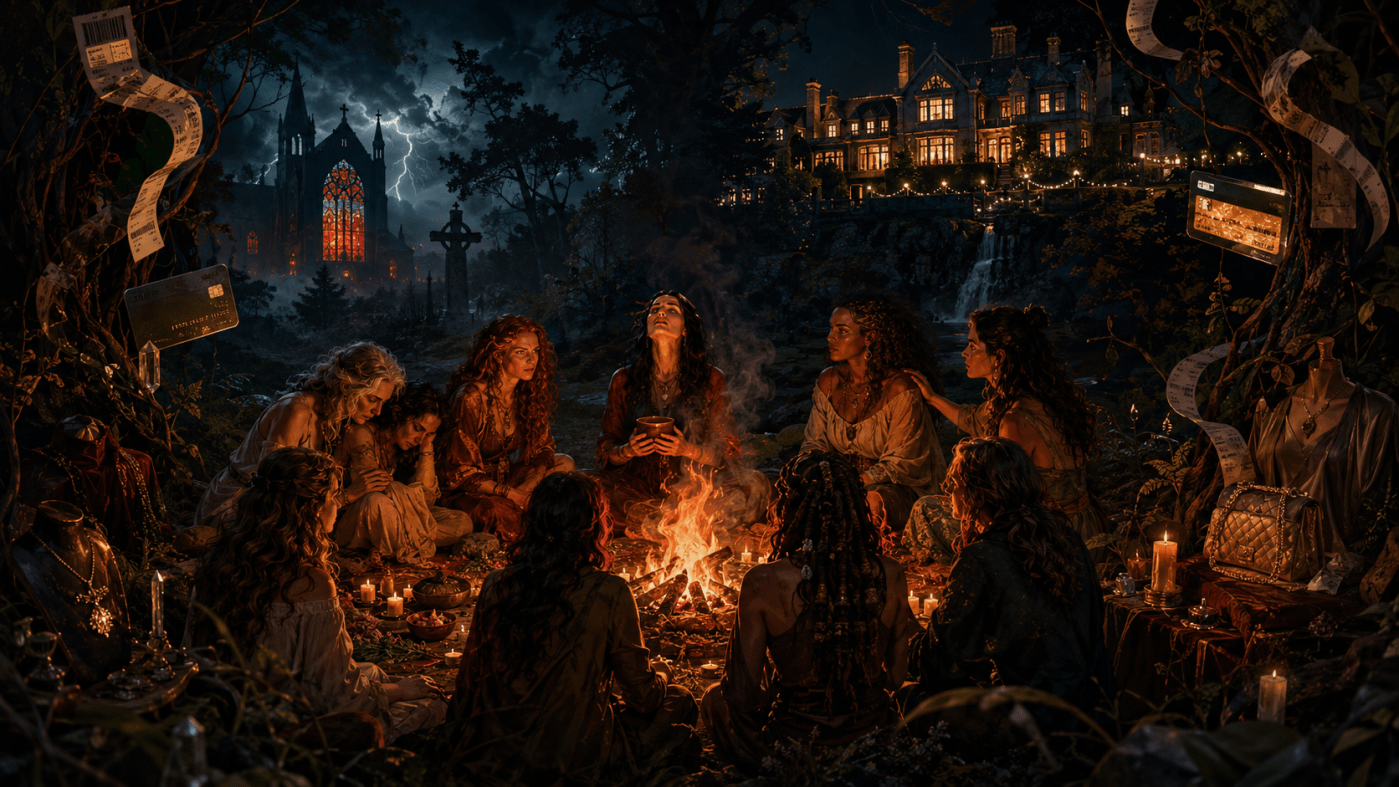
The Guardian wants us to see women escaping man and church through witchcraft retreats in the Irish woods, and there is truth in the wound it describes. But beneath the candles, pendulums, forest rituals, and “sisterhood” is a harder political reality: capitalism has broken communal life apart and now sells temporary imitations of it back to the lonely, grieving, and spiritually dispossessed. The witch was once punished because she represented unsanctioned knowledge, female defiance, communal care, and life outside patriarchal command; today, the same ruling order turns her into a wellness category with a price tier. The task is not to mock women seeking refuge, but to turn the circle outward — from commodified healing into organized anti-colonial, abolitionist, feminist, and working-class struggle.
By Prince Kapone | Weaponized Information | June 10, 2026
The Coven Comes With a Price Tag
Lauren Abunassar’s Guardian feature, “‘Demonized, called hysterical’: the rise of witchcraft retreats where US women go to defy man and church,” published on June 10, 2026, takes the reader into a sold-out witchcraft retreat in Ireland, where mostly American women gather in the woods to practice divination, make candles, commune with spirits, mourn their dead, name their anger, and briefly form what the article calls a coven of “sisterhood.” The scene is tender, wounded, and strange in the way capitalist modernity often is: a room full of women trying to recover something real from a world that has robbed them of it, while the bill for the recovery is quietly placed on the table.
The Guardian is not a crude tabloid operation screaming about Satanic panic. It is more refined than that, which often makes its ideological work more effective. Owned by Guardian Media Group, whose sole shareholder is the Scott Trust, the outlet presents itself as structurally protected from ordinary shareholder domination and dependent in large part on reader revenue. That arrangement gives it a certain liberal prestige. It allows the paper to speak in the idiom of independence, compassion, and moral seriousness. But liberal journalism is still journalism inside a capitalist media system. It still arranges reality for an audience. It still turns social pain into consumable narrative. It still knows how to make a wound beautiful enough to read over morning coffee.
Abunassar writes with the craft of the literary feature writer. She lingers on the light in the room, the clothes, the pendulums, the forest, the women weeping together, the bonfire at night. Her class and professional location is not that of the organizer, the shop steward, the tenant captain, the revolutionary educator, or the woman trying to stretch a paycheck through rent, groceries, and childcare. It is the location of the cultural observer, the one who enters the scene, collects voices, arranges atmosphere, and translates contradiction into story. The result is sympathetic, even moving in places, but sympathy is not the same thing as excavation. A velvet glove can still carry the assumptions of the class that wears it.
The central device of the article is narrative framing. The Guardian frames the rise of witchcraft retreats as a story of women leaving behind male-dominated religion, patriarchal judgment, and spiritual isolation in order to rediscover intuition, ritual, anger, and community. There is truth in that frame, but it is a narrowed truth. The article sees women reaching for a sacred alternative, but it does not yet ask why community has become so scarce that it must be purchased in a two-and-a-half-day package. It sees women finding permission to say, “I am so angry,” but does not ask what kind of society makes anger unspeakable until it is ritualized under professional guidance in an Irish estate.
The piece also leans heavily on appeal to emotion. We hear of rape, suicide, dead parents, stalking, grief, loneliness, religious rupture, and women crying together in a room that finally allows them to speak. These stories should not be mocked. They are the testimony of real wounds. But the article uses them as emotional proof of the retreat’s significance while leaving the machinery that produced those wounds largely outside the frame. Pain enters as biography, not as social evidence. Grief becomes atmosphere, not indictment. The reader is invited to feel deeply, but not yet to think dangerously.
There is also a plain-folks device at work. These are not presented as occult aristocrats or elite mystics. They are bartenders, interior designers, mothers, grandmothers, women in Columbia fleeces and Adidas sneakers. This makes the retreat feel democratic, approachable, almost ordinary. But the article itself tells us that these retreats cost thousands. The common woman appears in the prose, while the uncommon price tag sits nearby like a little bourgeois demon pretending not to be seen. “Sisterhood,” it turns out, may be universal in language but selective in admission.
Then come the glittering generalities: “inner wisdom,” “healing,” “sisterhood,” “community,” “sacred,” “nature,” “transformation.” These words glow warmly in the article. They do real ideological labor because they name desires without naming the social relations that frustrate them. Who stole the time for community? Who privatized care? Who made women’s anger pathological? Who turned the need for belonging into a market segment? The article circles these questions but does not seize them by the throat.
Finally, there is omission. Not the omission of empathy, but the omission of political economy. The article notices commercialization, even lets a critic call the retreat format a “glorified meditation retreat,” but it does not make commodification the organizing problem. Instead, the market appears as a complication around the edges of an otherwise sincere spiritual search. But the market is not around the edges. It is in the room. It is in the ticket price, the branding, the Instagram following, the retreat itinerary, the conversion of grief into experience, and the transformation of a coven into a purchasable container for alienation.
This is the soft genius of the piece. It does not demonize the women. It does not sneer at their rituals. It does something more useful for liberal capitalism: it honors their pain while keeping their anger safely inside the circle. The women gather around the fire, burn what they wish to release, and return home the next morning to the same world that wounded them. The Guardian gives us the beautiful photograph of that fire. Our task is to ask who built the cold house they are trying to escape.
The Wounds Are Not Imaginary, and Neither Is the Market
The Guardian article gives us enough facts to know that this is not a fringe curiosity, not a few eccentric women playing at moonlight theater. The retreat at the center of the piece, Green Veil, is described as a sold-out witchcraft retreat in Ireland where Isabella Ferrari teaches women divination, candle-making, spellcraft, somatic healing, and grief ritual over two and a half days. Its participants are not presented as one narrow subculture. They include American women from different regions, ages, jobs, and religious backgrounds, many of them raised inside Catholic, Pentecostal, evangelical, or non-denominational Christian worlds before moving toward witchcraft, paganism, or spiritual practices outside the church. The article reports that over half of the Ireland cohort came from the United States, and that the retreat became so popular that the April dates sold out, more dates were added, and those sold out too. This is not nothing. People do not cross the Atlantic, rearrange their lives, and gather in a forest because they are merely bored.
But the facts also tell us something the soft glow of the article tries not to emphasize too loudly. The admission price for this temporary coven ran from €1,900 to €3,000. A similar retreat circuit appears in the United States, where the article notes that Ashley Clauré hosts witchcraft retreats in Savannah and Salem with prices ranging from $2,700 to $5,200. The women are seeking community, safety, ritual, and a place to speak their anger. The market is there with a booking page. This does not mean the women are foolish or the pain is fake. It means the form in which the pain is being held is already shaped by the price of admission.
The Irish setting also has a material religious background that the article touches but does not fully ground. Ireland is not a blank mystical canvas for American women seeking the forest. It is a country still marked by the long institutional weight of Catholicism, even as formal religious authority has weakened. Ireland’s 2022 census found that Roman Catholics remained the largest religious category, while the number reporting no religion continued to rise. The retreat takes place in that space between a still-powerful religious inheritance and a population increasingly moving away from old forms of institutional belonging. Even the article’s reference to Petronilla de Meath is not just poetic scenery. Kilkenny Heritage records that the Kilkenny witch trial of 1324 led to the torture and burning of Petronilla de Meath, a concrete historical memory of church authority, accusation, punishment, and the policing of women’s bodies and knowledge.
The American side of the story has its own measurable terrain. The article says that more than 30% of Americans now identify as spiritual but not religious, but the most precise recent Pew data is more specific: in 2023, 70% of U.S. adults described themselves as spiritual in some way, while 22% were categorized as spiritual but not religious. Pew’s later Religious Landscape Study found that 62% of U.S. adults identified as Christian in 2023–24, down from 78% in 2007, while belief in spiritual realities remains common. In other words, the American population has not simply become coldly secular. Millions are leaving or loosening their ties to churches while retaining hunger for ritual, meaning, soul, spirit, ancestors, nature, and some vocabulary for the unseen. The retreat industry did not invent that hunger. It found a way to package it.
That shift is especially important among younger women. The American Survey Center reports that among Gen Z adults who left their formative religion, 54% were women, reversing older patterns in which men were more likely to disaffiliate. The Guardian gives us individual stories of women leaving Catholic or Pentecostal households after trauma, judgment, or spiritual suffocation. The wider data shows that these stories are not isolated. They belong to a larger movement away from male-dominated religious authority, especially among younger women who do not see churches defending their dignity, autonomy, or safety.
The article’s stories of rape, stalking, suicide, grief, and fear also sit inside a documented landscape of gendered violence. The National Sexual Violence Resource Center reports that 81% of women and 43% of men in the United States have experienced some form of sexual harassment and/or assault in their lifetime. The CDC reports that sexual violence often begins early, with many female survivors first experiencing rape before age 25. These figures do not explain every woman at the retreat, but they do establish that the article’s testimonies are not atmospheric decoration. They are part of a society-wide pattern of harm. When women gather in a room and chant “I am so angry,” that anger does not fall from the moon. It comes from somewhere.
The broader political context sharpens this point further. In 2022, the U.S. Supreme Court’s Dobbs decision removed federal constitutional protection for abortion. Guttmacher’s current state policy tracker reports that 13 states have total abortion bans and 28 states have abortion bans based on gestational duration. The Guardian article quotes scholars and participants who speak of women and queer people losing power, of patriarchal society punishing women, of a world “run by men.” Those comments are not floating opinions. They exist in a country where state legislatures, courts, governors, police, prosecutors, hospitals, and religious-right organizations have turned reproduction itself into a legal battlefield.
There is also the money question, which is not secondary. The Global Wellness Institute reports that the global wellness economy reached $6.8 trillion in 2024. McKinsey describes wellness as a $2 trillion global consumer market increasingly driven by millennials and Gen Z, with younger consumers turning wellness into a daily personalized practice. This is the world in which witchcraft retreats now circulate: not outside capitalism, but inside one of its fastest-growing emotional marketplaces. The product may look like a candle, a spell, a forest ritual, a tea reading, or a circle of women whispering to trees. But the commodity form remains very much alive, tapping its little wand on the cash register.
Platform capitalism has already learned how to manage this market. Etsy’s services policy states that services are generally not allowed unless they produce a new tangible item, while its rules permit certain readings or spiritual goods only when attached to an allowable product and not sold as guaranteed supernatural outcomes. The Guardian previously reported that Etsy moved against “metaphysical services,” while still permitting items such as tarot readings and astrological charts when they did not promise physical changes or outcomes. This shows the line clearly. The market will sell the atmosphere of magic, the aesthetic of rebellion, the feeling of spiritual control, and the digital artifact of divination. It will not tolerate claims that threaten consumer-protection rules, platform liability, or the smooth management of the storefront.
The historical-political meaning of the witch image is also older than the current wellness boom. In 1968, the Women’s International Terrorist Conspiracy from Hell, known as WITCH, emerged as a feminist formation that used occult imagery and theatrical protest against Wall Street, banks, consumerism, and corporate power; Teen Vogue’s historical account notes that WITCH’s first New York action targeted Wall Street as the epicenter of corporate America’s persecution of women. That history matters because it shows that “witch” politics has not always meant retreat consumption. It has also meant public confrontation, anti-capitalist theater, and direct symbolic attack on the institutions of money power.
This is where the continuity with prior Weaponized Information work becomes unavoidable. WI’s essay “Capital vs. the Commons: The War on Women, Land, and the World Proletariat” already placed the witch-hunt inside the longer history of enclosure, women’s reproductive labor, communal knowledge, land loss, and capitalist reorganization. That framework helps explain why the Guardian article feels both moving and incomplete. The women are not inventing their wounds. The retreats are not inventing their desire for collective life. But the article leaves the deepest contradiction only half-spoken: the very society that destroyed so many forms of communal care now sells brief imitations of community as healing experiences for those who can afford the door.
What Capital Burns, It Later Sells Back as Healing
The Guardian wants us to see women in the forest, and we should see them. We should see their grief, their anger, their longing for one another, their exhausted flight from churches that disciplined them, from homes that failed to protect them, from workplaces and health systems and schools and courts and states that have offered them so many rules and so little care. But the story does not end in the forest. The forest is only where the contradiction becomes visible.
These women are not gathering because they suddenly became irrational. They are gathering because rational society has become intolerable. They are not reaching for ritual because they lack intelligence. They are reaching for ritual because the official institutions of meaning have lost moral authority. They are not chanting “I am so angry” because anger has become fashionable. They are chanting it because the civilization that calls itself modern has trained women to swallow rage until it becomes illness, shame, silence, obedience, or private collapse.
The real story is not witchcraft as eccentric lifestyle. The real story is social reproduction in crisis. The institutions that claim to organize care, meaning, safety, education, family, health, and spiritual life have produced a mass hunger for refuge outside their walls. The church says obey. The market says buy. The state says comply. The employer says return Monday. The platform says subscribe. And when women finally say they are angry, the system replies: excellent, there is a retreat package for that.
This is the little capitalist miracle hidden under the incense. First, communal life is broken apart. Then loneliness is privatized. Then healing is individualized. Then community returns as a commodity. The old commons is destroyed, and in its place appears the boutique imitation: the paid circle, the curated ritual, the branded sanctuary, the spiritual experience designed for temporary relief rather than durable collective power. Capitalism is a thief with excellent marketing instincts. It steals the village and sells the weekend.
The women’s desire for a coven is therefore not foolish. It is politically revealing. A coven, at its most basic, is a form of collective life: women gathered outside patriarchal supervision, sharing knowledge, naming danger, mourning the dead, protecting one another, and refusing to let official society define the limits of the possible. That desire is not the problem. The problem is that the desire has been routed through the commodity form. Sisterhood appears, but with an invoice. Healing appears, but with a price tier. Sacred space appears, but on a schedule. What should belong to the people returns to them as an experience they must purchase before checkout closes.
The witch is powerful because she is not merely a religious figure. She is a political memory. She carries the memory of women punished for knowledge outside sanctioned authority, women feared because they healed, gathered, inherited, remembered, and refused. She stands at the crossroads of gender, land, labor, body, and belief. In her figure we find the long war over who may know, who may heal, who may speak, who may own the body, who may define the sacred, and who may organize life beyond the command of priest, husband, boss, landlord, judge, and state.
But capital is never ashamed of contradiction. It will sell rebellion in a gift box. It will put the witch on television, place the pentagram on a necklace, turn the spell into a service, the ritual into a booking, the forest into an amenity, and the old wound into a market niche. Yesterday the witch was a threat to order. Today she is a wellness category. Yesterday she was accused of corrupting society. Today she is invited to build a personal brand. Yesterday she was burned. Today she is monetized. Progress, as the bourgeoisie understands it, is the right to profit from what one’s ancestors once tried to destroy.
This is why the article is emotionally honest but politically incomplete. It allows the women to be wounded, but not dangerous. It permits anger, but keeps it inside the ritual circle. It dignifies spiritual searching, but does not follow that search into the social relations that made so many people spiritually homeless. It notices that women are tired of male domination, religious hierarchy, sexual violence, and the suffocation of judgment. But it stops before the harder conclusion: these are not merely cultural injuries. They are organized features of class society.
Patriarchy is not a bad attitude floating in the air. It is a system of power reproduced through households, churches, courts, clinics, workplaces, media, schools, and the state. Capitalism does not simply coexist with this system; it feeds on it. It feeds on unpaid and underpaid care. It feeds on women’s fear. It feeds on the privatization of trauma. It feeds on the isolation of mothers, survivors, workers, and daughters. It feeds on the conversion of every human need into a commodity. Even the need to be heard becomes a billable event.
The women in the article are searching for what the capitalist order cannot provide without ceasing to be itself: community that is not a market, care that is not a transaction, spirituality that is not obedience, safety that is not surveillance, healing that is not self-optimization, and anger that does not dissolve into lifestyle. Their search is real because the loss is real. The wound is not imaginary. But the wound cannot be cured by the same social order that profits from keeping it open.
Here the liberal feature performs its delicate service. It gives the reader the moving image of women weeping together and leaving no one to walk back alone. That image matters. It contains a truth about what human beings need. But liberal media likes the image better than the implication. It likes solidarity as atmosphere, not as structure. It likes sisterhood as feeling, not as power. It likes rebellion as aesthetic, not as organized rupture. It will photograph the fire, describe the tears, and quote the anger, but it will not hand the reader a map to the system that made the fire necessary.
The revolutionary task is to rescue the truth buried inside the spectacle. The truth is not that magic will save women from capitalism. The truth is that women are already naming, in spiritual language, the collapse of the social world around them. Their rituals express a hunger for the commons. Their anger expresses a knowledge of domination. Their grief expresses the failure of institutions that promised care and delivered discipline. Their longing for sisterhood expresses the need for collective forms of life beyond the market.
The problem is not that women seek healing in the woods. The problem is that society has made the woods more trustworthy than its churches, courts, hospitals, workplaces, and homes. The problem is not that women speak to the dead. The problem is that the living order refuses to hear them until their pain can be packaged. The problem is not that women call themselves witches. The problem is that every form of female defiance, communal care, and unsanctioned knowledge is either punished when it threatens power or commodified when it can be made profitable.
So we should not sneer at the coven. We should understand what the coven is trying, in distorted form, to recover. It is trying to recover the commons after enclosure, the circle after atomization, the voice after silencing, the body after discipline, the sacred after hierarchy, and the human after the market has itemized the soul. But no weekend retreat, however moving, can substitute for the reconstruction of collective life. No candle can burn away a class relation. No spell can exorcise a landlord. No pendulum can vote down a court. No forest ritual can abolish the system that sends women back to the very world they briefly escaped.
The fire in the Guardian article is therefore not the end of the story. It is the beginning of the question. Will women’s anger be kept inside the marketplace of healing, where every wound becomes a product and every longing becomes a brand? Or will that anger move outward, toward the structures that produced the wound in the first place? The ruling order is prepared for the first option. It has websites, retreats, payment plans, and beautiful photographs ready. It is terrified of the second. Because when the coven stops being a commodity and becomes collective power, the witch is no longer a lifestyle. She is a threat again.
Turn the Circle Outward
The answer to commodified sisterhood is not to mock the women who seek refuge in it. The answer is to move the circle outward, from retreat consumption into organized struggle. If the wound is collective, the response must also be collective. If women are being driven into forests, workshops, rituals, and temporary sanctuaries because the ordinary institutions of capitalist society have failed them, then our task is not to sneer at the candle. Our task is to build the kind of power that makes the candle unnecessary as a substitute for justice.
That work already exists. It begins, first, with the Indigenous nations and communities whose bodies, lands, waters, and knowledge systems have been attacked by the same colonial order that now sells “sacred” aesthetics back to alienated consumers. Sovereign Bodies Institute describes itself as a home for generating knowledge about how Indigenous nations and communities are impacted by gender and sexual violence, and it explicitly grounds that work in the sovereignty of Indigenous bodies, nations, land, and water. This is not boutique healing. This is data, memory, protection, and Indigenous accountability against the violence that settler society tries to bury. Just as importantly, Sovereign Bodies Institute states that it does not accept grants from colonial governments or extractive industries. That matters. A struggle against colonial and gendered violence cannot be politically subordinated to the very governments and industries that help produce the violence.
The same principle appears in the abolitionist survivor-defense work of Survived & Punished, a national coalition organizing against the criminalization of survivors of domestic and sexual violence. Where liberal society tells survivors to seek individual healing while the state cages those who defend themselves, Survived & Punished confronts the carceral machinery directly. Its public action center calls people to support criminalized survivors through letter-writing, defense funds, and commutation campaigns. This is the opposite direction from retreat capitalism. The survivor is not turned into a customer. The survivor is defended as part of a collective struggle against policing, prisons, and gendered violence.
For the transnational feminist line, AF3IRM identifies itself as a grassroots, all-volunteer organization of women engaged in transnational feminist, anti-imperialist organizing. This is crucial because the violence exposed by the Guardian article cannot be confined to the private household, the church pew, or the therapy room. Patriarchy is tied to migration, war, labor exploitation, colonial dependency, militarism, and the global traffic in women’s bodies and labor. That is the correct terrain: not spiritual individualism, but organized feminist anti-imperialism.
The African National Women’s Organization states that it supports African women’s leadership through political action campaigns and administrative support for actions and events. Its own donation materials say that ANWO is completely self-funded and mostly run by volunteer members, while movement reporting notes that membership dues and individual donations sustain its organizing and public campaigns. That is not a minor administrative detail. Funding is political. The women of the oppressed nation cannot build liberation on the payroll of the same ruling order that profits from their containment, surveillance, and superexploitation.
The tactical direction is therefore clear. Weaponized Information readers should not simply “support women” in the abstract. We should build study circles on the political economy of the witch-hunt, gendered violence, social reproduction, religious authority, and the wellness industry. We should circulate and discuss survivor-defense campaigns. We should donate to verified grassroots formations when possible, join their public actions where geographically and politically appropriate, and help move people from individual healing language into collective anti-capitalist, anti-colonial, and abolitionist practice. We should treat every glossy story about commodified healing as an opening for political education: who created the wound, who sells the balm, and who is already organizing so that women do not have to buy a weekend substitute for a world that belongs to them?
The women in the Guardian article end the night by refusing to let anyone walk back alone. That small gesture contains the seed of a larger politics. No one walks back alone from violence. No one walks back alone from church discipline. No one walks back alone from prison. No one walks back alone from the reservation, the barrio, the colony, the shelter, the clinic, the workplace, or the grief that capitalism has privatized. The task is to make that promise material. Not a retreat. Not a brand. Not a spiritual commodity. A movement.


Leave a Reply