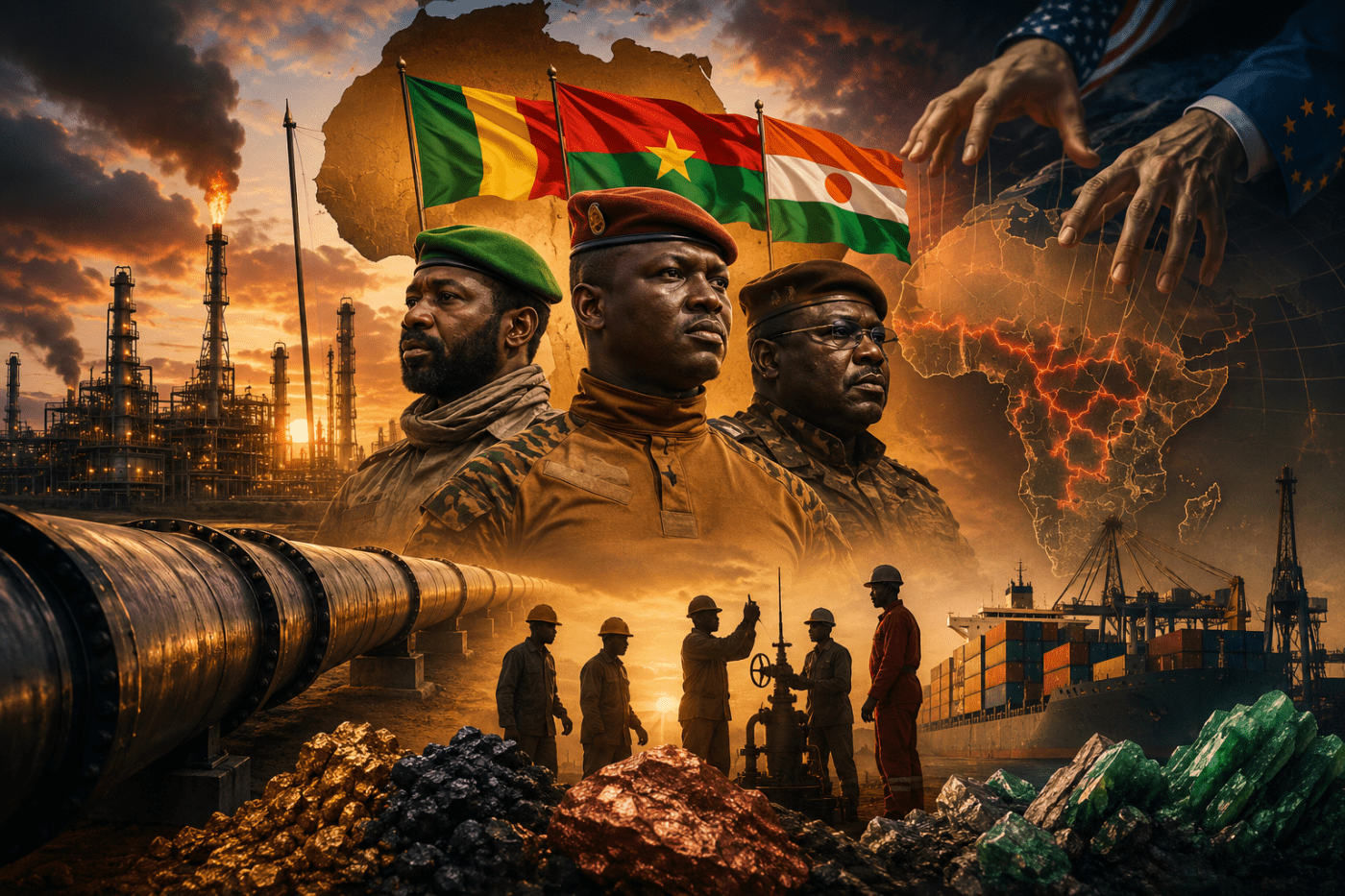
Niger’s new oil agreements with China reveal far more than a regional business deal — they expose the growing rupture between the Sahelian sovereignty bloc and the collapsing architecture of Françafrique, AFRICOM, and IMF-managed dependency. Across Mali, Burkina Faso, and Niger, states are attempting to renegotiate control over extraction, infrastructure, logistics, and accumulation itself while the Western powers scramble to reassemble imperial influence through finance, corridors, digital systems, and critical mineral strategy. The conflict increasingly centers not simply on who governs territory, but on who controls the pipelines, refineries, ports, corridors, and financial systems through which Africa’s immense wealth circulates outward into the global capitalist order. What is emerging across the Sahel is not a completed liberation, but a deeply contradictory and historically significant struggle over sovereignty in an age of multipolar fragmentation and imperial decline.
By Prince Kapone | Weaponized Information | May 20, 2026
The Pipeline Learned to Speak Hausa
When Niger’s military government sat down in Niamey this May to sign a new round of oil agreements with Chinese energy firms, the Western press treated the event like another dry investment story from the “developing world” — a little infrastructure here, a little petroleum there, another handshake photograph for the business pages before the global news cycle hurried back to Washington, Brussels, Tel Aviv, or Wall Street. But history often enters quietly through side doors while the empire is busy staring at itself in the mirror.
The agreements themselves are substantial. Roughly $1 billion in planned investment tied to the relaunch of the Dinga Deep and Abolo-Yogou oil projects. Expanded production targets intended to raise Nigerien crude output from 110,000 barrels per day to 145,000 by the end of the decade. A reduction in export transit costs through the Niger-Benin pipeline from $27 to $15 per barrel. A projected savings of more than $106 million annually. And perhaps most importantly, a 45% Nigerien stake in the West African Oil Pipeline Company, the CNPC-linked infrastructure operator controlling the export artery connecting Niger to Benin’s coast.
But the real story is not the numbers themselves. The real story is the changing political grammar surrounding them. The agreements also included commitments to hire more Nigerien workers, reduce salary disparities between expatriate and local labor, and expand subcontracting opportunities for domestic firms. Last year the Nigerien government had already expelled senior Chinese oil executives and ordered long-term expatriate employees removed amid growing disputes over labor practices and unequal compensation systems.
That contradiction matters enormously because it reveals something many Western geopolitical analysts still refuse to understand: the governments emerging across the Sahel are not simply replacing Western dependency with Chinese dependency in some neat Cold War transfer of allegiance. The relationship is far more contradictory than that. Niger is not passively opening itself to China. It is bargaining — sometimes aggressively, sometimes unevenly, sometimes clumsily — from a position shaped by a broader anti-colonial rupture taking place across the Sahel.
For decades the old neocolonial arrangement functioned according to a brutally simple formula. Foreign corporations extracted uranium, gold, oil, and strategic minerals while local populations remained among the poorest on earth. The mines glittered. The villages starved. Paris kept the currency system. Washington kept the military architecture. International financial institutions kept the debt machinery running. And whenever anyone questioned the arrangement, they were informed by very serious men in suits that “stability” required patience — the kind of patience usually demanded from people sitting on top of resources they do not control.
Niger’s confrontation with the French uranium giant Orano already exposed how fragile that arrangement had become. The collapse of French military dominance across Mali, Burkina Faso, and Niger revealed something even deeper: the old order had lost political legitimacy among large sections of the population. Anti-French demonstrations were not simply nationalist theater. They reflected decades of accumulated anger toward an international system that spoke endlessly about democracy while maintaining structures of extraction inherited directly from colonial rule.
The irony is rich enough to make Marx laugh in his grave. Europe lectures Africa about “good governance” while French nuclear reactors have depended for generations on uranium extracted from one of the poorest countries on earth. The same international order that tells African governments to privatize public assets suddenly becomes deeply concerned about “market distortions” the moment Sahelian states begin demanding larger ownership stakes in their own strategic sectors. Apparently free markets are sacred until Africans start asking where the money went.
And so the new Niger-China agreements matter not because they announce some triumphant post-imperial future, but because they expose a changing balance of forces inside the present one. Niger is attempting — however unevenly — to renegotiate the terms of extraction itself. Not abolish the global market. Not transcend capitalism overnight. Not build socialism through a pipeline contract signed beside Chinese executives and military officials. The reality is more grounded, more contradictory, and therefore more historically significant.
The state is trying to capture a larger share of the surplus generated from resources that previously exited the country through heavily externalized systems of ownership, logistics, finance, and labor management. That may sound technical. In reality it is profoundly political. Every percentage point of pipeline ownership matters. Every refinery matters. Every local hiring mandate matters. Every transportation tariff matters. Every contract renegotiation matters because sovereignty in the modern world is not merely about flags and anthems. It is about who controls the valves, the roads, the ports, the payrolls, the insurance systems, the export routes, and eventually the accumulated surplus itself.
This is why the Western reaction to the Sahel has become increasingly anxious beneath the diplomatic language. Washington talks about “stability.” Paris talks about “partnership.” Brussels talks about “development corridors.” But beneath the managerial vocabulary sits a much more material concern: large sections of Africa are beginning to challenge the old assumption that extraction should occur without meaningful sovereign control. And once that assumption begins to crack in one country, it rarely stays contained there for long.
The Niger deal therefore should not be read as an isolated business agreement. It is better understood as one visible fracture line within a much larger historical transition unfolding across West Africa — a transition shaped by collapsing French military influence, intensifying competition between global powers, regional sovereignty struggles, and the slow, uneven emergence of a new generation of African states attempting to renegotiate their place within the world-system itself. The pipeline, in other words, has started speaking a different political language.
The Sahel Stops Asking Permission
To understand why Niger is renegotiating oil contracts with China, one must first understand why the Sahel exploded politically in the first place. Coups do not descend from the sky like tropical storms detached from history. They emerge from accumulated contradictions — from political systems that lose legitimacy while continuing to demand obedience, from economic structures that enrich foreign corporations while producing permanent austerity for the societies sitting directly on top of strategic resources, and from security arrangements that promise protection while instability spreads year after year across the very territories supposedly being stabilized.
For more than a decade, Western governments and corporate media framed the Sahel primarily through the language of terrorism, extremism, and fragile governance. In this narrative, France and the United States appeared as reluctant guardians of order attempting to rescue unstable societies from collapse. AFRICOM became “security cooperation.” French military expansion became “counterterrorism assistance.” NATO’s destruction of Libya was quietly treated as an unfortunate but disconnected event rather than the geopolitical earthquake that helped militarize the entire Sahelian corridor from Mali to Lake Chad. Yet the collapse of Libya after the NATO intervention unleashed weapons flows, insurgent networks, trafficking routes, and regional instability that spread directly into Mali, Burkina Faso, Niger, and northern Nigeria, creating precisely the crisis that would later justify an even larger Western military footprint across the region.
The contradiction became increasingly impossible to conceal. France maintained military bases across the Sahel while jihadist violence expanded geographically and intensified socially. Western governments spoke endlessly about democracy while backing deeply unpopular political systems tied to IMF discipline, external security dependency, and foreign extraction. Elections rotated elites while poverty remained structurally intact. Entire generations of young people watched foreign troops patrol territories where local states could barely provide electricity, employment, transportation infrastructure, or stable food systems. Under these conditions, anti-Western sentiment did not emerge because populations were manipulated by “foreign disinformation,” as Washington and Paris increasingly claim. It emerged because millions of people could see with their own eyes that the old arrangement was producing neither sovereignty nor development.
Even AFRICOM’s own posture statements quietly acknowledge growing hostility toward Western influence across West Africa, though the language remains trapped within the sterile bureaucratic vocabulary of “instability,” “malign actors,” and “strategic competition.” What the reports cannot openly admit is that large sections of the population increasingly view the Western security architecture itself as part of the crisis rather than the solution to it. For decades, foreign military partnerships expanded while economic sovereignty weakened, infrastructure remained underdeveloped, and strategic sectors continued operating primarily for external accumulation. The old colonial order had modernized its language, digitized its administration, diversified its financial instruments, and outsourced portions of its management to local elites, but materially the underlying structure remained recognizable: resources flowed outward while dependency reproduced itself internally.
This is the historical terrain from which the AES emerged. France’s military withdrawals from Mali, Burkina Faso, Niger, Chad, and eventually Senegal were not isolated diplomatic disputes or temporary tactical setbacks. They represented the visible collapse of a regional legitimacy architecture that had governed postcolonial West Africa for generations. Françafrique did not disappear overnight, but the old operating system began malfunctioning publicly and dramatically. Military governments in Mali, Burkina Faso, and Niger capitalized on this legitimacy crisis by positioning themselves as defenders of sovereignty against an exhausted neocolonial order increasingly unable to justify its own existence to the populations living beneath it.
What began initially as a security alignment between Mali, Burkina Faso, and Niger rapidly evolved into something more politically ambitious. The Alliance of Sahel States started developing forms of coordination around military defense, sanctions resistance, energy policy, infrastructure planning, and economic sovereignty that moved beyond traditional bilateral state relations. This is what makes the AES historically significant. Its importance lies not in some romantic illusion that the Sahel has suddenly transcended capitalism or escaped dependency, but in the fact that states in the region are now attempting sovereignty collectively rather than individually. For decades African governments confronting Western pressure could be isolated one by one through sanctions, debt mechanisms, military pressure, aid conditionalities, currency dependency, or diplomatic destabilization. The AES represents an uneven attempt to alter that balance through bloc formation.
Naturally this triggered panic throughout both ECOWAS leadership circles and Western policy institutions. The sanctions imposed on Niger following the 2023 coup revealed how quickly regional institutions originally presented as vehicles for African integration could transform into disciplinary instruments once geopolitical alignment with Western interests came under threat. Borders closed. Financial systems tightened. Electricity supplies were disrupted. Trade routes were restricted. The official language emphasized constitutional order and democratic norms, but materially the sanctions functioned as coercive pressure designed to force political realignment back into the accepted regional hierarchy.
Yet something unexpected happened during the pressure campaign. Instead of collapsing politically, the AES governments consolidated legitimacy among significant sections of their populations precisely because many people interpreted the sanctions not as a defense of democracy, but as confirmation that the old regional order functioned largely as a system of externally managed dependency. This is where much Western geopolitical analysis continues failing fundamentally. The Sahel is still interpreted primarily through the conceptual vocabulary of the War on Terror or through simplistic Cold War binaries opposing “pro-Western” and “pro-Russian” camps. But the deeper issue running through the region is sovereignty itself — not sovereignty as ceremonial independence or constitutional symbolism, but sovereignty understood materially as control over security policy, resource extraction, infrastructure systems, logistical corridors, and eventually accumulation itself.
None of this means the AES states are free from contradiction. They remain military-led governments operating inside a capitalist world-system they do not control. Their economies remain externally dependent. Russian security partnerships create new asymmetries even as French dominance recedes. Chinese investment opens developmental space while simultaneously introducing fresh forms of dependency and bargaining pressure. Internal class contradictions remain unresolved. Ecological pressures remain severe. Political futures remain uncertain. But history rarely advances through pure conditions. Anti-colonial rupture has always emerged unevenly, imperfectly, and under immense pressure from the world-system surrounding it.
And that is precisely what makes the Sahelian rupture so historically important. For the first time in decades, a regional bloc in Africa is openly attempting — however partially and however inconsistently — to renegotiate military dependence, foreign extraction, regional integration, and geopolitical alignment simultaneously. The AES is not yet a fully sovereign formation. But it is no longer behaving like a collection of states content merely to administer inherited dependency more efficiently. The Sahel, in other words, has stopped asking permission to exist politically outside the terms historically established for it by Paris, Washington, Brussels, and the international financial institutions orbiting them. And once a region begins discovering that possibility, the entire postcolonial architecture starts trembling beneath its feet.
The Battle Beneath the Ground
By the time Western analysts finally realized the Sahelian crisis was not simply about coups or counterterrorism, the deeper struggle had already begun moving beneath the surface — quite literally into the mines, the pipelines, the refineries, the export terminals, and the buried architecture of accumulation itself. Political sovereignty, after all, means very little when the commanding heights of extraction remain externally owned, externally managed, externally insured, externally transported, externally refined, and ultimately externally monetized. A flag may fly over the presidential palace while the entire circulatory system of wealth quietly exits the country through pipelines, logistics corridors, shipping contracts, ratings agencies, and offshore financial centers controlled elsewhere.
This is why the emerging confrontation across the Sahel is increasingly centered not merely on territory, elections, or military alliances, but on accumulation itself — on who captures value, who governs strategic resources, who controls circulation systems, and who ultimately commands the surplus generated from Africa’s immense material wealth. The old colonial arrangement never depended simply on military occupation. It depended on structuring African economies around externalized accumulation: raw extraction internally, value realization externally. Gold left unrefined. Uranium left unenriched. Oil left through foreign-controlled infrastructure. Profits exited through international financial systems while debt, austerity, and underdevelopment remained localized inside the producing societies themselves.
Niger’s recent agreements with China only make sense inside this larger struggle over accumulation. The new agreements did not merely increase production targets; they expanded state ownership within the West African Oil Pipeline Company, reduced transportation costs through the Niger-Benin export corridor, increased demands for local employment, and intensified pressure for greater domestic participation inside the petroleum sector itself. These details may appear technical to outsiders accustomed to viewing Africa merely as a site of extraction, but each represents a direct intervention into the structure of value transfer.
And this struggle is no longer confined to Niger alone. Across the AES bloc, states are increasingly attempting — unevenly and often contradictorily — to move further into the chain of accumulation itself. Mali’s creation of SOPAMIM, a state-owned mining company designed to consolidate government stakes in strategic extractive projects, represents one dimension of this process. The renegotiated Goulamina lithium agreements, which increased Mali’s participation in one of the world’s largest lithium projects while incorporating domestic processing provisions, represent another. Meanwhile Mali’s Russia-backed gold refinery project may be the clearest symbol yet of what is actually changing across the region.
The refinery matters because it transforms the political economy of extraction itself. Under the classic colonial model, raw gold leaves the producing country and enters external refining systems tied to international certification networks, bullion markets, insurance systems, banking institutions, and ultimately the broader architecture of dollar-denominated global finance. Whoever controls refining and certification controls far more than metallurgy. They control the point where raw material becomes internationally recognized value. In this sense, refining is not merely industrial infrastructure. It is monetary infrastructure. It is geopolitical infrastructure. It is sovereignty infrastructure.
The struggle unfolding around gold refining in Mali therefore reveals a deeper shift taking place across the Sahel. The issue is no longer simply whether African states possess resources. Everyone already knows they do. The issue is whether they can intervene deeper into the systems through which those resources become globally realized wealth. Sovereignty over extraction alone is insufficient if refining, logistics, certification, insurance, shipping, pricing, and reserve management remain externally concentrated. The mine may sit in Africa while the commanding heights of value capture remain elsewhere.
This is precisely why Western governments and corporations react so aggressively whenever states attempt to renegotiate strategic sectors. Niger’s confrontation with Orano is not simply a business dispute. It is a collision between two competing assumptions about ownership and sovereignty. For decades Niger supplied uranium feeding the French nuclear system while vast sections of the Nigerien population remained trapped in severe poverty. Under the old arrangement this contradiction was treated as normal. The extraction continued. The profits circulated externally. Paris maintained energy security while Niger remained structurally dependent.
Now that arrangement is fracturing publicly, and the reaction from Western institutions reveals how much is actually at stake. International media coverage repeatedly frames AES resource nationalism as “investor risk,” “instability,” or “uncertainty.” But uncertainty for whom? Instability for which system? The old order was perfectly stable for multinational corporations, international creditors, commodity traders, and European energy systems precisely because the underlying asymmetry of accumulation remained intact. What is becoming unstable now is not Africa itself, but the inherited architecture through which African resources historically entered the world economy.
Burkina Faso illustrates this contradiction from another angle. The nationalization of major mining assets alongside the expansion of SOPAMIB, the state mining company, reflects growing pressure for increased domestic control over strategic sectors. Yet the government is simultaneously attempting to build domestic productive capacity beyond extraction alone. The expansion of agricultural processing facilities such as the SOFATO tomato-processing project may appear unrelated to gold or uranium, but materially they are connected through the same developmental question: can value remain within the country long enough to generate industrial capacity, employment, and infrastructural expansion rather than immediately exiting through externally organized commodity circuits?
This is what many mainstream analyses still fail to grasp. The struggle unfolding across the Sahel is not reducible to nationalism in the narrow political sense. It is fundamentally about command over accumulation. It is about whether African states remain trapped in the old colonial role of exporting raw materials while importing finished products, external debt systems, foreign security arrangements, and developmental dependency indefinitely. In this sense, the AES project represents not completed liberation, but an uneven attempt to renegotiate Africa’s position inside the world-system itself.
Naturally these efforts remain deeply contradictory. Russian partnerships create new potential dependencies even while weakening French dominance. Chinese investment expands developmental space while simultaneously embedding the region more deeply into global commodity circuits tied to Beijing’s own industrial requirements. Military-led governments risk reproducing elite control internally even while confronting external domination. Ecological pressures intensify as extractive expansion accelerates. None of these contradictions disappear simply because anti-colonial rhetoric grows louder.
But history does not move through contradiction-free conditions. The important shift is that states across the Sahel are increasingly attempting to intervene directly in the mechanisms through which dependency reproduces itself. They are attempting, however unevenly, to capture more surplus internally, increase participation within strategic sectors, localize portions of value production, and reduce the degree to which extraction operates entirely through external command systems. This does not yet amount to socialism. It does not even guarantee sovereign development. But it does represent a significant rupture with the old assumption that Africa’s role in the world economy should remain permanently fixed as a supplier of cheap raw materials governed largely for the benefit of external accumulation.
The battle unfolding across the Sahel, in other words, is no longer merely over who governs the state. It is increasingly over who governs the value flowing beneath the ground itself.
The Veins of Empire
The old colonial order was never organized simply around ownership of mines or oil fields. Empires have always understood a deeper truth about accumulation: extraction means very little without circulation. Gold sitting underground generates no profit. Uranium trapped inland powers no reactors. Oil sealed beneath desert rock moves no global market. Wealth becomes power only when infrastructure transforms raw material into movement — when pipelines connect wells to ports, railways connect mines to shipping terminals, insurance systems guarantee transit, financial institutions process payment, and international logistics networks circulate commodities outward toward the centers of industrial and financial command. This is why the modern struggle over African sovereignty is increasingly becoming a struggle over corridors.
The mine is the body. The corridor is the vein. And for generations the veins of Africa were engineered primarily to drain outward. Colonial railways were not originally designed to integrate African societies internally or stimulate balanced regional development. They were built to move minerals, cash crops, and strategic commodities from the interior toward imperial ports. The geometry of colonial infrastructure reflected the logic of extraction itself: outward-facing corridors tied African economies structurally to external accumulation while limiting the development of internally integrated industrial systems. Political independence changed flags and constitutions, but much of the underlying circulatory architecture remained remarkably intact.
This is precisely why the Niger-Benin pipeline conflict matters far beyond oil alone. When Benin temporarily blocked Nigerien oil exports following the post-coup regional crisis, the confrontation exposed a brutal geopolitical reality confronting many landlocked African states: sovereignty over resources means very little if export circulation remains externally vulnerable. Pipelines, border crossings, ports, insurance systems, and shipping routes can become instruments of political coercion just as effectively as sanctions or military deployments.
Niger’s subsequent effort to secure a 45% stake in the West African Oil Pipeline Company therefore represents far more than a business negotiation. It is an attempt — however partial — to intervene directly in the circulatory infrastructure through which value exits the country. The reduction in export transit costs from $27 to $15 per barrel matters for the same reason. Transportation itself is part of accumulation. Every toll, tariff, insurance premium, transit fee, and logistical dependency embedded within export infrastructure becomes part of the wider architecture through which surplus drains outward from the periphery toward the core.
Once this becomes visible, the broader geopolitical landscape across Africa starts looking very different. What many Western policy institutions call “development corridors” increasingly resemble strategic arteries within a reorganizing world-system. The U.S. and EU-backed Lobito Corridor project, connecting the mineral-rich copper and cobalt regions of Zambia and the Democratic Republic of Congo to Angola’s Atlantic coast, is routinely framed through the language of regional integration, sustainable infrastructure, and economic modernization. But materially the corridor is inseparable from intensifying geopolitical competition over strategic minerals essential to electric vehicles, military systems, battery production, semiconductors, and the wider technological infrastructure of twenty-first century capitalism.
The U.S. Development Finance Corporation’s financing for railway rehabilitation tied to the Lobito project makes the strategic logic even clearer. Washington increasingly views African infrastructure not merely as development policy but as critical supply-chain architecture within a larger geopolitical confrontation involving China, critical minerals, shipping routes, industrial dependency, and technological competition. The old imperial scramble for territory has evolved into a scramble for logistical command over circulation systems.
China, of course, understands this perfectly well too. The Belt and Road Initiative was never simply about goodwill or abstract “South-South cooperation.” It reflected Beijing’s recognition that infrastructure determines geopolitical leverage in the modern world-system. Ports, railways, pipelines, fiber-optic systems, industrial parks, and shipping corridors are not neutral developmental tools. They shape trade patterns, dependency relations, strategic influence, and ultimately the geography of accumulation itself.
This is why corridor politics increasingly sits at the center of the struggle unfolding between the AES bloc and the old regional order. The issue is no longer simply who governs particular territories. The issue is who governs circulation. Landlocked Sahelian states remain structurally dependent on coastal corridors controlled largely through ECOWAS-aligned transit systems, foreign infrastructure finance, and historically inherited export routes. The AES may challenge military dependency or renegotiate mining contracts, but unless circulation systems themselves begin shifting, large portions of the underlying dependency architecture remain operational.
The emerging corridor relationship between Burkina Faso and Ghana illustrates this contradiction clearly. On one level, regional trade and transportation integration can expand developmental possibilities, increase industrial coordination, and reduce isolation. But on another level, integration without transformation simply reproduces dependency more efficiently. Railways can move sovereignty outward just as easily as they can consolidate it internally. Ports can facilitate industrialization or deepen extraction depending on who controls the broader structure of accumulation surrounding them.
This is why the language surrounding infrastructure projects has become so ideological. Terms such as “connectivity,” “facilitation,” “harmonization,” and “regional integration” are often presented as politically neutral managerial objectives. Yet infrastructure always reflects class power and geopolitical strategy. A railway is never just a railway. A port is never just a port. Every corridor organizes movement in particular directions while subordinating other possibilities. The question is not whether Africa will integrate. The question is into what kind of system integration is occurring and on whose terms.
Western institutions increasingly recognize this reality even when they avoid stating it openly. The European Union’s Global Gateway initiative openly emphasizes strategic infrastructure, transport corridors, green energy systems, digital networks, and logistics integration throughout Africa. Beneath the rhetoric of sustainability and partnership sits a more material concern: preserving access to strategic resources, securing supply chains, and counterbalancing expanding Chinese influence across the continent. Infrastructure has become one of the primary terrains through which multipolar competition now unfolds.
Yet the AES challenge introduces a dangerous complication into this geopolitical landscape. Once states begin demanding larger ownership stakes, renegotiating logistics arrangements, nationalizing strategic sectors, and attempting bloc-level coordination around circulation systems, corridors themselves start becoming contested political territory. Pipelines become geopolitical fault lines. Ports become instruments of leverage. Railways become strategic bargaining tools. Infrastructure ceases appearing as neutral development and reveals itself as organized power.
And this is precisely why the struggle unfolding across West Africa increasingly terrifies both multinational capital and Western strategic planners. The danger is not simply that individual governments might demand higher royalties or revise contracts. The danger is that large sections of Africa may begin collectively questioning the inherited circulatory architecture through which wealth has historically exited the continent.
Because once the veins of empire themselves become politically contested, the entire anatomy of the old order starts facing rupture.
Two Africas Emerging
The growing rupture between the AES states and the old regional order has often been misrepresented as a simple conflict between military governments and constitutional governments, or between “pro-Russian” and “pro-Western” camps. But beneath the headlines and diplomatic rhetoric, something far more historically significant is unfolding across West Africa: the gradual emergence of two distinct and competing models of African integration operating under the pressure of a fragmenting world-system.
One model seeks to renegotiate dependency while remaining fundamentally integrated within the existing architecture of global accumulation. The other — still uneven, unstable, and deeply contradictory — is beginning to experiment with forms of bloc sovereignty aimed at partially escaping the old structure altogether. This is not yet a clean historical division. Most African states contain elements of both tendencies simultaneously. But the contradiction is sharpening rapidly.
The remaining ECOWAS states largely represent the first trajectory. Their governments increasingly recognize that the old neoliberal order has produced severe social strain, infrastructural weakness, debt vulnerability, and political instability. Yet for the most part they continue attempting reform within the inherited framework of global finance, foreign investment, export dependency, and externally mediated development. They seek improved bargaining positions inside the system rather than rupture from it.
Senegal perhaps illustrates this contradiction most clearly. The Faye-Sonko government’s review of oil and gas agreements reflects growing public pressure to reclaim greater national benefit from the country’s newly expanding hydrocarbon sector. Prime Minister Ousmane Sonko’s criticism of the BP-operated GTA gas agreement as “unfair” signals a real shift in political language compared to earlier generations of African technocratic management. Yet Senegal’s strategy still largely operates through legal renegotiation, parliamentary reform, investor recalibration, and managed adjustment within the broader global financial system. The state seeks more favorable terms of integration, not a full-scale rupture with the architecture of integration itself.
Ghana reveals a similar tension. The parliamentary disputes surrounding the Ewoyaa lithium agreements exposed growing public resistance to extractive arrangements perceived as overly favorable to foreign firms. Public pressure eventually forced reconsideration of portions of the agreement itself, reflecting rising awareness that strategic minerals tied to the global energy transition could easily reproduce older colonial patterns of extraction beneath the language of green development. Yet Ghana remains deeply embedded within IMF structures, sovereign debt pressures, foreign investment dependency, and externally mediated development finance systems that sharply constrain the range of available maneuver.
Nigeria occupies an even more complicated position. As Africa’s largest oil producer and one of the continent’s central economic powers, Nigeria possesses enormous strategic weight within West Africa. Yet the country also reveals the limits of formal resource wealth under conditions of dependent accumulation. For decades crude oil exports generated immense revenues while domestic refining weakness, infrastructure deficits, debt dependency, fuel import distortions, and multinational energy dominance reproduced structural underdevelopment internally. At the same time, Nigeria’s growing security integration with the United States and AFRICOM increasingly positions the country as the central Western-aligned security anchor in post-Sahel West Africa.
This is where the regional contradiction becomes especially sharp. While AES states increasingly frame sovereignty through anti-colonial rupture, military autonomy, and bloc coordination, many ECOWAS states continue framing development through the language of investor confidence, regional facilitation, trade harmonization, and managed integration into global markets. ECOWAS Vision 2050 emphasizes connectivity, regional trade expansion, private-sector growth, and institutional integration, reflecting a developmental model still heavily oriented toward externally financed market integration rather than strategic delinking from the world-system’s dominant structures of accumulation.
Côte d’Ivoire increasingly represents perhaps the clearest expression of this model. As investors seek alternatives to the increasingly assertive AES states, Côte d’Ivoire has emerged as a preferred destination for mining expansion, foreign capital, and export-oriented resource development. Political stability, investor guarantees, and predictable regulatory environments are presented as developmental virtues. And within the logic of global capital, they are. But the deeper question remains unresolved: stable integration into what structure of accumulation, and on whose terms?
This is why the AES rupture has generated such intense anxiety among regional and international elites. The danger is not merely that Mali, Burkina Faso, or Niger may pursue resource nationalism individually. The greater danger is that they may gradually legitimize an entirely different political imagination regarding sovereignty, integration, and development across Africa more broadly.
The contradiction between AfCFTA-style integration and AES-style bloc sovereignty increasingly reflects two competing visions of Africa’s future. One seeks smoother incorporation into global logistics, commodity chains, development finance systems, and investor-managed growth structures. The other — still embryonic and unstable — seeks greater regional control over security, extraction, circulation, and strategic development priorities, even at the cost of confrontation with the inherited neocolonial order.
Neither trajectory exists in pure form. AES states remain deeply dependent on global commodity markets, foreign technology, external investment, and geopolitical balancing between larger powers such as China and Russia. Meanwhile many ECOWAS governments are themselves beginning to adopt more assertive rhetoric around local content, contract renegotiation, industrial policy, and strategic sectors as public frustration with neoliberal dependency grows. The continent is not splitting into neat ideological camps. It is entering a far more unstable and historically fluid period in which states are searching for different methods of survival and development within an increasingly fractured world-system.
What matters is that the old consensus is weakening. For decades the dominant developmental assumption across much of Africa held that integration into global markets under Western financial supervision represented the only realistic path forward. The AES rupture has begun challenging that assumption directly. It has reopened political questions many elites hoped had been permanently settled: Who controls accumulation? Who governs infrastructure? Who secures resources? Who defines development? And most dangerously of all from the perspective of the old order — can African states coordinate sovereignty collectively rather than compete against one another inside externally managed systems of dependency?
These questions now haunt every corridor negotiation, every mining agreement, every military partnership, every infrastructure project, and every debt restructuring discussion unfolding across West Africa. Two Africas are not yet fully formed. But two different historical directions are becoming increasingly visible beneath the surface of the continent’s accelerating geopolitical transformation.
The Empire Reassembles Itself
Empires rarely disappear gracefully. They mutate. They retreat from one position while fortifying another. They abandon one vocabulary while preserving the underlying structure of power beneath new language, new institutions, new technologies, and new managerial techniques. This is the mistake many observers continue making when analyzing the Western response to the Sahelian rupture. They interpret French military withdrawals, declining Western legitimacy, and the rise of the AES as evidence that the Atlantic imperial system is simply collapsing in Africa. But the reality is more dangerous and more historically sophisticated than that.
The old order is not vanishing. It is reorganizing itself. For decades the Western posture in Africa relied heavily on a relatively recognizable formula: military partnerships, structural adjustment, resource concessions, NGO governance networks, counterterrorism doctrine, and local elite integration managed through the broader institutional framework of Bretton Woods finance and postcolonial diplomatic influence. France served as the primary security manager across much of Francophone West Africa while the United States increasingly expanded AFRICOM’s footprint behind the language of stabilization and counterinsurgency. But the Sahelian rupture exposed the growing fragility of this arrangement. Military presence no longer guaranteed legitimacy. Counterterrorism no longer concealed extraction. “Partnership” no longer masked dependency convincingly enough to stabilize the old order politically.
This is why the Western response has increasingly shifted toward infrastructural, financial, technological, and logistical forms of imperial management rather than straightforward territorial dominance. The emerging U.S. strategy toward Africa under Rubio’s State Department reflects precisely this transition. The emphasis is no longer merely on troop deployments or classical diplomacy, but on critical minerals, digital systems, strategic infrastructure, maritime security, telecommunications architecture, supply-chain protection, and integrated security partnerships tied directly to the geopolitical competition with China.
In this sense, diplomacy itself increasingly functions as logistical governance. Embassies become nodes inside wider security and infrastructure systems. Development finance becomes strategic corridor management. Aid becomes integrated with surveillance architecture, border security systems, telecom monitoring, and geopolitical alignment. The old colonial administrator in khaki has gradually been replaced by consultants, financiers, cybersecurity advisors, military contractors, development agencies, ratings analysts, and infrastructure coordinators carrying tablets instead of rifles — though the rifles remain close by whenever necessary.
Washington’s official strategy toward Sub-Saharan Africa openly frames the continent through the language of strategic competition, supply-chain resilience, democratic governance, and critical infrastructure. But beneath the sanitized policy vocabulary lies a much more material concern: preserving Western access to strategic minerals, maritime corridors, digital systems, logistics networks, and geopolitical influence during a period of accelerating multipolar fragmentation. Africa increasingly matters to the Atlantic powers not simply as a site of extraction, but as a decisive terrain in the global competition over technological infrastructure, industrial supply chains, green-energy transitions, military positioning, and logistical circulation.
This is especially visible in the growing Western fixation on critical minerals. The global transition toward electric vehicles, battery systems, semiconductor manufacturing, and advanced military technologies has dramatically intensified geopolitical competition over lithium, cobalt, copper, nickel, uranium, rare earths, and other strategic inputs concentrated heavily across Africa. The rhetoric surrounding green development often obscures a deeper reality: the “green transition” itself is becoming one of the largest resource competitions in modern history. And the Sahel sits directly inside that competition.
This helps explain why Western strategic planners increasingly treat instability in West Africa not merely as a humanitarian or security problem, but as a threat to wider supply-chain security and geopolitical positioning. AFRICOM’s recent posture statements repeatedly emphasize strategic access, coastal security, logistical resilience, and competition with China and Russia across the continent. The language remains bureaucratic, but the underlying concern is clear enough: the Atlantic powers are attempting to prevent large portions of Africa from slipping outside the integrated command systems governing extraction, circulation, and geopolitical alignment.
France’s own recalibration follows a similar logic. The collapse of the old Françafrique security architecture forced Paris to abandon portions of its overt military footprint across the Sahel. Yet the French response increasingly revolves around a quieter reassembly of influence through intelligence coordination, development finance, green-energy partnerships, infrastructure investment, elite integration, and European Union-backed strategic initiatives. The language changes from domination to partnership, from intervention to cooperation, from military presence to sustainable development. But the underlying objective remains preserving influence over strategic circulation systems and preventing the emergence of fully autonomous regional formations capable of reorganizing accumulation independently of Atlantic oversight.
This is where the European Union’s Global Gateway project becomes especially important. Global Gateway openly seeks to expand European influence through infrastructure, digital connectivity, transport systems, energy corridors, and investment platforms across Africa and the Global South more broadly. Presented publicly as an alternative to China’s Belt and Road Initiative, the project reflects Europe’s growing recognition that infrastructure itself has become geopolitical terrain. Railways, ports, fiber-optic systems, electricity grids, pipelines, and logistics hubs increasingly function as instruments of strategic influence every bit as important as military bases or diplomatic treaties.
What makes the current moment historically distinctive, however, is that the Atlantic powers are attempting this imperial recalibration under conditions of declining legitimacy and widening global fragmentation. During the height of unipolar dominance, Western institutions could largely dictate the terms of integration through overwhelming financial, military, and institutional leverage. That world is eroding. China offers alternative financing systems, infrastructure partnerships, and trade relationships. Russia provides military and diplomatic balancing opportunities. BRICS institutions widen maneuver space for many states seeking alternatives to dollar-centered dependency. Regional blocs such as the AES increasingly experiment with forms of collective sovereignty that complicate traditional methods of isolation and discipline.
This does not mean the empire has become weak. Far from it. The Atlantic system still commands enormous military, financial, technological, and institutional power. The dollar remains central to global finance. Western corporations continue dominating immense sectors of extraction, logistics, insurance, banking, and technological infrastructure. But imperial power now operates inside a far more unstable and contested environment than the one that existed even fifteen years ago. And instability changes the character of governance itself.
Under these conditions, imperial management increasingly becomes preventative, infrastructural, and technocratic rather than purely territorial. Control over data systems matters as much as troop deployments. Ratings agencies matter as much as ambassadors. Telecom infrastructure matters as much as military bases. Supply chains matter as much as elections. Empire becomes less visible precisely because it becomes more deeply embedded inside the ordinary circulatory systems governing finance, logistics, communications, extraction, and development itself.
This is why the confrontation unfolding across West Africa extends far beyond the AES states alone. The deeper issue is whether Africa’s future will continue being organized primarily through externally managed systems of circulation and accumulation, or whether regional formations may begin asserting increasing strategic control over the infrastructure, resources, and financial architectures shaping development itself.
The empire understands that this is the real question now unfolding beneath the crisis. Which is precisely why it is working so aggressively to reassemble itself before the old order fractures faster than its new managerial systems can stabilize it.
Multipolarity Comes to the Sahel Wearing Work Boots and Contradictions
By this point the old Western storyline about Africa has almost completely unraveled. The Sahel can no longer be explained merely through terrorism, coups, Russian influence, democratic backsliding, or “fragile governance.” Something far larger is taking place beneath the surface turbulence: the world-system itself is entering a period of structural fragmentation, and Africa is increasingly becoming one of the central terrains where the future shape of that fragmentation is being contested materially.
This is why the Niger-China oil agreements matter far beyond petroleum, and why the AES rupture has generated such disproportionate anxiety across Western policy circles. The issue is not simply that a few governments have become more nationalist or less diplomatically compliant. The issue is that large sections of Africa are beginning to exploit the widening fractures inside the global order itself in order to renegotiate the terms of sovereignty, extraction, circulation, and development.
In other words, multipolarity has stopped being an abstract geopolitical slogan and started becoming lived political reality. But that reality is far more contradictory than many celebratory narratives on either side are willing to admit. Multipolarity is not liberation. It does not abolish hierarchy, exploitation, dependency, or geopolitical coercion. It widens maneuver space inside a destabilizing world-system while simultaneously intensifying competition between states, blocs, corporations, logistics systems, and competing centers of accumulation. Sovereign development under conditions of multipolar fragmentation therefore emerges not as a clean break from dependency, but as an uneven struggle to subordinate external relations more directly to domestic and regional priorities.
This distinction matters enormously because much contemporary geopolitical discourse collapses every challenge to Western hegemony into automatic anti-imperial victory. But history is rarely that generous. China is not entering Africa as a socialist missionary project detached from material interests. Russia is not providing security partnerships out of abstract revolutionary solidarity. Gulf states are not investing across Africa purely from developmental altruism. Every major power operates through strategic interests shaped by accumulation, security concerns, logistics, industrial demand, geopolitical positioning, and long-term state planning.
Yet acknowledging this does not erase the real transformation taking place. The old unipolar order depended heavily on limiting strategic alternatives for states in the Global South. Countries challenging Western financial institutions, military structures, or extraction systems could often be isolated economically, diplomatically, and militarily with devastating consequences. What multipolar fragmentation increasingly changes is not the existence of power politics, but the range of maneuver available within them.
Chinese debt restructuring and infrastructure financing, Russian security and energy partnerships, BRICS financial initiatives, and alternative payment systems increasingly designed to bypass dollar-centered financial chokepoints collectively widen the geopolitical room through which states such as Mali, Niger, and Burkina Faso can maneuver. None of these developments eliminate dependency. But they complicate the old monopoly structures through which dependency was historically managed.
This is precisely why the AES phenomenon is historically significant even despite all its limitations and contradictions. The bloc is attempting to navigate a world where no single power fully controls the international system anymore, yet where enormous asymmetries of military, financial, and technological power still remain. The result is a highly unstable process of uneven sovereign transition. Military sovereignty may advance while financial sovereignty remains weak. Resource nationalism may intensify while logistical dependency persists. Regional coordination may deepen while industrial underdevelopment continues constraining long-term transformation.
This condition of uneven sovereignty is perhaps the defining political reality of the emerging multipolar era. Sovereignty no longer appears as a binary distinction between colonized and independent states. Instead different dimensions of sovereignty move unevenly across interconnected terrains of power. A country may expel foreign troops yet remain trapped inside externally dominated debt structures. It may nationalize mining assets while still depending on foreign refining systems and export corridors. It may diversify diplomatic relations while remaining structurally vulnerable to commodity price fluctuations controlled elsewhere.
This unevenness explains both the possibilities and the dangers now emerging across the Sahel. The AES governments are widening strategic maneuver space, but they are doing so inside an extremely hostile and unstable world-system. Climate pressures continue intensifying across the region. Ecological degradation threatens agricultural systems and social stability. Global commodity dependence leaves economies vulnerable to external shocks. Internal class contradictions remain unresolved. Military governments risk consolidating bureaucratic and security elites even while confronting external domination. The possibility always exists that sovereignty rhetoric may eventually stabilize new local ruling classes rather than fundamentally transform accumulation itself.
At the same time, however, the old order is clearly weakening. The Atlantic powers no longer possess uncontested authority to dictate developmental strategy across the continent. France’s legitimacy crisis in the Sahel revealed the exhaustion of older neocolonial management systems. IMF conditionality increasingly faces growing public hostility across Africa. Regional populations are becoming more conscious of how debt, extraction, logistics systems, foreign military architecture, and currency dependency intersect materially. Political questions once treated as settled are returning to the center of public life with explosive force.
Who controls the mines? Who owns the pipelines? Who governs the ports? Who secures the corridors? Who captures the surplus? Who defines development? And perhaps most dangerously from the perspective of the old imperial order: can African states collectively coordinate around these questions rather than confronting them individually?
This is why Africa increasingly occupies such a central position within the contemporary geopolitical transition. The continent contains enormous reserves of the strategic minerals necessary for green industrial systems, advanced electronics, military technologies, digital infrastructure, and energy transitions. Its ports and shipping corridors connect Atlantic, Mediterranean, Indian Ocean, and Red Sea trade systems. Its demographic future carries immense labor, consumption, and political significance. And its unresolved sovereignty struggles increasingly intersect with the wider fragmentation of the global order itself.
In this sense, the AES rupture reveals something much larger than regional instability or shifting alliances. It reveals the emergence of a world in which the old imperial center can no longer fully monopolize accumulation, circulation, infrastructure, finance, and geopolitical alignment without contestation. The result is not peace. It is not equilibrium. It is not automatic liberation. It is a widening field of struggle unfolding across every level of the world-system simultaneously.
The Sahel therefore should not be understood as some isolated frontier crisis at the margins of global politics. It is increasingly one of the places where the future architecture of the international order is being fought over materially — through pipelines, debt systems, military partnerships, logistics corridors, refineries, currency structures, strategic minerals, and competing visions of sovereignty itself.
Multipolarity, in other words, has arrived in West Africa carrying all the contradictions of history on its back.


Leave a comment