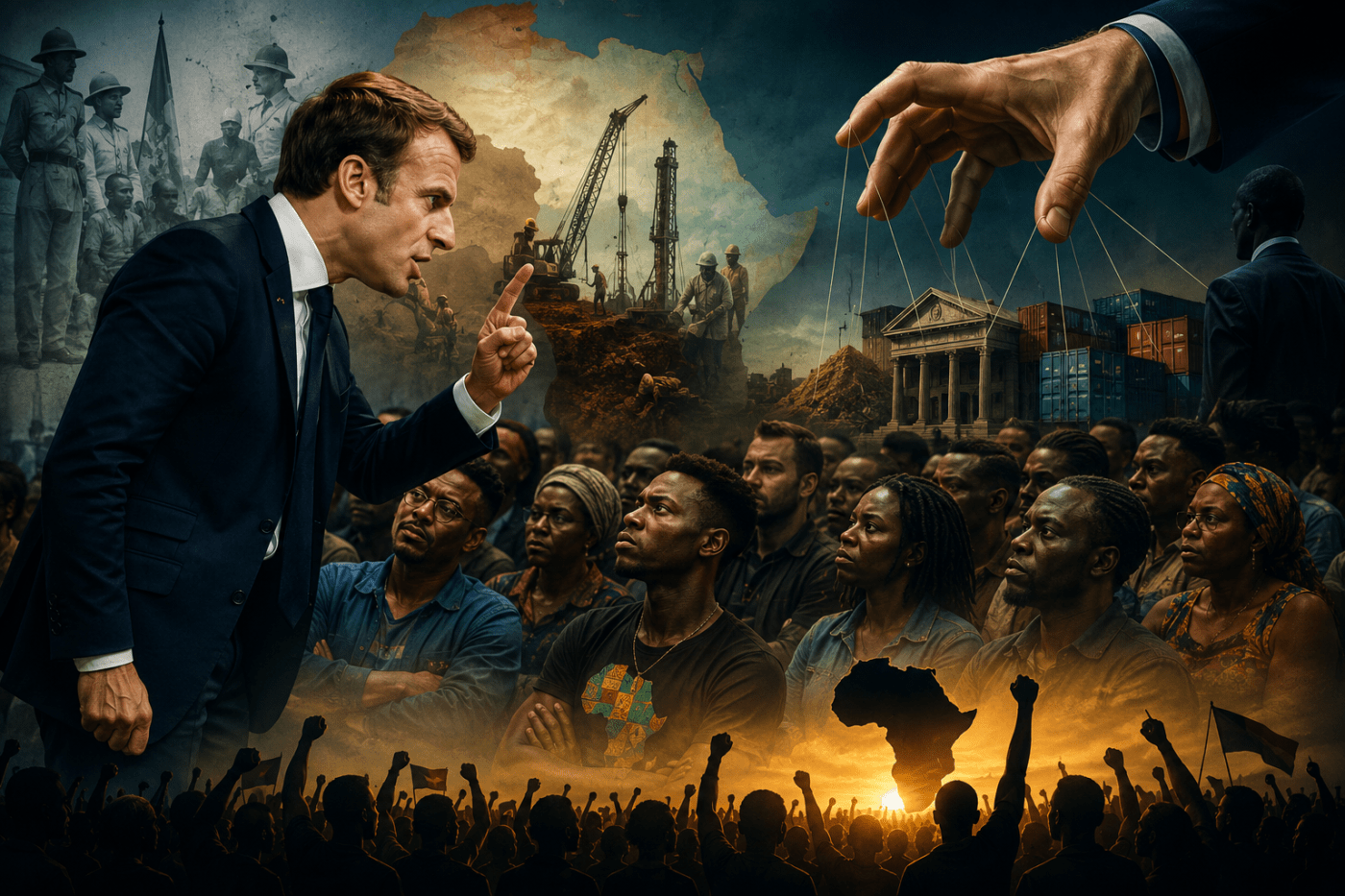
A French president’s interruption at a Nairobi summit exposed more than diplomatic arrogance; it revealed the lingering psychology of empire dressed in the language of “equal partnership.” Behind the spectacle of green investment pledges and startup rhetoric lies a deeper struggle over African sovereignty, debt dependency, military influence, and the geopolitical restructuring of imperial power in an increasingly multipolar world. As France loses ground across West Africa and the Sahel, Nairobi has emerged as a key terrain in the battle to reorganize neocolonial influence through finance, technology, security cooperation, and climate-development branding. Yet across Kenya, Africa, and the wider Global South, a new generation of anti-imperialist and Pan-African movements is beginning to challenge the old colonial architecture beneath its modernized facade.
By Prince Kapone | Weaponized Information | May 13, 2026
The Schoolmaster of Françafrique Takes the Microphone
The Associated Press article “Macron faces backlash after interrupting Africa summit panel in Kenya”, written by Mark Banchereau and published on May 12, 2026, reports that French President Emmanuel Macron interrupted a panel at the Africa Forward Summit in Nairobi to scold audience members for what he called a “total lack of respect.” The article presents the episode as a diplomatic controversy: Macron, gathered with African leaders and entrepreneurs under the banner of France’s new “partnership” with the continent, walks onto the stage, demands the microphone, and attempts to “restore order.” The scene is almost too perfect. The former colonial master arrives at the forum of “equal partnership,” hears noise from the natives, and decides that civilization requires his personal intervention.
AP situates the incident inside Macron’s broader attempt to reset France’s relationship with Africa. The article notes that Macron had earlier described himself as a “Pan-Africanist,” a statement that immediately drew criticism because Pan-Africanism was born in struggle against the very colonial and neocolonial structures France helped build, defend, and profit from. The reporting includes the backlash from African observers, French critics, and social media users, while also giving space to Macron’s own language of sovereignty, autonomy, investment, and partnership. The result is a carefully balanced corporate-wire construction: enough criticism to appear fair, enough diplomatic polish to keep the imperial narrative breathing.
The outlet itself matters. The Associated Press is a U.S.-based global news cooperative, one of the central distribution pipes through which the world’s newspapers, broadcasters, and digital platforms receive their daily ration of “objective” common sense. It does not speak in the crude voice of empire; it speaks in the smooth voice of professionalized neutrality. That is precisely its power. AP does not need to shout “France is innocent.” It merely needs to arrange the furniture of the story so that colonialism appears as background, diplomacy appears as substance, and African outrage appears as a reaction to tone rather than structure.
Banchereau’s professional location is also relevant. As AP’s West and Central Africa correspondent based in Dakar, he covers a vast region for a Western wire service whose primary audience is global and heavily shaped by corporate media circulation. This does not make the article useless. On the contrary, it gives us raw material. But raw material must be excavated. A wire article is not a window; it is a frame. And the frame here narrows a long history of French domination into a quarrel over manners.
The first propaganda device at work is narrative framing. The article frames Macron’s conduct as the central scandal, while the deeper scandal—the attempt by France to repackage its influence in Africa after military and diplomatic setbacks—is left mostly as scenery. The second is concision. Françafrique, one of the great monuments of neocolonial management, is compressed into a few lines, as if decades of troops, currency control, elite patronage, coups, and corporate extraction can be folded neatly into a paragraph and sent to bed without supper.
The third device is source hierarchy. Macron, analysts, French officials, and selected critics appear as the main voices through which the reader is guided. The organized forces of African anti-imperialism remain largely offstage. The fourth is card stacking. The article includes sharp criticism of Macron, but balances it with polling, diplomatic language, applause from some attendees, and claims that France now seeks respect. Thus the reader is invited to see contradiction where there is actually continuity: the old arrogance dressed in new linen.
The fifth device is glittering generalities. “Partnership,” “sovereignty,” “autonomy,” “success,” and “Pan-Africanism” float through the article like perfume sprayed over a garbage heap. These words sound noble, but in the article they are not materially tested. Who owns? Who finances? Who commands? Who profits? Who decides? Without those questions, “partnership” becomes the colonial handshake after the slap.
So the AP article gives us the incident, but not yet the truth. It shows Macron taking the microphone. It does not fully show the centuries of imperial entitlement that taught him he had the right to do so.
Nairobi and the Quiet Reassembly of Empire
The Africa Forward Summit held in Nairobi on May 11–12, 2026, was presented to the world through the polished vocabulary of “innovation,” “green transition,” entrepreneurship, and youth partnership. Yet beneath the startup aesthetics and diplomatic smiles stood a more concrete historical reality. France arrived in Kenya not from a position of confidence, but from a position of strategic retreat. As Reuters noted in its reporting on the summit, Paris has increasingly shifted its focus toward Anglophone Africa after facing escalating hostility and declining influence across much of West Africa and the Sahel. The summit therefore represented more than diplomacy. It represented an attempt to reorganize French influence after a long season of imperial embarrassment.
That crisis did not emerge from nowhere. Over the last several years, countries such as Mali, Burkina Faso, Niger, Chad, and Senegal have increasingly challenged the permanence of French military infrastructure and political management systems established during the long postcolonial era of Françafrique. AP itself reported on France’s troop withdrawals from Senegal and other regional strongholds, retreats driven by mounting public anger over foreign military presence, counterterror operations, elite patronage networks, and continuing perceptions of French interference in domestic political life. The language of “partnership” now emerges precisely because the language of paternal authority has become politically radioactive.
Inside Nairobi, France and Kenya signed a series of bilateral agreements covering agriculture, fisheries, renewable energy, hydropower, aviation fuel, and infrastructure financing. According to official statements released by the Kenyan presidency, the agreements included financing for Masinga Dam rehabilitation, expansion of wind-energy infrastructure, and climate investment mechanisms tied to sustainable development initiatives. These projects are routinely marketed through the moral language of climate responsibility and modernization, but global capital rarely invests because it has suddenly developed a conscience. Investment follows strategic corridors, profitable sectors, geopolitical access points, and long-term influence over emerging markets.
This became even clearer when Macron announced approximately $27 billion in Africa-focused investment initiatives targeting transportation, agriculture, artificial intelligence, and renewable energy. Western reporting largely framed the announcement as evidence of France’s commitment to a “new relationship” with Africa. But imperial power has always adapted its language to survive changing conditions. Yesterday it spoke of the “civilizing mission.” Today it speaks of “digital partnership,” “green development,” and “shared innovation.” The branding evolves because the old slogans have expired under the weight of history.
The summit also unfolded amid intensifying geopolitical competition across the continent. Kenya itself has increasingly maneuvered between competing external powers in pursuit of financing, infrastructure, and strategic leverage. In fact, Reuters previously reported that Kenya moved away from a major French-linked highway arrangement involving Vinci before pivoting toward Chinese-backed alternatives after concerns emerged regarding financial exposure and project structure. African governments today are not simply passive recipients of foreign policy; they are navigating a complex terrain in which China, the United States, France, Türkiye, Gulf states, India, and other powers compete for access, influence, logistics corridors, mineral chains, and political alignment.
At the same time, France’s retreat from visible military dominance does not necessarily signify the disappearance of imperial influence. Modern power increasingly operates through hybrid arrangements that combine finance, logistics, intelligence, development institutions, debt instruments, and security cooperation. Kenya and France deepened this process through a bilateral defense cooperation agreement covering maritime security, intelligence coordination, military training, and peacekeeping collaboration. Critics inside Kenya raised concerns over legal protections and operational privileges granted to French personnel. Such arrangements matter because contemporary imperial influence often arrives wearing the uniform of “cooperation” rather than conquest.
The deeper economic architecture behind these relationships cannot be understood without confronting the enduring structures of postcolonial financial control. One of the clearest surviving examples remains the CFA franc monetary system, originally established in 1945 under the title “franc of the French Colonies of Africa.” Though modified over time, the system continues linking multiple African economies to financial arrangements historically shaped through French monetary oversight. Critics across the continent have long argued that the CFA structure constrains monetary sovereignty while reproducing unequal dependency between African states and the former colonial center.
Questions of finance also surfaced directly at the summit itself. African leaders repeatedly criticized the global credit-rating system and the punitive borrowing conditions imposed on African economies. According to Reuters coverage of the summit discussions, officials argued that African states are systematically categorized as excessively risky despite growth potential and strategic importance. Meanwhile, UNDP estimates indicate that distorted sovereign credit-rating systems cost African countries tens of billions of dollars through inflated borrowing costs and restricted development financing. This is not merely a technical issue of accounting formulas and spreadsheets. Credit-rating systems function as disciplinary mechanisms through which international finance capital determines who may industrialize cheaply and who must remain trapped inside cycles of debt dependency.
It is precisely for this reason that the African Union has advanced plans for an African Credit Rating Agency designed to challenge the dominance of Western-controlled financial assessment institutions. The proposal reflects a broader continental push for greater financial autonomy and institutional sovereignty. Behind the bureaucratic language lies a larger struggle over who possesses the authority to define African economies, assign value to African development, and regulate Africa’s access to capital.
Previous Weaponized Information analysis on the summit argued that Nairobi represented an attempt by France to convert military retreat into diplomatic reinvention. The choreography of the summit strongly supports that interpretation. The old colonial vocabulary has become too discredited to use openly, so the architecture of influence is repackaged through entrepreneurship summits, climate-transition discourse, youth forums, digital cooperation, and sustainable-development branding. But changing the language of management does not automatically change the material structure of power underneath it. A colonial relationship painted green is still capable of extracting wealth just as efficiently.
Even criticism directed at Macron’s proposals exposed this contradiction. As Reuters reported following the summit, many observers argued that France’s initiatives avoided deeper structural questions involving debt cancellation, unequal trade relations, monetary sovereignty, and the enduring power of international finance capital. This distinction matters enormously. There is a difference between development and dependency financed under updated branding. There is a difference between sovereignty and supervised modernization. And there is certainly a difference between partnership and a relationship in which one side still arrives carrying centuries of accumulated imperial power in its briefcase.
The Colonial Hand Beneath the Velvet Glove
The Western press wants us to believe the central drama in Nairobi was a question of etiquette. Did Macron speak too harshly? Was the audience too noisy? Was the interruption “presidential”? Such framing shrinks history down to personality and transforms imperial relations into theater criticism. The microphone becomes the story while the empire holding the microphone disappears into the wallpaper.
But the incident in Nairobi was never simply about manners. It was a moment in which the colonial contradiction revealed itself with unusual clarity. A French president walked onto an African stage at a summit dedicated to “equal partnership” and instinctively assumed the authority to discipline the room. That reflex did not emerge from nowhere. It emerged from centuries of imperial conditioning in which Europe positioned itself as the manager, instructor, supervisor, and civilizer of the colonized world.
Macron’s claim to be among the “true Pan-Africanists” exposes the ideological desperation of a declining imperial formation attempting to survive inside a rapidly changing global order. Pan-Africanism was not born in French presidential palaces or European boardrooms discussing investment opportunities. It emerged from slave revolts, anti-colonial struggle, labor uprisings, national liberation movements, and the collective resistance of African people against colonial domination. It was forged in blood and fire against the very historical system France helped construct across the continent.
Yet this is how imperialist recalibration works in periods of crisis. When naked domination becomes politically costly, empire changes costumes. Yesterday the imperial powers spoke openly of the “civilizing mission.” Today they speak the language of entrepreneurship, climate transition, digital partnership, innovation hubs, and youth empowerment. The vocabulary modernizes because the old slogans have become contaminated by historical memory. But changing the public-relations script does not alter the material structure underneath it.
The Nairobi summit represented precisely this process of imperialist recalibration. France is attempting to reorganize its position in Africa after the erosion of its authority across large parts of West Africa and the Sahel. The decline of French military legitimacy forced Paris to search for new methods of influence less visibly colonial in form yet still capable of preserving strategic access, corporate penetration, diplomatic leverage, and geopolitical relevance. The empire has not disappeared. It has updated its software.
This transition reflects a broader transformation occurring across the global capitalist system under conditions of multipolarity and imperialist decay. The old postwar architecture of uncontested Western domination no longer functions with the same efficiency it once did. China’s economic rise, Russia’s geopolitical resurgence, the expansion of BRICS+, and the increasing assertiveness of states across the Global South have fractured the illusion of permanent unipolarity. African governments now maneuver between competing centers of global power rather than operating entirely within the gravitational pull of Europe and the United States.
This is why Kenya occupies such an important place in the current moment. Nairobi is not merely a diplomatic venue; it is emerging as contested terrain within a larger struggle over infrastructure, logistics corridors, energy systems, finance, digital networks, and geopolitical alignment across East Africa. France approaches Kenya not as a benevolent development partner but as a state seeking to preserve relevance inside a continent where the monopoly it once enjoyed has weakened considerably.
The summit’s heavy emphasis on renewable energy, artificial intelligence, and sustainable development reveals how neocolonialism increasingly operates through what might be called green managerialism. Under the contemporary regime of Hyper-Imperialism, extraction no longer arrives only through mining concessions, military occupation, or direct colonial administration. It increasingly arrives through climate finance mechanisms, technological dependency, debt architecture, digital infrastructure, and “development partnerships” tied to external capital flows.
The irony is almost Marxist in its comedy. The same imperial centers whose industrial expansion helped generate catastrophic global ecological crises now present themselves as tutors of sustainable development for the formerly colonized world. The arsonist returns carrying a fire extinguisher and invoices the neighborhood for emergency services.
The struggle over credit-rating systems exposes this contradiction sharply. African economies are told they must industrialize, digitize, modernize infrastructure, and transition toward green energy. Yet the global financial architecture simultaneously imposes punitive borrowing costs that make those transitions vastly more expensive. In this sense, financial power functions as a form of neocolonial governance. International finance capital does not merely allocate money; it disciplines sovereignty itself.
This is why demands for African-controlled financial institutions, alternative development mechanisms, and monetary sovereignty carry such political significance. They are not simply technical reforms. They are part of a broader sovereignty struggle unfolding across the Global South against systems historically designed to preserve unequal dependency between core and periphery.
The defense agreements signed alongside the summit further illustrate how modern imperial influence operates through flexible hybrid arrangements rather than straightforward colonial occupation. Military cooperation, intelligence sharing, logistical coordination, security partnerships, and legal protections for foreign personnel create what can be understood as a softer and more adaptable form of Forward Containment Architecture. The flag may no longer fly directly above the territory, but power continues circulating through institutional channels designed to preserve strategic influence.
And this is precisely why the AP article’s obsession with tone ultimately functions ideologically in service of the larger imperial narrative. If the public debate remains trapped at the level of whether Macron behaved arrogantly, then the deeper structure of coercion disappears from view. The audience is invited to discuss colonial psychology while ignoring colonial political economy.
The real story in Nairobi was not that Macron briefly acted like a schoolmaster. The real story is that the old colonial school itself is struggling to survive in a world where its former students increasingly refuse to remain seated quietly at the back of the classroom.
From Nairobi to the World: Organizing Beyond the Summit Stage
The struggle exposed in Nairobi will not be resolved through diplomatic choreography, investment summits, or carefully managed speeches about partnership. The contradiction runs deeper than personality and deeper than Macron himself. What emerged at the Africa Forward Summit is part of a larger global confrontation between peoples struggling for sovereignty and a decaying imperial order attempting to preserve its dominance through new methods of financial, military, and technological management.
The task before revolutionary and anti-imperialist forces is therefore not simply to criticize hypocrisy, but to organize materially against the structures that reproduce dependency. The people of Kenya, the broader African continent, and the Global South are already engaged in this struggle. Across Africa, youth uprisings, labor struggles, anti-austerity mobilizations, anti-base campaigns, debt justice movements, and Pan-African formations are increasingly confronting the mechanisms through which external powers continue shaping political and economic life long after formal colonialism supposedly ended.
One of the clearest expressions of this resistance emerged directly in response to the summit itself through the Pan-Africanism Summit Against Imperialism (PASAI), which organized a counter-summit in Nairobi opposing imperial intervention, militarization, debt dependency, and neocolonial restructuring across Africa. PASAI’s mobilization represented something politically important: the refusal to allow imperial powers to monopolize the language of African development and Pan-Africanism while revolutionary and anti-imperialist voices remain confined to the margins. At the very moment France attempted to rebrand itself as a partner of African sovereignty, African organizers were building independent spaces explicitly naming imperialism itself as the problem.
That struggle also extends into the imperial core itself. In France, the anti-Françafrique organization Survie has spent years exposing the political, military, and financial structures through which French influence continues operating across the continent. Supported primarily through member contributions, donations, and publication work rather than imperial-state funding streams, Survie represents one example of how people inside the Global North can participate in anti-imperialist struggle not through charity politics or NGO paternalism, but through direct confrontation with their own state’s role in neocolonial domination.
Likewise, the growing anti-militarist movement confronting foreign military presence in Africa remains essential. Organizations such as the U.S. Out of Africa Network, organized through the Black Alliance for Peace, have linked struggles against AFRICOM, NATO expansion, militarized imperialism, and foreign intervention to broader questions of Black liberation, anti-colonial sovereignty, and international solidarity. Their work is especially important because imperialism increasingly hides itself behind the language of “security cooperation,” “counterterrorism,” and “stabilization.” The military footprint often arrives today not as direct occupation but as training missions, logistics agreements, intelligence-sharing arrangements, and infrastructure partnerships embedded quietly inside diplomatic agreements.
The fight against debt dependency and financial coercion must also become central to international organizing. Institutions such as the Committee for the Abolition of Illegitimate Debt (CADTM) have helped build campaigns challenging the legitimacy of debt regimes that trap Global South nations inside permanent austerity, dependency, and externally supervised development. The issue is not merely technical economics. Debt functions politically. It disciplines governments, restructures public priorities, privatizes social life, and limits the sovereign ability of nations to direct their own development according to human need rather than creditor demand.
The uprising of Kenyan youth against austerity, taxation, corruption, police violence, and IMF-linked economic pressure over the last several years also points toward an important political lesson. The future of anti-imperialist struggle will not emerge exclusively through traditional parties, NGOs, or diplomatic institutions. Increasingly it is developing through decentralized mass formations, digitally coordinated youth movements, labor struggles, and popular political education emerging from below. The very generation Western powers seek to absorb into startup culture, entrepreneurial mythology, and “innovation ecosystems” is also the generation increasingly questioning debt dependency, elite comprador politics, and external domination.
For organizers in the Global North, solidarity requires more than symbolic statements. It means identifying and confronting the concrete institutions through which imperial power reproduces itself domestically: military alliances, weapons manufacturers, extractive finance, logistics corporations, speculative investment funds, and media systems that normalize imperial management as “development.” The task is not to “save Africa.” Africa does not require saving from Europe or North America. Africa requires space to determine its own future free from the economic and geopolitical chokehold of imperial power.
For organizers in Africa and across the Global South, the Nairobi summit reinforces the importance of building independent political institutions capable of resisting incorporation into externally managed development frameworks. Pan-Africanism cannot survive merely as ceremony or branding. It must exist materially through continental cooperation, sovereign financial institutions, regional industrial strategy, independent media systems, labor solidarity, food sovereignty, technological sovereignty, and resistance to military penetration by outside powers.
The old imperial order understands this danger clearly. That is precisely why it increasingly invests not only in armies and banks, but in narrative management, digital influence operations, entrepreneurial ideology, and soft-power diplomacy aimed at absorbing resistance before it hardens into organized political rupture.
But history has begun shifting beneath their feet. The same continent once treated as a permanent laboratory for colonial extraction is increasingly becoming one of the central terrains from which the future of multipolarity, sovereignty, and anti-imperialist struggle will be decided. And that future will not be negotiated politely on summit stages alone. It will be determined in the streets, workplaces, unions, schools, ports, farms, digital spaces, and political movements where ordinary people continue refusing to remain quiet while empire lectures them about partnership.


Leave a comment