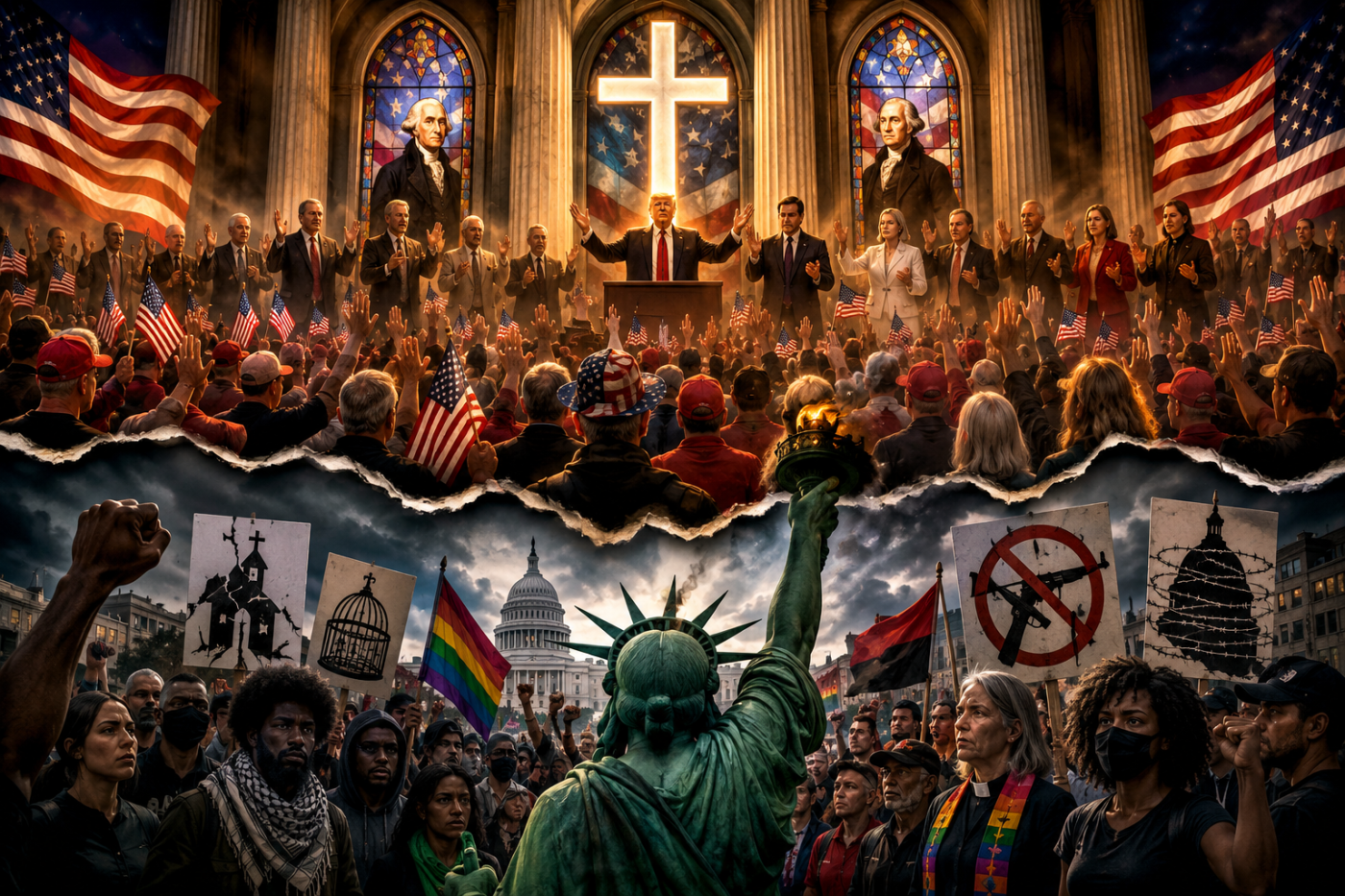
The cross now stands beside the flag because the empire no longer trusts the flag alone to hold the country together. Behind the patriotic hymns and prayer rallies lies a ruling order desperately trying to baptize imperial decline, transform social collapse into spiritual crisis, and convince millions of struggling people that the source of their suffering is moral decay rather than capitalism, oligarchy, and endless war. Rededicate 250 reveals an American ruling bloc reaching backward into mythology, civil religion, and Christian nationalism as economic insecurity, geopolitical instability, and domestic fragmentation tear through the foundations of unipolar power. Yet beneath the spectacle itself, new fractures, resistance movements, anti-imperialist formations, and grassroots struggles are beginning to emerge against the growing fusion of empire, reaction, militarism, and sacred nationalism.
By Prince Kapone | Weaponized Information | May 18, 2026
The Gospel According to Empire
The Associated Press article “Thousands flocked to the National Mall in Washington for an America-themed prayer rally”, written by Tiffany Stanley and published May 17, 2026, reports on the Rededicate 250 prayer rally held on the National Mall in Washington, D.C. The event was billed as a national act of religious renewal, a “rededication” of the United States as “One Nation under God,” staged beneath the Washington Monument with worship music, Christian imagery, patriotic colors, and recorded appearances from President Donald Trump and leading Republican officials. Stanley’s article describes the rally as a Christian-focused celebration tied to the 250th anniversary of U.S. independence, while also noting criticism from religious-liberty advocates, progressive Christians, Jewish leaders, and secular organizations who warned that the event promoted Christian nationalism. On the surface, then, AP presents the story as a conflict over the boundary between patriotism and religion, between national commemoration and sectarian politics, between ordinary believers praying for their country and critics fearing the erosion of church-state separation.
But this is precisely where the excavation must begin. The article reports the spectacle, but it does not fully dissect the machinery that made the spectacle politically meaningful. We are shown the stained-glass arches, the white cross, the founders, the patriotic costumes, the Trump hats, the video Scripture reading from the Oval Office, and the smiling procession of Republican dignitaries marching through the language of national salvation. Yet the deeper question is not merely whether this was “too Christian” for a pluralistic republic. The deeper question is why, at this precise moment of imperial crisis, the American state and its religious auxiliaries feel compelled to drag the cross onto the National Mall, wrap it in the flag, place it under federal architecture, and call the whole production a rededication. Empires do not stage ceremonies like this when they are confident. They stage them when legitimacy is leaking out of the walls.
The Associated Press occupies a particular place in the imperial media ecosystem. It is not Fox News frothing at the mouth, nor Breitbart handing out ideological brass knuckles in a digital alleyway. AP is the respectable wire service, the institutional voice of sober description, the outlet that tells the reader what happened in a tone that sounds like nobody in particular is speaking. That is precisely its power. The language of neutrality can often conceal the violence of the frame. Stanley’s professional location as a religion reporter allows the article to take religious conflict seriously, and to its credit, the piece does identify the event’s Christian focus and the criticism that it supports Christian nationalism. But the limits of the reporting are also the limits of the genre. The article treats Christian nationalism largely as a controversy among religious leaders, political officials, and advocacy groups, rather than as a weapon of state formation in a decaying settler empire.
The first major propaganda device at work is narrative framing. AP frames the event as a dispute over religious freedom and national identity. That frame is not false, but it is too small. It turns a political-theological mobilization of state power into a debate about whether the event made non-Christians feel excluded. This is the polite liberal doorway into the problem. It asks whether everyone was invited to the prayer circle, when the sharper question is why the prayer circle was built at the symbolic center of U.S. imperial power in the first place. The issue is not simply that Christianity was present. Christianity has been present in American public life from the beginning. The issue is that Christianity was staged as the spiritual grammar of the nation-state, while the state’s leading officials appeared as priests of the republic, reading Scripture over a country whose ruling class has never needed divine help to bomb villages, deport workers, break strikes, bless police violence, and call theft freedom.
The second device is source hierarchy. The article gives us a familiar cast: national politicians, evangelical celebrities, progressive clergy, Jewish institutional leaders, secular advocacy organizations, and selected attendees. These are legitimate sources, but their arrangement produces a narrow field of interpretation. The working class appears mainly as crowd color. The colonized appear barely at all. Indigenous people are mentioned only through a quote about early American religious diversity, not as nations whose dispossession made the National Mall possible. Black people, migrants, the poor, prisoners, and the victims of U.S. empire abroad do not occupy the center of the narrative, even though any serious discussion of America’s sacred self-image must pass through their blood-soaked historical experience. The article asks whether America welcomes many faiths. It does not ask what kind of country needed a theology capable of blessing genocide, slavery, conquest, segregation, imperial war, and capitalist plunder while still calling itself innocent.
The third device is omission. The article notes that Freedom 250 is a public-private partnership backed by the White House and that Democrats have questioned its structure and finances. But this is treated as one concern among others, not as a key to the whole operation. The phrase “public-private partnership” should make every worker check their pockets. It is the sweet little lullaby capital sings while climbing into the state’s bed. A public-private patriotic-religious project is not just a celebration. It is ideological infrastructure. It organizes donors, officials, churches, media attention, patriotic branding, and historical memory into one machine. The article gestures toward that machinery but does not pry it open. It leaves the reader with the impression of a controversial rally, not an organized campaign to discipline national memory during a period of political crisis.
The fourth device is transfer. The event itself transfers the emotional power of Christian worship onto the U.S. state, and the article faithfully records the imagery without fully naming the operation. The founders appear beside the cross. Federal columns surround stained-glass arches. Trump reads Scripture from the Oval Office. Republican officials speak as guardians of the nation’s soul. The Washington Monument rises in the background like a stone finger pointing toward heaven, as if the empire’s marble and blood were suddenly proof of divine favor. This is not accidental symbolism. It is a liturgy of political transfer. The holiness of religion is made to sanctify the legitimacy of the state. The reverence attached to prayer is redirected toward the republic. The suffering and anxiety of ordinary people are gathered up, baptized in patriotic spectacle, and returned to them as loyalty.
The fifth device is concision. The article has limited space, and within those limits it performs the standard journalistic compression: a rally happened, officials appeared, critics objected, attendees explained their motives, counterprotesters responded. But concision becomes political when the compressed history is the history of empire. To say that critics see Christian nationalism in the event is accurate. To leave the matter there is insufficient. Christian nationalism is not merely an attitude or a slogan. It is one of the ideological languages through which the settler state explains itself to itself. It says the land was promised, the conquest was providential, the founders were sacred, the nation has a divine mission, and those who resist that mission are not merely political opponents but enemies of God’s order. In a country built by enslaved labor on stolen land, that theology is not decorative. It is a weapon.
The sixth device is plain folks. AP includes attendees who speak sincerely about Jesus, prayer, Trump, conservative belonging, and the feeling of not being alone. These voices matter because propaganda does not work by forcing people to repeat slogans they know are false. It works by attaching real fears, real hopes, real loneliness, and real spiritual hunger to ruling-class political projects. A woman says Trump is not the savior, but the nation must be rededicated to God. A teenager says events like this help her feel less alone in her beliefs. These are human statements. They should not be mocked. But they must be understood materially. People are being gathered into a political religion that offers community without liberation, certainty without truth, belonging without justice, and salvation without any need to confront the empire whose privileges and violence make the whole ceremony possible.
This is the central limitation of the AP article. It sees the cross on the stage, but not fully the class power behind the altar. It sees the critics, but not fully the colonial dead missing from the guest list. It sees the patriotic performance, but not fully the desperation of a ruling order trying to turn historical amnesia into worship. The article is not crude propaganda in the tabloid sense. It is more refined than that. It is the respectable reporting of an imperial society that can notice Christian nationalism as a controversy while still struggling to name it as a governing technology. The empire does not always need journalists to lie. Sometimes it only needs them to describe the fire without asking who built the furnace.
Flags, Crosses, and the Crisis of American Legitimacy
The Rededicate 250 rally did not emerge from nowhere like a thunderstorm over the National Mall. It emerged from a rapidly intensifying campaign to fuse nationalism, religion, state power, and historical memory into a single ideological project during a period of accelerating imperial instability. The White House formally launched Freedom 250 as part of the broader semiquincentennial celebrations surrounding the 250th anniversary of U.S. independence, presenting the initiative as a patriotic renewal campaign intended to commemorate the nation’s founding and “inspire a new generation of Americans.” But the political significance of the project becomes clearer when one examines who is leading it, what language is being used, what institutional structures are being built around it, and what historical realities are being carefully pushed out of frame.
Congressional Democrats launched a formal probe into Freedom 250 after reports surfaced alleging that wealthy donors were offered privileged access connected to official semiquincentennial events. The issue here is not merely corruption in the vulgar sense, though American capitalism certainly never misses an opportunity to turn patriotism into a business conference. The deeper issue is that the state’s historical narrative itself is increasingly being privatized, managed, and packaged through networks of political donors, ideological operatives, religious institutions, and corporate influence. The same ruling class that outsourced factories, gutted unions, deregulated finance, militarized police, and flooded the population with debt now wishes to supervise how history itself is remembered. The nation becomes intellectual property. Patriotism becomes a managed commodity. Even memory is now subcontracted.
Trump’s Religious Liberty Commission includes figures such as Paula White-Cain, Franklin Graham, Cardinal Timothy Dolan, Bishop Robert Barron, and Rabbi Meir Soloveichik, many of whom appeared at or were connected to the Rededicate 250 spectacle itself. The commission was formally presented as a defense of religious freedom, but its political orientation becomes obvious once one examines its composition and rhetoric. This is not a broad ecumenical body concerned primarily with protecting pluralism. It is a coalition overwhelmingly rooted in conservative religious nationalism, one that increasingly frames Christianity not simply as a faith tradition inside America, but as the spiritual foundation of the American state itself.
AP itself previously reported that leading figures connected to Trump’s Religious Liberty Commission have openly questioned or rejected strict church-state separation. This matters enormously because the mythology that the United States was founded as an explicitly Christian nation is not merely a historical disagreement among professors arguing over dusty parchment. It is a live ideological weapon. If the nation is understood as divinely founded, then political dissent increasingly becomes framed not merely as disagreement, but as sacrilege. State authority acquires sacred legitimacy. The ruling order ceases to be merely constitutional and becomes theological.
This mythology collapses quickly under even modest historical scrutiny. The First Amendment explicitly prohibited Congress from establishing religion, while the 1797 Treaty of Tripoli declared in its ratified English text that “the Government of the United States of America is not, in any sense, founded on the Christian Religion”. Of course, the contradiction runs deeper than legal text. The United States was never truly a secular republic in the clean liberal sense imagined by civics textbooks. Christianity and settler expansion were intertwined from the colonial beginning. European colonizers routinely interpreted conquest, extermination, enslavement, and territorial expansion through providential language. Indigenous nations were framed as heathens obstructing civilization. Enslaved Africans were treated simultaneously as exploitable labor and targets of religious paternalism. Manifest Destiny itself functioned as a theological doctrine draped over capitalist and colonial expansion. The modern Christian nationalist movement did not invent this tradition. It inherited and updated it for the age of imperial decline.
Pew Research polling released in May 2026 found that the share of Americans who believe religion is gaining influence in public life reached its highest recorded level in decades, while favorable views toward Christian nationalism have increased compared to earlier years. These shifts are unfolding amid a broader social crisis defined by economic insecurity, imperial overextension, political fragmentation, social atomization, declining institutional trust, and escalating geopolitical confrontation abroad. People searching for meaning inside collapsing systems often become vulnerable to mythologies that promise order, certainty, belonging, and restoration. The ruling class understands this very well. When material legitimacy weakens, ideological legitimacy must be intensified.
That is why the Rededicate 250 event cannot be understood merely as a religious gathering. It was also a ritual of political consolidation. The White House itself promoted “America Prays” initiatives connected to the semiquincentennial campaign, explicitly linking national renewal to organized public religiosity. Meanwhile, Defense Secretary Pete Hegseth used the occasion to invoke George Washington while urging Americans to pray “without ceasing” for the nation. This fusion of military symbolism, religious language, patriotic spectacle, and executive authority reflects a deeper transformation underway inside the American political system. The state increasingly presents itself not merely as an administrative structure governing society, but as the guardian of civilizational destiny itself.
This ideological shift is occurring alongside intensifying material contradictions. The United States faces mounting debt, deindustrialization, widening inequality, declining life expectancy among sections of the working class, deteriorating infrastructure, expanding surveillance, militarized policing, endless foreign wars, and growing instability across the imperial system itself. Yet rather than confront the structural roots of these crises inside capitalism and empire, large sections of the ruling bloc increasingly retreat into civilizational mythology. The language of “national rebirth,” “spiritual warfare,” “biblical foundations,” and “restoring America” becomes a substitute for confronting the social devastation produced by monopoly capital and imperial decay.
Even the staging of the rally revealed this contradiction. The event’s architecture intentionally merged Christian iconography with the visual language of the American state: federal columns, stained-glass windows depicting founders, the Washington Monument towering behind the stage, and the white cross situated at the symbolic center of the spectacle. This was not random decoration. It was political theology rendered spatially. The message was unmistakable: the republic itself is sacred; its founders were instruments of providence; the nation possesses a divine mission; loyalty to the nation merges with loyalty to God.
Yet the entire production rested atop buried histories the ceremony itself could never fully acknowledge. The National Mall exists inside a settler capital constructed through Indigenous dispossession, financed historically through slavery and capitalist expansion, and consolidated through centuries of imperial war. The same state now invoking divine renewal has spent decades invading countries, imposing sanctions, orchestrating coups, financing proxy wars, militarizing borders, surveilling populations, crushing labor militancy, and concentrating wealth upward into the hands of finance capital and corporate oligarchy. The contradiction becomes almost biblical in its absurdity. Babylon now kneels publicly in prayer and asks to be mistaken for Jerusalem.
Predictably, opposition emerged. The Freedom From Religion Foundation and Faithful America organized counterprotests against the event, including a giant inflatable golden calf mocking the idolatrous fusion of Trumpism and religion. Interfaith Alliance projected slogans such as “Democracy not theocracy” and “The separation of church and state is good for both” onto buildings near the Mall. These protests reflected genuine concern over the growing fusion of state power and reactionary religious nationalism. But the contradiction runs deeper still. The issue is not simply whether America risks becoming a theocracy in the narrow legal sense. The issue is that empire itself increasingly requires sacred myths to stabilize social order as material legitimacy erodes.
This is precisely why the ruling bloc invests so heavily in patriotic spirituality during moments of crisis. The more unstable the empire becomes materially, the more intensely it seeks emotional and theological cohesion. The worker whose rent explodes, whose wages stagnate, whose healthcare disappears, whose children inherit debt, surveillance, climate catastrophe, and permanent war is told that the real solution lies not in transforming the political economy, but in national prayer. The same system that immiserates people then offers them transcendence through flag worship and religious spectacle. It is a remarkable arrangement. Capitalism steals the bread, then sells back salvation.
The AP article gestures toward this terrain without fully reconstructing it. Once the omitted structures are restored, however, Rededicate 250 appears not as an isolated controversy, but as part of a much broader ideological recalibration underway inside the United States itself. The empire is attempting to narrate itself through crisis. It is reaching backward into sacred mythology because its future no longer appears stable enough to inspire confidence on material grounds alone. The cross, the flag, the military, the founders, and the executive state are increasingly being fused into one symbolic architecture designed to hold together a fragmenting imperial society. The prayer rally was therefore not simply about religion. It was about legitimacy. And legitimacy is always the first thing empires begin to pray for when history starts knocking at the door.
When Empires Begin to Pray
The liberal imagination insists on treating events like Rededicate 250 as unfortunate excesses — a little too much religion, a little too much nationalism, a few too many crosses near federal marble. The assumption buried underneath this interpretation is that the American republic exists in some naturally secular and democratic equilibrium, periodically disturbed by reactionary outbursts that can be corrected through institutional restraint and civic moderation. But this reading misunderstands both the nature of the American state and the historical function of political religion inside empires. Rededicate 250 was not an aberration from the trajectory of American power. It was one of its clearest revelations.
Every ruling order requires mythology. No empire can survive merely through police, armies, courts, banks, and prisons alone. Violence can conquer territory, but legitimacy governs memory. The population must be taught not only to obey power, but to emotionally identify with it, moralize it, spiritualize it, and eventually defend it as an extension of themselves. This is why empires manufacture sacred narratives about their origins. Rome had divine destiny. Britain carried the “civilizing mission.” France spoke the language of republican enlightenment while colonizing Africa at gunpoint. The United States wrapped settler expansion in providence, capitalism in freedom, and military domination in democracy. What appeared on the National Mall was therefore not something new emerging from nowhere. It was an old imperial theology adapting itself to conditions of imperial decline.
The most important thing about the rally was not that politicians quoted Scripture. American politicians have always quoted Scripture. It was not even the presence of Christian nationalism itself. The deeper significance lay in the fusion taking place between state authority, historical memory, religious identity, and civilizational anxiety. The ruling bloc increasingly presents America not simply as a country among others, but as a sacred historical project under existential threat. Once that framework is established, every social contradiction becomes morally inverted. Economic collapse becomes spiritual decay. Political dissent becomes national betrayal. Imperial retreat becomes civilizational humiliation. Structural crisis becomes evidence that the population has drifted too far from God rather than too far into monopoly capitalism, militarized imperialism, and oligarchic rule.
This is the genius of political theology inside decaying systems: it transfers responsibility upward and downward simultaneously. The ruling class escapes blame while ordinary people are taught to interpret collective suffering as moral failure. Workers lose healthcare because the nation abandoned prayer. Communities collapse because the culture lost faith. Social atomization spreads because the family weakened. Empire declines because patriotism faded. In this framework, the billionaire ceases to be the architect of misery and instead becomes merely another believer trying to save the nation. Exploitation disappears into morality play. Class power disguises itself as spiritual concern.
What we are witnessing is therefore not simply conservatism, nor even religion in the abstract, but the consolidation of a specifically American form of political mythology rooted in the colonial contradiction itself. The United States was born through conquest and accumulation on stolen land. Its expansion was justified through providential language from the very beginning. Settler colonialism required theological permission because extermination always sounds cleaner when narrated as destiny. The enslaved African became both exploitable labor and evidence of divine hierarchy. Indigenous resistance became savagery obstructing civilization. Expansion became mission. War became redemption. Capital became liberty. The theological language changed across centuries, but the underlying structure remained remarkably stable: American power represented moral order itself.
The modern spectacle of Christian nationalism emerges from this historical soil. It is not simply a manipulation imposed from above onto an otherwise innocent population. It draws energy from genuine social dislocation, loneliness, fear, economic precarity, and imperial instability. Millions of people inside the United States sense that the country is unraveling. They see declining living standards, endless war, collapsing trust, cultural fragmentation, social isolation, addiction, ecological disaster, and political paralysis. But because the ideological institutions of society remain overwhelmingly controlled by ruling-class power, the causes of these crises are systematically mystified. The worker is encouraged to fear migrants more than landlords, secularism more than finance capital, cultural liberalism more than militarized oligarchy. Social pain is rerouted away from class consciousness and toward civilizational panic.
This is where the prayer rally becomes historically significant. It functioned as a ritual of imperial recalibration. The empire is attempting to spiritually reorganize sections of the population around sacred nationalism precisely because material legitimacy is weakening. The old promises no longer persuade the way they once did. The American Dream has become increasingly inaccessible to broad layers of the working class. Industrial employment has eroded. Debt saturates daily life. Housing becomes unaffordable. Infrastructure decays while military budgets explode upward into the stratosphere. Entire generations inherit instability as normalcy. Under such conditions, the ruling order requires new forms of emotional cohesion capable of stabilizing social fragmentation without transforming the underlying economic system producing it.
This is why the fusion of patriotism and religion intensifies during periods of imperial crisis. The state seeks transcendence because it can no longer easily provide material security. The flag becomes sacred because wages stagnate. The nation becomes holy because the social contract disintegrates. Historical mythology expands to fill the vacuum left by collapsing legitimacy. In earlier periods of capitalist expansion, liberal democracy could present itself as materially progressive for broad sections of the population inside the imperial core. But in periods of stagnation and decline, coercion and mythology become increasingly central to governance. The state no longer merely administers society. It performs civilization itself.
The architecture of the rally captured this perfectly. The founders beside stained-glass imagery. The white cross positioned under federal columns. The Washington Monument looming behind the stage. Scripture flowing directly from the Oval Office into the prayer gathering. Military officials invoking God and nation in the same breath. The entire spectacle dissolved the boundary between civil religion and executive authority. This was not accidental symbolism. It was Sovereignty Theater — a state dramatizing itself as sacred continuity during a moment when its historical continuity feels increasingly unstable.
And this instability is not imagined. The United States remains enormously powerful militarily and financially, but it now governs amid deepening Crisis of Imperialism. The unipolar moment that followed the collapse of the Soviet Union is eroding. The rise of China, the emergence of BRICS+, the expansion of multipolar economic relations, and the declining capacity of the United States to unilaterally dictate global outcomes have destabilized the ideological certainty that defined the post-Cold War period. Simultaneously, domestic polarization intensifies because the empire can no longer distribute social stability internally at the scale it once could during earlier periods of hegemonic expansion.
Under these conditions, reactionary nationalism increasingly functions as emotional infrastructure for imperial adjustment. Sections of the ruling class seek to consolidate political legitimacy through narratives of civilizational struggle, cultural purification, and national rebirth. Christianity becomes fused with border militarization, anti-communism, patriarchal restoration, policing, military glorification, and mythologized interpretations of the founding. The result is not classical fascism reproduced mechanically from the twentieth century, but something more specifically adapted to contemporary American conditions: a Technofascist political culture in which digital propaganda, surveillance power, oligarchic capital, militarized nationalism, and sacred mythology reinforce one another inside an increasingly unstable imperial order.
The tragedy is that many ordinary participants in these spectacles are responding to real suffering. The loneliness is real. The despair is real. The instability is real. The search for meaning is real. But the ruling bloc offers them counterfeit transcendence. Instead of solidarity, nationalism. Instead of class consciousness, civilizational panic. Instead of liberation, obedience sanctified through prayer. Instead of confronting the structures producing social misery, people are encouraged to emotionally merge themselves with the very empire accelerating that misery. The worker is invited to kneel beside the ruling class under the illusion that both share the same national destiny.
This is why liberal critiques alone remain insufficient. Simply defending “church-state separation” without confronting the material crisis underneath the spectacle leaves the deeper terrain untouched. The problem is not merely that religion entered politics. Religion has always moved through politics because power itself constantly seeks moral legitimacy. The real question is: which class project is being sanctified, and whose historical interests does it serve? Rededicate 250 answered that question very clearly. The ceremony did not sanctify the poor, the colonized, the exploited, the indebted, the displaced, or the victims of empire. It sanctified the American state itself.
And this is the contradiction now emerging with increasing clarity across the imperial core. The more unstable the system becomes materially, the more intensely it reaches for sacred legitimacy. The empire no longer trusts history alone to justify itself. It now seeks divine certification. The ruling order senses the erosion of its own ideological foundations and responds by wrapping itself simultaneously in God, nation, military symbolism, and mythologized memory. Rededicate 250 therefore was not merely a prayer rally. It was a liturgy for a declining empire attempting to convince itself that history is still on its side.
The Empire’s Altar and the People Who Refuse to Kneel
The danger posed by spectacles like Rededicate 250 cannot be confronted merely through outrage on social media, legal commentary from constitutional scholars, or liberal panic about “norms.” Political theology rooted in imperial crisis cannot be defeated through etiquette. It must be confronted materially, organizationally, historically, and collectively. What emerged around the prayer rally therefore matters not simply because protests occurred, but because different sections of society are beginning to recognize that the fusion of nationalism, religion, militarism, and oligarchic power represents something larger than ordinary electoral conservatism. Beneath the surface of the culture war, deeper political alignments are beginning to form.
One of the clearest developments is the emergence of organized opposition to Christian nationalism itself. Americans United for Separation of Church and State has expanded national organizing campaigns directly confronting Christian nationalist political infrastructure. Their work increasingly reflects a recognition that Christian nationalism is no longer a fringe rhetorical tendency, but a central ideological current moving through sections of the American ruling bloc and state apparatus itself.
At the same time, opposition is emerging from inside Christianity itself. Christians Against Christian Nationalism has helped organize decentralized local groups, congregational education campaigns, and faith-based resistance to the fusion of authoritarian politics and reactionary theology. This contradiction is historically significant because it disrupts one of the central myths sustaining the Christian nationalist project: the claim that reactionary nationalism speaks for Christianity as a whole. Across churches, seminaries, congregations, and grassroots faith communities, increasing numbers of religious people are openly rejecting the conversion of the Gospel into imperial state ideology.
The contradiction also extends beyond formal church-state questions into broader struggles against authoritarianism and repression. Interfaith Alliance has increasingly connected anti-Christian-nationalist organizing to migrant defense, democratic rights, and resistance to totalitarian state consolidation. This widening political terrain matters because Christian nationalism does not operate in isolation. It intersects materially with border militarization, anti-migrant politics, patriarchal restoration, censorship campaigns, attacks on labor militancy, and expanding executive authority. The same ideological machinery sanctifying the nation also legitimizes coercion carried out in the nation’s name.
Secular resistance has also begun sharpening itself organizationally. The Freedom From Religion Foundation directly organized visible counteractions against the Rededicate 250 rally, including demonstrations exposing the fusion of Trumpism and political idolatry. The importance of these efforts lies not simply in defending secularism abstractly, but in challenging the normalization of sacred state power itself. Once the state begins presenting itself as divinely sanctioned, democratic opposition increasingly risks being framed as moral or civilizational deviance rather than political disagreement.
Meanwhile, Faithful America has continued organizing progressive Christian opposition to Christian nationalism, MAGA-aligned religious mobilization, and authoritarian political theology. These struggles reveal something critically important: the battle unfolding is not between “religion” and “nonreligion” in the simplistic liberal sense. It is a struggle over which moral vision will define public life during a period of systemic crisis. One vision sanctifies hierarchy, nationalism, militarism, and empire. The other attempts — unevenly, imperfectly, but genuinely — to defend human dignity against the machinery of domination.
Yet the contradictions exposed by Rededicate 250 ultimately extend beyond the question of religion alone. The prayer rally was part of a broader imperial recalibration taking place across American society: expanding surveillance power, militarized borders, intensified propaganda systems, corporate-state fusion, oligarchic consolidation, and increasingly open forms of reactionary nationalism. That is why anti-imperialist formations remain essential to understanding and confronting this terrain. Black Alliance for Peace has consistently linked domestic militarization, police expansion, imperial warfare, and racialized state repression into a unified critique of empire. This analysis is crucial because Christian nationalism does not simply emerge from theological disagreement. It grows from the material crisis of empire itself.
The strategic task now is not merely to denounce reaction, but to organize against the conditions producing it. Workers, students, tenants, migrants, clergy, antiwar organizers, abolitionists, and anti-imperialist formations must increasingly recognize that these struggles are interconnected. The same ruling order invoking God on the National Mall is funding wars abroad, expanding policing at home, criminalizing dissent, disciplining labor, militarizing borders, and concentrating wealth upward into the hands of finance capital and corporate oligarchy. These are not separate crises accidentally occurring at the same time. They are interconnected expressions of a system attempting to stabilize itself through coercion, mythology, and fear.
This means the response cannot remain trapped inside defensive liberal constitutionalism alone. Defending church-state separation matters. Opposing Christian nationalism matters. But if the deeper material crisis remains untouched, the ideological machinery of reaction will continue regenerating itself in new forms. People searching for belonging inside collapsing systems will continue being pulled toward political mythologies unless movements capable of offering solidarity, organization, historical clarity, and collective struggle become materially present in their lives.
The answer to the empire’s sacred nationalism therefore cannot simply be cynicism or secular elitism. It must be a different moral and political horizon altogether — one rooted not in worship of the state, but in solidarity among the exploited and oppressed. A politics that tells workers the truth about why their lives are deteriorating. A politics that names empire directly rather than disguising it behind patriotic ritual. A politics capable of uniting struggles against war, racism, debt, austerity, border militarization, surveillance, colonial domination, and oligarchic rule into one coherent movement against the system producing them.
The ruling bloc understands that history is entering a more unstable period. That is why it increasingly reaches for sacred legitimacy. But instability cuts both ways. The same crisis producing reactionary nationalism is also producing new contradictions, new fractures, and new possibilities for organization. The empire is attempting to gather people beneath the cross and the flag because it senses the erosion of its own authority. The task now is to build movements capable of teaching people that liberation will never come from kneeling before the altar of empire, no matter how brightly the stage lights glow behind the prayer.


Leave a comment