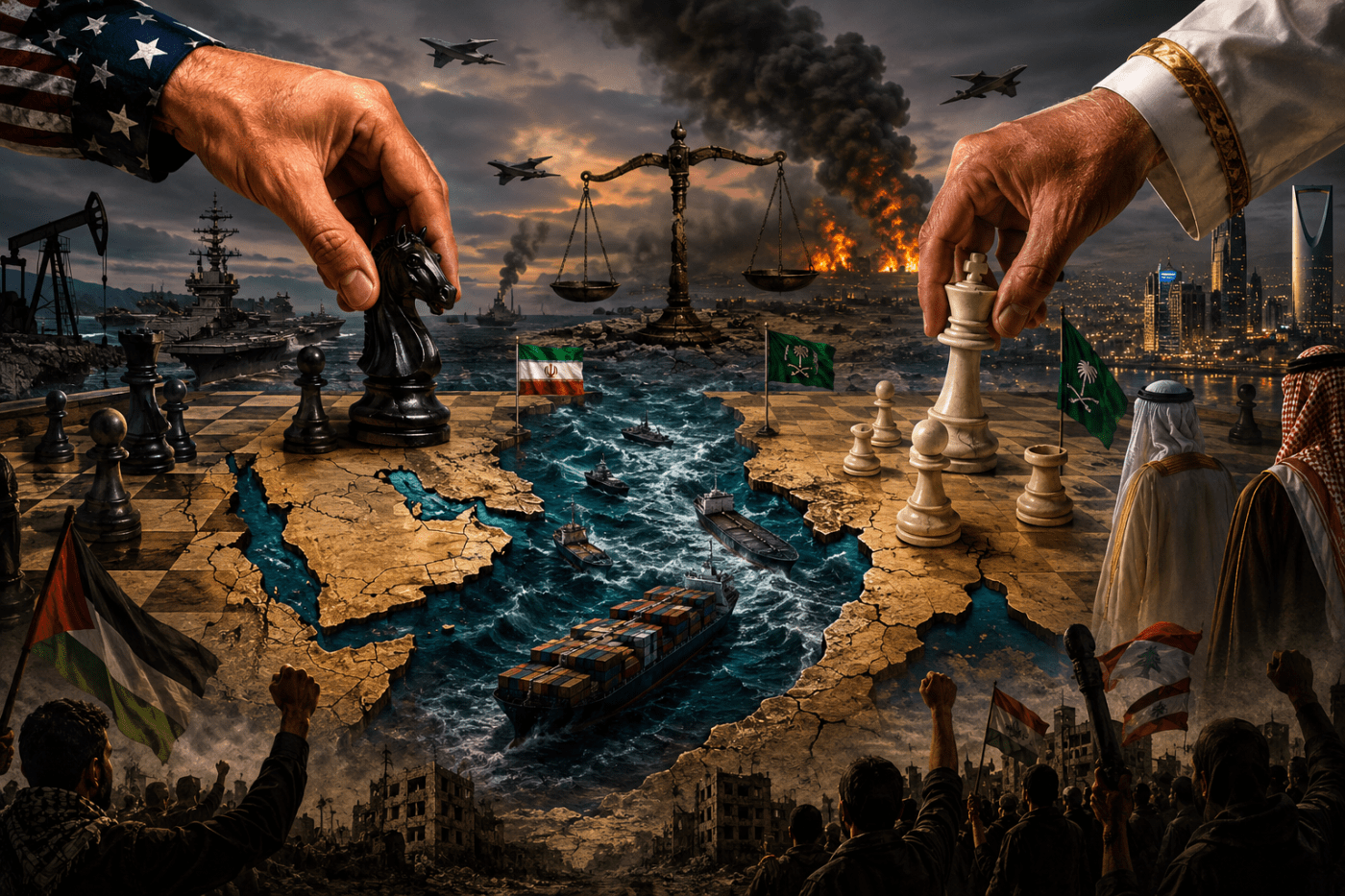
The Financial Times presents the emerging Saudi-Iran non-aggression discussions as a pragmatic response to regional instability, but beneath the diplomatic language sits the deeper crisis of a collapsing imperial security order. The factual terrain reveals a region shaped not simply by Iranian power, but by decades of sanctions, militarization, energy chokepoints, and competing projects of regional realignment unfolding under the shadow of U.S.-Israeli escalation. As Gulf states attempt to balance economic survival, strategic autonomy, and continued dependence upon American military infrastructure, the contradictions of unipolarity are producing a new and unstable political landscape across Western Asia. From antiwar movements in Britain and Pakistan to anti-base organizing in the Mediterranean and renewed Palestine solidarity mobilizations in the imperial core, new forms of resistance are emerging against the permanent-war machinery of empire.
By Prince Kapone | Weaponized Information | May 14, 2026
The Diplomats Whisper While the Region Burns
The Financial Times article “Saudi Arabia floats Middle Eastern non-aggression pact with Iran”, written by Andrew England and Henry Foy and published on May 14, 2026, reports that Saudi Arabia has discussed a possible Middle Eastern non-aggression pact with Iran as part of the regional scramble to manage the aftermath of the U.S.-Israeli war on the Islamic Republic. The article says Riyadh is looking toward the 1970s Helsinki process as a possible model for cooling tensions, while European governments and EU institutions have begun lining up behind the idea. It presents Gulf states as anxious that, once the war ends and the U.S. military presence is scaled down, they may be left beside a weakened but more aggressive Iran. Around this central anxiety, the article gathers the pieces of a possible postwar arrangement: Saudi diplomacy, European endorsement, Iranian guarantees, UAE resistance, Israeli belligerence, and Pakistan-led mediation.
The outlet matters. The Financial Times is not a bulletin passed hand to hand in the refugee camp, the oilfield, the port, or the factory. It is a paper of the boardroom and the bond market, a daily prayer book for capital managers, policy officials, bankers, diplomats, and imperial technicians. Its ownership by Nikkei places it inside the architecture of global corporate media, where the world is translated into risks, markets, corridors, investment climates, and security frameworks. It does not usually lie in the crude manner of a drunken colonial officer. It performs a more refined service. It teaches the ruling class how to think about the trouble its own system has produced.
The authors operate from within that world. Andrew England writes through the Financial Times Middle East lens, where anonymous diplomats, Gulf officials, and Western strategic anxieties often become the raw material of “regional analysis.” Henry Foy writes from Brussels and the European policy world, where the ruins created by NATO, sanctions, and Atlantic diplomacy are often discussed as though Europe were merely a worried humanitarian spectator with a notebook in its hand. Together, the article gives us the tone of elite crisis management: calm sentences about burning countries, diplomatic phrases placed gently over craters, and the usual imperial habit of describing war as “tension” once the bombs have already fallen.
The first propaganda device is narrative framing. Iran is placed at the center as the danger that must be managed. The region is said to anticipate a “wounded but still threatening” Iran, as if the main question is how the neighborhood should handle the injured animal after the hunt. The U.S.-Israeli war appears, but it does not command the moral and political center of the article. It is treated almost like weather: unfortunate, forceful, part of the conditions. This is how imperial journalism launders aggression. The initiators of the war become background; the target of the war becomes the future threat.
The second device is omission. The article discusses a possible pact as though the idea emerged mainly from postwar anxiety, but it leaves outside the frame the already existing record of Saudi-Iran rapprochement, regional efforts to move beyond U.S.-dominated security arrangements, and the deep material contradictions inside Gulf politics itself. The reader is not invited to ask why a region saturated with U.S. bases, Israeli strikes, sanctions regimes, naval deployments, and arms deals has become so insecure. That question would lead to dangerous territory. It would point back toward empire. Better, then, to speak of “regional tensions,” that useful little phrase which can bury a mountain of corpses under two polite words.
The third device is source hierarchy. The article’s world is populated by diplomats, officials, capitals, institutions, and security planners. These are the priests of respectable knowledge. They speak, and reality enters the newspaper. The people of Iran, Palestine, Lebanon, Yemen, Iraq, Syria, and the Gulf working classes do not appear as historical subjects. Their suffering becomes atmosphere. Their political judgment is not required. This is not an accident. Imperial media does not merely report whose voices matter; it trains the reader to accept that only certain voices can matter.
The fourth device is fear. The article builds its emotional structure around the fear of a more hawkish Iran. Gulf states are worried. Diplomats are concerned. Europe wants guarantees. The danger is coming after the war, we are told, when Iran may be wounded, angry, and nearby. But the fear is carefully rationed. There is fear of Iranian retaliation, but not equal fear of Israeli expansion. There is fear of missiles and drones, but not equal fear of sanctions, assassinations, military bases, naval blockades, or nuclear double standards. Fear, in this article, has a passport. It travels only in the direction useful to imperial management.
The fifth device is card stacking. Iranian force is foregrounded as a regional threat, while Israeli military conduct is acknowledged but not made structurally central. The article notes that many Arab and Muslim states now view Israel as destabilizing, but this admission remains secondary to the larger frame of managing Iran. The deck is arranged before the reader sits down to play. Iran is the problem to be contained. Saudi Arabia is the pragmatic mediator. Europe is the responsible supporter. The United States is present but oddly weightless, like a giant sitting on the roof while everyone inside debates why the ceiling keeps cracking.
The sixth device is vagueness. “Security concerns,” “regional tensions,” “postwar arrangements,” and “non-aggression pact” all float above the concrete machinery of power. Such language performs a political function. It drains blood from the sentence. It removes the names of weapons, bases, sanctions, ports, oil routes, and military alliances. It turns imperial violence into administrative difficulty. Marx once noted that ruling ideas are the ideas of the ruling class. In our time, those ideas often arrive wearing the gray suit of policy prose, carrying a diplomatic briefcase, and asking us politely to forget who lit the fire.
What the article gives us, then, is not simply information. It gives us an elite map of acceptable concern. It allows the reader to worry about Iran, to admire Saudi pragmatism, to note European responsibility, and to treat the war itself as the unfortunate context rather than the central crime. That is why it must be excavated. Beneath its polished language sits the old imperial grammar: first create the crisis, then manage the crisis, then sell the management of the crisis as peace.
The Architecture Beneath the Headlines
The Financial Times article correctly reports that Saudi Arabia has discussed a regional non-aggression framework with Iran and that European governments have supported the initiative. It also correctly notes that Gulf monarchies fear the aftermath of the U.S.-Israeli war on Iran and worry about what comes after the smoke clears. But once we move beyond the narrow corridor of elite diplomatic language, a much larger structure comes into view.
What the article leaves largely unexplained is that Saudi Arabia and Iran are not beginning from zero. In March 2023, China brokered the Beijing Joint Trilateral Statement between Saudi Arabia and Iran, under which both countries agreed to restore diplomatic relations, reopen embassies, respect sovereignty, and revive earlier cooperation agreements. This was not a symbolic photo opportunity. It marked one of the clearest signs that major regional powers were exploring mechanisms for coexistence outside the exclusive management of Washington. The article treats the current discussions as though they emerged suddenly from wartime panic, but the groundwork for regional recalibration had already been developing for years.
The article also compresses the regional military picture into vague references to “security concerns,” while avoiding the actual infrastructure of force sitting across the Gulf. The United States maintains one of the largest concentrations of overseas military power in the world throughout the region, including the Fifth Fleet in Bahrain and major command infrastructure at Al Udeid Air Base in Qatar. This military architecture is not passive scenery. It is one of the principal organizing structures of Gulf politics. The region is not merely reacting to Iran. It is reacting to decades of militarization, sanctions enforcement, naval pressure, arms dependency, and permanent strategic competition imposed through the architecture of U.S. hegemony.
At the same time, the article understates the degree to which regional states themselves are now attempting to diversify security relationships beyond Washington. In September 2025, Saudi Arabia and Pakistan signed a Strategic Mutual Defense Agreement aimed at strengthening deterrence, military coordination, and defense cooperation. Pakistani officials later proposed expanding the arrangement to include Türkiye and Qatar. These moves signal that parts of the region are searching for layered security structures that do not depend entirely upon direct U.S. management.
Iran, meanwhile, has not simply responded to the current war with retaliation and military signaling. For years Tehran has advanced proposals for regional security frameworks managed by regional states themselves. Through initiatives like the Hormuz Peace Endeavor, Iran argued that Gulf security should emerge through cooperation among neighboring countries rather than through external military domination. Whether one agrees with Tehran’s position or not, the historical record matters because it reveals that the current diplomatic discussion did not emerge solely from Gulf fear of Iran. It also emerged from exhaustion with a regional order permanently organized around outside military force.
The material economic dimension is equally important. Saudi Arabia’s Vision 2030 project depends heavily on regional stability, foreign investment, tourism growth, logistics integration, and uninterrupted trade routes. According to the kingdom’s own Vision 2030 framework, Saudi Arabia aims to position itself as a global logistics hub connecting Asia, Africa, and Europe. Endless war in the Gulf threatens precisely those ambitions. Missile exchanges across maritime energy corridors are bad for investor confidence, but they are even worse for states trying to reinvent themselves as transport and infrastructure centers.
This economic contradiction extends across the Gulf. The article presents the UAE as among the most hawkish states toward Iran, but it omits the fact that Iran and the UAE remain deeply intertwined economically through trade, ports, banking, logistics, aviation, and re-export networks. Gulf capital often speaks in the language of confrontation while trading in the language of integration. One hand signs security agreements; the other hand loads containers onto ships.
The Strait of Hormuz sits at the center of this contradiction. The article references the possibility of reopening the strait, but the actual scale of Hormuz’s importance explains why the current crisis has shaken capitals from Riyadh to Beijing. According to the International Energy Agency, the strait carries a massive share of globally traded oil and liquefied natural gas. It is one of the central arteries of the world economy. A disruption there affects not only Gulf monarchies and Iran, but also Asian manufacturing systems, shipping networks, energy markets, insurance systems, and global commodity chains. Hormuz is not simply a regional waterway. It is one of the pressure valves of capitalism itself.
This is why Iran’s maritime posture cannot be separated from the country’s longer history of sanctions and siege. For decades Iran has faced sanctions regimes, covert sabotage operations, assassinations, cyberattacks, military encirclement, and repeated threats of regime change. The current security logic inside Tehran did not emerge from nowhere. It emerged through a long history of confrontation with the United States and Israel. Iranian officials now openly describe U.S. pressure on Iranian ports and maritime trade as acts of economic warfare, linking present tensions directly to the broader sanctions architecture imposed against the country since 1979.
The article also avoids fully grappling with the changing diplomatic terrain created by China’s expanding regional role. The Beijing-mediated rapprochement between Saudi Arabia and Iran demonstrated that Washington no longer monopolizes diplomatic brokerage in Western Asia. This does not mean the United States has disappeared from the region. Far from it. But it does mean that regional states are increasingly maneuvering between competing poles of power, trying to reduce exposure to a unipolar order that now appears less stable, more militarized, and less capable of guaranteeing predictable outcomes.
At the same time, contradictions inside the Gulf bloc itself continue to sharpen. Iran has accused the UAE of materially assisting the U.S.-Israeli campaign against Tehran, while the UAE simultaneously maintains major commercial ties with Iran. Saudi Arabia pursues cautious de-escalation while still operating inside the larger U.S. security architecture. Qatar balances diplomacy, mediation, and military hosting. Pakistan seeks regional influence through defense integration while also pursuing economic corridor stability with Iran. Türkiye maneuvers between NATO obligations and regional ambitions. Beneath the polished language of diplomacy lies a region where nearly every state is attempting to hedge against uncertainty while avoiding direct collapse into regional war.
What emerges from this larger factual terrain is not the simple story of “Iranian aggression” presented in much Western coverage. What emerges instead is a deeply fractured regional order shaped by sanctions, military dependency, energy chokepoints, competing corridor projects, economic integration, and the gradual erosion of uncontested U.S. primacy. The diplomats now discussing “non-aggression pacts” are not operating in a vacuum. They are operating in the wreckage of a security system that increasingly threatens the very states it was supposed to protect.
When the Empire’s Shield Becomes a Knife
What is unfolding across Western Asia is not simply another diplomatic adjustment between rival states. It is the visible cracking of a regional order built under the long shadow of American unipolar power. The proposed non-aggression pact between Saudi Arabia and Iran is not important because diplomats suddenly discovered the virtues of peace. Ruling classes rarely wake up with humanitarian revelations. It is important because sections of the Gulf monarchies increasingly recognize that the very imperial security architecture they depended upon for decades has become a source of instability, economic danger, and strategic uncertainty.
For generations the United States sold the Gulf monarchies a simple historical bargain. Washington would provide military protection, naval dominance, weapons systems, intelligence coordination, and regime security. In exchange, the Gulf would remain integrated into the broader architecture of American empire: oil denominated through the dollar system, military dependence institutionalized through bases and arms contracts, and regional politics organized around U.S. strategic priorities. This arrangement formed one of the central pillars of the unipolar order after the Cold War.
But empires carry contradictions inside themselves like termites inside wood. The very machinery built to stabilize imperial domination eventually begins destabilizing the societies attached to it. The region today stands inside that contradiction. The Gulf monarchies now face a reality in which the militarized order designed to protect them increasingly threatens the economic and developmental ambitions upon which their own future legitimacy depends.
Saudi Arabia’s Vision 2030 project is not merely a public-relations slogan about modernization. It is an attempt by the Saudi ruling bloc to prepare for a future in which oil alone cannot indefinitely reproduce domestic stability and geopolitical influence. Logistics corridors, tourism zones, financial hubs, industrial diversification, maritime infrastructure, and transcontinental trade routes all require something very simple: predictability. Investors do not pour billions into regions drifting toward generalized war. Cargo ships prefer ports over missile exchanges. Tourism campaigns struggle when neighboring skies are filled with drones and fighter jets.
This is the deeper contradiction concealed beneath the diplomatic language of “regional security.” Gulf capital requires stability for accumulation, but the imperial system to which Gulf states remain tied increasingly reproduces instability as a permanent condition. The United States and Israel claim to provide deterrence, yet their escalating military posture continuously risks dragging the region toward broader war. The shield increasingly resembles a knife pressed against the throat of the client.
Iran, meanwhile, cannot be understood through the cartoon language of “regional aggression” so common in Western political discourse. The Islamic Republic emerged through revolution against a U.S.-backed monarchy and has spent decades under sanctions, sabotage, assassination campaigns, cyberwarfare, economic siege, diplomatic isolation, and military encirclement. None of this magically transforms the Iranian state into a socialist paradise or removes contradictions inside Iranian society itself. But historical materialism demands that states be understood within the conditions that produce them. A country subjected to continuous coercion develops security doctrines shaped by survival.
The Western narrative often speaks as though Iran militarized the Gulf in a vacuum. In reality, the Gulf became one of the most militarized regions on earth through the accumulation of foreign bases, naval fleets, weapons contracts, sanctions enforcement systems, intelligence operations, and interventionist wars conducted primarily under U.S. imperial management. Iran’s security posture developed inside that environment. The empire first surrounds the house with soldiers, then acts shocked when the occupants begin locking the doors.
At the same time, the region is no longer organized under uncontested American primacy. China’s mediation between Saudi Arabia and Iran signaled something historically significant: Washington no longer monopolizes diplomacy in Western Asia. This does not mean the United States has disappeared. American military infrastructure still stretches across the Gulf like iron scaffolding. But the scaffolding shakes now. Regional powers increasingly maneuver between competing centers of power rather than accepting a single imperial command structure.
This is why the emerging diplomatic process should be understood as a form of uneven multipolar recalibration. The Gulf monarchies are not leading an anti-imperialist rupture. They remain deeply integrated into the circuits of global capitalism and tied materially to Western finance, military procurement, and energy systems. Yet sections of these ruling classes increasingly seek greater strategic flexibility because the old order no longer guarantees stability. They are attempting to widen the space for maneuver without collapsing the imperial relationship entirely.
The contradictions inside the Gulf itself reveal how unstable the old framework has become. The UAE deepens security ties with Israel while maintaining extensive commercial integration with Iran. Saudi Arabia pursues cautious de-escalation while remaining dependent upon U.S. military infrastructure. Qatar hosts major American bases while simultaneously acting as a regional mediator. Pakistan seeks expanded defense coordination with Gulf states while deepening economic and transit integration with Iran. Türkiye maneuvers between NATO obligations and independent regional ambitions. Every state now hedges, balances, recalibrates, and improvises because no actor fully trusts the future shape of the regional order.
At the center of this entire contradiction sits the Strait of Hormuz, one of the great chokepoints of the capitalist world system. Hormuz is not merely a narrow body of water between coastlines. It is a pressure valve of global accumulation. Energy flows through it. Commodity chains depend upon it. Insurance markets monitor it. Financial markets react to it. Asian industrial systems require it. The strait compresses the contradictions of modern imperialism into a single geography: naval militarization, energy dependency, sanctions enforcement, sovereign resistance, and the vulnerability of globalized capitalism itself.
The current crisis therefore reveals something deeper than “regional instability.” It reveals the growing crisis of imperial management in an age of imperial decline. The United States can still project enormous destructive power across the region, but destructive capacity is not the same thing as stable hegemony. Bombing campaigns can shatter infrastructure, but they cannot easily restore legitimacy to a collapsing order. Military supremacy can terrorize populations, but it cannot permanently erase the material contradictions driving regional realignment.
This is the real story hidden beneath the polite diplomatic prose of the Financial Times. Western Asia is not naturally condemned to endless conflict by culture, religion, or ancient hatred — those old colonial fairy tales still whispered by respectable commentators. The region has been organized through decades of militarized imperialism, sanctions warfare, strategic fragmentation, comprador dependency, and externally managed insecurity. The proposed non-aggression pact emerges not because peace suddenly became fashionable among ruling elites, but because the old imperial order increasingly threatens to consume even the states that once depended upon it.
And so the diplomats gather once more around polished tables to discuss “regional stability,” while the empire that produced the instability still towers behind them like a burning refinery lighting the desert sky.
From Chokepoints to Struggle
The task before anti-imperialists is not to choose which ruling class should dominate Western Asia more efficiently. The task is to oppose the machinery that keeps turning the region into a battlefield for empire, sanctions, militarization, and capitalist extraction. The peoples of Iran, Palestine, Lebanon, Yemen, Iraq, Syria, and the Gulf do not need another generation sacrificed so that weapons manufacturers, naval strategists, oil traders, and political elites can continue reorganizing the region through fire and siege. They need breathing room. They need sovereignty. They need the ability to develop outside the permanent threat of bombardment, strangulation, and externally managed instability.
Across the world, movements are already beginning to organize around these contradictions. In Britain, the Hands Off Iran Coalition has brought together antiwar, Muslim, Palestinian solidarity, and anti-imperialist forces against the escalation toward regional war. The coalition emerged not from think tanks or state foundations, but from activists, community organizations, antiwar networks, and grassroots organizers responding directly to the threat of a wider catastrophe. Around it have gathered formations like Iranians Against Imposed War, Palestine solidarity organizers, anti-sanctions campaigners, and independent antiwar currents that reject both imperial intervention and the cynical manipulation of diaspora politics by regime-change forces.
In South Asia, antiwar organizing has also intensified. Pakistan’s Mazdoor Kisan Party and Haqooq-e-Khalq Party joined protests condemning the assault on Iran and warning that regional war would devastate workers and peasants across the broader region. This matters because the struggle over Western Asia is not confined to the Gulf itself. Fuel prices, shipping disruptions, sanctions regimes, migrant labor systems, and military escalation ripple outward through South Asia, Africa, Latin America, and the wider Global South. The same imperial order that strangles Iran through sanctions also imposes debt, austerity, extraction, and military dependency across much of the planet.
Inside the imperial core itself, a younger generation increasingly understands that Palestine, Iran, sanctions, policing, militarization, and economic crisis are interconnected questions. The Palestinian Youth Movement has helped mobilize demonstrations linking the assault on Iran to the broader regional war structure sustained by the United States and Israel. Student organizers, antiwar coalitions, labor activists, veterans groups, and grassroots formations have begun reconnecting antiwar politics with questions of empire, extraction, and capitalist crisis rather than treating war as a detached humanitarian tragedy.
Meanwhile, anti-base organizing has resurfaced with renewed urgency across the Mediterranean and Europe. In Greece, antiwar demonstrators connected to communist and anti-imperialist networks protested outside U.S. and Israeli diplomatic sites while demanding the closure of military infrastructure used in regional operations. In Cyprus, activists protested outside RAF Akrotiri, recognizing that imperial war is not sustained only through speeches in Washington or Tel Aviv, but through a vast chain of bases, ports, airfields, intelligence hubs, logistics corridors, and fuel depots stretching across the globe. Empires move through infrastructure. Resistance must learn to see the infrastructure.
This is one of the central political tasks ahead. Antiwar organizing must move beyond moral outrage alone and develop a concrete understanding of how the modern imperial system functions materially. The Strait of Hormuz is not merely a geopolitical flashpoint discussed by diplomats on television panels. It is a chokepoint of global capitalism linking Gulf oil, Asian industry, shipping routes, insurance systems, logistics networks, military deployments, and financial markets into a single fragile chain. To understand why Western Asia remains permanently militarized, one must understand what flows through it and who profits from controlling those flows.
That means political education must become sharper, more disciplined, and more materially grounded. Organizers should develop study circles, teach-ins, labor forums, community discussions, and independent media projects around sanctions warfare, maritime chokepoints, military basing structures, and the relationship between capitalist accumulation and permanent war. The language of “regional instability” must be challenged wherever it appears. The people must learn to identify the machinery behind the slogans: sanctions offices, naval fleets, intelligence alliances, arms contracts, surveillance systems, financial institutions, and energy corridors.
At the same time, solidarity cannot remain abstract performance politics. Concrete campaigns matter. Pressure campaigns against weapons manufacturers, anti-base mobilizations, labor refusals tied to military logistics, sanctions opposition networks, independent journalism projects, and coordinated antiwar demonstrations all help widen the political cost of escalation. The struggle must connect Palestine solidarity with anti-sanctions work, anti-militarism with labor organizing, and anti-imperialism with broader fights against austerity and capitalist dispossession.
There is also a deeper lesson emerging from the present crisis. The old unipolar order increasingly survives not through consent but through coercion, fragmentation, and militarized management. Yet every escalation produces new contradictions. Every sanctions regime pushes states toward alternative financial systems. Every war generates new regional alignments. Every attempt to impose total dominance accelerates the search for strategic autonomy elsewhere. Empire still possesses enormous destructive power, but destruction is no longer the same thing as stable hegemony.
And so the responsibility falls increasingly upon workers, students, peasants, organizers, intellectuals, migrants, antiwar veterans, and colonized peoples themselves to construct forms of solidarity capable of confronting a world system drifting toward permanent militarization. The struggle ahead is not simply about preventing one war. It is about resisting a global order that reproduces war as a normal condition of capitalist survival.
The diplomats may negotiate temporary arrangements around conference tables, but history has never ultimately moved through diplomatic prose alone. History moves through organized people. It moves through resistance. It moves through solidarity forged across borders against the empires that profit from division. And in Western Asia today, beneath the missiles, the sanctions, the naval fleets, and the oil routes, that struggle continues to grow.


Leave a comment