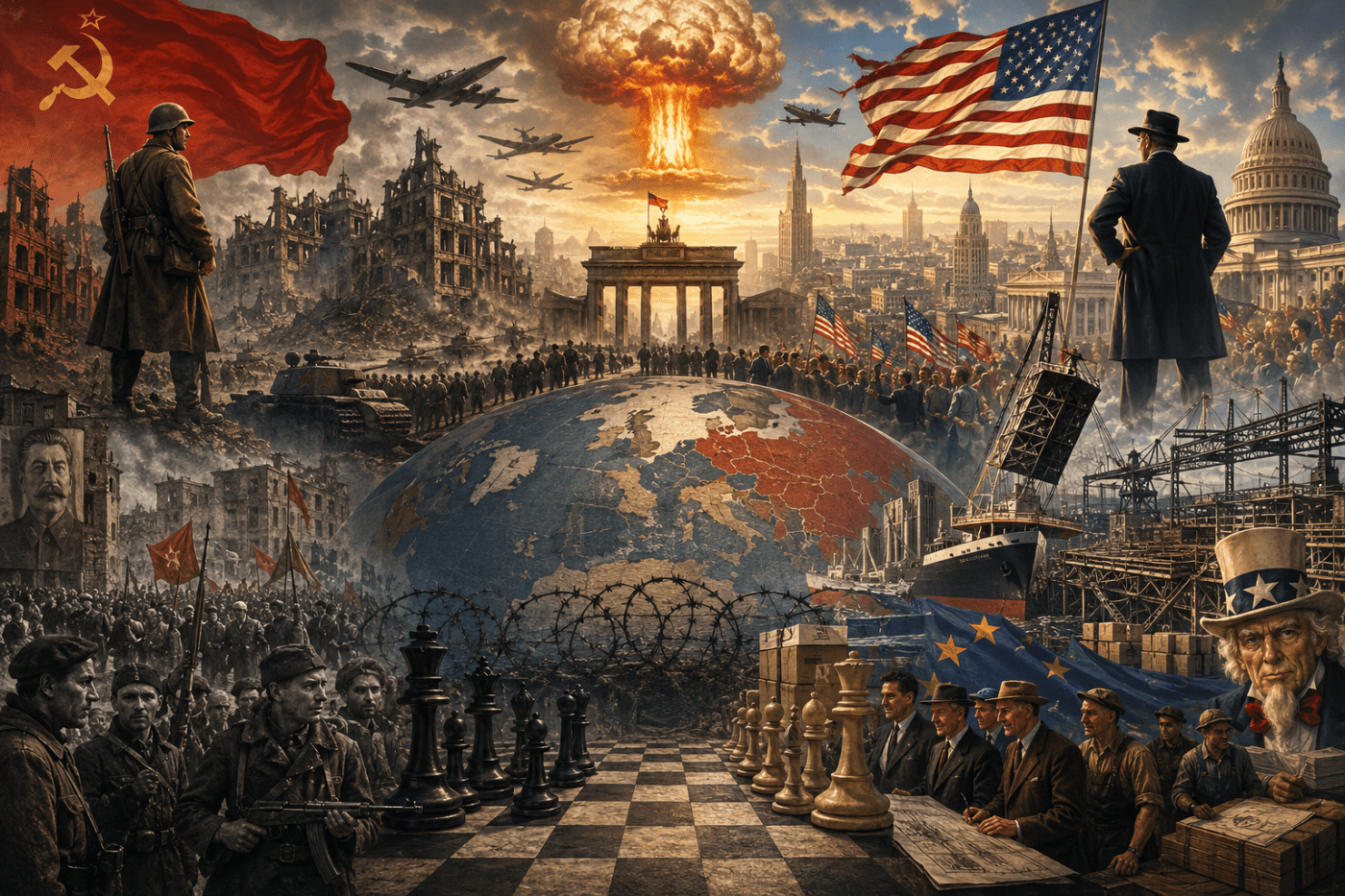
This essay argues that the early Cold War emerged not from inevitable ideological conflict or irrational Soviet expansionism, but from the United States’ determination to reconstruct and stabilize a U.S.-led capitalist world order after World War II against the rising pressures of socialism, anti-fascist radicalism, labor militancy, and anti-colonial liberation. Drawing on the strategic crises of Poland, Greece, Germany, atomic diplomacy, the Marshall Plan, covert political warfare, and the globalization of containment, the essay traces how Anglo-American elites transformed wartime alliance into permanent peacetime confrontation, while the Soviet Union—shaped by catastrophic wartime devastation and deep security fears—sought buffer zones and strategic survival. The result was the institutionalization of a global Cold War system rooted in economic integration, propaganda, covert operations, militarization, and ideological discipline that would define the modern imperial order.
By Prince Kapone | Weaponized Information | May 9, 2026
The Myth of “Soviet Aggression”: Setting the Terms of the Debate
The Cold War is supposed to be over. That is the official story. The Berlin Wall fell, the Soviet Union dissolved, Wall Street celebrated like a drunk landlord after an eviction, and liberal intellectuals declared “the end of history” as though humanity had finally fulfilled its destiny inside a privatized shopping mall patrolled by American bombers. Capitalism, we were told, had defeated socialism not only economically and militarily, but morally and permanently. The future belonged to deregulation, financial speculation, humanitarian bombing campaigns, IMF restructuring packages, and elections carefully supervised by institutions headquartered somewhere between Washington, Brussels, and a defense contractor’s boardroom.
Yet history refused to obey imperial scriptwriters. The old Cold War language returned almost immediately, dusted off and repackaged for a new century. We were warned once again about “authoritarian expansion,” “threats to democracy,” “foreign disinformation,” and enemies of the “rules-based international order”—that wonderfully elastic phrase meaning rules written in Washington and enforced at missile-point everywhere else. NATO expanded steadily eastward despite repeated assurances to the contrary. Economic sanctions became normalized as instruments of siege warfare. Information systems fused with military and intelligence infrastructure. Russia was reconstructed as a civilizational enemy. China became the new existential threat. Iran remained criminalized for the unforgivable offense of refusing imperial supervision. Multipolar institutions were treated not as geopolitical alternatives but as acts of rebellion against the sacred right of the Atlantic powers to manage the planet.
The Cold War, then, did not simply disappear and return. Its institutions survived. Its assumptions survived. Its military architecture survived. Its propaganda reflexes survived. The slogans changed while the machinery remained intact. The same imperial order that once described anti-colonial movements as Soviet puppets now describes independent development projects as threats to “global stability.” Yesterday the targets were Guatemala, Congo, Indonesia, Vietnam, Chile, and Iran. Today they are BRICS, Huawei, Belt and Road infrastructure, de-dollarization, sovereign industrial policy, and any state reckless enough to believe that political independence should include control over its own economy, labor, resources, or technological future.
That is why the historical narrative of the original Cold War still matters. It is not merely a story about the past. It is an ideological operating manual for the present. It legitimizes sanctions, encirclement, intelligence operations, covert destabilization, military alliances, information warfare, and the continued expansion of a global order organized around American strategic primacy. The mythology of the Cold War functions less like historical memory than like infrastructure: a permanent system for manufacturing consent around empire.
According to the orthodox Western account, the wartime alliance collapsed because Joseph Stalin and the Soviet Union pursued aggressive expansion after 1945. Eastern Europe was supposedly “taken over” by Moscow in violation of wartime agreements. The United States allegedly reacted reluctantly and defensively. Containment emerged as an unfortunate necessity. NATO became a shield for democracy. The Marshall Plan represented humanitarian reconstruction. American intervention across Europe and later the colonial world served merely to defend freedom against totalitarian aggression.
This mythology has been repeated so relentlessly that it now passes for common sense itself. Hollywood reproduced it. Universities professionalized it. Newspapers sanctified it. Politicians ritualized it. Entire generations were trained to interpret the twentieth century through a morality play in which the United States inherited the role of global guardian while every challenge to capitalist order became evidence of tyranny, fanaticism, or foreign subversion. The crimes of empire disappeared beneath the sentimental glow of “leadership.”
The ideological function of this narrative is obvious once one steps outside it. It transforms U.S. power into something reactive rather than expansionist. It erases anti-colonial struggle by reducing every conflict to Soviet manipulation. It hides the reconstruction of global capitalism beneath the language of “freedom.” It converts anti-communism from a worldwide campaign of political warfare, labor discipline, military coercion, and counter-revolution into a posture of innocent anxiety. Most importantly, it presents American domination not as a historically specific imperial project rooted in class power and capitalist expansion, but as the natural expression of civilization itself.
This essay rejects that framework completely.
The Cold War did not originate primarily from irrational Soviet aggression or abstract ideological fanaticism. It emerged from Anglo-American efforts to reconstruct and stabilize a capitalist-imperialist world order after the anti-fascist victory of World War II. The destruction of fascism created revolutionary possibilities across Europe and the colonial world. Old ruling classes stood discredited by collaboration, appeasement, and fascist accommodation. Millions of workers and peasants emerged from the war armed, radicalized, organized, and politically conscious. Communist parties possessed enormous legitimacy because communists had often formed the backbone of anti-fascist resistance movements. Anti-colonial struggles accelerated from Vietnam to Indonesia to Algeria. Socialism no longer appeared as a distant intellectual theory discussed by melancholic academics beneath café portraits of Marx. It appeared as a living historical force tied to resistance, reconstruction, liberation, and national survival.
This was the real crisis confronting Anglo-American planners after 1945. The anti-fascist victory threatened to become something far more dangerous than the defeat of Germany and Japan. It threatened to become social revolution.
Across Europe, industrial economies lay shattered. Railways, factories, ports, bridges, and entire cities had been pulverized. Tens of millions were displaced. Hunger spread across the continent. Black markets flourished beside armed political movements. In Italy and France, communist parties emerged from the resistance with mass support and deep roots inside organized labor. In Greece, communist-led partisans had carried the burden of anti-fascist struggle while Britain prepared to crush them before the war had even fully ended. In Yugoslavia, Tito’s forces liberated large sections of the country independently. In China, communist power expanded through anti-Japanese resistance. In Vietnam, Ho Chi Minh fused national liberation with anti-colonial socialism. Across the colonial world, oppressed peoples watched European empires collapse into barbarism, dependence, and exhaustion while still preaching civilization to everybody else.
The old imperial powers emerged from the war weakened and compromised. Britain remained formally victorious but materially diminished, clinging to empire with exhausted hands. France returned from occupation politically fractured and morally discredited. Germany lay destroyed. Japan was occupied. The Soviet Union, though victorious, suffered devastation on a scale almost unimaginable in the contemporary West: tens of millions dead, entire regions obliterated, infrastructure annihilated, agriculture shattered, cities reduced to skeletal ruins. Soviet policy after the war cannot be understood apart from this catastrophe. A state invaded repeatedly through Eastern Europe, at the cost of unimaginable human destruction, was never going to approach geopolitics through liberal fantasies about goodwill, parliamentary etiquette, and polite diplomatic trust exercises.
The United States, meanwhile, emerged from the war in a position unprecedented in modern capitalist history. Its industrial plant remained intact. Its productive capacity expanded massively during wartime mobilization. The dollar became globally dominant. American finance capital entered the postwar world with extraordinary leverage. Washington possessed the atomic monopoly, overwhelming manufacturing power, command over emerging global financial institutions, and the ability to shape reconstruction across entire continents.
American planners understood perfectly well what this meant. The United States did not stumble accidentally into global leadership like a confused tourist wandering into an empire by mistake. As historians such as Melvyn Leffler have shown, U.S. officials openly pursued “preponderance of power”: reconstruction of Europe and Japan within a capitalist framework integrated into American markets, institutions, financial systems, and strategic networks. The objective was not simply recovery. It was controlled recovery. It was the reconstruction of capitalism under American management before revolutionary movements could transform postwar crisis into systemic rupture.
Containment, therefore, was never merely defensive. It was a project of world-order construction. The Marshall Plan illustrates this perfectly. Popular mythology remembers it as humanitarian generosity flowing from democratic virtue. In reality, reconstruction was inseparable from anti-communist stabilization, market integration, political discipline, and strategic consolidation. American aid rebuilt Europe while simultaneously reorganizing it safely for capitalism and securely beneath U.S. leadership.
The same logic extended beyond Europe almost immediately. The anti-fascist victory destabilized colonial rule across Asia, Africa, Latin America, and the Middle East. Anti-colonial movements increasingly linked national liberation with socialism, land reform, resource sovereignty, anti-imperialism, and independent development. The Cold War was therefore never merely a European confrontation between two superpowers glaring suspiciously across barbed wire. It became a global struggle over whether the colonized world would achieve genuine sovereignty or simply exchange direct colonial rule for new systems of financial, military, and political dependency supervised from Washington.
Washington consistently feared not only communist revolution, but independent development itself—especially when tied to land redistribution, nationalization, neutralism, industrial planning, or control over strategic resources. The issue was never democracy in the abstract. The issue was whether newly independent states would remain integrated inside a U.S.-managed capitalist order.
None of this requires romanticizing Soviet policy. The Soviet Union was not a utopia distributing flowers across Eastern Europe while choirs sang revolutionary hymns in perfect harmony. Soviet policy involved coercion, strategic domination, repression, and the narrowing of political pluralism. But serious historical analysis requires asymmetry rather than liberal moral flattening. The USSR emerged from annihilatory war seeking security, reconstruction, buffers, and survival. The United States emerged from victory seeking global preponderance, capitalist stabilization, strategic integration, and worldwide influence. These are not historically equivalent projects.
The anti-fascist alliance itself contained incompatible political futures from the beginning. For millions of workers, peasants, colonized peoples, and resistance fighters, anti-fascism implied social transformation: workers’ power, socialism, decolonization, land redistribution, and destruction of the oligarchic order that had incubated fascism in the first place. For Anglo-American planners, anti-fascism could never be permitted to become anti-capitalism. That contradiction sat beneath the alliance like an unexploded mine.
Communist parties emerged from the war mass-based, armed, electorally viable, and deeply rooted inside labor movements. In France and Italy especially, they possessed legitimacy earned through resistance rather than manufactured through advertising firms, intelligence operations, and billionaire-owned newspapers. To American planners, this represented not merely ideological competition but a structural threat to capitalist reconstruction itself.
The alliance therefore began fracturing long before official Cold War mythology announces the beginning of hostilities. Tensions surrounding the Second Front, disputes over reparations, the atomic bomb, Greece, Germany, Poland, and Eastern Europe reflected deeper contradictions already embedded within wartime cooperation. By the time of the Truman Doctrine and Marshall Plan, the transition was already underway: from military alliance against fascism to economic containment, covert political warfare, ideological confrontation, and militarized bloc formation.
The Cold War cannot be reduced to diplomatic rivalry or ideological disagreement between two states. It was a global struggle over how the postwar world would be organized: whether around socialist transformation, anti-colonial liberation, and sovereign development, or around a U.S.-managed capitalist order secured through military alliances, economic integration, intelligence operations, sanctions, propaganda systems, and political warfare.
The sections that follow trace the construction of that order historically and materially. They examine the wartime origins of distrust, the revolutionary crisis unleashed by anti-fascist victory, the emergence of American preponderance, atomic diplomacy, the Marshall Plan as capitalist reconstruction, the rise of organized political warfare, the militarization of Europe, the globalization of containment, and the asymmetrical security logic shaping Soviet policy after 1945.
The Cold War did not emerge from irrational hatred, Soviet insanity, or civilizational incompatibility. It was assembled through a sequence of material decisions made in the ruins of World War II as Anglo-American power moved to reconstruct a capitalist world system while suppressing the revolutionary possibilities unleashed by anti-fascist victory. To understand how the wartime alliance unraveled into permanent confrontation, we must begin not with the mythology of Soviet aggression, but with the contradictions already forming beneath the alliance itself.
Foundations of Distrust, 1942–1944: The Second Front Delay and the Fracturing of the Grand Alliance
The alliance that defeated Nazi Germany was never a harmonious coalition united by shared democratic virtue. It was a temporary convergence of incompatible historical forces held together by the immediate necessity of destroying fascism. Beneath the public ceremonies of Allied unity stood three radically different projects. Britain fought to preserve a dying empire stretched across the globe through colonial extraction and naval supremacy. The United States entered the war as an ascendant capitalist giant preparing to inherit leadership of the imperial world-system from exhausted European powers. The Soviet Union fought a war of physical survival against a genocidal invasion explicitly designed to annihilate socialism, depopulate Eastern Europe, and reduce vast sections of the Soviet population to slave labor or extermination. For Soviet citizens, the war was not an abstract geopolitical dispute discussed over diplomatic banquets and cigar smoke. It was organized industrial slaughter. Villages disappeared from the map. Entire cities became graveyards. Millions were burned, starved, executed, displaced, or worked to death beneath a colonial-racial campaign of extermination unprecedented in modern European history.
The dispute over the Second Front emerged from this radically unequal reality. For the Soviet leadership, the question was immediate and existential: how quickly would Britain and the United States open a major western front capable of forcing Germany to divide its military concentration? Every month of delay translated into more Soviet dead, more destroyed cities, more erased villages, and more territory drowned in blood. For London and Washington, however, the issue became entangled with imperial calculations, operational caution, postwar strategy, and mounting anxiety over the political consequences of liberation itself. The delay of the Second Front did not mechanically “cause” the Cold War, but it produced the atmosphere of distrust in which the Cold War became possible. It raised the questions that would later fracture the alliance completely: Who would bear the burden of defeating fascism? Which power would dominate Europe after Hitler’s collapse? Would communist movements emerge from resistance with mass legitimacy and political authority? Could Anglo-American capitalism contain Soviet influence without openly destroying the alliance before Germany was defeated?
The Soviet Union carried the overwhelming burden of the anti-fascist war in Europe. Approximately 26 to 27 million Soviet citizens died during the war, while the Nazi invasion itself was conceived as a racial-colonial war of extermination involving starvation plans, depopulation schemes, slave labor systems, and organized mass murder. Soviet civilians were not accidental casualties trapped between armies; they were among the principal targets of the Nazi project itself. The Eastern Front absorbed the overwhelming concentration of German military power. Moscow, Leningrad, Stalingrad, Kursk, and later Operation Bagration shattered the Wehrmacht at catastrophic human cost. At Stalingrad the myth of German invincibility died frozen beside the Volga. At Kursk, the largest armored battle in history crippled Germany’s offensive capacity permanently. By 1944, the Red Army had become the decisive anti-fascist military force on the European continent.
Most German military losses occurred on the Eastern Front. Nazi Germany was not principally defeated in Normandy, however important the Western Front later became. The Wehrmacht was broken through years of attritional warfare against the Soviet Union. Operation Bagration in 1944 destroyed Army Group Center and collapsed German lines across Belarus in one of the most devastating defeats in German military history. By then the Soviet Union was not merely surviving fascism. It was dismantling the military foundations of Nazi Europe itself. None of this diminishes the significance of Western Allied contributions, strategic bombing, colonial troop mobilization, resistance networks, naval warfare, or the liberation of Western Europe. But historical reality matters. The Soviet Union fought a continental extermination war while absorbing the overwhelming share of destruction inflicted by Nazi Germany.
From 1942 onward, Stalin repeatedly demanded a major cross-Channel invasion capable of forcing Germany to divert substantial military resources away from the East. Soviet leadership viewed this not as diplomatic theater but as the minimum obligation of an alliance supposedly united against fascism. Yet delay followed delay. Negotiations throughout 1942 and 1943 revealed mounting tensions over the Second Front question, with Churchill repeatedly resisting definitive commitments while emphasizing logistical limitations, operational risk, and insufficient preparation.
Some of these military concerns were real. Amphibious invasion on the scale eventually required for Normandy involved staggering logistical complexity. American forces were still mobilizing. Britain remained cautious after earlier disasters on the continent. But history is shaped not only by objective constraints, but by how states interpret the intentions behind them. From Moscow’s perspective, Anglo-American rhetoric increasingly appeared disconnected from material sacrifice. Soviet leaders watched Red Army casualties climb into the millions while Britain prioritized North Africa, Sicily, Italy, and Mediterranean operations deeply tied to imperial geography and postwar positioning. Every delay on the Western Front meant more Soviet dead. The dispute therefore evolved beyond military timing into political interpretation. Soviet leaders increasingly suspected that sections of the British ruling class were willing to let the USSR bleed so long as Germany and the Soviet Union continued exhausting one another.
That suspicion did not emerge from fantasy. It emerged from concrete wartime contradictions. Communist prestige was expanding rapidly across Europe. Resistance movements in France, Italy, Yugoslavia, and Greece increasingly possessed revolutionary potential. Fascist collapse threatened not merely military defeat for Germany, but the destabilization of capitalist rule across the continent. For sections of the British elite especially, the nightmare scenario was not simply Nazi victory. It was a postwar Europe dominated by communist-led mass movements emerging from anti-fascist legitimacy.
No figure embodied these contradictions more clearly than Winston Churchill. Churchill consistently favored a Mediterranean-centered strategy focused on North Africa, Sicily, Italy, the Balkans, and the eastern Mediterranean rather than an immediate invasion of France. This reflected far more than military caution. It reflected imperial strategy. Britain’s worldview remained organized around Mediterranean sea routes, the Suez Canal, Middle Eastern oil corridors, and preservation of British leverage in Southern and Eastern Europe. Churchill feared not only German power, but the revolutionary consequences of fascist collapse. Communist-led partisan movements were gaining strength across Southern Europe, while Soviet military advance threatened to transform the political balance of the continent. Greece became especially central because Britain intended to crush communist influence there before liberation could become revolution.
From Moscow’s standpoint, Mediterranean operations increasingly looked less like anti-fascist urgency and more like imperial maneuvering. Soviet leaders watched Britain positioning itself politically across the Mediterranean and Balkans while Soviet cities burned under German assault. The Kremlin therefore interpreted British strategy through an increasingly hostile lens: Britain appeared less interested in rapidly defeating Germany than in shaping the political geography of postwar Europe before the Red Army reached too far west.
The Western alliance itself, however, was hardly unified. American military planners frequently clashed with Churchill’s Mediterranean obsession. General George Marshall repeatedly argued for concentrating resources toward a decisive cross-Channel invasion rather than dissipating forces across secondary theaters. Roosevelt balanced uneasily between these competing priorities while simultaneously preparing the United States for postwar global dominance. Roosevelt was less emotionally attached than Churchill to formal colonial empire, but American planners increasingly envisioned a world system reorganized around U.S. industrial, financial, and strategic supremacy. The Second Front dispute therefore exposed multiple agendas colliding uneasily inside the alliance itself: Soviet survival imperatives, British imperial strategy, American military planning, and emerging struggles over the shape of the postwar order.
Meanwhile, anti-communist hostility never disappeared beneath wartime cooperation. Powerful sectors of the British and American ruling classes continued viewing the Soviet Union simultaneously as ally and future enemy. Anti-socialist assumptions persisted inside diplomatic circles, intelligence institutions, military planning networks, conservative political factions, and major sectors of the press. The alliance against Hitler was strategically necessary, but it never erased the class hatred embedded inside capitalist ruling structures toward socialism itself.
As Nazi defeat approached, portions of the Anglo-American intelligence apparatus increasingly shifted attention toward the postwar Soviet position in Europe. Operation Sunrise involved secret OSS negotiations in Switzerland between Allen Dulles and SS General Karl Wolff regarding surrender arrangements in northern Italy. German officials increasingly hoped sections of the Anglo-American alliance might eventually align against the Soviet Union or at minimum limit Soviet influence in Central Europe. Soviet exclusion from these negotiations reinforced fears that the Western powers were already thinking beyond anti-fascist unity toward postwar confrontation.
At the same time, intelligence planning itself increasingly drifted toward anti-Soviet preparation. OSS operations increasingly cultivated anti-Soviet émigré networks and intelligence structures useful for future anti-communist operations. Late-war OSS activity also deepened relationships with former enemy intelligence assets and anti-communist operational networks that would later feed directly into Cold War infrastructure. Even before fascism had been fully destroyed, sections of the Anglo-American security apparatus were already preparing for the next conflict.
The speed of this transition became unmistakable in 1945. Churchill ordered contingency planning for possible military confrontation with the Soviet Union, including scenarios contemplating surprise attack and potential use of German forces against the USSR. Operation Unthinkable never became operational policy, but its significance is enormous. Before the anti-fascist war had even fully concluded politically, sections of the British state were already imagining military confrontation against their Soviet ally. Anti-fascism was rapidly giving way to anti-communism as the organizing principle of strategic thinking.
The delayed Second Front therefore mattered because it unfolded inside this broader atmosphere of emerging geopolitical and class hostility. The issue was never merely operational timing. It foreshadowed the coming struggles over Poland, Germany, reparations, Eastern Europe, reconstruction, and political legitimacy across liberated Europe. Soviet distrust did not emerge from Russian paranoia or Stalinist irrationality. It emerged from concrete wartime experience: unequal sacrifice, strategic delay, imperial maneuvering, intelligence intrigue, and mounting evidence that sections of the Anglo-American ruling class already viewed anti-communism as the organizing principle of the postwar order.
By 1944, the military and political situation transformed rapidly. The Red Army surged westward. Fascist collapse approached. Communist prestige expanded. Resistance movements strengthened across occupied Europe. Liberation itself became a struggle over political authority, class power, land, labor, and the future organization of society. The central question was no longer simply how Germany would be defeated. The question became which social forces would inherit Europe after fascism collapsed. The anti-fascist victory threatened to destabilize capitalist rule across the continent, radicalize workers and peasants, accelerate decolonization, and empower socialist movements with genuine mass legitimacy. The foundations of the Cold War were therefore laid not after World War II ended, but inside the contradictions of the wartime alliance itself. As fascism collapsed, Anglo-American elites increasingly confronted a terrifying possibility: that anti-fascist victory might escape capitalist control and become social revolution.
Liberation as Counter-Revolution, 1944–1945: Europe’s Revolutionary Crisis and the Western Fear of Armed Anti-Fascism
As the Red Army smashed westward through Eastern Europe and Nazi power began collapsing beneath Soviet offensives, partisan warfare, industrial exhaustion, and Allied military pressure, the political meaning of “liberation” became the central unresolved question of postwar Europe. The destruction of fascism did not automatically restore the old liberal order as though Europe had merely suffered a temporary interruption in bourgeois normalcy. The continent that emerged from occupation was not peacefully awaiting the return of parliamentary routine and respectable bankers in pressed suits lecturing workers about civic responsibility. Europe in 1944 and 1945 was a continent-wide legitimacy crisis. States had collapsed. Ruling classes had collaborated, accommodated, or hidden while fascism ruled through terror. Millions of workers and peasants emerged from the war armed, radicalized, organized, and unwilling to quietly reinstall the same social order that had produced depression, fascism, imperial slaughter, and occupation in the first place.
Across Europe, communist parties and partisan movements emerged from the war not as fringe conspiracies imported artificially from Moscow, but as mass political forces rooted in resistance itself. They organized sabotage networks, underground presses, labor mobilization, clandestine logistics, guerrilla warfare, and urban insurrection while large sections of the old bourgeois order either compromised with fascism or waited cautiously for the outcome before rediscovering their democratic convictions. In France, sectors of the elite openly collaborated with Vichy. In Italy, fascism emerged organically from the crisis of liberal capitalism rather than descending mysteriously from another planet. Throughout occupied Europe, anti-fascist legitimacy increasingly belonged not to traditional ruling institutions, but to workers, partisans, communists, peasants, and armed resistance movements that had materially fought fascism while the old order collapsed morally and politically around them.
This is the reality systematically erased by orthodox Cold War mythology. The standard Western narrative portrays communism in postwar Europe as an external Soviet intrusion imposed mechanically through military occupation. In reality, communist parties gained enormous legitimacy because they fought fascism materially while much of the old order collapsed into compromise, cowardice, or outright collaboration. Alessandro Brogi demonstrates that communist movements in France and Italy emerged from liberation as deeply rooted national political forces tied to anti-fascist resistance, labor structures, and mass working-class organization. This terrified Anglo-American planners because communist parties were no longer isolated revolutionary sects operating on the margins of political life. They had become mass organizations with electoral strength, labor influence, municipal authority, partisan legitimacy, and deep roots inside working-class society itself.
The crisis confronting capitalist Europe after 1945 was therefore not simply Soviet military expansion. It was the possibility that anti-fascist victory might become social revolution. Workers expected transformation, not merely the resurrection of the same ruling classes that had overseen interwar collapse, appeasement, fascist accommodation, colonial brutality, and economic misery. Millions no longer accepted the liberal fantasy that democracy meant returning power to elites who had failed catastrophically before the war and often disgraced themselves during it. The anti-fascist struggle transformed political legitimacy itself.
Nowhere was this clearer than in France and Italy. The French Communist Party and Italian Communist Party emerged from liberation as enormous mass organizations with deep support among industrial workers, partisans, intellectuals, municipal governments, and sections of the rural poor. These were not symbolic protest parties tolerated harmlessly inside parliamentary theater. They were genuine contenders for political power inside core capitalist societies. Brogi shows that communist strength in France and Italy quickly became a central strategic concern for Washington, forcing U.S. planners to develop anti-communist intervention strategies before the formal Cold War architecture had even fully consolidated. This chronology matters because it demolishes the mythology that containment emerged purely as a reaction to Soviet aggression. The United States moved aggressively against communist movements in Western Europe because anti-fascism itself had produced mass anti-capitalist legitimacy.
By 1947, communists would be expelled from governing coalitions in both France and Italy under mounting American pressure, while Italy would soon become the prototype for an entirely new form of imperial management integrating covert operations, propaganda, labor manipulation, business coordination, religious institutions, civic fronts, psychological warfare, and clandestine finance into what Washington increasingly understood as political warfare. But even before these mechanisms became fully institutionalized, France and Italy had already revealed the central nightmare confronting capitalist planners: communist movements possessed the ability to compete for power inside formally democratic societies through mass legitimacy rather than foreign invasion.
Greece exposed this contradiction in even more naked form because there the transition from anti-fascist alliance to anti-communist counter-revolution unfolded before the Cold War had fully announced itself ideologically. During Nazi occupation, the communist-led EAM/ELAS resistance became the dominant anti-fascist force inside Greece, organizing military struggle, food distribution, local governance, and mass political mobilization against occupation. Yet the moment liberation raised the question of who would inherit political authority, Britain intervened militarily to prevent communist-led forces from taking power. Historical retrospectives on the December 1944 Athens fighting emphasize the direct confrontation between British forces, the restored Greek state, and communist-led resistance fighters, while former collaborators and right-wing forces increasingly reentered the emerging anti-communist order.
Greece became the prototype of Cold War counter-revolution before “containment” had even become official doctrine. Communist resistance was celebrated so long as it fought Nazis. The moment it threatened capitalist restoration and British imperial influence in the Eastern Mediterranean, it became an enemy to be crushed. Anti-fascism rapidly gave way to anti-communism as the organizing principle of postwar order. Britain’s intervention was not motivated by some abstract devotion to parliamentary democracy. Greece occupied critical strategic terrain tied to Mediterranean control, imperial communication routes, Middle Eastern access, and regional influence. Communist-led liberation threatened not only a domestic ruling class, but the imperial geography of British power itself.
The lesson was unmistakable. Armed anti-fascist movements would be tolerated only so long as they did not transform military victory into social revolution. The issue was never simply Soviet expansion. The issue was whether workers, peasants, and partisan movements emerging from anti-fascist struggle would seize political authority from collapsing capitalist elites.
Poland revealed a different but equally explosive contradiction because there the central issue became the collision between national sovereignty and Soviet security after a genocidal invasion campaign that nearly annihilated the USSR. Poland occupied uniquely sensitive strategic terrain in Soviet thinking. For centuries it had functioned as the invasion corridor through which hostile armies moved eastward into Russia. Operation Barbarossa transformed this historical memory into living catastrophe. Tens of millions of Soviet dead ensured that Moscow would never again treat Eastern Europe as neutral geopolitical space.
This is why liberal narratives about “Soviet denial of Polish freedom” are historically dishonest when detached from the material reality shaping Soviet policy after 1941. The Yalta agreements spoke vaguely about democratic inclusion and free elections, but those diplomatic formulas concealed fundamentally incompatible understandings of what “democracy,” “security,” and “anti-fascism” actually meant. Meanwhile, Operation Tempest revealed that anti-German resistance inside Poland simultaneously functioned as an attempt by British-backed Polish forces to establish politico-military control before the Soviet Red Army could do so.
Nazi occupation shattered the Polish social order. The prewar state collapsed. Much of the intelligentsia was exterminated. Polish Jewry was subjected to industrial annihilation. Infrastructure lay in ruins. Political legitimacy fragmented across competing nationalist, socialist, communist, conservative, and anti-Soviet forces. The myth of a unified Polish national resistance conceals a deeply fractured political landscape shaped by class conflict, occupation, nationalism, anti-communism, border disputes, and competing visions of postwar Poland.
Three competing legitimacies collided simultaneously. Soviet and Polish communist forces claimed legitimacy through anti-fascist liberation, reconstruction, land reform, destruction of reactionary structures, and protection against renewed German aggression. The London government-in-exile and Armia Krajowa grounded legitimacy in continuity with the prewar Polish state, nationalism, sovereign independence, and anti-German resistance. Britain and the United States framed the issue through the language of pluralism and self-determination while increasingly treating Poland as a strategic test of Soviet intentions throughout Eastern Europe.
As noted, Operation Tempest exposed the dual political character of anti-fascist resistance under these conditions. Militarily, it was genuinely anti-German. Politically, it aimed to establish London-backed authority before Soviet consolidation could occur. From Moscow’s perspective, armed formations hostile to Soviet influence operating inside liberated territory could not be viewed as politically neutral actors. Anti-German resistance and anti-Soviet state-building increasingly merged into the same battlefield.
The Warsaw Uprising crystallized these contradictions with tragic brutality. It was simultaneously a heroic anti-Nazi struggle, a nationalist attempt to assert sovereignty before Soviet entry, and a battle over postwar legitimacy. Germany bears direct responsibility for Warsaw’s destruction and the massacre of civilians during the suppression of the uprising. But the uprising also unfolded inside a larger strategic conflict shaped by profound Soviet distrust toward the London-backed Polish leadership. The Armia Krajowa hoped to establish political authority before Soviet-backed institutions could consolidate power. Stalin, meanwhile, viewed the AK through the lens of security calculations shaped by anti-Soviet hostility, border fears, and the memory of invasion. Red Army exhaustion and operational limitations were real, but Soviet political calculation was equally real. The destruction of the AK objectively strengthened Soviet-backed forces regardless of the precise balance between military limitation and political intent shaping Soviet behavior.
Yalta concealed rather than resolved these contradictions. Diplomatic formulas promising coalition governments, democratic participation, and anti-fascist unity temporarily papered over fundamentally incompatible visions of postwar Europe. For the Western powers, “democracy” increasingly meant governments open to capitalist reconstruction and resistant to communist dominance. For the Soviet Union, it meant governments that would not become hostile corridors for another western invasion. For communist movements throughout Europe, it often meant land reform, destruction of reactionary elites, workers’ participation, reconstruction, and social transformation after fascist collapse.
Taken together, France, Italy, Greece, and Poland revealed the central contradiction emerging from anti-fascist victory. France and Italy demonstrated that communism possessed mass legitimacy inside capitalist societies themselves. Greece demonstrated that anti-fascist resistance would be violently crushed once it threatened capitalist restoration and imperial strategic order. Poland revealed the frontier where Soviet security imperatives collided directly with nationalism, sovereignty, and Western geopolitical maneuvering after genocidal war. The Cold War did not begin because liberation failed. It began because liberation threatened to escape capitalist control. Fascism’s defeat empowered workers, communists, partisans, and colonized peoples across enormous sections of the world, forcing Anglo-American power to transform liberation into containment before anti-fascism became revolution.
Atomic Diplomacy and the Power Transition, 1945: Hiroshima, Nagasaki, and the U.S. Announcement of Postwar Supremacy
The atomic bombings of Hiroshima and Nagasaki marked a historical rupture unlike any previous military event in modern history because they announced the arrival of a new structure of power. The mushroom cloud rose not only over Japan, but over the entire architecture of the postwar world order. Nuclear weapons transformed diplomacy itself. For the first time, industrial civilization possessed the ability to annihilate entire urban populations in moments through the fusion of scientific research, industrial production, military bureaucracy, and centralized state power. August 1945 therefore represented more than the end of World War II. It marked the opening of an era in which global politics would increasingly operate beneath the shadow of mechanized extermination.
The timing mattered enormously. Nazi Germany had already collapsed. Japan was militarily exhausted, strategically isolated, economically strangled, and facing inevitable defeat. Yet precisely as fascism was being destroyed, the contradictions temporarily submerged beneath the anti-fascist alliance began violently resurfacing. Soviet security demands, capitalist reconstruction, colonial recovery, geopolitical competition, and competing visions of postwar Europe and Asia all reemerged simultaneously. The bomb accelerated this transition by introducing a staggering asymmetry into the emerging postwar order: one side emerged economically strengthened and armed with unprecedented destructive power, while the other emerged victorious but devastated, encircled, and obsessed with survival after near-annihilation.
The asymmetry of 1945 was almost absolute. The United States emerged from the war economically expanded, industrially dominant, financially ascendant, and geographically untouched by mass devastation. American factories operated at immense productive capacity. Infrastructure remained intact. The dollar became the foundation of the emerging Bretton Woods system. U.S. naval and air power possessed global reach. The United States entered the postwar era as the world’s sole atomic power, combining nuclear monopoly with industrial and financial supremacy on a scale unprecedented in capitalist history. Washington therefore approached the postwar settlement not as one victorious power among equals, but as the commanding center of a reconstructed capitalist world system increasingly organized around American power.
The Soviet Union emerged from the war in radically different condition. Victory came through devastation bordering on civilizational catastrophe. Tens of millions were dead. Entire cities and villages were erased. Agricultural regions were scorched. Transportation systems collapsed under years of warfare. Industrial zones suffered immense destruction. Soviet leaders viewed postwar politics through the memory of repeated invasions moving west to east across Europe: Napoleon, World War I, the intervention armies after 1917, and finally Hitler’s extermination campaign. Soviet insistence upon friendly governments along its borders therefore emerged not from abstract ideological paranoia alone, but from the concrete geography of repeated invasion and mass death.
The Cold War emerged inside this asymmetrical landscape: one side economically strengthened, globally dominant, and nuclear armed; the other victorious but traumatized, devastated, and determined never again to face invasion without strategic depth.
Into this world entered the atomic monopoly.
The successful Trinity test in July 1945 transformed the atmosphere surrounding the Potsdam Conference almost immediately. American officials understood at once that the bomb altered not merely military calculations, but diplomatic leverage itself. The U.S. State Department’s own historical summary acknowledges that the successful atomic test strengthened Truman’s confidence and contributed to a harder posture toward the Soviet Union. Secretary of State James Byrnes increasingly viewed the bomb as a geopolitical instrument capable of strengthening Washington’s bargaining position globally. The atomic monopoly altered diplomacy psychologically as much as militarily. Power no longer rested solely upon industrial production, colonial reach, naval supremacy, or military manpower. It now included the ability to vaporize entire cities while no comparable retaliatory capability yet existed anywhere else on earth.
When Truman informed Stalin at Potsdam that the United States possessed a weapon of “unusual destructive force,” both sides immediately grasped the implications. Stalin was not surprised. Soviet intelligence had already penetrated the Manhattan Project, and Soviet leadership understood the United States was pursuing atomic weapons. But this does not weaken the argument for atomic diplomacy; it strengthens it. The bomb did not need to surprise Soviet leaders to reshape global power relations. Its significance lay in the political reality it announced publicly: the United States now possessed a monopoly over industrialized annihilation.
After Trinity, American dependence upon Soviet entry into the Pacific War declined sharply. Soviet advances in East Asia increasingly appeared not as allied assistance, but as geopolitical complications threatening U.S. dominance in the Pacific settlement. The bomb therefore functioned simultaneously as a weapon against Japan and as an announcement to the world that postwar negotiations would unfold beneath American nuclear supremacy.
Orthodox Cold War mythology insists the bombings were purely tragic military necessities required to force Japanese surrender and avoid catastrophic invasion casualties. This narrative deliberately isolates Hiroshima and Nagasaki from the broader geopolitical transition unfolding in 1945. Revisionist historians such as Gar Alperovitz shattered this mythology decades ago by demonstrating that American officials understood the bomb would also strengthen U.S. leverage against the Soviet Union. Alperovitz argued directly that atomic diplomacy toward the Soviet Union formed an important component of American decision-making surrounding the bomb.
The point is not to reduce Hiroshima and Nagasaki to a simplistic anti-Soviet conspiracy detached from the Pacific War itself. Japan was still fighting. U.S. military planners anticipated brutal invasion scenarios. Military considerations remained real. But the bombings cannot be detached from the emerging struggle over postwar power. The strongest historical interpretation is therefore dialectical rather than reductionist: Hiroshima and Nagasaki simultaneously destroyed Japanese cities and inaugurated a new geopolitical order organized around American nuclear supremacy.
Soviet entry into the Pacific War intensified these calculations dramatically. Stalin had already committed at Yalta to enter the war against Japan following Germany’s defeat. When Soviet forces invaded Manchuria in August 1945, they moved with enormous speed and force, smashing the Japanese Kwantung Army and rapidly advancing into Korea, Sakhalin, and surrounding territories. Historical scholarship increasingly recognizes that Soviet entry shattered Tokyo’s remaining diplomatic strategy and accelerated the collapse of Japanese resistance. Japanese leaders had hoped Moscow might mediate a negotiated settlement preserving elements of the imperial system. Soviet intervention destroyed that possibility almost instantly while threatening occupation zones, revolutionary upheaval, and communist influence spreading across East Asia.
For Washington, Soviet advances intensified the urgency of securing surrender before Moscow expanded its position further throughout Asia. The United States sought overwhelming influence over the occupation of Japan because Japan would become central to the reconstruction of capitalist order across the Pacific. Unlike Germany, Japan emerged overwhelmingly under American control. This mattered enormously. Japan would become a strategic industrial base, anti-communist platform, military outpost, and economic anchor for U.S. power throughout Asia. The rapid partition of Korea along the 38th Parallel revealed how quickly wartime cooperation was giving way to geopolitical division. Soviet advances in Northeast Asia, combined with the looming Chinese Revolution, intensified American fears that anti-colonial and socialist transformation might spread across the region beyond imperial control.
The atomic monopoly therefore did not remain merely a diplomatic advantage. It was rapidly bureaucratized into permanent military planning. This is one of the most revealing dimensions of the early Cold War transition because it demonstrates how quickly the Soviet Union shifted from wartime ally to target inside American strategic thinking. September 1945 War Department and USAAF planning documents show American military planners rapidly developing target calculations for large-scale atomic attacks against 166 Soviet urban-industrial centers. The significance of these plans lies not in proving immediate war was inevitable, but in revealing how quickly U.S. strategic planning normalized the idea of Soviet annihilation only weeks after the alliance against fascism formally ended.
Hiroshima and Nagasaki therefore inaugurated more than a nuclear age. They inaugurated a new machinery of militarized global management in which industrial civilization itself became hostage to permanent strategic calculation. Nuclear weapons were integrated into bureaucratic systems involving target categories, stockpile requirements, industrial destruction models, and civilian extermination planning. This trajectory later culminated in Strategic Air Command planning systems that treated entire Soviet-bloc populations as coordinates within mechanized extermination scenarios.
The bomb transformed diplomacy because it fused negotiation permanently with annihilatory possibility. Atomic capability altered bargaining behavior, military doctrine, geopolitical calculation, and conceptions of world power itself. Soviet leaders responded accordingly by accelerating atomic development, tightening security policy, and consolidating buffer zones throughout Eastern Europe. These actions cannot be understood apart from the reality that the United States possessed nuclear monopoly while simultaneously hardening its political posture toward the USSR.
The symbolic meaning of Hiroshima and Nagasaki extended even further. The bombings revealed the fusion of science, technocracy, industry, bureaucracy, and imperial warfare into forms of destruction capable of eliminating entire civilian populations almost instantaneously. The racial dimensions of this history cannot be ignored. Nuclear weapons were first used against an Asian population after years of intensely racialized Pacific War propaganda and strategic bombing campaigns that had already normalized civilian incineration on extraordinary scale. The atomic age emerged not from moral necessity, but from the convergence of imperial war, technological supremacy, racialized violence, and geopolitical ambition.
Atomic diplomacy therefore marked the transition from wartime alliance toward nuclearized imperial management of the postwar capitalist order. Hiroshima and Nagasaki announced that the United States intended to reconstruct the world from a position unprecedented in modern history: industrial supremacy, financial supremacy, military supremacy, and monopoly control over atomic destruction itself. The bomb did not singlehandedly create the Cold War. But it transformed the structure in which the Cold War emerged by introducing nuclear monopoly into an already profoundly unequal world order.
From atomic monopoly emerged atomic diplomacy. From atomic diplomacy emerged nuclear war planning. From nuclear war planning emerged the militarized architecture of permanent Cold War confrontation. The next rupture would unfold through Truman’s hardened posture toward the Soviet Union, the abrupt termination of Lend-Lease, disputes over reparations and Germany’s future, and Churchill’s public declaration that an “Iron Curtain” had descended across Europe.
The Break in Alliance, 1945–1946: Truman, Lend-Lease, Reparations, Germany, and the “Iron Curtain”
The Grand Alliance did not collapse because Stalin suddenly developed an irrational appetite for world conquest the moment Hitler shot himself in a Berlin bunker. That mythology belongs to Hollywood screenwriters, Cold War propagandists, and professors whose understanding of empire begins and ends at the NATO press office. The wartime alliance fractured because the defeat of fascism reopened the underlying contradiction temporarily buried beneath military necessity: the Soviet Union wanted security after catastrophe, while the United States and Britain moved increasingly toward reconstructing Europe under capitalist management and Anglo-American dominance. The break unfolded through a sequence of escalations — Truman’s accession, the hardening of U.S. diplomacy, the abrupt termination of Lend-Lease, struggles over reparations and German industry, and finally Churchill’s Fulton speech, which transformed an already developing geopolitical rupture into an open ideological crusade.
Roosevelt had managed the alliance as a pragmatic imperial statesman who understood a basic reality: Nazi Germany could not be defeated without the Soviet Union, and any stable postwar arrangement would require accommodation with Soviet security demands whether American elites liked it or not. Roosevelt was no socialist sympathizer. He represented American capitalism as faithfully as a banker represents compound interest. But he understood the necessity of balancing contradictions rather than escalating them recklessly before Germany and Japan had been defeated. Truman entered office under radically different conditions. He possessed less foreign-policy experience, no comparable relationship with Stalin, greater dependence upon advisers, deeper exposure to anti-Soviet hardliners, and, after July 1945, the confidence produced by atomic monopoly. FRUS records from 1945 show American officials openly discussing the “great leverage” Washington possessed over the Soviet Union and the need to demonstrate firmness rather than accommodation. Under Truman, anti-Soviet hostility ceased being an undercurrent inside wartime diplomacy and moved steadily toward becoming the organizing principle of American grand strategy.
This transition unfolded inside a larger project already taking shape within American ruling circles. Washington did not simply seek peace in the narrow diplomatic sense. American planners wanted a reconstructed capitalist world economy organized around U.S. industrial supremacy, dollar dominance, open markets, strategic access, and the integration of Europe and Japan into an American-led system. Soviet influence in Eastern Europe, communist legitimacy in Western Europe, militant labor movements, demands for punitive reparations, and anti-fascist radicalization increasingly appeared not merely as Soviet preferences, but as obstacles to capitalist stabilization itself. The United States emerged from the war with intact industry, financial supremacy, creditor status, and the ability to finance reconstruction on terms no other capitalist power could match. Such power rarely announces itself through dramatic speeches. It operates more quietly through loans, shortages, currencies, trade agreements, and the silent discipline imposed by dependency itself.
The abrupt termination of Soviet Lend-Lease became one of the first material signals that wartime reciprocity was ending and economic coercion was beginning. Formally, Washington justified the move by arguing that Lend-Lease had been wartime aid tied to the defeat of Germany. But historical significance lies not merely in formal legality, but in political meaning. The Soviet Union emerged from the war devastated, faced immense reconstruction burdens, and still maintained obligations in the Pacific War against Japan. From Moscow’s perspective, the sudden cutoff looked less like bureaucratic procedure than a declaration that the United States was prepared to weaponize its economic dominance almost immediately after victory. Stalin sharply objected not simply to the curtailment itself, but to “the manner and form” in which Washington terminated Lend-Lease. The grievance mattered because it revealed a growing Soviet belief that the political relationship itself was changing beneath the language of alliance.
The contrast with Britain exposed the deeper economic logic of the emerging order. Washington ended wartime aid broadly, but quickly shifted toward reorganizing postwar dependency through loans, convertibility demands, dismantling imperial preference systems, and opening trade under American terms. Britain, weakened and indebted, was disciplined into the emerging dollar-centered system. The Soviet Union, devastated but unwilling to integrate itself into capitalist reconstruction under American supervision, faced pressure without incorporation. In both cases, American financial supremacy became an instrument for reorganizing the postwar world long before “containment” had fully hardened into official doctrine.
Germany stood at the center of this struggle because Germany was never merely occupied territory. It was Europe’s industrial core, the historic launchpad for invasion into the Soviet Union, and the indispensable foundation for any future reconstruction of European capitalism. For Moscow, Germany represented the source of unimaginable devastation and therefore had to remain demilitarized, weakened, and incapable of future aggression. Reparations were not abstract punishment. They were compensation extracted from the ruins of Soviet cities, industries, villages, and lives. For Washington and London, however, Germany increasingly became essential to Western European recovery. Ruhr coal, steel, and industrial capacity could not remain permanently dismantled if capitalism in Western Europe was to recover at all. FRUS records on Ruhr rehabilitation explicitly framed the problem as balancing the prevention of renewed German war potential against the need for German industry to contribute to European recovery. Beneath the dry bureaucratic language sat the core contradiction of the postwar settlement itself.
The Potsdam Agreement concealed rather than resolved this contradiction. The agreement established that Soviet reparations would come from the Soviet zone and from agreed removals from western zones, but the formula masked fundamentally incompatible visions for Europe’s future. The Soviet Union demanded security, reparations, and demilitarization. The United States increasingly demanded productivity, integration, recovery, and capitalist stabilization. Germany became the terrain where Soviet security collided directly with American reconstruction strategy. To Soviet leaders, German industrial revival under Anglo-American sponsorship looked dangerously close to historical insanity disguised as economic pragmatism. To American planners, prolonged German weakness threatened the revival of Europe as a functioning capitalist system.
This is why the alliance rupture was economic before it became fully military. The sequence is unmistakable: Lend-Lease termination, reparations conflict, British loan discipline, Ruhr rehabilitation, western German recovery planning, and eventually the Marshall Plan. Long before NATO formalized military confrontation, American economic power was already reorganizing the political geography of Europe. Washington increasingly used its unmatched industrial and financial position to determine which economies would recover, through what currencies, under whose leadership, and against which political forces.
Churchill’s “Iron Curtain” speech at Fulton in March 1946 did not create the Cold War. It publicly baptized a confrontation already underway materially through economic leverage, reconstruction planning, atomic supremacy, and strategic alignment. Churchill’s “Sinews of Peace” address declared that an “iron curtain” had descended across Europe and called for Anglo-American unity against Soviet influence. The speech remains preserved in British archives as one of the foundational ideological documents of the Cold War. Churchill transformed disputes over reconstruction, security, and spheres of influence into a civilizational fable about Western freedom confronting communist darkness. The old imperialist who spent decades defending colonial domination now reappeared as prophet of liberty — proof once again that empire possesses an almost supernatural ability to rename itself morally while preserving the same global hierarchy beneath the new vocabulary.
The ideological power of Fulton rested precisely in what it erased. Churchill obscured Soviet devastation, British intervention in Greece, American atomic monopoly, Western economic leverage, the abrupt end of wartime reciprocity, and the accelerating reconstruction of capitalist Europe under U.S. leadership. The speech invited Western publics to see Soviet influence only as tyranny rather than also as the security policy of a state devastated by the largest invasion in modern history. It presented Anglo-American consolidation as noble defense rather than as the formation of a capitalist bloc organized around American supremacy. The “Iron Curtain” was therefore not merely a phrase. It was an ideological weapon designed to prepare Western populations psychologically for permanent confrontation.
Moscow understood Fulton exactly that way. Stalin’s response in Pravda denounced Churchill’s speech as an attempt to sow dissension among the Allies and obstruct postwar cooperation. Soviet leaders did not interpret Fulton as idle rhetoric from an aging British statesman nostalgic for empire. They understood it as public confirmation that anti-Soviet bloc politics were being consolidated openly.
By 1946, the wartime alliance had fractured across several connected fronts simultaneously. Truman’s accession strengthened hardline anti-Soviet currents inside American policy. Lend-Lease termination signaled the end of wartime reciprocity and the beginning of economic pressure. Germany exposed the contradiction between Soviet security and capitalist reconstruction. Fulton converted strategic conflict into moral crusade. The alliance did not collapse because Stalin irrationally sought world conquest. It fractured because Anglo-American planners increasingly viewed Soviet security demands, communist legitimacy, anti-fascist radicalization, and demands for economic restructuring as obstacles to the reconstruction of a U.S.-dominated capitalist world order.
Once the alliance broke politically, the next stage became institutional. The Truman Doctrine and Marshall Plan would soon transform anti-communism from diplomatic hostility into a comprehensive global system of capitalist reconstruction, ideological discipline, political warfare, and imperial management.
Institutionalization, 1947: Truman Doctrine, Marshall Plan, and the Political-Economic Architecture of Containment
By 1947, the Cold War ceased being a diplomatic quarrel and became a system. The wartime alliance had already fractured through the hardening of Truman’s posture, the abrupt termination of Lend-Lease, the struggle over Germany’s industrial future, and Churchill’s “Iron Curtain” crusade. But a fractured alliance is not yet an order. What changed in 1947 was that the United States began constructing permanent institutions capable of reorganizing Europe economically, politically, ideologically, and eventually militarily against socialism and anti-colonial radicalization. Containment ceased to be improvisation and became infrastructure: military aid, economic reconstruction, anti-communist discipline, covert intervention, labor management, propaganda, psychological warfare, and Western European integration fused into a coordinated architecture of capitalist stabilization under American leadership. This was not a reluctant defensive response to Soviet behavior. It was the organized reconstruction of capitalist power after fascism and war.
The Truman Doctrine announced the ideological language of the new order. On March 12, 1947, Truman asked Congress for $400 million in military and economic assistance for Greece and Turkey. But Greece and Turkey were never merely Greece and Turkey. They were the staging ground for transforming anti-communism into a universal doctrine of American intervention. Truman declared that the United States must support “free peoples” resisting “armed minorities” or “outside pressures”. The phrase deserves recognition as one of the great propaganda achievements of modern empire. Communist-led resistance movements became “armed minorities.” Civil wars became evidence of foreign conspiracy. Anti-colonial instability became Soviet aggression. U.S.-aligned monarchies, oligarchies, and police states became “free peoples” so long as they remained useful to American strategy. Real conflicts over class power, land reform, labor militancy, imperial collapse, and social revolution disappeared beneath the moral theater of “freedom versus totalitarianism.”
The brilliance of the Truman Doctrine from the standpoint of empire was that it transformed counter-revolution into humanitarian obligation. It established the principle that Washington possessed not merely the right, but the moral responsibility, to intervene politically, economically, covertly, and eventually militarily wherever socialism, radical nationalism, or anti-imperialist transformation threatened capitalist alignment. The Truman Doctrine became the basic framework guiding U.S. foreign policy for the next four decades. The language was universal; the class content was unmistakable. Anti-communism became a permanent organizing principle of American power before the full institutional machinery of containment had even been assembled.
That machinery emerged economically through the Marshall Plan. Europe faced genuine devastation: collapsed industry, food shortages, inflation, destroyed infrastructure, unemployment, displaced populations, political instability, and militant labor unrest. Reconstruction was necessary. But reconstruction is never neutral. Every reconstruction restores some social order while foreclosing another. The National WWII Museum notes that U.S. officials linked Europe’s economic deterioration directly to fears of communist political gains. American planners feared poverty would strengthen communism while U.S. industry required markets for surplus production generated during wartime mobilization. The issue was therefore never whether Europe would be rebuilt. The issue was who would control the rebuilding, through what institutions, in whose interests, and against which political forces.
The Marshall Plan functioned simultaneously as capitalist stabilization, anti-communist discipline, market integration, dollar expansion, productivity management, bloc formation, and political alignment under U.S. leadership. Marshall’s Harvard speech described the program as directed against “hunger, poverty, desperation, and chaos”. The suffering was real enough. But Washington’s answer to European collapse was never workers’ power, socialist planning, democratic control of production, or anti-fascist transformation from below. The answer was the restoration of a functioning capitalist order strong enough to suppress revolutionary politics and stable enough to anchor American hegemony. The Marshall Plan was not humanitarian generosity floating above history. It was capitalist reconstruction financed by the most powerful imperial state on earth.
The most sophisticated American planners understood this clearly. Kennan’s Policy Planning Staff argued that communists were exploiting Europe’s crisis, but that U.S. aid should focus not on “combatting communism as such” but on restoring the “economic health and vigor” of European society. In reality, it was intolerable social conditions that gave communism its appeal. This matters enormously because it exposes the dishonesty of later Cold War mythology. American planners did not genuinely believe communism spread simply because Stalin hypnotized peasants through Moscow radio signals. They understood that communism gained mass legitimacy through hunger, unemployment, fascist collaboration, inequality, war devastation, and the collapse of liberal capitalism itself. The Marshall Plan attacked the conditions that made socialist politics attractive while ensuring the solution remained capitalist.
France and Italy sat at the center of this struggle because their communist parties possessed genuine mass legitimacy earned through anti-fascist resistance, labor organizing, and popular militancy. They were rooted inside factories, ports, unions, municipalities, and working-class neighborhoods. They represented the terrifying possibility — terrifying from the standpoint of American capital — that democratic mass politics in Western Europe might produce socialist transformation without Soviet military intervention. Communist strength in France and Italy became a central obsession of U.S. planners. Washington feared communist participation not because communists lacked legitimacy, but precisely because they possessed it. The danger was not dictatorship imposed from outside. The danger was that workers might vote the wrong way.
Communist critiques of the Marshall Plan emerged directly from this reality. European communist parties argued that ERP would stabilize capitalism, subordinate Europe economically to the United States, rehabilitate German industrial power, and divide the continent into rival blocs under American leadership. Whatever rhetorical excesses accompanied those critiques, the structural concern was fundamentally correct. U.S. victory over the Marxist left in Italy was understood in Washington as success in a “war short of war” combining overt pressure, covert intervention, propaganda, and anti-communist networks. Recovery itself became a political battlefield. The Marshall Plan was not simply rebuilding economies. It was reorganizing class power across Western Europe.
Germany remained the hidden center of the entire project. Western European capitalism could not recover without Ruhr coal, steel, transport systems, and German industrial productivity. Yet German revival represented exactly what terrified Soviet leaders most. To the USSR, German reconstruction under Anglo-American sponsorship looked dangerously close to rebuilding the industrial foundation that had powered Nazi aggression and nearly annihilated Soviet society. American planners increasingly concluded that European recovery required German productivity; Soviet planners increasingly viewed the same process as the construction of a hostile Western bloc around revived German industry. The Marshall Plan was therefore also a German plan: the controlled resurrection of German industrial power inside an American-led order.
Soviet rejection of ERP did not emerge from irrational hostility toward prosperity. Moscow debated participation seriously before concluding that the plan threatened political subordination and bloc encirclement. But Soviet rejection involved strategic calculation and debate rather than automatic reflex. Soviet officials feared centralized American influence over recipient economies, penetration into Eastern Europe, and the reconstruction of Germany outside inter-Allied frameworks. Stalin understood that Marshall aid was never economically neutral. It carried political discipline inside the package. The choice confronting Eastern Europe was not simply whether to accept aid. It was whether to enter a U.S.-organized capitalist order.
By mid-1947, the lines hardened rapidly. Czechoslovakia was pressured to reject participation. Poland and other Eastern European states followed Moscow’s lead. In the West, this became proof of Soviet tyranny. In reality, both blocs already understood the same truth: reconstruction was becoming geopolitical warfare conducted through credit, trade, productivity, and integration rather than artillery alone. Zhdanov’s 1947 Cominform report described the Truman and Marshall Plans as expressions of a world-embracing American expansionist policy. The Soviet interpretation was polemical, but hardly irrational. Washington was openly using aid to organize a capitalist bloc, stabilize anti-communist governments, marginalize the left, restore German productivity, and bind Europe to American leadership.
The Western bloc emerged economically before it hardened militarily. The Marshall Plan accelerated trade coordination, currency stabilization, productivity campaigns, administrative integration, and political alignment with Washington. An OECD historical account notes that anti-communism remained central to American aid planning even while officials described Europe’s crisis in terms of “hunger, poverty, desperation, and chaos”. That contradiction reveals the entire structure. Material misery produced radical politics; American aid sought to resolve the misery while eliminating the politics. ERP preserved export markets, expanded dollar circulation, stabilized capitalist governments, suppressed socialist alternatives, and integrated Western Europe into an American-centered order.
The Soviet response produced counter-consolidation. Cominform emerged. Eastern European autonomy narrowed. Communist parties faced greater discipline from Moscow. Zhdanov’s Cominform doctrine divided the world into an imperialist camp led by the United States and an anti-imperialist camp centered around the Soviet Union. Soviet policy became harsher and more centralized. But causality matters. This hardening unfolded amid U.S. bloc construction, covert intervention, economic integration under American leadership, and the growing perception inside Moscow that “reconstruction” had become the vehicle through which American power intended to dominate Europe politically as well as economically.
The hidden side of this institutional turn was political warfare. The public face of containment was aid, democracy, and recovery. The concealed face was covert intervention, labor manipulation, propaganda, media operations, electoral management, and psychological warfare. Mistry’s research shows that U.S. political warfare increasingly fused covert operations, propaganda systems, civic fronts, religious institutions, labor networks, and anti-communist coordination into a systematic offensive. The United States did not merely rebuild Europe economically. It began constructing the political machinery necessary to guarantee that reconstruction produced the correct ideological and class outcome.
By 1947, the Cold War had become institutionalized. The Truman Doctrine supplied the moral language of permanent intervention. The Marshall Plan supplied the economic architecture of capitalist stabilization. Political warfare supplied the covert operating system beneath them both. Together they transformed the postwar crisis into a new world order organized around American supremacy, capitalist reconstruction, anti-communist discipline, and the management of revolutionary possibility on a global scale.
Once containment acquired doctrine and economic architecture, it required an operational machinery capable of managing political struggle beneath the threshold of open war. That machinery was political warfare: covert action, propaganda, labor intervention, psychological operations, electoral manipulation, media management, and clandestine anti-communist organization. France and Italy would become the first laboratories of this emerging imperial operating system.
Political Warfare Becomes the Operating System, 1947–1948: Kennan, Italy, OPC, CIA, Labor, Media, and Covert Infrastructure
By 1947–48, the Cold War was no longer simply a diplomatic confrontation or an economic reconstruction project. It became an organized machinery of political warfare. Containment acquired nerves, microphones, bank accounts, labor agents, priests, newspapers, radio transmitters, covert funding channels, psychological operations, and clandestine command structures. The United States was no longer merely rebuilding Western Europe. It was constructing a permanent apparatus capable of managing elections, unions, political parties, media systems, refugee networks, intellectual life, and public consciousness beneath the threshold of formal war. Anti-communism ceased being rhetoric and became administration.
The need for such a machinery emerged directly from the contradictions exposed in the previous section. The Truman Doctrine had established the moral language of intervention. The Marshall Plan had established the economic architecture of capitalist reconstruction. But money and speeches alone could not defeat communist parties deeply rooted in anti-fascist resistance, labor militancy, and working-class life. Washington required methods capable of weakening socialism without open military occupation, shaping elections without abolishing parliamentary forms, disciplining labor while speaking the language of “free unions,” and manipulating political outcomes while maintaining the public fiction of democratic neutrality. Political warfare solved this problem. It allowed empire to operate invisibly while still pretending not to exist.
George Kennan stood at the center of this transition. Popular mythology reduces him to the “Long Telegram” and the doctrine of containment, as though he merely diagnosed Soviet behavior and proposed patience. In reality, Kennan became one of the principal architects of organized political warfare as a permanent operating logic of U.S. global power. His May 4, 1948 Policy Planning Staff memorandum defined political warfare as the use of “all the means at a nation’s command, short of war”, including overt alliances, economic measures, propaganda, covert support to foreign political elements, underground resistance, and psychological operations. This was not occasional espionage or improvised interference. Kennan envisioned the systematic application of war by political, economic, ideological, and clandestine means during nominal peacetime.
The significance of Kennan’s framework is difficult to overstate because it exposed the fraud hidden inside liberal Cold War mythology. The United States publicly claimed to defend democracy while privately constructing an apparatus dedicated to secretly shaping democratic outcomes across entire continents. Kennan understood perfectly well that overt military conquest was politically expensive and strategically dangerous. Political warfare offered something far more elegant from the standpoint of empire: the ability to manipulate sovereign societies while preserving plausible deniability and maintaining the appearance of constitutional normalcy. Elections would continue. Newspapers would continue printing. Parliaments would continue meeting. Workers would continue voting. But the entire political environment surrounding those institutions would be quietly engineered through covert money, propaganda systems, labor manipulation, church networks, intelligence operations, and psychological pressure.
This machinery emerged rapidly through both overt and covert channels. NSC 4-A in December 1947 authorized the CIA to conduct covert psychological operations against Soviet and communist influence. The Smith-Mundt Act of 1948 created the legal basis for a massive global propaganda infrastructure, including radio broadcasting, cultural programs, film distribution, educational exchanges, publications, and information campaigns. One face of the system remained public and respectable: Voice of America, official cultural diplomacy, anti-communist educational programming, liberal-democratic messaging. The other face operated covertly: black propaganda, clandestine broadcasting, front organizations, psychological warfare, and deniable intervention. The early Cold War propaganda state was deliberately constructed as a dual apparatus — one visible, one concealed; one legal, one clandestine; one pedagogical, the other manipulative.
Italy became the first great laboratory of this new machinery. Earlier sections established Italy as a site of mass communist legitimacy rooted in anti-fascist resistance and labor organization. What matters now is operational method. Washington feared not armed insurrection in Italy, but the possibility that communists might legally enter government through elections. NSC 1/2 explicitly warned about communist participation in the Italian government through constitutional means. This is critical because it strips away decades of Cold War mythology. The danger confronting Washington was not dictatorship imposed from Moscow. The danger was democratic legitimacy escaping capitalist control.
The U.S. response fused economic pressure, covert finance, propaganda, Catholic networks, labor operations, business intermediaries, civic organizations, psychological campaigns, and electoral intervention into one integrated anti-communist offensive. Kaeten Mistry demonstrates that Italy became the prototype for “political war short of shooting war”. Washington learned that ballots could be managed with the same strategic logic traditionally reserved for military campaigns. Priests warned congregations against communism from the pulpit. Newspapers flooded readers with anti-communist messaging. Marshall aid was linked psychologically to electoral outcomes. Civic organizations mobilized middle-class fear. Covert money flowed into anti-communist parties. The CIA learned that modern empire did not always require occupation troops. Sometimes it required bishops, journalists, labor brokers, and carefully distributed suitcases of cash.
Italy revealed something fundamental about American Cold War strategy: the United States was not defending democracy in the abstract. It was defending acceptable democratic outcomes. Elections remained legitimate only so long as they reproduced capitalist alignment. The moment workers, communists, or anti-colonial forces threatened to win through mass politics, democracy itself became something to be quietly managed from behind the curtain.
The labor front became one of the most important battlefields of this hidden war because communist power in Europe was rooted not simply in parliaments, but inside unions, factories, docks, rail systems, and working-class institutions. The United States therefore intervened directly inside labor movements. Studies of early Cold War labor operations show that U.S. covert programs targeted communist-led unions in France and Italy in particular. The objective was not worker emancipation. It was class management. Washington sought to detach workers from communist leadership, weaken strike capacity, stabilize industrial production, and create “free labor” movements compatible with Marshall Plan productivity goals and Atlantic integration.
Figures like Irving Brown and Jay Lovestone became crucial operatives in this campaign. Research on AFL international operations documents how Brown worked to split or build anti-communist unions throughout Europe. The language of “free labor” concealed a brutal reality: American labor intervention functioned as anti-communist counterinsurgency inside the working class itself. The United States fought communism not only in ministries and embassies, but inside strike committees, dockyards, union halls, and workers’ newspapers.
Media and propaganda systems formed another critical front. Political warfare required control over narrative, emotion, legitimacy, and memory. Newspapers, radio broadcasts, pamphlets, films, cultural programming, intellectual journals, and rumor networks all became weapons. Kenneth Osgood’s work on psychological warfare demonstrates how Voice of America and official information programs increasingly shifted toward openly anti-communist messaging after Smith-Mundt. At the same time, clandestine infrastructure expanded rapidly. Richard Cummings documents Kennan’s central role in developing Radio Free Europe and Radio Liberty, including the use of refugee committees and exile organizations as instruments of ideological warfare directed into the socialist bloc.
This dimension matters because political warfare transformed information itself into a battlefield. Refugee leaders became assets. Intellectuals became ideological intermediaries. Cultural production became strategic terrain. Radio transmitters became weapons systems. The Cold War was not simply fought through armies and treaties. It was fought through narratives, symbols, emotions, fears, aspirations, and manufactured consent.
The creation of the Office of Policy Coordination institutionalized covert action permanently inside the American state. NSC 10/2 established the Office of Special Projects, soon renamed the OPC, inside the CIA in 1948. National Security Archive material confirms that NSC 10/2 dramatically expanded covert operational authority beyond earlier psychological warfare directives. OPC’s mandate included propaganda, economic warfare, subversion, sabotage preparation, covert political action, support for underground movements, and assistance to guerrilla and refugee organizations.
Frank Wisner became one of the principal organizers of this machinery. Peter Grose documents how Wisner was appointed to direct America’s “political war with communism”. Wisner embodied the transition from wartime OSS improvisation to permanent covert statecraft. Refugee armies, clandestine networks, sabotage infrastructure, propaganda systems, deniable operations, and hidden funding channels all became normalized instruments of foreign policy. The key principle governing the system was “plausible deniability.” Mistry notes that the plausible deniability doctrine was specifically designed to shield senior U.S. officials from responsibility if covert operations were exposed. This was not a side effect of the system. It was one of its foundational constitutional technologies.
Secret funding mechanisms expanded accordingly. Grose notes that Wisner used obscure channels such as the Exchange Stabilization Fund to finance covert operations beyond publicly authorized budgets. Empire increasingly operated through hidden appropriations, front organizations, foundations, labor intermediaries, and unofficial channels that blurred distinctions between public authority and clandestine manipulation. The United States was constructing something historically unprecedented: a permanent covert bureaucracy operating globally during peacetime beneath the formal constitutional surface of liberal democracy.
Refugee and émigré networks became central components of this emerging apparatus. Kennan’s PPS 22/1 memorandum proposed systematic use of refugees from the Soviet world for intelligence, propaganda, and political-psychological operations. Refugees from socialism were transformed into strategic raw material: radio broadcasters, informants, propagandists, clandestine operatives, liberation committee members, and future rollback assets. Mistry further shows that Wisner and associated networks explored displaced-person infrastructure as the basis for potential covert armies and infiltration operations. Human displacement itself became operationalized inside Cold War strategy.
Political warfare also fused directly with the Marshall Plan. Economic reconstruction and covert stabilization were never separate systems. Marshall aid fed the body of Western European capitalism while political warfare disciplined its political nervous system. Mistry explicitly links covert political operations in Europe to the wider stabilization goals of the Marshall Plan. Psychological warfare campaigns promoted ERP while attacking communist parties, labor militancy, and neutralist tendencies. Recovery and manipulation advanced together.
By 1948, the contradiction at the center of the “free world” had become unmistakable. The United States celebrated democracy publicly while secretly constructing a machinery dedicated to manipulating democratic outcomes wherever workers, communists, or anti-imperialists threatened to win. Political warfare normalized covert intervention, peacetime propaganda, labor discipline, deniable subversion, and mass psychological management as ordinary instruments of governance. What emerged was not simply anti-Soviet policy. It was a permanent imperial operating system.
By the end of 1948, the Cold War had acquired its full internal machinery: Truman Doctrine ideology, Marshall Plan leverage, Smith-Mundt propaganda infrastructure, covert psychological warfare, organized labor intervention, clandestine broadcasting, émigré networks, black propaganda, hidden funding channels, and permanent covert bureaucracy through the OPC and CIA. Anti-communism had become not merely a doctrine but a governing technology capable of penetrating nearly every sphere of political and social life.
Once political warfare became the operating system, the territorial and military shell of the Western bloc hardened around Germany. The next rupture would emerge in Berlin, where currency reform, state-building, industrial recovery, and Soviet security fears transformed the German question into the militarized architecture of NATO.
The German Question and the Militarization of Europe, 1948–1949: Berlin, NATO, and the Consolidation of the Western Bloc
The German question transformed the Cold War from political-economic containment into the territorial and military organization of Europe itself. By 1948 and 1949, the struggle was no longer simply over recovery loans, parliamentary coalitions, covert electoral intervention, or the political warfare apparatus examined in Section VI. The conflict now hardened around borders, currencies, occupation zones, command structures, and the military shell of the Western bloc. Germany became the hinge because Germany was Europe’s industrial heart, the historic invasion corridor into the Soviet Union, the object of reparations conflict, the foundation of Western European recovery, and the territory upon which four-power cooperation either had to survive or collapse. Washington increasingly viewed West German recovery as indispensable to capitalist stabilization and Atlantic integration. Moscow looked at the same process and saw the resurrection—under Anglo-American sponsorship—of the very industrial machine and strategic corridor that had left entire Soviet cities in ashes and Soviet fields filled with bones. Germany became the place where capitalist reconstruction, Soviet security fears, and Atlantic military integration fused into the territorial architecture of the Cold War.
The unresolved German question had contained explosive contradictions from the beginning. Would Germany remain unified under four-power administration? Would it be neutralized and permanently demilitarized? Would its industrial system be dismantled, internationally supervised, socialized, or revived? Would the Ruhr serve a common European recovery, or would it once again become the furnace of German power? Most importantly: who would control the political direction of Germany once the occupation period gave way to state formation? These were not technical questions left behind by military victory. They were questions about the future organization of Europe itself. A neutral, demilitarized Germany might have created one kind of postwar order. A revived West Germany tied to American capital, Atlantic institutions, and Western military structures created another entirely. By 1948, the second path was rapidly becoming reality.
For American planners, German recovery had become inseparable from the recovery of Western capitalism as a whole. Ruhr coal, steel production, transport systems, engineering capacity, and industrial labor were indispensable to rebuilding Western Europe. A ruined Germany threatened not merely German stability but continental production, trade, employment, and political order. A neutral Germany, meanwhile, terrified Washington because neutrality in the early Cold War did not mean innocence; it meant unpredictability. It meant a major industrial society potentially drifting between blocs, bargaining independently, or refusing integration into the U.S.-led Atlantic system. The solution increasingly favored in Washington was therefore not merely German recovery, but controlled German recovery: rebuild western Germany, integrate it economically into the Marshall Plan system discussed in Section V, and gradually anchor it politically and strategically inside a permanent Atlantic framework.
For the Soviet Union, this same process looked very different. Germany had invaded Russia and the USSR twice in a single generation. Nazi Germany had carried out a war of extermination unprecedented in modern European history. Entire Soviet regions were left physically annihilated. Villages vanished. Rail systems collapsed. Millions died not only in combat but through starvation, siege, deportation, and industrialized murder. Soviet fears regarding German revival were therefore not paranoia manufactured by propaganda ministers in dark basements somewhere beneath the Kremlin. They emerged from catastrophe. Western moves toward a separate West German state appeared in Moscow not as innocent administrative efficiency but as permanent partition, future rearmament, and strategic encirclement unfolding in slow motion beneath the polite language of reconstruction conferences and monetary policy.
The London decisions marked a decisive step toward that partition. In 1948, the Western powers moved toward the creation of a federal German state in the western occupation zones, transforming economic coordination into overt political state-building. From Washington’s standpoint, this was presented as practical necessity. The western zones required administrative coherence, economic stabilization, and integration into the broader recovery system already examined in previous sections. But from Moscow’s standpoint, the London program signaled the effective abandonment of four-power administration and the construction of a separate western German political entity aligned with American strategy. The emerging West German state was not born as a neutral administrative convenience. It was constructed as the political vessel through which German industrial power could be safely absorbed into the Atlantic capitalist order without threatening American control over Europe. Empire, after all, does not merely dominate enemies. It organizes allies.
Currency reform then transformed economic reconstruction into open territorial confrontation. The Western military governors introduced a new currency in the Western zones in June 1948, and Soviet authorities opposed its extension into Berlin. The new Deutsche Mark stabilized the western zones economically, but it also deepened German division by creating separate monetary systems inside an already collapsing occupation structure. Berlin sharpened the contradiction further because the city sat deep inside the Soviet zone while remaining divided among the four occupying powers. To the Western powers, extending the new currency into West Berlin linked the city to the emerging western German economy. To Moscow, a separate Western currency circulating inside a city surrounded by Soviet-administered territory appeared absurd and strategically intolerable. Stalin argued that Berlin could not be economically separated from the surrounding Soviet zone and that the Western currency measures created an impossible arrangement. Monetary policy here was not merely bookkeeping. It was sovereignty under another name.
The Berlin crisis emerged directly from this collision. The Soviet blockade restricting Western land and water access to West Berlin beginning in June 1948 was coercive, politically dangerous, and ultimately disastrous for Soviet legitimacy in the West. But it should not be narrated as though Stalin woke up one morning possessed by cartoon villainy and decided to terrorize Berlin for entertainment. The blockade followed the London decisions, Western currency reform, movement toward separate West German institutions, and the visible collapse of four-power governance. PBS identifies Western currency reform and the planned introduction of the Deutschmark into Berlin as the immediate flashpoint behind the blockade and airlift crisis. Stalin’s pressure aimed to force the Western powers back into negotiations over Germany’s future and to halt the consolidation of a separate western German state aligned with the Atlantic system. None of this makes the blockade benevolent. Coercion remains coercion. But serious history requires explaining political action materially instead of reducing everything inconvenient to liberal mythology into irrational aggression by evil men with accents.
The Western airlift transformed Berlin into the first great morality play of the Cold War. Cargo planes became symbols of freedom descending from the skies. American logistical power became ideological theater. The Soviet Union appeared before Western publics as the force strangling a city into submission, while the United States appeared as protector, rescuer, and provider. The airlift was undeniably a remarkable logistical achievement, but its political function was equally important. Berlin became a struggle over legitimacy itself: who would define Germany’s future, who would command German public opinion, and who would appear before the world as defender or aggressor. The Western narrative buried the political origins of the crisis—currency reform, Western state-building, collapse of four-power administration, and Soviet security fears—beneath the emotional spectacle of rescue. Logistics became mythology. Aircraft became sermons with engines. A sack of flour unloaded from an American plane suddenly carried more ideological significance than entire diplomatic archives.
The blockade ended in May 1949 after agreement to reconvene negotiations through the Council of Foreign Ministers, but diplomacy could no longer reverse the institutional momentum toward partition. Soviet representatives sought restoration of earlier frameworks of four-power administration, while the Western powers refused to abandon the political structures already under construction. The result was formal division. The Federal Republic of Germany emerged in September 1949, followed shortly afterward by the German Democratic Republic in October. The two German states were not ancient national destinies finally revealing themselves after centuries of philosophical meditation by bearded professors wandering through forests quoting Hegel. They were the institutional expression of a failed peace settlement. German division emerged through reparations conflict, Marshall Plan integration, currency reform, competing occupation policies, the Berlin crisis, Western state-building, and Soviet counter-state-building. The Cold War did not merely divide Germany. It used Germany to divide Europe.
NATO then gave this division its military shell. As discussed in Section VI, political warfare had already constructed the covert operating system of containment through intelligence networks, propaganda systems, labor manipulation, and clandestine intervention. NATO extended that logic into formal military geography. The North Atlantic Treaty Organization was created in 1949 by the United States, Canada, and Western European states as a collective security organization directed against the Soviet Union. But that description alone reproduces the official mythology at the level of a high school civics textbook. NATO institutionalized permanent American military anchoring in Europe, protected capitalist reconstruction, reassured Western European elites, disciplined West German revival, and formalized Atlantic command structures under American leadership. It was not simply a shield against Moscow. It was also a mechanism for controlling Germany.
The National Security Archive emphasizes that NATO’s original purpose involved “double containment”: containing the Soviet Union while simultaneously managing the danger of a resurgent Germany by embedding West Germany inside a Western alliance system. This point matters enormously because it reveals NATO’s deeper strategic function. The alliance reassured France that German recovery would remain supervised, reassured Britain that continental stability would persist, and ensured that revived German industrial power would never operate independently from Atlantic structures dominated by Washington. NATO solved the German problem for American strategy by making German revival compatible with U.S. hegemony. The alliance did not eliminate old European rivalries so much as place them beneath American management.
West Germany was not yet openly rearmed in 1949, and we should avoid smuggling later developments backward into earlier moments simply because hindsight makes them appear inevitable. But the architecture was already in place. NATO militarized Europe before West German rearmament formally arrived. It constructed the political and strategic framework within which rearmament would later become normal, negotiable, and eventually necessary to Atlantic planning. In this sense, NATO did not merely respond to militarization. It organized the conditions under which militarization could proceed respectably beneath the language of collective security and democratic cooperation.
Moscow interpreted NATO through the same logic of bloc consolidation it had already applied to the Marshall Plan and West German state-building. Soviet officials denounced the alliance as an aggressive military structure directed against the USSR and the socialist states of Eastern Europe. Yet Soviet fears in 1949 should not be reduced to immediate panic about imminent world war. Stalin reportedly believed neither side possessed the strength for another global conflict so soon after the devastation of World War II. The deeper Soviet concern was political and structural: the West was coalescing into an integrated military-economic bloc, western Germany was being absorbed into that bloc, and the United States was securing a permanent strategic position on the European continent. From Moscow’s perspective, capitalist reconstruction, German revival, Atlantic integration, and anti-Soviet military organization were no longer separate developments. They had fused into one system.
Berlin helped consolidate this system psychologically. The crisis produced the image of the United States as savior, the Soviet Union as aggressor, West Berliners as heroic defenders of freedom, and NATO as common-sense protection against communist coercion. The airlift helped mobilize Western public opinion behind the mythology of the “free world” while burying the actual origins of the crisis beneath emotional spectacle. The crisis itself was real. But political mythology rarely invents reality from nothing. It selects, arranges, dramatizes, and then quietly buries the inconvenient context beneath a usable moral picture.
By 1949, the Cold War had acquired a map, a border, a command structure, and a myth. Germany had been partitioned. Berlin had become the first great crisis theater of the new era. West Germany was being integrated into the Atlantic capitalist order. East Germany emerged as the Soviet counter-state. NATO formalized Western military organization under American leadership. Soviet fears of encirclement intensified. Western publics were mobilized around anti-Soviet security ideology. The German question transformed containment from doctrine and economic architecture into territorial and military reality. Berlin dramatized the confrontation; the Federal Republic embodied Western bloc construction; the GDR embodied Soviet counter-consolidation; and NATO placed a military shell around the capitalist reconstruction of Western Europe.
But the Cold War was never simply European. Even as the Atlantic bloc hardened around Germany and NATO, anti-colonial struggles were erupting across Asia, Africa, the Middle East, and Latin America. The machinery built to discipline Europe would now be turned outward against decolonization, neutralism, revolutionary nationalism, and every nation reckless enough to believe independence might mean more than changing the flag above the governor’s palace.
Globalizing Containment: The Cold War Against Anti-Colonial Liberation
The Cold War was never merely a European argument conducted across barbed wire and conference tables by nervous diplomats pretending civilization depended on which exhausted bureaucrat frowned harder at Potsdam. Europe was only the first stabilized front — the first laboratory where Marshall Plan money, political warfare, German partition, and NATO hardened the Western bloc into institutional form. But that bloc did not float above the earth like some self-generated miracle of democracy. It rested upon empire. Western European reconstruction depended on colonial raw materials, strategic sea lanes, plantation economies, oil corridors, forced underdevelopment, cheap labor, and the continued extraction of wealth from the colonized world. The factories of Western Europe could not revive without Southeast Asian rubber and tin, Middle Eastern oil, African minerals, Latin American raw materials, and the trade arteries of empire functioning beneath the language of “freedom.” The Cold War globalized because the colonized world refused to remain the plantation of Europe, and Washington moved rapidly to decide which forms of independence would be tolerated and which would be drowned in blood, sanctions, coups, psychological warfare, and counterinsurgency.
This is the point where the entire liberal mythology of the Cold War begins to collapse under the weight of reality. The official story tells us the United States and Britain were defending democracy from Soviet aggression. But European capitalism had never been merely European. It had been built through slavery, colonial extraction, racial hierarchy, land theft, unequal exchange, gunboat diplomacy, and the permanent siphoning of labor and resources from the Global South into the imperial core. The restoration of capitalism in Europe after 1945 therefore required not only rebuilding factories and currencies, but preserving access to the colonial world that fed them. Melvyn Leffler’s work is devastating here because it strips away the moral perfume. U.S. planners openly understood that Southeast Asian markets and raw materials were essential not only for regional stability, but for the reconstruction of Japan, Western Europe, and what officials called the “entire free world.” In plain English: if Britain and France could not hold the colonial system together, the United States would inherit the responsibility of managing it. European recovery and colonial stabilization were not separate projects. They were the same project wearing different uniforms.
Official U.S. diplomatic history itself acknowledges that between 1945 and 1960 roughly three dozen states in Asia and Africa achieved autonomy or independence from European colonial rulers. That is not background scenery to the Cold War. That is one of the greatest social ruptures in modern history. The anti-fascist war shattered the moral legitimacy of empire. Colonized peoples looked at Europe — burned, occupied, bankrupt, dependent on foreign aid, rescued militarily by Soviet sacrifice and colonial troops — and naturally asked why these same powers still imagined they possessed the right to rule humanity. Why should Britain lecture India about civilization after Bengal famine and colonial terror? Why should France reclaim Indochina after surrendering to fascism in six weeks? Why should Dutch businessmen reclaim Indonesia after Japanese occupation had already shattered the myth of European invincibility? Why should anti-fascist victory stop at the borders of white Europe while Africa and Asia remained trapped inside colonial extraction systems maintained by machine guns and racial arrogance?
This is why Odd Arne Westad’s framework remains so useful. He relocates the Cold War from the narrow geography of Berlin and Washington into the vast upheavals of the Third World, treating anti-colonial revolution as a central force shaping the conflict rather than a peripheral sideshow. The peoples of Asia, Africa, Latin America, and the Middle East were not passive spectators waiting for Moscow or Washington to move them around like chess pieces. They were historical actors trying to seize land, sovereignty, resources, and dignity after centuries of colonial domination. But the WI framework must sharpen what liberal scholarship constantly blurs: asymmetry. The United States intervened to preserve global capitalism and imperial hierarchy. The Soviet Union, however contradictory and bureaucratically distorted, materially disrupted imperial domination and widened the strategic space available for anti-colonial struggle. To flatten those realities into “two competing empires” is not nuance. It is ideological laundering for the imperial system.
Washington loved to present itself as anti-colonial. American officials constantly contrasted themselves with the old European empires, wrapping U.S. power in the mythology of 1776 and self-determination. But this anti-colonialism was always conditional, selective, and deeply fraudulent. The United States opposed colonialism when colonialism obstructed American leadership. It opposed liberation whenever liberation threatened capitalist alignment. In practice, U.S. policy stabilized European colonial powers, undermined radical nationalism, treated independent development as communist infiltration, subordinated self-determination to anti-communist alignment, and preferred carefully managed independence under pro-Western elites. The colonial governor could leave. The flag could change. The anthem could change. But the mines, ports, plantations, shipping lanes, investment systems, and development trajectories had to remain safely inside the orbit of capitalist control. The empire modernized itself by replacing colonial administrators with economists, intelligence officers, military advisers, and development planners carrying briefcases instead of cavalry sabers.
The postwar colonial restoration campaigns exposed this contradiction immediately. Britain fought to preserve imperial control from Greece to Malaya. In Malaya, British counterinsurgency targeted a communist-led anti-colonial movement in a territory central to rubber and tin production. The newspapers called it anti-subversion. The balance sheets called it protection of imperial extraction. France attempted to restore colonial rule in Indochina after the Japanese defeat, only to face a mass nationalist movement under Ho Chi Minh that linked independence directly to socialism and land reform. Even the U.S. State Department acknowledges that nationalist uprisings against French colonial rule steadily eroded French power in Indochina despite massive American assistance. The Netherlands tried to reimpose colonial authority over Indonesia, and Washington eventually pressured the Dutch toward withdrawal not because American officials suddenly developed a conscience about empire, but because Dutch brutality threatened to radicalize Indonesian nationalism and damage U.S. legitimacy across Asia. The Roosevelt Institute notes directly that concern over Soviet influence shaped Washington’s support for pressuring Dutch withdrawal. The pattern repeated constantly: the United States opposed colonial restoration only when colonial restoration became too destabilizing to preserve the wider imperial order.
Indochina exposed the central contradiction of the entire postwar world. U.S. officials knew perfectly well that Ho Chi Minh possessed genuine nationalist legitimacy. Leffler records that American officials privately admitted Ho was the only Vietnamese leader with real prestige among the population, while Bao Dai inspired roughly the emotional enthusiasm of damp cardboard. But Ho’s movement was communist-led, and that alone made Vietnamese self-determination unacceptable. The problem was not simply Soviet influence. The problem was that the most legitimate anti-colonial force in Vietnam threatened to combine independence with social revolution, land redistribution, and economic sovereignty outside U.S. supervision. Southeast Asia was not merely an ideological battlefield. It was materially central to the reconstruction of the capitalist world economy. Leffler shows that American planners viewed the region’s rice, rubber, oil, tin, and trade surpluses as strategically essential to Japan, Western Europe, and U.S. economic stability. In Vietnam, Washington confronted the nightmare that haunted every empire in decline: the people most capable of leading national liberation were precisely those least willing to subordinate liberation to foreign capital.
Indonesia revealed the preferred American formula for “acceptable” decolonization. Washington eventually accepted Dutch withdrawal because direct colonial rule had become politically unsustainable. But U.S. planners did not want revolutionary sovereignty. They wanted disciplined nationalism: independence without socialism, anti-colonial legitimacy without communist leadership, sovereignty without resource control threatening Western interests. Leffler shows that American officials increasingly viewed Sukarno and Hatta as manageable nationalists who could stabilize Indonesia once Dutch rule collapsed, while simultaneously encouraging anti-communist repression. Some U.S. officials openly discussed helping Indonesian Republicans obtain military equipment to “liquidate their Commies.” There it was in plain language, stripped of diplomatic euphemism. Formal colonialism would be replaced with anti-communist nationalism safely integrated into the capitalist order. Indonesia became an early blueprint for the entire postcolonial world: the empire could tolerate independence as long as independence remained obedient.
Malaya exposed the resource logic even more nakedly. British counterinsurgency there defended rubber plantations, tin extraction, and the financial survival of the sterling bloc. Leffler records that U.S. officials considered Malaya’s strategic materials indispensable to Western recovery. Osgood shows that American planners grouped Malaya alongside Burma and Indochina as zones vulnerable to communist influence and revolutionary “subversion.” But the real fear was not abstract ideology floating mysteriously through the jungle. The fear was that anti-colonial movements might disrupt the extraction systems upon which European recovery and capitalist stability depended. Rubber workers, miners, peasants, guerrillas, and militant trade unionists threatened imperial accumulation more effectively than any speech in Moscow ever could. The newspapers talked about security; the empire worried about commodities.
Neutralism terrified Washington for the same reason. Many newly independent states did not want to become satellites of either superpower. They wanted room to maneuver, trade across ideological lines, nationalize resources, avoid foreign military bases, and pursue development strategies suited to their own societies. But to U.S. planners, neutralism itself became suspicious because it implied independence from American control. Neutral development could mean state planning, resource sovereignty, anti-colonial solidarity, economic cooperation with socialist states, or refusal to subordinate national priorities to U.S. strategic doctrine. Leffler notes that American officials increasingly feared revolutionary nationalism and neutralism across the Middle East and North Africa because they believed such movements could drift toward communism or escape Western influence altogether. And there lay the real crime. Neutralism threatened empire because it denied Washington the divine right to organize the political and economic future of the postcolonial world.
This is where containment reveals its actual historical meaning. In the Third World, containment meant policing the boundaries of permissible sovereignty. Land reform became “extremism.” Nationalization became “aggression.” Socialist planning became “penetration.” Independent diplomacy became “instability.” Anti-imperialism became “subversion.” The same machinery developed earlier in Europe — aid leverage, covert operations, psychological warfare, labor manipulation, propaganda systems, electoral interference, intelligence penetration, and counterinsurgency doctrine — was globalized across Asia, Africa, Latin America, and the Middle East. Osgood shows that by the mid-1950s U.S. psychological operations increasingly targeted elites throughout the newly decolonizing world in order to produce ideological alignment with American leadership. The operating system first refined against communists in Europe was now exported against decolonization itself.
The Cold War globalized because anti-colonial liberation threatened the material foundation of the capitalist-imperialist order. Washington could tolerate independence ceremonies, parliamentary constitutions, and patriotic speeches. What it could not tolerate was genuine sovereignty over land, labor, resources, finance, and development. The peoples of Asia, Africa, Latin America, and the Middle East were not merely caught in the crossfire of superpower rivalry. They were attempting to dismantle the global system that made Western recovery and U.S. supremacy possible in the first place. They wanted oil back, land back, ports back, mines back, labor back, history back, dignity back. Naturally, imperial strategists described this as communist aggression — which is how empires have always described people attempting to stop being ruled by them.
By the late 1940s and early 1950s, European reconstruction depended on colonial resources, anti-colonial struggles radicalized, colonial restoration campaigns intensified, neutralism became suspect, and national liberation increasingly became treated as Soviet penetration regardless of local conditions. In Asia, Africa, Latin America, and the Middle East, containment meant deciding which forms of freedom would be permitted and which would be destroyed. The Cold War therefore ceased to be merely a European confrontation and became a planetary system for disciplining decolonization itself. This global expansion of containment sharpens the final theoretical problem facing the essay: how to analyze Soviet policy without collapsing into liberal equivalence. The USSR acted coercively in Eastern Europe, but its historical role cannot be equated with Washington’s attempt to reconstruct and police a capitalist-imperialist world system on a global scale.
The Soviet Union: Security, Contradiction, and Historical Asymmetry
At this point in the argument the predictable liberal ritual appears, dressed up in the language of “balance” like a Wall Street accountant pretending neutrality while tallying the corpses of empire. “But what about Soviet domination of Eastern Europe?” The question itself is rarely asked honestly. It functions less as inquiry than as ideological escape hatch — a way to redirect attention from the global reconstruction of capitalist-imperial power after 1945 back toward the familiar moral theater where socialism is always forced into the defendant’s chair while imperialism presides as judge, jury, and executioner. The answer, however, should not be evasive. The Soviet Union exercised immense influence across Eastern Europe. Opposition forces hostile to socialism were marginalized or defeated. Security structures expanded. Political systems were reorganized around communist leadership aligned with Moscow. But to begin and end analysis there is to accept the intellectual architecture of Cold War mythology itself. The central historical reality remains unchanged: one side emerged from the war devastated almost beyond comprehension after sacrificing tens of millions to destroy fascism; the other emerged richer, stronger, nuclear armed, and positioned to reorganize the capitalist world system beneath its own supremacy. To flatten those radically different historical positions into “two equally aggressive empires” is not nuance. It is ideological laundering for imperial power.
The Soviet Union did not emerge from the Second World War as some leisurely conquering empire searching for decorative satellites to hang around Moscow like trophies. It emerged from catastrophe. Entire cities had been obliterated. Villages disappeared from the map. Railroads, factories, farms, and transport systems lay shattered. Tens of millions were dead. Huge sections of the Soviet population carried the trauma of a genocidal war explicitly designed to annihilate socialism itself and reduce Slavic populations to colonial labor. Soviet leaders interpreted Eastern Europe through this geography of invasion and extermination. Napoleon invaded through the West. Imperial Germany invaded through the West. The anti-Bolshevik intervention after 1917 came wrapped in Western hostility. Hitler invaded through the West with the most destructive military campaign in human history. For Moscow, Poland and Germany were not abstract diplomatic puzzles debated over cigars inside polite conference halls. They were invasion corridors drenched in blood and memory. The Soviet insistence on friendly governments along its frontier did not emerge from irrational paranoia. It emerged from the concrete historical experience that every major existential threat to the Soviet state had arrived through Eastern Europe.
This is the point liberal historiography consistently tries to dissolve beneath moral abstraction. Soviet policy after 1945 cannot be understood outside the historical fact that socialism survived only through almost unimaginable sacrifice. The Red Army did not merely contribute to the defeat of fascism. It shattered the core of Nazi military power at catastrophic human cost while much of Western Europe collapsed, collaborated, or waited for liberation. Any serious historical analysis must begin from that asymmetry. The Soviet Union was not seeking global “preponderance of power” in the American sense. It was seeking survival inside a capitalist world that had already attempted to destroy it repeatedly since 1917. Stalin sought continuation of the wartime alliance after 1945 even while pursuing strict security measures in Eastern Europe. This matters because it destroys the cartoon mythology that Stalin emerged from the war with some blueprint for world conquest hidden beneath his coat pocket. Stalin was a revolutionary statesman forged through civil war, invasion, sabotage, industrialization, and anti-fascist struggle. His worldview was shaped above all by the conviction that socialism would not survive without strategic depth, industrial power, military preparedness, and buffer zones against renewed capitalist assault. That orientation produced coercive policies and rigid security structures, but it was fundamentally different from Washington’s project of reorganizing the world economy around American capitalist supremacy.
Albert Resis further dismantles the mythology of a fully crystallized Soviet master plan for postwar expansion. The Soviet leadership itself entered the atomic age confronting enormous strategic uncertainty after Hiroshima and Nagasaki. Soviet leaders were preoccupied with reconstruction, industrial recovery, demobilization, and the terrifying implications of an American nuclear monopoly. Stalin publicly declared after the defeat of Japan that the conditions for durable peace had supposedly been achieved. Soviet officials discussed reconstruction loans, civilian production, and economic rebuilding even while relations with the West deteriorated rapidly. This does not transform Stalin into a liberal internationalist distributing olive branches beneath portraits of Roosevelt. It simply restores historical reality against Cold War mythology. The USSR did not emerge from 1945 preparing immediate military conquest of Europe. It emerged attempting to rebuild a shattered socialist society while confronting a capitalist rival that already possessed overwhelming industrial superiority, global financial leverage, and atomic monopoly.
Even hostile or anti-communist historians often end up confirming the material basis of Soviet insecurity once the ideological fog begins to clear. Vojtech Mastny frames the early Cold War around Soviet insecurity and the search for security after catastrophic devastation. The important point is not whether Soviet policy was flawless. No socialist state emerging from civil war, invasion, sabotage, encirclement, and genocide was going to resemble a graduate seminar on parliamentary etiquette. The point is that Soviet fears were materially grounded. The United States possessed the atomic bomb. Washington rapidly integrated anti-Soviet planning into military doctrine. NATO emerged as a hostile military alliance on the Soviet frontier. West Germany moved toward reintegration into a U.S.-led capitalist bloc despite the memory of Barbarossa still hanging over Soviet society like smoke over ruins. Under such conditions the Soviet state tightened control over Eastern Europe because Soviet leadership believed — not irrationally — that socialism would not survive another invasion corridor opening along its borders.
The liberal narrative deliberately erases another decisive reality: Soviet power in Eastern Europe was not experienced uniformly as foreign occupation imposed upon helpless populations yearning eternally for capitalist salvation beneath Coca-Cola skies. Communist parties possessed real support among workers, anti-fascists, Jews, partisans, poor peasants, and survivors of fascist occupation who associated Soviet victory with liberation from Nazism, landlordism, and oligarchic reaction. Land reform mattered. The destruction of fascist collaborationist structures mattered. Industrial nationalization mattered. Social mobility mattered. In large parts of Eastern Europe, Soviet-backed transformation represented not merely external pressure but profound class upheaval against old reactionary elites. Of course contradictions existed. Political life narrowed. Moscow exerted heavy influence. Security concerns frequently overrode local democratic initiative. But history here was not a fairy tale where NATO represented freedom while socialism arrived only through tanks and darkness. Eastern Europe after 1945 was a terrain of anti-fascist reconstruction, socialist transformation, class struggle, and geopolitical security simultaneously.
This is exactly why criticism does not mean equivalence. Historical function matters. The Soviet Union emerged from war devastated, encircled, and vulnerable. The United States emerged from war economically dominant, militarily ascendant, and openly committed to organizing the postwar world around American “preponderance of power.” U.S. grand strategy centered on constructing an open international economy, integrating Western Europe and Japan into capitalist reconstruction, and maintaining favorable global balances under American leadership. That was not merely “defense.” It was imperial management on a planetary scale. The Soviet Union sought buffers against renewed invasion and survival for socialism. The United States sought a world order organized through capitalist integration, military alliances, political warfare, covert intervention, and economic dominance. One side was defending a socialist project born from revolution and anti-fascist sacrifice. The other was reconstructing global capitalism after its greatest systemic crisis. These are not interchangeable historical phenomena simply because both involved powerful states exercising force.
The nuclear question sharpens the asymmetry even further. The United States used atomic weapons against civilian populations, monopolized nuclear capability until 1949, and rapidly integrated Soviet cities into strategic war planning. Soviet nuclear development therefore did not emerge from irrational expansionism. It emerged from the recognition that no socialist state could survive indefinitely beneath another power’s nuclear monopoly. Resis is particularly important here because he shows that Hiroshima created a major doctrinal crisis inside Soviet leadership circles. The atomic bomb revealed that capitalist imperialism now possessed the capacity to annihilate entire societies within moments while simultaneously presenting itself as civilization’s guardian. Under such conditions Soviet militarization was not simply aggression. It was survival logic inside a world increasingly organized around American military supremacy.
Postwar Soviet foreign policy also cannot be separated from domestic reconstruction. Diplomacy did not float above history like some elegant cloud of abstract ideology. The Soviet state had to rebuild destroyed regions, revive heavy industry, restore transportation systems, feed populations devastated by war, and prepare for possible renewed confrontation. Soviet leaders wrestled constantly with reconstruction priorities, industrial recovery, defense needs, and resource allocation during 1946. The contradiction was severe: the USSR desperately needed peace for rebuilding, but Soviet leaders believed peace could only be secured through strength, industrial capacity, buffers, and military preparedness. That contradiction shaped the entire postwar Soviet project.
The Soviet role in the Global South destroys the liberal equivalence narrative completely. While Washington increasingly treated anti-colonial movements as security threats, the USSR provided ideological inspiration, diplomatic support, and eventually material assistance to many liberation struggles and postcolonial states. Soviet support was uneven, interest-shaped, and conditioned by state priorities, but materially the existence of the USSR shattered the imperialist monopoly over global development. It constrained Western freedom of action. It gave revolutionary movements strategic space. It helped delegitimize colonialism internationally. It made possible forms of industrialization and development outside direct Western supervision. Thus, anti-colonial revolution was one of the most central forces globalizing the Cold War, though the asymmetry must be sharpened more clearly than liberal scholarship usually permits: the United States defended the capitalist-imperialist world system, while the USSR — despite contradictions — materially disrupted that system and expanded the horizon of anti-colonial possibility. Korea, China, Cuba, Vietnam, Angola, and countless liberation movements understood this concretely, not academically.
So the necessary conclusions should be stated plainly. The Soviet Union under Stalin was not perfect, pure, or free of contradiction. No socialist project forged under siege could possibly resemble the liberal fantasy worlds constructed afterward by Cold War professors and Hollywood scriptwriters. But the attempt to equate Soviet security policy with U.S. imperial reconstruction is intellectually fraudulent from beginning to end. The USSR emerged from catastrophe seeking survival, reconstruction, socialist development, and security against renewed invasion. The United States emerged from victory seeking global capitalist stabilization, military supremacy, market integration, and strategic preponderance. One side represented the principal anti-fascist force and greatest obstacle to total imperial domination. The other organized the postwar capitalist world system around its own power. To erase that asymmetry beneath moral slogans about “totalitarianism” is not historical sophistication. It is propaganda masquerading as balance. With that reality clarified, the chronology of the Cold War can now be understood for what it actually was: not a tragic misunderstanding between equivalent powers, but the construction of a U.S.-led architecture designed to contain socialism, discipline decolonization, and preserve capitalist world order after the anti-fascist rupture of 1945.
From the Original Cold War to the New Cold War
The dominant mythology of the Cold War still survives because it performs ideological labor for the present. It tells us that the Soviet Union irrationally sought world conquest, that the United States merely reacted defensively, that NATO protected democracy, and that containment preserved freedom against totalitarian aggression. But the historical record assembled across this essay points toward a different conclusion entirely. Containment emerged before any Soviet military drive into Western Europe. Political warfare preceded formal military blocs. Capitalist reconstruction and anti-communist stabilization developed together as inseparable projects. Anti-colonial liberation movements were rapidly reframed as security threats. Economic integration fused with ideological management, covert intervention, military planning, and psychological warfare. What emerged after 1945 was not a temporary emergency response to Soviet behavior. It was the construction of a new architecture for governing the capitalist world after the crisis of fascism, depression, inter-imperialist war, and colonial revolt.
The Cold War was therefore not fundamentally a struggle between democracy and dictatorship, freedom and tyranny, or peace and aggression. Those slogans belonged to the propaganda layer, the theatrical paint spread across deeper material structures. Beneath them stood the real historical conflict: capitalist reconstruction versus socialist transformation, imperial stabilization versus anti-colonial liberation, managed integration versus sovereign development, world-system discipline versus revolutionary rupture. The United States emerged from World War II determined not merely to contain Soviet military influence, but to prevent the anti-fascist victory from becoming a worldwide crisis of capitalism itself. Workers were armed. Communist parties possessed mass legitimacy. Colonial empires were weakened. European ruling classes were discredited by fascism, collaboration, and collapse. Socialist planning appeared dynamic while liberal capitalism looked exhausted and bloodstained. The anti-fascist war had opened the possibility that liberation might continue beyond military victory into social revolution.
The Cold War became the mechanism through which those possibilities were disciplined. Greece became the prototype of anti-communist restoration. The Marshall Plan stabilized capitalist Europe while subordinating reconstruction to U.S. leadership. NATO militarized the rebuilt Western bloc. Political warfare institutionalized covert management of elections, unions, media, culture, and public consciousness. Decolonization itself became acceptable only when stripped of socialism, resource sovereignty, or independent geopolitical alignment. The Cold War was therefore not a pause between wars or an unfortunate diplomatic misunderstanding. It was the reorganization of global capitalism after fascism through military alliances, economic integration, covert operations, ideological discipline, and anti-communist management.
What emerged during these years was the permanent national security state. Intelligence expansion, covert action, military Keynesianism, propaganda systems, psychological warfare, peacetime alliance structures, and surveillance logics became normalized features of governance rather than temporary wartime measures. Earlier sections traced how by 1947–48 the CIA, OPC, NSC, and broader political warfare apparatus had already fused overt diplomacy with clandestine intervention. Elections could now be manipulated without invasion. Labor unions could be split without openly attacking workers. Newspapers, radio networks, refugee organizations, universities, churches, civic fronts, and cultural institutions became instruments inside a broader architecture of ideological management. The Cold War normalized permanent political warfare as a mode of governance.
The importance of this transformation cannot be overstated because its descendants still organize contemporary political life. The techniques pioneered against communist parties and anti-colonial movements evolved into modern counterinsurgency doctrine, soft-power systems, NGO management, digital propaganda, algorithmic censorship, behavioral surveillance, and platform governance. The early Cold War established the principle that populations could be managed not only through armies and police, but through perception itself: information, media environments, controlled narratives, manufactured consent, psychological operations, and technological supervision. Long before Silicon Valley sold itself as a temple of innovation, the national security state had already discovered that communication systems could become instruments of imperial governance.
At the same time, decolonization transformed the terrain of empire. Formal colonial rule became increasingly untenable after World War II, but imperial domination did not disappear. It evolved. Colonial administration gave way to developmental discipline: aid conditionality, debt leverage, military dependency, covert destabilization, comprador state formation, sanctions regimes, psychological warfare, and anti-communist policing of sovereignty. The United States could tolerate flags, elections, anthems, and ceremonial independence. What it could not tolerate was sovereignty over development itself: resource nationalization, socialist planning, neutralism, land reform, independent industrialization, or geopolitical alignment outside U.S.-led structures. The issue was never freedom in the abstract. It was control over the material direction of economic and political life.
This is why the Cold War did not disappear after 1991. Western triumphalism announced the “end of history,” the final victory of liberal capitalism, and the arrival of a harmonious unipolar world. Yet the structures built between 1945 and the early 1950s did not dissolve. They expanded. NATO did not retreat after the Soviet collapse; it enlarged itself eastward. Sanctions evolved into normalized economic warfare. Information management intensified through digital infrastructure. “Democracy promotion” became a softer phrase for regime management. NGO networks, intelligence partnerships, media coordination, and financial institutions continued disciplining states that resisted integration into the U.S.-led order. The language shifted from “communism” to “authoritarianism,” “human rights,” “malign influence,” or “rules-based order,” but the architecture remained strikingly familiar.
The contemporary “New Cold War” reveals these continuities with particular clarity. The same structural logic now appears in sanctions campaigns, NATO expansion, anti-China containment, hostility toward BRICS, attacks on Belt and Road initiatives, cyberwarfare narratives, information warfare, and the convergence of intelligence agencies with media and technology corporations. The central issue is not democracy. It is whether the post-1945 U.S.-led order can survive the emergence of alternative centers of economic and geopolitical power. China’s rise matters because it challenges U.S. technological dominance, dollar-centered globalization, development monopolies, and Western control over infrastructure and trade. Multipolarity itself increasingly becomes coded as instability because it threatens the concentration of global authority inside Atlantic institutions.
The deeper continuity is unmistakable: any developmental path outside U.S.-managed capitalism becomes framed as a systemic threat. In the original Cold War, anti-colonial socialism, national liberation, neutralism, and Soviet-aligned development were treated as intolerable. In the contemporary period, sovereign industrial policy, South-South integration, Eurasian connectivity, resource coordination, and independent financial mechanisms provoke similar hostility. The vocabulary changes, but the underlying anxiety remains the same. Washington continues to reserve for itself the right to determine which forms of sovereignty are legitimate and which must be isolated, disciplined, destabilized, or contained.
This historical continuity also demands a reassessment of the Soviet Union itself. The essay has not romanticized Soviet policy. Soviet coercion existed. Eastern European sovereignty was restricted. Bureaucratic rigidity and repression were real. But historical asymmetry matters. The USSR destroyed the core of Nazi military power, accelerated decolonization both directly and indirectly, constrained imperial freedom of action, expanded the political horizon of socialism and national development, and provided material support to anti-colonial struggles. To flatten the Cold War into a morality play about “two equivalent empires” erases colonialism, racial hierarchy, capitalist reconstruction, developmental dependency, and the distinction between hegemonic management and defensive security. The Soviet Union was contradictory, coercive, and often bureaucratically rigid, but it was not historically equivalent to the global project of capitalist-imperial reconstruction organized by the United States after 1945.
The deeper historical meaning of the Cold War therefore lies beyond diplomacy alone. It reveals something fundamental about modern capitalism itself: moments of systemic crisis produce not merely wars, but reorganizations of global power. After World War II, anti-fascist victory threatened capitalist hierarchy, decolonization threatened imperial extraction, and socialism threatened the legitimacy of liberal capitalism. The Cold War emerged as the mechanism through which those threats were managed. It was the institutionalization of a permanent world order designed to contain revolution, discipline sovereignty, regulate development, and preserve capitalist hierarchy on a global scale.
The Cold War began when U.S. imperialism decided that the postwar world would be reconstructed for capital, not liberated by workers, colonized peoples, or socialist states. Its first targets were not only the Soviet Union, but every force capable of transforming anti-fascist victory into social revolution. And it never truly ended. Its institutions survived, its methods evolved, and its logic continues to organize contemporary geopolitics beneath new slogans and new technologies.
The Cold War was never cold for the peoples of Greece, Korea, Vietnam, Indonesia, Congo, Iran, Guatemala, and the rest of the colonized world. It was the heat of counter-revolution disguised as the defense of freedom.
Annotated Bibliography
Leffler, Melvyn P. A Preponderance of Power: National Security, the Truman Administration, and the Cold War. Stanford University Press, 1992.
Source link.
Used for the essay’s framework of U.S. “preponderance of power,” especially the connection between national security, open markets, Western European reconstruction, German and Japanese reintegration, and U.S.-managed capitalist order.
Roberts, Geoffrey. Stalin’s Wars: From World War to Cold War, 1939–1953. Yale University Press, 2006.
Source link.
Used to frame Stalin and the Soviet Union as contradictory but fundamentally shaped by wartime devastation, security imperatives, and the desire to preserve the Grand Alliance rather than pursue immediate world conquest.
Grose, Peter. Operation Rollback: America’s Secret War Behind the Iron Curtain. Houghton Mifflin, 2000.
Source link.
Used for the development of U.S. rollback strategy, George Kennan’s transition from public containment to covert political warfare, and the emergence of U.S. espionage, sabotage, émigré networks, and anti-Soviet operations behind the Iron Curtain.
Westad, Odd Arne. The Global Cold War: Third World Interventions and the Making of Our Times. Cambridge University Press, 2005.
Source link.
Used to expand the essay beyond Europe, grounding the Cold War as a global conflict shaped by interventionist ideologies, anti-colonial revolution, and the struggle over development in Africa, Asia, Latin America, and the Middle East.
Osgood, Kenneth. Total Cold War: Eisenhower’s Secret Propaganda Battle at Home and Abroad. University Press of Kansas, 2006.
Source link.
Used for the essay’s treatment of psychological warfare, propaganda, cultural diplomacy, and the normalization of permanent peacetime ideological warfare as central infrastructure of U.S. empire.
Mistry, Kaeten. The United States, Italy and the Origins of Cold War: Waging Political Warfare, 1945–1950. Cambridge University Press, 2014.
Source link.
Used for the section on Italy as a laboratory of U.S. political warfare, especially the 1948 election, covert intervention, propaganda, labor manipulation, and the construction of “war short of war.”
Brogi, Alessandro. Confronting America: The Cold War between the United States and the Communists in France and Italy. University of North Carolina Press, 2011.
Source link.
Used for the essay’s analysis of communist mass legitimacy in France and Italy, U.S. propaganda, Marshall Plan messaging, anti-communist political pressure, and the cultural struggle over American power in Western Europe.
Corke, Sarah-Jane. US Covert Operations and Cold War Strategy: Truman, Secret Warfare and the CIA, 1945–53. Routledge, 2008.
Source link.
Used for the development of covert operations under Truman, the institutionalization of secret warfare, and the transition from ad hoc anti-communist action to organized CIA-backed Cold War strategy.
Steil, Benn. The Marshall Plan: Dawn of the Cold War. Simon & Schuster, 2018.
Source link.
Used for the Marshall Plan as a decisive turning point in postwar U.S.-Soviet relations, especially its role in European recovery, bloc formation, German reconstruction, and the economic architecture of containment.
Cummings, Richard H. Cold War Frequencies: CIA Clandestine Radio Broadcasting to the Soviet Union and Eastern Europe. McFarland, 2021.
Source link.
Used for clandestine broadcasting, Radio Free Europe, Radio Liberty, black and gray propaganda, and the informational infrastructure of U.S. rollback and psychological warfare.
Wettig, Gerhard. Stalin and the Cold War in Europe: The Emergence and Development of East-West Conflict, 1939–1953. Rowman & Littlefield, 2008.
Source link.
Used as a contrasting source on Soviet policy, Stalin’s role in Eastern Europe, systemic transformation, and the relationship between Soviet security, ideology, and bloc consolidation.
Mastny, Vojtech. The Cold War and Soviet Insecurity: The Stalin Years. Oxford University Press, 1996.
Source link.
Used to deepen the essay’s treatment of Soviet insecurity, Stalin-era threat perception, and the internal logic of Soviet defensive strategy during the early Cold War.
Resis, Albert. “Stalin, the Politburo, and the Onset of the Cold War, 1945–1946.” The Carl Beck Papers in Russian and East European Studies, no. 701, 1988.
Source link.
Used for Soviet leadership debates, Stalin’s postwar calculations, the revival of Marxist-Leninist ideological language, and the question of whether Soviet policy in 1945–46 was oriented toward war, reconstruction, or security.
Kinzer, Stephen. The Brothers: John Foster Dulles, Allen Dulles, and Their Secret World War. Times Books, 2013.
Source link.
Used for the Dulles brothers’ role in Cold War ideology, missionary anti-communism, corporate imperialism, covert operations, and the later intensification of rollback and regime-change strategy.
Williams, Susan. White Malice: The CIA and the Covert Recolonization of Africa. PublicAffairs, 2021.
Source link.
Used for the broader Third World and African dimension of Cold War covert action, showing how U.S. intelligence operations targeted postcolonial sovereignty and revolutionary nationalist movements.
Statler, Kathryn C., and Andrew L. Johns, eds. The Eisenhower Administration, the Third World, and the Globalization of the Cold War. Rowman & Littlefield, 2006.
Source link.
Used to extend the essay’s argument into the 1950s, especially the globalization of containment, decolonization, anti-neutralism, propaganda, covert operations, and U.S. management of Third World nationalism.
Kersten, Krystyna. The Establishment of Communist Rule in Poland, 1943–1948. University of California Press, 1991.
Source link.
Used for the Polish question, especially coalition politics, Mikołajczyk, the Polish communists’ control of key ministries, and the collapse of postwar pluralism under conditions of Soviet military power and Cold War polarization.
Gross, Jan T. “War as Social Revolution: Preliminaries to the Study of the Imposition of Communist Regimes in East Central Europe.” 1997.
Source link.
Used for the argument that communist consolidation in Eastern Europe cannot be explained solely by Soviet occupation, because Nazi rule and wartime destruction transformed class relations, state institutions, social legitimacy, and political possibilities.


Leave a comment