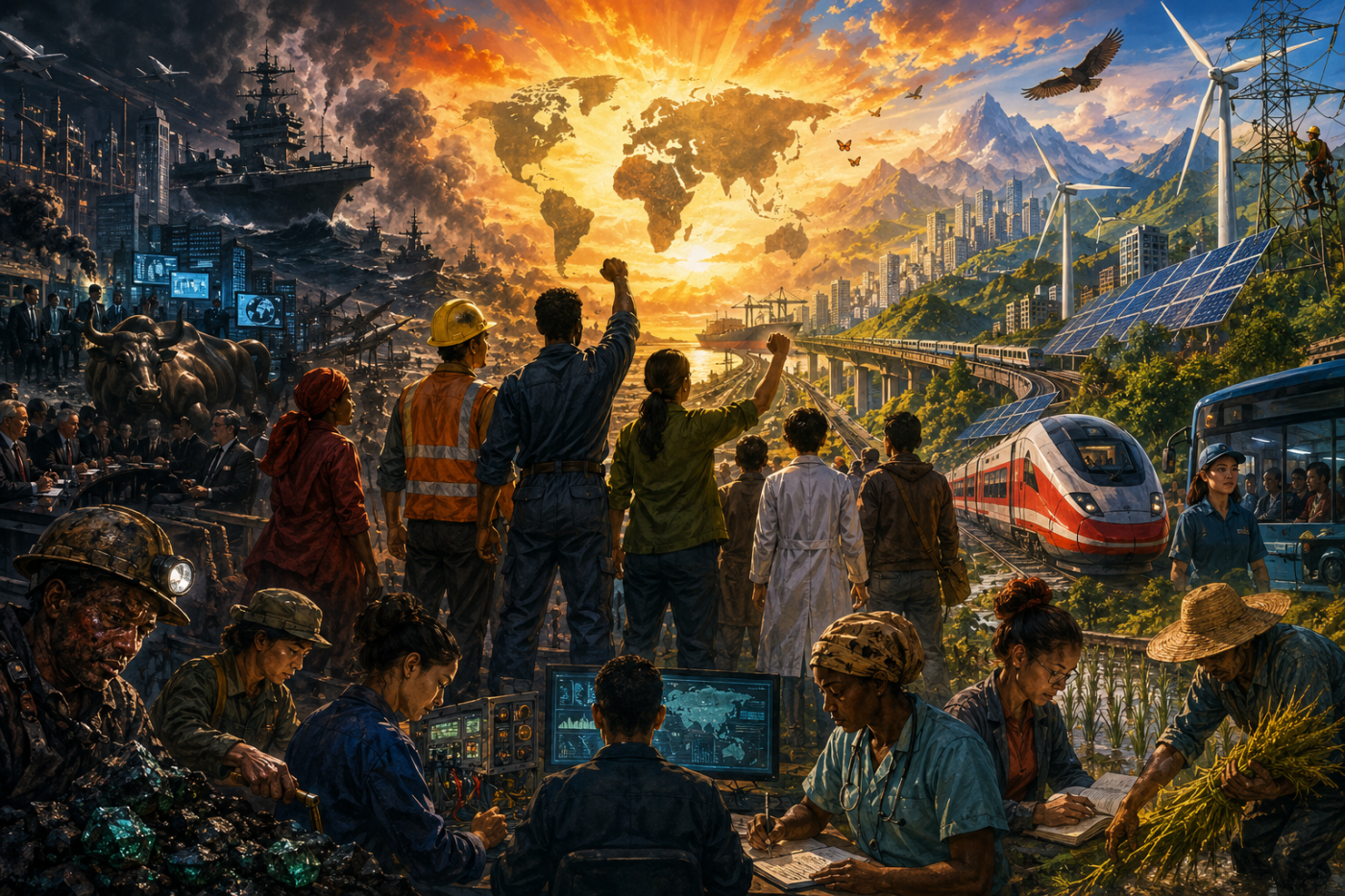
The crisis of the Atlantic neoliberal order has transformed labor instability, digital exploitation, and infrastructural struggle into central contradictions of the emerging multipolar era. Across BRICS+ and the wider Global South, states are attempting to reorganize workforce planning, industrial development, social protection, and technological sovereignty while workers confront new forms of platform capitalism, surveillance, and uneven development. Yet multipolarity itself remains contested terrain, containing socialist-oriented projects, bourgeois developmentalism, labor militancy, oligarchic accumulation, and competing visions of the future inside the same historical rupture. The decisive struggle of the twenty-first century will not simply determine which states dominate the world system, but whether the workers physically constructing the new world can transform sovereign development into genuine human emancipation.
By Prince Kapone | Weaponized Information | May 8, 2026
The Empire That Offshored Its Workers
The Atlantic order did not begin to rot because workers demanded too much. It began to rot because capital wanted the entire planet and no longer wanted to pay the people who built it. For forty years, the priests of neoliberalism stood behind podiums and television screens promising that globalization would lift all boats, while their actual policy was to drill holes into working-class life and auction off the life jackets to private equity firms. Factories were closed. Unions were gutted. Public housing was neglected. Public hospitals were privatized. Industrial towns were hollowed out and reorganized around warehouses, debt, police budgets, opioids, gig work, and patriotic speeches about national greatness delivered by politicians funded by the same corporations that shipped the jobs away.
The worker was no longer treated as the producer of social wealth or the foundation of democratic life. The worker became a cost variable. A statistic. A flexibility target. A body to be automated, outsourced, surveilled, or disciplined through debt. Stable industrial labor was broken apart and reorganized into temporary contracts, logistics chains, subcontracting systems, informal labor markets, app-mediated work, and fragmented service economies. None of this was accidental. Neoliberalism did not fail to protect workers. It was designed to weaken them.
The International Labour Organization’s World Employment and Social Outlook 2025 warns of slowing employment growth, persistent youth unemployment, and worsening job quality across much of the world economy. That is the institutional language. On the ground, it means something simpler. The young are told to hustle permanently. The middle-aged are told to retrain forever. The old are told retirement is unrealistic. The unemployed are blamed for conditions they did not create, while the employed are reminded daily that they can be replaced by software, outsourcing, subcontracting, or desperation waiting outside the hiring office. Capitalism has reached the remarkable stage where millions are exhausted from overwork while millions more cannot find stable work at all. The machine runs constantly; the people become disposable parts beside it.
The postwar Atlantic order once stabilized itself through industrial expansion, controlled incorporation of sections of the working class, cheap energy, colonial extraction, and the suppression of revolutionary movements abroad. But by the crisis of the 1970s, capital decided even limited social compromise had become intolerably expensive. The worker with a pension became a threat to profitability. The union contract became inefficiency. The public sector became waste. Entire industries were reorganized around cheaper labor pools in Asia, Latin America, Africa, and other regions of the Global South. The language of globalization concealed a much harsher reality: capital was searching the earth for cheaper hands and weaker bargaining power.
This was the transition from production-centered capitalism to financialized capitalism. Production itself never disappeared. Somebody still had to mine the cobalt, sew the clothes, assemble the phones, weld the railways, drive the trucks, load the ports, maintain the grids, and harvest the crops. But profit increasingly floated upward into finance, debt instruments, intellectual property monopolies, logistics management, speculative capital flows, and ownership over global supply chains. The imperial bourgeoisie learned how to exploit labor at enormous geographic distance while pretending the exploitation itself had vanished. The violence was still there; it was simply hidden behind shipping invoices, subcontractors, consulting firms, and apps with minimalist logos.
UN Trade and Development’s 2025 report on global trade resilience under pressure and its assessment of the trends shaping global trade in 2026 describe a world increasingly defined by fragmentation, geopolitical tension, strategic trade realignment, tariffs, friendshoring, nearshoring, and unstable supply chains. The old fantasy of frictionless globalization is collapsing under the weight of the contradictions it created. The same ruling classes that spent decades preaching market efficiency now scramble to secure semiconductor chains, industrial capacity, rare earth supplies, shipping routes, energy systems, and strategic industries through direct state intervention. Apparently planning becomes acceptable the moment Western monopoly power feels threatened.
The world neoliberalism built was enormously profitable but structurally brittle. Production stretched across oceans through just-in-time systems designed for efficiency rather than resilience. One component crossed five countries before final assembly. One shipping disruption could stall factories thousands of miles away. One sanctions package could freeze industrial inputs across entire sectors. The global economy became dependent upon corridors, chokepoints, ports, logistics software, bonded warehouses, undersea cables, shipping lanes, and financial clearing systems operating with almost no margin for interruption. Capital treated the planet like a giant warehouse connected by algorithms and container ships. Human beings were expected to absorb the instability personally.
UNCTAD’s maritime trade report on Red Sea disruptions and shipping instability captures the reality of this fragility. Ships that once moved through the Red Sea in days are increasingly forced into weeks-long rerouting around the Cape of Good Hope. Freight backs up. Port schedules shift. Warehouse crews wait for delayed containers. Dockworkers lose hours one week and face crushing overload the next. Truckers sit idle outside distribution centers while cargo reroutes across continents. A family pays more for food because a container ship changed direction thousands of miles away. The empire calls this geopolitics. The worker experiences it as rent pressure.
This instability did not emerge from nowhere. It is the delayed invoice for decades of deindustrialization, labor fragmentation, imperial war, and financialized accumulation. The same system that maximized profitability also maximized vulnerability. One pandemic, one sanctions regime, one shipping disruption, one semiconductor shortage, one energy crisis, one military escalation, and suddenly the masters of globalization rediscover that the world economy still depends upon actual laboring human beings moving physical goods through physical space.
The Global South absorbed much of the burden of this restructuring. Structural adjustment programs dismantled public sectors, weakened labor protections, privatized infrastructure, and reorganized economies around export dependency. Entire regions were integrated into low-value positions inside global production systems: assembly zones, extraction corridors, logistics hubs, commodity chains, and informal labor markets feeding the consumption patterns of the imperial core. The textbooks described this as modernization. Millions experienced it as dependency reorganized through spreadsheets and trade agreements.
ILO research on world employment trends and informality emphasizes that informal labor remains a structural feature of developing economies rather than a temporary leftover from the past. That point matters enormously because informality is often discussed as if it were merely administrative failure. In reality, informality became one of the preferred labor systems of neoliberal capitalism precisely because it lowers obligations while preserving exploitation. Capital receives the labor without assuming full responsibility for the worker. The market consumes human energy while disclaiming social accountability for the life producing it.
The imperial core externalized labor exploitation geographically while internalizing profit financially. It exported pollution and imported commodities. It exported industrial labor and imported cheap finished goods. It exported wage pressure and imported shareholder returns. Meanwhile, workers inside the imperial core were told that migrants stole their jobs, foreign workers stole their industries, and poor people stole their taxes. The capitalist who closed the factory disappeared from the story entirely. This remains one of the oldest tricks of ruling classes: rob workers in two different countries and convince each one that the other is the thief.
Sanctions intensified this instability further. Economic warfare increasingly replaced developmental legitimacy as the preferred instrument of imperial management. The empire discovered that it could no longer fully organize the world through consent, so it turned more aggressively toward coercion: freezing assets, restricting technologies, blocking payment systems, threatening secondary sanctions, controlling financial flows, and punishing countries attempting independent development paths.
Research on sanctions and trade disruption shows how sanctions ripple through intermediate goods, industrial inputs, supply chains, and cross-border production systems. Sanctions are not merely diplomatic disputes between governments. They attack the conditions through which labor reproduces itself socially. They interrupt medicines, machine parts, shipping access, banking systems, wages, industrial supply networks, and everyday economic life. The empire throws a stone into the river and entire working populations downstream absorb the current.
Reuters coverage of ILO warnings on trade tensions and global employment pressure makes the class reality plain even through cautious institutional language: workers pay for instability created by ruling classes. When trade slows, shifts disappear. When sanctions hit, shortages spread. When logistics chains fracture, prices rise. When capital panics, workers are disciplined. The losses are socialized downward while the profits remain privatized upward. Capitalism has become so efficient that billionaires can lose money on paper while workers lose housing in reality.
Inside the imperial core itself, deindustrialization produced more than economic decline. It generated political bitterness, social isolation, authoritarian temptation, and collapsing democratic legitimacy. Entire communities once organized around factories, unions, schools, public institutions, and collective social life were reorganized around precarious service work, warehouse labor, opioids, debt, police expansion, surveillance systems, and nationalist resentment. The industrial worker with stable wages became the gig worker sleeping in a car between shifts, the warehouse picker timed by algorithms, the care worker juggling multiple jobs, the indebted graduate delivering food through an app, the laid-off machinist blamed for not adapting quickly enough to his own economic destruction.
This is why the right wing grows so effectively in the ruins of neoliberalism. When workers are fragmented, unions weakened, communities hollowed out, and public institutions degraded, reaction arrives carrying a flag in one hand and a scapegoat in the other. The discarded worker is told his enemy is the migrant, the Muslim, the Chinese laborer, the welfare recipient, the Black rebel, the feminist, the trans child, anyone except the capitalist who closed the factory and moved production abroad. Without organization, social collapse produces resentment more easily than solidarity.
The neoliberal labor regime therefore cannot be understood simply as an economic arrangement. It is a political machine. It disciplines workers through insecurity, nations through debt, rivals through sanctions, migrants through borders, and dissent through surveillance. It transforms citizenship into employability and solidarity into competition. Every worker is told to become an entrepreneur of the self, which mostly means becoming the unpaid manager of one’s own instability. The worker must constantly retrain, self-market, absorb risk, optimize productivity, maintain flexibility, and smile through exhaustion while billionaires lecture society about innovation from conference stages protected by private security.
Yet the crisis of this order has reopened history itself. The fragmentation of neoliberal globalization does not automatically produce liberation. Crisis can generate fascism, militarization, fragmentation, and new forms of capitalist discipline as easily as it can generate emancipatory politics. But the collapse of Atlantic labor stability has created new historical space. States across the Global South increasingly seek to secure industrial capacity, workforce training, infrastructure systems, labor-market stabilization, supply-chain resilience, and greater developmental sovereignty outside the direct command structures of Western finance capital.
These experiments remain uneven, contradictory, and constrained by class power. But they reveal something historically important: the world is no longer willing to remain permanently organized around the labor regime imposed during the height of unipolar globalization. The empire that offshored its workers, financialized its future, militarized its decline, and then blamed ordinary people for the wreckage now confronts a world it can no longer fully command.
The crisis of the neoliberal labor order did not end history. It reopened it. And from that rupture emerges the next question: if the old imperial system can no longer stabilize labor globally, what forces will attempt to govern development differently — and for whom?
The Return of Developmental Labor Governance
The empire’s answer to the worker question was abandonment. Let the market decide. Let the boss decide. Let the platform decide. Let the creditor decide. Let the worker migrate, hustle, retrain, borrow, improvise, and call the instability freedom. This was the neoliberal catechism repeated for forty years across ministries, universities, IMF reports, consulting firms, and corporate media networks: labor must remain flexible, capital must remain mobile, social protections must remain lean, and workers must adapt endlessly to conditions they did not create. But the old formula is beginning to break apart under the pressure of reality itself. Across large parts of the Global South, states are increasingly being forced back into the terrain they once abandoned: labor organization, workforce planning, social protection, industrial coordination, and long-term developmental strategy.
The Second BRICS Employment Working Group Meeting in Thiruvananthapuram matters precisely because it reflects this historical shift. The gathering did not revolve around the fantasies that dominate Western coverage of BRICS — reserve currencies, geopolitical paranoia, or endless speculation about a “China threat.” The agenda moved directly into labor itself: social security systems, youth employability, women’s workforce participation, platform labor, skills development, and technological transformation. The worker question has re-entered statecraft. Not because ruling classes suddenly discovered compassion, but because societies built on informal labor, precarious employment, fragmented logistics, and mass youth unemployment eventually become politically unstable.
The return of developmental labor governance does not unfold evenly. It moves with different rhythms in different countries. In some places it appears as administrative struggle. In others it appears as industrial planning. In others it appears as crisis management over unresolved colonial structures. But across the multipolar world, labor is increasingly treated not simply as a private contract between employer and employee, but as a strategic question tied directly to sovereignty, development, industrial capacity, demographic stability, and technological transition.
India reveals this problem at enormous scale. Here the labor question feels less like one economy than several layered on top of each other simultaneously. Construction site. Delivery route. Village return. App login. Welfare queue. Informal workshop. Platform shift. Database entry. The movement never stops. Hundreds of millions move between rural labor, seasonal migration, informal urban work, small trade, domestic labor, transportation, logistics, and digital platform employment with almost no stable boundary between them. The state confronts not merely unemployment, but fragmentation on a civilizational scale.
India’s Ministry of Labour and Employment annual report shows the immense administrative effort underway through e-Shram registration systems, welfare linkage integration, platform-worker modules, and advisories encouraging digital aggregators to register both themselves and their workers. This is not bureaucratic trivia. It is an attempt to render a massive informal labor universe visible to policy for the first time. The informal worker who was previously invisible to welfare systems, employment databases, portability structures, and state protection mechanisms is increasingly being pulled into national labor architecture through digital systems.
But India’s labor question is not one database. It is a battlefield of databases. e-Shram. Welfare IDs. Platform-worker modules. State-level gig laws. Aggregator registration systems. Algorithmic transparency demands. Telangana’s Draft Gig and Platform Workers Registration, Social Security and Welfare Bill reveals how rapidly the struggle is evolving at the state level as governments debate welfare boards, unique worker IDs, aggregator contributions to welfare funds, and demands for transparency in algorithmic management. The state is trying to map chaos; workers are trying to turn recognition into rights.
This contradiction runs through the entire Indian developmental project. Digital labor registration can become a pathway toward protection, portability, and welfare integration. It can also become infrastructure for surveillance, labor discipline, and data extraction. A worker entered into a database is not automatically empowered. Yet invisibility is hardly liberation either. The migrant worker without registration, the delivery rider without insurance, the domestic laborer without formal recognition, the street vendor without legal protection, and the construction worker without portability all understand that being “outside the system” usually means absorbing exploitation alone.
India’s demographic pressure intensifies everything. BRICS discussions around youth employability, apprenticeships, and reducing NEET rates reflect the scale of the problem confronting much of the Global South. A young labor force can become industrial strength or social instability depending on whether societies can absorb workers into productive life. But “employability” itself remains an insufficient answer. Training millions of people for precarious labor inside fragmented digital economies does not resolve the worker question. It simply modernizes desperation.
China moves through a different rhythm entirely. Where India feels crowded, fragmented, and administratively overloaded, China feels directional. Planned movement. Industrial transition. Long-horizon coordination. The labor question there is tied directly to national industrial strategy, technological upgrading, and developmental planning. Chinese state reporting on vocational education and workforce modernization makes clear that labor formation is treated not as a secondary social issue but as part of industrial policy itself.
The difference is visible everywhere. Rural workers entering retraining systems. Vocational students preparing for advanced manufacturing sectors. Technicians moving into electric vehicle production, robotics, AI-linked industry, and semiconductor supply chains. Workers relocating through managed urban transition programs. China’s rural worker skills initiative includes vocational education, retraining, support for domestic and care work sectors, and city-adaptation systems designed to integrate labor mobility into broader developmental planning.
This is the decisive distinction. Under neoliberalism, workers are told to adapt after capital has already made its decisions. Under the Chinese developmental model, labor planning increasingly moves together with industrial transformation itself. The state does not simply react to labor-market collapse after the fact; it attempts to shape labor transition proactively. That does not eliminate contradiction or class struggle. But it does create a fundamentally different relationship between labor, infrastructure, industrial policy, and long-term development than the finance-dominated systems that hollowed out the Atlantic economies.
China’s movement from low-cost export production toward higher technological complexity requires enormous social coordination. Rail systems. Technical schools. Advanced manufacturing clusters. Workforce retraining. Industrial upgrading. Employment stabilization. This is not the spontaneous genius of “the market.” It is organized developmental direction operating at national scale. The Western ideological apparatus calls this authoritarianism because the imperial center reserves planning primarily for itself. When Washington subsidizes strategic industries, it becomes national security. When Silicon Valley receives state-backed infrastructure and research support, it becomes innovation. When China coordinates labor and industrial planning, suddenly the apostles of the free market begin clutching their pearls beside the sanctions paperwork.
Yet China’s direction should not be romanticized into fantasy. Rural-to-urban labor transition remains uneven. Labor discipline remains real. Development generates pressures alongside achievements. But the broader trajectory matters historically because it demonstrates that modernization does not require neoliberal surrender. The state can still organize labor formation, infrastructure, industrial capacity, and technological transition outside the logic of pure market spontaneity.
South Africa enters the essay like a warning written across abandoned machinery. Here the labor question feels stalled rather than directional. The formal end of apartheid did not dismantle the economic structures built through racial capitalism. The mines remained concentrated. Finance remained dominant. Land ownership remained unequal. Townships remained underdeveloped. Liberation arrived politically while much of the economic structure survived intact beneath it.
South Africa’s Q3 2025 labor-force data reported official unemployment at 31.9% with roughly 13.3 million underutilized people. SAFTU’s broader labor critique placed unemployment even higher under expanded definitions while attacking austerity policies, electricity tariff hikes, and township supply cuts. The numbers matter, but the atmosphere matters more. The miner without work. The township under tariff pressure. The youth outside the labor market. The electricity cut as class policy. The post-apartheid promise suspended in a queue.
South Africa reveals the hard limit of multipolar participation when internal economic transformation remains incomplete. A country can sit inside BRICS while much of its working class remains trapped inside unresolved colonial political economy. Sovereignty at the summit level does not automatically produce sovereignty at the level of everyday life. The unemployed township youth cannot eat geopolitical alignment. The worker whose electricity is cut does not experience “development” through diplomatic communiqués.
This is why South Africa becomes so important analytically. It prevents the essay from collapsing into romantic multipolar mythology. It shows that anti-imperialist positioning alone cannot resolve labor precarity if domestic economies remain dominated by finance, privatization pressures, austerity logic, and uneven development. The language of sovereignty can coexist quite comfortably with unemployment, labor fragmentation, and elite accumulation unless workers themselves become organized political actors capable of forcing deeper transformation.
The Alternative Information and Development Centre’s call for a break with austerity captures the deeper issue facing much of the Global South. Austerity is not technical management. It is class policy. It weakens labor reproduction, shrinks public infrastructure, degrades social life, and then invites private capital to profit from the ruins. The state first abandons the worker and then sells the wreckage back at market price.
Placed side by side, India, China, and South Africa reveal three different faces of developmental labor governance inside the emerging multipolar world. India shows the attempt to administratively map enormous informal labor systems through registration, welfare integration, and digital governance. China shows labor coordination tied directly to industrial planning, technological upgrading, and long-term developmental strategy. South Africa shows the dangers of unresolved colonial political economy operating beneath formal sovereignty and multipolar participation.
These are not three versions of the same process. They are three different struggles unfolding inside the same historical transition away from neoliberal labor abandonment. The return of labor governance reflects something fundamental: states increasingly understand that labor instability can no longer simply be outsourced to “the market.” Workforce fragmentation, youth unemployment, informalization, technological disruption, and demographic pressure have become questions of political legitimacy itself.
The ruling classes may not have rediscovered the dignity of labor, but they have rediscovered the danger of ignoring it.
And yet another contradiction is already emerging beneath these developmental systems. Labor is no longer governed only through ministries, factories, and welfare institutions. Increasingly it moves through apps, digital IDs, algorithmic management systems, platform ratings, logistics software, automated dispatch systems, and data infrastructures operating across borders. The worker is not simply being registered anymore. The worker is being scored, tracked, routed, ranked, and managed through code. Which means the next battlefield is no longer only the factory or the ministry office. It is the platform itself.
The Factory Has Entered the Phone
The old factory never disappeared. It scattered itself across highways, apartment blocks, motorcycles, ports, warehouses, cloud servers, smartphones, and logistics corridors. The foreman no longer necessarily stands beside the assembly line holding a stopwatch. Now he arrives as a notification sound. A courier wakes up and checks the app before brushing his teeth. A driver watches acceptance rates like a stockbroker monitoring collapse. A warehouse picker moves beneath scanners timed to fractions of a second. A migrant worker scans biometric checkpoints before entering a construction site built for someone else’s future. The labor process has entered the phone, the database, the platform, the cloud, the route optimizer, the digital ID system. Capital has managed one of the great ideological tricks of the modern age: it reorganized labor through surveillance infrastructure while marketing the entire arrangement as freedom.
The digital economy did not abolish exploitation. It reorganized exploitation through platforms, ratings systems, behavioral tracking, algorithmic management, and logistics software operating across enormous geographic space. The app economy speaks the language of entrepreneurship because the ruling class understands that workers are less likely to revolt if they are told they own their own precarity. The delivery rider is called a partner. The driver is called independent. The courier is called flexible. The corporation governs pricing, routes, visibility, customer access, performance scoring, and discipline while insisting it merely provides “connection.” The landlord now claims he is simply facilitating housing opportunities.
Brazil exposes this contradiction with extraordinary clarity. Across São Paulo, Rio de Janeiro, Belo Horizonte, Recife, and Porto Alegre, platform labor expanded through delivery apps, ride-hailing systems, logistics networks, and digitally mediated informal work. The smartphone became dispatcher, manager, surveillance device, payroll office, disciplinary system, and labor market compressed into one glowing screen. A rider waits for a notification the way dockworkers once waited for ships to enter the harbor. One delivery means dinner. Another cancellation means debt. An account suspension can erase income instantly with no manager physically present and no meaningful appeal process.
Brasil de Fato’s reporting on app-worker criticism of delivery-platform legislation shows that workers increasingly reject the fantasy that apps merely “connect” independent contractors to opportunity. Riders and drivers understand through direct experience that platforms govern labor while refusing responsibility for labor. The corporation controls the map while pretending the rider is wandering freely through it.
The brilliance of platform capitalism lies in its ability to industrialize fragmentation itself. The old informal economy required brokers, local middlemen, and scattered labor arrangements. The app centralizes this instability into scalable infrastructure. Workers compete individually while the platform accumulates collectively. One rider crashes his motorcycle; another logs in. One courier protests; ten more appear through unemployment and recruitment incentives. The risk flows downward. The data flows upward.
Yet the rider is not only a victim of code. He stops. He strikes. He gathers outside city buildings. He blocks traffic with hundreds of motorcycles. He refuses the fiction of entrepreneurship. The April 2026 delivery-worker protests in Rio de Janeiro made clear that platform labor is increasingly producing collective resistance rather than passive adaptation. The app says the rider is independent; the protest says he is a worker.
This struggle now stretches internationally. Progressive International’s reporting on app-worker organizing connects Brazil’s platform-worker mobilizations with broader organizing efforts unfolding across India, Rajasthan, Karnataka, and Telangana. Workers increasingly understand that algorithmic management does not eliminate class relations. It digitizes them. The strike itself evolves accordingly. Riders coordinate through encrypted chats. Protest routes spread through social media. Platform workers who supposedly “work independently” increasingly discover that their conditions are shared collectively.
The legal battle over platform regulation reveals the contradiction directly. Debates surrounding Brazil’s PLP 12 platform labor regulation framework show governments attempting to establish minimum protections, social insurance obligations, and labor definitions for digital work systems designed structurally to avoid long-term labor obligations in the first place. Capital wants the efficiency of workforce control without the historical burdens attached to formal employment. The ideal platform worker from the standpoint of capital is permanently available, fully surveilled, individually isolated, legally disposable, and socially responsible for every risk personally.
The platforms call this flexibility. The worker experiences it as permanent instability. There is no guaranteed wage floor. No stable scheduling. No meaningful transparency over pricing formulas. No democratic influence over the systems governing visibility and dispatch. The app economy treats labor protections like technical bugs interfering with scalability targets. A rider can spend twelve hours moving through traffic while the corporation continues insisting he is simply enjoying entrepreneurial freedom beneath the tropical sun.
One of the defining class relations of digital capitalism is informational asymmetry. The platform sees the worker completely: speed, location, acceptance rates, idle time, cancellation behavior, productivity patterns, customer reviews, route efficiency, and earnings history. The worker sees almost nothing about the formulas governing wages, penalties, prioritization, or suspension. Surveillance flows downward. Opacity flows upward.
WIEGO’s reporting on parliamentary initiatives defending workers in Brazil reveals that labor struggles increasingly include demands not merely for wages, but for algorithmic transparency, platform accountability, data visibility, and democratic influence over digital labor systems themselves. This is historically significant. Class struggle has entered the architecture of code.
At the same time, digital oversight can expose inequality statistically while leaving exploitation structurally intact. Brazilian labor-ministry transparency initiatives and equal-pay reporting frameworks tied to Law No. 14,611/2023 represent attempts to modernize labor governance through reporting systems, salary transparency, and compliance mechanisms. Such reforms matter because exploitation hidden inside opaque systems becomes harder to confront collectively. But disclosure alone cannot abolish hierarchy. Capital can publish inequality in polished spreadsheets while continuing to profit from the social relations producing it.
The platformization of labor extends far beyond Latin America. In the Gulf states, labor increasingly moves through highly coordinated transnational systems linking South Asia, Southeast Asia, Africa, and West Asia into integrated circuits of workforce mobility. Here labor itself functions almost like logistical infrastructure. Airports, ports, construction corridors, logistics hubs, financial centers, industrial zones, and smart-city projects all depend upon managed labor circulation operating across borders at enormous scale.
The Abu Dhabi Dialogue’s 2026 discussions around workforce skills, labor mobility, productivity, worker protection, and unemployment insurance demonstrate how labor migration is increasingly approached through administrative coordination rather than spontaneous movement alone. States coordinate recruitment systems, skills certification, labor-market responsiveness, and workforce planning across multiple countries simultaneously. The migrant worker crosses borders not simply as an individual laborer, but as part of a managed regional labor architecture.
The imagery of this system is striking. Dormitories outside the skyline. Recruitment debt carried across oceans. Biometric checkpoints beside luxury towers. Wage-protection systems linked to digital payroll infrastructure. A worker wiring the city but unable to belong fully to it. The Gulf economies increasingly function as logistical and infrastructural hubs within the emerging multipolar order, yet much of this development depends upon labor regimes structured around temporary incorporation, segmented rights, and unequal citizenship relations.
Institutional frameworks developed through the Abu Dhabi Dialogue emphasize portability systems, labor-market coordination, skills forecasting, workforce responsiveness, and managed labor mobility. The model differs sharply from Atlantic migration panic politics. Labor migration is treated less as chaos than as strategic economic infrastructure. But efficiency does not eliminate hierarchy. The worker may build the airport, wire the logistics center, maintain the hotel tower, and construct the data corridor while remaining socially suspended beneath the system materially dependent upon his labor.
ILO discussions around migrant-worker social protection portability reveal growing awareness that labor mobility itself now requires governance beyond traditional national frameworks. Workers increasingly move through systems of digital credentialing, biometric verification, contract monitoring, skills databases, and labor-market forecasting. Labor migration is becoming datafied. The border itself increasingly functions through software.
This transformation carries enormous consequences for class power. Digital systems can improve wage portability, contract tracking, and labor coordination while simultaneously deepening surveillance asymmetry and administrative control. The worker becomes visible everywhere while possessing little visibility into the systems governing him. The dream of digital capitalism is not merely profit extraction. It is the perfectly transparent worker inside the perfectly opaque platform.
The Global South cannot achieve technological sovereignty while its labor force remains governed through foreign-owned platforms, cloud monopolies, opaque algorithms, proprietary software ecosystems, and externally controlled data infrastructures. The struggle over platform labor therefore extends far beyond workplace regulation. It reaches into cloud infrastructure, semiconductor dependency, digital payments, AI governance, communications systems, and data ownership itself. A country cannot meaningfully claim sovereignty while its workers generate value inside infrastructures controlled elsewhere.
This is why the emerging struggle over digital labor increasingly resembles a new form of Bandung politics unfolding through platforms and information systems. Data has become strategic terrain. Algorithms organize labor mobility. Logistics software structures trade flows. Cloud architecture governs economic coordination. The digital sphere increasingly functions as infrastructure every bit as important as railways, ports, and energy systems. The fight over technological sovereignty is simultaneously a fight over who governs labor in the twenty-first century.
Yet despite every technological disguise, labor remains stubbornly physical. The app cannot deliver food without the rider. The logistics corridor cannot move freight without drivers and warehouse crews. The smart city cannot function without migrant construction labor. The AI supply chain still depends upon miners, assemblers, coders, electricians, technicians, transport workers, and maintenance labor spread across continents. The digital economy speaks endlessly about innovation because it wants humanity to forget that every server farm still rests upon laboring bodies somewhere beneath the cloud.
Brazil and the Gulf therefore reveal two interconnected dimensions of labor inside the multipolar transition. Brazil shows the internal platformization of work: labor reorganized through apps, ratings systems, and algorithmic management. The Gulf reveals the transnational coordination of labor mobility itself: workforce circulation integrated into regional infrastructure and developmental strategy. In both cases, labor becomes increasingly digitalized, mobile, datafied, and administratively managed across large systems optimized for efficiency and accumulation.
But the workers routed through these systems are not passive components inside software architecture. Riders strike. Migrants organize. Platform workers demand transparency. Laborers challenge invisibility. Across ports, industrial zones, delivery routes, construction corridors, and logistics systems, workers increasingly recognize that the infrastructure of multipolarity cannot function for even a single day without them.
And this realization opens the next terrain of struggle entirely. The digital economy is not floating above material reality. It is being welded, transported, assembled, mined, wired, and maintained by workers spread across continents. Beneath every app sits infrastructure. Beneath every infrastructure sits labor. Which means the struggle over digital capitalism inevitably leads beyond the platform itself — toward the workers physically constructing the corridors, ports, railways, industrial systems, and logistical networks of the emerging post-unipolar world.
The Workers Who Are Literally Building a New World
Multipolarity is often discussed as if it were a private conversation between diplomats floating somewhere above ordinary life. Analysts debate reserve currencies, maritime strategy, sanctions, energy corridors, trade blocs, and great-power competition while somehow forgetting the most obvious fact of all: none of it exists without labor. Ports do not build themselves. Railways do not weld themselves together. Fiber-optic cables do not crawl across deserts through the magic of entrepreneurship. Semiconductor chains do not emerge from motivational speeches delivered at investment forums. Somebody digs the trench. Somebody pours the concrete. Somebody installs the server. Somebody drives the shipment through the night while experts on television explain geopolitics with maps that mysteriously contain no workers.
The emerging multipolar world is not merely being negotiated in summit halls. It is being physically assembled across mines, industrial parks, logistics corridors, ports, rail systems, shipping lanes, energy grids, data centers, and construction zones throughout the Global South. The worker question therefore cannot be reduced to welfare administration or labor-market policy alone. Labor is not simply a population to be managed. It is the material force constructing the infrastructure of a new historical period. Every corridor contains workers inside it. Every supply chain rests upon organized labor. Every development strategy eventually arrives at the same unavoidable truth: human beings must build the world before politicians can cut ribbons in front of it.
The historical roots of this moment stretch back far beyond BRICS itself. The Tricontinental’s reflections on the Bandung Spirit remind us that the anti-colonial movements of Asia, Africa, and Latin America never fought merely for flags and diplomatic recognition. They fought for developmental sovereignty. They fought for the right to industrialize, electrify, educate, mechanize, modernize, and escape a world system organized around extraction outward and dependency downward. Colonial infrastructure was designed primarily to move wealth from the colony to the empire. The railway from the mine to the port mattered more than the road between villages. Colonialism built extraction corridors, not sovereign economies.
That developmental project was interrupted but never extinguished. Debt crises, IMF restructuring, privatization, sanctions regimes, structural adjustment, and neoliberal globalization shattered much of the industrial momentum that emerged after formal decolonization. Public sectors weakened. Infrastructure decayed. States surrendered planning capacity to creditors and market discipline. The dream of sovereign development was replaced with the managerial vocabulary of competitiveness, austerity, and export dependency. Entire countries were told that industrial policy had become obsolete — conveniently around the same time Western states quietly subsidized their own strategic sectors while outsourcing production abroad.
Yet the crisis of neoliberal globalization reopened many of the questions Bandung posed generations ago. The discussion of a “new Bandung spirit” centered on industrial development captures the deeper significance of the present transition. Across the Global South, states increasingly seek not merely access to Western markets, but logistical integration, industrial capacity, technological sovereignty, energy coordination, and infrastructure systems outside direct Atlantic control. Multipolarity is not only geopolitical balancing. It is the attempt to reorganize the material geography of development itself.
This reorganization is visible everywhere. Railways increasingly connect Eurasian industrial systems laterally rather than feeding exclusively into Atlantic-centered trade patterns. Ports across Africa, West Asia, South Asia, and Latin America are being integrated into broader logistical systems tied to manufacturing corridors, industrial zones, digital infrastructure, and energy routes. Xinhua’s reflections on Bandung’s continuing relevance emphasize precisely this point: South-South integration increasingly centers industrialization and developmental coordination rather than permanent raw-material dependency.
Infrastructure is never neutral concrete. A railway changes the direction of trade. A port changes the flow of accumulation. A fiber-optic line changes information sovereignty. An energy corridor alters political leverage. A semiconductor facility changes technological dependency. The imperial world always understood this very clearly, which is why infrastructure became one of the primary battlegrounds of colonial and neocolonial power. Whoever controls the corridor shapes the possibilities of development around it.
Today the emerging multipolar transition increasingly attempts to construct a different infrastructural logic. Discussions surrounding the Belt and Road Initiative’s role in logistics integration, industrial parks, and South-South development reveal how infrastructure projects increasingly combine transport, energy, manufacturing, communications, and regional development into broader systems of economic coordination. The significance of these projects does not lie simply in their size. It lies in their capacity to reorganize economic geography itself. A corridor changes where factories emerge. A port changes where labor concentrates. An industrial zone changes migration patterns. Infrastructure becomes frozen political economy.
And inside every corridor stand workers. The railway laborer in western China. The dockworker in Gwadar. The construction worker in East Africa. The miner in the Congo. The truck driver crossing Iranian drylands at night. The semiconductor assembler in Southeast Asia. The fiber-optic installer wiring logistics hubs in South Asia. These are not background figures beneath geopolitics. They are the actual producers of the material world multipolarity depends upon. The new world order, if such a thing is emerging, is not being built primarily through speeches. It is being assembled through labor disciplined into steel, electricity, concrete, shipping systems, telecommunications infrastructure, and industrial production.
The Green Finance and Development Center’s 2025 BRI report noted record engagement levels, including roughly $128.4 billion in construction contracts and another $85.2 billion in investments. But the meaning of those numbers does not reside in spreadsheets alone. Behind every billion dollars stand workers laying track across deserts, repairing ports, welding pipelines, assembling substations, constructing industrial parks, maintaining freight systems, and expanding the physical infrastructure through which new developmental possibilities emerge.
Empire bombs corridors; workers build them.
This contradiction appears most clearly across the transport and logistics systems now reshaping Eurasia and West Asia. India’s official reporting on Chabahar port engagement details the ten-year IPGL agreement to equip and operate the Shahid Beheshti Terminal in Iran. Meanwhile, the Asian Development Bank’s overview of the International North-South Transport Corridor describes the multimodal ship-rail-road network linking the Indian Ocean and Persian Gulf through Iran toward the Caspian region, Russia, and Northern Europe.
These systems are usually discussed through the sterile language of connectivity, throughput, and strategic alignment. But connectivity is not abstract. It is labor. A crane operator at Chabahar guiding containers into position beneath sanctions pressure. Railway mechanics maintaining freight systems along the INSTC corridor. Truck convoys crossing dry borderlands carrying industrial components, grain shipments, machinery, and fuel. Customs workers processing rerouted cargo after disruptions in the Red Sea. Port laborers reorganizing schedules after shipping detours stretch delivery times by weeks.
UNCTAD’s reporting on maritime disruption and Red Sea shipping instability shows how quickly global logistics can fracture under geopolitical pressure. Ships reroute around Africa. Freight schedules collapse. Insurance costs rise. Warehouses back up. Dockworkers absorb irregular shifts while trucking routes stretch across thousands of additional miles. When corridors destabilize, labor absorbs the shock physically. The empire experiences disruption through trade metrics. The worker experiences it through exhaustion.
This is why infrastructure matters politically. A corridor is never simply a transport route. It reorganizes sovereignty, labor concentration, industrial geography, and developmental possibility simultaneously. The old colonial world routed trade vertically toward imperial centers. The emerging multipolar world increasingly builds lateral systems across the Global South itself. The significance of Chabahar, the INSTC, and broader South-South logistical integration lies precisely here: they weaken monopoly control over trade routes and developmental coordination previously dominated by Atlantic power.
Research examining the developmental impact of expanding railway systems demonstrates how transport infrastructure reshapes labor mobility, industrial integration, and regional development. Yet development literature frequently treats workers like oxygen — absolutely essential yet strangely absent from the equation. High-speed rail does not emerge from investment flows magically converting themselves into steel. Human labor transforms political strategy into physical reality. The blueprint means nothing until workers pick up tools.
The same contradiction appears across global logistics more broadly. Studies examining the Belt and Road’s role in trade integration and logistical connectivity often focus on throughput statistics, freight efficiency, and strategic alignment. These dimensions matter, but they conceal another truth beneath the charts: the workers of the Global South increasingly occupy strategic positions inside the circulation system of the world economy itself. Dockworkers, railway crews, warehouse laborers, mechanics, transport workers, miners, and freight operators increasingly stand at the chokepoints of accumulation.
This is especially true in the digital sphere. Multipolarity is not merely a world of ports and railways. It is increasingly a struggle over cloud systems, undersea cables, AI infrastructure, semiconductor chains, telecommunications architecture, digital payment systems, and technological sovereignty. The concept of a “Digital Bandung” centered on data sovereignty reflects the growing realization that the digital economy itself has become terrain of anti-colonial struggle. Whoever controls cloud systems, compute infrastructure, semiconductors, communications networks, and data flows increasingly controls development itself.
The worker therefore reappears in new forms inside the digital economy. The rare-earth miner. The fiber-optic installer. The warehouse laborer feeding e-commerce systems. The technician maintaining server farms. The electronics worker assembling devices. The engineer expanding broadband corridors. The coder maintaining industrial logistics platforms. Silicon Valley speaks endlessly about “the cloud” because billionaires prefer humanity imagining data floating weightlessly through cyberspace rather than recognizing the enormous material labor chain beneath every screen.
The call for a new developmental theory for the Global South insists correctly that technological sovereignty cannot be separated from productive sovereignty more broadly. Nations trapped permanently at the bottom of industrial chains remain dependent no matter how many smartphones circulate inside their markets. Development requires productive capacity. Productive capacity requires infrastructure. Infrastructure requires labor. And labor increasingly requires political organization capable of transforming workers from expendable inputs into conscious historical actors.
This is why the workers constructing the multipolar world form something larger than isolated national labor markets. Across the Global South, labor is becoming infrastructurally interconnected through ports, railways, energy systems, digital corridors, shipping networks, and industrial integration. The miner in Africa increasingly connects directly to battery production in Asia. The Gulf port worker connects to Eurasian manufacturing corridors. The Indian logistics worker connects to freight systems crossing Iran and Russia. The coder in Bengaluru connects to telecommunications systems operating across continents. The old colonial labor hierarchy fragmented the South into isolated zones feeding Atlantic accumulation. The emerging multipolar system increasingly links the South laterally.
This does not abolish exploitation. Workers building sovereign infrastructure may still remain excluded from democratic control over the accumulation process itself. A laborer constructing the corridor may possess little authority over the development strategy governing it. South-South trade can coexist with oligarchic power. Industrial integration can coexist with labor discipline. Multipolarity opens historical space, but space alone does not determine what will be built inside it.
Yet something fundamentally important is changing. The Tricontinental’s argument that a new dawn is emerging against the backdrop of Western decline points toward the deeper significance of the moment. The laboring classes of the Global South are no longer positioned solely as passive suppliers feeding Atlantic development. Increasingly, they are constructing interconnected systems of infrastructure, logistics, industrial production, energy coordination, and technological capacity that alter the balance of global power itself.
Walter Rodney once insisted that the people who build society must understand the systems they are building and the powers ruling over them. That remains true today. The railway worker, the dockworker, the coder, the miner, the crane operator, the mechanic, the transport laborer, the warehouse crew, and the migrant construction worker increasingly occupy strategic positions inside the emerging world economy. The question is whether these workers remain merely laboring bodies inside developmental systems directed from above, or whether they become conscious political actors capable of shaping development itself.
The workers building ports, railways, semiconductor systems, logistics hubs, industrial corridors, energy grids, and digital infrastructure across the Global South are therefore doing something larger than constructing isolated projects. They are assembling the material skeleton of a world no longer organized entirely around Atlantic supremacy. The decisive political question is whether that new world will merely redistribute accumulation among competing elites, or whether the laboring classes physically constructing it will eventually claim democratic power over development itself.
The Contradiction Inside Multipolarity
The decline of the Atlantic order has produced two equal and opposite forms of political confusion. The first comes from imperial ideologues who speak as if every crack in Western dominance were a civilizational catastrophe. To hear them tell it, any attempt by the Global South to build sovereign infrastructure, independent financial systems, industrial corridors, technological capacity, or alternative development institutions somehow threatens world stability itself — by which they mean the old arrangement where Washington issued commands and everybody else adjusted their budgets accordingly. The second confusion comes from sections of the left who speak about multipolarity as if the mere existence of BRICS were already the dawn of socialism, as if every summit communiqué were secretly a chapter from State and Revolution rewritten into development-bank language. Both illusions misunderstand the terrain completely.
Multipolarity is neither salvation nor apocalypse. It is a battlefield. It is the unstable reorganization of world power under conditions of imperial decline. Inside this process move socialist-oriented states, bourgeois developmental states, rentier monarchies, sanctioned sovereign states, comprador elites, industrial capital, logistics blocs, labor movements, technology sectors, and planners attempting to reorganize development outside direct Atlantic control. These forces do not march in the same direction simply because they appear in the same summit photograph. The emerging multipolar order contains anti-imperialism and accumulation, sovereignty and hierarchy, industrial planning and labor discipline simultaneously.
UNCTAD’s Trade and Development Report 2025 reflects the scale of global instability now reshaping development itself: fragmented trade systems, rising geopolitical pressure, debt vulnerability, technological rivalry, supply-chain restructuring, and uneven growth patterns stretching across the world economy. The old neoliberal promise that globalization would naturally stabilize development has collapsed under the weight of its own contradictions. States increasingly intervene because the market left to itself produces logistical fragility, industrial hollowing, ecological pressure, and permanent insecurity for billions of people.
This is why the labor and developmental questions have re-entered geopolitics so forcefully. The anti-colonial movements understood something neoliberalism spent decades trying to erase: sovereignty without productive capacity is fragile. A country dependent entirely upon external finance, imported technology, foreign-controlled logistics, and commodity export vulnerability remains politically constrained no matter how many flags fly above parliament buildings. Industrialization, energy systems, transport infrastructure, technical education, scientific capacity, and technological coordination remain historically necessary for societies attempting to escape dependency. But a port can break dependency and still discipline labor. A flag can defeat empire abroad and protect class rule at home. A development bank can fund infrastructure without transferring power to the workers who build it.
This is the contradiction sitting at the center of the multipolar transition itself. The BRICS Rio de Janeiro Declaration speaks repeatedly about social protection, labor cooperation, sustainable development, AI governance, poverty reduction, and inclusive growth. Such language matters. It signals that labor instability can no longer remain politically invisible. But the declaration also reveals the heterogeneity of the bloc itself. BRICS is not a unified class formation. A socialist-oriented developmental state does not occupy the same historical position as a rentier monarchy simply because both participate in South-South diplomacy. A sanctioned sovereign state resisting imperial pressure does not possess the same structural role as a comprador elite tied directly to Western finance.
This distinction becomes essential because contemporary political discourse increasingly collapses every contradiction into moral equivalence. The loudest critiques of Chinese infrastructure projects often fixate on wage disparities between Chinese technical workers and local labor. But these disparities are negotiated through bilateral agreements between sovereign governments and Chinese firms — not imposed unilaterally. Host states set labor terms in pursuit of speed, cost, and capital inflow. Where gaps exist, they reflect skill differentials, relocation costs, technical expertise, and contractual realities common to transnational projects. More importantly, Chinese-funded projects frequently pay better than comparable local or Western firms in the same sectors, creating jobs, skills transfer, and infrastructure where none existed.
The imperial left’s obsessive focus on these gaps — while remaining comparatively silent on Western extractive operations, Halliburton-style profiteering in occupied countries, French uranium exploitation in Niger, or decades of IMF-mandated austerity — functions as ideological counterinsurgency. It demands that anti-imperialist development meet impossible standards of purity while ignoring the structural violence of the old order. This is not proletarian internationalism. It is moralism in leftist clothing, measuring bricks laid by rivals while remaining comfortably distant from the actual work of construction. The revolutionary question is not whether every wage is perfectly equal on day one. It is whether the project expands sovereign productive capacity, creates material uplift, and weakens imperial monopoly. On that metric, the direction of motion is clear.
The anti-imperialist struggle therefore remains historically necessary precisely because imperial power continues organizing dependency through debt systems, technology restrictions, sanctions regimes, military pressure, and financial control. Countries under siege cannot pursue independent development while trapped inside permanent economic coercion. Sanctions are not abstract diplomatic disagreements. They attack industrial supply chains, technological access, banking systems, wages, medicines, transport networks, and developmental planning directly. Sovereignty matters because without it, the space for labor protection, industrial policy, and public investment narrows dramatically.
Yet sovereignty itself contains class contradiction. The Tricontinental Institute’s reflections on the contradictions inside the so-called rules-based order correctly emphasize that the Global South is not socially homogeneous. A national bourgeoisie may oppose Western domination while suppressing labor militancy internally. A government may defend sovereign infrastructure while preserving oligarchic accumulation. A country may reject IMF discipline while still reproducing capitalist hierarchy domestically. The worker does not become emancipated automatically because the ruling class speaks the language of national development.
This is why the question of planning has returned so forcefully. One of neoliberalism’s greatest ideological myths was the claim that planning itself had failed historically. The market would supposedly allocate resources efficiently if only states stepped aside. Then came financial collapse, pandemic disruption, logistics breakdowns, semiconductor shortages, sanctions wars, inflation crises, and supply-chain instability. Suddenly every major power rediscovered industrial policy overnight. Apparently planning is disastrous until capital urgently requires it.
Official BRICS language around governance reform, infrastructure coordination, AI regulation, and South-South development reflects this renewed importance of state coordination. But planning itself is not class neutral. States can plan for socialist transition, for national capitalist modernization, for oligarchic enrichment, or for militarized competition. The existence of planning alone does not reveal whose interests planning ultimately serves.
This is where class differentiation inside multipolarity becomes decisive. Socialist-oriented states such as China and Vietnam operate through revolutionary political inheritances that transformed land relations, state structure, planning institutions, and developmental strategy historically. Bourgeois developmental states attempt industrial modernization while preserving capitalist accumulation. Rentier monarchies organize labor through segmented citizenship systems and transnational workforce management. Sanctioned sovereign states struggle to preserve developmental autonomy under siege conditions. Comprador elites remain integrated directly into Atlantic finance and external dependency structures. Meanwhile labor movements across all these formations continue contesting the direction of development itself.
China and Vietnam therefore cannot simply be collapsed into the same category as every state participating in multipolar realignment. Official Chinese discussions of socialist modernization, employment, industrial development, and public wellbeing continue framing development through the language of long-term planning, productive coordination, poverty reduction, and socialist orientation. Analysis of Vietnam’s socialist-oriented market economy similarly emphasizes the attempt to develop productive forces under hostile global conditions while retaining strategic political direction through socialist institutions.
These experiences matter because they reveal something the imperial center desperately wishes to deny: modernization does not require neoliberal surrender. States can coordinate infrastructure, regulate finance, shape industrial policy, direct investment, expand technical education, and maintain long-term planning without dissolving themselves completely into the spontaneous chaos of market rule. This is one of the real reasons China provokes such anxiety in the Atlantic world. The threat is not simply Chinese growth. The threat is the demonstration effect. China shows that industrialization, technological expansion, infrastructure coordination, and poverty reduction can occur outside direct Western command.
That does not mean contradiction disappears. Market reforms generate inequality pressures. Development produces unevenness. Labor discipline remains real. Capital accumulates influence. Socialist-oriented states still operate inside a hostile global capitalist system shaped by sanctions pressure, uneven exchange, ecological strain, and technological rivalry. But contradictions unfolding inside anti-imperialist developmental projects are not identical to contradictions reproducing imperial domination itself. Historical materialism requires differentiation, not moral flattening.
Research on Belt and Road financing and infrastructure expansion reveals another side of this contradiction. Development finance can weaken dependence upon Atlantic-controlled institutions while still leaving unresolved questions about labor power, democratic participation, ecological cost, and class control over accumulation. A railway financed outside IMF conditionality may still operate through labor hierarchies internally. Sovereign development opens historical possibility; it does not complete history automatically.
This was precisely the warning advanced repeatedly by Amílcar Cabral. Cabral’s reflections on liberation and neocolonial regression insisted that formal independence alone could easily devolve into elite-controlled development if the masses remained politically passive beneath nationalist leadership. The danger was never only recolonization from outside. It was the emergence of domestic ruling blocs inheriting colonial structures while changing the flag above them.
The worker question therefore returns directly to the center of multipolarity itself. ILO discussions surrounding BRICS labor coordination, AI governance, just transition frameworks, and social protection systems show labor increasingly entering official developmental discourse not merely as labor input, but as a subject requiring social stability, protection, training, and governance. Yet bourgeois development speaks the language of inclusion while often preserving the hierarchy of accumulation underneath it. The worker is invited into the spreadsheet without necessarily entering power.
Only socialist struggle transforms the worker from managed population into ruler of development itself.
This is the decisive contradiction inside multipolarity. The weakening of Atlantic monopoly creates enormous openings: sovereign finance, industrial coordination, South-South infrastructure, technological development, and expanded room for policy experimentation outside imperial command. These shifts matter historically because they fracture the institutional architecture through which Western imperialism organized dependency for generations. But inside the same process move competing futures simultaneously: socialist transition, bourgeois developmentalism, oligarchic accumulation, labor struggle, nationalist modernization, and new forms of dependency emerging beside genuine anti-imperialist openings.
Nothing is predetermined. The collapse of unipolarity does not automatically deliver emancipation any more than formal decolonization automatically produced socialism after independence. Infrastructure alone does not liberate labor. Sovereignty alone does not abolish exploitation. The workers physically constructing the multipolar world may still find themselves governed by new elites operating through new corridors of accumulation if they remain politically disorganized.
The deeper historical question is therefore no longer simply whether the Atlantic order is declining. It clearly is. The real question is what class project will govern the world emerging from its decline. Will multipolarity stabilize into a more distributed form of capitalist competition among sovereign states? Will it generate new oligarchic blocs outside Western command? Or will the laboring classes whose work sustains the new world begin transforming sovereign development into democratic socialist development?
Multipolarity opens historical space. Class struggle decides what enters it.
Beyond the Post-Unipolar World
The greatest ideological victory neoliberalism ever achieved was convincing humanity that history had reached a dead end. Markets were eternal. Socialism was finished. Planning was obsolete. Collective development was impossible outside the management systems of finance capital. The future would consist of isolated individuals competing inside a global marketplace while billionaires explained innovation from private islands and governments reduced themselves to debt collectors with flags. Humanity was told there was no alternative because the ruling class had temporarily run out of imagination and mistook its own exhaustion for a law of nature.
History has reopened. Capitalism did not step aside. Empire did not develop a conscience. The contradictions became too large to hide. The neoliberal order promised prosperity and produced precarity. It promised globalization and produced fragmentation. It promised democracy and produced oligarchy. It promised innovation and produced surveillance. It promised freedom and produced debt dependency on a planetary scale. Market civilization revealed itself as a social order incapable of governing the crises it creates.
The demand for a new development theory for the Global South emerges from this collapse of neoliberal certainty. The question before humanity is no longer whether neoliberalism works. That corpse is already rotting in public view. The real question is what kind of civilization comes next. Multipolarity alone cannot answer this. A world with several power centers can still reproduce exploitation, hierarchy, ecological destruction, and labor discipline under new arrangements of accumulation. The collapse of one empire removes one layer of the prison wall. It does not build the liberated society.
The socialist horizon is not nostalgia. It is the return of historical possibility. Humanity does not need to crawl backward into a museum of revolutionary memory. Humanity must move forward beyond a civilization organized around profit, extraction, militarized inequality, commodity fetishism, debt, and the degradation of people into market units. Capitalism reduces human beings to labor-power, consumers, debtors, productivity metrics, demographic targets, and data points circulating through systems of accumulation. Socialism begins from the opposite premise: human beings are social producers capable of consciously organizing collective life.
Walter Rodney’s insistence that development begins with the producers themselves remains decisive. GDP can rise while workers remain alienated, displaced, indebted, and disposable. Ports can expand while the dockworker stays powerless. Mines can feed the green transition while miners breathe poison underground. The real measure is whether the products of human labor are organized rationally for collective human flourishing. Capitalism treats production as an end in itself and human beings as expendable instruments of production. Socialism reverses the relation. Production exists for humanity, not humanity for production.
Market civilization turns everything into a commodity. Housing becomes speculation. Food becomes a commodity chain. Education becomes debt. Medicine becomes a profit center. Nature becomes raw material. Technology becomes monopoly power. Even personality is dragged onto the auction block: friendship becomes networking, creativity becomes branding, survival becomes entrepreneurship. The worker is told to market the self continuously until the soul begins to look like a LinkedIn profile screaming into the void.
The call for a new socialist development theory restores the question capitalism buried: development for whom, by whom, and toward what kind of life? A socialist civilization does not ask only whether output rises. It asks whether people are housed, educated, nourished, healthy, cultured, and politically active. It asks whether labor is becoming less degrading and more creative. It asks whether technology reduces toil or intensifies surveillance. It asks whether productivity expands public freedom or fattens private wealth.
Labor must be liberated from survival.
Under capitalism, hunger disciplines the worker. Rent disciplines the worker. Debt disciplines the worker. Unemployment disciplines the worker. The labor contract appears formally voluntary while material necessity quietly places a knife at the throat. The worker may be legally “free,” but it is the freedom to choose which boss extracts the surplus while the landlord waits at the end of the month like a tax collector from medieval hell.
Socialist planning as the conscious coordination of social labor across time opens a different future. Planning is not gray bureaucracy barking orders from a ministry window. Planning is expanded democracy over the organization of life itself. It is the collective direction of production toward food sovereignty, universal housing, public health, decarbonization, education, care, science, culture, and human development. Capitalism cannot plan beyond the next earnings report without crisis. Socialism can make the future a public responsibility.
Planning must become democracy across time.
The worker is not merely to be protected, trained, registered, or administered. The worker must become a conscious participant in social development. Necessary labor time must shrink. Education, culture, science, rest, political participation, and creativity must expand. Silicon Valley billionaires promise automated paradise while building digital feudalism beneath our feet. The socialist question is sharper: not whether machines replace humanity, but whether humanity socially controls the machines.
Technology must be socialized.
Under capitalism, technological development concentrates monopoly power, surveillance capacity, patent control, algorithmic discipline, platform dependency, and imperial command over digital infrastructure. The smartphone becomes commodity and leash. The algorithm becomes logistical tool and shop-floor supervisor. Artificial intelligence becomes productive advance and weapon of deskilling, displacement, and behavioral control. The issue is not whether machines will rule humanity. The issue is which class rules the machines.
The struggle for a people-centered future for the planet places the digital world inside the larger battle over civilization itself. Digital infrastructure must become a public good. Artificial intelligence must reduce socially necessary labor time rather than intensify unemployment anxiety. Automation must expand human freedom rather than concentrate wealth upward into billionaire ownership structures. Scientific knowledge must circulate internationally rather than be trapped behind patents, sanctions, and corporate secrecy. Technology must serve collective development, not imperial command.
Nature must be restored.
Capitalism cannot solve ecological destruction because ecological destruction is built into endless accumulation. Forests become timber inventories. Rivers become industrial inputs. Oceans become shipping corridors. The atmosphere becomes a dumping ground. The cobalt miner descends into the shaft for batteries advertised as clean. The lithium worker carries the burden of the green transition while investors polish sustainability reports. The farmer faces climate instability produced by a system that tells him to adapt while the corporations keep extracting. The transit worker moves the low-carbon city while private capital tries to privatize the rails beneath it.
The global metabolic rift names capitalism’s rupture between human society and nature under the rule of profit. Imperialism deepens that rupture by exporting ecological destruction onto the Global South. Mines poison peripheral regions while profits accumulate elsewhere. Climate disasters strike countries least responsible for emissions. Agricultural systems are reorganized around export dependency while local food security is sacrificed. Capitalism treats the Earth like both warehouse and sewer.
The environmental crisis is a capitalist crisis. Green capitalism cannot repair a catastrophe generated by accumulation itself. It can sell electric cars while preserving extraction. It can create carbon markets while forests burn. It can brand militarized corporations as sustainable while oceans fill with plastic. It can paint the machine green while the machine continues eating the living world.
Ecological civilization rooted in harmony between humanity and nature points toward a higher form of modernization than the suicidal model of endless extraction. Socialist ecological civilization requires planned restoration, renewable industrialization, public transit, food sovereignty, ecological repair, sustainable cities, and rational coordination between human development and planetary limits. Human freedom cannot be built on a dead planet. The land, water, forests, atmosphere, and species of this earth are not external to liberation. They are its living condition.
A new internationalism must rise from this terrain. The old imperial world fragmented workers geographically while integrating capital globally. The new internationalism begins from the shared conditions of sanctions, debt, technological monopoly, labor exploitation, ecological destruction, and imperial war. Bandung and Tricontinentalism return under new material conditions because the unfinished struggle remains: humanity against systems organized for imperial accumulation.
Cabral’s weapon of theory still cuts cleanly through the fog. Liberation must pass beyond formal sovereignty. A flag without social transformation can become camouflage for neocolonial return. National independence reaches its highest meaning when the people themselves become makers of history, not managed populations beneath developmental elites.
Delinking from imperial logic names the deeper necessity: development subordinated to internal popular priorities rather than external accumulation demands. The future cannot be imported from Western finance with kinder language. It must be built through popular power, social ownership, planned development, ecological repair, and international solidarity among the oppressed.
The future must become conscious of itself.
Multipolarity matters because it weakens the monopoly structure of imperial domination and reopens historical movement. But socialism names the struggle beyond the rupture. The point is not a world with more flags at the table. The point is a world where the producers govern the table, build the house, restore the land, and decide what humanity becomes.


Leave a comment