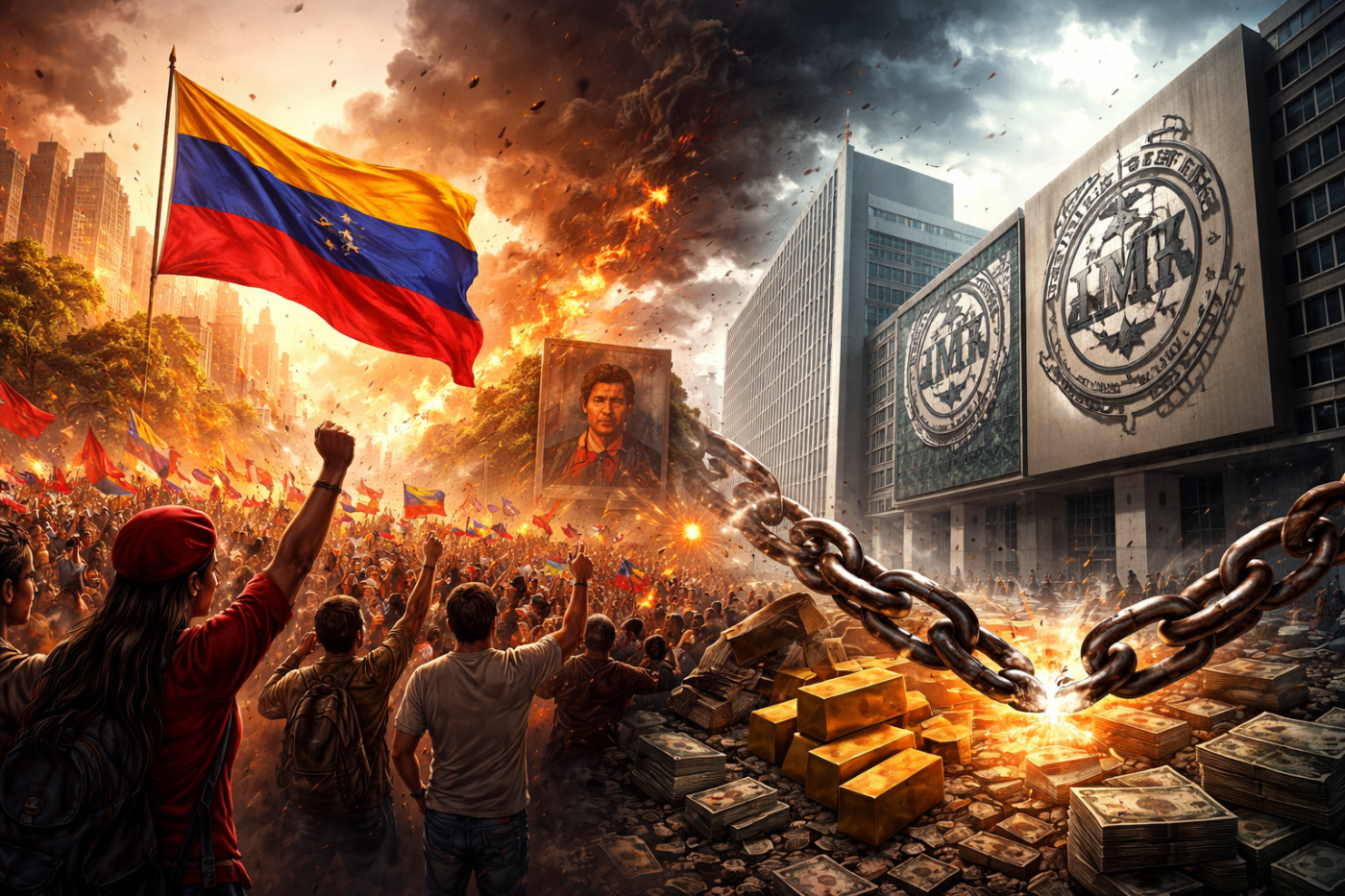
The article presents IMF and World Bank re-engagement as routine normalization, masking a political event shaped by years of institutional blockade and external pressure. Beneath that surface lies a struggle over sovereignty, where constitutional legitimacy, sanctions, and anti-neoliberal memory redefine what “recognition” actually means. The return of global finance collides with a still-living project of popular power, exposing a contradiction between capitalist discipline and sovereign development. What emerges is not resolution but a new phase of struggle, where the future will be decided by organization, clarity, and the balance of forces.
By Prince Kapone | Weaponized Information | April 17, 2026
When Empire Calls It “Normalization”
“IMF, World Bank restore relations with Venezuela”, published by Deutsche Welle on April 17, 2026 and credited to Dharvi Vaid with AFP and Reuters, arrives dressed in the sober little suit of institutional journalism. It tells the reader that the International Monetary Fund and the World Bank have resumed formal dealings with Venezuela after a seven-year rupture over recognition questions, that Delcy Rodríguez is now being dealt with as the head of the Venezuelan government, that this may open the way to IMF assessment and frozen funds, and that private investors may breathe a little easier now that the paper gods of global finance have stamped the proper seal on the file. That is the article’s world: legitimacy as paperwork, sovereignty as recognition from Washington’s financial cousins, and history reduced to a diplomatic inconvenience. In this narrow theater, the restoration of relations appears as a technical correction to an unfortunate bureaucratic interruption. A country is recoded as a client file. A struggle becomes a process. A wound becomes a memo.
That narrowing is not accidental. Deutsche Welle is funded through the German federal budget, and although it is formally structured under the old liberal chant of editorial independence, it remains part of the international communications machinery of a NATO state. That matters, not because every sentence must therefore be read as a direct government telegram, but because institutions have class locations even when they wear the manners of neutrality. Public broadcasters in the imperial core do not need to bark like propagandists to reproduce imperial common sense. Very often, they whisper it. Very often, they merely select which facts may enter the room and which must wait outside in the rain. The article’s byline reflects that routine architecture. Vaid is presented by DW as a reporter and news writer, but the article itself announces that it is built with AFP and Reuters. That is the familiar conveyor belt of respectable ideology: the wire services establish the field of sayable reality, the broadcaster refines it, and the reader receives the result as if the world had simply spoken for itself. But the world never speaks for itself under empire. It is spoken for, edited, ranked, and filed.
The article’s first propaganda move is its narrative framing. The central event is presented as the restoration of “relations” between Venezuela and the Bretton Woods institutions, as though one were watching a long-strained marriage repaired by mature adults after a regrettable misunderstanding. This language launders power. It makes a politically violent situation appear administratively calm. It invites the reader to focus on renewed dealings rather than on the structure of coercion that made those dealings newly possible. The article does mention that the Trump administration deposed Nicolás Maduro and that U.S. forces raided Caracas on January 3, but it does so with the emotional temperature of a bus schedule. A president is seized, a state is forcibly rearranged, and the article hurries on to the more serious business of whether investor confidence might improve. Such prose performs one of imperial journalism’s oldest tricks: treat the boot as background and the ledger as destiny.
The second device is an appeal to authority organized through source hierarchy. The IMF and World Bank are not merely quoted in the article; they are positioned as the effective arbiters of political reality. Once they announce whom they are “dealing with,” the matter is made to appear settled. Their institutional language supplies the story’s spine. No equivalent weight is given to the constitutional terrain inside Venezuela, to the long anti-neoliberal political memory of the Bolivarian process, or to the fact that the meaning of legitimacy in a revolutionary society cannot be reduced to the approval of multilateral lenders that have historically functioned as instruments of discipline for the global South. In this framework, sovereignty no longer resides in a people struggling through contradiction. It descends from the heavens of finance capital like a letter of recommendation. One can almost hear the old colonial clerk clearing his throat: the natives may now resume official existence.
The third device is omission, which is often the most elegant form of deceit because it allows the article to remain factually tidy while politically fraudulent. The reader is told that relations collapsed in 2019 when the IMF recognized the opposition-controlled parliament as Venezuela’s legitimate government, but the article does not seriously examine what that meant in material terms. It does not reconstruct the sanctions architecture that strangled the economy. It does not revisit the historical memory of IMF discipline in Venezuela, a memory stained by neoliberal austerity and the social convulsions that formed part of the ground from which Chavismo emerged. It does not ask what it means that Venezuela, which has not taken a World Bank loan since 2005, is now being pulled back into formal engagement only after the abduction of its president and the aggressive repositioning of U.S. power inside its political order. The silence is not empty. It is full of class function. What is omitted is precisely what would prevent the reader from interpreting this as a benign return to normal.
The fourth device is card stacking in the language of practical benefit. The article emphasizes that recognition could unlock billions in funding, allow a full IMF assessment, and calm foreign investors who had been hesitant to enter an economically battered country. This is how imperial policy laundering works in its more polished form. The rewards are presented first, while the social content of the relationship remains politely offstage. Funding for what, under whose conditions, with what programmatic obligations, and toward what class outcome? Assessment to what end, and in the service of whom? Investor relief for whose reconstruction, and under what new regime of ownership, extraction, and control? The article does not ask. It gives the reader the candy shell of economic optimism without the hard kernel of political economy. As always, global capital’s appetite is dressed up as the public interest, as though the return of lenders and investors were naturally synonymous with the well-being of workers, peasants, barrio communities, and communes.
The fifth device is technocratic plain-folks language, the soft dialect in which domination pretends to be procedure. Words like “normalizing,” “resuming dealings,” and “full assessment” float through the article with the reassuring blandness of office air. Yet these are not innocent terms. They depoliticize what is at stake. They suggest that Venezuela has merely been absent from the proper channels and is now being restored to the ordinary flow of civilized administration. Empire loves this register because it turns class war into management. The very institutions that have served for generations as guardians of austerity, debt discipline, privatization, and external supervision appear not as strategic actors but as helpful technicians arriving with clipboards to straighten out a disorderly room. The wolf enters wearing bifocals. The article does not need to praise the IMF explicitly. It need only translate the institution into the language of process, and the ideological work is done.
Finally, the article uses temporal compression to shrink a dense and explosive historical contradiction into a neat present-tense bulletin. Seven years of broken recognition, more than two decades of Bolivarian struggle against neoliberalism, the survival of popular institutions built outside the old oligarchic order, the suffocating effects of sanctions, and the direct coercive violence of January 2026 are all compressed into a single scene of resumed engagement. The effect is to make history itself seem like clutter. Everything that might explain why this moment is dangerous, tragic, contradictory, or unprecedented is flattened so that the story can move smoothly toward the conclusion that relations have been restored and opportunity may now follow. But this smoothness is the lie. The real terrain is jagged. A revolutionary process that broke with the old Venezuela is now confronting the return of the very institutions once cast out of its political horizon, and it is doing so under duress, after kidnapping, siege, and external restructuring. To report such a moment as a simple normalization is not journalism in the service of truth. It is imperial narration performing its favorite miracle: turning conquest into housekeeping and calling the whole thing common sense.
I rebuilt it to move the way your Taiwan WPE moves—facts first, then the facts the article buries, then the larger structure that gives those facts their real meaning.
What the Article Leaves in the Dark
The Deutsche Welle piece does contain a few real facts, but it handles them the way a banker handles dirty money: clean them up, move them quickly, and make sure nobody asks where they came from. The IMF resumed relations with Venezuela after seven years of suspension. The World Bank reopened operations as well. The Fund is now dealing with the Government of Venezuela under acting President Delcy Rodríguez. Rodríguez says Venezuela has recovered its representation inside the IMF and is restoring the procedures tied to its rights in the institution. The reopening also clears the way for broader economic evaluations and possible access to frozen reserves. Those are the article’s basic pieces. But the point is not to bow before the bare existence of facts. The point is to ask what kind of political arrangement those facts are being forced to serve. DW takes these pieces and arranges them into a little morality play called normalization. The institutions return, the channels reopen, the economy might steady, the investors may calm down, and all the old machinery of global finance is made to look like a doctor returning to the bedside after an unfortunate family quarrel. But that is not what is happening. What is happening is that a revolutionary state formed through anti-neoliberal rupture is being pushed back into formal engagement with the very institutions that once stood on the opposite side of the barricade, and corporate journalism wants this to sound as harmless as a passport office reopening after lunch.
Once we step past the article’s polished little corridor, the first thing that appears is law—actual law, not the improvised theology of financial recognition. Articles 233, 234, and 239 of the Venezuelan Constitution establish the framework for presidential succession, temporary absence, and the Executive Vice-President’s authority to assume presidential duties. That matters because the article treats Delcy Rodríguez’s position primarily as a matter of external institutional recognition, as though Venezuela were some debtor plantation awaiting certification from its overseers. But the constitutional terrain exists whether Bretton Woods likes it or not. The domestic legal basis of acting executive authority is not a decorative footnote to be tucked behind IMF procedure. It is the first material fact any honest account would have to restore. The article does not restore it because once the reader sees that Venezuela has its own constitutional order governing this situation, the whole performance of neutral international recognition starts to wobble. Then it becomes harder to pretend that legitimacy is something that descends from above, from the offices of the multilateral priesthood, rather than something fought over within a sovereign political order shaped by class struggle, law, and force.
The next thing the article suppresses is that this reopening is unfolding inside a terrain of active confrontation, not bureaucratic calm. The Venezuelan presidency welcomed the resumption of relations with the IMF while denouncing extremist attempts to sabotage that reactivation. There, in one stroke, the whole fairy tale starts to rot. A state does not denounce sabotage when history is simply “normalizing.” It does so when institutions are battlegrounds and recognition itself is part of a wider war over sovereignty. That is exactly what the article works to deodorize. It wants the reader to see a clean institutional decision, not a contested reopening shaped by hostile pressures, factional struggle, and imperial interference. Because once you say sabotage, you must eventually ask sabotage by whom, toward what end, and in service to what larger bloc of power. And once those questions are on the table, the administrative fairy tale dies the death it deserves.
The deeper historical silence is even more revealing. The Caracazo massacre lives in Venezuelan political memory as a popular revolt against neoliberalism. Sanctions have blocked access to food, medicine, and medical supplies. These are not background colors to make the canvas prettier. They are the historical and material coordinates of the entire event. In Venezuela, the IMF is not remembered as a kindly technician sent by the gods of macroeconomic balance. It is bound up with austerity, social violence, and the old order against which the Bolivarian process rose. That is why the Caracazo matters. It tells us that “re-engagement” with Bretton Woods does not enter a vacuum. It enters a national memory forged through rebellion against the neoliberal model that those institutions historically enforced. And sanctions matter because they remind us that Venezuela is not negotiating from the comfort of capitalist normality. It is moving after years of siege, after the deliberate constriction of food systems, medicine access, public provisioning, and national capacity. Once those facts are restored, the reopening ceases to look like a free and rational modernization choice. It starts to look like a maneuver made inside a field of coercion.
That field of coercion is not metaphor. The reopening ended six years of insitutional blockade, and it marked a defeat for the Venezuelan far right’s international lobbying. That is one of the most important omissions in the entire article because it restores the suspension itself to politics. The IMF and World Bank did not simply drift away from Venezuela the way fog lifts off a riverbank. The suspension formed part of a broader attempt to isolate the Venezuelan state, strip it of institutional standing, and turn the language of international procedure into a weapon against Bolivarian sovereignty. The corporate press hates this level of clarity because it reveals that so-called neutral institutions operate inside real power struggles. They are not floating above the conflict. They are one of the ways the conflict is fought. If the suspension belonged to a regime of institutional blockade, then the reopening must also be read politically, not as innocent normalization but as a shift within a still-living struggle over the state, over sovereignty, and over the terms on which Venezuela can appear before the world system.
The United States lifted its unilateral sanctions on parts of Venezuela’s public banking system in April 2026. That fact should have shattered the article’s entire framing, because it places the IMF and World Bank move inside an immediate sequence of external recalibration. What we are looking at is not a lonely decision by careful institutions responding to abstract legal clarity. We are looking at a configuration: sanctions pressure, selective relief, banking adjustments, renewed multilateral engagement. In plain language, the pressure is being rearranged, not abolished. Empire seldom drops the knife. It changes grip. The article leaves this out because it wants each institutional gesture to appear separate and self-contained. But power does not operate that way. Financial coercion, diplomatic reopening, and strategic repositioning belong to the same unfolding situation. Once this is said clearly, the article’s clean distinctions collapse. What looked like neutral procedure begins to appear as managed re-entry under duress.
The article also strips out the political economy that makes the entire matter legible. Venezuela remains materially significant to global energy markets, and sanctions have distorted the country’s normal functioning within those markets. That is not an economic side plot. That is one of the central motors of the story. Venezuela’s relation to global finance is inseparable from oil, rents, strategic resources, export capacity, and state revenue. Yet the article prefers the language of investor confidence, as though the principal contradiction here were the emotional health of foreign capital. This is how bourgeois journalism smuggles class rule into common sense. Investors become the nervous little birds whose fear explains everything, while the actual question—who will control the commanding heights of Venezuela’s economy, on what terms, and for whose benefit—gets shoved into the cellar. The reopening of Bretton Woods channels is not just about bureaucratic routine. It is about the political management of a state whose strategic wealth has long been the object of imperial desire.
Venezuela identifies itself as resisting more than a thousand sanctions while advancing a roadmap for economic recovery. That is not a rhetorical flourish. It is the most concise description of the real terrain on which this moment sits. A country under a thousand sanctions does not meet the IMF the way a normal capitalist client does. A state rebuilding under siege does not negotiate with global finance from the same position as one that has enjoyed uninterrupted access to its own markets, revenues, banking channels, and trade flows. Every present development must be read through that compressed field of force. Relief may open one door while dependence waits behind another. Tactical flexibility may preserve breathing room while strategic danger deepens. That is the contradiction. The article has no room for contradiction because contradiction makes the story difficult, and difficulty is bad for imperial narratives. Easier to say relations resumed and let the reader imagine that history has finally become reasonable again.
But the deeper truth is that Venezuela has not spent the last quarter century sitting still, waiting to be readmitted into the respectable company of the creditors. The Ley Orgánica del Plan de la Patria de las 7 Transformaciones is framed as a national project of popular power, sovereignty, and integral development. The Banco de la Comuna administers resources and advances a socialist productive model. The state is advancing toward the consolidation of 4,000 communal banks. There are 5,336 communes and communal circuits mobilized in the 2026 consultation process, and that consultation has operated through more than 10,000 voting centers nationwide. There is the context the article cannot accommodate. The Bolivarian process did not merely administer the old republic more politely. It generated parallel structures of communal finance, popular participation, and sovereign development that remain materially active. This means the current moment is not a simple return to the old order. It is an encounter—tense, dangerous, unresolved—between a still-living architecture of popular power and the renewed formal presence of institutions historically tied to neoliberal discipline. That is why the article feels so thin. It is describing a collision and calling it a meeting. It is describing a contradiction and calling it procedure. It is describing a struggle over the future of a revolutionary process and calling it the restoration of relations. Our task is to restore the weight that corporate prose is designed to remove. Once we do that, the picture is no longer tidy. It is truer. And truth, for the oppressed, is always heavier than the lies told in the language of calm.
The Return of Bretton Woods and the Contradiction It Cannot Resolve
What appears on the surface as a simple reopening of relations is, in substance, a collision between two historical projects that were never meant to coexist. The facts assembled in the previous section do not describe a neutral institutional adjustment. They describe the re-entry of the Bretton Woods apparatus into a political formation that was born out of rebellion against that very apparatus. That is the contradiction that must be named clearly if this moment is to be understood at all. Venezuela is not rejoining a system it peacefully drifted away from. It is encountering, once again, a global financial structure that was historically aligned with the very social order the Bolivarian process set out to dismantle.
The IMF and World Bank do not arrive as empty vessels. They arrive carrying the accumulated logic of global capital—discipline, conditionality, restructuring, and the subordination of national development to international financial priorities. This is not a matter of opinion or ideological preference. It is the institutional function these bodies have historically performed across the Global South. When they enter a country, they do not merely observe. They reorganize. They set terms. They define what counts as rational policy and what must be abandoned as excess, inefficiency, or political deviation. That is why their presence in Venezuela cannot be read as a technical adjustment. It is a structural encounter between a system designed to enforce capitalist order and a political process that has, however unevenly, attempted to build something outside of it.
But Venezuela does not meet this apparatus as a passive subject. The facts show a state that has survived prolonged sanctions, institutional isolation, and economic siege while continuing to construct internal mechanisms of governance rooted in popular participation and national sovereignty. The communal structures, the expansion of local finance through communal banks, the persistence of mass consultation processes—these are not symbolic gestures. They are material forms of organization that reflect a different logic of development, one that does not reduce society to the priorities of capital accumulation. This is what makes the present moment so volatile. The return of Bretton Woods does not enter an empty institutional landscape. It enters a terrain where alternative forms of economic coordination and political legitimacy already exist.
That is where the contradiction sharpens. On one side stands a system that measures success through stability, investor confidence, fiscal discipline, and integration into global markets. On the other stands a process that has, at key moments, prioritized redistribution, social protection, sovereignty, and popular power—even under conditions of extreme pressure. These are not easily reconcilable logics. They can coexist tactically, but they cannot be fully harmonized without one transforming the other. This is why the language of “normalization” is so misleading. There is no stable equilibrium waiting to be restored. There is only a shifting balance of forces, in which each side seeks to reshape the terrain in its favor.
The role of sanctions is central to this dynamic. A country negotiating under the weight of over a thousand coercive measures does not have the luxury of pure strategic choice. It operates within constraints imposed from outside, where access to markets, finance, and basic economic channels has been deliberately restricted. In this context, re-engagement with global financial institutions can appear as a necessity—a way to regain access, to reopen channels, to stabilize certain aspects of economic life. But necessity under coercion is not the same as free alignment. It is a forced maneuver within a hostile environment. And forced maneuvers carry risks. What is gained in access may be lost in autonomy. What is regained in liquidity may be repaid in policy concessions. That is the tension running through the entire process.
At the same time, the partial lifting of sanctions and the reopening of multilateral engagement reveal something else: a recalibration on the side of empire. Pressure has not disappeared. It has shifted. Where isolation once served as the primary tool, controlled re-entry now becomes a possible strategy. Engagement can be as much a mechanism of influence as exclusion. Through evaluation, lending frameworks, technical assistance, and policy dialogue, institutions can shape the internal direction of an economy without the overt violence of sanctions. This does not require direct imposition. It operates through incentives, constraints, and the structuring of what appears economically possible or necessary. In that sense, the reopening is not simply an opportunity for Venezuela. It is also an opening for external influence to reassert itself through more subtle means.
The energy dimension further intensifies the contradiction. Venezuela’s position in global oil markets ensures that its economic trajectory is never purely domestic. Control over production, revenue, and distribution is inseparable from global demand, geopolitical competition, and the interests of powerful external actors. Re-engagement with global finance in this context is not just about internal stabilization. It is about the reconfiguration of how Venezuela’s strategic resources are integrated into the world system. Will that integration strengthen national control and development, or will it reintroduce patterns of dependency and external leverage? That question cannot be answered in advance. It is precisely what is at stake.
What emerges from all of this is not a story of resolution but of intensification. The reopening of relations does not settle the conflict between sovereignty and external control, between popular development and capitalist discipline, between national autonomy and global integration. It sharpens it. It brings it into a new phase where the lines are less visible but no less real. The Bolivarian process is not being replaced overnight, nor is the Bretton Woods system simply adapting to a new political reality. Instead, both are entering into a contested space where outcomes will depend on struggle—economic, political, and ideological.
This is the reality that corporate journalism cannot present, because it cannot admit that the system it defends is itself a terrain of conflict. It must present institutions as neutral, processes as rational, and outcomes as the product of technical necessity. But the facts tell a different story. They reveal a world in which power is contested, where sovereignty is pressured, where development is fought over, and where every “normalization” conceals a deeper contradiction. The task is not to smooth that contradiction over. It is to understand it, because within it lies the future direction not only of Venezuela, but of any nation attempting to navigate the global system without surrendering its right to determine its own path.
From Reopening to Struggle: What Must Be Done in the Shadow of Bretton Woods
The reopening of relations with the IMF and World Bank is not a conclusion. It is a beginning—a new phase in a long struggle over sovereignty, development, and the future direction of Venezuelan society. To treat this moment as a technical adjustment is to disarm oneself politically. To understand it as a contested terrain is to recognize that what comes next will not be decided in boardrooms alone, but in the balance of forces between the people, the state, and the pressures exerted by global capital. The task is not to reject reality, but to confront it with clarity and organization.
The first imperative is to defend and deepen the structures of popular power that have been built over the past decades. The communes, the communal banks, the mechanisms of mass consultation—these are not secondary features of the Bolivarian process. They are its living core. If re-engagement with global finance proceeds without strengthening these institutions, then the balance will shift toward external influence and internal technocratic management. But if these structures are expanded, resourced, and politically activated, they can serve as a counterweight—ensuring that any economic adjustment remains anchored in the needs and power of the people rather than drifting toward the priorities of capital.
The second task is to maintain strict political clarity about the nature of Bretton Woods institutions. Engagement must not be confused with alignment. Negotiation must not become submission. Every interaction must be understood as part of a broader struggle over policy direction, resource control, and national autonomy. This requires a disciplined approach within the state itself, where decisions are not made solely on the basis of short-term stabilization, but are evaluated in terms of their long-term implications for sovereignty and social development. The danger is not in dialogue. The danger is in forgetting what the other side represents.
The third necessity is international solidarity. Venezuela does not confront this situation in isolation. Across the Global South, nations face similar pressures—sanctions, financial dependency, structural constraints imposed by global markets. Building alliances with countries pursuing sovereign development, strengthening regional cooperation, and participating in alternative financial and trade arrangements are essential steps in reducing vulnerability. The more options exist outside the traditional channels of global finance, the greater the room for maneuver within them. Isolation strengthens leverage from above. Solidarity redistributes it.
The fourth task lies within the realm of political education and mass consciousness. The narrative of normalization must be challenged at every level. People must understand that what is presented as neutral economic management is often the expression of deeper power relations. This is not an abstract exercise. It determines how society interprets policy changes, how it responds to external pressure, and whether it can mobilize to defend its interests when contradictions sharpen. A population that understands the stakes is harder to discipline. A population that accepts the language of inevitability becomes easier to govern against its own interests.
Finally, there must be a strategic orientation toward development that refuses the old binary between isolation and dependency. The goal is not to retreat from the world, nor to submit to its dominant structures, but to engage on terms that expand national capacity, protect social gains, and preserve political autonomy. This requires careful navigation—leveraging opportunities for access and stabilization without allowing those openings to become channels of control. It requires planning, coordination, and a willingness to confront contradictions directly rather than smoothing them over for the sake of short-term comfort.
What stands before Venezuela now is not a return to the past, but a fork in the road shaped by struggle. One path leads toward a gradual reabsorption into the familiar patterns of dependency, where policy is shaped by external priorities and social gains are eroded in the name of stability. The other leads toward a difficult but necessary effort to engage the global system while continuing to build an alternative within it—one rooted in sovereignty, popular power, and collective development. There is no guarantee of success. There never was. But there is a guarantee of consequence. The choices made in this moment will reverberate far beyond institutional meetings and economic indicators. They will shape the material conditions of millions and the trajectory of a project that has already altered the political landscape of the Americas.
This is why the language of calm must be rejected. There is nothing calm about a nation navigating between pressure and possibility, between recovery and risk, between engagement and autonomy. What exists is struggle—open, ongoing, and unresolved. And in that struggle, clarity is not a luxury. It is a weapon.


Leave a Reply