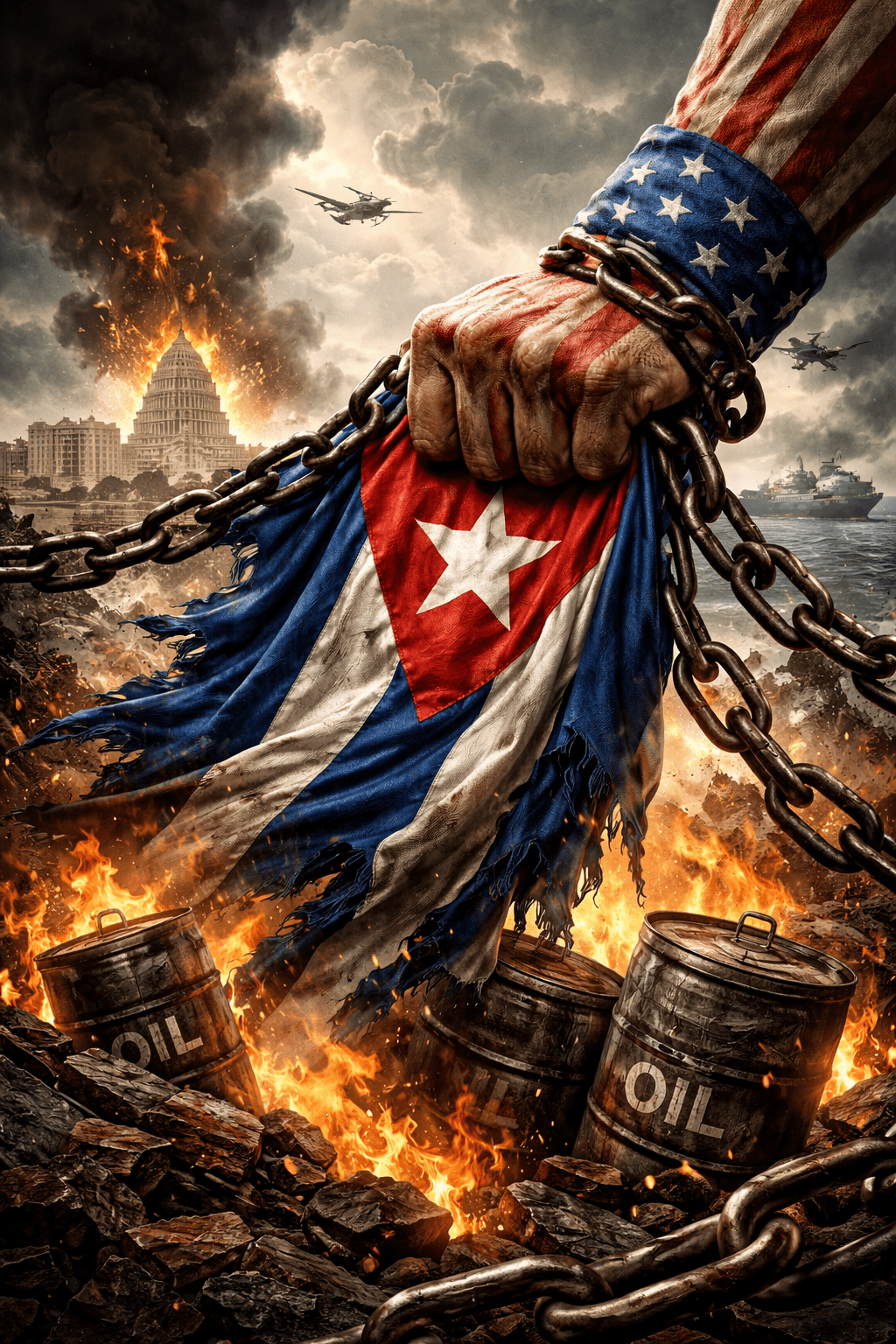
The New York Times repackages economic warfare as diplomatic tension, presenting Cuba’s resistance as irrational defiance rather than a response to material coercion. A reconstruction of the facts reveals a deliberate strategy of energy strangulation, financial restriction, and calibrated pressure designed to destabilize Cuban society from within. When these conditions are placed back at the center, Díaz-Canel’s position emerges not as stubbornness, but as a refusal to surrender sovereignty under siege. What appears as crisis is in fact policy—an imperial system that manufactures suffering, then weaponizes it to justify further domination.
By Prince Kapone | Weaponized Information
April 16, 2026
The Clean Shirt of Empire
“Cuba’s President Projects Defiance in Standoff With the U.S.”, written by Adam B. Ellick and Simon Romero and published by The New York Times on April 12, 2026, arrives dressed in the calm, respectable tailoring of liberal journalism, which is to say that it comes to us washed, pressed, and perfumed so that domination may pass for concern. On its surface, the article tells a straightforward story. President Miguel Díaz-Canel appears on Meet the Press, speaks defiantly about Cuba’s willingness to resist U.S. pressure, rejects the idea that Washington can dictate Cuba’s internal political order, and insists that the island’s suffering is inseparable from the economic siege imposed upon it. The article then arranges these facts in a familiar imperial sequence: the Cuban people are suffering, the United States is applying pressure, and the obstacle standing in the way of progress appears to be a revolutionary government unwilling to bend. That is the official melody. But like so much of what passes for sober foreign reporting in the corporate press, the article does not merely report a crisis. It organizes the reader’s relationship to that crisis. It does not simply describe Cuba. It interprets Cuba in advance, so that by the time the reader reaches Díaz-Canel’s words, the verdict has already been prepared.
This is how elite media earns its keep. The New York Times is not some neutral village bulletin pinned to a fence post by curious townspeople. It is a corporate institution of immense ideological consequence, one of the principal translation centers through which the U.S. professional class learns how to think about the world without ever having to dirty its hands in the actual machinery of empire. It speaks in the accents of seriousness, moderation, and prudence. It sells itself not as propaganda, but as the mature alternative to propaganda. That is precisely its power. It need not foam at the mouth or bark with the crude hysteria of a tabloid. It simply places the empire in a clean shirt and sits it at the head of the table. Ellick, coming out of prestige opinion-video journalism, and Romero, operating within the established world of Latin America and Caribbean correspondence, occupy exactly that class position: they are not cartoonists of empire, but its stylists, its interpreters, its respectable narrators. They do not need to shout that Washington has the right to shape Cuba’s destiny. They merely write as though this were already understood by all sensible adults in the room.
The article’s first and most important propaganda device is narrative framing. Díaz-Canel is not introduced chiefly as the president of a country under intensifying economic assault. He is introduced through the grammar of “defiance,” as though the central political fact here were his tone rather than the coercive conditions under which that tone emerges. This is a very old trick. Empire places its boot on someone’s neck and then expresses grave concern about the impolite manner in which the victim complains. Once that framing is established, everything else begins to slide obediently into place. His insistence on sovereignty becomes rigidity. His refusal to let Washington determine Cuba’s political future becomes obstinacy. His commitment to defend the country from foreign aggression becomes dramatic theater rather than the ordinary language of state self-defense. The article does not openly sneer, because the liberal mind prefers its contempt properly folded. But the architecture of the piece leads the reader toward that very conclusion: here is a leader clinging to defiance while his people suffer, here is a government digging in when what is needed is change, here is a revolutionary posture standing in the way of relief. In this way, the article transforms a confrontation over sovereignty into a morality play about temperament.
The second device is omission, and here the article does what liberal imperial texts do best: it names the wound only softly enough that the knife may remain invisible. Yes, it acknowledges that the United States has been essentially blockading oil shipments to Cuba. Yes, it admits that this pressure has worsened the island’s already dire conditions. But these admissions are subordinated to a broader narrative in which Cuban hardship still appears chiefly as evidence of internal governmental failure. The blockade becomes scenery. The suffering becomes indictment. Causality is redistributed with all the delicacy of an accountant shifting numbers between columns. The effect is ideological rather than merely editorial. The reader is permitted to know that Washington is squeezing Cuba, but not encouraged to dwell on that squeeze as the structuring fact of the story. Instead, attention is redirected toward what Cuba refuses to do: release prisoners, hold multiparty elections, alter its system, conform to the approved script of political modernization. This is what the corporate press calls balance. First, the empire strangles. Then the newspaper asks why the victim looks short of breath.
The third device is source hierarchy, that sacred ritual by which imperial reason is made to seem like reason as such. The article moves within a universe where U.S. demands, U.S. assumptions, and U.S. expectations define the outer boundary of legitimacy. Washington’s concerns are treated as intelligible, practical, and strategically grounded. Cuba’s position, by contrast, is forced into the role of response. The burden of explanation lies with Havana. It is Cuba that must justify why it will not restructure itself according to the wishes of a hostile power. It is Cuba that must explain why it rejects outside conditions on its constitutional order. It is Cuba that appears before the tribunal of common sense. Notice what this does. It quietly naturalizes the premise that the United States may properly set terms for Cuba’s political future, while Cuba’s insistence on self-determination becomes the thing to be scrutinized. That is not journalism floating above power. That is journalism already seated on power’s lap, taking dictation with elegant posture.
The fourth device is false analogy, or perhaps more precisely the imperial chain of association. The article links Cuba’s current position to Washington’s handling of Venezuela and Iran, not to clarify material differences, but to fold Cuba into a wider narrative of adversary management. This is a subtle but important move. It normalizes the logic that states resisting U.S. dominance can be understood as entries in the same policy ledger, each one another problem to be pressured, contained, or rearranged. Cuba is thereby placed inside a sequence rather than a history. The reader is not invited to think carefully about Cuba’s distinct political institutions, historical experience, or revolutionary trajectory. The reader is invited to recognize a pattern: hostile government, humanitarian crisis, U.S. pressure, question of leadership change. Once that chain is forged, each case appears to validate the next. Empire loves this kind of reasoning because it saves time. Why study a people in their concreteness when one can simply file them alphabetically under “states requiring correction”?
The fifth device is poisoning the well. Before the article has reconstructed the full coercive environment in which Cuba is operating, it primes the reader with references to “political prisoners,” the reassertion of the Castro family’s authority, and the refusal of multiparty elections. These are not minor details in themselves, but their arrangement matters. Their placement matters. Their cumulative effect matters. They establish an atmosphere in which Cuba is already half-convicted before the larger conditions of siege have been brought into view. This is how respectable propaganda works. It does not usually lie by inventing facts outright. It lies by sequencing facts so that one moral intuition arrives early and another arrives late. The United States can blockade fuel, deepen blackouts, intensify scarcity, and still appear as the party asking sensible questions about democracy, because the article has already taught the reader where sympathy is supposed to hesitate. In the courtroom of liberal empire, the prosecution is always allowed to open first.
The sixth device is controlling the message through selective concision. The full political conflict disclosed in the interview is wider and sharper than the article lets on. Díaz-Canel’s central line is not merely that he is personally defiant. It is that Cuba’s leadership is not elected by Washington, that Cuba is a sovereign state, and that its constitutional order is not something for the United States to negotiate over like a customs tariff or a parking dispute. That point is explosive because it cuts through the entire imperial script. It names the actual obscenity in plain language: a foreign power presuming the right to dictate the internal political arrangements of a neighboring nation. But the article compresses this confrontation into the manageable language of standoff and pressure, as though we were watching two difficult parties haggle across a conference table rather than witnessing a much older drama in which empire again attempts to convert domination into common sense. The result is a text polished enough for brunch conversation in Manhattan and bloodless enough to conceal the hand around Cuba’s throat.
And that, finally, is the article’s real accomplishment. It does not openly celebrate conquest, nor crudely call for invasion, nor descend into the comic-book barbarism of cable-news chauvinism. It does something more refined and therefore more dangerous. It translates coercion into diplomacy, external diktat into negotiation, and revolutionary refusal into theatrical obstinacy. It presents Washington as the adult in the room and Cuba as the difficult child who will not cooperate with its own rescue. This is the house style of liberal imperialism: violence with table manners, domination with educated syntax, the whip hidden behind a well-edited paragraph. The article does not need to say that the United States has the right to decide Cuba’s future. It simply writes as though the matter were already settled, and asks the reader only to consider how best that right should be exercised. In that sense, the piece is less a report on Cuba than a small act of ideological administration. It is the empire explaining itself to itself, softly, responsibly, and with just enough humanitarian perfume to keep the smell of power from becoming unbearable.
What the Article Leaves in the Dark
The New York Times article lays out its surface facts like a neatly arranged table—clean, orderly, and stripped of the very forces that give them meaning. Miguel Díaz-Canel says dialogue with the United States is possible but difficult. He rejects any U.S. authority over Cuba’s internal political order. He declares that Cuba will defend itself and affirms a willingness to die for the revolution. The article concedes that Washington has been blockading oil shipments and that this has worsened the crisis. It notes that Díaz-Canel refuses multiparty elections and declines to release prisoners framed as political detainees. And all of this is wrapped in the quiet insinuation that Cuba’s leadership is “digging in” while the United States is busy elsewhere. That is the architecture. But once you step outside that carefully managed frame, the scene changes completely. What looks like a diplomatic standoff reveals itself as a story of siege—with the siege itself pushed politely out of view.
Start where the pressure actually lives: in policy. On January 29, 2026, Washington issued an executive order declaring a national emergency regarding Cuba and authorizing measures to restrict third-country oil supplies to the island. Havana named it directly: a “total blockade on fuel supplies.” That same reality was affirmed globally when UN human rights experts described the measure as a “fuel blockade” and condemned it as a violation of international law. This is not background pressure. This is infrastructural coercion, targeted and explicit. Not weather—policy with intent.
The timeline makes the mechanism unmistakable. In March 2026, Cuba stated that more than three months had passed without a fuel ship entering the country. The energy crisis is not abstract dysfunction—it is the direct outcome of interdicted supply. Even within imperial reporting, the structure is visible: the White House retains the authority to seize vessels violating Cuba sanctions. Control over fuel becomes discretionary power over an entire society. At the same time, Washington deploys a calibrated strategy: fuel access is restricted for the state while selectively authorized for private firms. This is not humanitarian concern. This is engineered scarcity—pressure applied unevenly to reshape internal economic relations.
Follow that pressure into daily life and the omissions become impossible to ignore. After three months without imported fuel, diesel and fuel oil stocks are exhausted, taking megawatts offline and collapsing generation capacity. The blockade strikes the entire chain of social reproduction: electricity, hospitals, water supply, sanitation, food storage, and transport. This is what energy interdiction does—it radiates through everything. The consequences are not theoretical. Islandwide blackouts hit all 11 million Cubans. Movement slows to the point where the Ciclobús becomes a mechanism of survival. Cuba produces less than one-third of the oil it needs, making external supply decisive. Even the showcase zones of tourism collapse into the same reality: 22-hour blackouts, reduced water access, shrinking medical services. This is not mismanagement. This is a society being squeezed at its infrastructural joints.
The geopolitical field tells the same story from another angle. Russia dispatches roughly 700,000 barrels of crude and pledges further supplies, stepping into the breach created by U.S. interdiction. That supply is framed directly as humanitarian assistance. The crisis generates rerouting, not isolation. Multiple countries explore ways to supply oil despite U.S. tariff threats. Solidarity becomes material: the Nuestra América Convoy brings participants from 33 countries and 120 organizations, alongside European and North African missions delivering medical aid. The island is not isolated—it is contested terrain within a wider global field.
The financial and trade architecture completes the picture. Dozens of banks suspend operations with Cuba, disrupting transfers for fuel, food, medicine, and materials. The blockade raises costs and delays access to medical equipment, pharmaceuticals, and industrial inputs. It obstructs the import of food, medicine, and essential supplies. The impact is measurable: 69 percent of essential medicines are affected and more than 300 drugs become unavailable. The objective is stated plainly in U.S. policy itself: to isolate the Cuban Government economically and deprive it of resources. There is no ambiguity here. The policy declares its purpose. The article simply refuses to center it.
The deeper historical structure makes the present moment intelligible. The record is continuous. The Bay of Pigs invasion stands as direct U.S.-backed military intervention. Operation Mongoose formalizes covert destabilization aimed at overthrowing the government. Policy documents lay out the strategy explicitly: maximum pressure short of direct military intervention. Cuba is pushed out of the hemispheric system through exclusion from the OAS. This is not a series of isolated events. It is a coherent strategy evolving over decades—military, economic, diplomatic, and covert pressure converging on the same objective.
Place the present inside that trajectory and the broader context snaps into focus. The UN General Assembly condemns the blockade by a vote of 165 to 7, isolating Washington on the global stage. Cuba defines the objective clearly: to provoke social breakdown and constitutional rupture. The political system targeted by this pressure is not a personal project but an institutional order: the National Assembly of People’s Power as the supreme organ of state authority, grounded in constitutional authority. Meanwhile, the U.S. sharpens its intervention by design: fuel flows expand to the private sector while restrictions tighten on the state, and Venezuelan oil is allowed to reach private firms under controlled conditions. Scarcity is not only imposed—it is structured.
Energy stands at the center of this entire configuration. Imported crude feeds directly into the grid, with 40 percent of a Russian shipment converted into fuel oil for electricity generation. When supply is cut, the grid collapses: system-wide failures and repeated nationwide blackouts follow. The regional dimension sharpens the strategy further. The halt of Venezuelan oil flows after the January 3 removal of Maduro tightens the chokehold. Supply routes are threatened while controlled openings are considered on U.S. terms. Cuban diplomacy links the escalation directly to broader interventionist pressure and threat construction.
Restore all of this, and the illusion collapses. What the article presents as a diplomatic standoff is a coordinated system of coercion—fuel blockade, financial strangulation, medical scarcity, geopolitical rerouting, and a long-standing regime-change strategy operating through updated mechanisms. This is not a crisis that simply exists. It is a crisis that is produced. And once that production process is made visible, the entire narrative flips: not a government failing under pressure, but a society being pressured into failure.
The Interview They Rewrote: From Siege to “Defiance”
Let’s return to the actual moment—because that is where the lie lives. A sitting president of a small Caribbean nation appears on U.S. television and states, in clear and unambiguous terms, that his country is under intensifying economic pressure, that its access to fuel and essential inputs is being constricted, and that it will not reorganize its political system at the command of a foreign power. That is the event. That is what happened. Not in abstraction, not in theory, but in real time, under real conditions. Now compare that to what the New York Times gives us: a story about “defiance,” about a leader digging in, about a government refusing to change while its people suffer. That is not reporting. That is narrative inversion—what we in WI call the imperial reversal of causality.
Because the order of events matters. It always matters. The United States tightens economic pressure, restricts fuel flows, and deepens the material constraints under which Cuban society is forced to operate. Those constraints produce blackouts, transport disruptions, strain on hospitals, and interruptions in the everyday reproduction of life. Díaz-Canel appears and says, in essence: we are being squeezed, and we will not surrender our sovereignty in exchange for relief. That is the sequence. But the NYT flips it on its head. Suddenly, the hardship becomes the starting point, and Cuba’s political system becomes the cause. The siege disappears into the background, and what remains is a morality tale about stubborn leadership. The knife is hidden, and the wound is blamed for bleeding.
This is not an innocent mistake. It is narrative management in its cleanest form. The material reality—energy restriction, financial pressure, logistical strangulation—is pushed to the margins, acknowledged just enough to avoid outright falsehood, but never allowed to define the story. Instead, the reader is trained to focus on what Cuba refuses to do: open its political system to U.S. approval, restructure its governance, conform to the ideological expectations of liberal democracy as defined in Washington. The pressure becomes reasonable. The resistance becomes irrational. And just like that, coercion is rebranded as policy, and sovereignty is reframed as defiance.
But look closer at the conditions under which this interview took place. This was not a neutral diplomatic exchange between equal parties. This was a conversation unfolding inside what can only be described as a siege economy. Fuel shortages were not abstract statistics; they were shaping daily life—interrupting electricity, slowing transport, complicating healthcare delivery, and destabilizing food distribution. In any serious materialist analysis, that is the starting point. That is the ground on which political statements must be understood. Yet the NYT treats these conditions as background noise, as though Díaz-Canel’s words floated freely above them rather than being produced by them.
And here is where the logic of hyper-imperialist calibration becomes visible. The pressure being applied is not blunt, not random, not chaotic. It is targeted. It moves through chokepoints—energy, finance, logistics—precisely because those are the sectors that regulate the entire social metabolism. Disrupt fuel, and you disrupt everything. Restrict financial access, and you choke the ability to import essentials. Interfere with shipping, and you fracture supply chains. This is not about encouraging reform. It is about engineering crisis conditions that can then be politically leveraged. The goal is not simply to weaken Cuba. It is to produce internal strain that can be read—by the media, by the public, by international observers—as evidence that the system itself is failing.
Now return again to Díaz-Canel’s so-called “defiance.” What is he actually saying? He is saying that Cuba’s political system is not up for negotiation under conditions of coercion. That its leadership is not appointed by Washington. That its institutional structure—organized through its own constitutional framework—is not something to be bartered in exchange for fuel shipments. Strip away the media framing, and what remains is a straightforward assertion of sovereignty. Not dramatic. Not theatrical. Simply a refusal to accept the premise that economic strangulation grants another country the right to redesign your society.
But that position cannot be allowed to stand on its own terms. Because if it does, the entire imperial narrative begins to crack. So it must be translated. Softened. Rewritten. And that is exactly what the NYT does. It takes a statement rooted in material conditions—conditions of pressure, scarcity, and external constraint—and recodes it as attitude. As tone. As posture. This is the ideological move that allows empire to operate without appearing as empire. Structural violence is converted into personality conflict. A geopolitical confrontation becomes a story about stubbornness.
The result is a completely inverted picture of reality. The United States appears as a rational actor applying measured pressure in pursuit of reform. Cuba appears as an irrational actor refusing to adapt despite mounting hardship. But once we restore the actual sequence of events, the image flips back into place. It is the pressure that produces the hardship. It is the hardship that frames the response. And it is the response that is then used to justify further pressure. This is the feedback loop of imperial policy: create the conditions of crisis, interpret the crisis as failure, and then escalate the measures that produced it in the first place.
What the NYT cannot say—because it sits inside the ideological architecture of U.S. power—is that this is not diplomacy in any meaningful sense. Diplomacy implies negotiation between sovereign equals. What we are seeing here is conditionality under duress. It is the attempt to convert economic leverage into political transformation. And when that transformation is refused, the refusal itself becomes the story. Not the pressure. Not the blockade. Not the restrictions. The refusal.
So let us be clear about what this interview actually represents. It is not a spectacle of defiance. It is a moment in an ongoing confrontation where one state is applying structured economic pressure to force political change, and another state is refusing to accept those terms. Everything else—the language of reform, the emphasis on governance, the moral framing of leadership—is layered on top of that core reality. Strip those layers away, and the picture becomes unmistakable. This is not a failure of Cuba to meet expectations. It is a refusal to submit to them.
And that is the real story the NYT could not tell. Not because the facts are unavailable, but because telling that story would require abandoning the comfortable fiction that U.S. power operates as neutral policy rather than organized coercion. It would require admitting that what is being contested is not simply how Cuba is governed, but who has the right to decide. And once that question is asked plainly, the entire narrative collapses under its own weight. What remains is not confusion, not complexity, but clarity: a siege presented as diplomacy, and a defense of sovereignty presented as defiance.
The Blockade Is Not Absolute—It Is Being Fought
Now let’s address the only question that matters: what is to be done? Not in abstraction, not in the safe language of “awareness,” but in the concrete terrain where struggle actually unfolds. Because here is the truth that the empire works tirelessly to conceal—Cuba is not alone. The blockade is not uncontested. It is being resisted, chipped at, and in certain moments materially broken through by a growing network of organizations, movements, and working people across the world. The real story is not just one of siege. It is one of counter-siege.
Inside the United States itself—the belly of the beast—the cracks are visible. Organizations like the National Network on Cuba have built a broad-based infrastructure linking faith groups, unions, and grassroots organizers into a coordinated effort to both expose and materially disrupt the blockade. Their caravans do not simply deliver aid; they perform a political act. They move supplies across space while breaking the ideological quarantine imposed on the American public. At the same time, formations like the International US-Cuba Normalization Coalition Committee have turned the question of sanctions into a national political issue, organizing conferences, protests, and campaigns that directly challenge the legitimacy of economic warfare. Even within newer layers of organizing, such as anti-war currents inside formations like the Democratic Socialists of America, we see a re-emerging understanding that Cuba is not an isolated issue but part of a broader imperial system of sanctions, intervention, and coercion.
Across the Global North, solidarity has not disappeared—it has deepened and institutionalized itself. In Britain, the Cuba Solidarity Campaign has spent decades building a durable political presence, linking parliamentary pressure with grassroots mobilization, education, and international exchange. These are not symbolic gestures. They are sustained efforts to delegitimize the blockade at the level of public consciousness and state policy. Alongside them, more militant formations such as the Revolutionary Communist Group have carried forward the tradition of anti-imperialist internationalism, organizing brigades, political education, and direct engagement with Cuba that bypasses the filters of imperial media entirely. What these movements demonstrate is that solidarity is not charity—it is alignment in struggle.
But it is in the Global South and in internationalist networks where the most decisive developments are taking place. When hundreds of organizations across dozens of countries coordinate convoys carrying food, medicine, and energy infrastructure into Cuba, they are not merely offering assistance. They are directly confronting the material effects of the blockade. They are saying, in practice, that the attempt to isolate Cuba can be countered through collective action. This is what solidarity looks like when it moves beyond slogans. It becomes logistical. It becomes organized. It becomes a force capable of interrupting imperial strategy on the ground.
The role of global labor is equally significant. When international trade union federations call for coordinated weeks of action, protests, and material support, they are linking the Cuban struggle to the broader condition of the global working class. Because the blockade is not just about Cuba. It is a weapon in the arsenal of empire, one that is used against any nation that attempts to assert control over its own development. To oppose it is not an act of narrow national solidarity—it is part of a wider struggle against a system that disciplines entire populations through economic strangulation.
And within the United States, perhaps the most important terrain is ideological. Organizations like the Witness for Peace Solidarity Collective are engaged in a different kind of battle: breaking the narrative blockade. Through delegations, education campaigns, and direct exposure to the realities on the ground, they challenge the stories that sustain imperial policy. Because the blockade does not operate only through sanctions and restrictions. It operates through consent—manufactured, managed, and reproduced through institutions like the New York Times. To dismantle the blockade materially, one must also dismantle the ideological apparatus that justifies it.
So what does this mean in practical terms? It means that solidarity is not a feeling—it is a set of actions. It means joining and strengthening organizations that are already engaged in this work. It means contributing to material aid efforts that directly alleviate the pressure imposed by sanctions. It means organizing locally—educating, agitating, building networks that can apply pressure on political institutions while connecting struggles across borders. And it means refusing the ideological framing that presents economic warfare as policy and resistance as defiance.
The lesson here is simple, but it cuts against everything the empire wants us to believe. The blockade is not an unchangeable fact of nature. It is a policy—constructed, enforced, and therefore capable of being dismantled. But it will not collapse on its own. It will be weakened, piece by piece, through organized struggle—through the convergence of movements, through the alignment of material support and political pressure, through the refusal of people across the world to accept that one nation has the right to suffocate another.
And this brings us back to Cuba itself. What is being defended there is not perfection. It is not some abstract ideal. It is the principle that a people has the right to determine its own path without being brought to its knees by external force. Every convoy that arrives, every campaign that mobilizes, every organization that refuses to be silent—these are not acts of charity. They are acts of political alignment with that principle.
Because in the end, the real isolation is not Cuba’s. It is the isolation of a system that must rely on coercion, pressure, and narrative manipulation to maintain itself. And the more that system is exposed—materially, politically, and ideologically—the more its grip begins to loosen. The siege is real. But so is the resistance. And history has shown, time and again, that when resistance organizes itself with clarity and purpose, even the most entrenched systems of domination can be forced to retreat.


Leave a Reply