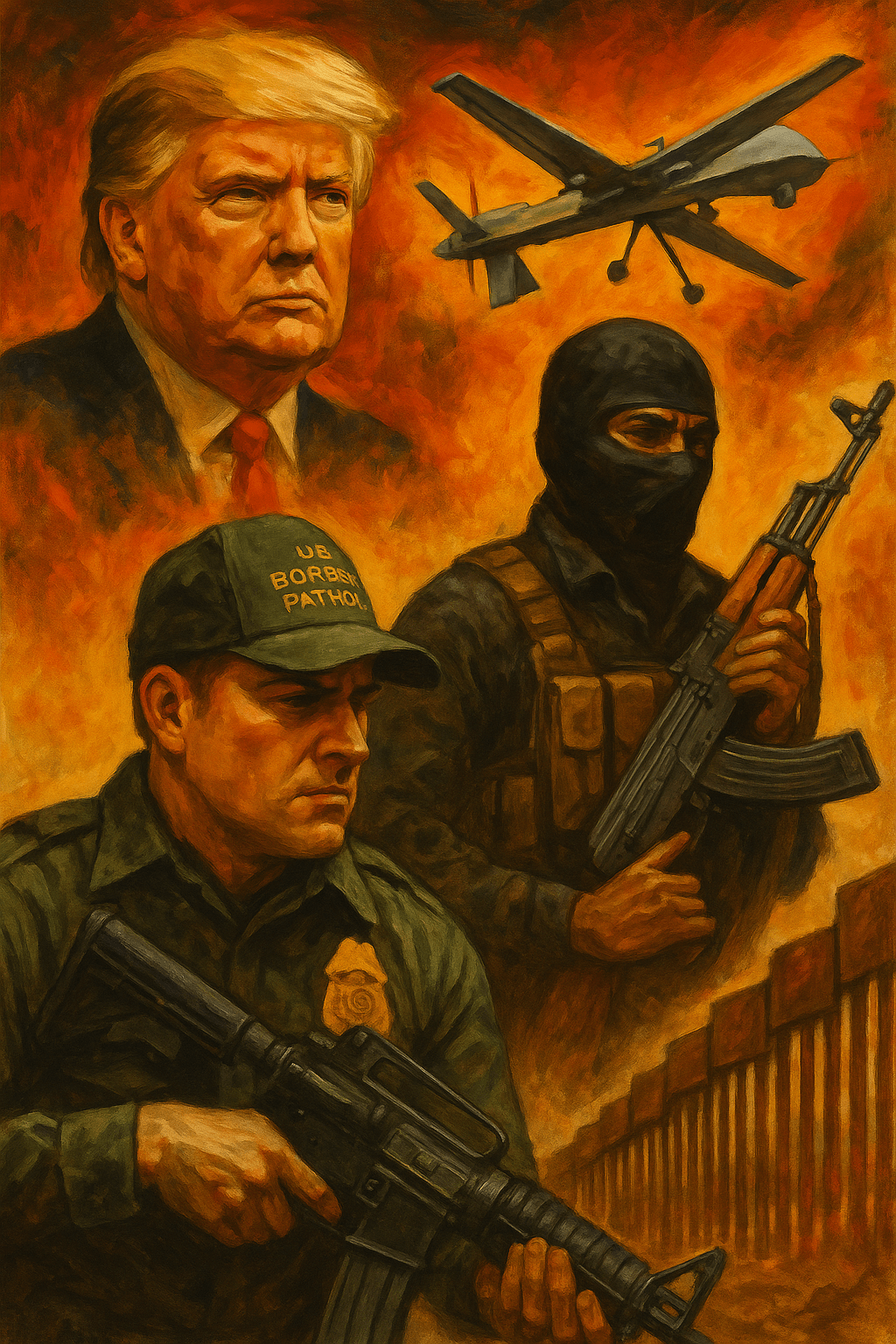
Tariff relief isn’t liberation—it’s calibration. Mexico’s challenge isn’t diplomacy. It’s surviving an imperial framework designed to discipline, extract, and contain.
By Prince Kapone | Weaponized Information
May 22, 2025
Part I – Framing the Leash as Liberation: Media Applause for Imperial Concessions
The teleSUR article on President Sheinbaum’s negotiated tariff reduction reads like a victory dispatch from the diplomatic front. It casts the 40% drop in U.S. duties on Mexican auto exports as a triumph of progressive governance—proof, we’re told, that strategic negotiation within the USMCA framework can protect national industry, preserve jobs, and deepen “regional economic sovereignty.”
But let’s slow the applause. The narrative is clean, celebratory, and uncritical—and therein lies the problem. What’s being framed as a sovereign breakthrough is, in material terms, a narrowly scoped concession granted within a treaty framework designed to discipline, not liberate. The United States-Mexico-Canada Agreement (USMCA) is not a platform for economic justice—it’s a legal enclosure. One that was crafted to ensure Mexico’s labor, land, and logistics remain subordinated to U.S. capital and geopolitical strategy.
Nowhere in the article is this structure named. USMCA is treated as neutral terrain, rather than a weaponized continuity of NAFTA’s corporate supremacy. Sheinbaum’s government is portrayed as winning a fair fight, rather than managing contradictions imposed by decades of imperial trade architecture. By reducing the tariff cut to a diplomatic headline, the piece unintentionally reinforces the very logic it should interrogate: that economic integration on U.S. terms is something to celebrate rather than contest.
Absent, too, is any critical engagement with the power asymmetry at the heart of this so-called win. The reader is not reminded that the tariff hike was unilaterally imposed by Trump to begin with, nor that its selective reversal simply restores the terms of a status quo already rigged against Mexico’s sovereignty. That is not victory—it’s calibrated leniency. A tightening of the leash disguised as a loosening.
To be clear: Sheinbaum is not the problem. Her administration is navigating a minefield that predates her tenure. But coverage like this—however well-intentioned—risks obscuring the deeper contradiction. Because when empire grants a reprieve, it is rarely a retreat. It is recalibration. And every time we frame an imperial concession as a breakthrough, we lose the clarity needed to break the chains for real.
Part II – The Machinery Beneath the Win: Extracting the Facts, Revealing the Trap
The material facts are straightforward: under the banner of the United States-Mexico-Canada Agreement (USMCA), President Sheinbaum’s administration secured a 40% reduction in U.S. tariffs on Mexican-made vehicles. The duties, previously set at 25% under Trump’s 2025 protectionist campaign, are now averaged down to 15%. According to official statements, the move preserves jobs in Mexico’s auto industry, stabilizes investor confidence, and signals diplomatic progress within the USMCA framework.
But in material terms, this is not a reversal of imperialist pressure—it is its moderation. A pullback from the cliff’s edge, not a redrawing of the map. The tariff was not removed. It was adjusted. And the adjustment reinforces—not disrupts—the structural bind in which Mexico now operates: as a labor-intensive supplier to a U.S.-dominated logistics chain that controls movement, pricing, and policy.
That chain is the real infrastructure of USMCA. Built atop the ruins of NAFTA and refined for the needs of 21st-century monopoly capital, it locks Mexico into a system of “integration” where capital moves freely, but sovereignty does not. Wage floors are kept low by design. Regulatory standards are “harmonized” downward. Labor strikes are constrained by supranational tribunals. And industrial development is steered to serve U.S. corporations, not Mexican autonomy.
That’s why the tariff cut, though politically useful, cannot be understood as a breach in the system. It is a recalibration within it. And its timing is not accidental. As revealed in our earlier analysis of Trump’s narco-terrorism designations, the current regime is simultaneously expanding its legal and military reach into Mexican territory. By labeling cartels “terrorist organizations,” the United States has opened a jurisdictional backdoor for cross-border operations, drone strikes, and intelligence infrastructure—under the same legal umbrella that just granted Sheinbaum a tariff reprieve.
This is how hyper-imperialism operates in the current era. With one hand, it negotiates trade. With the other, it militarizes the borders, the discourse, and the legal frameworks that constrain real sovereignty. The Sheinbaum administration is walking a tightrope above a trapdoor, and every “victory” it secures is conditional—granted only insofar as it preserves the underlying architecture of labor extraction, capital mobility, and compliance.
So let us be precise: the tariff reduction is real. The material relief is real. But so is the structure that allowed the tariff to exist—and to be selectively weaponized—in the first place. This is not “policy flexibility.” It is a test of obedience, a tool of calibration, and a reminder of who holds the switch.
Part III – Concessions Under Surveillance: Sheinbaum’s Dilemma, Empire’s Design
Claudia Sheinbaum is not betraying the people. She is governing inside an imperial chokehold. The tariff cut she won is real, and the jobs it preserves are not abstract numbers—they’re rent, medicine, and tortillas for Mexican families. But the terms of that victory were written elsewhere, and long before she entered the National Palace. That’s not betrayal. That’s contradiction under coercion.
This is the fundamental problem with the USMCA framework: it offers gains, but only on imperial terms. It forces Mexico to beg for relief inside a structure designed to extract, discipline, and manage. It creates a game where the best outcome a progressive administration can hope for is to soften the punishment—not to alter the rules, and certainly not to flip the board.
We must be honest about what this “integration” actually means. It means that Mexico’s industrial sectors are functionally outsourced arms of U.S. supply chains—highly mobile, highly surveilled, and hyper-exploited. It means that sovereignty is always up for negotiation, but capital’s rights are not. It means that even progressive governments must perform diplomacy with a knife pressed gently to their ribs.
And now, under Trump 2.0’s reign, that knife has grown sharper. Trade is no longer the polite arena of multilateralism. It is the weapon of a decaying empire trying to enforce compliance as its legitimacy dissolves. As we exposed in Trade by the Gunpoint of Empire, USMCA is not just a treaty—it is a logistics trap, an imperial operating system that encodes jurisdictional dominance into every container shipment, every labor clause, every cross-border contract.
So Sheinbaum’s task is immense. She is trying to deliver material security without losing the structural fight. But the structure is designed so that even tactical wins deepen dependency. Every tariff reversed through negotiation reinforces the illusion that negotiation is sovereignty. Every supply chain safeguarded under USMCA secures empire’s hold a little tighter. Every public celebration risks becoming an ideological victory for the very machine it momentarily sidestepped.
That’s why revolutionary clarity matters. Not to condemn, but to illuminate. Sheinbaum’s maneuver is not cowardice. It is survival. But if survival is mistaken for freedom, we lose the thread. We must honor her tactic and expose the architecture. Celebrate the preservation of labor and indict the system that made that labor vulnerable to tariffs in the first place. That is the dialectic: material wins under duress are not endorsements of the duress. They are demands for a deeper rupture.
Part IV – From Conditional Gains to Revolutionary Breaks: Building the Exit from USMCA
The tariff reduction is not the final word—it is a reminder of the stakes. Mexico’s economic survival should not hinge on the temperament of a U.S. president, nor be contingent on compliance with a treaty architected for dependency. The path forward does not lie in negotiating within the cage—it lies in organizing to dismantle it.
That means this moment cannot be reduced to a policy debate. It must become a platform for revolutionary strategy. The Mexican working class, the peasantry, the Indigenous nations, and their comrades across the border must recognize that this isn’t just about autos and tariffs. This is about imperial chokeholds disguised as trade agreements. It’s about militarized logistics corridors. It’s about narco-capitalism as counterinsurgency. It’s about being trapped in the empire’s supply chain as both labor and liability.
Sheinbaum’s tactical maneuver should not become a ceiling—it must be treated as a spark. The next step isn’t deeper integration. It’s de-integration: pulling Mexico’s economy, infrastructure, and sovereignty out of the U.S.-dominated framework and into alignment with the revolutionary South. BRICS+, ALBA, and CELAC are not perfect, but they are spaces where imperial power is not pre-written into the rules.
We must also mobilize within the imperial core. U.S. revolutionaries have a duty to strike at the mechanisms that hold Mexico hostage. That means:
- Expose the grid: Map out the logistics infrastructure—ports, rail yards, assembly plants, customs software—that powers USMCA’s enforcement. Show how it intersects with border militarization, ICE raids, and cartel collusion.
- Strike the nodes: Organize direct action at these sites—auto supply chains, defense contractors profiting from “counter-narcotics,” agricultural monopolies flooding Mexico with U.S. grain. Block the flows. Disrupt the routines. Break the dependence.
- Build transnational class unity: Unite auto workers in Michigan with maquila workers in Ciudad Juárez. Unite Indigenous land defenders in Oaxaca with water protectors in Minnesota. The supply chain is global. So must be our resistance.
- Reclaim the narrative: Challenge the media spectacle of “terrorist cartels” by exposing the narco-paramilitary nexus as a tool of U.S. jurisdictional overreach. Reframe trade not as policy, but as war by other means. Agitate relentlessly.
This is not a call for liberal reform. This is a call to rupture. The goal is not to make USMCA “fairer.” It is to break free from its colonial logic. The goal is not to contain cartels through U.S. drone strikes. It is to dismantle the imperial drug war economy and rebuild popular sovereignty from below.
Mexico does not need empire’s permission to be free. And Sheinbaum, for all her contradictions, has inherited a battlefield—not a blank slate. The question now is whether we, the people, will fight to widen the cracks or content ourselves with concessions that leave the scaffold intact.
Let this article serve as our answer: the scaffold must fall. And we must organize accordingly—from the border to the fields, from the factories to the barrios, from the syndicates to the sovereign councils. Trade is their chain. Solidarity is our hammer. The people will write the next treaty. And this time, it won’t be signed in English, dollars, or blood.
Further Reading from Weaponized Information
- Empire’s Terrorism Card: Trump’s Narco-War as Technofascist Recalibration
- Empire Armed the Cartels: Narco-Capitalism, Money Laundering, and the Machinery of Repression
- Trade by the Gunpoint of Empire: Mexico, the USMCA, and the Technofascist Trap
- Corn, Capital, and Colonization: How U.S. Agribusiness Recolonized Mexico
- Tariffs, Trauma, and Hyper-Imperialism: Mexico Under the Heel of Empire
For a complete archive of all articles and essays, visit Weaponized Information.
 Weaponized Information
Leave a comment