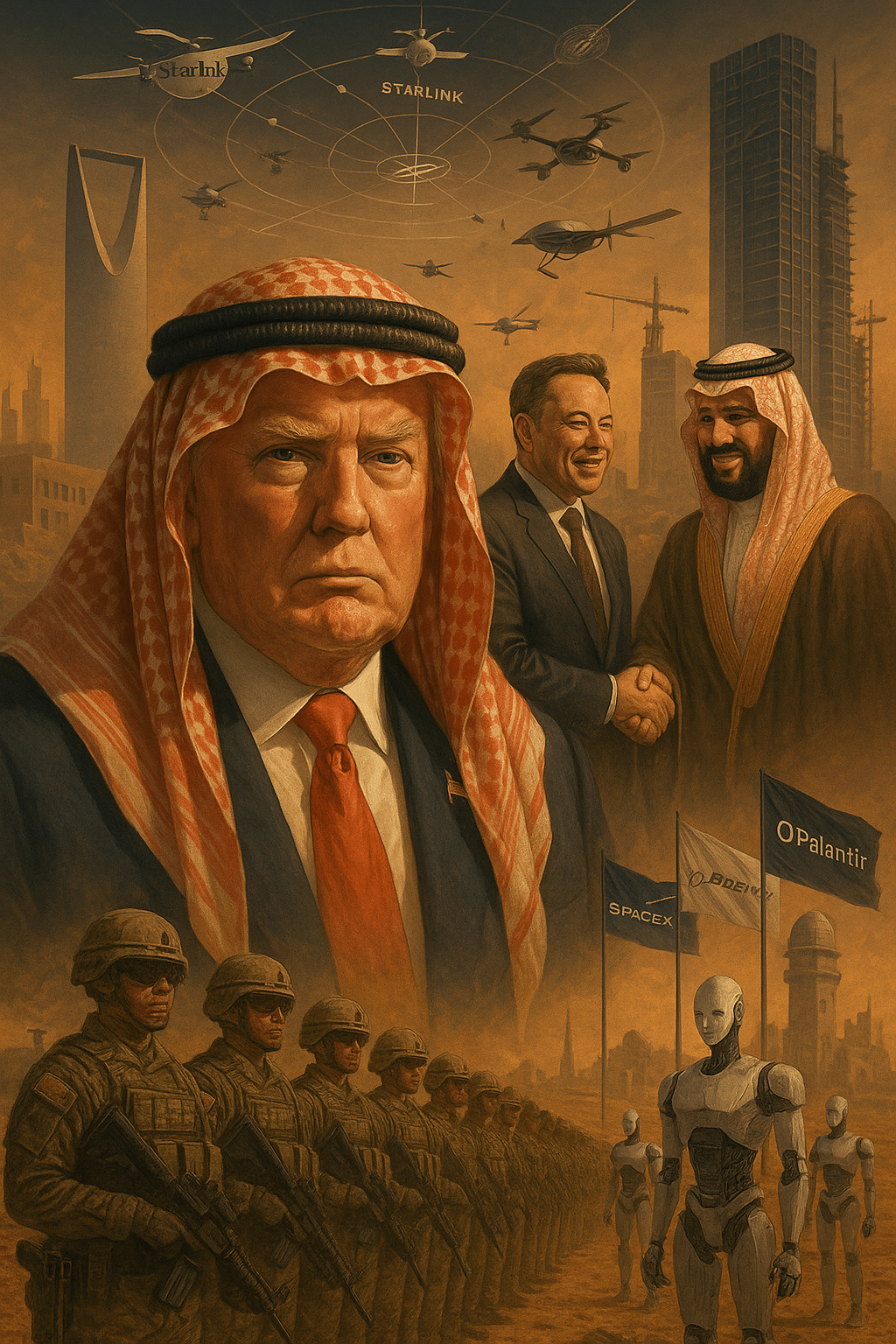
Sanctions lifted, satellites launched, tyrants embraced—Trump’s Middle East tour isn’t diplomacy, it’s a digital crusade to salvage U.S. hegemony through Gulf monarchs, billionaires, and blood-soaked bargains.
By Prince Kapone | Weaponized Information
May 14, 2025
Where There’s Smoke, There’s Empire: The Mirage of Trump’s Return
Let’s dispense with the pageantry. This isn’t diplomacy—it’s imperial choreography dressed up as a business expo. Trump’s Middle East tour isn’t about peace, partnership, or a “new deal.” It’s about clawing back control in a region where U.S. influence has rotted from the inside. With the dollar wobbling, Europe drifting, and Asia bolting toward multipolarity, the Gulf becomes Washington’s last reliable fiefdom—and Trump knows it.
So he flies in like a colonial envoy on a shareholder visit. Not to negotiate, but to collect. To audit the assets of empire. What follows is not a tour, but a reassertion: a desperate recalibration of American imperialism through weapons, satellites, and sovereign bribes—anchored not in democratic values but in petrodollars and predictive algorithms.
This first leg of the journey has all the hallmarks of what we at Weaponized Information define as imperialist recalibration: a strategic shift in tactics to preserve U.S. domination in the face of terminal decline. The empire isn’t withdrawing from the region—it’s rewiring itself into it. Less military bases, more fiber optics. Less camouflage, more contracts. And behind the grinning billionaires and ceremonial handshakes lies the same old logic: control, extract, suppress.
Just look at the opening moves. Trump floats the idea of a new nuclear deal with Iran—on the condition that Tehran abandon its support for all Axis of Resistance forces. This isn’t diplomacy; it’s extortion. Iran, a sovereign anti-imperialist power, is expected to disarm its regional alliances, accept U.S. hegemony, and offer its own containment on a silver platter. It’s a non-starter, and Trump knows it. But the suggestion alone signals the recalibrated game plan: isolate Iran, fracture resistance, and seduce Gulf monarchies into a counterweight against BRICS+, the Shanghai Cooperation Organization, and China’s growing gravitational pull.
Then comes Yemen. Trump announces a sudden ceasefire with Ansar Allah. The same forces that have been labeled terrorists, targeted by drone strikes, and decimated by U.S.-backed Saudi bombings are now invited to negotiate. It’s not a moral awakening—it’s realpolitik. The Saudis want out of a losing war. Trump wants a facelift for American imperialism. So a ceasefire is declared—not to heal, but to rebrand.
And then, the curveball: Trump reportedly offers to mediate between India and Pakistan. Why? Because a brokered calm in South Asia gives him the optics of statesmanship while freeing up Gulf bandwidth to focus on his main objective—turning the Arabian Peninsula into a digitalized fortress of hyper-imperial control.
Most curiously, Trump begins to cool toward his old friends in Tel Aviv. He criticizes Netanyahu, withholds performative gestures, and sends signals of discontent. It might be real. It might be optics. Either way, the message is strategic: Riyadh comes first. And if sidelining Israel is what it takes to win Saudi loyalty and unlock trillions in Gulf wealth, then so be it. Don’t worry, though—the bombs will still fall on Gaza. This isn’t rupture. It’s repositioning.
Add to this the not-so-minor detail that Trump’s own family and business empire have long been entangled in the Gulf’s gold-plated architecture—from hotel deals and real estate ventures to Kushner’s $2 billion payout from the Saudi sovereign wealth fund. What looks like statecraft is really a merger: of personal fortune and national policy, of private greed and public empire.
And this is only the beginning. As we’ll see in the next section, once Trump lands in Riyadh, the mirage becomes material. Trillion-dollar deals, handshakes with terrorists, sanctions traded for normalization, and the launch of an imperial tech stack from Elon Musk’s orbital arsenal. The whole tour is less about diplomacy than it is about architecture—laying down the cables, contracts, and coercive ties that bind the region tighter to a crumbling empire.
This isn’t a new Middle East. It’s the old one, rewired for 21st century subjugation.
Palaces and Payloads: Riyadh as the Nerve Center of Empire’s Reboot
When Trump touched down in Riyadh, he wasn’t arriving as a head of state—he was arriving as a broker. A merchant of empire. A courier for capital. And the Kingdom rolled out the red carpet not for diplomacy, but for delivery. What followed was not a summit. It was a ritual: the reaffirmation of vassalage, sealed in arms and algorithms, signed with blood and bandwidth.
The headline deal was thunderous: a $1 trillion Saudi investment package into the United States, paired with a $142 billion arms agreement. The media called it “historic.” What they didn’t say is that it’s protection money. A trillion-dollar bribe to guarantee U.S. military backing, diplomatic cover, and regime security. It’s not “cooperation.” It’s imperialist extortion in Gucci robes. MBS buys another decade of impunity; Trump sells another decade of empire.
And then came the sanctions relief for Syria. But not for the Syrian people. Not for rebuilding bombed-out cities or repatriating refugees. No—the sanctions were lifted on the condition that al-Jolani, a warlord-turned-warlord-in-a-suit, be installed as Syria’s new puppet in chief. Jolani, a former leader of Jabhat al-Nusra, handshakes his way into Washington’s good graces, while Trump poses beside him like a mafia don christening a new capo.
But even that wasn’t enough. In a moment of grotesque symmetry, Trump—at the request of MBS—pressured Jolani to begin normalizing ties with the Zionist regime. Imagine the spectacle: the U.S. President, a Gulf monarch, and a rehabilitated terrorist collaborating to build an anti-Iran alliance through backroom deals and staged reconciliations. This isn’t diplomacy. It’s necropolitics wrapped in velvet.
And then the tech caravan arrives. Enter Elon Musk, stage right. The imperial showman rolls out Starlink, robotaxis, and his creepy humanoid Optimus robots like party favors for dictators. Starlink is framed as internet expansion. But as we exposed in Starlink Over the Desert, this isn’t connectivity—it’s control. Satellite grids over shipping lanes. Surveillance infrastructure licensed to a regime known for dismembering journalists. This is digital colonialism with a SpaceX logo.
Musk isn’t alone. Jensen Huang of Nvidia is there, hawking AI chips that will power facial recognition and predictive policing. Alex Karp of Palantir is likely somewhere nearby, peddling algorithms for preemptive arrest. Larry Fink of BlackRock looms in the background like a modern-day Rothschild, pulling the strings without saying a word. They aren’t innovators—they’re technofascist subcontractors installing the infrastructure of obedience.
And who benefits? The empire. Starlink gives Washington control over communications. Palantir gives it predictive enforcement tools. BlackRock ties it all into the veins of global finance. In one summit, Trump reboots the Middle East as a satellite-dependent, cloud-governed, dollar-leveraged zone of imperial enforcement. The Pentagon gets a logistics upgrade. The Saudis get new weapons. And Musk gets to play god with satellites.
Yet behind the trillion-dollar pomp, something more desperate pulses. This isn’t strength—it’s compensation. A performance staged to mask decline. U.S. influence in Eurasia is eroding. BRICS+ is rising. The Saudis flirt with Beijing. The UAE is already in BRICS. The dollar is wobbling. And so, Trump comes bearing weapons, investment promises, and surveillance toys in a last-ditch effort to tether the Gulf to empire before the multipolar tide pulls them away for good.
This is what imperialist recalibration looks like in real time: no troops deployed, no flags planted—just data streamed, loyalties purchased, and terror digitized.
In Riyadh, the empire isn’t retreating. It’s uploading itself.
Jet Diplomacy and Gulf Graft: Qatar Buys Its Way Into the Empire’s Ledger
If Riyadh was the imperial nucleus, Qatar was the layover turned loot drop. Trump didn’t just visit a strategic ally—he stopped by the cashier’s window. The headlines focused on aircraft: Boeing’s largest single plane sale in its history, signed and sealed in Doha. But this wasn’t just a trade agreement—it was a balancing act between empire’s military-industrial lifeline and its dwindling geopolitical options.
Boeing, the bruised behemoth of American industry, got a cash infusion it desperately needed. In exchange, Qatar got something even more valuable: a reinforced guarantee of U.S. military protection and political favoritism, plus renewed access to the Pentagon gravy train. That’s how these deals work. Arms sales aren’t just commerce—they’re contracts of obedience.
Then came the personal gift: a luxury jet, handed to Trump by the Qatari royal family like a sultan handing gold to a mercenary general. This isn’t just corruption—it’s the logical conclusion of privatized empire. When the head of state is also the head of the family firm, every summit is a sales pitch, every treaty a hustle, every foreign ally a business partner in waiting.
But the real story lies behind the photo ops. What else was signed, promised, or whispered in those lavish backroom lounges? No press coverage. No public disclosures. Just speculation grounded in pattern: construction deals for Trump’s private firm? Expanded energy partnerships for Kushner’s shadow diplomacy? Exclusive tech contracts for Musk’s orbiting empire? When empires decline, their borders blur with the billionaires who bankroll them—and every “state visit” becomes an investor meeting.
Qatar’s role in this recalibration is no accident. It is the U.S.’s forward operating base in the Gulf, home to the massive al-Udeid Air Base and central command operations. It’s also trying to walk a tightrope: aligned with the U.S. militarily, yet keeping one foot in the BRICS-adjacent zone economically. Trump’s job was to nudge them off the rope—deeper into Washington’s pocket and away from Beijing’s hand.
The Boeing deal, the luxury jet, the unreported side contracts—these aren’t isolated events. They’re fragments of a broader imperial logic. This is how hyper-imperialism now functions: not through declarations of war, but through checkbook diplomacy, elite collusion, and digital extraction.
There is no “new order” being built here. What’s happening is preservation by any means necessary. Empire is not collapsing quietly—it’s selling off pieces of itself to stay in the game. And Trump, ever the auctioneer, is unloading whatever’s left—from State Department favors to sovereign assets to his own credibility—so long as the price is right.
As we look ahead to his next stop in the UAE, the question isn’t whether Trump will make more deals. It’s whether the empire can afford not to.
Feasting at Both Tables: The UAE, BRICS+, and the Empire’s Divide-and-Coopt Strategy
Trump’s next stop is the United Arab Emirates, where the contradictions of empire are impossible to ignore. The UAE is many things at once: a U.S. client, a BRICS+ member, a financial laundromat for global capital, and a soft-power sultanate trading in tourism, tech, and total surveillance. It’s also a bellwether. If Trump can flip the UAE fully back into the U.S. orbit, he may yet preserve a foothold in a region slipping eastward.
This isn’t just another Gulf visit—it’s an imperial audition. The UAE joined BRICS+ less than a year ago, aligning itself with China, Russia, and the growing anti-dollar coalition. It’s participated in yuan oil settlements, Belt and Road infrastructure, and quiet diplomatic exchanges with Beijing and Moscow. From Washington’s perspective, that’s betrayal. From Trump’s perspective, it’s opportunity.
Expect two things: carrots and contracts. Trump will likely offer weapons, tech partnerships, real estate sweeteners, and perhaps new concessions on trade or visa agreements. In return, he’ll demand loyalty—not in rhetoric, but in policy. A vote here, a delay there. Stall BRICS initiatives. Dampen yuan-based oil deals. Undercut multipolar unity from the inside.
That’s the strategy. The U.S. can’t stop BRICS+ from growing—but it can corrupt it. Convert members into saboteurs. Turn multipolarity into controlled opposition. The empire doesn’t need to destroy the table if it can buy off enough people sitting at it.
The UAE is a prime target for this operation. Its ruling elite has always balanced East and West, capital and religion, modernization and repression. Trump is betting that the allure of private contracts and geopolitical protection will outweigh any long-term benefits of Eurasian alignment. He may not be wrong.
But the very fact that this is necessary speaks volumes. If the U.S. were still in command, there’d be no need for all this theater—no need to bribe allies, flatter monarchs, or offer concessions. Trump’s Gulf strategy reveals not confidence, but fragility. The empire is dangling carrots because it’s fresh out of sticks.
What happens in Abu Dhabi won’t just shape U.S.-Gulf relations—it will shape the future of multipolar struggle. If the UAE folds, it weakens BRICS+ cohesion. If it resists, it signals a deeper break that no amount of Muskian satellites or Trumpian handshakes can reverse.
Either way, Trump’s imperial recalibration continues—not as a triumph, but as a gamble. A last-ditch effort to shore up alliances before the tide turns irreversibly against U.S. unipolarity. The desert deals aren’t signs of strength. They’re symptoms of desperation.
The Architecture of Recalibration: What Empire Hopes to Gain
Strip away the summit statements, the luxury jets, the PR gloss, and you’re left with a cold calculus. Trump’s Middle East tour isn’t about diplomacy—it’s about preservation. It’s a strategic reconfiguration of imperial logistics in a world where U.S. dominance is no longer assumed, but must be purchased, performed, and policed. What we’re witnessing is imperialist recalibration in motion: not a retreat, but a remapping of empire’s priorities and methods in the shadow of its decline.
Let’s name the objectives:
1. Reassert Neocolonial Control Over the Gulf
The U.S. is losing the rest of Eurasia to multipolar currents—China’s Belt and Road, Russia’s energy diplomacy, the rise of BRICS+, and a widening rift with the EU. The Gulf remains one of the last pliable zones of imperial control. Trump’s tour aims to double down: lock in the monarchies, wire up their repression systems, and re-center the U.S. military-economic presence. Not through boots—but through bandwidth, capital flows, and joint ventures.
2. Further Isolate and Encircle Iran
Every stop—from Riyadh to Doha to Abu Dhabi—is a chess move aimed at cutting Iran out of regional diplomacy. The offer of a “new deal” is a smokescreen. The real game is containment: disrupt Iran’s partnerships, sever its allies, normalize its enemies, and frame it as the lone pariah in a restructured Gulf order.
3. Preserve the Petrodollar System
The dollar is wobbling. De-dollarization is accelerating. Gulf states are experimenting with yuan settlements. If Washington loses its monopoly on oil pricing, it loses its stranglehold on global finance. Trump’s tour, saturated in weapons deals and financial promises, is about locking oil-exporting allies into renewed dollar dependence. That’s not just economics—it’s imperial lifeblood.
4. Forge a Gulf Bloc to Undermine BRICS+
The UAE may have joined BRICS+, and Saudi Arabia still has an open invite (until now), but Trump’s goal is to turn them into in-house saboteurs: loyal clients masquerading as multipolar allies. The U.S. knows it can’t defeat BRICS head-on, so it’ll try to fracture it from within. Divide the bloc. Corrupt its nodes. Reintroduce Western capital in friendly terms and suppress efforts at independent financial systems.
5. Deploy Technofascist Infrastructure Abroad
Domestically, the U.S. has already fused Big Tech with state repression. Now, it’s exporting the model. Starlink satellites. AI surveillance tools. Predictive policing software. These aren’t business ventures—they’re weapons systems. Trump’s delegation wasn’t just political—it was corporate-military. The aim is to discipline Gulf populations through privatized digital repression. It’s technofascism for export.
6. Cement a Strategic Firewall Against China
Every Gulf state that tightens ties with the U.S. is a potential barrier to China’s westward expansion. Whether through ports, telecom, or military alignment, the goal is clear: obstruct Belt and Road corridors, undermine yuan-based trade networks, and prevent Asia-Africa integration. The U.S. doesn’t need to build anything—it just needs to block China from doing so.
7. Privatize Empire to Serve Personal Empire
None of this happens in a vacuum. Trump is not just an imperial agent—he’s an imperial profiteer. His family, allies, and class interests are baked into every deal. This is the empire as business model. The state serves the syndicate. Sovereign wealth becomes startup capital. The office of the president becomes a franchise outlet for privatized plunder.
In short, Trump isn’t just rebooting empire. He’s reorganizing it. Offloading risk onto client states. Subcontracting repression to tech billionaires. Turning war into investment portfolios. And as the traditional pillars of imperialism fracture—military dominance, ideological hegemony, economic supremacy—Trump is building new scaffolding from digital infrastructure, loyalist monarchies, and sovereign ATM machines.
It’s not sustainable. But it’s not meant to be. It’s meant to hold the line—just long enough to buy a little more time. Time for the white ruling class to reposition. For capital to find new outlets. For empire to survive the storm not through victory—but through recalibration.
Family Ties and Imperial Profits: The Business of Recolonization
Peel back the curtain and what you’ll find isn’t a geopolitical strategy—it’s a business plan. Trump’s Middle East tour isn’t just an exercise in statecraft. It’s a personal enterprise, a franchise operation where the U.S. presidency doubles as a CEO position and the empire’s frontiers serve as private investment zones. This is where imperialism becomes inheritance—where policy, plunder, and personal profit move as one.
Trump’s history in the Gulf is long and lucrative. His name is etched onto luxury towers in Dubai. His son-in-law Jared Kushner secured a $2 billion investment from the Saudi Public Investment Fund just months after leaving the White House. His former Treasury Secretary Steven Mnuchin received a similar windfall. These are not coincidences. They are kickbacks disguised as ventures, rewards for loyal service to Gulf monarchs during the first Trump administration.
And now, Trump is back—only this time, the stakes are higher and the empire more brittle. Every deal inked on this tour likely doubles as a benefit to Trump’s personal empire. The Boeing mega-contract in Qatar? Expect finders fees, subcontractor arrangements, and backdoor equity stakes. The Starlink rollout in Saudi Arabia? A digital real estate grab where access to infrastructure guarantees decades of surveillance royalties and control. The arms packages and sanctions relief? Signals to the world’s capital markets that Trump is once again the gatekeeper of imperial spoils.
It doesn’t stop there. The jet gifted to Trump by the Qatari monarchy is not symbolic—it’s transactional. A reward. A down payment. A show of loyalty to a man who is not just positioned as America’s president, but as the primary broker of imperial favor in the Global South. These aren’t gifts—they’re investments. In return, the Gulf gets protection, preferential access, and a seat at the empire’s table.
This is how oligarchic state capture operates. The lines between the state and the syndicate blur. The foreign policy apparatus becomes a conveyor belt for private enrichment. The U.S. government is weaponized to serve a cabal of billionaires, royal families, and technocrats who understand that empire is no longer a national project—it’s a privatized multinational operation.
And while the corporate press calls it “diplomacy,” we know what it is: an auction. A sell-off. A strategic liquidation of imperial assets to the highest bidder. Trump isn’t acting alone—he’s acting on behalf of an entire class of looters trying to salvage profitability from a crumbling system. When unipolarity dies, they don’t mourn—they monetize.
This is not just a Trump problem. It’s a systemic one. What we are seeing is the full merger of the American oligarchy with Gulf sub-imperialism—a joint venture in repression, resource theft, and financial autocracy. The family business is the empire, and the empire is a business. If this tour is any indication, the Gulf monarchies have bought themselves a new franchisee.
And the colonized, the working class, the dispossessed? They’re not shareholders. They’re the collateral.
Recalibration, Not Retreat: Empire Reloads Behind the Veil
Let’s end with clarity. Trump’s Middle East tour is not a sign of U.S. withdrawal—it’s a blueprint for imperial persistence. What we’re seeing is not the collapse of empire, but its reformatting. A recalibration, not a retreat. The boots are fewer, but the deals are deeper. The speeches are shorter, but the contracts are longer. And behind it all stands a decaying empire, desperate to look like it’s still running the show.
This is the anatomy of hyper-imperialism in crisis: sanctions traded for silence, satellites sold as service, and warlords groomed into presidents. Where Biden offers war by committee, Trump delivers empire as enterprise. And that’s what this tour really is—an imperial stock offering, marketed in Riyadh, underwritten in Doha, and managed by the family firm.
But let’s not mistake desperation for weakness. Recalibration can be deadly. The empire is not rolling over—it is digitizing, monetizing, and subcontracting its violence in ways that make it harder to see, but no less brutal. Starlink becomes a surveillance scaffold. A plane sale becomes a strategic alliance. A handshake with a terrorist becomes a coup in disguise.
For the working class, for the colonized, for the revolutionaries watching from Palestine to Yemen, from Damascus to Detroit, the lesson is clear: the U.S. ruling class will not give up its dominance willingly. It will pivot. It will lie. It will repackage imperialism in robes, robes in algorithms, and algorithms in “peace deals.” And it will sell that deception with a smile and a satellite.
But beneath the sand-polished optics, the contradictions remain. Trump’s recalibration is built on shaky ground: a fracturing Gulf, a disobedient Iran, an emerging multipolar world, and a growing global rejection of U.S. diktats. Every contract he signs, every ceasefire he announces, every billionaire he brings along for the ride—these are not signs of strength. They are signs of empire scrambling for relevance.
So let’s not get confused by the spectacle. Let’s stay focused on the system. This isn’t about Trump’s personality. It’s about the class he serves. It’s about the empire he fronts. And it’s about the world we must build in its place.
The task ahead is revolutionary, not reformist. We must resist the infrastructure of digital repression. Expose the networks of collusion. Support the movements building dual and contending power across the colonized world and in the belly of the beast. Organize proletarian cyber resistance. Train cadres in geopolitical clarity. And fight this recalibrated empire at every node—on the ground, in the cloud, and in the hearts and minds of the people.
Empire doesn’t end because it wants to. It ends because we make it impossible to function.
So let them shake hands with tyrants. Let them wire deserts with surveillance. Let them auction off the last scraps of a dying order. We’ll be organizing in the shadows of their skyscrapers, plotting in the margins of their headlines, and preparing for the revolutionary rupture they never saw coming.
 Weaponized Information
Leave a comment